
Judge, 1917-09-01 · page 14 of 28
Judge — September 1, 1917 — page 14: what you’re looking at
What you’re looking at
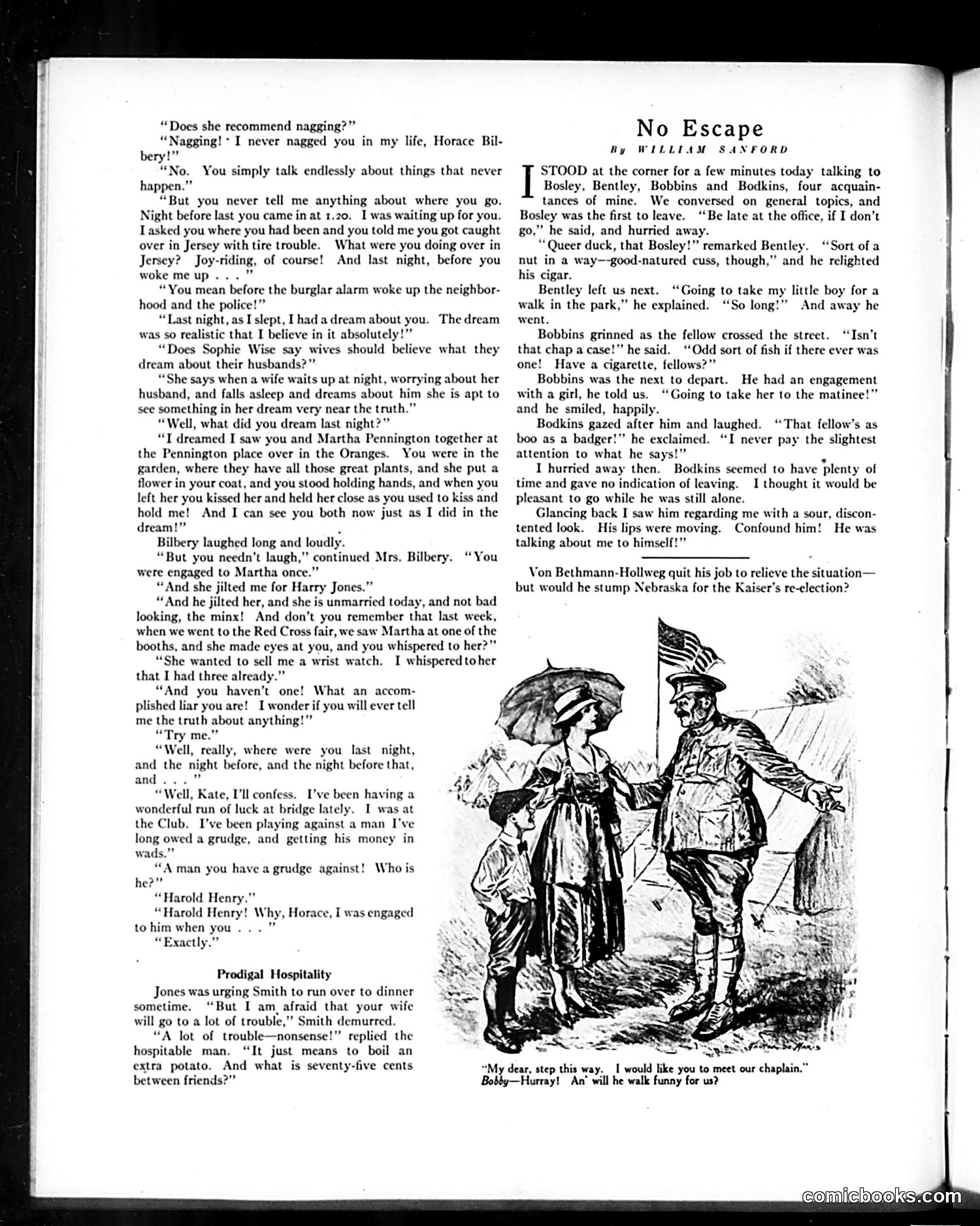
This page contains two distinct pieces: a marital comedy dialogue and a satirical sketch. The main story, "No Escape" by William Sanford, depicts a husband (Horace Bilbery) caught in domestic entanglement. His wife Kate confronts him about late nights, suspicious behavior with an ex-fiancée (Martha Pennington), and lies about his whereabouts. Bilbery eventually confesses he's been gambling at his club, winning money from Harold Henry—who was *also* engaged to Kate previously. The satire highlights the inescapable web of small-town social connections and past romantic entanglements that trap even guilty husbands. The secondary piece, "Prodigal Hospitality," mocks working-class pretense: a man invites a friend to dinner, dismissing concerns about trouble by claiming it "just means to boil an extra potato," reducing hospitality to 75 cents' worth of effort—suggesting stingy superficiality disguised as friendliness. The illustration shows a soldier and woman, likely supporting the magazine's patriotic content typical of this era.
📄 Transcribed text from this page (OCR, searchable)
Machine-transcribed from the original scan — historical spelling and the odd misread are preserved.
“Does she recommend nagging?” “Nagging! * I never nagged you in my life, Horace Bil- bery!” “No. happen.” “But you never tell me anything about where you go. Night before last you came in at 1.20. I was waiting up for you. Tasked you where you had been and you told me you got caught over in Jersey with tire trouble. What were you doing over in Jersey? Joy-riding, of course! And last night, before you woke me up...” “You mean before the burglar alarm woke up the neighbor- hood and the police!” “Last night, as I slept, [had a dream about you. The dream was so realistic that I believe in it absolutely! “Does Sophie Wise say wives should believe what they dream about their husbands?” “She says when a wife waits up at night, worrying about her husband, and falls asleep and dreams about him she is apt to see something in her dream very near the truth.” “Well, what did you dream last nigh “T dreamed I saw you and Martha Pennington together at the Pennington place over in the Oranges. You were in the garden, where they have all those great plants, and she put a flower in your coat, and you stood holding hands, and when you left her you kissed her and held her close as you used to kiss and hold me! And I can see you both now just as I did in the dream!” ‘s Bilbery laughed long and loudly. “But you needn’t laugh,” continued Mrs. Bilbery. “You were engaged to Martha once.” “And she jilted me for Harry Jones.” “And he jilted her, and she is unmarried today, and not bad You simply talk endlessly about things that never looking, the minx! And don’t you remember that last week, when we went to the Red Cross fair, we saw Martha at one of the booths, and she made eyes at you, and you whispered to her?” “She wanted to sell me a wrist watch. I whispered toher that I had three already.” “And you haven't one! What an accom- plished liar you are! I wonder if you will ever tell me the truth about anything!” “Try me.” “Well, really, where were you last night, and the night before, and the night before that, and...” “Well, Kate, I'll confess. I'v wonderful run of luck at bridge | I was at the Club. I’ve been playing against a man I've long owed a grudge, and getting his money in wads, Aman you have a grudge against! Who is he?” “Harold Henry.” “Harold Henry! Why, Horace, I was engaged to him when you...” “Exactly.” been having a Prodigal Hospitality Jones was urging Smith to run over to dinner sometime. “But I am, afraid that your wife will go to a lot of trouble,” Smith demurred. “A lot of trouble—nonsense!” replied the hospitable man. “It just means to boil an extra potato. And what is seventy-five cents between friends?” “My dear, step this way. Bobby—Hurray! An’ will he walk funny for us? No Escape By WILLIAM SANFORD STOOD at the corner for a few minutes today talking to I Bosley, Bentley, Bobbins and Bodkins, four acquain- tances of mine. We conversed on general topics, and Bosley was the first to leave. ‘‘Be late at the office, if I don’t go,” he said, and hurried away. “Queer duck, that Bosley!” remarked Bentley. ‘Sort of a nut in a way—-good-natured cuss, though,” and he relighted his cigar. Bentley left us next. walk in the park,” he explained. went. Bobbins grinned as the fellow crossed the street. “Isn't that chap a case!" he said. ‘Odd sort of fish if there ever was one! Have a cigarette, fellows?” Bobbins was the next to depart. He had an engagement with a girl, he told us. “Going to take her to the matinee!” and he smiled, happily. Bodkins gazed after him and Jaughed. “That fellow’s as boo as a badger!”’ he exclaimed. “I never pay the slightest attention to what he says!” é I hurried away then. Bodkins seemed to have plenty of time and gave no indication of leaving. I thought it would be pleasant to go while he was still alone. Glancing back I saw him regarding me with a sour, discon- tented look. His lips were moving. Confound him! He was talking about me to himself!” “Going to take my little boy for a “So long!” And away he Von Bethmann-Hollweg quit his job to relieve the situation— but would he stump Nebraska for the Kaiser's re-election? I would like you to meet our chaplain.”