
Judge, 1917-09-01 · page 11 of 28
Judge — September 1, 1917 — page 11: what you’re looking at
What you’re looking at
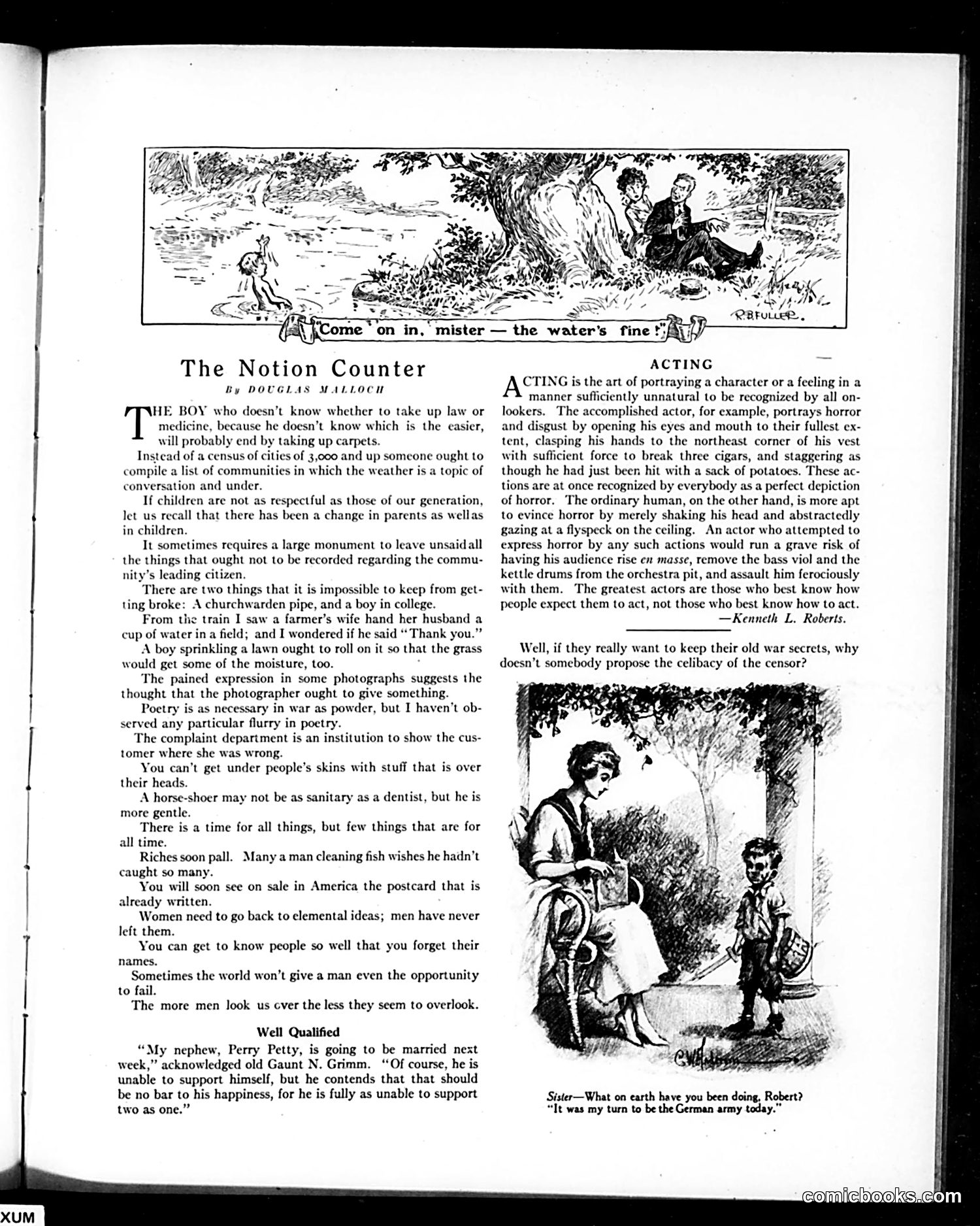
This Judge magazine page contains two distinct pieces of social commentary: **"The Notion Counter"** is a humorous column of brief observations about human nature and social foibles—mostly aphorisms about laziness, hypocrisy, and the disconnect between appearance and reality. There's no specific political target; it's general satire of everyday life. **"Acting"** is a cynical essay (attributed to Kenneth L. Roberts) mocking theatrical performance as pure artifice. The author argues that accomplished actors succeed not by genuinely understanding human emotion, but by performing exaggerated, unnatural gestures that *audiences expect* to see. The satire criticizes both actors and audiences for preferring theatrical convention over authentic human behavior. **The cartoon** shows a child explaining to his sister that he's been "playing German army"—likely a WWI-era reference to children's war games mimicking contemporary military conflict. The overall theme: society values performative exaggeration over authenticity, whether on stage or in daily life.
📄 Transcribed text from this page (OCR, searchable)
Machine-transcribed from the original scan — historical spelling and the odd misread are preserved.
ar ee XUM The Notion Counter By DOUGLAS MALLOCH HE BOY who doesn’t know whether to take up law or T medicine, because he doesn’t know which is the easier, will probably end by taking up carpets. Instead of a census of ci of 3,000 and up someone ought to compile a list of communities in which the weather is a topic of conversation and under. If children are not as respectful as those of our generation, let us recall that there has been a change in parents as wellas in children. It sometimes requires a large monument to leave unsaidall the things that ought not to be recorded regarding the commu- ni y’s leading citizen. There are two things that it is impossible to keep from get- ting broke: A churchwarden pipe, and a boy in college. From the train I saw a farmer’s wife hand her husband a cup of water in a field; and I wondered if h “Thank you.” A boy sprinkling a lawn ought to roll on it so that the grass would get some of the moisture, too. . The pained expression in some photographs suggests the thought that the photographer ought to give something. Poetry is as necessary in war as powder, but I haven't ob- served any particular flurry in poetry. The complaint department is an institution to show the cus- tomer where she was wrong. You can’t get under people’s skins with stuff that is over their heads. A horse-shoer may not be as sanitary as a dentist, but he is more gentle. There is a time for all things, but few things that are for all time. Riches soon pall. Many a man cleaning fish wishes he hadn’t caught so many. You will soon see on sale in America the postcard that is already written. Women need to go back to elemental ideas; men have never left them. You can get to know people so well that you forget their names. Sometimes the world won’t give a man even the opportunity to fail. The more men look us cver the less they seem to overlook. Well Qualified “My nephew, Perry Petty, is going to be married next week,” acknowledged old Gaunt N. Grimm. ‘Of course, he is unable to support himself, but he contends that that should be no bar to his happiness, for he is fully as unable to support two as one.” ACTING CTING is the art of portraying a character or a feeling in a manner sufficiently unnatural to be recognized by all on- lookers. The accomplished actor, for example, portrays horror and disgust by opening his eyes and mouth to their fullest ex- tent, clasping his hands to the northeast corner of his vest with sufficient force to break three cigars, and staggering as though he had just been hit with a sack of potatoes. These ac- tions are at once recognized by everybody as a perfect depiction of horror. The ordinary human, on the other hand, is more apt to evince horror by merely shaking his head and abstractedly gazing at a flyspeck on the ceiling. An actor who attempted to express horror by any such actions would run a grave risk of having his audience rise en masse, remove the bass viol and the kettle drums from the orchestra pit, and assault him ferociously with them. The greatest actors are those who best know how people expect them to act, not those who best know how to act. —Kenneth L. Roberts. Well, if they really want to keep their old war secrets, why doesn’t somebody propose the celibacy of the censor? ‘Sister—What on earth have you been doing, Robert? “Tt was my turn to be the German army today.”