
A complete issue · 28 pages · 1917
Judge — August 4, 1917
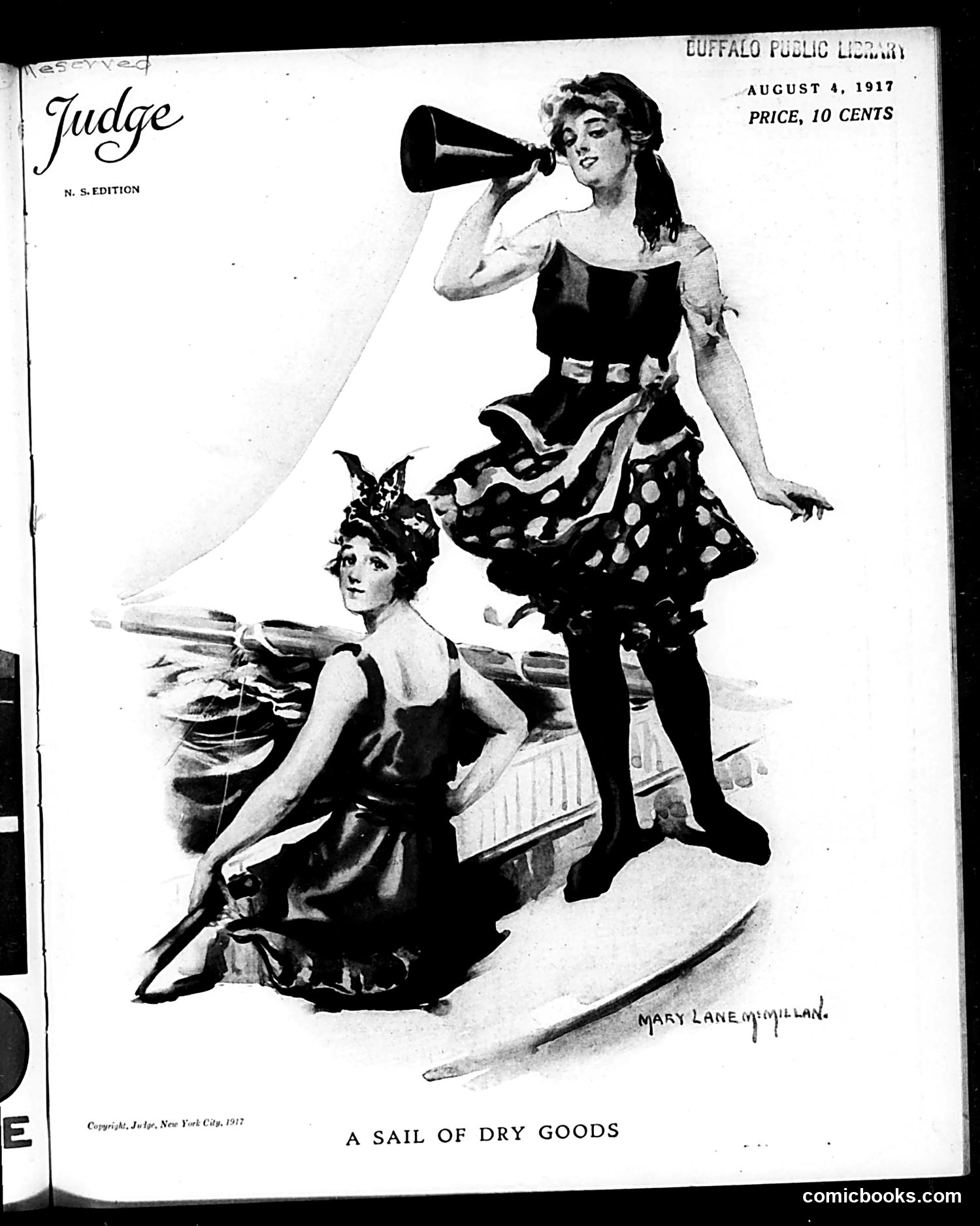
This appears to be a visual pun playing on nautical and commercial terminology. The title "A Sail of Dry Goods" conflates "sail" (nautical) with "sale" (retail commerce). The illustration by Mary Lane McMillan shows two fashionably dressed women in a boat-like setting. One stands with a megaphone (announcing a sale?), while the other sits nearby. The composition suggests they're "sailing" on dry goods—fabric or merchandise—rather than water. This likely satirizes either department store sales promotions or women's consumer culture in 1917. The megaphone figure may represent aggressive retail marketing. The visual wordplay between "sail/sale" and the nautical staging creates the cartoon's central joke, typical of Judge magazine's punning humor.
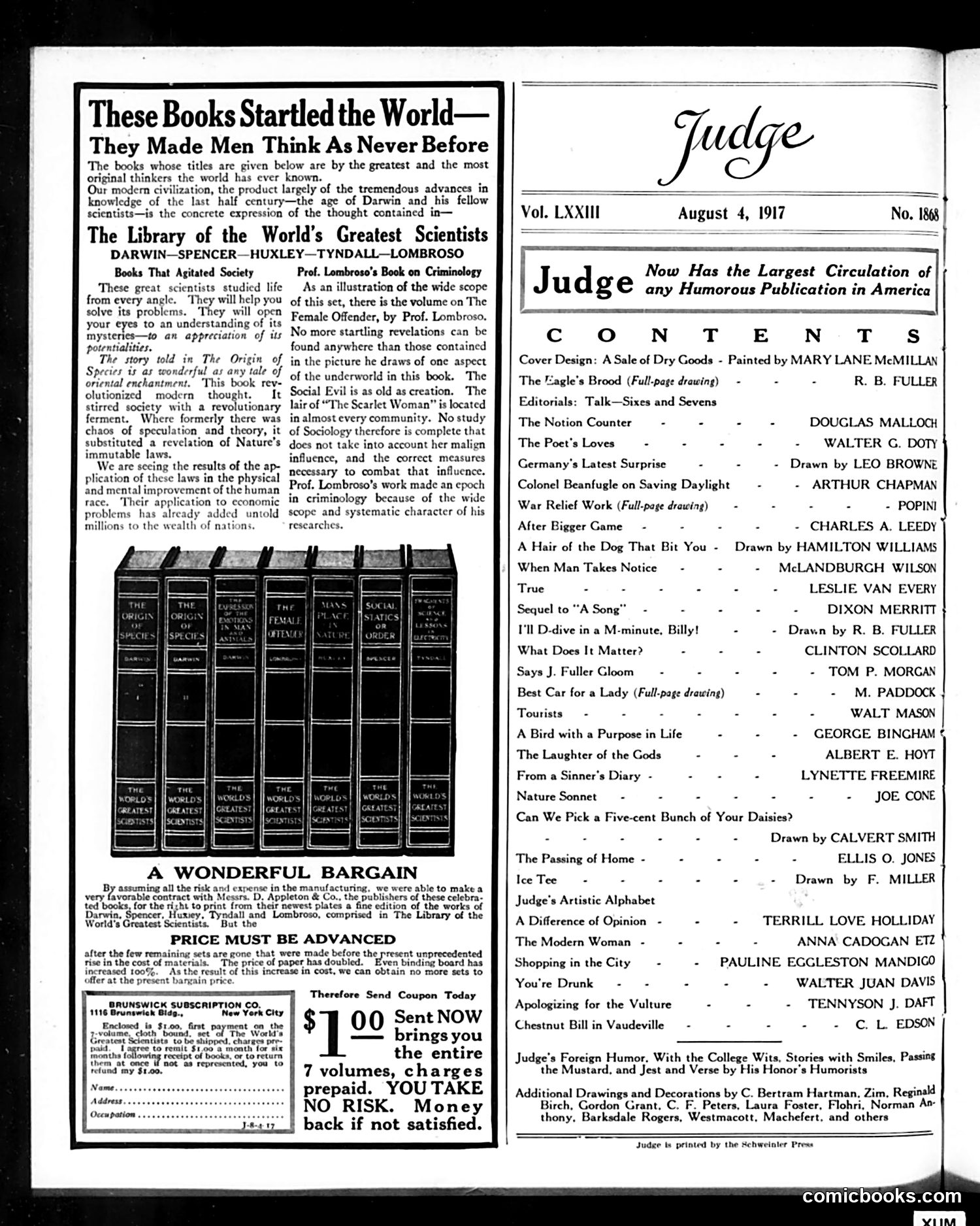
This page is primarily **advertising and table of contents** rather than political cartoon. The left side promotes "The Library of the World's Greatest Scientists" — a seven-volume set featuring Darwin, Spencer, Huxley, Tyndall, and Lombroso, priced at $1.00. This appears to be marketing popular science literature to American readers. The right side lists Judge's August 1917 contents, featuring humorous pieces and drawings by contributors like R.B. Fuller and Hamilton Williams. **Historical context**: Published during America's involvement in World War I, the contents likely reflect contemporary concerns, though specific pieces aren't visible. The scientific emphasis suggests Judge maintained intellectual credibility alongside humor during this period.
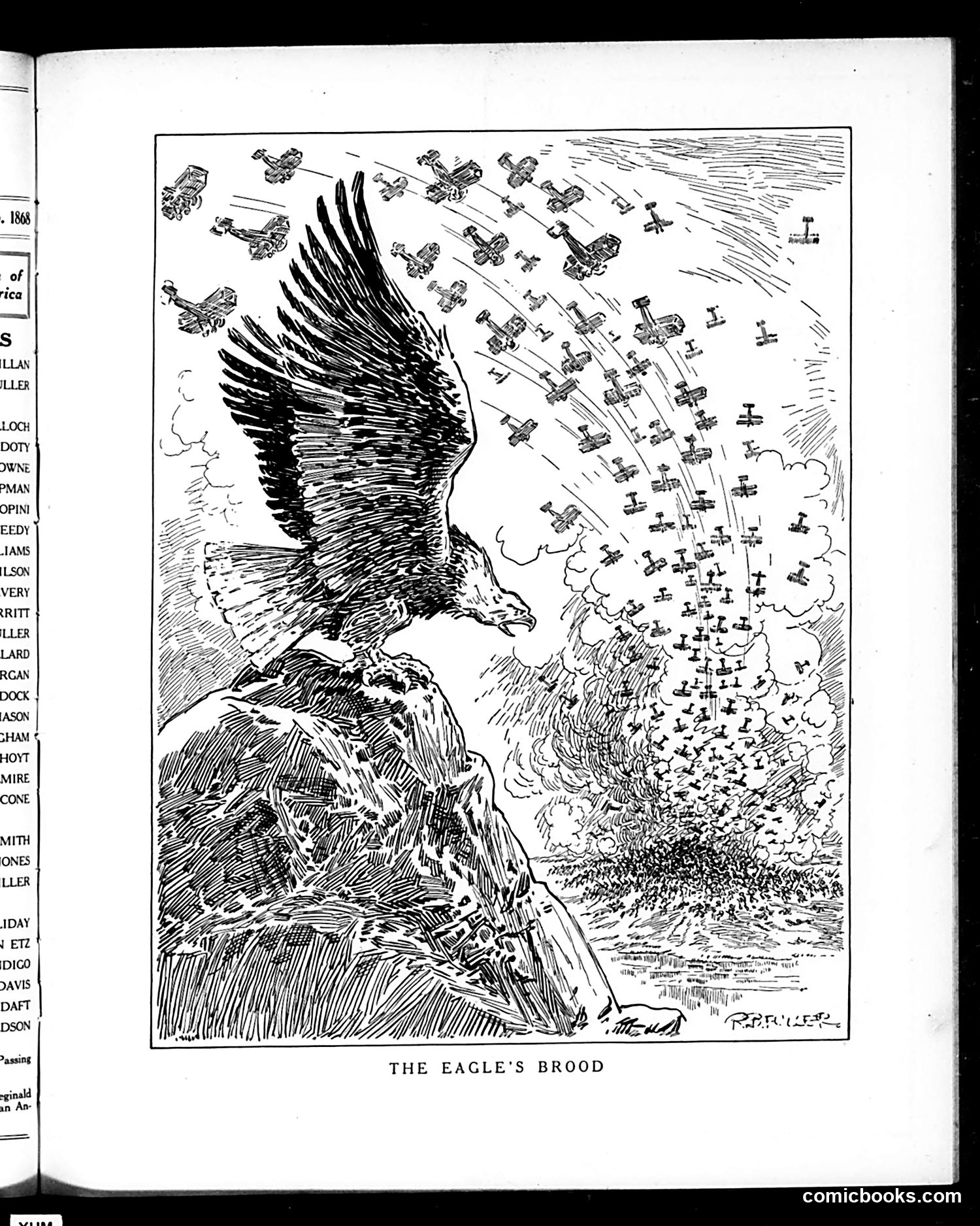
This political cartoon depicts a majestic American eagle with widespread wings overlooking a landscape filled with military aircraft. The title "The Eagle's Brood" uses the metaphor of an eagle protecting her offspring to represent American military strength and aerial power. The numerous planes streaming across the sky likely reference American military expansion or buildup, possibly during World War II or the interwar period when aviation was becoming militarily significant. The eagle—a symbol of America—watches over these "offspring" (the aircraft), suggesting national pride in American aerial capabilities or military preparedness. The satirical point appears to celebrate or comment on America's growing air force as a source of national strength and protection, though without a specific date, the exact historical context remains unclear.
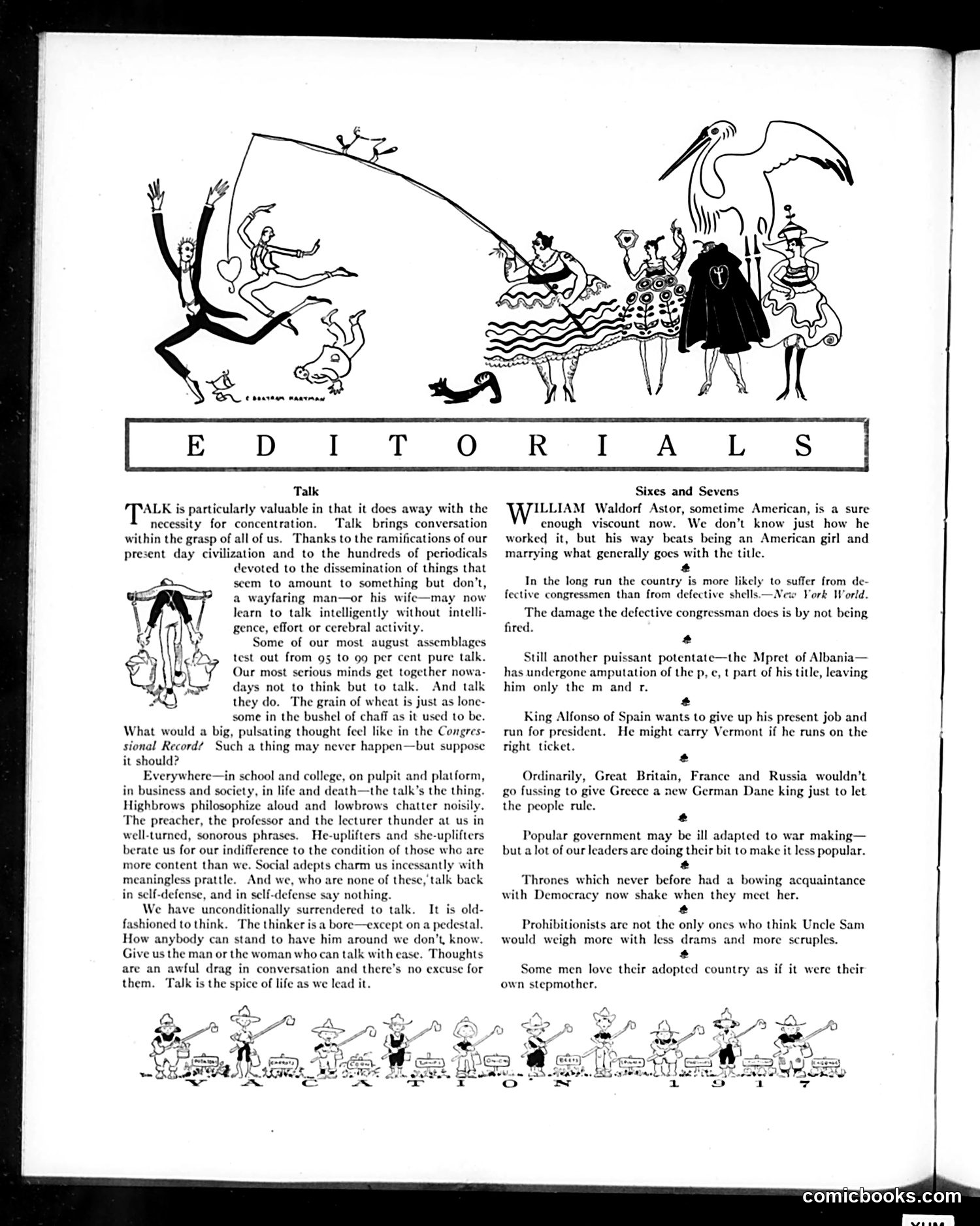
This editorial page contains two sections: a philosophical essay on "Talk" and political commentary titled "Sixes and Sevens." The "Talk" section argues that conversation is undervalued in modern society and advocates for its importance in personal and intellectual development. "Sixes and Sevens" offers brief political observations, including references to William Waldorf Astor (an American businessman with British connections), the King of Spain considering a presidential run, and commentary on European politics regarding Greece and Germany. The piece satirizes how democracies and thrones are adapting to modern politics, and mocks prohibitionists and those with excessive patriotism. The cartoons at top and bottom illustrate these themes with whimsical figures, though specific identities remain unclear without additional historical context.
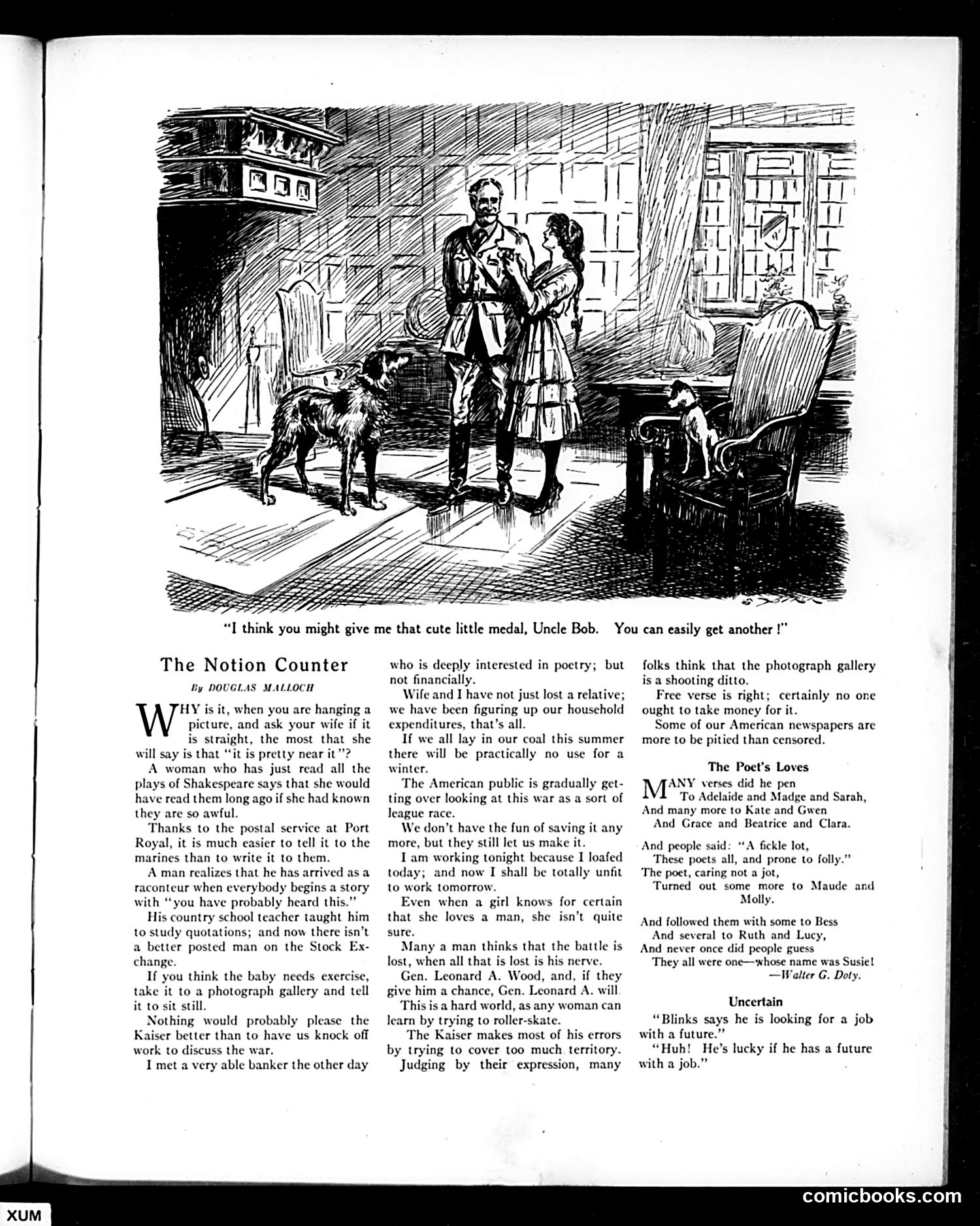
The main cartoon depicts a domestic scene where a uniformed military officer (likely a general, given the formal dress) converses with a woman while two dogs are present. The caption reads: "I think you might give me that cute little medal, Uncle Bob. You can easily get another!" The satire critiques how military medals and honors—supposedly earned through service—have become casual commodities, traded casually among the wealthy or connected. The woman's flippant request suggests medals are mere decorative objects rather than meaningful recognition of valor. Douglas Malloch's accompanying essay, "The Notion Counter," discusses wartime absurdities: the public's detachment from war's reality, newspaper censorship, and how Americans view conflict as entertainment rather than tragedy. The overall message questions whether society properly values or understands military sacrifice.
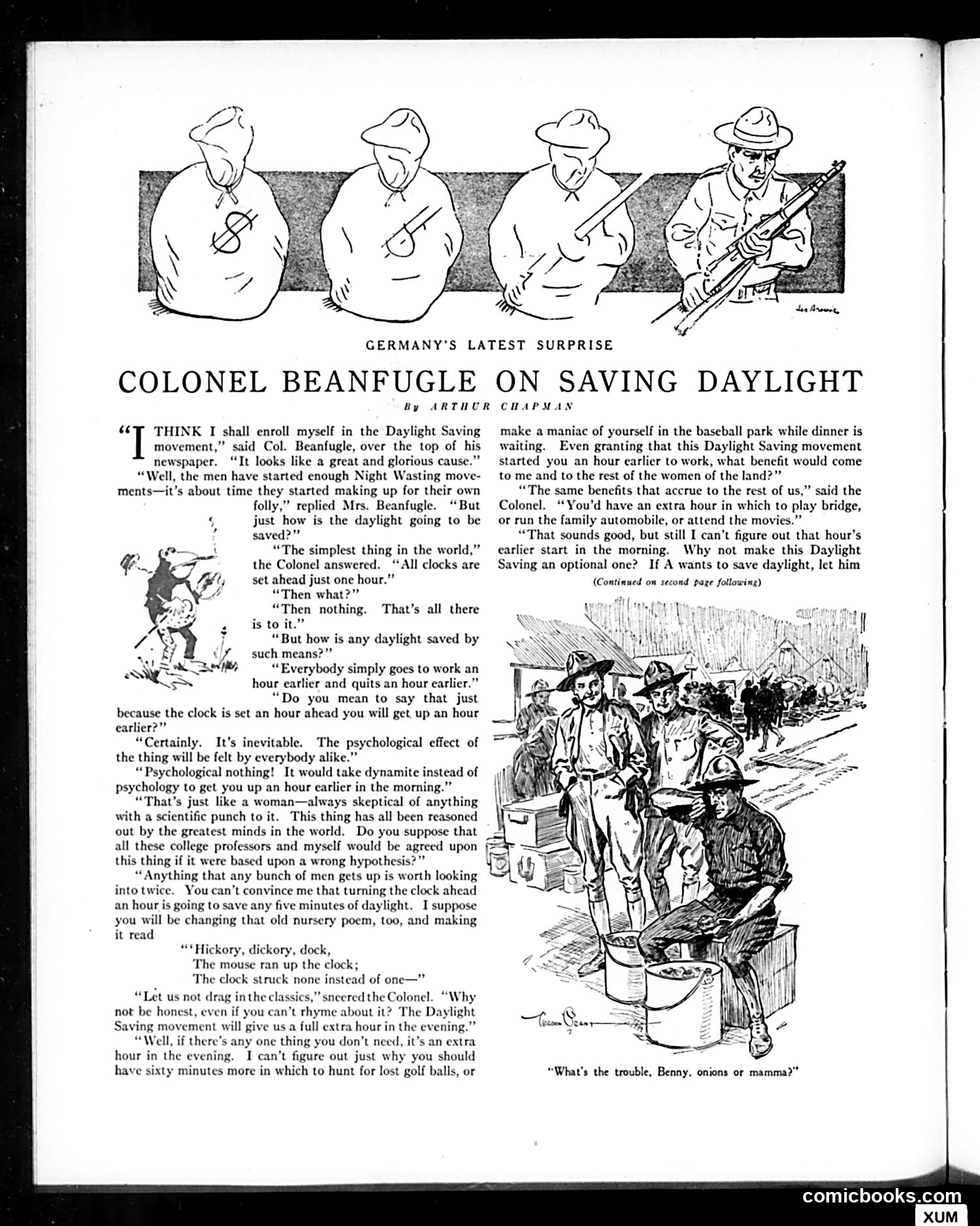
This is a humorous satirical piece by Arthur Chapman mocking Daylight Saving Time. Colonel Beanfugle proposes the "solution" to daylight saving: simply set all clocks ahead one hour, claiming this saves daylight through psychological effect rather than actual time manipulation. The satire targets the absurdity of DST arguments—Beanfugle's logic that "everybody" feeling an hour earlier starts would somehow conserve daylight is transparently ridiculous. His dismissal of practical concerns (no actual daylight is saved) in favor of vague "psychological effects" lampoons the period's genuine debates over DST's real benefits. The top cartoon shows escalating "surprises" (dollar signs, tools, rifles)—likely Germany's wartime escalations, darkly juxtaposing military threats with domestic time-management debates.
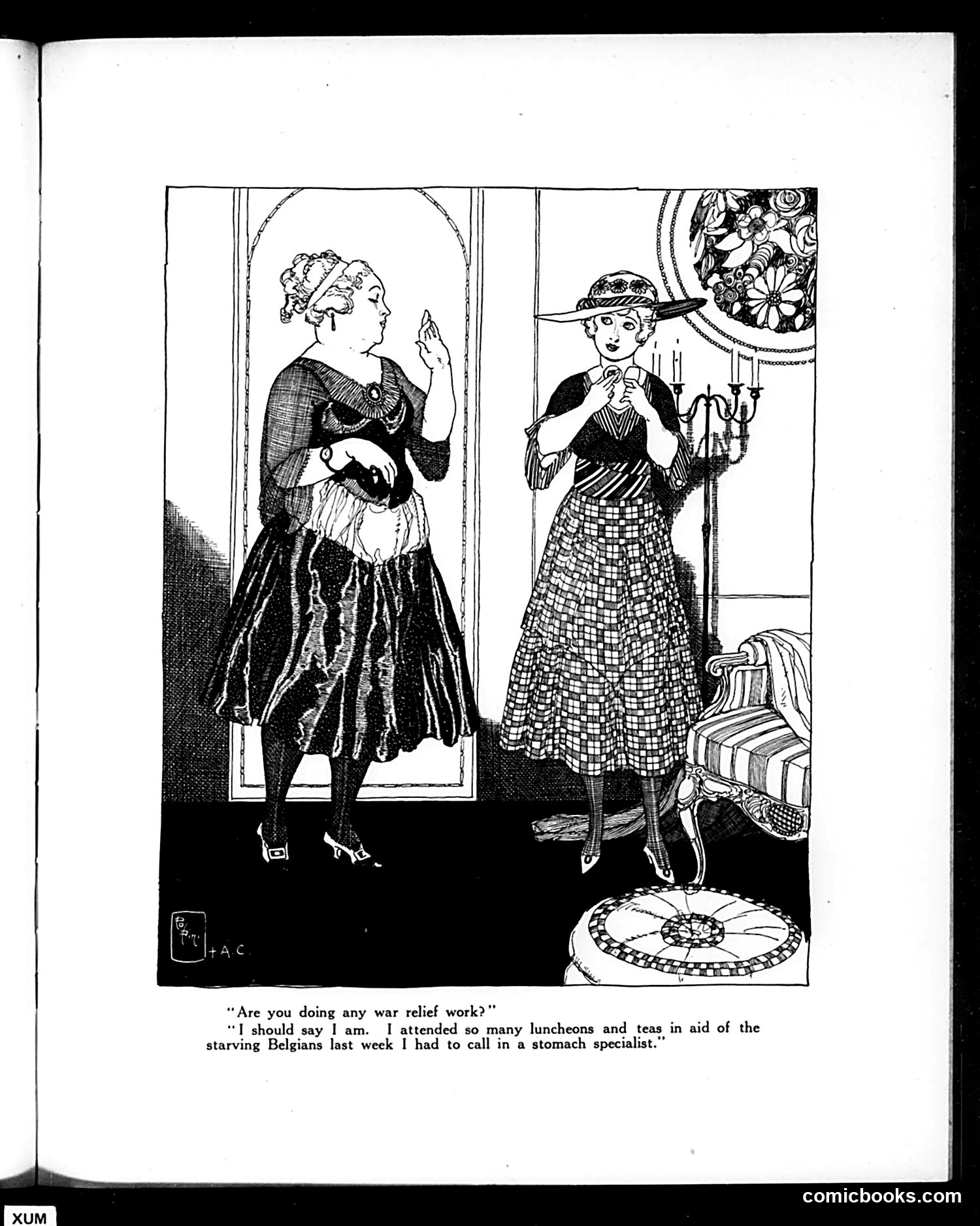
This Judge magazine cartoon satirizes wealthy women's war relief efforts during World War I. The dialogue reveals the satire's target: one woman claims extensive charitable work for starving Belgians—a major humanitarian crisis during the war—but admits attending "so many luncheons and teas" that she required a stomach specialist afterward. The joke critiques the socialite practice of organizing elaborate fundraising events that became more about fashionable social gatherings than actual relief. The women's elegant clothing and interior setting emphasize their wealth and comfort, contrasting sharply with the suffering Belgians they claim to aid. The cartoon suggests their charitable activities primarily served social networking rather than meaningful humanitarian impact.
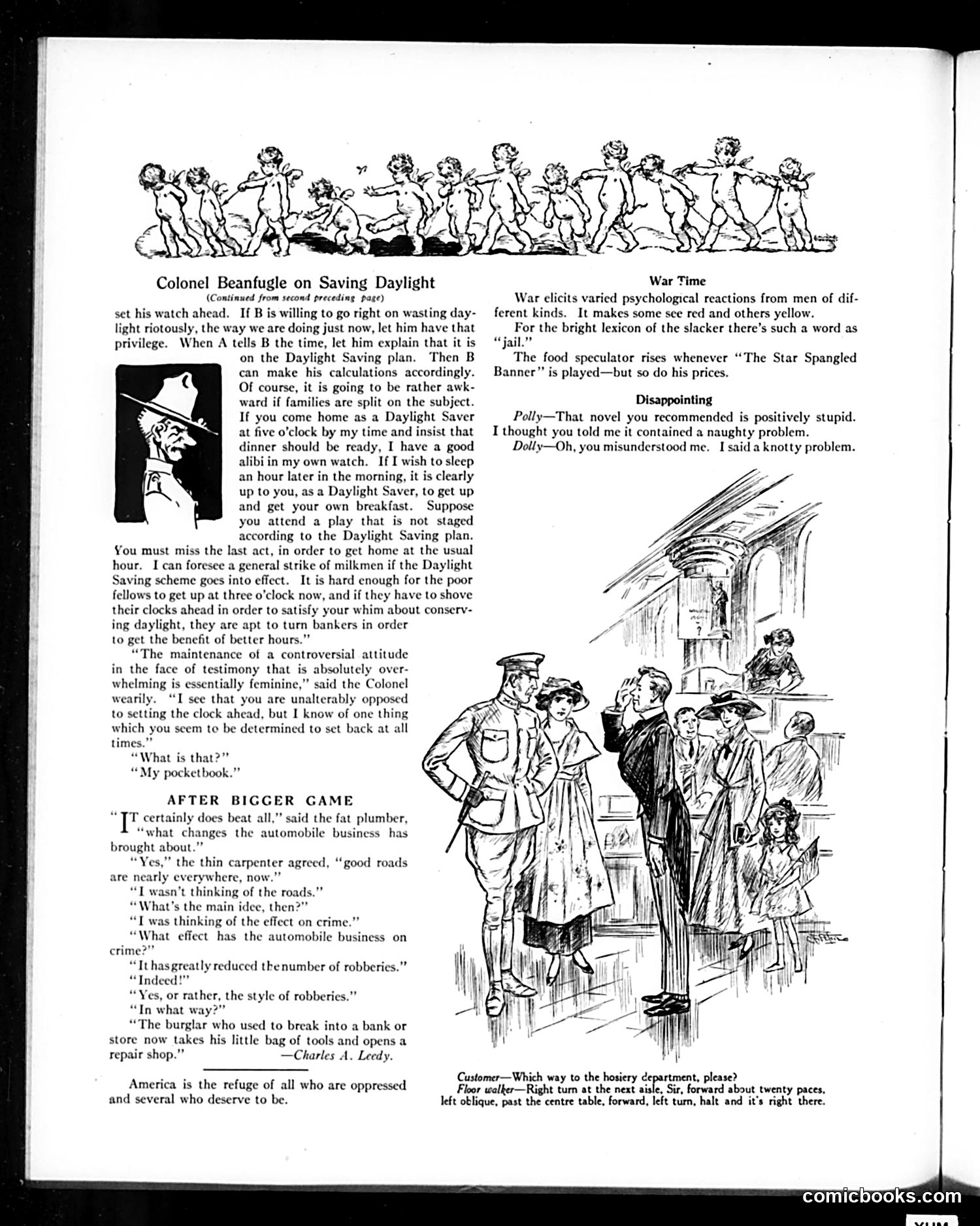
This page from *Judge* contains satirical commentary on **Daylight Saving Time** during World War I. "Colonel Beanfugle" argues against the practice, predicting domestic chaos: families will quarrel over meal times, workers (milkmen, theater-goers) will suffer, and the whole scheme will collapse. The satire mocks both the impracticality of the policy and its supporters' enthusiasm. The page also includes brief humorous items: a dialogue joke about a "knotty problem" in a novel, and a piece by Charles A. Leedy about how automobiles changed crime—burglars now pose as repair-shop owners rather than breaking into banks. A final caption cartoon shows a store floor-walker giving convoluted directions. The underlying satire targets wartime regulations and their unintended consequences, while poking fun at modernization and changing social conditions during the WWI era.
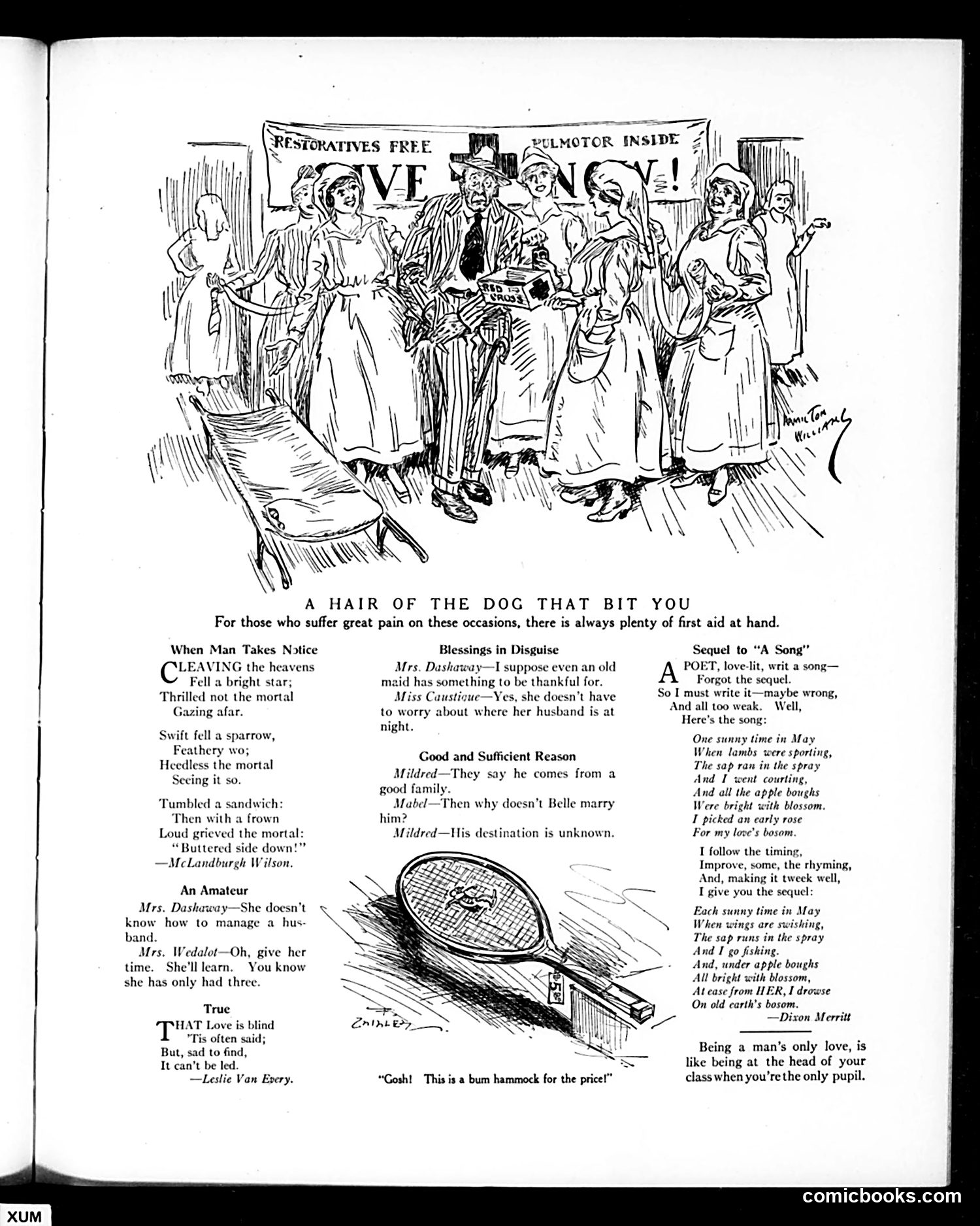
The top cartoon depicts a "Pulmotor" demonstration—an early mechanical resuscitation device. The banner reading "Restoratives Free" and "Hair of the Dog That Bit You" suggests this is satirizing medical quackery or dubious health remedies of the era. The crowded scene of women observing the device mocks both the novelty of such contraptions and public fascination with pseudoscientific "cures." The remainder of the page consists of humor pieces and poetry rather than political satire. The jokes target domestic life: wives managing (or mismanaging) husbands, marriages of convenience, and romantic disappointment. The final poem's sequel is particularly cynical—a man's ardent springtime love song becomes, upon repetition, a meditation on escaping his wife through fishing. This reflects early 20th-century magazine humor: domestic comedy, gentle marital satire, and skepticism about medical fads—typical of *Judge*'s satirical but non-political content.
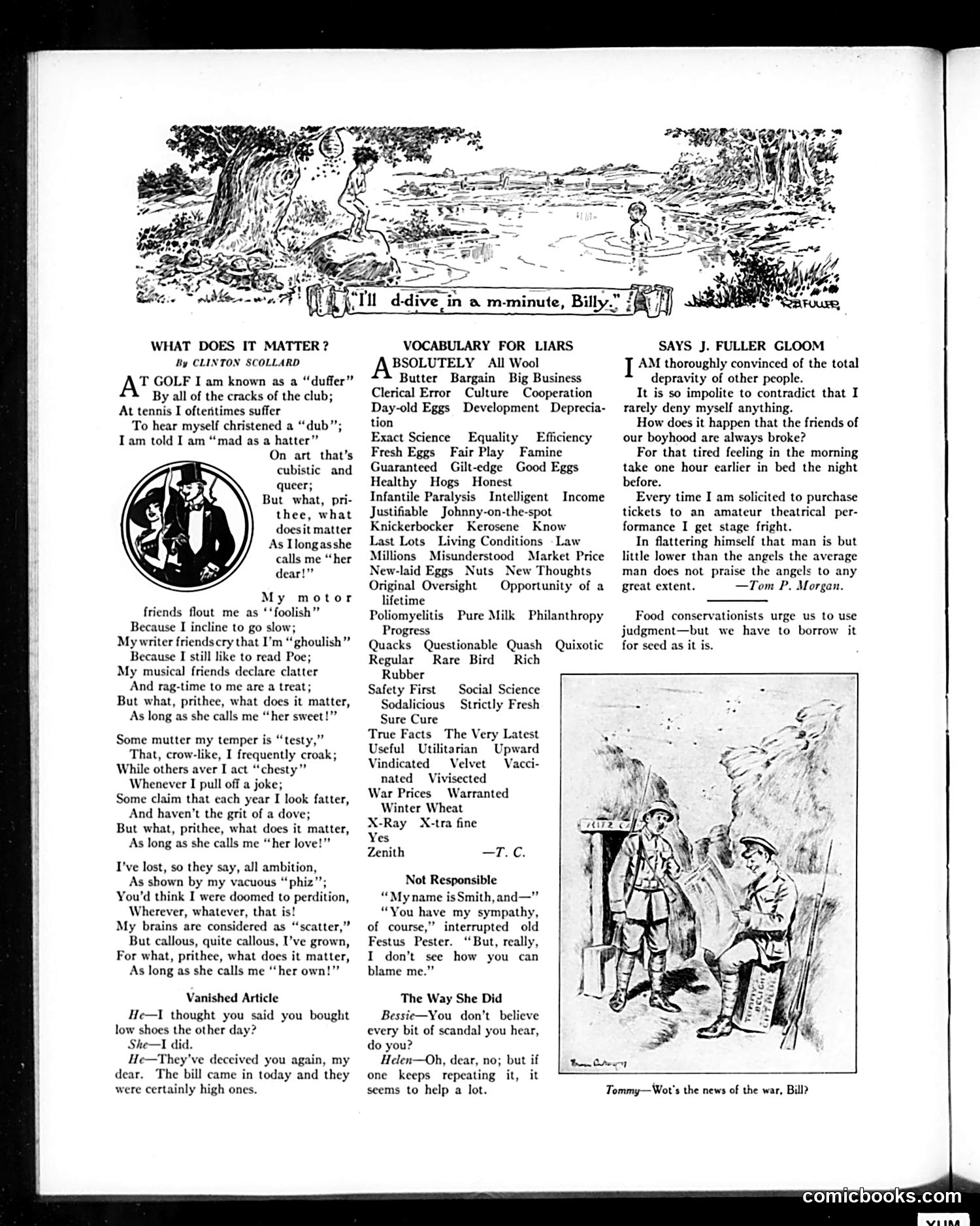
This page contains three satirical humor pieces typical of Judge magazine's social commentary: **"What Does It Matter?"** (poem by Clinton Scollard): A romantic poem mocking the narrator's various social failures—he's a terrible golfer, tennis player, and art critic; his friends ridicule his tastes and appearance. The refrain jokes that none of it matters "as long as she calls me 'her dear/sweet/love/own'"—satirizing how romantic attachment blinds men to legitimate criticism and their own inadequacies. **"Vocabulary for Liars"**: An alphabetical list mocking common business and political euphemisms of the era—terms like "Absolutely All Wool," "Market Price," and "War Prices Warranted" that advertisers and politicians use deceptively. This satirizes widespread commercial dishonesty. **"The Way She Did"** and other brief jokes play on misunderstandings and social hypocrisy. **The cartoon** (bottom right) shows two soldiers in what appears to WWI-era uniforms discussing war news, anchoring the page's era to wartime. The overall page satirizes romantic delusion, commercial fraud, and wartime concerns.
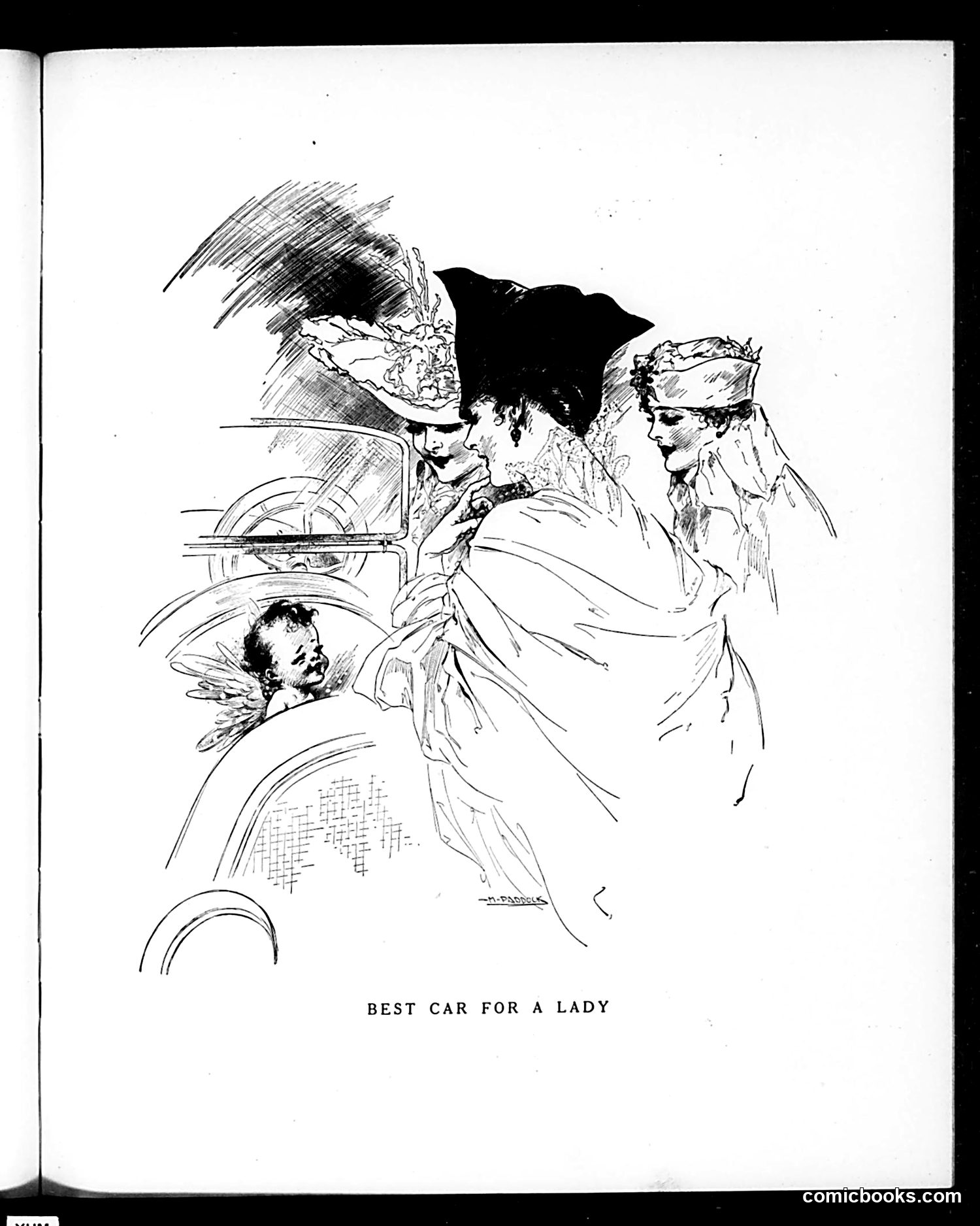
This illustration depicts three elegantly dressed women in an early automobile, with a cherub or cupid figure visible on the vehicle itself. The caption "Best Car for a Lady" is the entire textual content. The cartoon appears to satirize early 20th-century automobile advertising and gender expectations. The presence of the cherub suggests this is likely a humorous commentary on romantic ideals or the commodification of femininity in car marketing. The women's elaborate clothing and hats are rendered in the fashionable style of the period. Without additional context or identifying information visible in the image, the specific automobile being advertised or the precise satirical point remains unclear, though it likely mocks either the absurdity of marketing cars to women or contemporary assumptions about what constitutes a "lady's" vehicle.
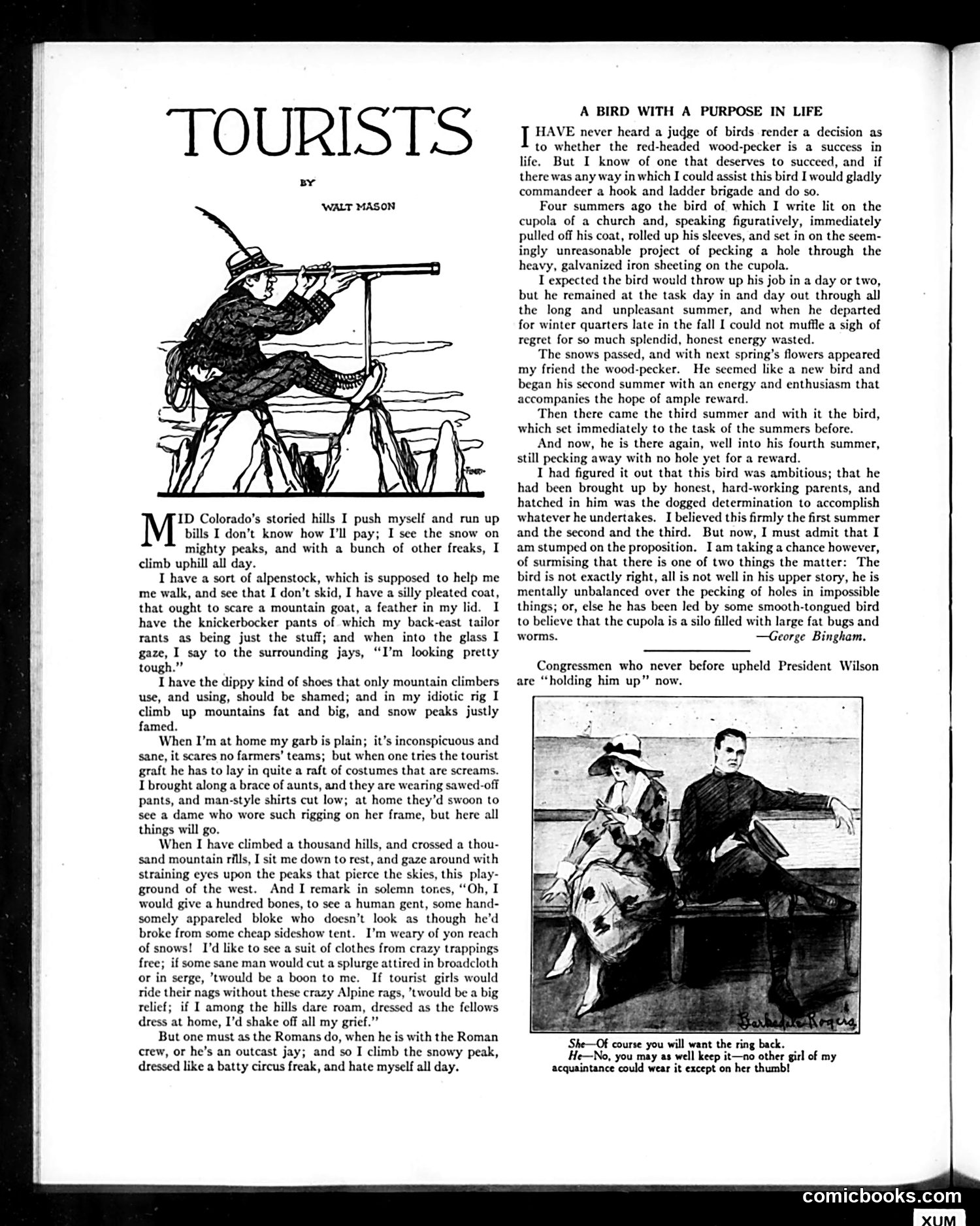
**"Tourists"** satirizes American tourists in Colorado who adopt ridiculous, affected clothing and behavior once they leave home. The author mocks the hypocrisy: at home, people dress sensibly, but on vacation they don "crazy Alpine rags"—knickerbockers, pleated coats, and absurd accessories—to conform to tourist stereotypes. The satire targets not mountain climbing itself but the performative, self-conscious costume-wearing that transforms ordinary people into "batty circus freaks." The concluding moral—"one must as the Romans do"—resignedly accepts social conformity even when it produces misery. **"A Bird with a Purpose in Life"** praises a red-headed woodpecker's persistent, dogged work ethic. For four summers, the bird attempts to peck through iron sheeting on a church cupola, failing repeatedly yet returning each spring with renewed determination. The piece admires this honest labor and unwavering commitment to a goal, contrasting the bird's reliability with human inconsistency. Both pieces reflect early 20th-century tensions between authenticity and social performance, and between genuine effort and hollow pretense.
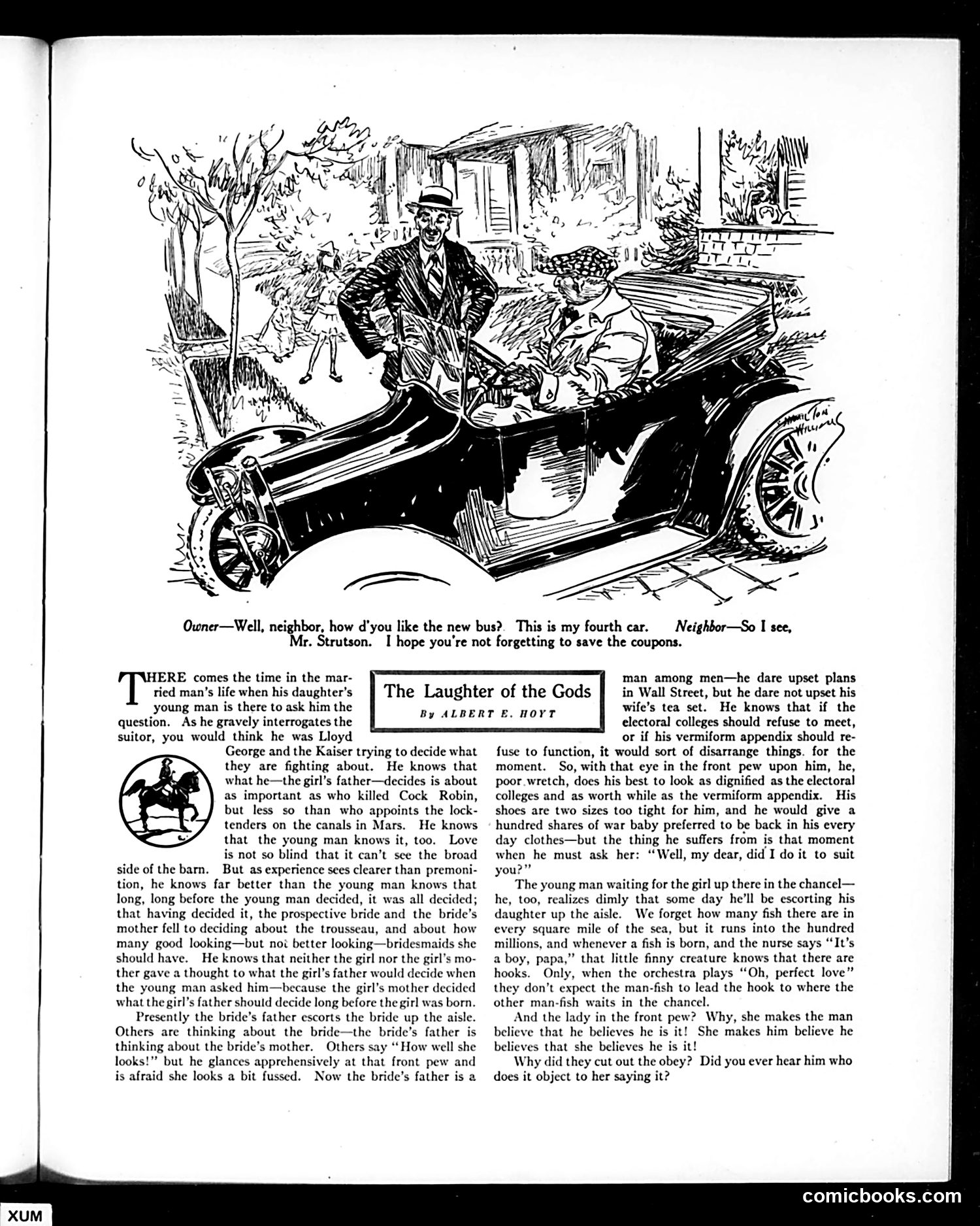
**Top cartoon:** A wealthy man (Mr. Strutson) shows off his new automobile—his fourth car—to a neighbor, who sarcastically notes he hopes Strutson remembers to save coupons (likely rationing-related, suggesting wartime scarcity). The satire mocks conspicuous consumption and the absurdity of accumulating luxury cars while ordinary citizens practice thrift. **Main article:** Albert E. Hoyt's satirical story about a father giving away his daughter at her wedding. The piece humorously exposes the illusion of male authority: fathers pretend to "decide" on marriages, but mothers and daughters have predetermined everything—the trousseau, bridesmaids, even the proposal itself. The father merely performs dignity while suffering discomfort (tight shoes), aware his real power extends only to upsetting his wife's tea set. The satire reveals traditional gender dynamics where women actually control domestic decisions despite men's ceremonial authority.
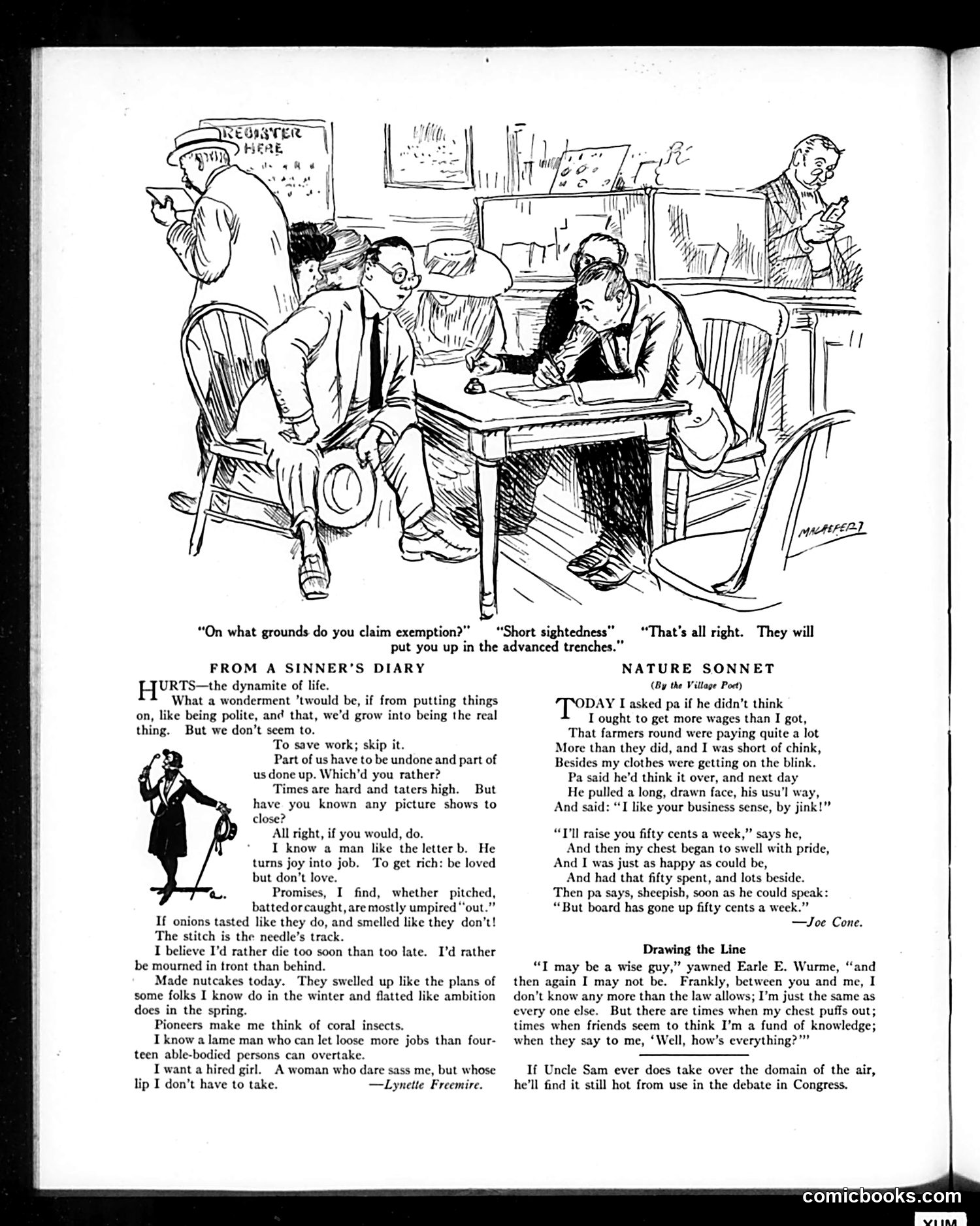
The top cartoon satirizes WWI draft exemption claims. A man claims "short sightedness" to avoid military service, but the examiner replies that those with poor vision will simply be placed in "advanced trenches"—the most dangerous frontline positions. The joke exposes the absurdity of using physical disabilities as exemption grounds when they'd be sent to the worst combat zones anyway. The page also contains humorous essays and poems about everyday life frustrations: a farm worker's wage raise immediately negated by increased board costs; cynical observations about human nature; and commentary on Congressional debate (likely about aviation policy during the WWI era). The overall tone critiques both military bureaucracy and the economic struggles of ordinary Americans during wartime.
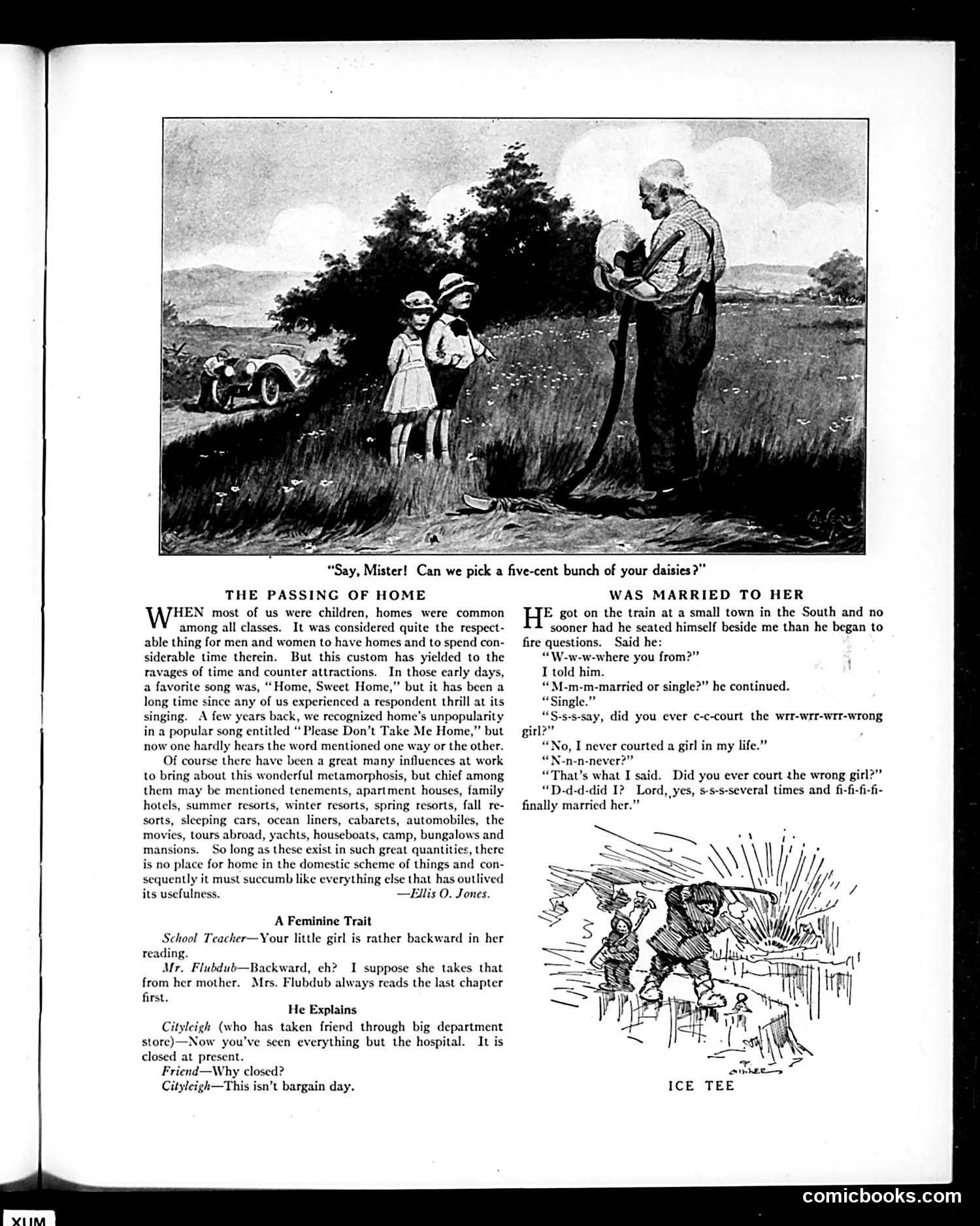
This page contains three satirical pieces reflecting early 20th-century American concerns: **"The Passing of Home"** laments that domestic life is disappearing as Americans embrace modern distractions—apartments, hotels, automobiles, movies, and travel. The accompanying illustration shows a man picking wildflowers with children, romanticizing a pastoral past now lost to urban development and commercialism. **"A Feminine Trait"** jokes that a girl reads books backward (starting with the last chapter), supposedly inheriting this oddity from her mother's reading habits—poking fun at female literary behavior. **"He Explains"** contains two brief jokes: one about hospital hours during sales, and another featuring a stuttering Southern man recounting romantic misadventures before marrying. Overall, the page reflects nostalgic anxiety about modernization's social costs, combined with genteel humor about gender and regional stereotypes typical of early-20th-century American satire.
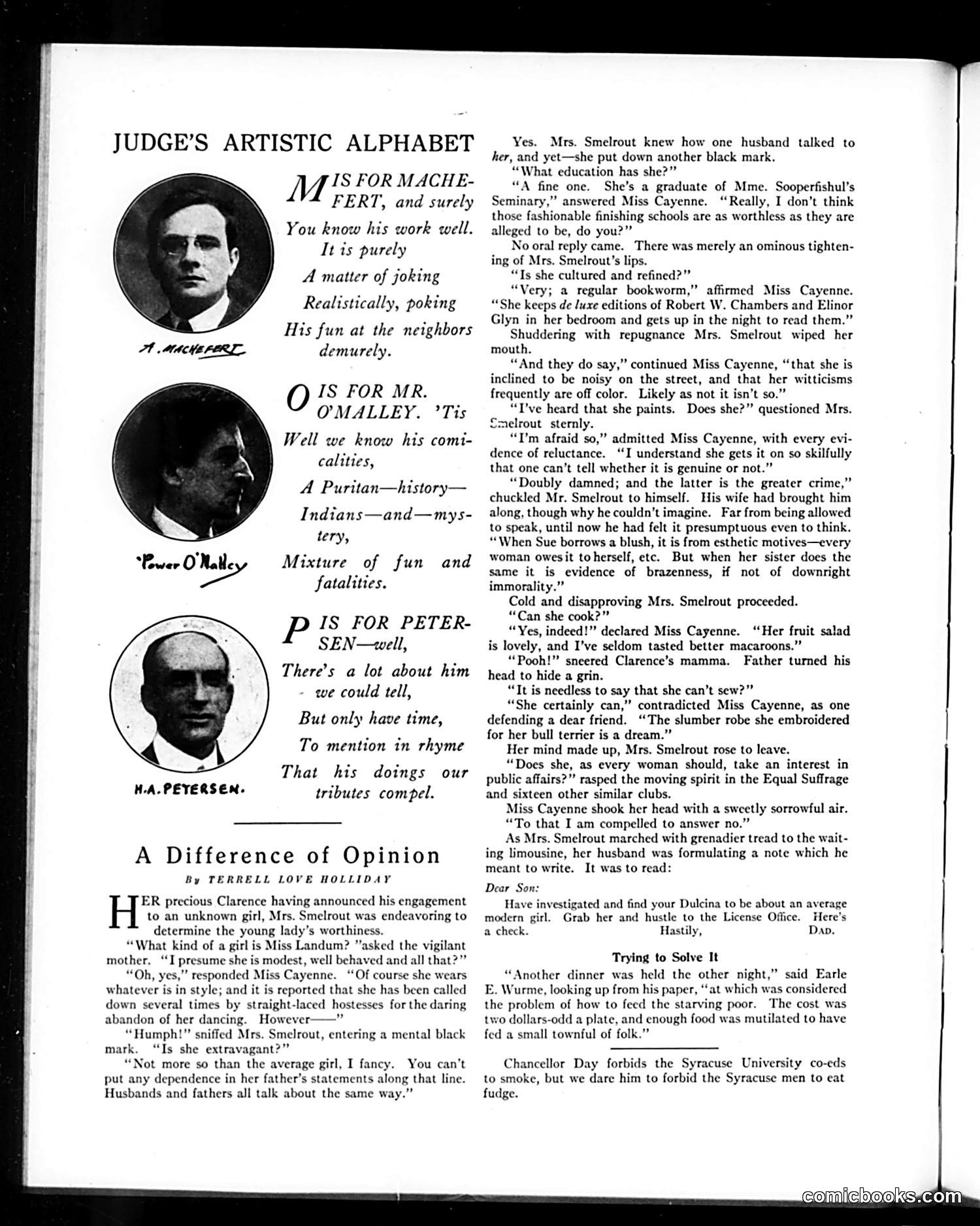
This page contains two distinct sections: **Left Side: "Judge's Artistic Alphabet"** features caricatured portraits and brief descriptions of three artists—Machefert, O'Malley, and Petersen—praising their work in satirical verse. The cartoons mock their artistic styles and subject matter (O'Malley's work involves "Puritans," "Indians," and "mystery"). **Right Side: "A Difference of Opinion"** is a satirical story about Mrs. Smelrout, a judgmental prospective mother-in-law interrogating Miss Cayenne about her son Clarence's fiancée. The humor lies in Mrs. Smelrout's **hypocritical double standards**: she dismisses the fiancée's dancing, spending, makeup use, and literary taste (Elinor Glyn was risqué), yet when defending her own sister's identical behaviors, claims they reflect "esthetic motives." The story satirizes snobbish maternal gatekeeping and selective moral judgment—whatever the fiancée does is condemned; whatever respectable women do is excused.
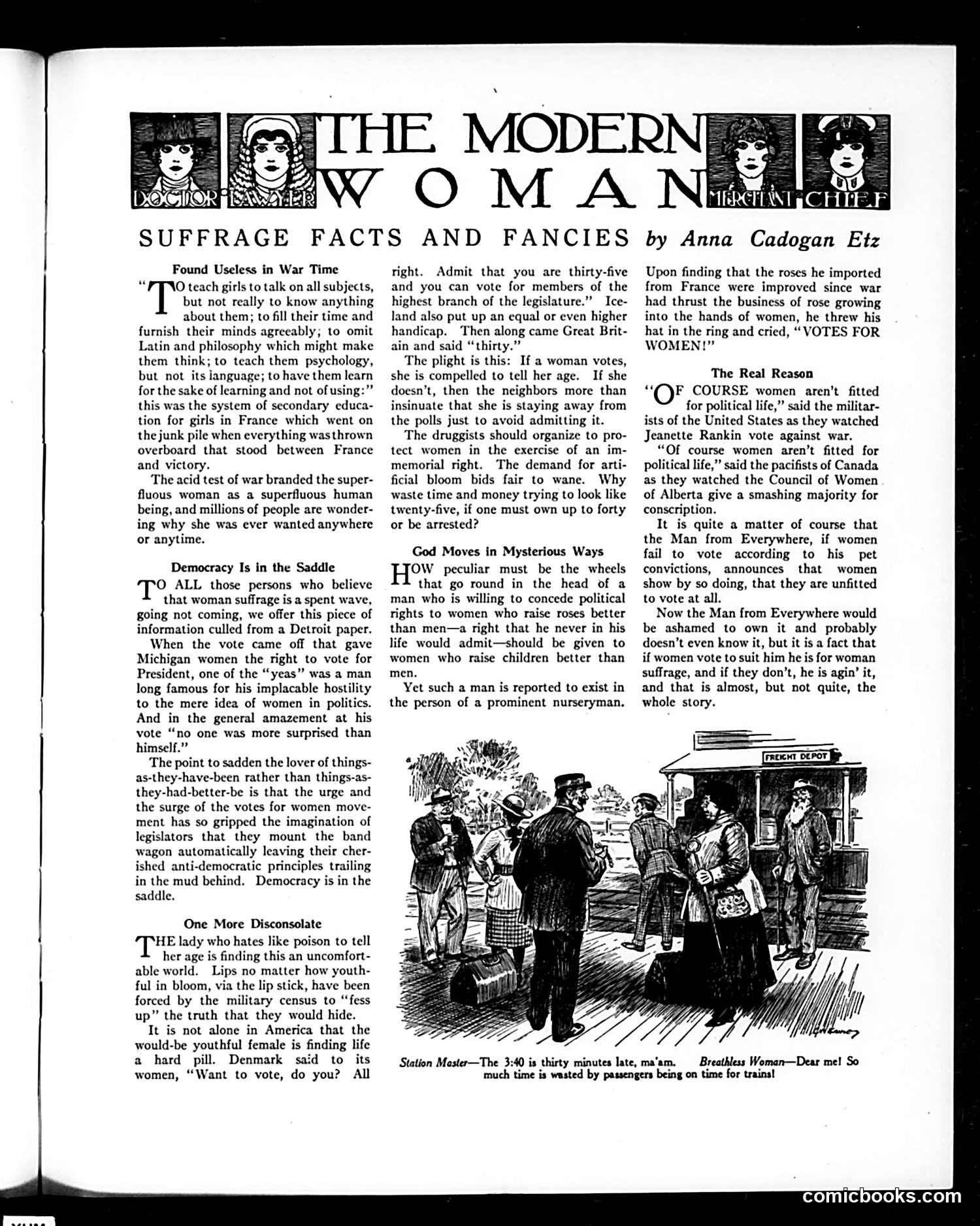
This 1918 *Judge* magazine page by Anna Cadogan Etz satirizes anti-suffrage arguments using irony and absurdist examples. **Main arguments presented:** 1. **Women proved useful in wartime** — France abandoned frivolous female education when women's labor became essential, proving women weren't actually "superfluous." 2. **Male hypocrisy on voting age** — Denmark, Iceland, and Britain required women voters to publicly declare their age (a social taboo), yet no such requirement existed for men. The satire highlights how suffrage opponents invented arbitrary barriers. 3. **The nurseryman's contradiction** — A prominent nurseryman praised women's superior rose-cultivation (learned during war) yet wouldn't grant them political rights, exposing the illogic of denying suffrage based on supposed incapacity. 4. **Militarists and pacifists both opposed women voters** — Yet Jeanette Rankin's actual Congressional vote against war showed women *could* engage in serious political judgment, contradicting both groups' claims. The cartoon (bottom) shows a station scene, likely illustrating women's wartime public participation. The page systematically dismantles suffrage opponents' reasoning through concrete examples.
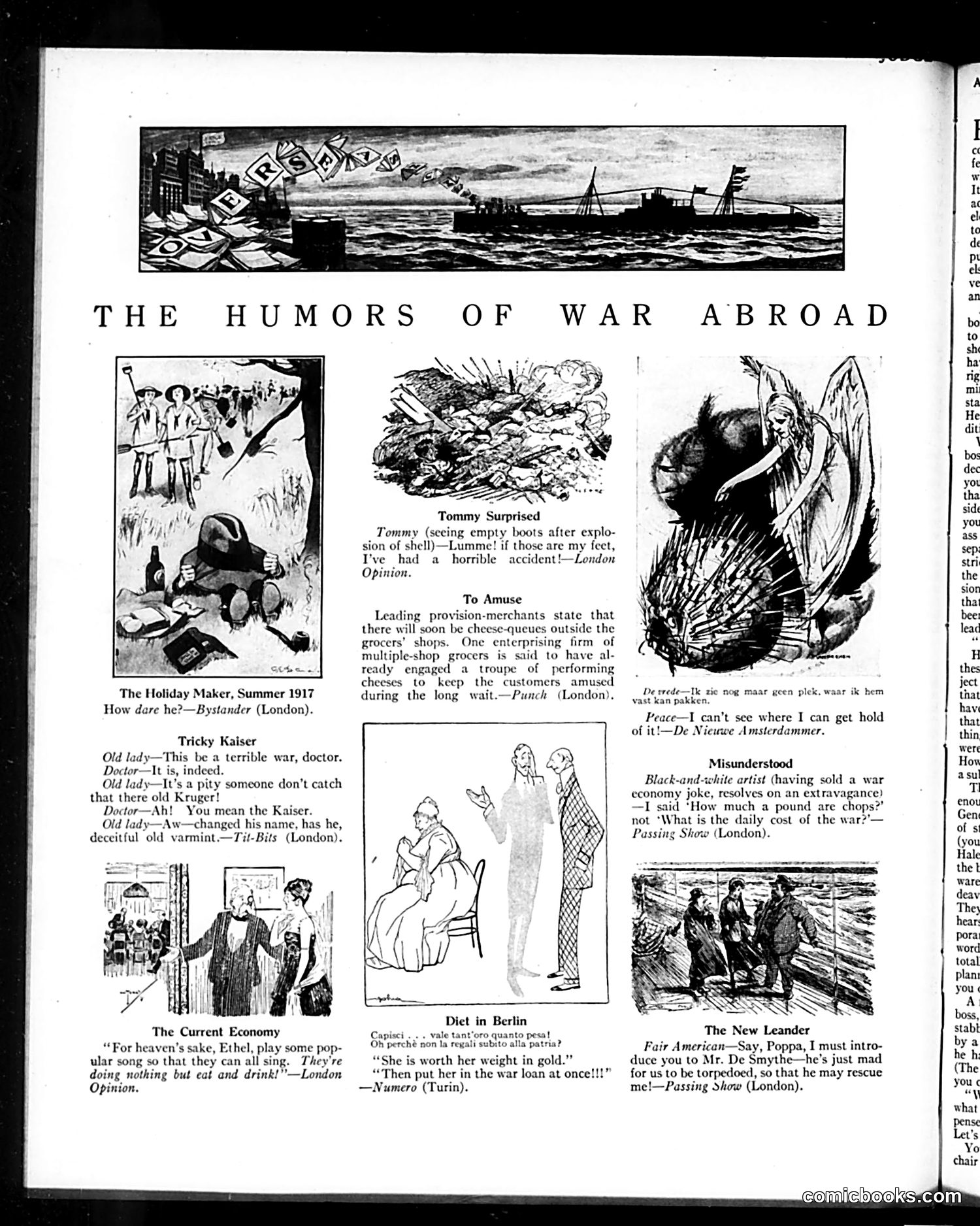
This page collects international wartime satirical cartoons from WWI-era publications, primarily mocking civilian absurdities and military follies. **Key cartoons:** - **"Tricky Kaiser"**: An elderly British woman confuses the Kaiser with "Kruger" (likely Paul Kruger, Boer War figure), satirizing public confusion about enemies. - **"Tommy Surprised"**: Dark humor about a soldier finding empty boots after a shell explosion, joking he's lost his feet. - **"The Current Economy"**: Mocks British rationing anxieties—grocers allegedly hire performing monkeys to entertain customers during cheese shortages, lampooning both scarcity and commercial opportunism. - **"Diet in Berlin"**: An Italian cartoon plays on the phrase "worth her weight in gold"—suggesting putting a woman into war bonds at that valuation. - **"The New Leander"**: American satire on a woman wanting to be torpedoed for rescue heroics, mocking romantic wartime fantasies. The collection satirizes civilian morale, economic strain, and the absurd ways people coped with or profited from WWI privations across multiple nations.
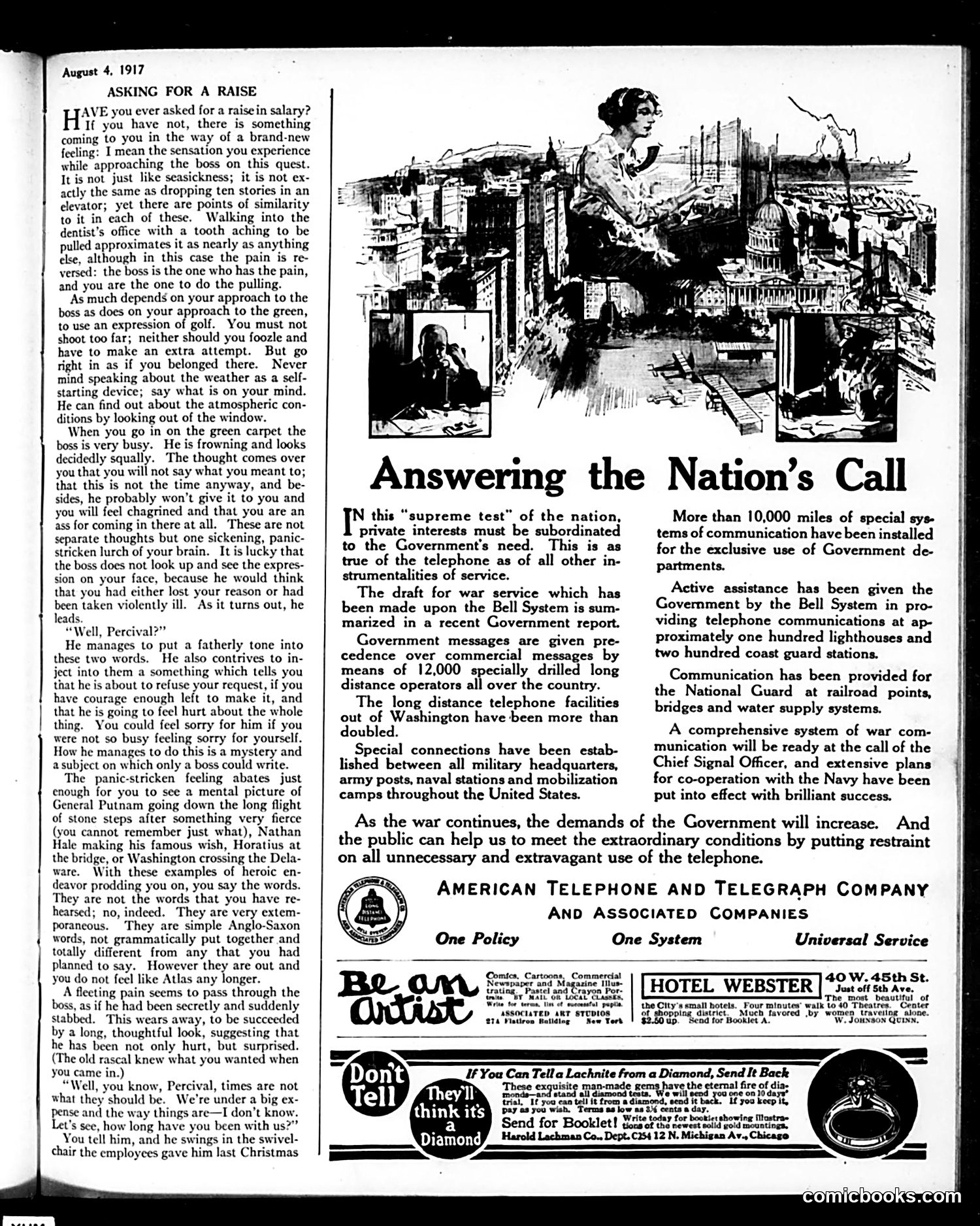
This page combines two distinct pieces: **"Asking for a Raise"** (left) is a humorous essay about the anxiety of requesting a salary increase from one's boss. The author compares the nervousness to seasickness, dental work, and dropping in an elevator. The piece humorously dramatizes the employee's fear and internal panic, noting how the boss's seemingly sympathetic response ("Well, Percival?") actually signals refusal. The essay uses historical references (Nathan Hale, General Putnam, Washington) as inspirational examples to steel one's courage. **"Answering the Nation's Call"** (right) is a serious corporate advertisement by American Telephone and Telegraph Company, describing how telephone/telegraph infrastructure supports the U.S. military effort during World War I. It emphasizes civilian sacrifice of "private interests" to government needs. The juxtaposition is ironic: a worker's modest personal request for a raise is satirically compared to the patriotic subordination of private business interests to national war efforts—suggesting the gap between corporate patriotism and individual worker treatment.
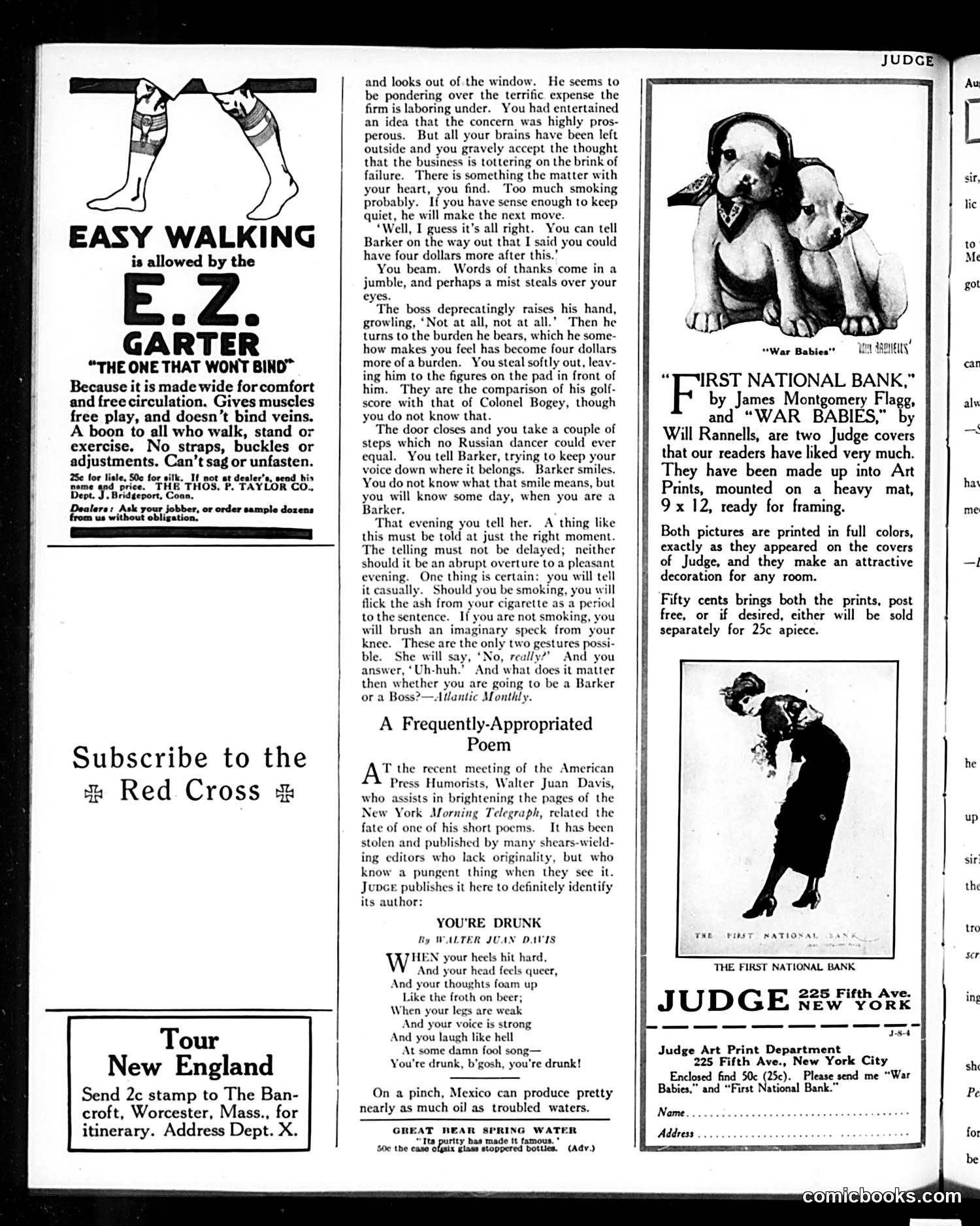
This page is primarily **advertising and filler content** rather than political satire. Key elements: **Advertisements:** - E.Z. Garter (elastic garter product) - Red Cross subscription appeal - New England tour - Judge Art Print Department offerings **Literary Content:** A serialized story about an employee receiving a modest raise ($4) from his boss, illustrating workplace anxiety and social climbing aspirations of the era. The narrative captures early 20th-century office culture—the employee's nervousness, the boss's emotional manipulation through feigned burden-sharing, and the protagonist's eagerness to share news with "her" (his wife). **Poem Section:** "You're Drunk" by Walter Juan Davis, presented as a frequently plagiarized poem. It humorously catalogs drunkenness symptoms in colloquial language—a common subject for satirical magazines of this period. **Overall:** This page reflects Judge's mix of advertising revenue and light satirical/humorous content rather than focused political commentary.
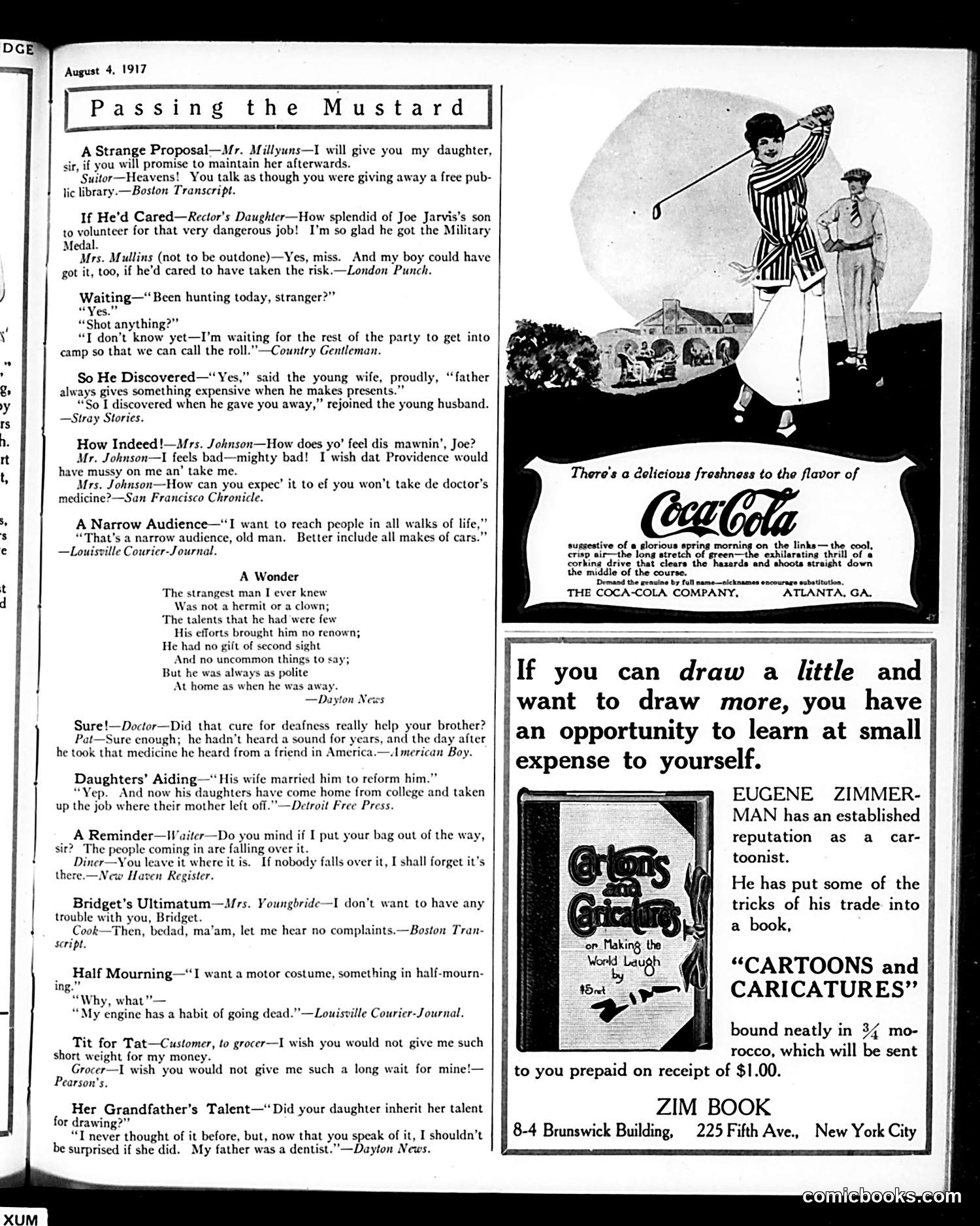
This page from *Judge* contains primarily **short humorous anecdotes** rather than political cartoons. The jokes, drawn from various newspapers, satirize everyday social situations: **Key themes:** - **Wealthy pretension**: A rich man's daughter compared to a "free public library" - **WWI patriotism**: Mothers competitively claiming their sons' military service - **Class differences**: Irish servant ("Bridget") sass; African American dialect humor (period-typical but offensive) - **Gender/marriage**: Newlyweds and domestic economics - **Wordplay**: A doctor's patient hearing from America after taking "medicine" for deafness **The large advertisement** features a Coca-Cola ad using a golf-course scene to associate the drink with leisure and spring freshness—a marketing approach common to 1917. **Below that**: Eugene Zimmerman advertises his cartooning instruction book, capitalizing on readers' interest in drawing. The page reflects 1917 American popular humor: middlebrow, domestically focused, with casual ethnic stereotyping acceptable for the era.
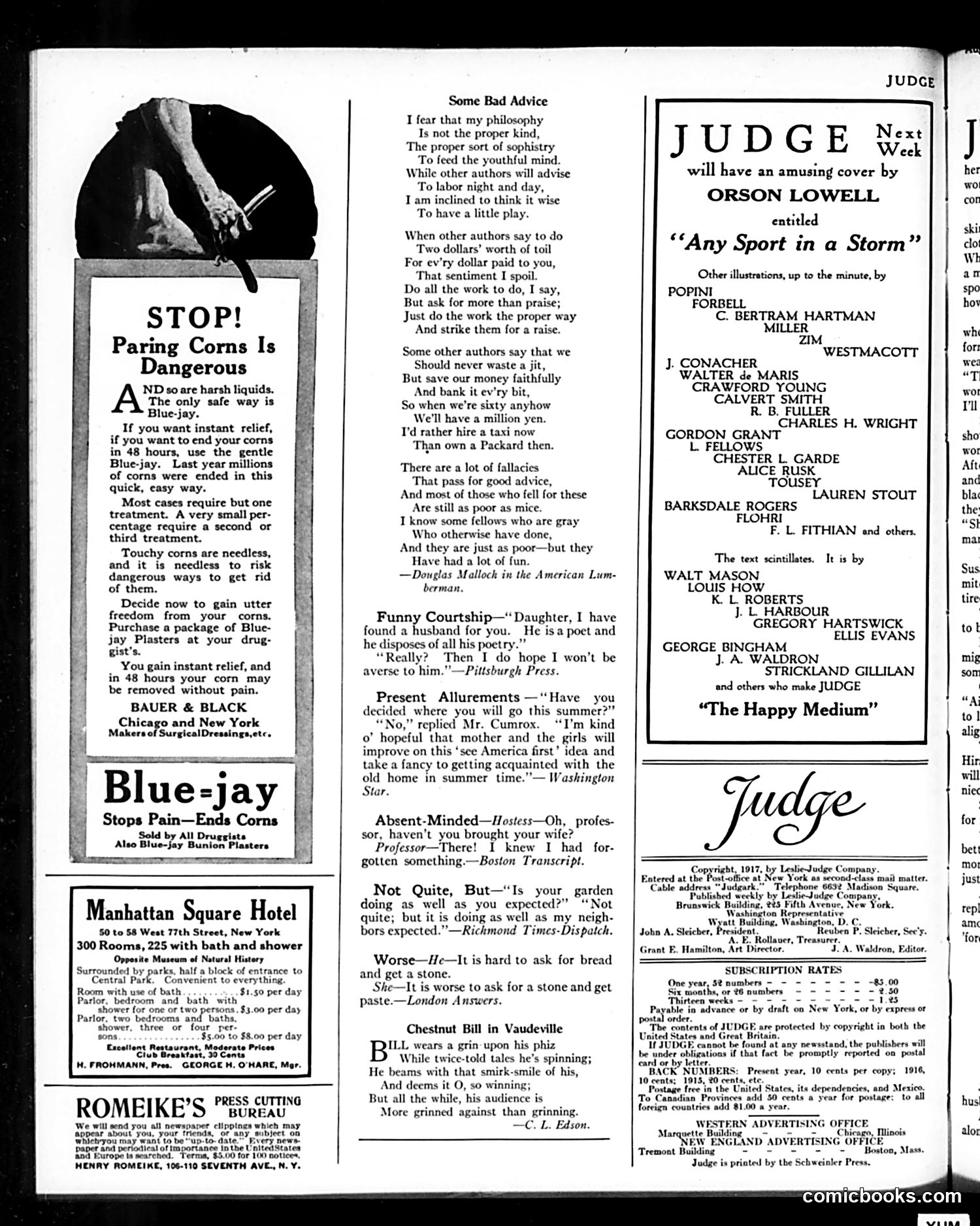
This page is primarily **advertising and miscellaneous content**, not political satire. The dominant feature is a Blue-jay corn plaster advertisement showing a dramatic image of a foot with the warning "STOP! Paring Corns Is Dangerous." The ad promotes Blue-jay as a safe, gentle alternative to dangerous home remedies, claiming corns can be removed painlessly in 48 hours. The page also contains hotel and business service advertisements (Manhattan Square Hotel, Romeike's press clipping bureau) and a section titled "Some Bad Advice"—a humorous poem by Douglas Malloch advising young workers to enjoy leisure and entertainment rather than obsessively save money or work constantly. This represents mild social commentary about work-life balance and consumerism, but it's presented as light verse rather than sharp satire. The remaining content consists of brief, anonymous humor snippets about courtship, absent-mindedness, and gardening—standard filler fare for the era.
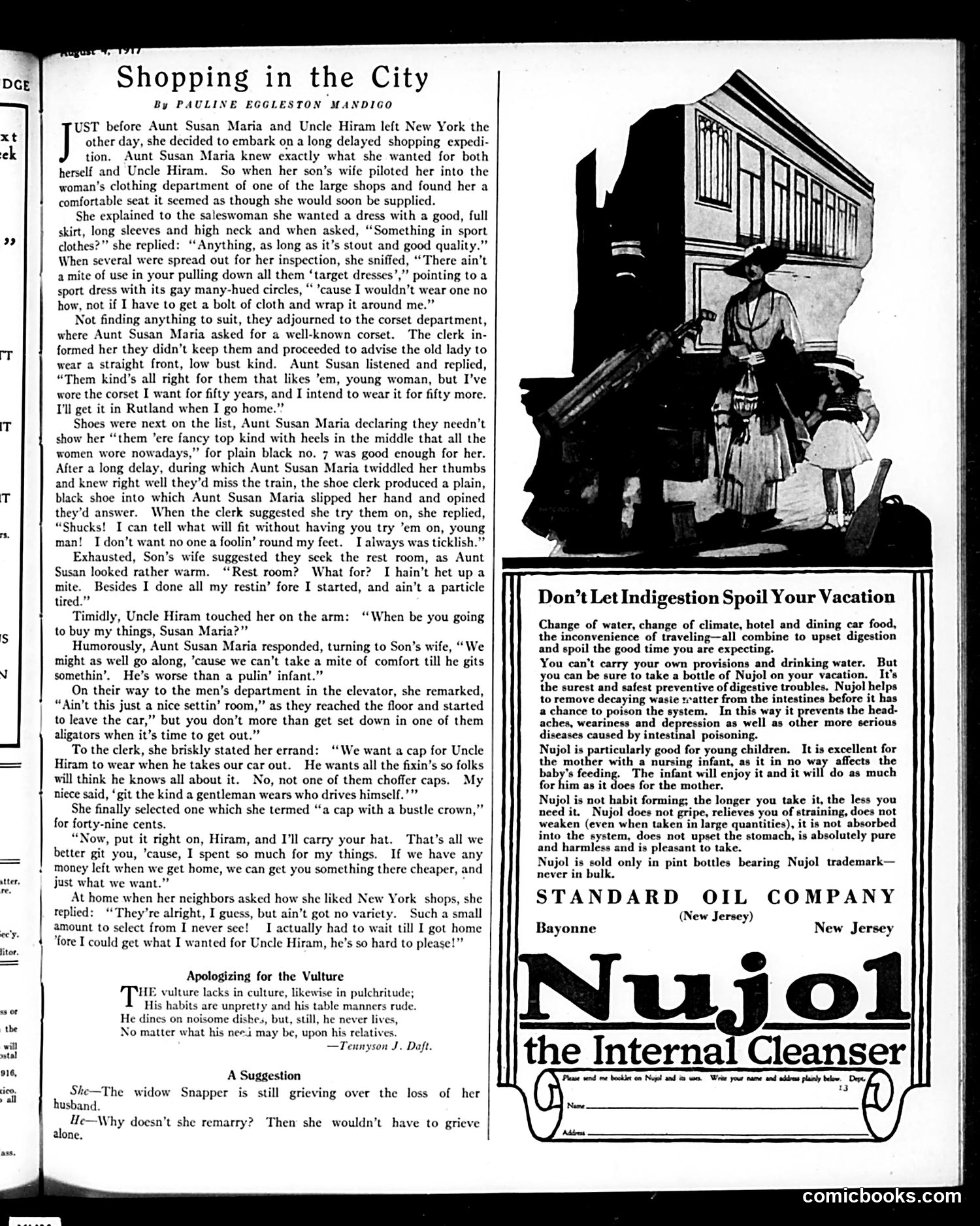
This is a humorous story (not a political cartoon) satirizing old-fashioned rural values clashing with modern urban consumer culture. "Aunt Susan Maria" represents a stereotypical small-town New England woman (references to Rutland suggest Vermont) visiting New York City with her relatives. The satire targets her stubborn resistance to contemporary fashion: she rejects "sport clothes" with bright colors, refuses modern low-bust corsets despite the clerk's advice, insists on plain black shoes, and generally distrusts city shops' variety and fashionable offerings. Her complaints about elevators ("aligators"), rest rooms, and spending money reflect rural suspicion of urban conveniences and consumption. The humor derives from her clash between practical small-town values and the city's commercial modernity—she's penny-pinching, skeptical of trends, and ultimately vindicated by finding everything inadequate. The accompanying Nujol advertisement exploits similar anxieties about travel and unfamiliar food disrupting digestion.
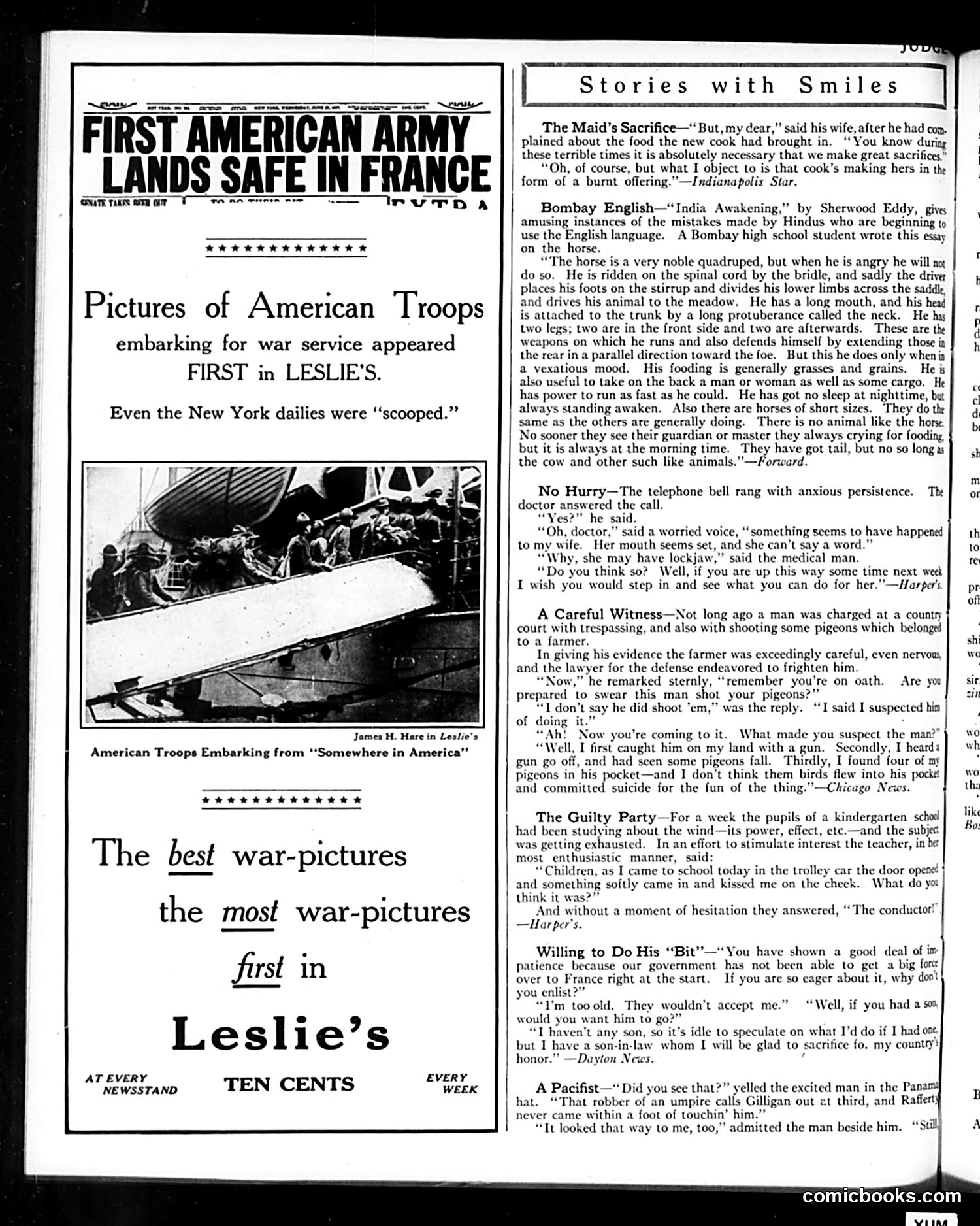
This page from **Judge** magazine (a satirical publication) celebrates American military involvement in World War I. **Main Content:** The left side advertises Leslie's magazine, promoting their exclusive photographs of American troops embarking for France—claiming they "scooped" even major New York newspapers. This was a competitive boast about journalistic access during wartime. **The Right Side:** "Stories with Smiles" contains humorous anecdotes typical of the era's light magazines, including: - A joke about a cook's "burnt offerings" - Satire of English as spoken by Hindi speakers learning the language (the horse essay is intentionally absurd malapropisms) - Domestic humor about wives and doctors - A courtroom witness story **Context for Modern Readers:** This represents American popular culture supporting the war effort through both patriotic celebration of military mobilization and escapist humor. The magazine simultaneously promoted commercial war photography while offering comedic relief—a common approach to maintaining public morale during WWI.
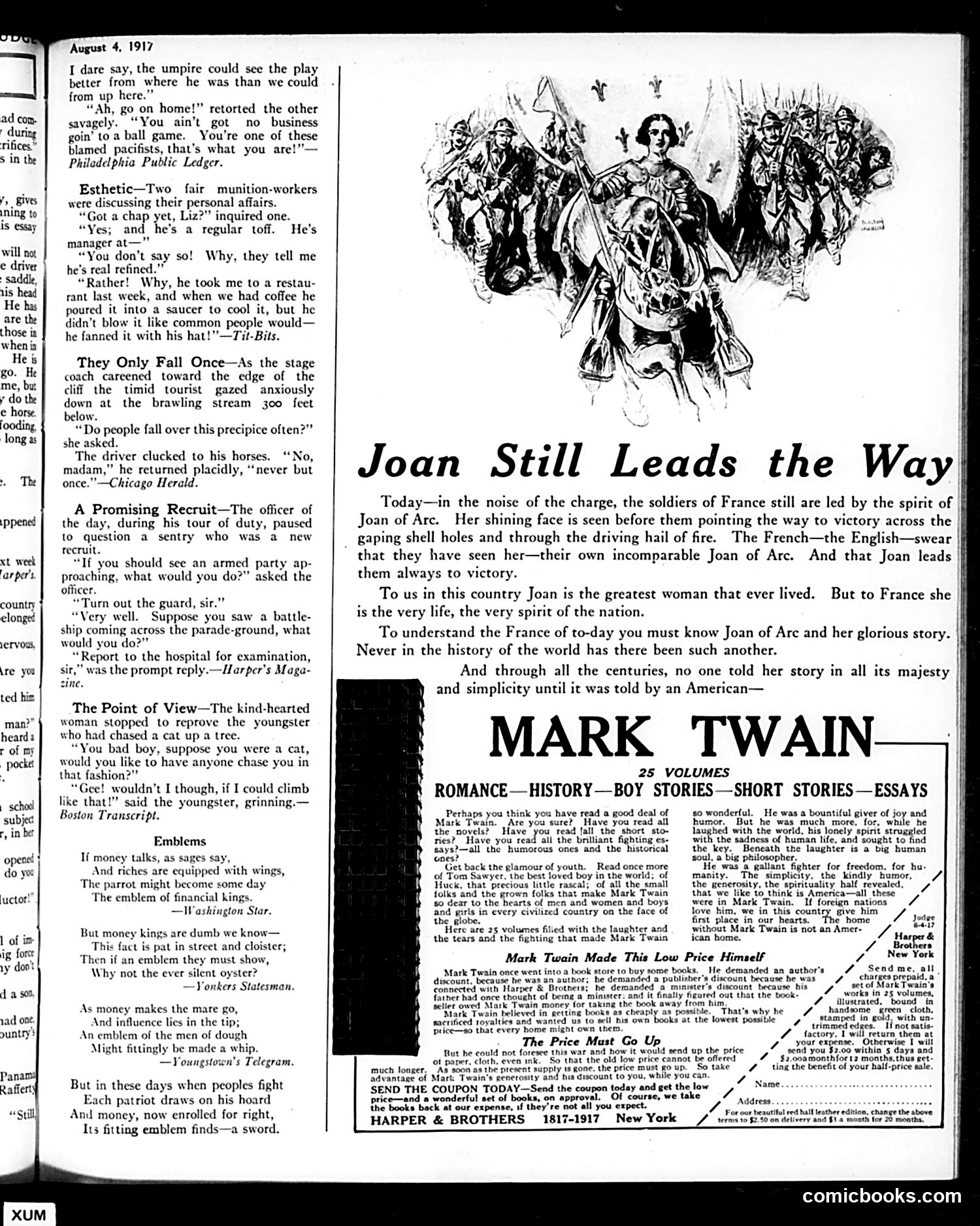
This page contains several short satirical anecdotes and a major advertisement, reflecting American attitudes during World War I. The anecdotes mock various subjects: a baseball fan criticized as a "pacifist" for complaining about an umpire (linking anti-war sentiment to unpatriotism); working-class affectation; a tourist's naïveté; and military incompetence. The "Emblems" poetry section culminates in patriotic sentiment: money's "fitting emblem" is now a sword—reflecting wartime mobilization. The dominant content is an advertisement for Mark Twain's 25-volume collected works, featuring a large illustration titled "Joan Still Leads the Way." The copy uses Joan of Arc as a metaphor for French wartime inspiration, suggesting Twain's account uniquely captures her story. This advertisement links American literature to the Allied cause, positioning Twain as the authorized American narrator of Joan's legend. The page reflects 1917 American pro-war sentiment and commercial exploitation of patriotic emotion.
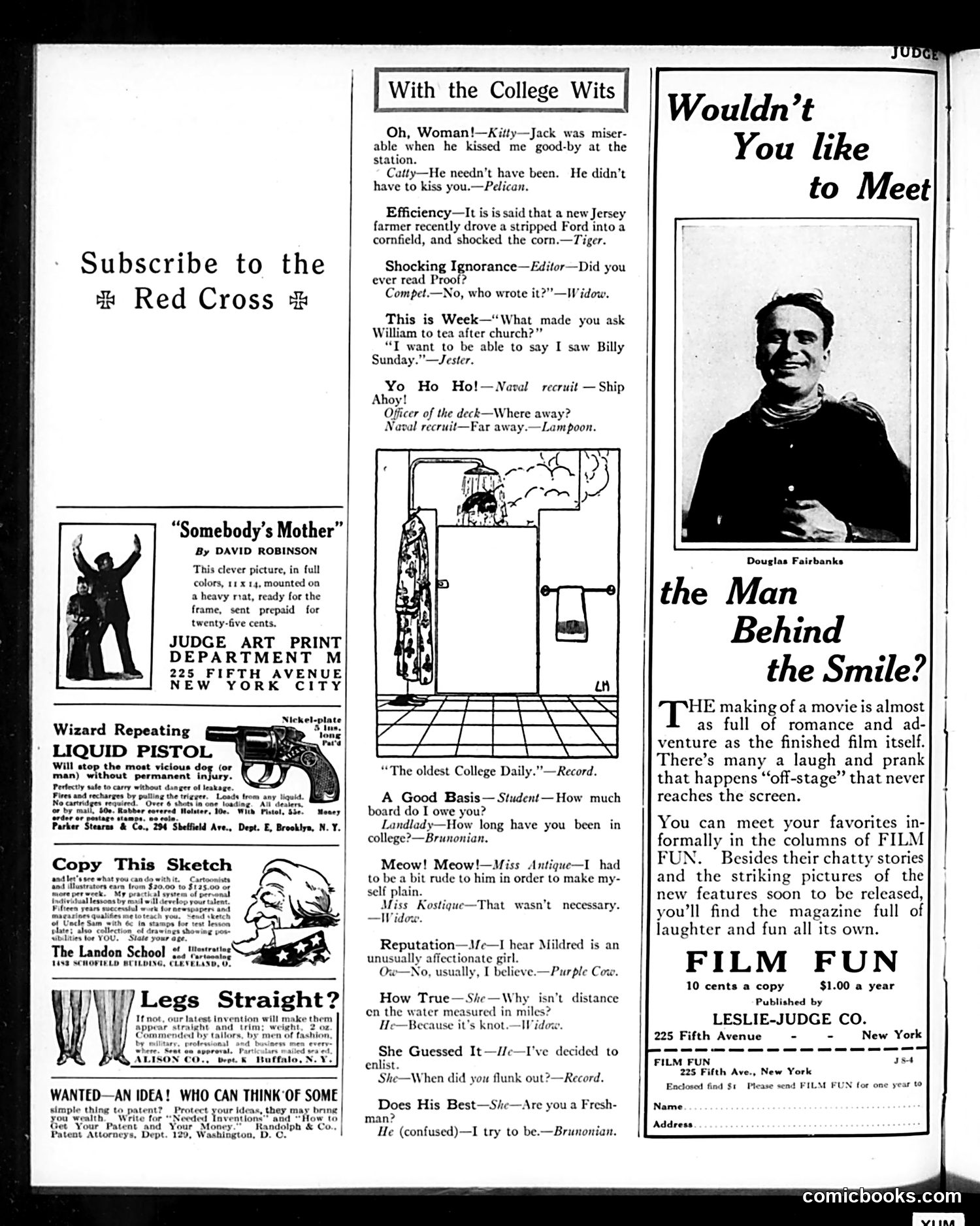
This page is primarily **advertising and humor content** rather than political satire. The main elements are: **"With the College Wits"** section: A collection of college humor jokes playing on misunderstandings and romantic situations—typical early 20th-century campus comedy (references to "Billy Sunday," naval recruits, freshmen). **Douglas Fairbanks advertisement**: Promoting a "Film Fun" magazine feature about the famous silent film star, positioning him as a glamorous celebrity whose off-screen personality readers want to know about. **Miscellaneous ads**: Including a "Red Cross" subscription appeal (likely WWI-era), a "Wizard Repeating Liquid Pistol" (a novelty self-defense device), and various other commercial notices. **Context for modern readers**: This reflects early 1900s Judge audience interests—silent film celebrity culture, college humor, and commercial products marketed through humor magazines. The tone is lighthearted and apolitical by today's standards.
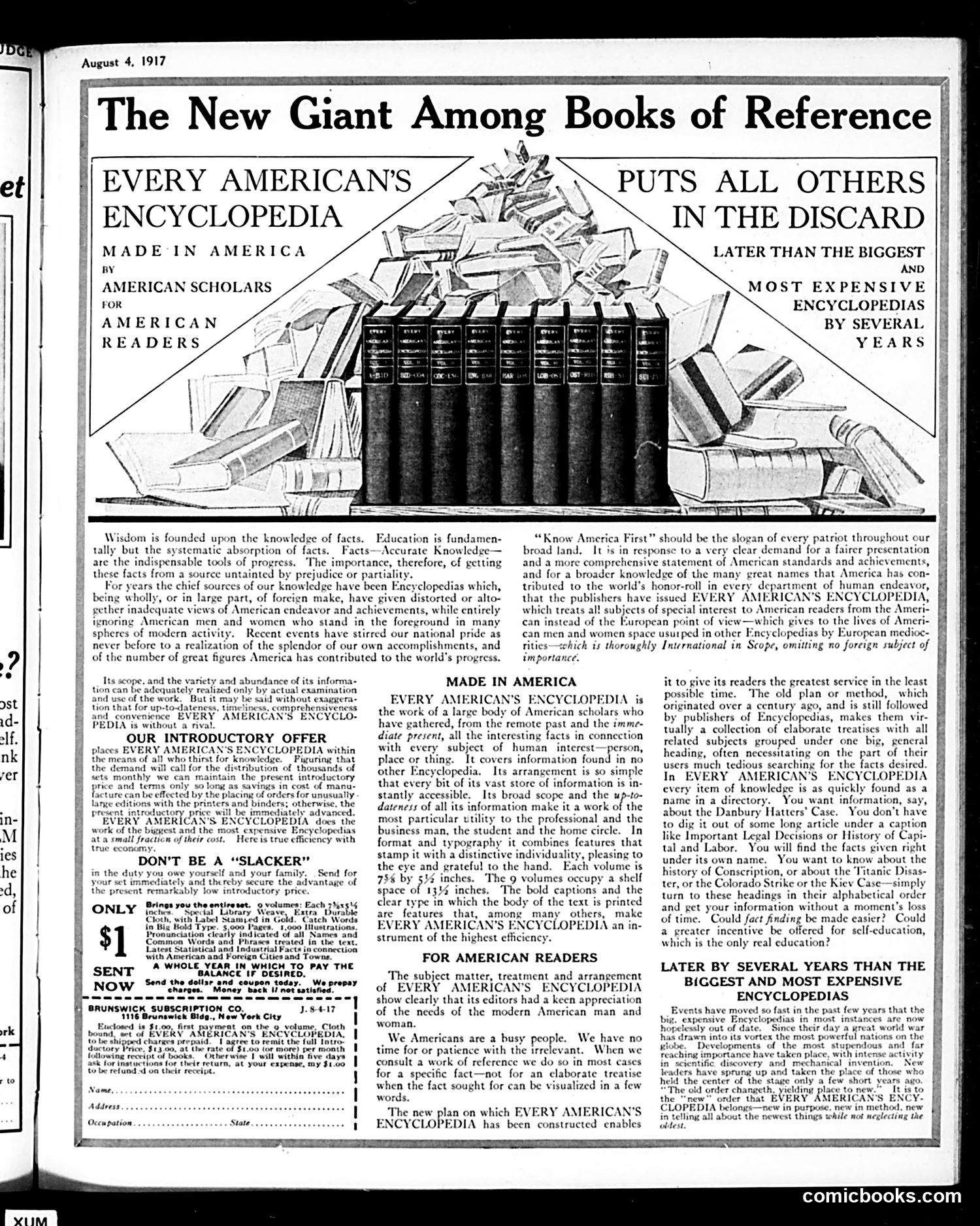
This is **not a cartoon but a full-page advertisement** from Judge magazine (August 4, 1917), promoting "Every American's Encyclopedia." The ad employs **patriotic nationalism** as its marketing strategy, reflecting the U.S. entry into World War I (April 1917). Key appeals include: - **"Know America First"** slogan positioning the encyclopedia as patriotic duty - Claims that previous encyclopedias gave "distorted or altogether inadequate views" of American achievements because they were "foreign make" - Positions the product as superior to "European mediocrites" - Uses wartime language: calls non-purchasers "slackers" (a term for draft dodgers) The visual shows a tower of encyclopedia volumes surrounded by discarded books, suggesting American superiority. The underlying message: **buying this American-made encyclopedia is a patriotic act** during wartime. It conflates consumer behavior with national loyalty—a common advertising tactic during WWI, when "Made in America" marketing became intertwined with supporting the war effort against Germany.
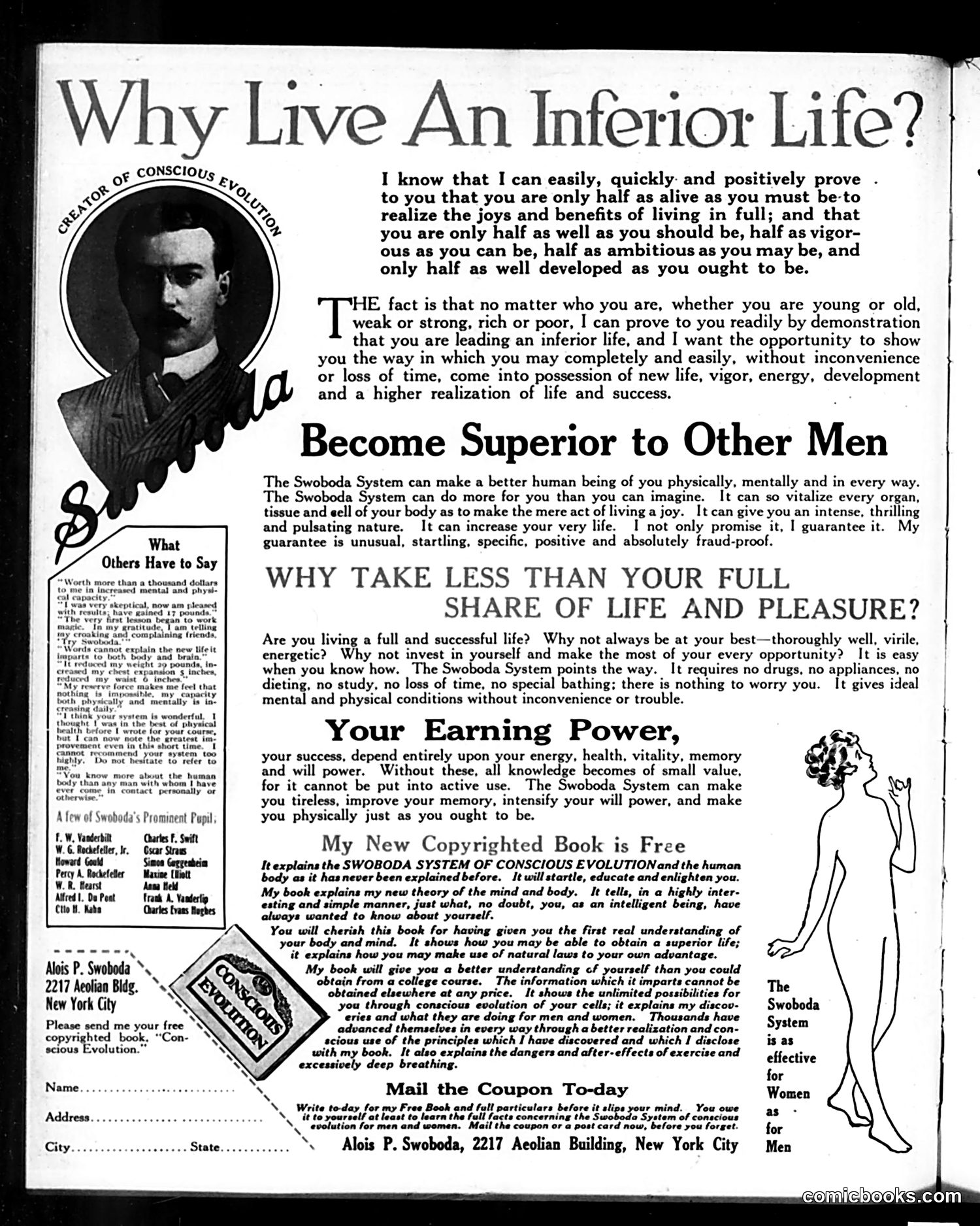
This is a full-page advertisement (not satire) for the "Swoboda System," a self-improvement program by Alois P. Swoboda of New York City, circa early 1900s. **The pitch:** Swoboda claims his system can make readers "superior to other men" and transform them from living "inferior" lives. He promises increased vitality, energy, physical development, and earning power through his copyrighted book on "Conscious Evolution"—requiring no drugs, appliances, dieting, or exercise. **The appeal:** The ad targets ambitious men wanting self-improvement and success. It lists prominent wealthy names (Vanderbilt, Rockefeller, Hearst) as supposed pupils, lending credibility. **Modern perspective:** This is pseudoscientific self-help marketing—common in early-20th-century magazines. The vague promises, celebrity testimonials, and free-book bait are classic dubious marketing tactics. The philosophy echoes eugenics-era thinking about human "evolution" and superiority.