
Judge, 1917-08-04 · page 24 of 28
Judge — August 4, 1917 — page 24: what you’re looking at
What you’re looking at
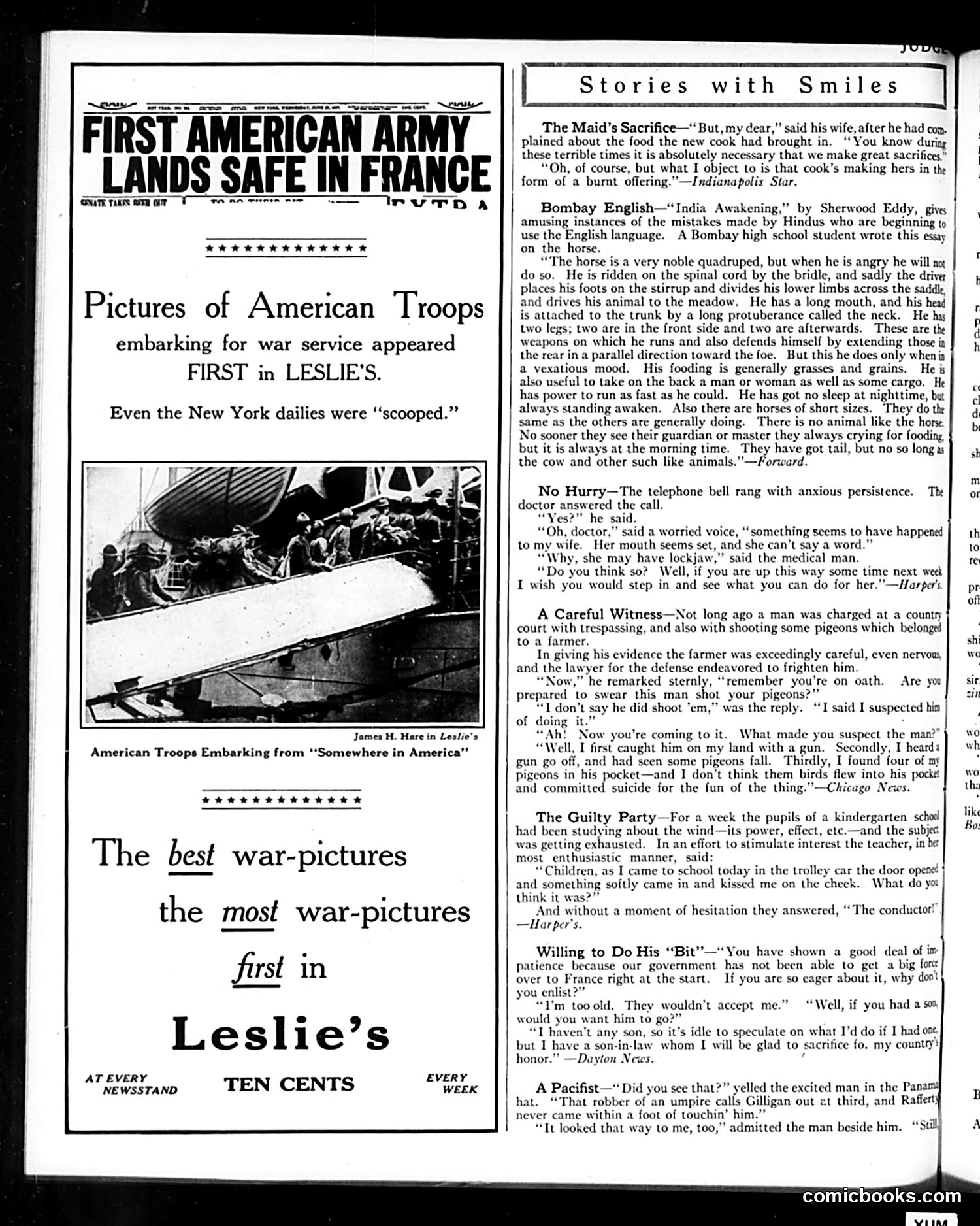
This page from **Judge** magazine (a satirical publication) celebrates American military involvement in World War I. **Main Content:** The left side advertises Leslie's magazine, promoting their exclusive photographs of American troops embarking for France—claiming they "scooped" even major New York newspapers. This was a competitive boast about journalistic access during wartime. **The Right Side:** "Stories with Smiles" contains humorous anecdotes typical of the era's light magazines, including: - A joke about a cook's "burnt offerings" - Satire of English as spoken by Hindi speakers learning the language (the horse essay is intentionally absurd malapropisms) - Domestic humor about wives and doctors - A courtroom witness story **Context for Modern Readers:** This represents American popular culture supporting the war effort through both patriotic celebration of military mobilization and escapist humor. The magazine simultaneously promoted commercial war photography while offering comedic relief—a common approach to maintaining public morale during WWI.
📄 Transcribed text from this page (OCR, searchable)
Machine-transcribed from the original scan — historical spelling and the odd misread are preserved.
we ee ee eee ee FIRST AMERICAN ARMY LANDS SAFE IN FRANCE | (GNITE TAKA TR ONT KKK KKK FIRST in LESLIE'S. Even the New York dailies were ‘‘scooped.” IPrwrpa Pictures of American Troops embarking for war service appeared James H. Hare in Les! Kk RK KK The best war-pictures Leslie’s TEN CENTS AT EVERY NEWSSTAND American Troops Embarking from ‘‘Somewhere in America’’ the most war-pictures EVERY with Smiles Stories The Maid’s Sacrifice—‘‘ But, my dear,” said his wife, after he had com. plained about the food the new cook had brought in. ‘You know during these terrible times it is absolutely necessary that we make great sacrifices.” “Oh, of course, but what I object to is that cook’s making hers in the form of a burnt offering.”"—Indianapolis Star. Bombay English—‘‘India Awakening,” by Sherwood Eddy, gives amusing instances of the mistakes made by Hindus who are beginning to use the English language. A Bombay high school student wrote this essay on the hors “The horse is a very noble quadruped, but when he is angry he will not do so. He is ridden on the spinal cord by the bridle, and sadly the driver } places his foots on the stirrup and divides his lower limbs across the saddle, and drives his animal to the meadow. He has a long mouth, and his head tached to the trunk by a long protuberance called the neck. He has two legs; two are in the front side and two are afterwards. These are the weapons on w ich he runs and also defends himself by extending those iz the rear in a parallel direction toward the foe. But this he does only when ia a vexatious mood. His fooding is generally grasses and grains. He is also useful to take on the back a man or woman as well as some cargo. He has power to run as fast as he could. He has got no sleep at nighttime, but always standing awaken. Also there are horses of short sizes. They do the same as the others are generally doing. There is no animal like the hors. No sooner they see their guardian or master they always crying for fooding but it is always at the morning time. They have got tail, but no so long as the cow and other such like animals.”—Forward. ‘The No Hurry—The telephone bell rang with anxious persistence. doctor vered the call. “Yes?” he said. “Oh, doctor,” said a worried voice, “something scems to have happened to my wife. Her mouth seems set, and she can’t say a word.” “Why, she may have lockjaw,” said the medical man. “Do you think so? Well, if you are up this way some time next weet I wish you would step in and see what you can do for her.”"—Harper's A Careful Witness—Not long ago a man was charged at a country court with trespassing, and also with shooting some pigeons which belonged to a farmer. In giving his evidence the farmer was exceedingly careful, even nervous, and the lawyer for the defense endeavored to frighten him. “Now,” he remarked sternly, “remember you're on oath. prepared to swear this man shot your pigeons?” “I don’t say he did shoot ’em,” was the reply. “I said I suspected hia Are yoa Now you're coming to it. What made you suspect the man?” “Well, I first caught him on my land with a gun. Secondly, I heard: gun go off, and had seen some pigeons fall. Thirdly, I found four of my pigeons in his pocket—and I don’t think them birds flew into his pocke and committed suicide for the fun of the thing.”—Chicago News. The Guilty Party—For a week the pupils of a kindergarten schol had been studying about the wind—its power, effect, etc.—and the subject was getting exhausted. In an effort to stimulate interest the teacher, in be most enthusiastic manner, said: “Children, as I came to school t and something softly came in and think it was?” And without a moment of hesitation they answered, —Harper's. day in the trolley car the door opene! ; ed me on the check. What do yor “The conduct Willing to Do His ‘‘Bit””—You have shown a good deal of im patience because our government has not been able to get a big force over to France right at the start. If you are so eager about it, why dost you enlist?” “I'm tooold. They wouldn't accept me.” would you want him to go “T haven't any son, so it’s idle to speculate on what I'd do if I had ost but I have a son-in-law whom I will be glad to sacrifice fo. my country honor.”” —Dayton News. “Well, if you had a s, A Pacifist—‘ Did you see that?” yelled the excited man in the Panam hat. “That robber of an umpire calls Gilligan out et third, and Rafferty never came within a foot of touchin’ him.” It looked that way to me, too,” admitted the man beside him. “S off we sir cin wo wh wo ths like Bo. comicbooks.com