
Judge, 1917-08-04 · page 13 of 28
Judge — August 4, 1917 — page 13: what you’re looking at
What you’re looking at
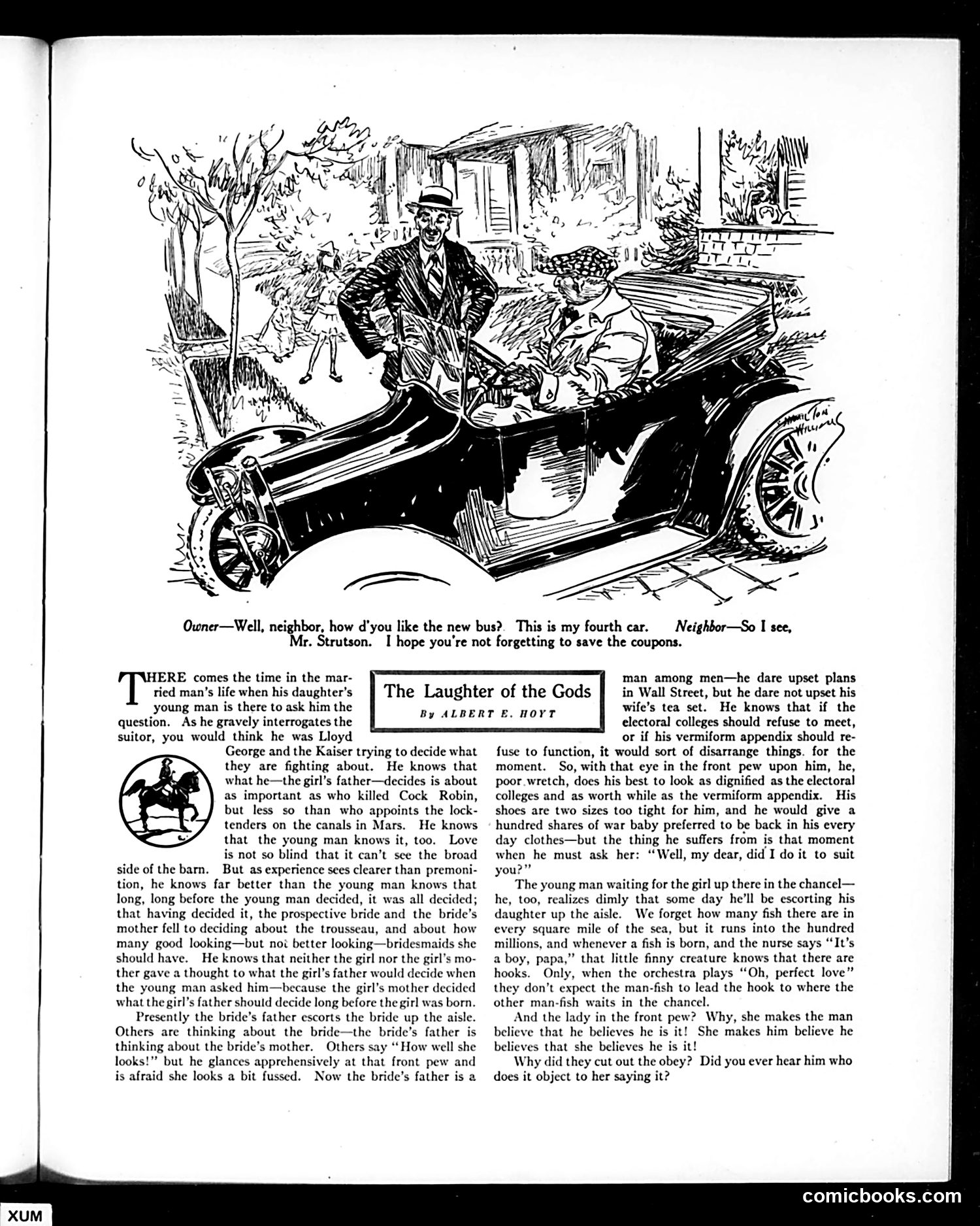
**Top cartoon:** A wealthy man (Mr. Strutson) shows off his new automobile—his fourth car—to a neighbor, who sarcastically notes he hopes Strutson remembers to save coupons (likely rationing-related, suggesting wartime scarcity). The satire mocks conspicuous consumption and the absurdity of accumulating luxury cars while ordinary citizens practice thrift. **Main article:** Albert E. Hoyt's satirical story about a father giving away his daughter at her wedding. The piece humorously exposes the illusion of male authority: fathers pretend to "decide" on marriages, but mothers and daughters have predetermined everything—the trousseau, bridesmaids, even the proposal itself. The father merely performs dignity while suffering discomfort (tight shoes), aware his real power extends only to upsetting his wife's tea set. The satire reveals traditional gender dynamics where women actually control domestic decisions despite men's ceremonial authority.
📄 Transcribed text from this page (OCR, searchable)
Machine-transcribed from the original scan — historical spelling and the odd misread are preserved.
2 “WI ii Owner—Well, neighbor, how d’you like the new bus?. This is my fourth car. I hope you're not forgetting to save the coupons. Mr. Strutson. ERE comes the time in the mar- | ried man’s life when his daughter's young man is there to ask him the question. As he gravely interrogates the suitor, you would think he was Lloyd George and the Kaiser trying to decide what they are fighting about. He knows that what he—the girl's father—decides is about as important as who killed Cock Robin, but less so than who appoints the lock- tenders on the canals in Mars. He knows that the young man knows it, too. Love is not so blind that it can’t see the broad side of the barn. But as experience sees clearer than premoni- tion, he knows far better than the young man knows that long, long before the young man decided, it was all decided; that having decided it, the prospective bride and the bride’s mother fell to deciding about the trousseau, and about how many good looking—but noi better looking—bridesmaids she should have. He knows that neither the girl nor the girl’s mo- ther gave a thought to what the girl’s father would decide when the young man asked him—because the girl’s mother decided what the girl’s father should decide long before the girl was born. Presently the bride’s father escorts the bride up the aisle. Others are thinking about the bride—the bride’s father is thinking about the bride’s mother. Others say ‘‘ How well she looks!” but he glances apprehensively at that front pew and is afraid she looks a bit fussed. Now the bride’s father is a The Laughter of the Gods By ALBERT £. HOYT Neighbor—So I see, man among men—he dare upset plans in Wall Street, but he dare not upset his wife’s tea set. He knows that if the electoral colleges should refuse to meet, or if his vermiform appendix should re- fuse to function, it would sort of disarrange things. for the moment. So, with that eye in the front pew upon him, he, poor.wretch, does his best to look as dignified as the electoral colleges and as worth while as the vermiform appendix. His shoes are two sizes too tight for him, and he would give a hundred shares of war baby preferred to be back in his every day clothes—but the thing he suffers from is that moment when he must ask her: “Well, my dear, did I do it to suit you?” The young man waiting for the girl up there in the chancel— he, too, realizes dimly that some day he'll be escorting his daughter up the aisle. We forget how many fish there are in every square mile of the sea, but it runs into the hundred millions, and whenever a fish is born, and the nurse says ‘It’s a boy, papa,” that little finny creature knows that there are hooks. Only, when the orchestra plays ‘‘Oh, perfect love” they don’t expect the man-fish to lead the hook to where the other man-fish waits in the chancel. And the lady in the front pew? Why, she makes the man believe that he believes he is it! She makes him believe he believes that she believes he is it! Why did they cut out the obey? Did you ever hear him who does it object to her saying it? comicbooks.com