
Judge, 1917-08-04 · page 20 of 28
Judge — August 4, 1917 — page 20: what you’re looking at
What you’re looking at
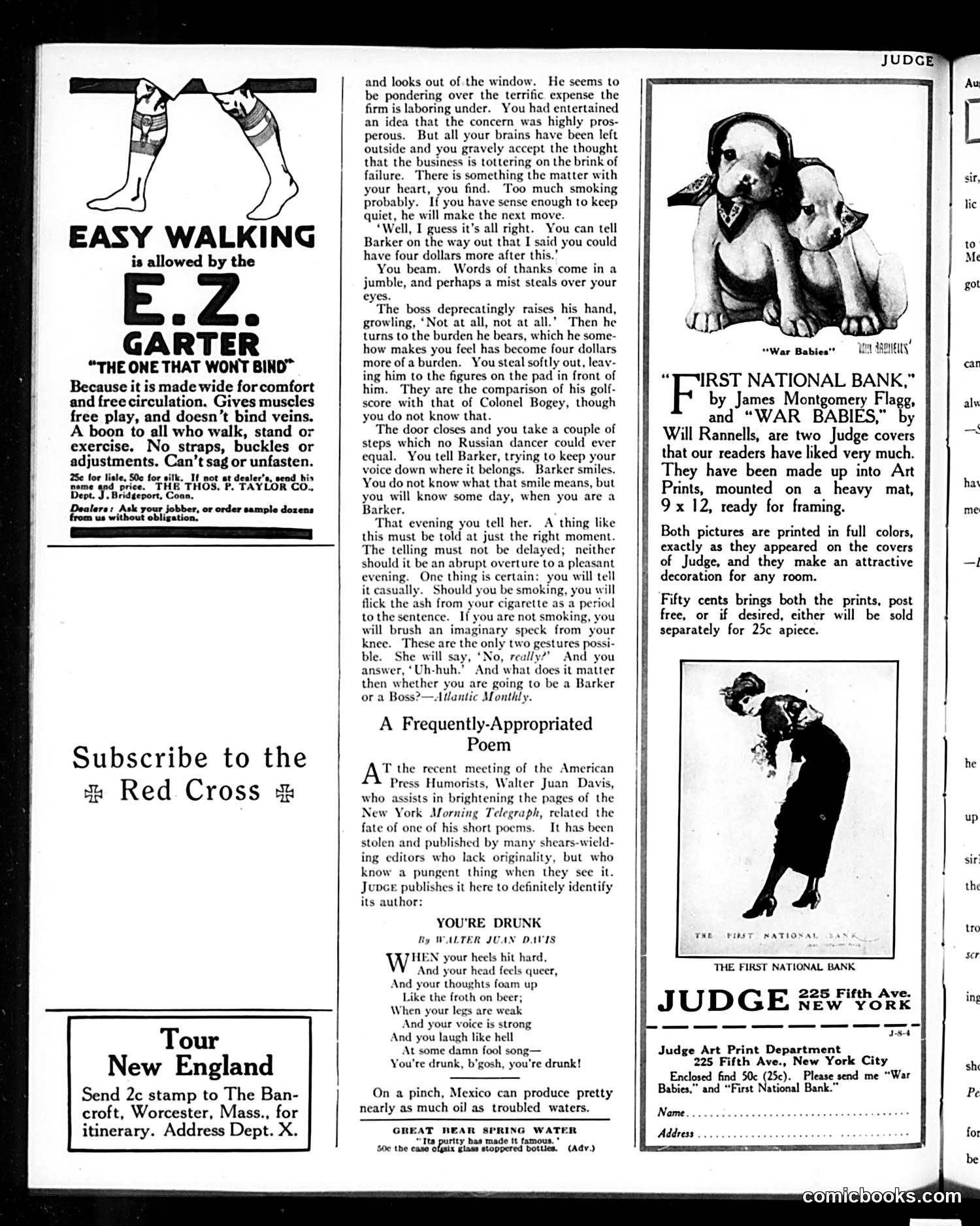
This page is primarily **advertising and filler content** rather than political satire. Key elements: **Advertisements:** - E.Z. Garter (elastic garter product) - Red Cross subscription appeal - New England tour - Judge Art Print Department offerings **Literary Content:** A serialized story about an employee receiving a modest raise ($4) from his boss, illustrating workplace anxiety and social climbing aspirations of the era. The narrative captures early 20th-century office culture—the employee's nervousness, the boss's emotional manipulation through feigned burden-sharing, and the protagonist's eagerness to share news with "her" (his wife). **Poem Section:** "You're Drunk" by Walter Juan Davis, presented as a frequently plagiarized poem. It humorously catalogs drunkenness symptoms in colloquial language—a common subject for satirical magazines of this period. **Overall:** This page reflects Judge's mix of advertising revenue and light satirical/humorous content rather than focused political commentary.
📄 Transcribed text from this page (OCR, searchable)
Machine-transcribed from the original scan — historical spelling and the odd misread are preserved.
EASY WALKING is allowed by the EZ. GARTER “THE ONE THAT WONT BIND™ Because it is made wide for comfort and free circulation. Gives muscles free play, and doesn’t bind veins. A boon to all who walk, stand or exercise. No straps, buckles or adjustments. Can’t sag or unfasten. ‘Se for lisle, SOc for silk. If not at dealer's, send hi name price. THE THOS, P. TAYLOR co. Dept. J. Bridgeport, Conn. Dealers: Ask bber, or order ere: ak your jobber, or order sample dozens Subscribe to the s Red Cross & Tour New England Send 2c stamp to The Ban- croft, Worcester, Mass., for itinerary. Address Dept. X. and looks out of the window. He seems to be pondering over the terrific expense the firm is laboring under. You had entertained an idea that the concern was highly pros- perous. But all your brains have been left outside and you gravely accept the thought that the business is tottering on the brink of failure. There is something the matter with your heart, you find. Too much smoking probably. If you have sense enough to keep quiet, he will make the next move. ‘Well, I guess it’s all right. You can tell Barker on the way out that I said you could have four dollars more after this.’ You beam. Words of thanks come in a jumble, and perhaps a mist steals over your eyes. The boss deprecatingly raises his hand, growling, ‘Not at all, not at all.’ Then he turns to the burden he bears, which he some- how makes you feel has become four dollars more ofa burden. You steal softly out, leav- ing him to the figures on the pad in front of him. They are the comparison of his golf- score with that of Colonel Bogey, though you do not know that. The door closes and you take a couple of steps which no Russian dancer could ever equal. You tell Barker, trying to keep your voice down where it belongs. Barker smiles. You do not know what that smile means, but vill know some day, when you are a That evening you tell her. A thing like this must be told at just the right moment. The telling must not be delayed; neither should it be an abrupt overture to a pleasant in: you will tell it casually. Should you be smoking, you will flick the ash from your cigarette as a period to the sentence. If you are not smoking, will brush an imaginary speck from your knee. These are the only two gestures possi- ble. She will say, ‘No, really?” And you answer, ‘Uh-huh.’ And what does it matter then whether you are going to be a Barker or a Boss?—Allantic Monthly. A Frequently-Appropriated Poem T the recent meeting of the American Press Humorists, Walter Juan Davis, who s in brightening the pages of the New York Morning Telegraph, related the fate of one of his short poems. It has stolen and published by many shears-wield- ing editors who lack origi ality, but who know a pungent thing when they see it. Jvpce publishes it here to definitely identify its author: YOU'RE DRUNK Ry WALTER JUAN DAVIS WHEN your heels hit hard. And your head feels queer, And your thoughts foam up Like the froth on beer; When your legs are weak And your voice is strong And you laugh like hell At some damn fool song— You're drunk, b’gosh, you're drunk! On a pinch, Mexico can produce pretty nearly as much oil as troubled waters. GRE. aT BEAR SERINO WaTeE rity has made tt famot oe the cane ofp glass stoppered bowties. (Adv) IRST NATIONAL BANK,” by James Montgomery Flagg, and “WAR BABIES,” by Will Rannells, are two Judge covers that our readers have liked very much. They have been made up into Art Prints, mounted on a heavy mat, 9x 12, ready for framing. Both pictures are printed in full colors, exactly as they appeared on the covers of Judge, and they make an attractive decoration for any room. Fifty cents brings both the prints, post free, or if desired, either will be sold separately for 25c apiece. FIRST NATIONAL THE FIRST NATIONAL BANK 225 Fifth Ave. NEW YORK Judge Art Print Department 225 Fifth Ave., New York City Enclosed find 50c (25). Please send me “War Babies,” and “First National Bank. Address