
Judge, 1917-08-04 · page 16 of 28
Judge — August 4, 1917 — page 16: what you’re looking at
What you’re looking at
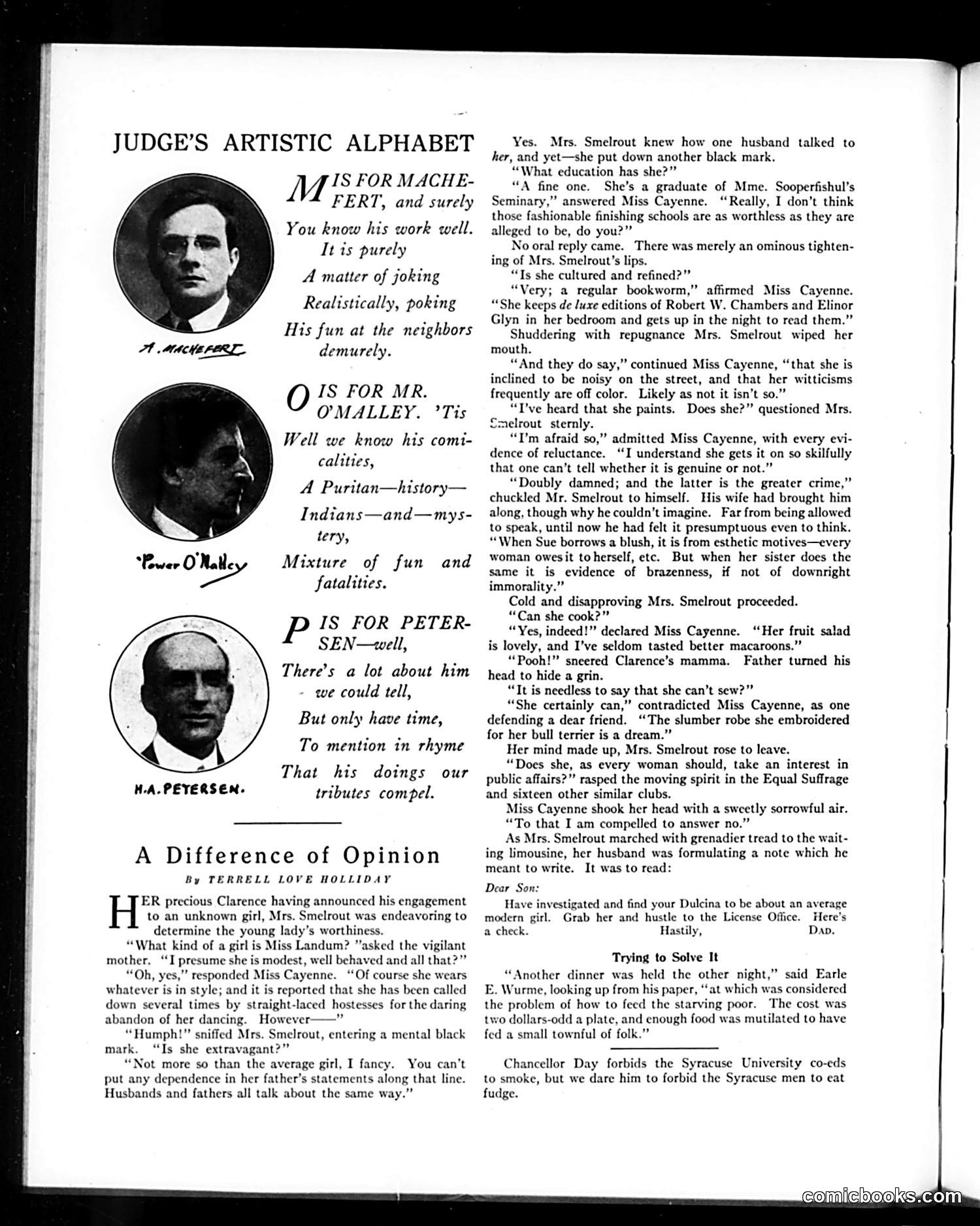
This page contains two distinct sections: **Left Side: "Judge's Artistic Alphabet"** features caricatured portraits and brief descriptions of three artists—Machefert, O'Malley, and Petersen—praising their work in satirical verse. The cartoons mock their artistic styles and subject matter (O'Malley's work involves "Puritans," "Indians," and "mystery"). **Right Side: "A Difference of Opinion"** is a satirical story about Mrs. Smelrout, a judgmental prospective mother-in-law interrogating Miss Cayenne about her son Clarence's fiancée. The humor lies in Mrs. Smelrout's **hypocritical double standards**: she dismisses the fiancée's dancing, spending, makeup use, and literary taste (Elinor Glyn was risqué), yet when defending her own sister's identical behaviors, claims they reflect "esthetic motives." The story satirizes snobbish maternal gatekeeping and selective moral judgment—whatever the fiancée does is condemned; whatever respectable women do is excused.
📄 Transcribed text from this page (OCR, searchable)
Machine-transcribed from the original scan — historical spelling and the odd misread are preserved.
JUDGE’S ARTISTIC ALPHABET IS FOR MACHE- FERT, and surely You know his work well. It is purely A matter of joking Realistically, poking His fun at the neighbors demurely. IS FOR MR. OMALLEY. ’Tis Well we know his comi- calities, A Puritan—history— Indians—and—mys- tery, Mixture of fun and fatalities. IS FOR PETER- SEN—well, There’s a lot about him we could tell, But only have time, To mention in rhyme That his doings our tributes compel. HA. PETERSEN. A Difference of Opinion By TERRELL LOVE HOLLIDAY ER precious Clarence having announced his engagement H to an unknown girl, Mrs. Smelrout was endeavoring to determine the young lady’s worthiness. “What kind of a girl is Miss Landum? "asked the vigilant mother, “I presume she is modest, well behaved and all that?” “Oh, yes,” responded Miss C: ne. “Of course she wears whatever is in style; and it is reported that she has been called down several times by straight-laced hostesses for the daring abandon of her dancing. However——” “Humph!” sniffed Mrs. Smelrout, entering a mental black k. “Is she extravagant?” ‘Not more so than the average girl, I fancy. You can't put any dependence in her father’s statements along that line. Husbands and fathers all talk about the same way.” ma Yes. Mrs. Smelrout knew how one husband talked to her, and yet—she put down another black mark. “What education has she?” “A fine one. She’s a graduate of Mme. Sooperfishul’s Seminary,” answered Miss Cayenne. “Really, I don’t think those fashionable finishing schools are as worthless as they are alleged to be, do you?” No oral reply came. There was merely an ominous tighten- ing of Mrs. Smelrout’s lips. “Ts she cultured and refined?” “Very; a regular bookworm,” affirmed Miss Cayenne. “She keeps de luxe editions of Robert W. Chambers and Elinor Glyn in her bedroom and gets up in the night to read them.” Shuddering with repugnance Mrs. Smelrout wiped her mouth. “And they do say,” continued Miss Cayenne, “that she is inclined to be noisy on the street, and that her witticisms frequently are off color. Likely as not it isn’t so.” “I’ve heard that she paints. Does she?” questioned Mrs. elrout sternly. “T'm afraid so,” admitted Miss Cayenne, with every evi- dence of reluctance. ‘I understand she gets it on so skilfully that one can’t tell whether it is genuine or not.” “Doubly damned; and the latter is the greater crime,” chuckled Mr. Smelrout to himself. His wife had brought him along, though why he couldn’t imagine. Far from being allowed to speak, until now he had felt it presumptuous even to think. “When Sue borrows a blush, it is from esthetic motives—every woman owesit toherself, etc. But when her sister does the same it is evidence of brazenness, if not of downright immorality.” Cold and disapproving Mrs. Smelrout proceeded. “Can she cook?” “Yes, indeed!” declared Miss Cayenne. ‘Her fruit salad is lovely, and I’ve seldom tasted better macaroons.” “Pooh!” sneered Clarence’s mamma. Father turned his head to hide a grin. “It is needless to say that she can’t sew?” “She certainly can,” contradicted Miss Cayenne, as one defending a dear friend. “The slumber robe she embroidered for her bull terrier is a dream.” Her mind made up, Mrs. Smelrout rose to leave. “Does she, as every woman should, take an interest in public affairs?” rasped the moving spirit in the Equal Suffrage and sixteen other similar clubs. Miss Cayenne shook her head with a sweetly sorrowful air. “To that I am compelled to answer no.” As Mrs. Smelrout marched with grenadier tread to the wait- ing limousine, her husband was formulating a note which he meant to write. It was to read: é Dear Son: Have investigated and find your Dulcina to be about an average modern girl. Grab her and hustle to the License Office. Here's a check. Hastily, Dav. Trying to Solve It “Another dinner was held the other night,” said Earle E. Wurme, looking up from his paper, “‘at which was considered the problem of how to feed the starving poor. The cost was two dollars-odd a plate, and enough food was mutilated to have fed a small townful of folk.” Chancellor Day forbids the Syracuse University co-eds to smoke, but we dare him to forbid the Syracuse men to eat fudge.