
Judge, 1917-08-04 · page 4 of 28
Judge — August 4, 1917 — page 4: what you’re looking at
What you’re looking at
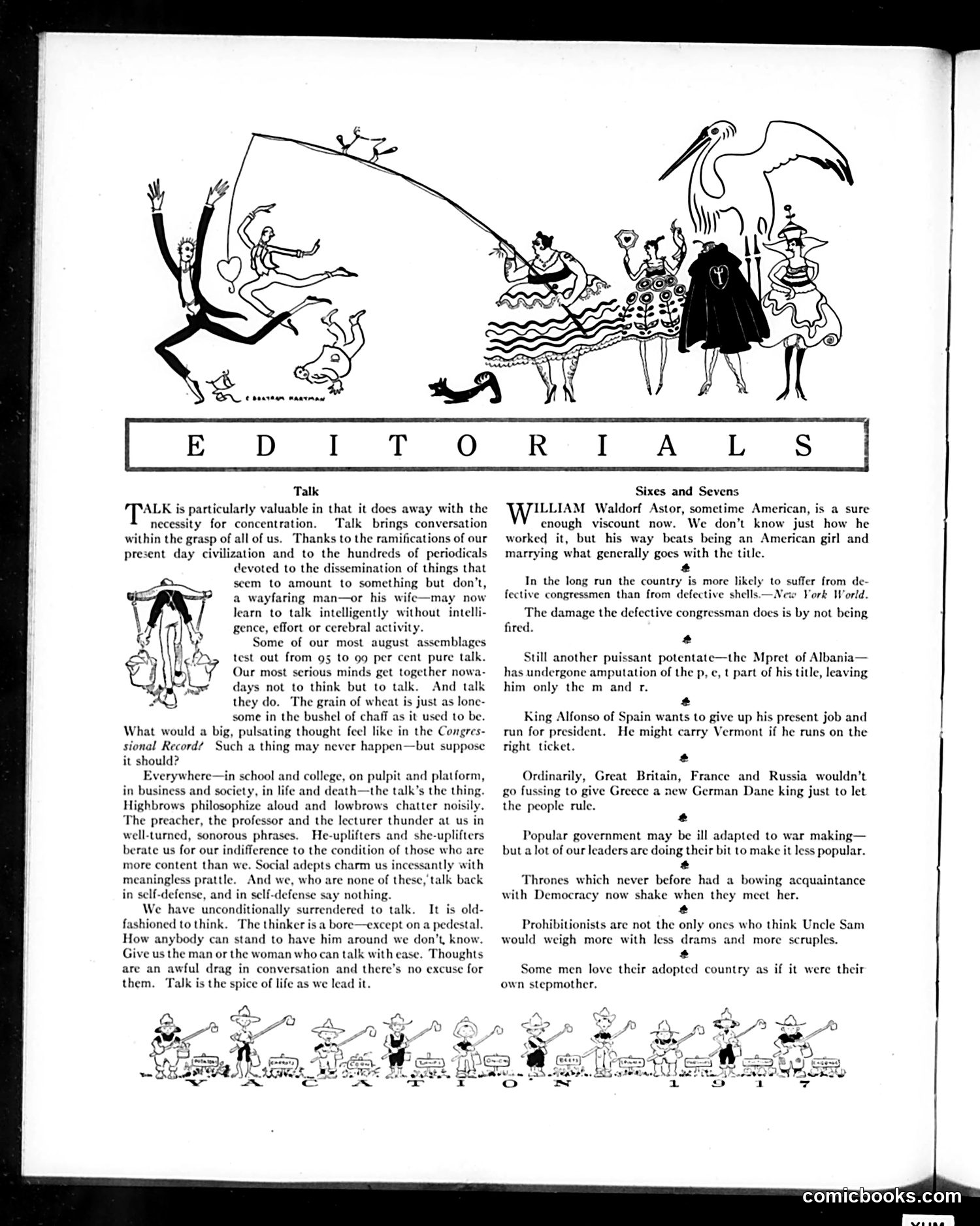
This editorial page contains two sections: a philosophical essay on "Talk" and political commentary titled "Sixes and Sevens." The "Talk" section argues that conversation is undervalued in modern society and advocates for its importance in personal and intellectual development. "Sixes and Sevens" offers brief political observations, including references to William Waldorf Astor (an American businessman with British connections), the King of Spain considering a presidential run, and commentary on European politics regarding Greece and Germany. The piece satirizes how democracies and thrones are adapting to modern politics, and mocks prohibitionists and those with excessive patriotism. The cartoons at top and bottom illustrate these themes with whimsical figures, though specific identities remain unclear without additional historical context.
📄 Transcribed text from this page (OCR, searchable)
Machine-transcribed from the original scan — historical spelling and the odd misread are preserved.
Talk ALK is particularly valuable in t it does away with the necessity for concentration. Talk brings conversation within the grasp of all of us. Thanks to the ramifications of our present day civilization and to the hundreds of periodicals devoted to the dissemination of things that seem to amount to something but don’t, a wayfaring man—or his wife—may now learn to talk intelligently without intelli- gence, effort or cerebral activity. Some of our most august assemblages test out from 95 to 99 per cent pure talk. Our most serious minds get together nowa- days not to think but to talk. And talk they do. The grain of wheat is just as lone- some in the bushel of chaff as it used to be. What would a big, pulsating thought feel like in the Congres- sional Record? Such a thing may never happen—but suppose it should? Everywhere—in school and college, on pulpit and platform, in business and society, in life and death—the talk’s the thing. Highbrows philosophize aloud and lowbrows chatter noisily. The preacher, the professor and the lecturer thunder at us in well-turned, sonorous phrases. He-uplifters and she-uplifters berate us for our indifference to the condition of those who are more content than we. Social adepts charm us incessantly with meaningless prattle. And we, who are none of these, talk back in self-defense, and in self-defense say nothing. We have unconditionally surrendered to talk. It is old- fashioned to think. The thinker isa bore—except on a pedestal. How anybody can stand to have him around we don’t, know. Give us the man or the woman who can talk with ease. Thoughts are an awful drag in conversation and there’s no excuse for them. Talk is the spice of life as we lead it. Sixes and Sevens ILLIAM Waldorf Astor, sometime American, is a sure enough viscount now. We don’t know just how he worked it, but his way beats being an American girl and marrying what generally gocs with the title. £ In the long run the country is more likely to suffer from de- fective congressmen than from defective shells.—New Vork World. The damage the defective congressman does is by not being fired. 2 Still another puissant potentate—the Mpret of Albania has undergone amputation of the p, e, t part of his title, leaving him only the m and r. 2 King Alfonso of Spain wants to give up his present job and run for president. He might carry Vermont if he runs on the right ticket. rd Ordinarily, Great Britain, France and Russia wouldn’t go fussing to give Greece a new German Dane king just to let the people rule. # Popular government may be ill adapted to war making— but a lot of our leaders are doing their bit to make it less popular. £ Thrones which never before had a bowing acquaintance with Democr. now shake when they meet her. 2 Prohibitionists are not the only ones who think Uncle Sam would weigh more with less drams and more scruples. 2 Some men love their adopted country as if it were their own stepmother. comicbooks.com