
Judge, 1917-08-04 · page 5 of 28
Judge — August 4, 1917 — page 5: what you’re looking at
What you’re looking at
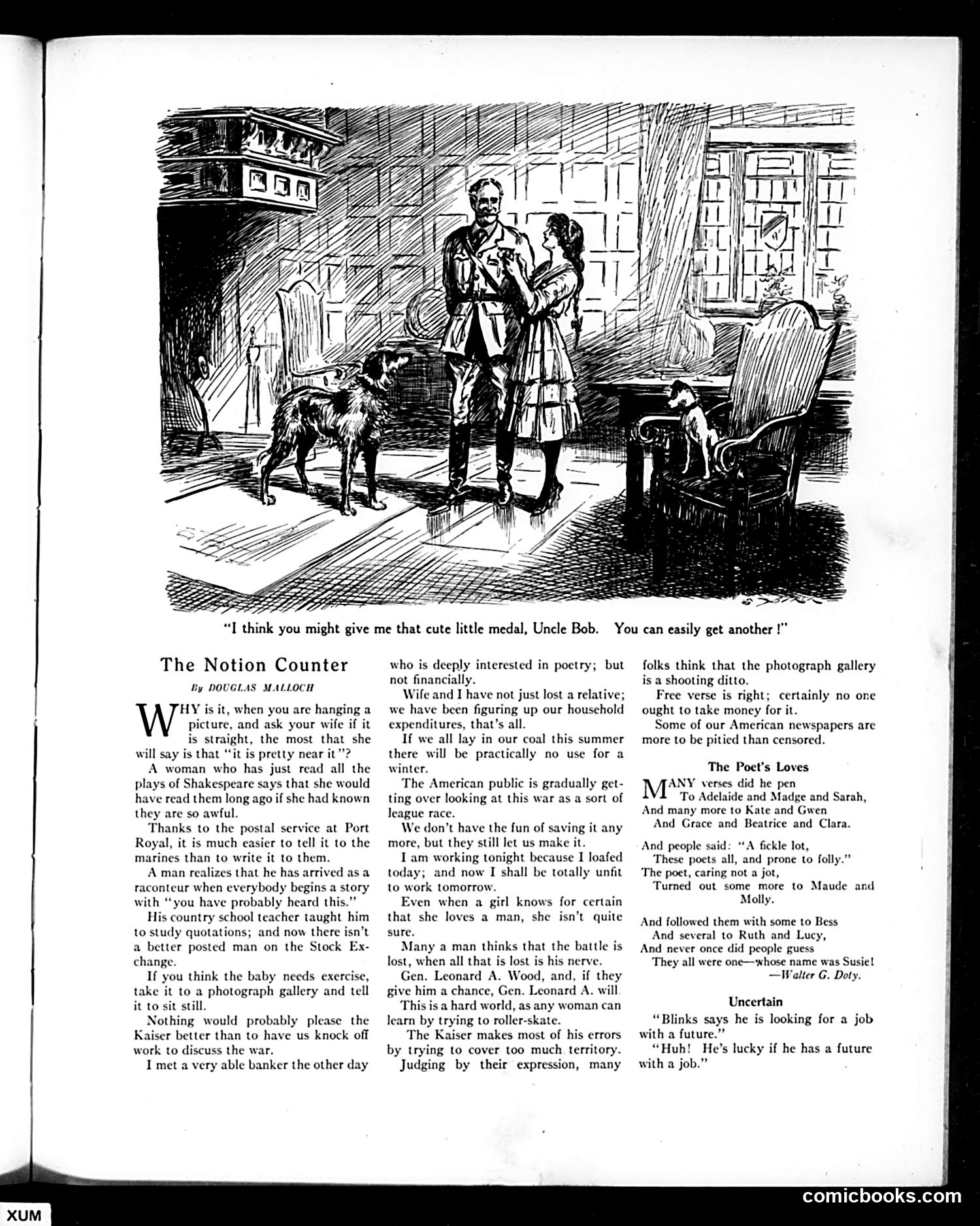
The main cartoon depicts a domestic scene where a uniformed military officer (likely a general, given the formal dress) converses with a woman while two dogs are present. The caption reads: "I think you might give me that cute little medal, Uncle Bob. You can easily get another!" The satire critiques how military medals and honors—supposedly earned through service—have become casual commodities, traded casually among the wealthy or connected. The woman's flippant request suggests medals are mere decorative objects rather than meaningful recognition of valor. Douglas Malloch's accompanying essay, "The Notion Counter," discusses wartime absurdities: the public's detachment from war's reality, newspaper censorship, and how Americans view conflict as entertainment rather than tragedy. The overall message questions whether society properly values or understands military sacrifice.
📄 Transcribed text from this page (OCR, searchable)
Machine-transcribed from the original scan — historical spelling and the odd misread are preserved.
The Notion Counter By DOUGLAS MALLOCH HY is it, when you are hanging a picture, and ask your wife if it is straight, the most that she will say is that “it is pretty near it”? A woman who has just read all the plays of Shakespeare says that she would read them long ago if she had known ey are so awful. Thanks to the postal service at Port Royal, it is much easier to tell it to the marines than to write it to them. A man realizes that he has arrived asa raconteur when everybody begins a story with “you have probably heard this.” His country school teacher taught him to study quotations; and now there isn’t a better posted man on the Stock Ex- change. If you think the baby needs exercise, take it to a photograph gallery and tell it to sit still. Nothing would probably please the Kaiser better than to have us knock off work to discuss the war. I met a very able banker the other day th “I think you might give me that cute little medal, Uncle Bob. You can easily get another !"” who is deeply interested in poetry; but not financially. Wife and I have not just lost a relative; we have been figuring up our houschold expenditures, that’s all. If we all lay in our coal this summer there will be practically no use for a winter. The American public is gradually get- ting over looking at this war as a sort of league race. We don’t have the fun of saving it any more, but they still let us make it. I am working tonight because I loafed today; and now I shall be totally unfit to work tomorrow. Even when a girl knows for certain that she loves a man, she isn’t quite sure. Many a man thinks that the battle is lost, when all that is lost is his nerve. Gen. Leonard A. Wood, and, if they give him a chance, Gen. Leonard A, will This is a hard world, as any woman can learn by trying to roller-skate. The Kaiser makes most of his errors by trying to cover too much territory. Judging by their expression, many folks think that the photograph gallery is a shooting ditto. Free verse is right; certainly no one ought to take money for it. Some of our American newspapers are more to be pitied than censored. The Poet's Loves M*sY verses did he pen To Adelaide and Madge and Sarah, And many more to Kate and Gwen And Grace and Beatrice and Clara. And people said: “A fickle lot, These poets all, and prone to folly.” The poet, caring not a jot, Turned out some more to Maude and Molly. And followed them with some to Bess And several to Ruth and Lucy, And never once did people guess They all were one—whose name was Susie! —Walter G. Doty. Uncertain “Blinks says he is looking for a job with a future.” “Huh! He's lucky if he has a future with a job.” comicbooks.com