
A complete issue · 27 pages · 1917
Judge — July 14, 1917
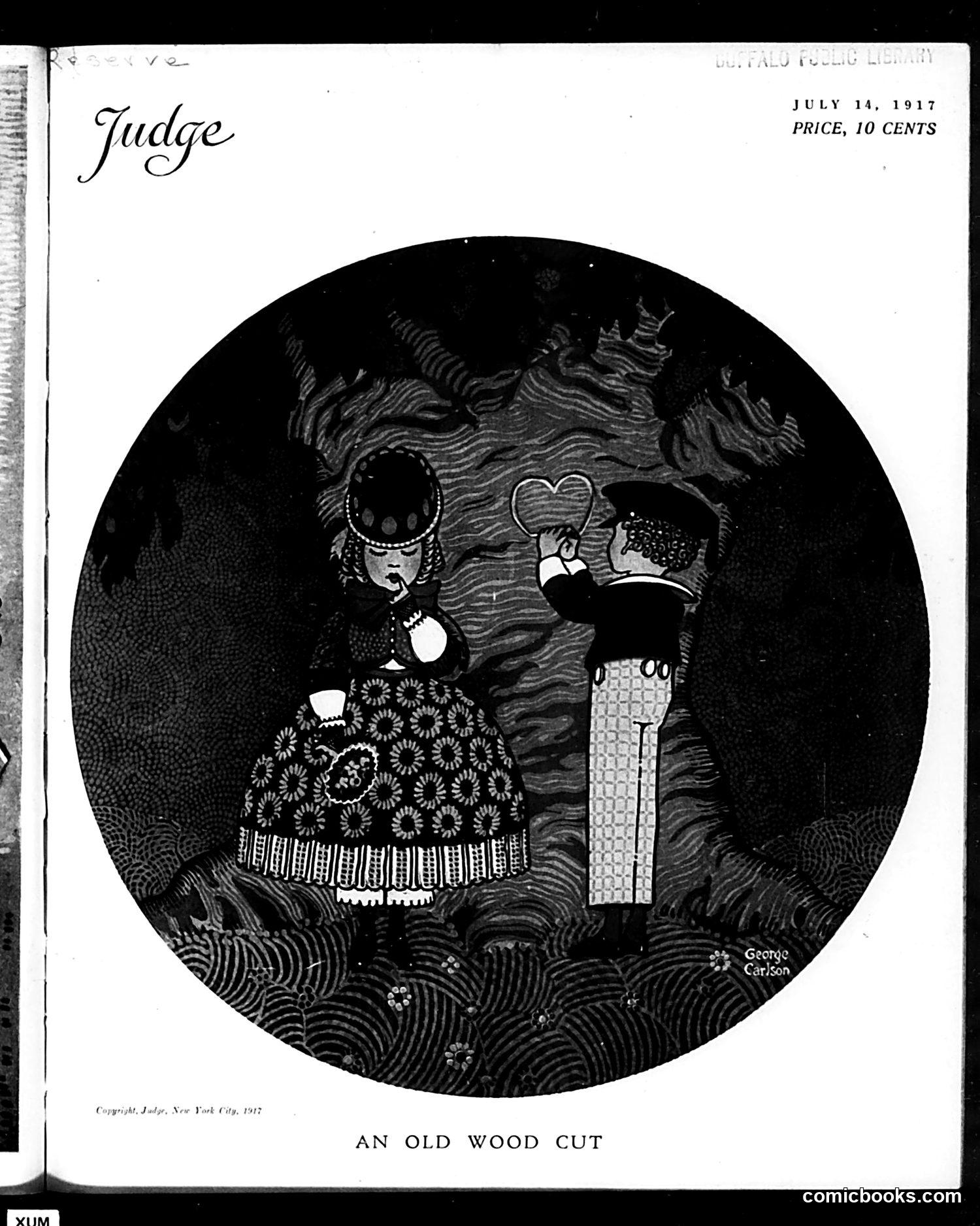
This circular illustration by George Carlson depicts three figures in an old-fashioned style. Two appear to be women in elaborate period dress with decorative patterns, and a man between them holding a heart symbol. The "wood cut" style mimics medieval or Renaissance engravings. The satire likely comments on romantic or marital themes common to Judge's humor. The heart imagery suggests courtship or love, while the deliberately archaic artistic style creates ironic distance—treating contemporary romantic situations as if they were centuries-old moral tales. Published during World War I (1917), the cartoon's specific social commentary remains unclear without additional context, though the nostalgic framing may comment on changing social attitudes toward relationships and gender roles during this period.
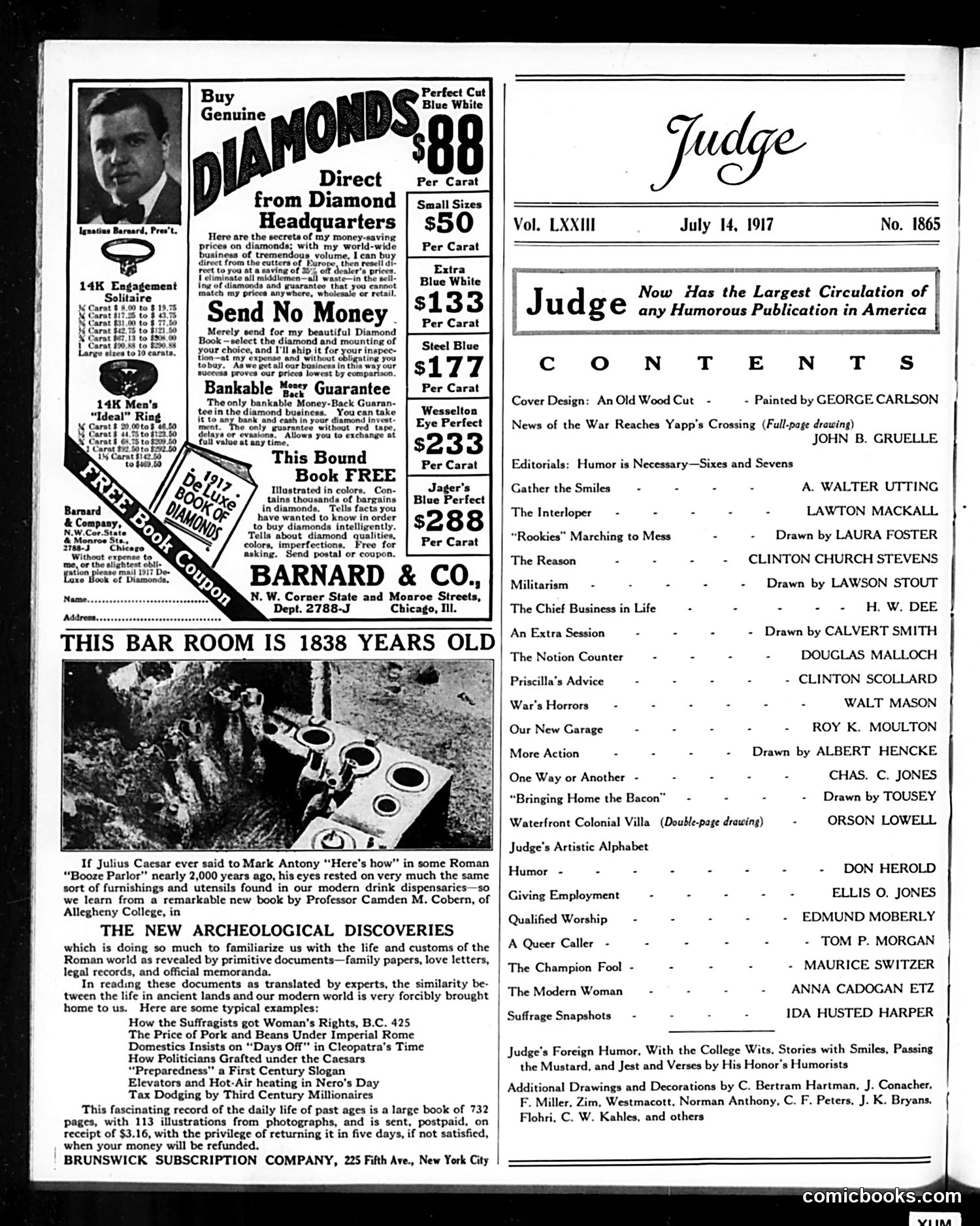
This page is predominantly **advertising** (a diamond engagement ring and jewelry promotion by Barnard & Co.) rather than editorial satire. The main illustrated content is "This Bar Room is 1838 Years Old," comparing ancient Roman drinking culture to modern times through archaeological discoveries. The piece references Professor Camden M. Cobern's book on Roman domestic life, suggesting that despite nearly 2,000 years of history, human behavior—particularly socializing in bars—remains remarkably unchanged. The contents listing indicates typical Judge features: political/social humor ("Militarism," "War's Horrors"), war-related commentary (this is July 1917, during U.S. involvement in WWI), and domestic satire ("The Modern Woman," "Suffrage Snapshots"). The specific cartoons themselves are not visible in this reproduction.
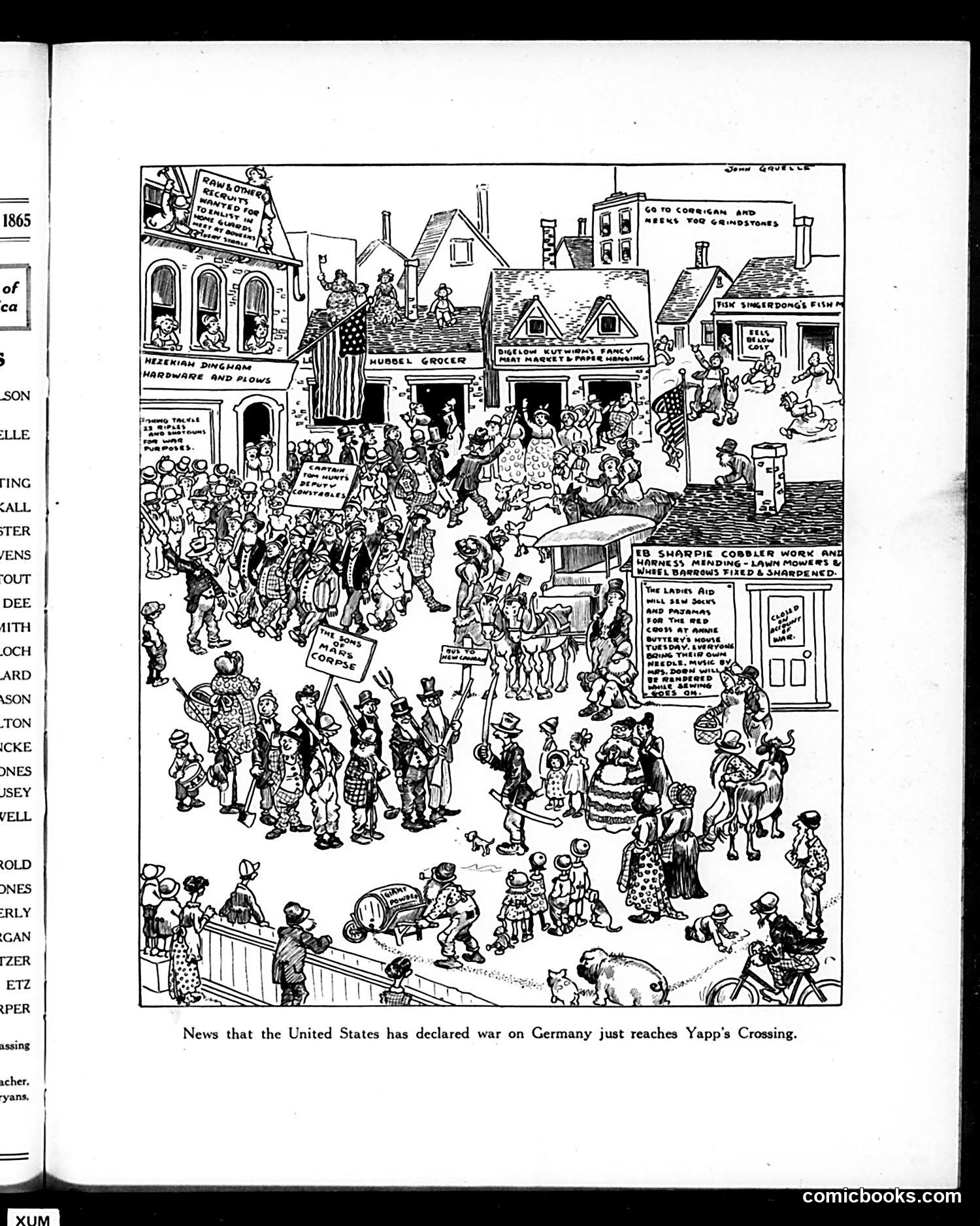
This is a satirical cartoon from *Judge* magazine depicting the reaction at "Yapp's Crossing" (a fictional rural community) to news that the United States has declared war on Germany. The illustration shows a bustling small-town street scene with numerous townspeople—men, women, and children—reacting with apparent excitement and chaos to the war announcement. The cartoon satirizes small-town American patriotism and wartime fervor, showing crowds gathering outside local businesses (including a grocer and hardware store) in animated response. Various figures carry signs and engage in celebratory or agitated behavior. Given the reference to U.S. declaration of war on Germany, this almost certainly references April 1917, when America entered World War I. The satire likely mocks the enthusiastic, sometimes chaotic civilian response to the momentous news in ordinary American towns.
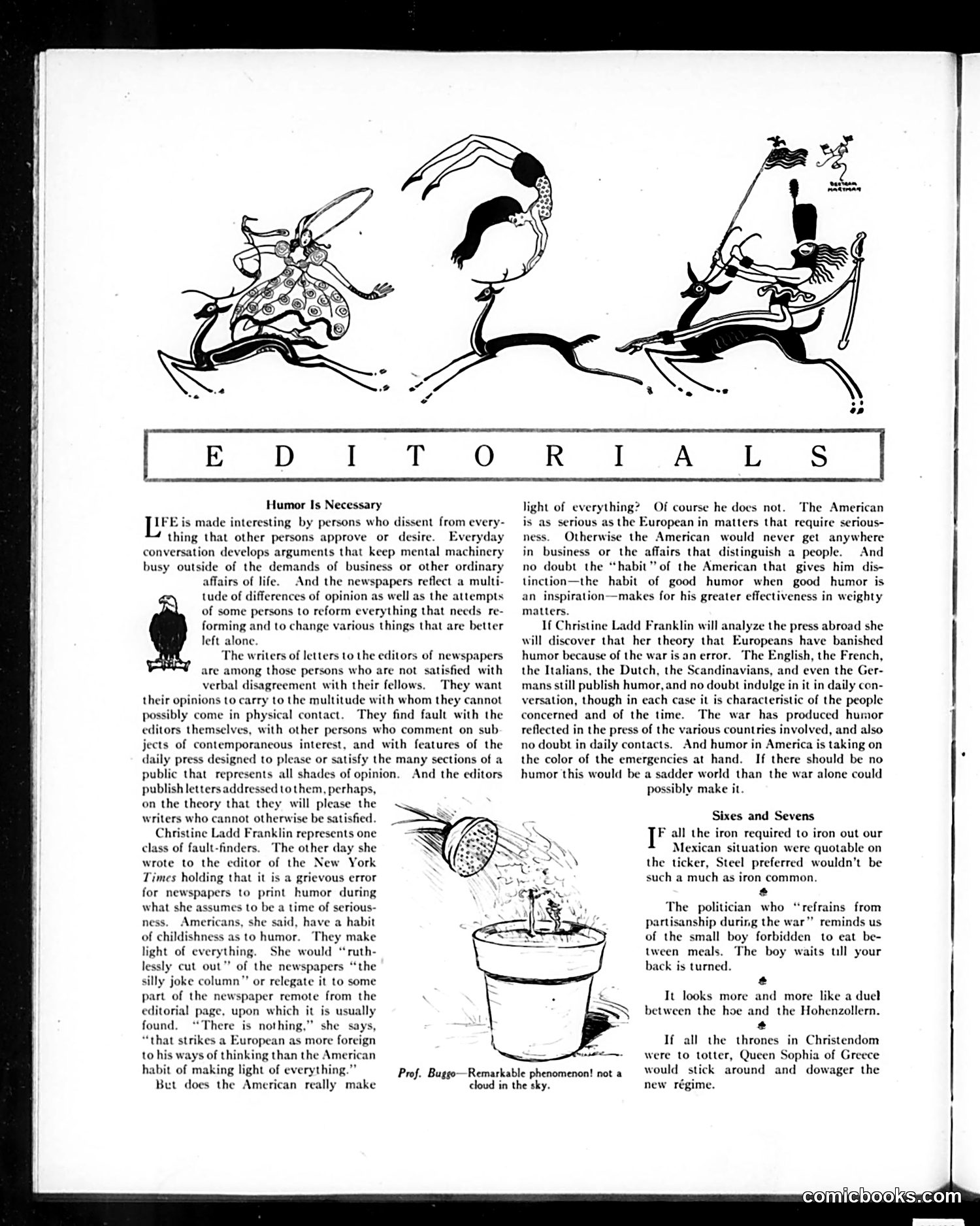
This editorial page from *Judge* magazine contains three main sections: **"Humor Is Necessary"** argues that Americans uniquely value humor and levity in serious times, contrasting this with European seriousness. The piece defends humor's role in public discourse. **"Sixes and Sevens"** offers brief satirical quips about contemporary issues, likely referencing World War I (mentions "Mexican situation," "partisanship during the war," and "thrones in Christendom"). One joke plays on a politician's "refrains from partisanship." The decorative header illustration shows stylized figures in animated poses—likely generic representations of comedic characters rather than specific political figures. The small illustration labeled "Prof. Bugge" depicts someone observing a peculiar cloud phenomenon, presenting an absurdist joke about weather observation.
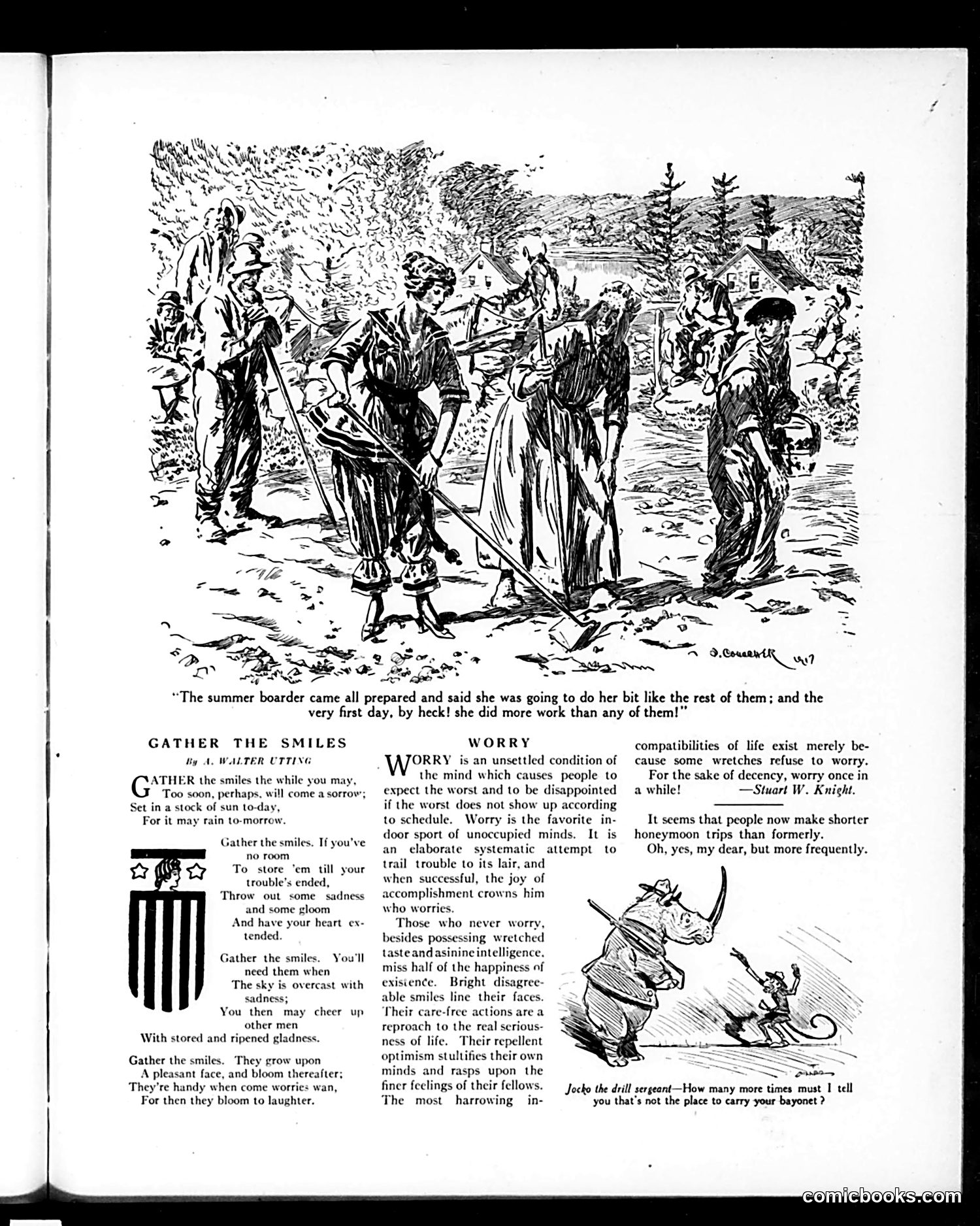
This page contains two distinct pieces: **Top illustration**: A sketch showing a woman doing farm labor alongside men during what appears to be wartime. The caption quotes "The summer boarder came all prepared and said she was going to do her bit like the rest of them; and the very first day, by heck! she did more work than any of them!" This likely references women's increased labor participation during World War I, when men were away fighting. The satire mocks either the city woman's unexpected competence or her overeagerness compared to the men. **Lower content**: "Gather the Smiles" is an inspirational poem by Walter Utting encouraging optimism. The "Worry" essay argues against excessive anxiety, positioning worry as unproductive and advocating cheerfulness instead. Both pieces promote morale and positive attitudes—typical wartime propaganda messaging.
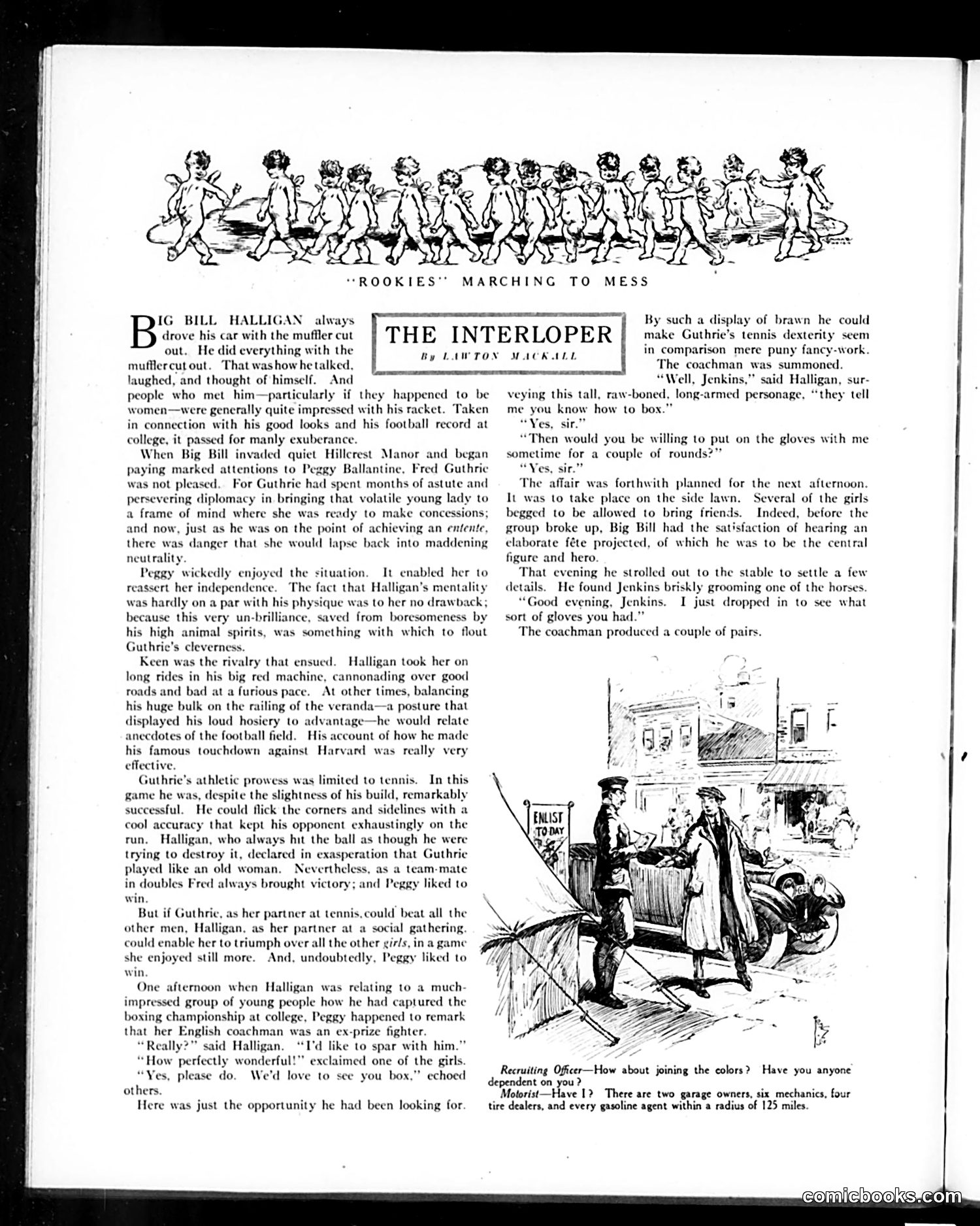
This story centers on **Big Bill Halligan**, a cocky college athlete known for his success in football and his reputation with women. The narrative contrasts his athletic prowess with his social superiority complex. The plot involves **Peggy Ballantine**, a young woman Halligan pursues, and **Fred Guthrie**, an intellectual rival who proves Halligan's superior at tennis and social settings despite his less impressive build. The "interloper" refers to Guthrie's unwelcome intrusion into Halligan's pursuit of Peggy. The satire mocks **masculine ego and athletic arrogance**—suggesting that physical prowess and swagger don't guarantee romantic or social success. Guthrie's cleverness and refinement ultimately outclass Halligan's brutish confidence, challenging early 20th-century assumptions about athletic superiority equaling overall male dominance.
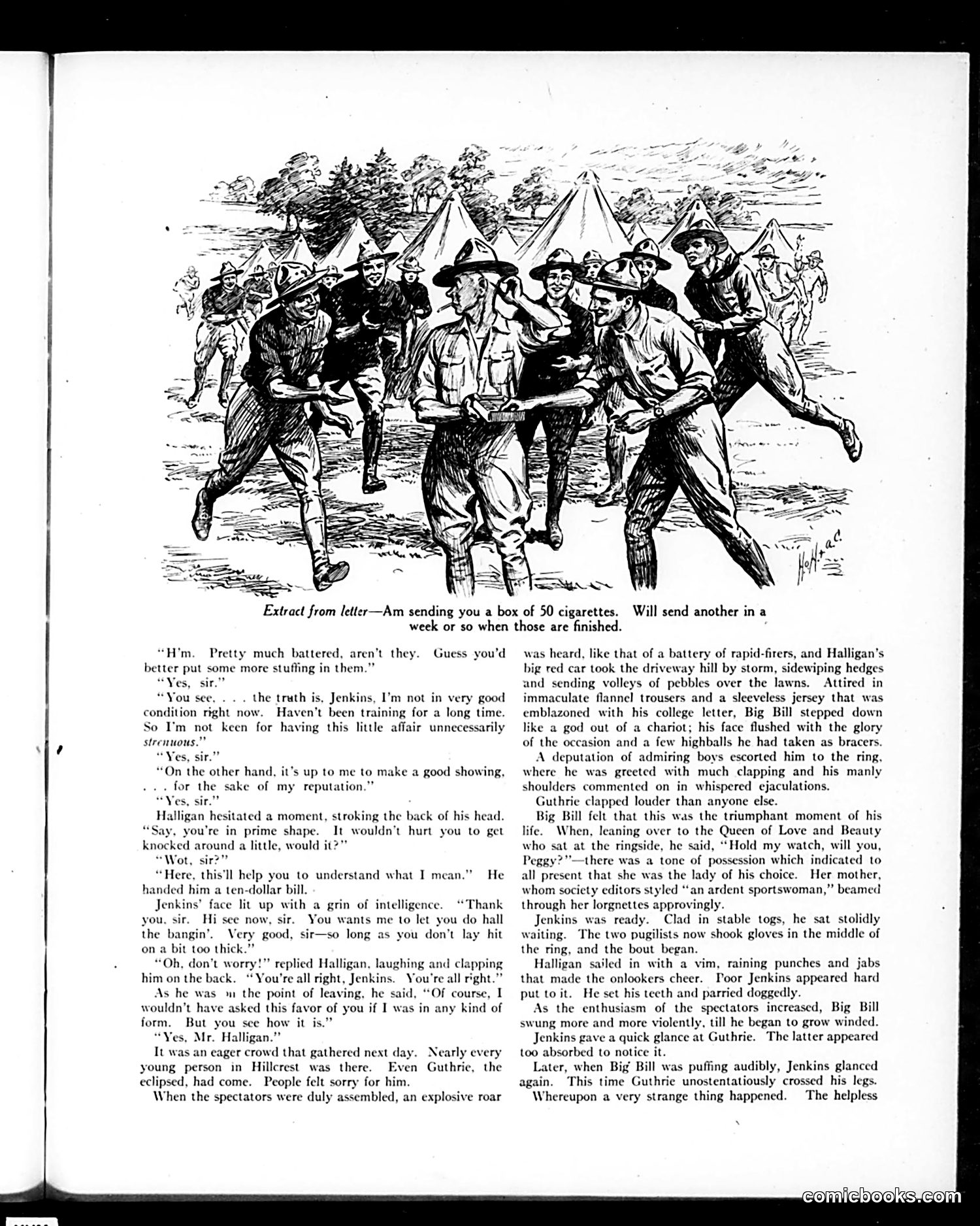
This page satirizes class pretension and fixed fights. "Big Bill" Halligan, a wealthy man of poor physical condition, bribes his servant Jenkins with money and cigarettes to deliberately lose their boxing match. Halligan wants to impress spectators—particularly "the Queen of Love and Beauty" (a woman named Peggy)—by appearing as a triumphant boxer without actually risking injury. The satire targets Halligan's vanity: he arrives in an ostentatious automobile, wears collegiate regalia, and seeks admiration despite lacking genuine ability. Jenkins accepts the bribe, but the narrative hints at comeuppance when "a very strange thing happened"—suggesting the fixed fight goes awry. The joke exposes how wealthy men manipulate situations for reputation while exploiting working-class people, and how spectator culture enables such deception through gullible admiration.
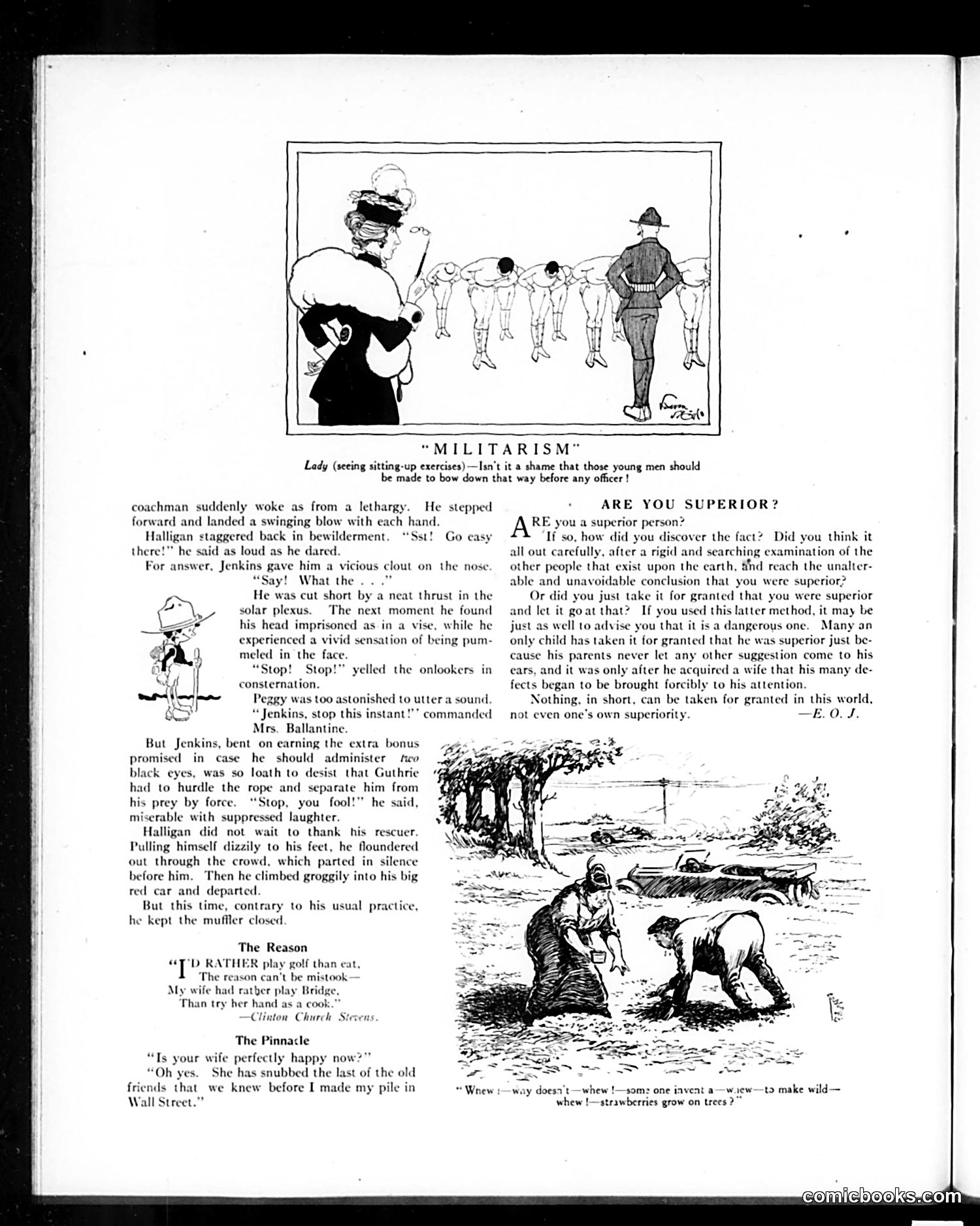
The top cartoon titled "MILITARISM" satirizes military discipline by showing a fashionable lady criticizing soldiers for bowing to officers—yet the accompanying story depicts Jenkins, a coachman, brutally beating Halligan after being promised a bonus for delivering "two black eyes." The irony is clear: the lady objects to military obedience while ordinary men eagerly embrace violence for monetary reward, suggesting that militarism corrupts civilians as much as soldiers. The accompanying text pieces are unrelated humor: "The Reason" jokes about marital priorities (golf vs. cooking), and "The Pinnacle" mocks social climbing via wealth. The final cartoon shows manual laborers, likely illustrating working-class life in contrast to the lady's refined concerns. The page's core message critiques how militaristic values—obedience, violence, hierarchy—permeate American civilian life, making the lady's genteel objections seem naive or hypocritical.
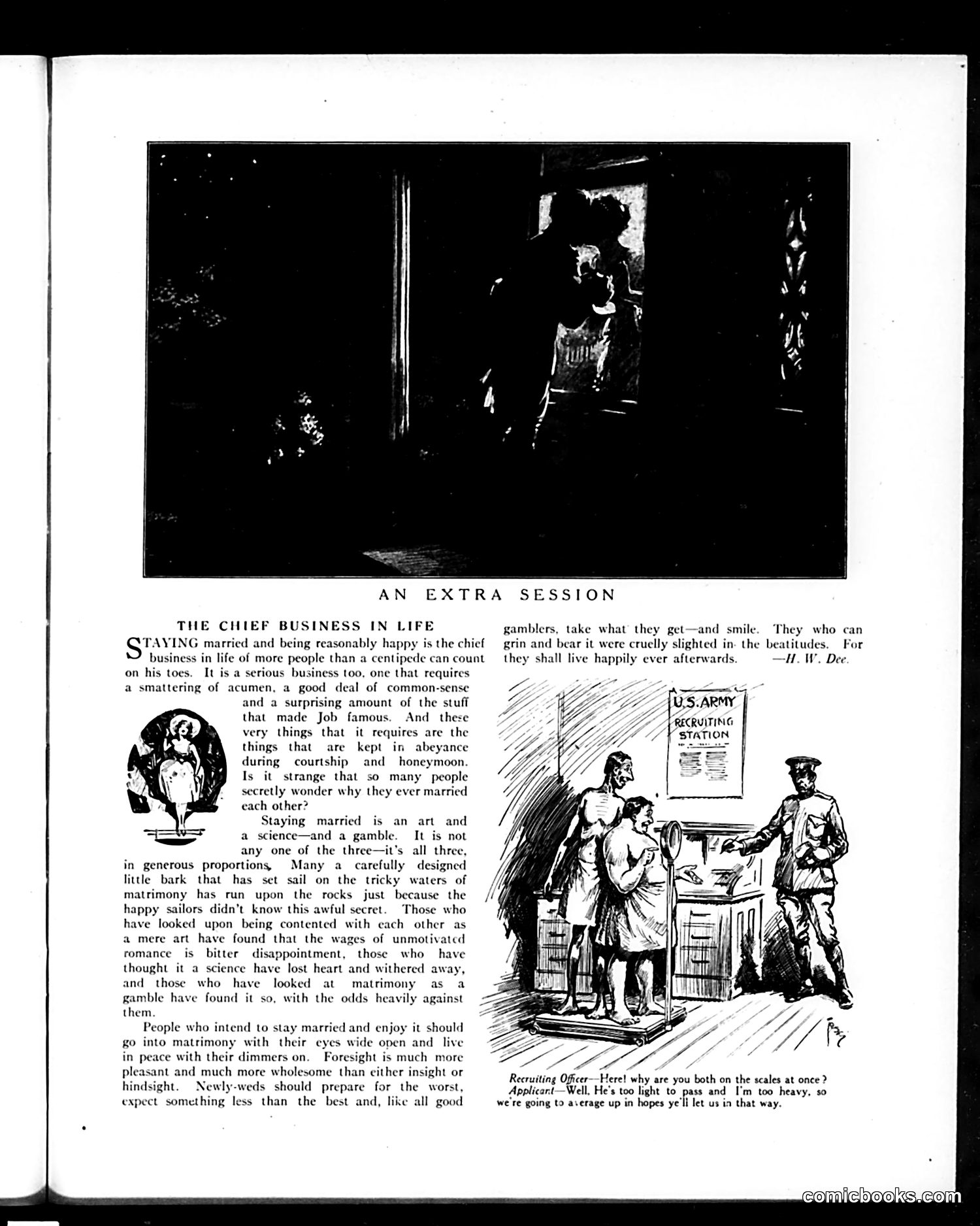
This page combines a serious essay on marriage with a humorous cartoon about WWI military recruitment. **The Main Cartoon:** A recruiting officer weighs two men trying to enlist for the U.S. Army. One is underweight, the other overweight. Their solution: "average" themselves together on the scales to meet the weight requirement. The joke satirizes both the desperation of would-be soldiers and the apparent flexibility (or incompetence) of Army recruitment standards during wartime. **The Essay:** "The Chief Business in Life" offers conventional wisdom about marriage as requiring art, science, and gambling—a serious meditation on domestic stability. The contrast between earnest marital advice and the absurd recruitment cartoon creates the satirical effect typical of Judge: juxtaposing solemn commentary with ridicule of contemporary institutions. **Historical Context:** This appears to reference WWI-era conscription efforts, when the military faced recruitment and fitness challenges.
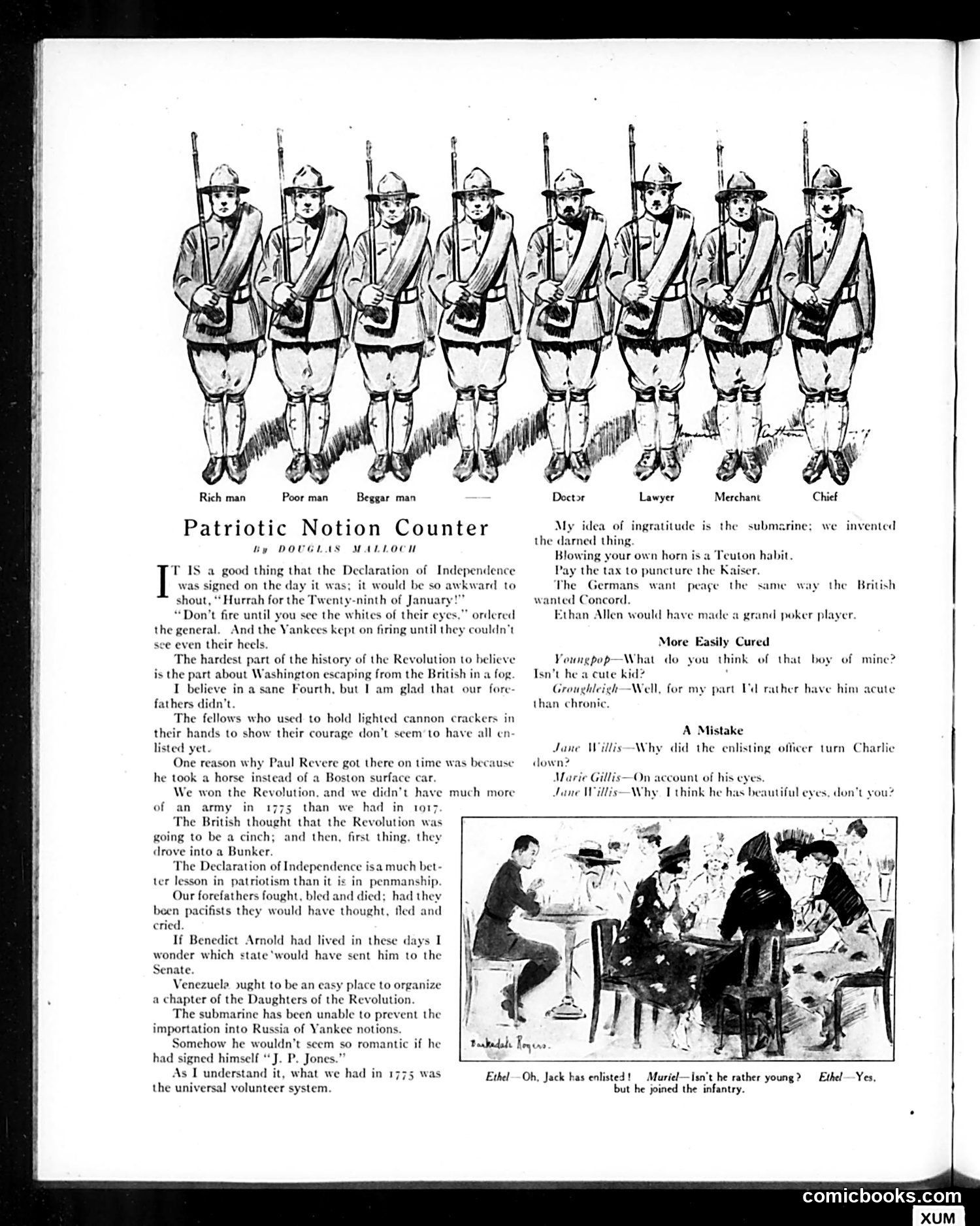
**Top Illustration**: A satirical "Patriotic Notion Counter" showing eight identical soldiers in WWI-era uniforms labeled by social class (Rich man, Poor man, Beggar man, Doctor, Lawyer, Merchant, Chief). The joke mocks how military service supposedly equalizes social classes—they all look identical, suggesting the uniform erases individual identity and status. **Main Text**: Douglas Malloch's humorous essay offers tongue-in-cheek observations about the American Revolution and contemporary (likely WWI-era) patriotism. It includes jokes about the Declaration of Independence's awkward anniversary date, Paul Revere's horse transportation, and jabs at pacifists versus patriots. **Scattered Jokes**: Include satirical jabs at German militarism ("Blowing your own horn is a Teuton habit"), submarine warfare, and Venezuela's revolutionary credentials. **Bottom Cartoon**: Depicts a conversation where someone enlists despite appearing too young, joining the infantry anyway—likely commenting on underage enlistment or enthusiasm for military service during wartime. The overall tone criticizes both pacifism and celebrates martial sacrifice while poking fun at military life and bureaucracy.
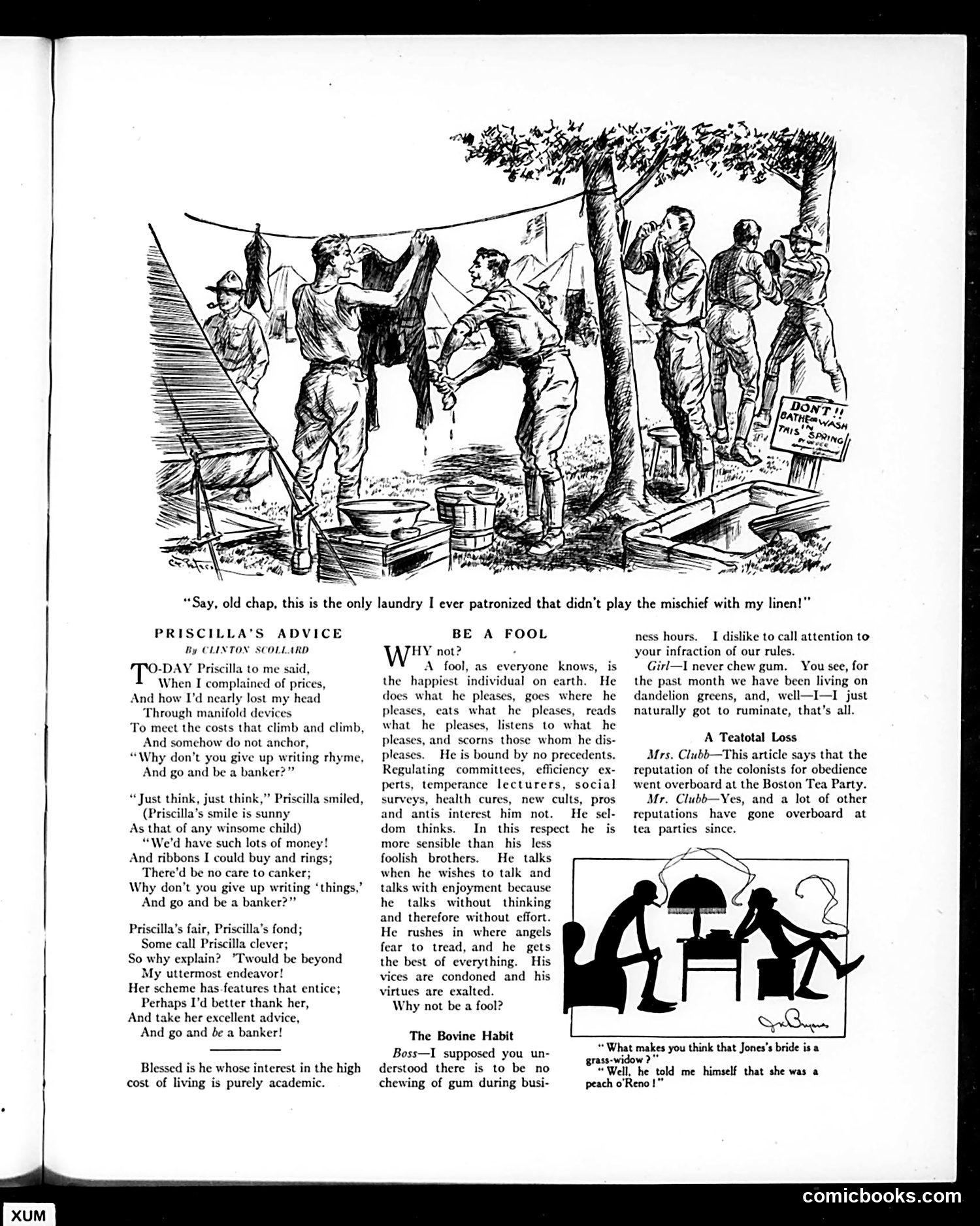
This page contains three distinct satirical pieces: **"Priscilla's Advice"** (poem by Clinton Scollard): A writer complains about rising costs of living to his girlfriend Priscilla, who jokes he should abandon poetry and "be a banker" to earn real money. The satire mocks both the writer's financial struggles and perhaps the era's materialism—suggesting that practical wealth-seeking trumps artistic pursuits. **"Be a Fool"** (essay): A philosophical piece arguing that fools are happiest because they ignore social conventions, committees, and moral lecturers. It's ironic social commentary—suggesting that rejecting society's rules and expectations leads to contentment. **The cartoon** (top): Soldiers at camp doing laundry, with one praising a laundry service for not damaging his clothes—a humorous domestic complaint even in military settings. **Bottom cartoons** involve dated jokes about infidelity ("grass-widow") and a female employee who's been eating dandelion greens, causing her to chew like a cow—crude humor about workplace propriety and women's behavior.
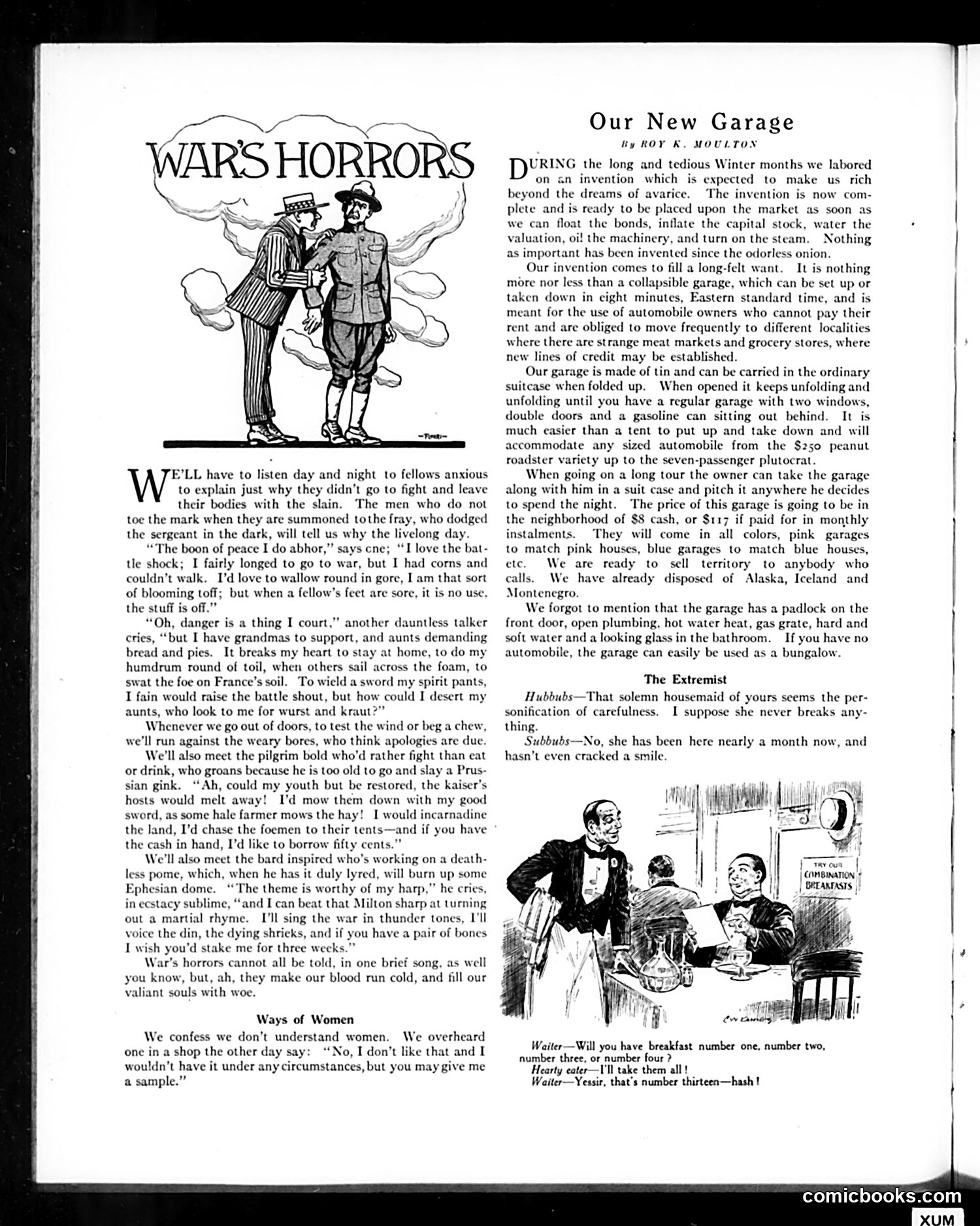
The "War's Horrors" cartoon satirizes men making excuses to avoid WWI military service. It mocks various dodgers: those claiming physical ailments (corns, age), financial hardship (supporting elderly relatives), or patriotic pretense while actually seeking loans. The figure labeled "Prussian" references Germany as the enemy. The satire targets cowardice disguised as legitimate reasons—particularly the absurdity of men simultaneously claiming eagerness to fight while asking for borrowed money. The accompanying section "Ways of Women" presents an unrelated brief joke about female consumer behavior and apparent contradictions in shopping preferences. "Our New Garage" is a humorous advertisement/article for a collapsible, portable garage marketed to automobile owners facing frequent relocations. It's satirical promotional copy, poking fun at the product's impracticality while maintaining sales pitch language about bonds, capitalization, and market readiness.
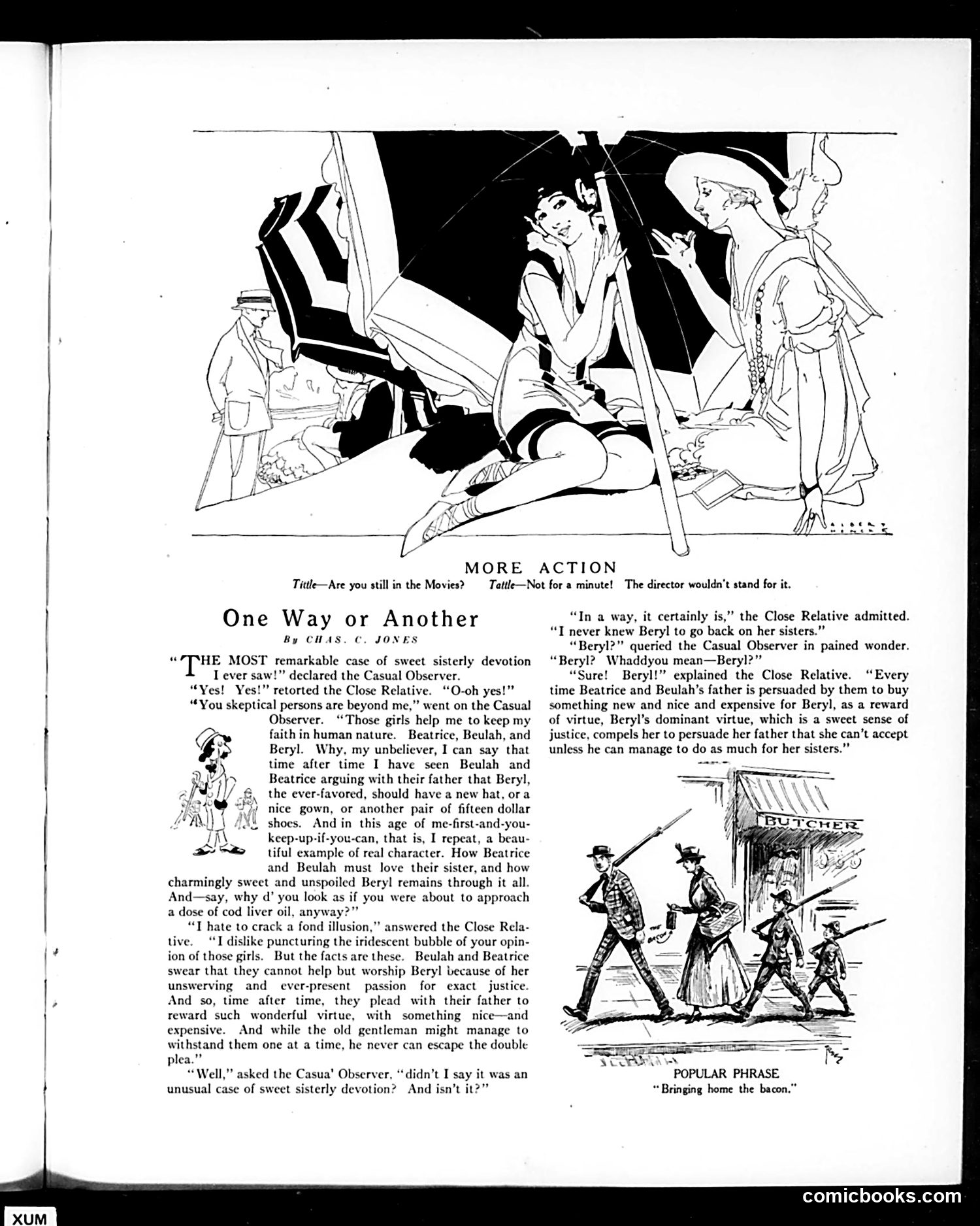
This is a humorous short story with illustrations satirizing family dynamics and parental manipulation. Two observers discuss three sisters—Beatrice, Beulah, and Beryl—whom the "Casual Observer" admires for their apparent selfless devotion to their youngest sister Beryl. The satire reveals the con: Beatrice and Beulah flatter their father by praising Beryl's "sense of justice," persuading him to buy her expensive gifts. Then Beryl manipulates him further by claiming she cannot accept anything unless her sisters receive equal treatment—forcing him to spend more. The joke exposes how these daughters exploit paternal sentiment and appeals to virtue as a coordinated scheme to extract money. Their "sweet sisterly devotion" is actually calculated self-interest disguised as moral principle. The "Popular Phrase" illustration about "bringing home the bacon" reinforces the theme of extracting financial support from the father. The page satirizes both female manipulation and male gullibility to flattery.
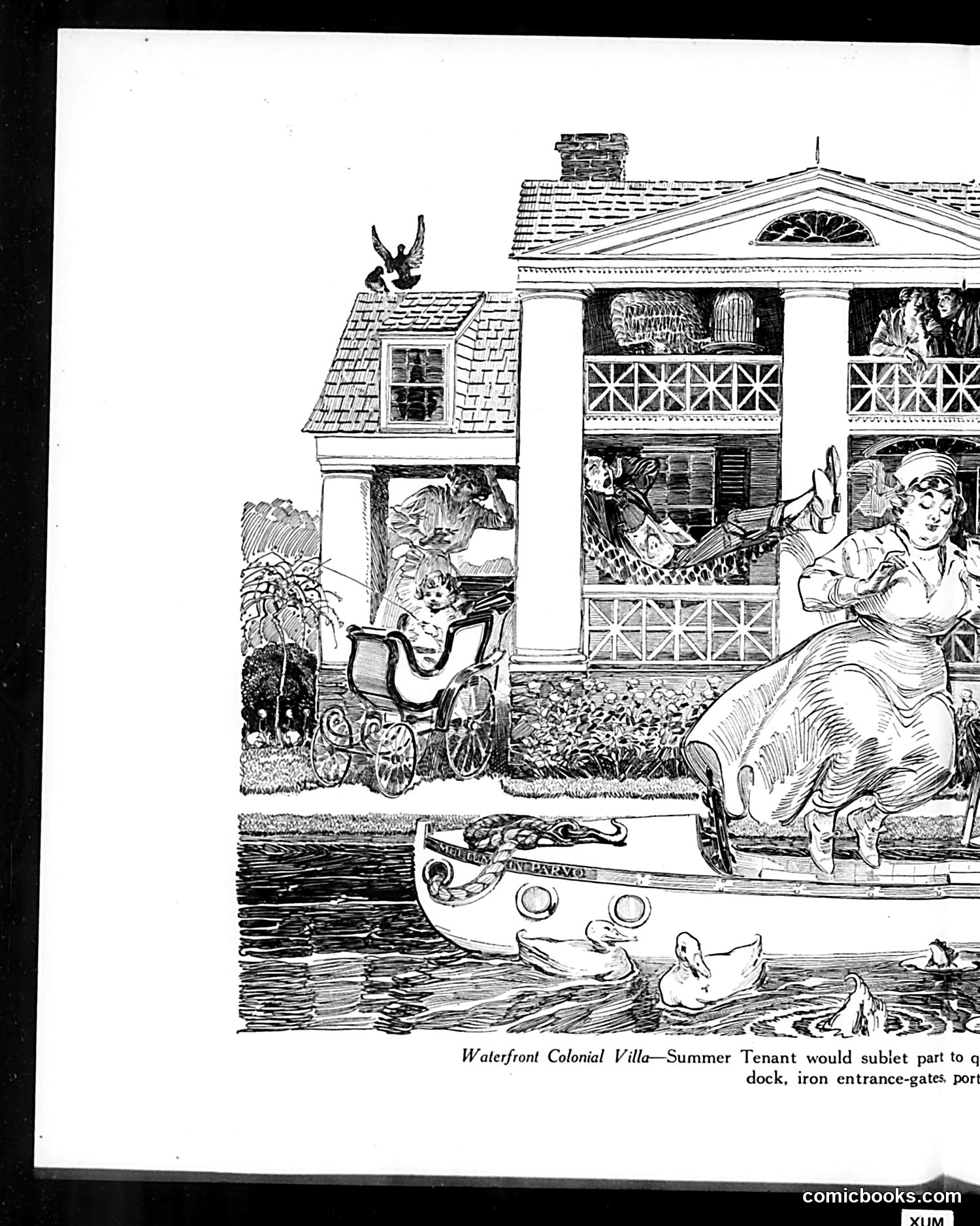
This illustration satirizes wealthy summer renters in colonial-style waterfront properties. The scene depicts a fashionable woman in an elaborate dress lounging on a veranda overlooking a dock, while a child plays nearby in a carriage. A boat is moored below, and ducks swim in the water. The caption indicates the tenant would "sublet part" of this villa—likely a commentary on how the wealthy rented expensive summer homes, then recouped costs by subletting portions to others. The detailed architectural rendering and elegant figures suggest this mocks the pretensions of affluent vacationers who adopted "colonial" aesthetics as markers of status and refinement. The satire appears directed at this leisure-class behavior and real estate practices among the wealthy during the summer season.
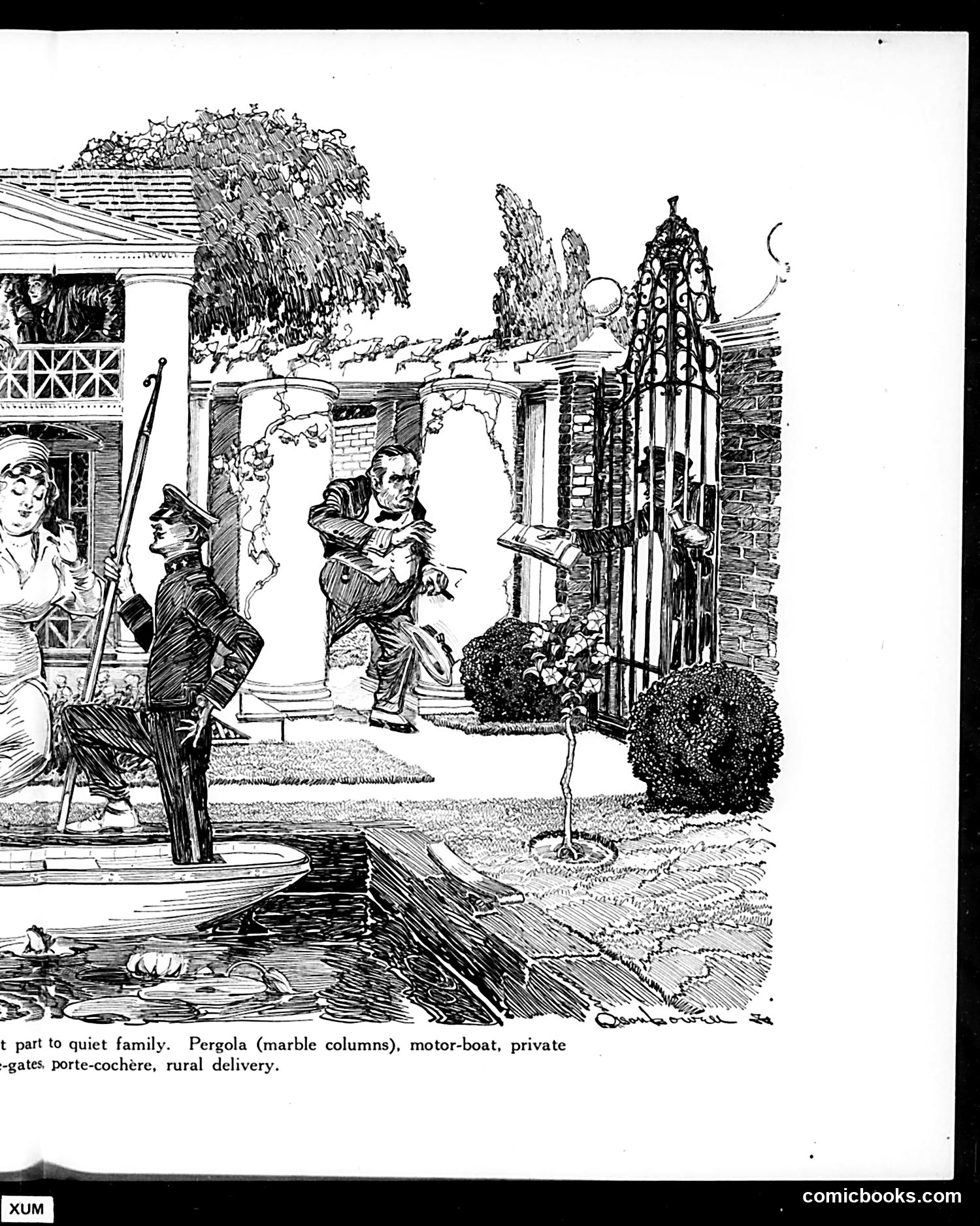
This appears to be a satirical cartoon mocking the aspirations of wealthy or newly wealthy Americans around the early 20th century. The caption lists luxury amenities—pergola with marble columns, motor-boat, private gates, porte-cochère (covered carriage entrance), and rural delivery—suggesting ostentatious displays of wealth in suburban estates. The illustration depicts figures in formal dress (possibly military uniforms) interacting near an ornate garden gate, with classical architectural elements visible. The satire likely targets the pretentious desire to display status symbols and European refinement among the American upper class, particularly the contrast between rural settings and imported aesthetic sophistication. The "quiet family" reference is ironic, suggesting such elaborate estates hardly guarantee domestic tranquility.
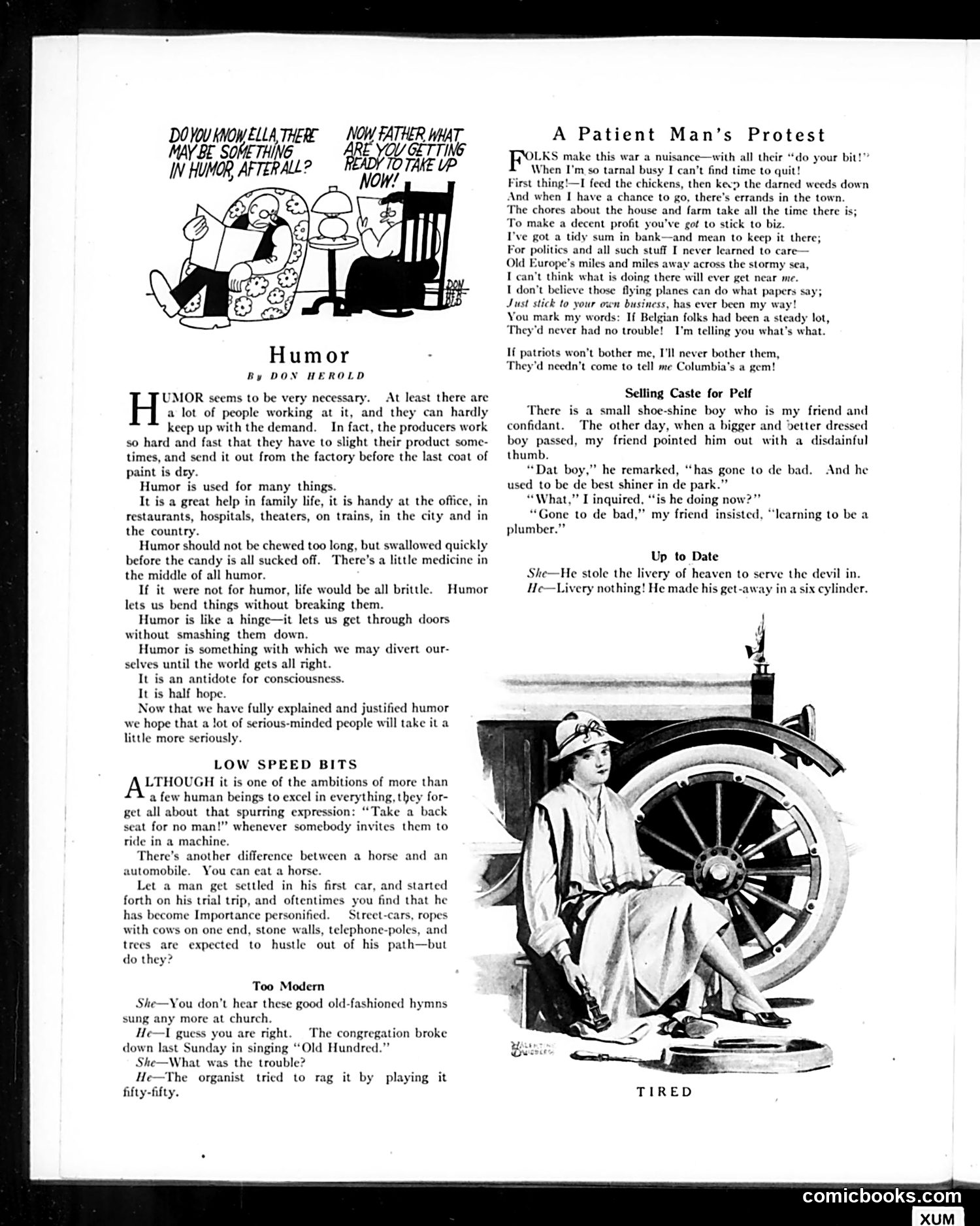
This Judge magazine page contains several satirical pieces about American life, likely from the WWI era: **"A Patient Man's Protest"** is the most historically significant. It mocks isolationist attitudes toward World War I—a farmer refuses civic duty, dismisses European conflict as irrelevant, and expresses xenophobic skepticism of Belgians and new technology (airplanes). The satire targets Americans who prioritized profit and personal concerns over patriotic obligation during the war debate. **"Low Speed Bits"** satirizes nouveau-riche automobile owners who become arrogant once they acquire cars, demanding pedestrians and horse-drawn traffic yield to them—a common complaint as cars became common. **The humor essay** by Don Herold philosophically defends humor as necessary social medicine and stress relief. **Lighter pieces** ("Too Modern," "Up to Date," "Selling Caste for Pelf") mock changing social values: outdated church hymns, materialism replacing craftsmanship, and modern dating customs. The shoe-shine boy abandoning his trade for plumbing represents anxieties about social mobility and lost tradition.
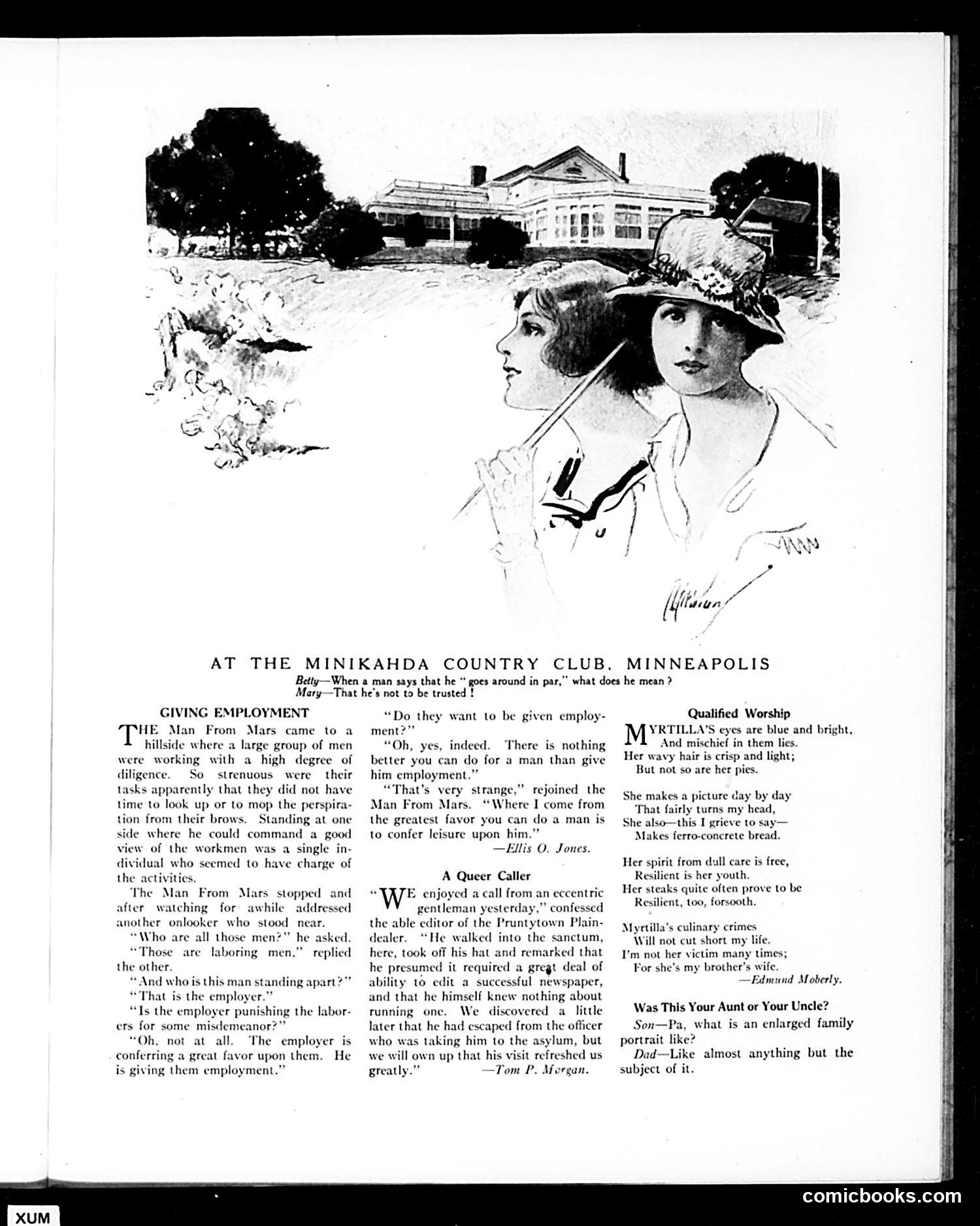
This page contains three distinct humorous pieces satirizing early 20th-century American social attitudes: **"Giving Employment"** presents a Martian visitor observing American labor practices. The satire critiques how employers frame employment as a *favor* to workers—a great "gift"—when the worker actually needs the job to survive. The Martian's alien perspective exposes this hypocrisy: on Mars, conferring *leisure* (freedom from work) is considered the real favor. This mocks American capitalist ideology that treats job provision as benevolence rather than mutual economic exchange. **"A Queer Caller"** jokes about an escaped asylum patient who visits a newspaper editor and, despite knowing nothing about journalism, flatters the editor's skills—inadvertently providing honest praise that refreshes him more than genuine conversation. **"Qualified Worship"** and the opening golf joke are lighthearted domestic humor about women's domestic failures (bad cooking, "ferro-concrete bread") and the reliability of cautious husbands. The cartoon at top depicts two women at a country club; the caption suggests skepticism toward men's claims of golfing competence.
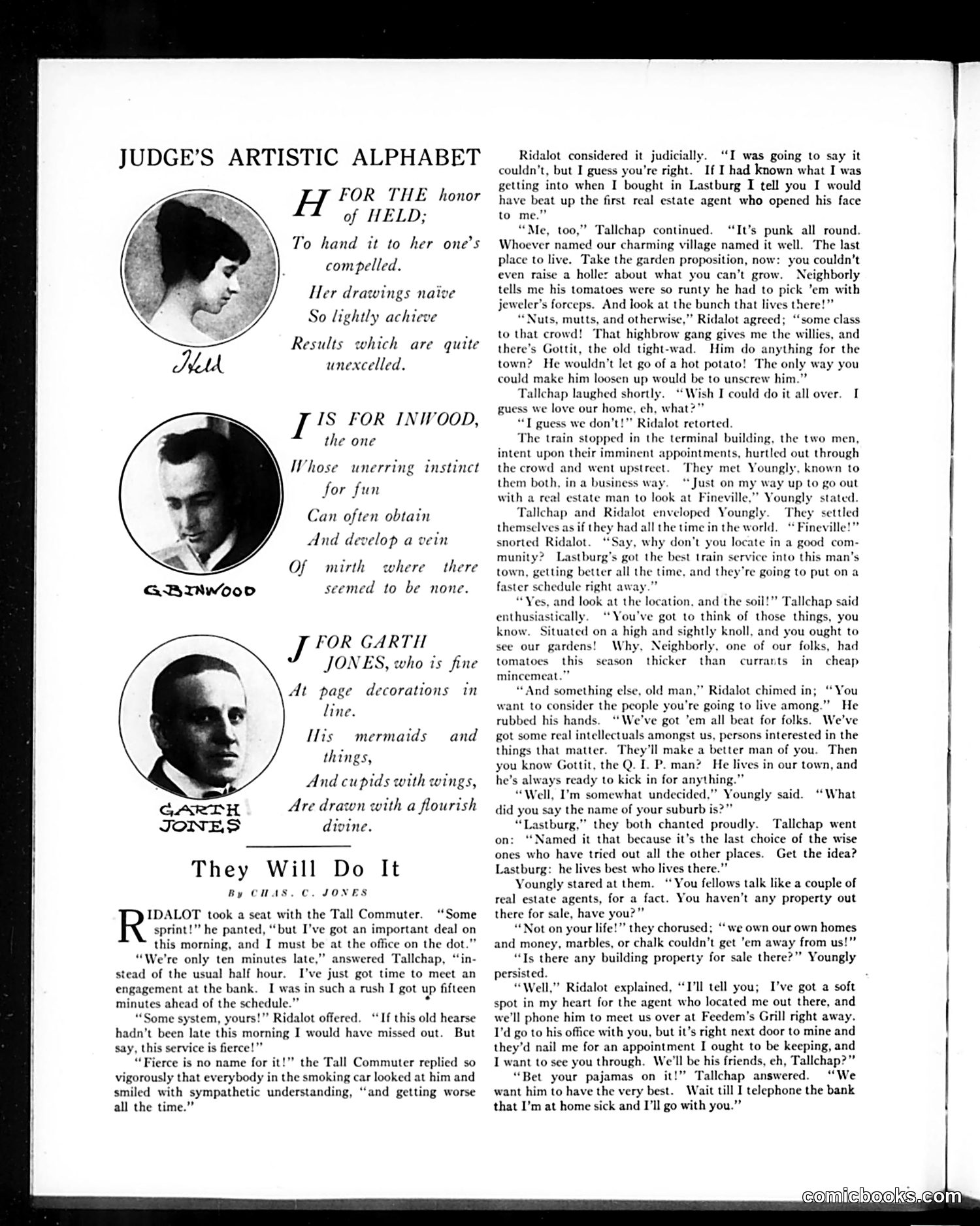
This page contains two satirical pieces from *Judge* magazine: **"Judge's Artistic Alphabet"** is a lighthearted tribute to illustrators H[ill], G.B. Inwood, and Garth Jones, praising their artistic contributions. **"They Will Do It"** is the main satire. Two commuters complaining about train delays and their suburb "Lastburg" encounter a third man considering moving to "Fineville." The two immediately launch into aggressive salesmanship, inverting their earlier complaints: suddenly Lastburg has excellent train service, beautiful gardens, and sophisticated residents. The satire mocks suburban boosterism and dishonest real estate promotion—how people will enthusiastically oversell their own communities to persuade newcomers to move there, despite privately acknowledging the town's actual shortcomings. The irony is that Ridalot and Tallchap seamlessly switch from genuine complaints to transparent exaggeration within minutes, representing how self-interest shapes public promotion of suburban living.
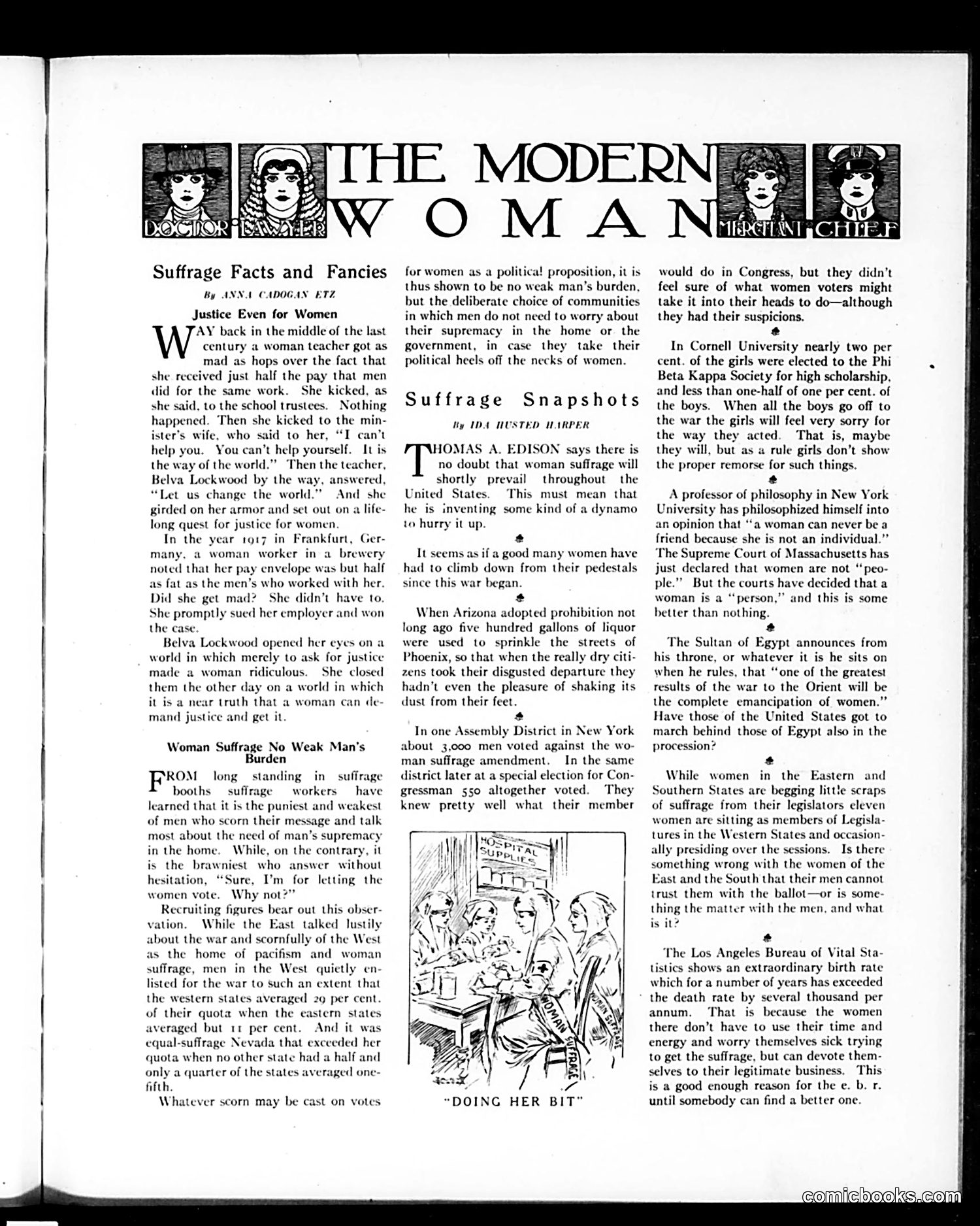
This page from *Judge* magazine presents pro-suffrage arguments through articles and a cartoon titled "Doing Her Bit." **The Articles:** Written by Anna Cadogan Utz and Ida Husted Harper, they counter anti-suffrage claims. They argue that woman suffrage isn't a "weak man's burden" but supported by strong communities (citing Nevada and western states' military enlistment records). They highlight the hypocrisy of men claiming women shouldn't vote while opposing equal pay—using Belva Lockwood's 19th-century fight for equal teacher wages as historical precedent. **The Cartoon:** "Doing Her Bit" depicts women at what appears to be a suffrage information booth, ironically suggesting women are already doing civic work. The satire implies that if women are trusted with wartime duties, denying them voting rights is unjust. **Context:** Published during WWI, this argues suffrage is logical given women's demonstrated responsibility and competence—a common suffragist strategy of the era.
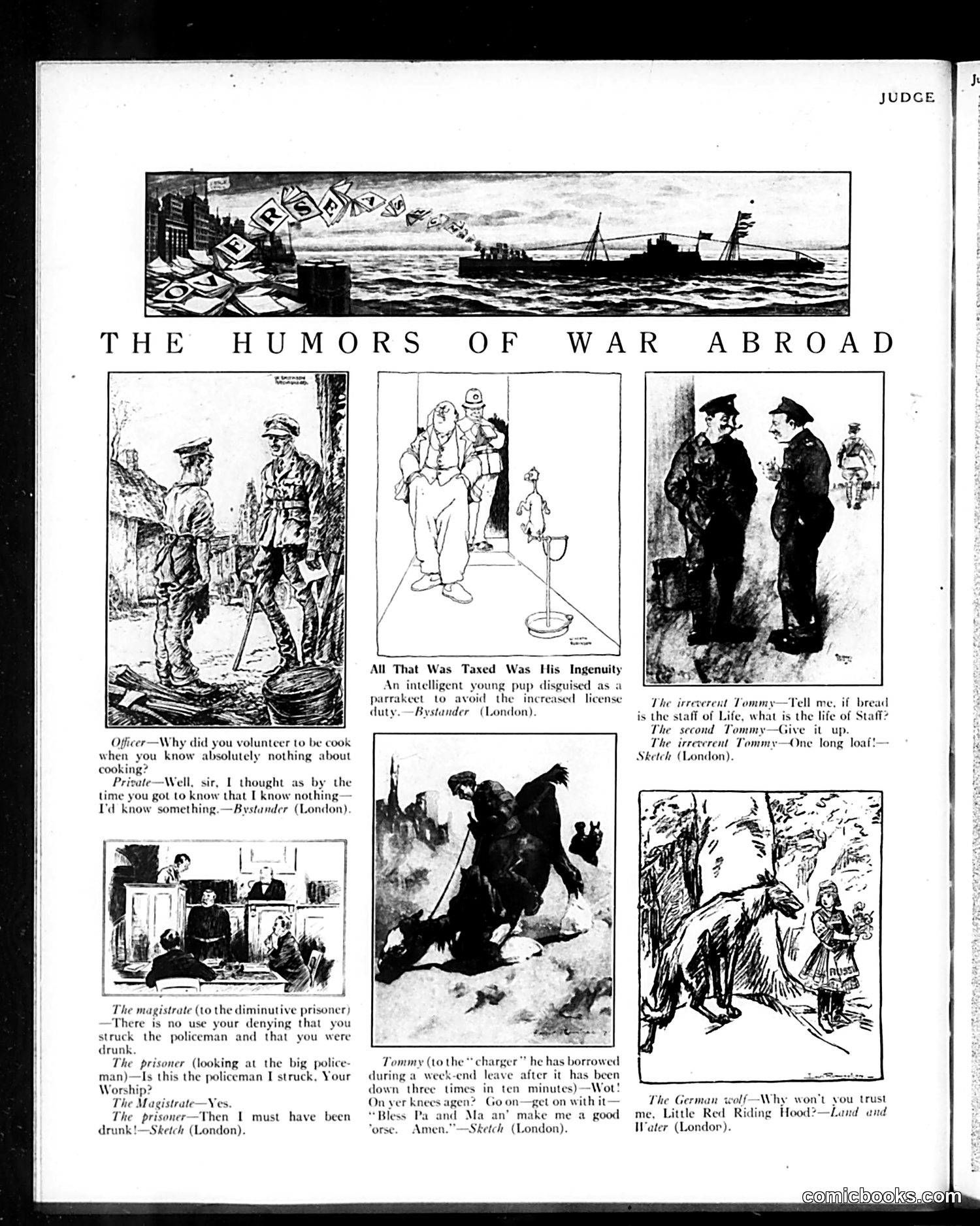
This page collects humorous wartime anecdotes from British publications, primarily depicting soldiers' wit and resourcefulness during World War I. The cartoons satirize military life through enlisted men's perspectives: **Key jokes:** - A private volunteers as cook, planning to learn on the job - A drunk man, confronted by a large policeman in court, questions whether *this* is really the officer he struck - A dog disguised as a parrot to avoid pet license taxes - A soldier borrowed a horse that repeatedly falls, sardonically encouraging it to "make me a good 'orse" - A reference to "Little Red Riding Hood" and a "German wolf" The satire targets bureaucratic absurdity (licensing fees), military inefficiency, and soldiers' darkly humorous coping mechanisms. These are British humor pieces reprinted in the American *Judge* magazine, offering Anglo-American audiences entertainment from the "home front" perspective during WWI.
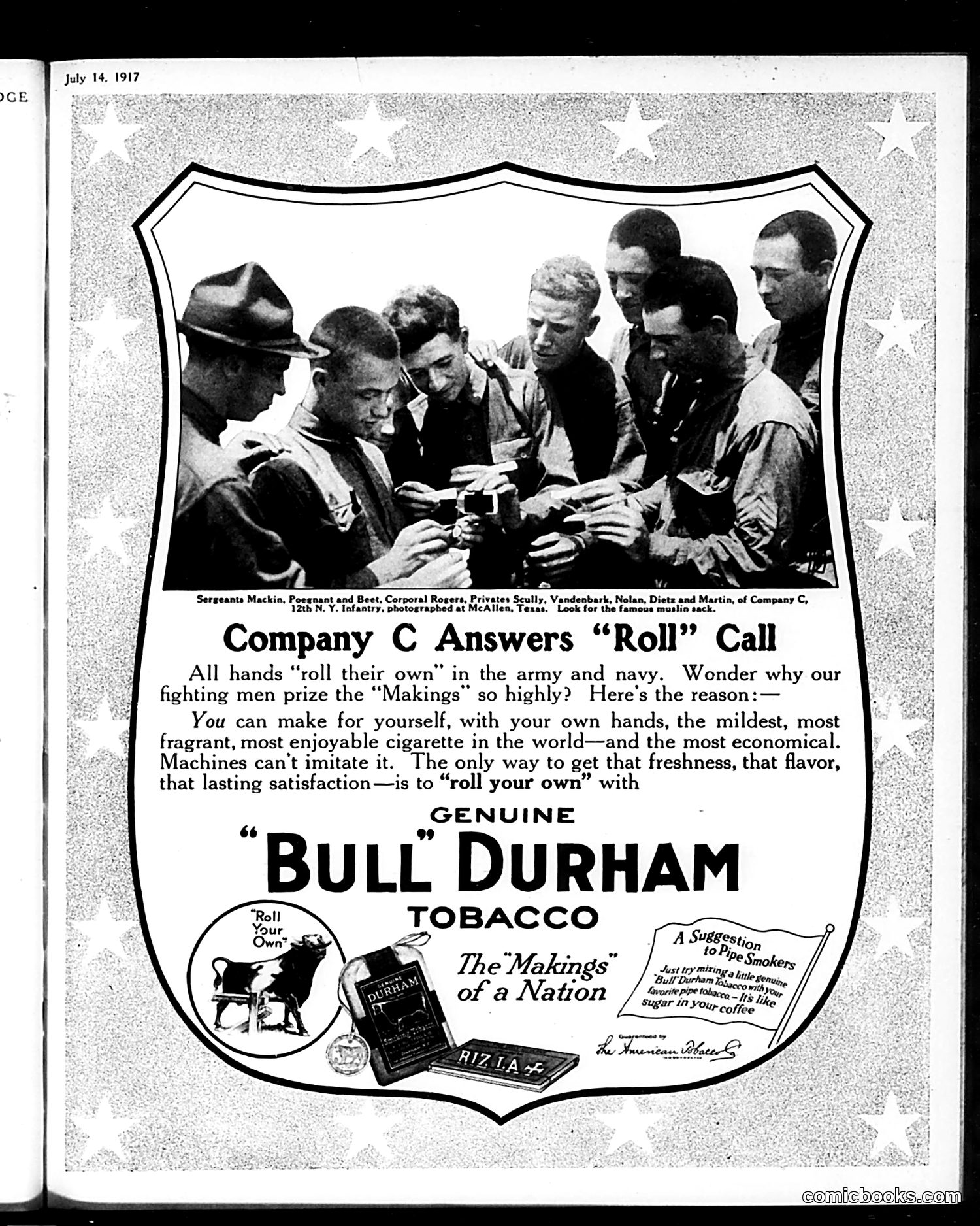
This is a **tobacco advertisement**, not satire or a political cartoon. Published July 14, 1917 (during WWI), it uses a photograph of real soldiers from the 12th New York Infantry to promote Bull Durham tobacco. The ad capitalizes on wartime patriotism and soldiers' actual practice of rolling cigarettes by hand. The headline "Company C Answers 'Roll' Call" puns on military terminology—soldiers literally "roll their own" cigarettes using Bull Durham's loose tobacco and rolling papers (called "Makings"). The sales pitch argues hand-rolled cigarettes are superior to machine-made ones because they're fresher and more economical. A sidebar suggests the product for pipe smokers as well. The "famous muslin sack" referenced in the caption refers to Bull Durham's distinctive small cloth pouches, recognizable to consumers of the era. This exploits soldiers' actual needs and habits for commercial purposes, presenting the product as patriotic and soldier-approved.
This page is primarily **advertising and announcements** with minimal cartoon content. The main satirical pieces are brief humorous anecdotes rather than visual cartoons: **"Shear Steal"** mocks hasty wartime marriages—the joke being the woman rushed into marriage to "land a man" before he escaped, not from romantic urgency. **"Reprisals"** satirizes Colonel Woodhouse's recruitment speech advocating German retaliation for Hun atrocities (referencing WWI destruction like the bombing of Rheims Cathedral). The anecdote undercutting his point—about a doctor and tobacconist's tit-for-tat exchange—suggests the absurdity of "reprisal" logic. **"The Champion Fool"** is a moralistic poem criticizing those who fail, blame fate, and won't admit responsibility—wartime messaging encouraging personal accountability. The **James Montgomery Flagg patriotic cover** announcement indicates this is 1917-era Judge content, when the magazine heavily promoted American war efforts. The page is dominated by hotel, watch, and beverage advertisements typical of the period.
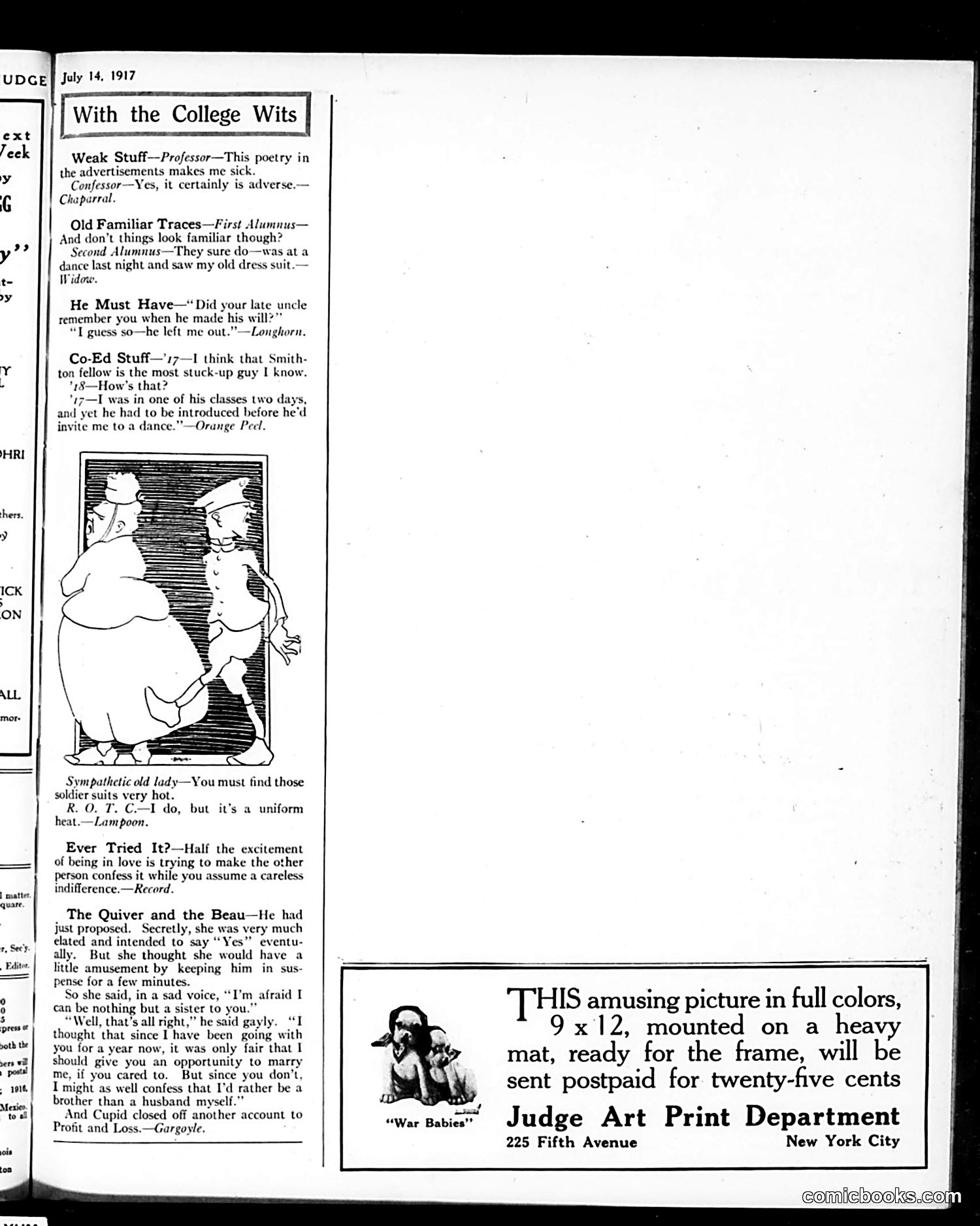
This page collects brief humorous anecdotes aimed at college audiences, presented as witty exchanges. The jokes rely on wordplay and social observations typical of early 20th-century campus life: **Notable items:** - "Co-Ed Stuff" mocks a snobby male student who requires formal introduction before socializing, even with classmates - "Sympathetic old lady" references soldiers in uniform during WWI (America entered in April 1917)—the joke plays on "uniform heat" as both literal discomfort and implied masculinity - "The Quiver and the Beau" depicts courtship games, where an engaged woman teases her fiancé by delaying her acceptance The cartoon (bottom left, labeled "War Babies") appears to show children, likely satirizing wartime conditions. The page emphasizes college romance, military service, and generational humor. Most jokes depend on period-specific social conventions—formal introductions, strict courting etiquette, and wartime awareness—that modern readers would find quaint rather than funny.
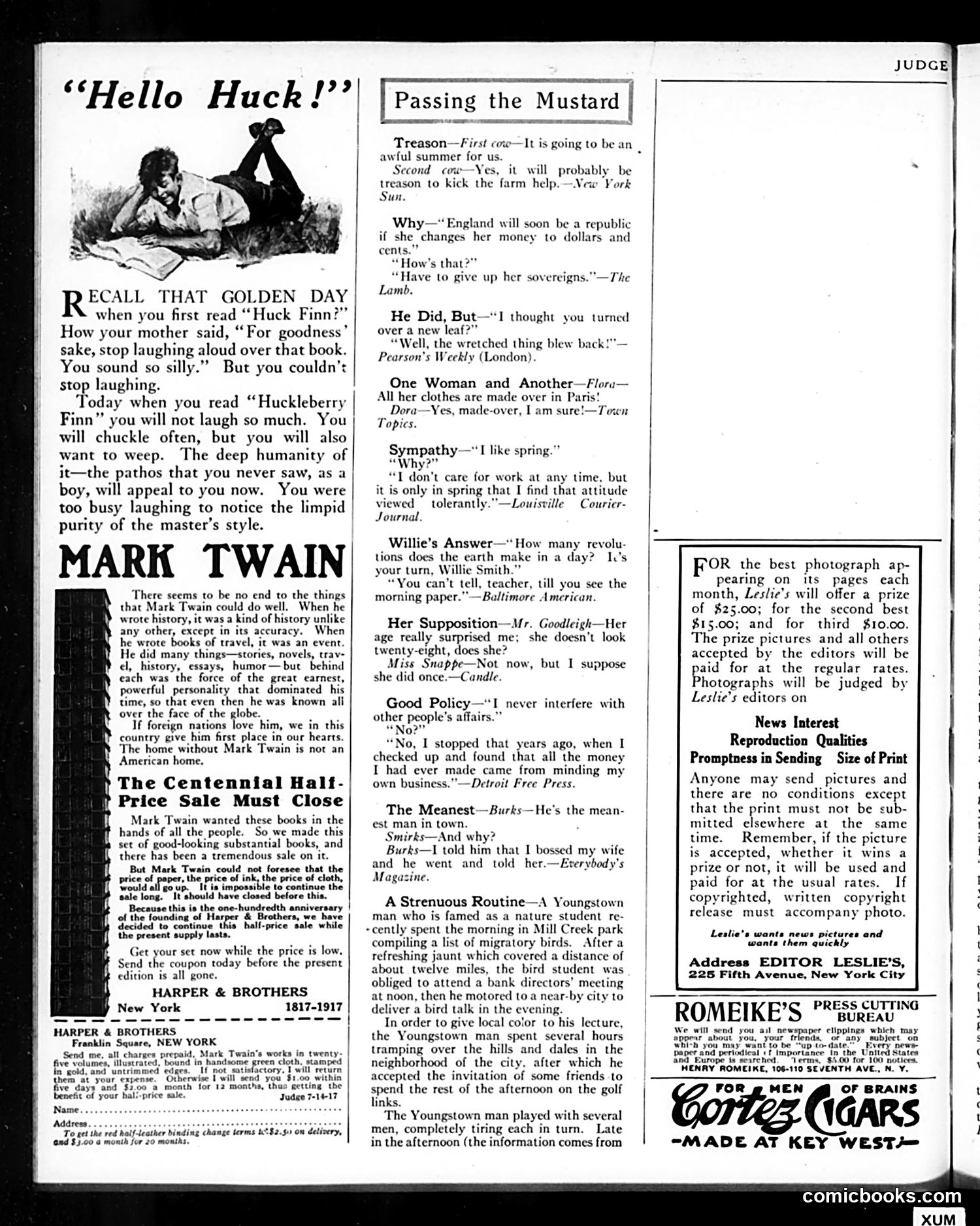
This page is primarily a **Mark Twain promotional advertisement** disguised as editorial content. The large cartoon showing a boy saying "Hello Huck!" illustrates nostalgia for *Huckleberry Finn*. The accompanying essay celebrates Twain as America's greatest writer, praising his ability across multiple genres (history, travel, novels, essays, humor). It emphasizes his universal appeal—"foreign nations love him, we in this country give him first place." The bulk of the page is a **Harper & Brothers book advertisement** offering Twain's collected works at half-price during their centennial anniversary (1817-1917). This was a direct-mail offer with payment terms. The remaining content under "**Passing the Mustard**" consists of brief **humorous filler items** from various publications—short jokes about cows, England, relationships, and children's wit. These were typical of Judge magazine's satirical format but lack specific political reference; they're general social humor about everyday absurdities. Overall, this is advertisement-heavy content with light satirical humor rather than political cartooning.
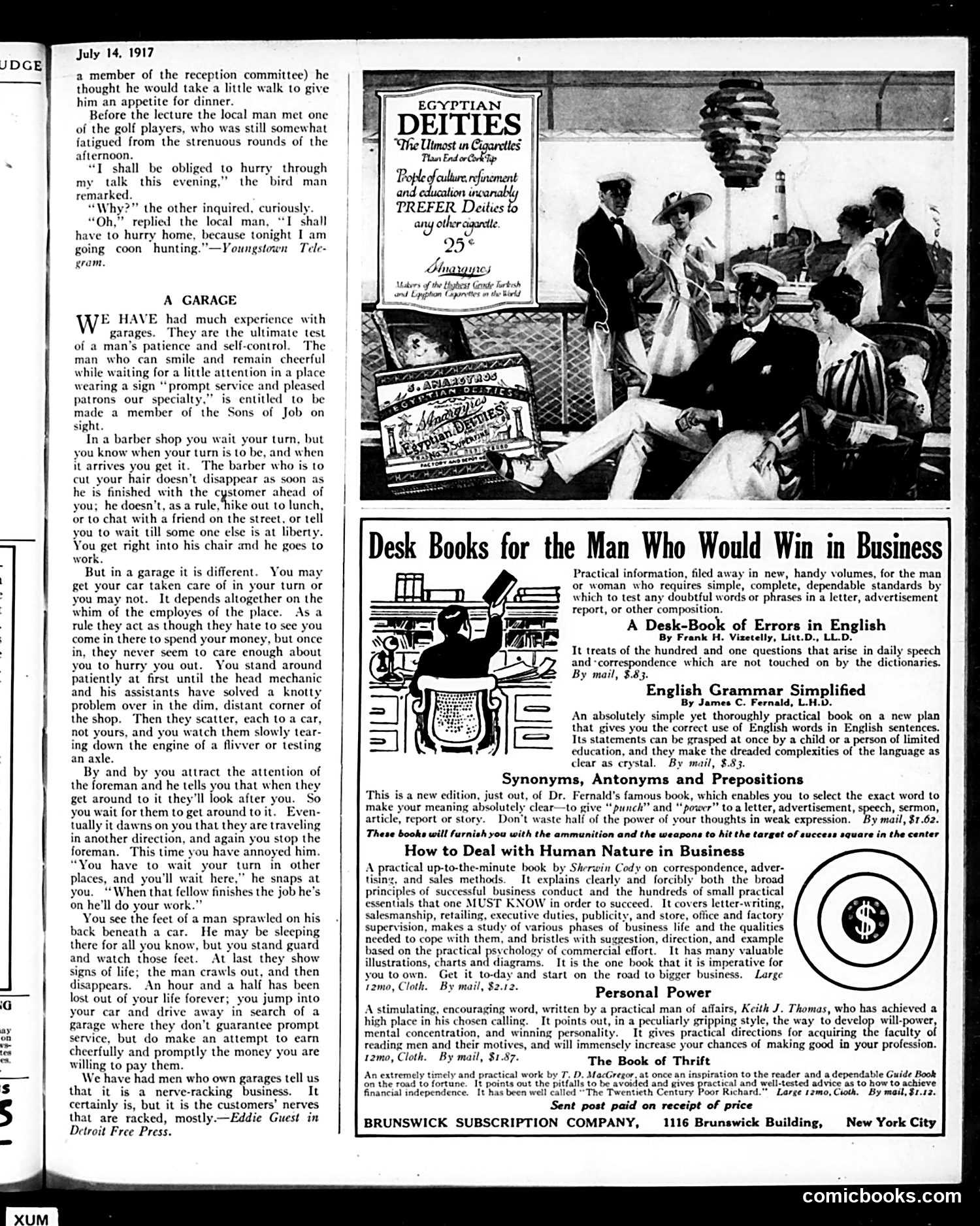
This page contains two main elements: **The "A Garage" Essay** (left): A humorous complaint about automotive repair shop service. The author, Eddie Guest, satirizes garage mechanics' indifference to customers—how they disappear after taking your car, ignore you while working on other vehicles, and treat waiting customers with contempt. The piece mocks mechanics' poor work ethic and their dismissive attitude ("You have to wait your turn... and you'll wait here"). It's social satire about working-class service businesses prioritizing their own convenience over customer satisfaction. **Advertisements** (right): Primarily ads for self-help business books and cigarettes. The Egyptian Deities cigarette ad and various "Desk Books" promising business success reflect 1917 advertising aimed at ambitious men seeking professional advancement. **Context**: Published during WWI, the page reflects American middle-class anxieties about commerce, service standards, and personal improvement through education.
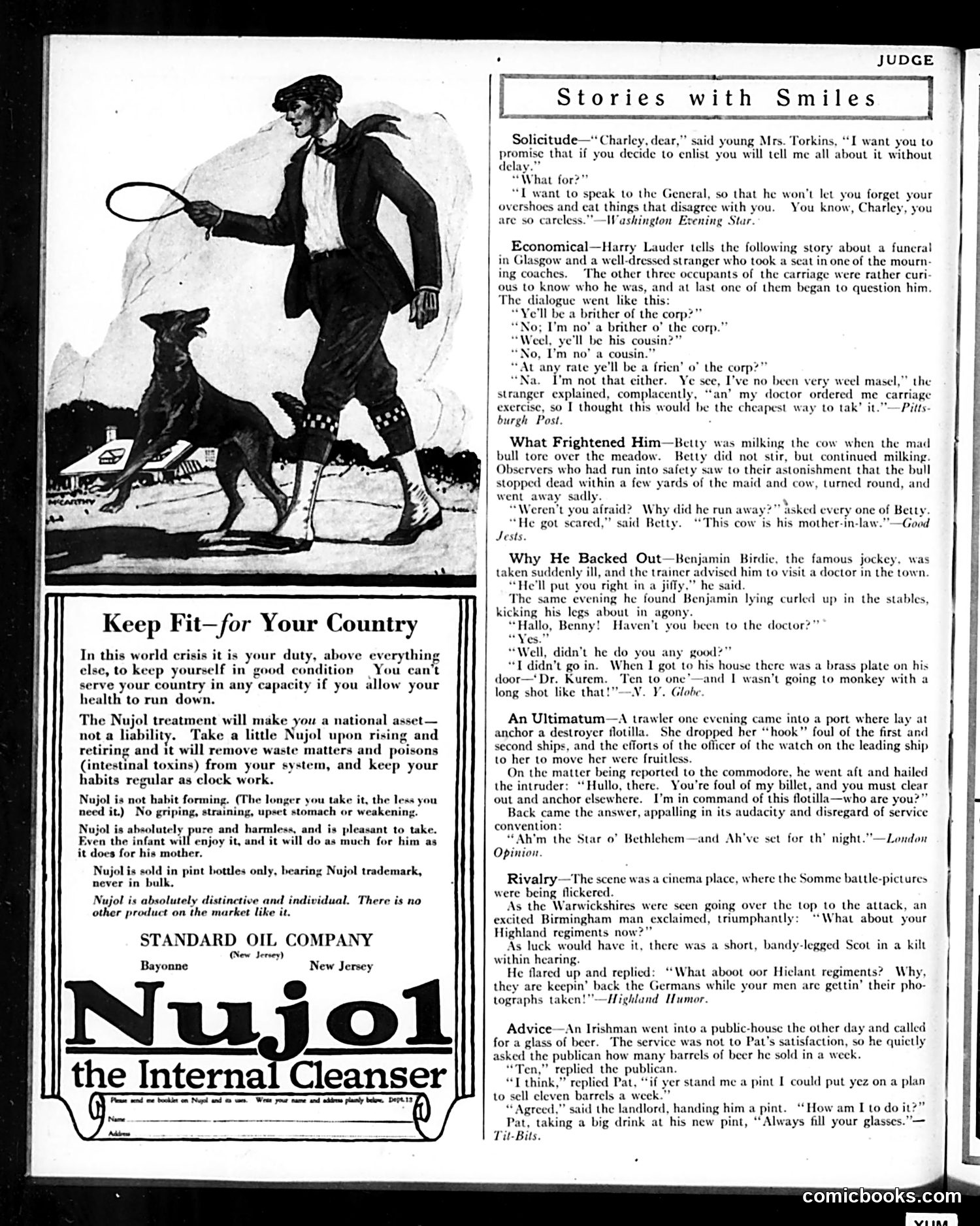
This page combines patriotic advertising with humorous anecdotes typical of Judge's satirical style. **Main Advertisement (Nujol):** The large Nujol ad uses WWI-era patriotism as a sales pitch, framing bowel regularity as a national duty—"keep yourself in good condition" to "serve your country." This reflects how wartime mobilization permeated American consumer marketing. **Comic Stories:** The page features brief humorous tales: - A wife worried about her enlisted husband forgetting practical matters - A Scottish funeral-goer using a funeral carriage for cheap "doctor-ordered" exercise - A cow's maternal instinct stopping a charging bull - A jockey avoiding a doctor named "Kurem" (a pun on "cure 'em") **Context:** These anecdotes reflect WWI-era concerns (enlistment, military life) mixed with timeless domestic humor. The Scottish dialect humor and class-conscious jokes (the funeral-goer's cheapness) were standard Judge fare, appealing to middle-class readers through gentle mockery of various social types.
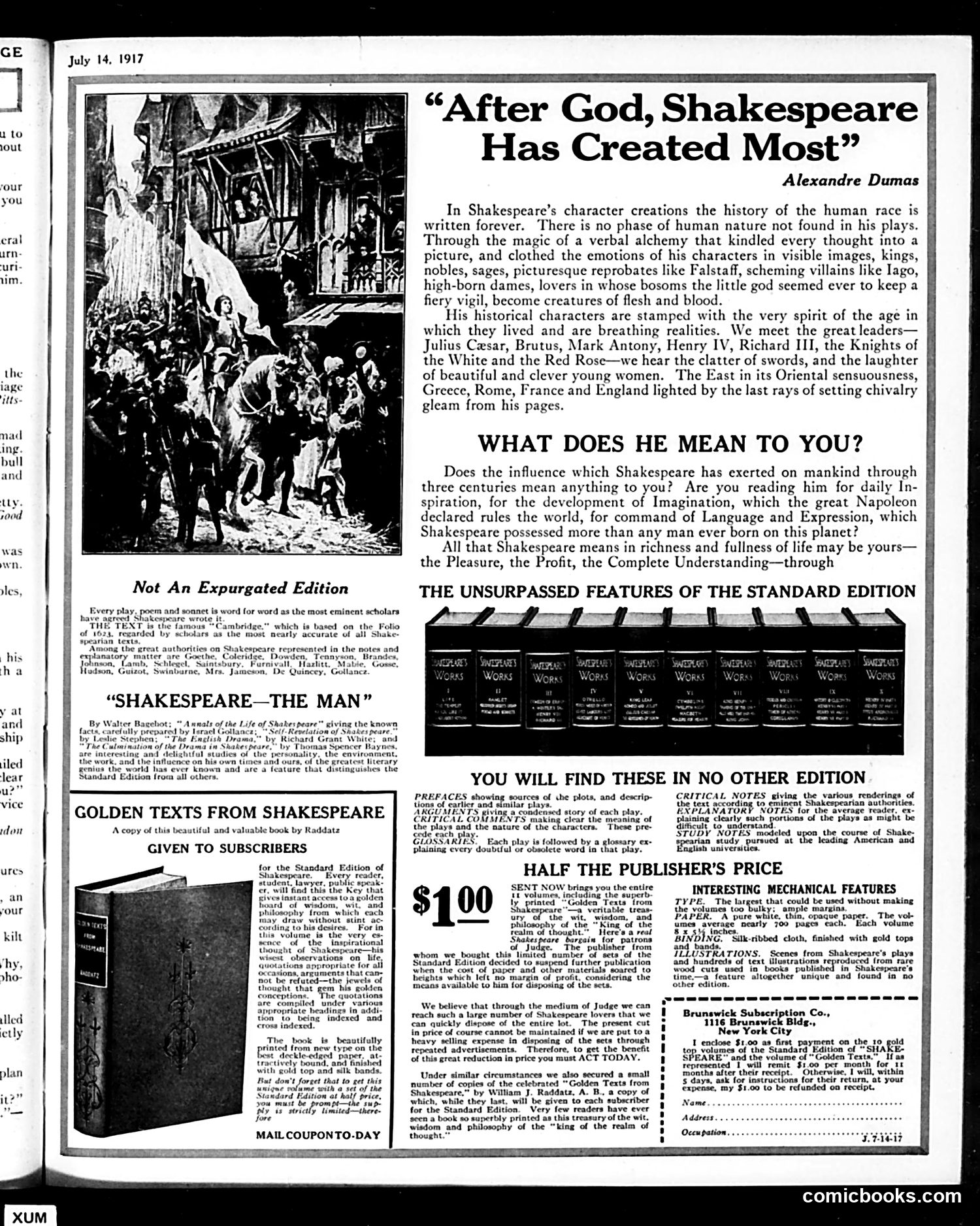
This page is **primarily advertising**, not satire. It promotes the "Standard Edition" of Shakespeare's complete works via the Brunswick Subscription Company. The quote from Alexandre Dumas ("After God, Shakespeare Has Created Most") frames Shakespeare as near-divine in cultural importance—a common Romantic-era reverence. The advertisement emphasizes the edition's scholarly credibility through appeals to academic authority and "eminent scholars." The "Golden Texts from Shakespeare" premium gift and repeated assertions that features appear "in no other edition" use marketing psychology typical of subscription sales. The price ($1.00 for initial payment, with installment options) targets middle-class readers seeking cultural refinement. The phrase "Not An Expurgated Edition" is notable—it suggests some editions removed "objectionable" content, implying this version preserves Shakespeare's complete, unfiltered text. This reflects early 20th-century debates over whether classic literature should be "cleaned up" for respectable audiences. The page reflects how publishers marketed literature as both intellectual and profitable commodities.