
Judge, 1917-07-14 · page 4 of 27
Judge — July 14, 1917 — page 4: what you’re looking at
What you’re looking at
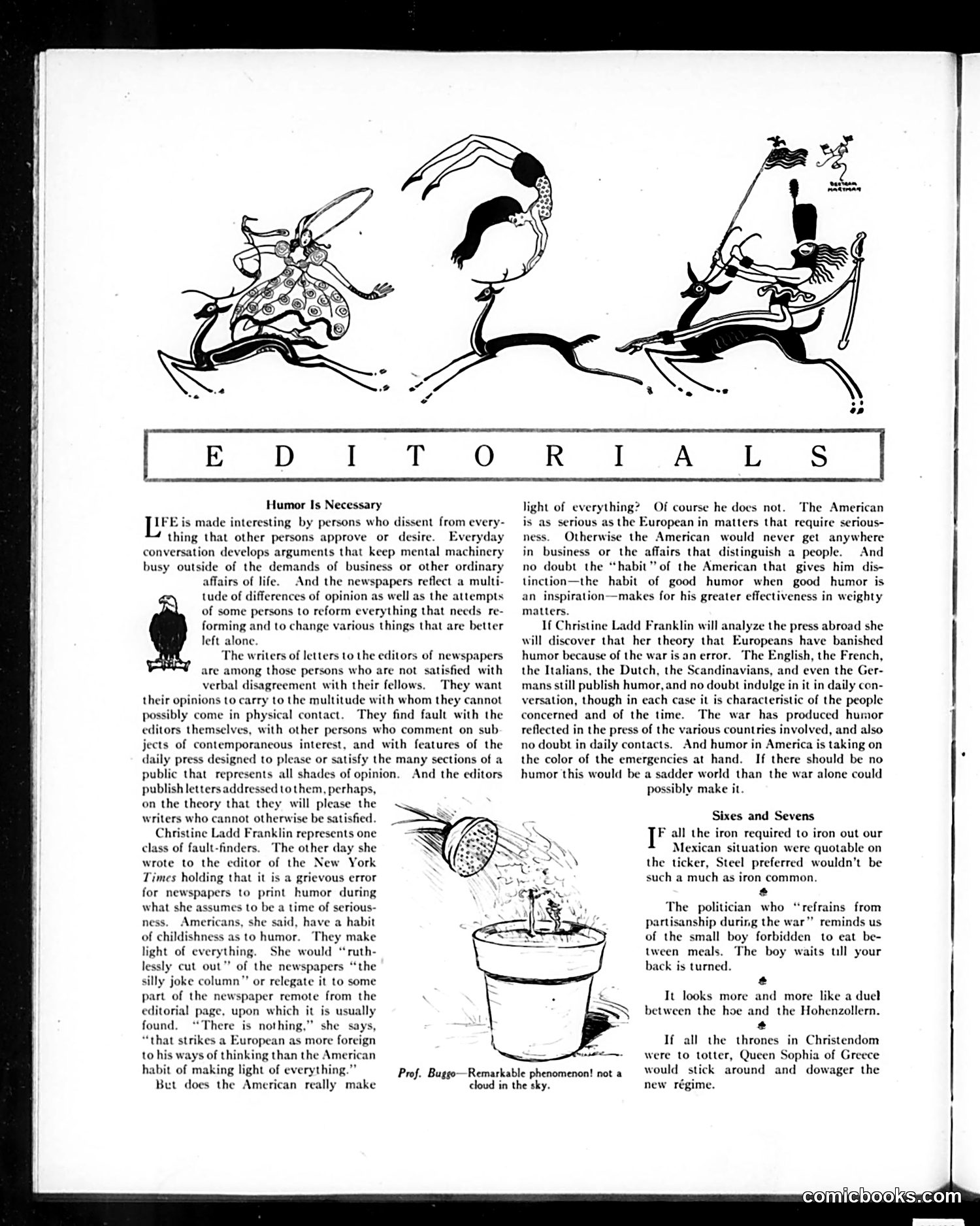
This editorial page from *Judge* magazine contains three main sections: **"Humor Is Necessary"** argues that Americans uniquely value humor and levity in serious times, contrasting this with European seriousness. The piece defends humor's role in public discourse. **"Sixes and Sevens"** offers brief satirical quips about contemporary issues, likely referencing World War I (mentions "Mexican situation," "partisanship during the war," and "thrones in Christendom"). One joke plays on a politician's "refrains from partisanship." The decorative header illustration shows stylized figures in animated poses—likely generic representations of comedic characters rather than specific political figures. The small illustration labeled "Prof. Bugge" depicts someone observing a peculiar cloud phenomenon, presenting an absurdist joke about weather observation.
📄 Transcribed text from this page (OCR, searchable)
Machine-transcribed from the original scan — historical spelling and the odd misread are preserved.
iT Humor Is Necessary IFE is made interesting by persons who dissent from every- thing that other persons approve or desire. Everyday conversation develops arguments that keep mental machinery busy outside of the demands of business or other ordinary affairs of life. And the newspapers reflect a multi- tude of differences of opinion as well as the attempts of some persons to reform everything that needs re- forming and to change various things that are better left alone. The writers of letters to the editors of newspapers are among those persons who are not satisfied with verbal disagreement with their fellows. They want their opinions to carry to the multitude with whom they cannot possibly come in physi contact. They find fault with the editors themselves, with other persons who comment on sub jects of contemporaneous interest, and with features of the daily press designed to please or satisfy the many sections of a public that represents all shades of opinion. And the editors publish lettersaddressed tothem, perhaps, on the theory that they will please the writers who cannot otherwise be satisfied. ine Ladd Franklin represents one class of fault-finders. The other day she wrote to the editor of the New York Times holding that it is a grievous error for newspapers to print humor during what she assumes to be a time of serious- ness. Americans, she said, have a habit of childishness as to humor. They make light of everything. She would “ruth- lessly cut out” of the newspapers “the joke column” or relegate it to some part of the newspaper remote from the editorial page, upon which it is usually found. ‘There is nothing,” she say: ba strikes a European as more foreign to his ways of thinking than the American habit of making light of everything.” But does the American really make Ch Prof. Buggo—Remarkable phenomenon! not a cloud in the sky. light of everything? Of course he does not. The American is as serious as the European in matters that require serious- ness. Otherwise the American would never get anywhere in business or the affairs that distinguish a people. And no doubt the “habit” of the American that gives him dis- tinction—the habit of good humor when good humor is an inspiration—makes for his greater effectiveness in weighty matters. If Christine Ladd Franklin will analyze the press abroad she will discover that her theory that Europeans have banished humor because of the war is an error. The English, the French, ns, the Dutch, the Scandinavians, and even the Ger- mans still publish humor, and no doubt indulge in it in daily con- versation, though in each case it is characteristic of the people concerned and of the time. The war has produced humor reflected in the press of the various countries involved, and also no doubt in daily contacts. And humor in America is taking on the color of the emergencies at hand. If there should be no humor this would be a sadder world than the war alone could possibly make it. Sixes and Sevens IF all the iron required to iron out our Mexican situation were quotable on the ticker, Steel preferred wouldn’t be such a much as iron common. rd The politician who “refrains from partisanship during the war” reminds us of the small boy forbidden to eat be- tween meals. The boy waits ull your back is turned. 2 It looks more and more like a duel between the h: nd the Hohenzollern. * If all the thrones in Christendom were to totter, Queen Sophia of Greece would stick around and dowager the new régime.