
Judge, 1917-07-14 · page 18 of 27
Judge — July 14, 1917 — page 18: what you’re looking at
What you’re looking at
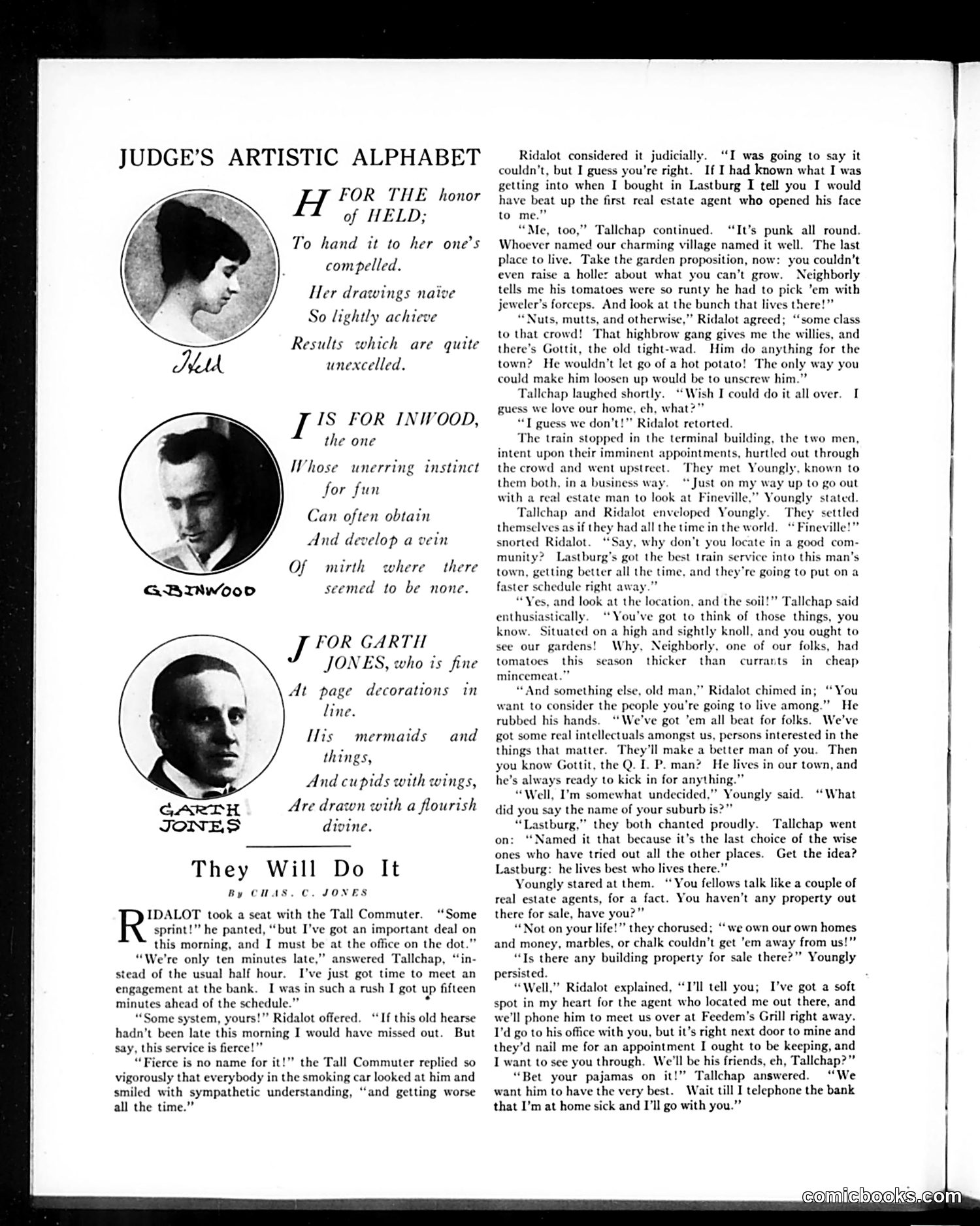
This page contains two satirical pieces from *Judge* magazine: **"Judge's Artistic Alphabet"** is a lighthearted tribute to illustrators H[ill], G.B. Inwood, and Garth Jones, praising their artistic contributions. **"They Will Do It"** is the main satire. Two commuters complaining about train delays and their suburb "Lastburg" encounter a third man considering moving to "Fineville." The two immediately launch into aggressive salesmanship, inverting their earlier complaints: suddenly Lastburg has excellent train service, beautiful gardens, and sophisticated residents. The satire mocks suburban boosterism and dishonest real estate promotion—how people will enthusiastically oversell their own communities to persuade newcomers to move there, despite privately acknowledging the town's actual shortcomings. The irony is that Ridalot and Tallchap seamlessly switch from genuine complaints to transparent exaggeration within minutes, representing how self-interest shapes public promotion of suburban living.
📄 Transcribed text from this page (OCR, searchable)
Machine-transcribed from the original scan — historical spelling and the odd misread are preserved.
JUDGE’S ARTISTIC ALPHABET FOR THE honor of HELD; To hand it to her one’s compelled. Her drawings naive So lightly achieve Results which are quite unexcelled. IS FOR INIVOOD, the one Whose unerring instinct for fun Can often obtain And develop a vein — Of mirth where there GBmMwooo seemed to be none. FOR GARTH JONES, who is fine At page decorations in line. Ilis | mermaids and things, And cupids with wings, ¢ARLDH Are drawn with a flourish JONES divine. They Will Do It By CHAS, ©. JONES IDALOT took a seat with the Tall Commuter. ‘Some R sprint!” he panted, “but I’ve got an important deal on this morning, and I must be at the office on the dot.” “We're only ten minutes late,” answered Tallchap, “in- stead of the usual half hour. I’ve just got time to meet an engagement at the bank. I was in such a rush I got up fifteen minutes ahead of the schedule.” . “Some system, yours!" Ridalot offered. “If this old hearse hadn’t been late this morning I would have missed out. But say, this service is fierce!” “Fierce is no name for it!” the Tall Commuter replied so vigorously that everybody in the smoking car looked at him and smiled with sympathetic understanding, ‘‘and getting worse all the time.” Ridalot considered it judicially. ‘‘I was going to say it couldn’t, but I guess you’re right. If I had known what I was getting into when I bought in Lastburg I tell you I would have beat up the first real estate agent who opened his face to me.” “Me, too,” Tallchap continued. ‘It’s punk all round. Whoever named our charming village named it well. The last place to live. Take the garden proposition, now: you couldn't even raise a holler about what you can’t grow. Neighborly tells me his tomatoes were so runty he had to pick 'em with jeweler’s forceps. And look at the bunch that lives there!” “Nuts, mutts, and otherwise,” Ridalot agreed; ‘‘some class to that crowd! That highbrow gang gives me the willies, and there’s Gottit, the old tight-wad. Him de ything for the town? He wouldn't let go of a hot potato! The only way you could make him loosen up would be to unscrew him.” Tallchap laughed shortly. h I could do it all over. I guess we love our home, ch, what? “T guess we don’t!” Ridalot retorted. The train stopped in the terminal building, the two men, intent upon their imminent appointments, hurtled out through the crowd and went upstreet. They met Youngly, known to them both, in a business way. “Just on my way up to go out with a real estate man to look at Fineville,”” Youngly stated. Tallchap and Ridalot enveloped Youngly. They settled themselves as if they had all the time in the world.“ Fineville!” snorted Ridalot y, why don’t you locate in a good com- munity? Lastburg’s got the best train service into this man's town, getting better all the time, and they're going to put on a faster schedule right away.” Yes, and look at the location, and the soil!” Tallchap said enthusiastically. ‘* You've got to think of those things, you know. Situated on a high and sightly knoll, and you ought to see our gardens! Why, Neighborly, one of our folks, had tomatoes this season thicker than currants in cheap mincemeat.” “And something else, old man,” Ridalot chimed in; “You want to consider the people you're going to live among.” He rubbed his hands. ‘We've got ‘em all beat for folks. We've got some real intellectuals amongst us, persons interested in the things that matter. They'll make a better man of you. Then sottit, the Q. I. P. man? He lives in our town, and ready to kick in for anything.” Youngly said. ‘What 3" you know he’s al “Well, I’m somewhat undecided. did you say the name of your suburb “Lastburg,” they both chanted proudly. Tallchap went on: ‘Named it that because it’s the last choice of the wise ones who have tried out all the other places. Get the idea? Lastburg: he lives best who lives there.” Youngly stared at them. ‘You fellows talk like a couple of real estate agents, for a fact. You haven’t any property out there for sale, have you?” “Not on your life!” they chorused; own our own homes and money, marbles, or chalk couldn't get ‘em away from us!” “Ts there any building property for sale there?” Youngly persisted. “Well,” Ridalot explained, “I'll tell you; I’ve got a soft spot in my heart for the agent who located me out there, and we'll phone him to meet us over at Feedem’s Grill right away. I'd go to his office with you, but it’s right next door to mine and they’d nail me for an appointment I ought to be keeping, and I want to see you through. We'll be his friends, eh, Tallchap?” “Bet your pajamas on it!” Tallchap answered. “We want him to have the very best. Wait till I telephone the bank that I’m at home sick and I'll go with you.”