
Judge, 1917-07-14 · page 19 of 27
Judge — July 14, 1917 — page 19: what you’re looking at
What you’re looking at
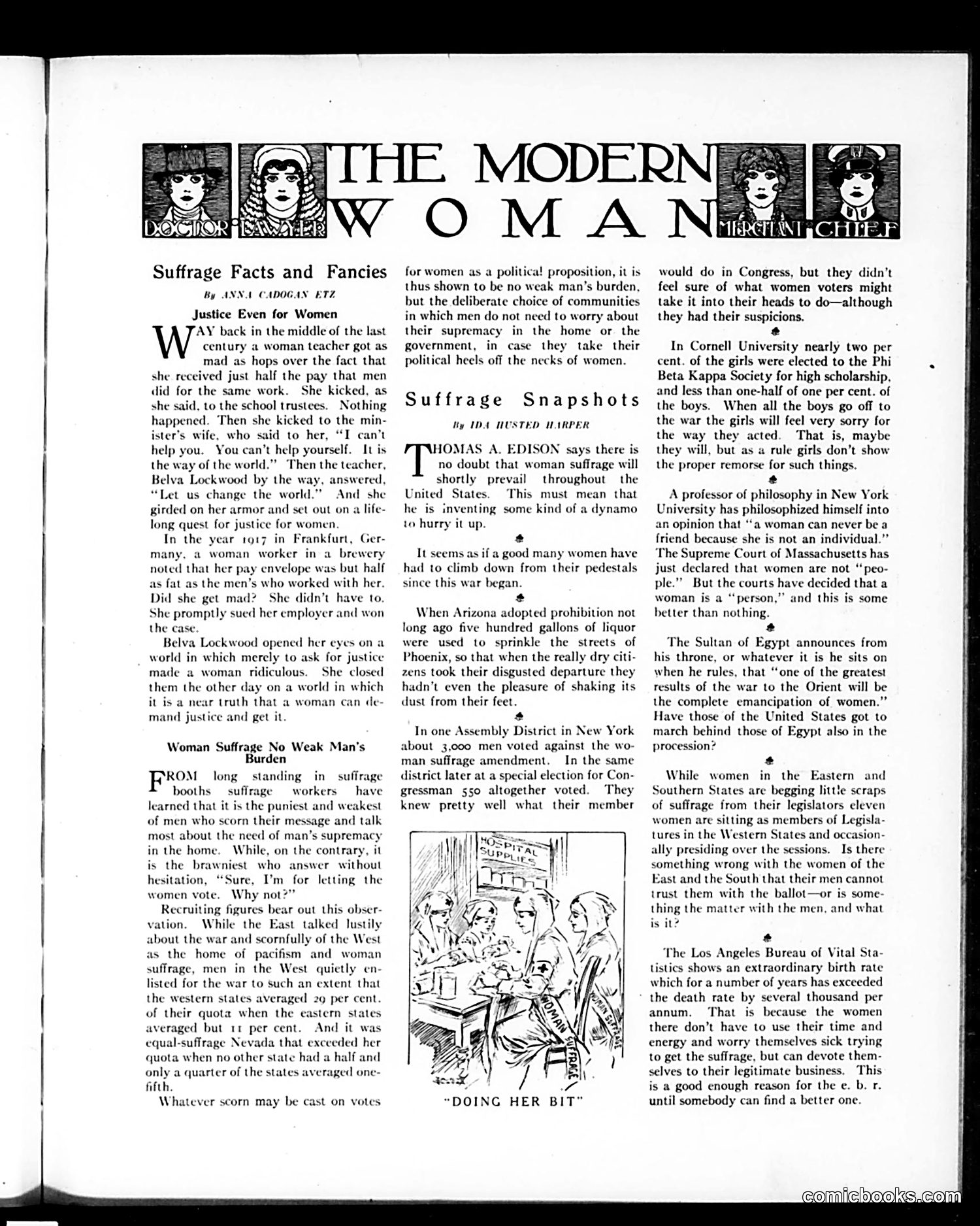
This page from *Judge* magazine presents pro-suffrage arguments through articles and a cartoon titled "Doing Her Bit." **The Articles:** Written by Anna Cadogan Utz and Ida Husted Harper, they counter anti-suffrage claims. They argue that woman suffrage isn't a "weak man's burden" but supported by strong communities (citing Nevada and western states' military enlistment records). They highlight the hypocrisy of men claiming women shouldn't vote while opposing equal pay—using Belva Lockwood's 19th-century fight for equal teacher wages as historical precedent. **The Cartoon:** "Doing Her Bit" depicts women at what appears to be a suffrage information booth, ironically suggesting women are already doing civic work. The satire implies that if women are trusted with wartime duties, denying them voting rights is unjust. **Context:** Published during WWI, this argues suffrage is logical given women's demonstrated responsibility and competence—a common suffragist strategy of the era.
📄 Transcribed text from this page (OCR, searchable)
Machine-transcribed from the original scan — historical spelling and the odd misread are preserved.
Suffrage Facts and Fancies By ANNA CADOGAN ETZ Justice Even for Women Y back in the middle of the last W century a woman teacher got as mad as hops over the fact that she received just half the pay that men did for the same work. She kicked, as she said, to the school trustees. Nothing happened. Then she kicked to the min ister’s wife, who said to her, “I can’t help you. You can’t help yourself. It is the way of the world.” Then the teacher, Belva Lockwood by the way, answered, “Let us change the world.” And she girded on her armor and set out on a life- long quest for justice for women. In the year 1917 in Frankfurt, Ger- many, a woman worker in a brewery noted that her pay envelope was but half as fat as the men’s who worked with her. Did she get mad? She didn’t have to. She promptly sued her employer and won the case. Belva Lockwood opened her eyes on a world in which merely to ask for justice made a woman ridiculous. She closed them the other day on a world in which it is a near truth that a woman can de- mand justice and get it. Woman Suffrage No Weak Man's urden ROM long standing in suffrage booths = suffrage — workers ave learned that it is the puniest and weakest of men who scorn their message and talk most about the need of man’s supremacy in the home. While, on the contrary, it is the brawniest who answer without hesitation, “Sure, I’m for letting the women vote. Why not?” Recruiting figures b out this obser- vation. While the East talked lustily about the war and scornfully of the West as the home of pacifism and woman suffrage, men in the West quietly en- listed for the war to Such an extent that the western st 1 29 per cent of their quota when the eastern states averaged but 11 per cent. And it was equal-suffrage Nevada that exceeded her quota when no other state had a half and only a quarter of the states averaged one- fifth. What r scorn may be cast on votes for women as a politica! proposition, it is thus shown to be no weak man’s burden, but the deliberate choice of communities in which men do not need to worry about their supremacy in the home or the government, in case they take their political heels off the necks of women. Suffrage Snapshots By IDA HUSTED HARPER IHOMAS A. EDISON says there is no doubt that woman suffrage will shortly prevail throughout the United States. This must mean that he is inventing some kind of a dynamo to hurry it up. ¢ It seems as if a good many women have had to climb down from their pedestals. since this war began. + When Arizona adopted prohibition not long ago five hundred gallons of liquor were used to sprinkle the streets of Phoenix, so that when the really dry citi- zens took their disgusted departure they hadn’t even the pleasure of shaking its dust from their feet. s In one Assembly District in New York about 3,000 men voted against the wo- man suffrage amendment. In the same district later at a special election for Con- gressman 550 altogether voted. They knew pretty well what their member would do in Congress, but they didn’t feel sure of what women voters might take it into their heads to do—although they had their suspicions. e In Cornell University nearly two per cent. of the girls were elected to the Phi Beta Kappa Society for high scholarship, and less than one-half of one per cent. of the boys. When all the boys go off to the war the girls will feel very sorry for the way they acted. That is, maybe they will, but as # rule girls don’t show the proper remorse for such things. ¢ A professor of philosophy in New York University has philosophized himself into an opinion that ‘a woman can never be a friend because she is not an individual.” The Supreme Court of Massachusetts has just declared that women are not “peo- ple.” But the courts have decided that a woman is a “person,” and this is some better than nothing. ¢ The Sultan of Egypt announces from his throne, or whatever it is he sits on when he rules, that “one of the greatest results of the war to the Orient will be the complete emancipation of women.” Have those of the United States got to march behind those of Egypt also in the procession? * While women in the Eastern and Southern States are begging litt raps of suffrage from their legislators eleven women are sitting as members of Legisla- tures in the Western States and occasion- ally presiding over the sessions. Is there something wrong with the women of the Sast and the South that their men cannot trust them with the ballot—or is some- thing the matter with the men, and what is it? * The Los Angeles Bureau of Vital Sta- tistics shows an extraordinary birth rate which for a number of years has exceeded the death rate by several thousand per annum. That because the women there don’t have to use their time and energy and worry themselves sick trying to get the suffrage, but can devote them- selves to their legitimate business. This is a good enough reason for the e. b. r. until somebody can find a better one.