
A complete issue · 28 pages · 1917
Judge — March 17, 1917
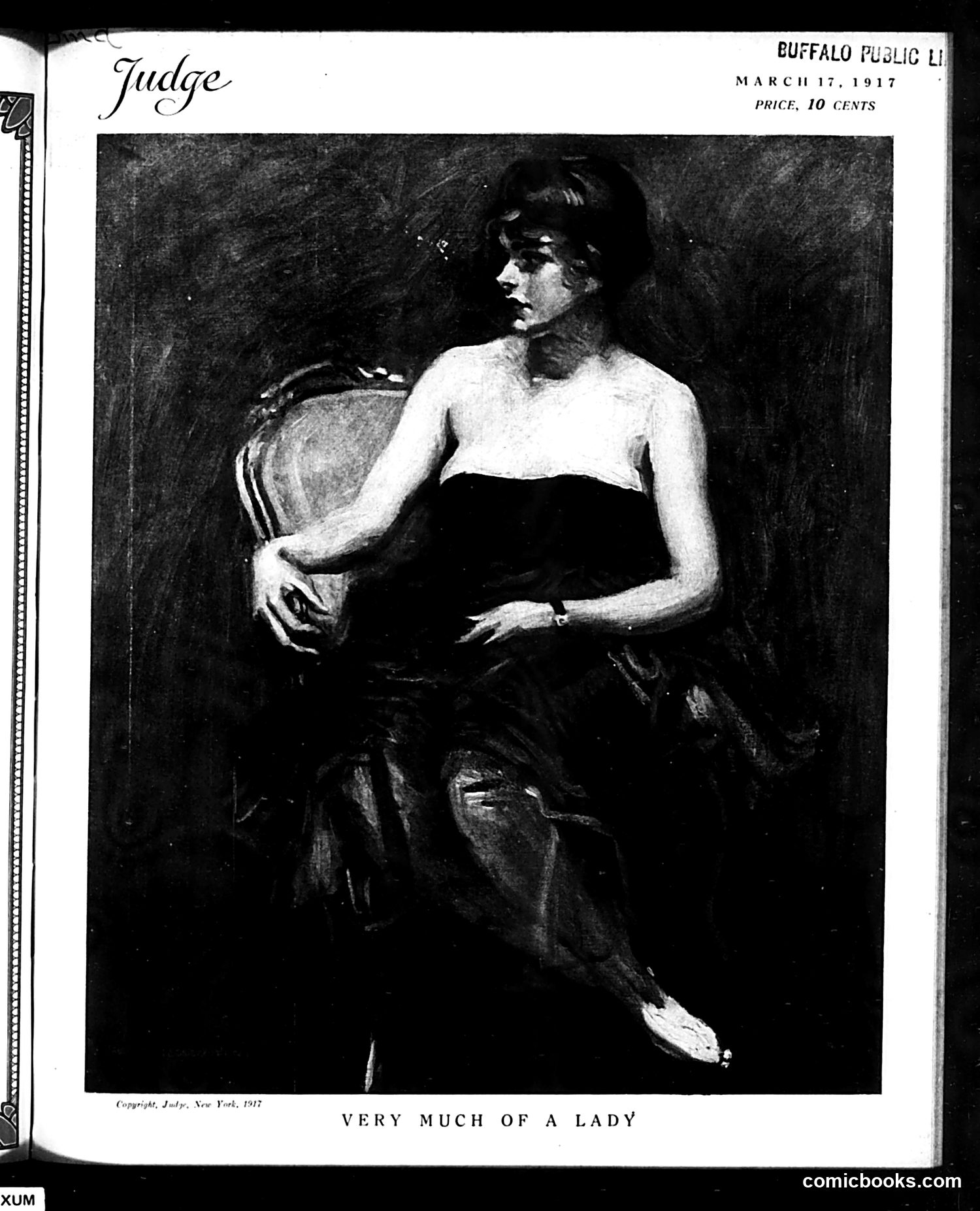
This is a portrait illustration rather than a political cartoon. The image shows a woman in elegant early 20th-century attire—a black strapless gown with bare shoulders—posed with refined composure. She holds what appears to be a decorative fan or similar accessory. The caption "Very Much of a Lady" appears to be satirical commentary on social pretension. Given Judge magazine's satirical nature, this likely mocks either affected sophistication, class pretension, or specific social attitudes of 1917. Without additional context identifying the subject, the exact target of the satire remains unclear. The composition and styling suggest it may reference a public figure or social type recognizable to contemporary readers.
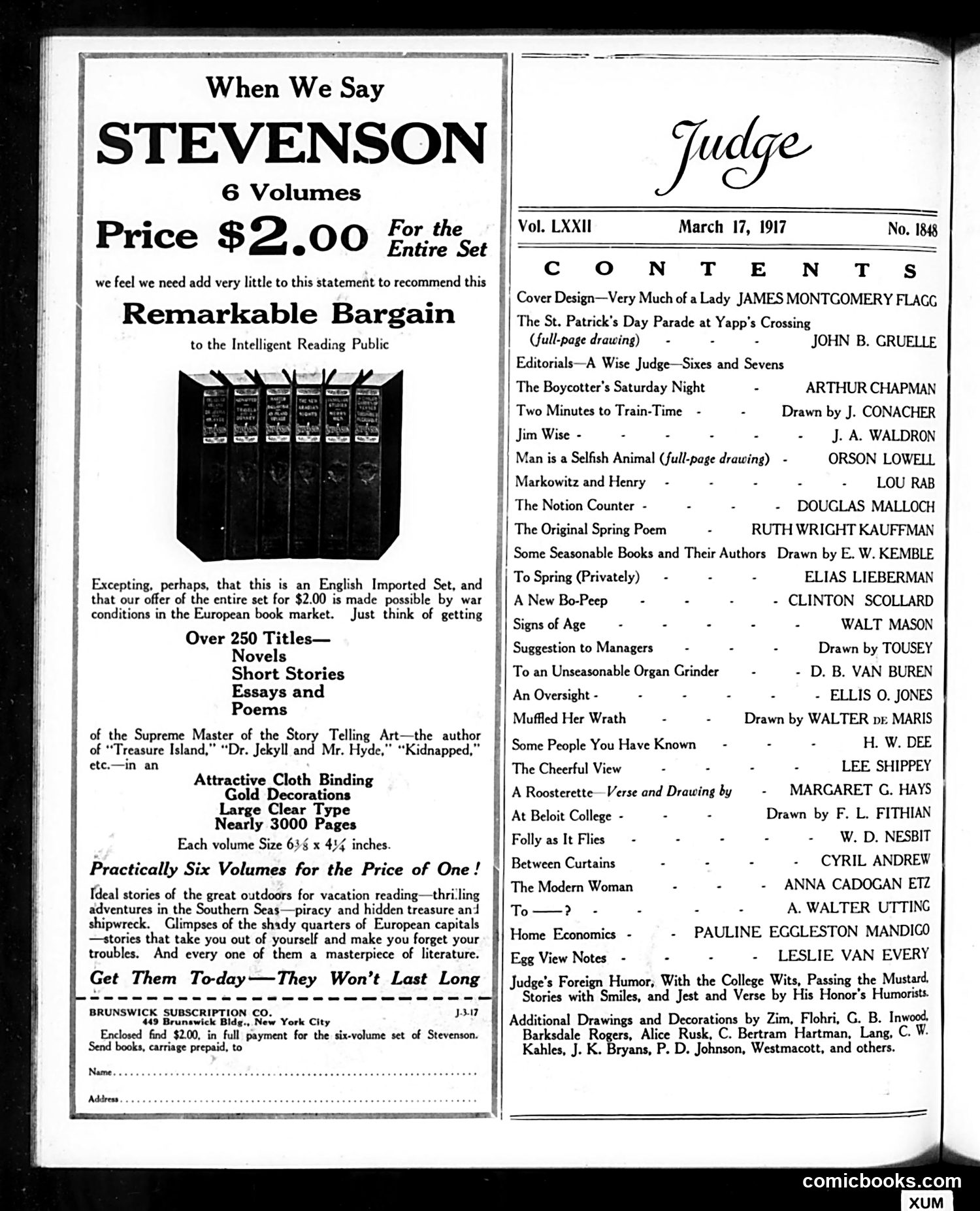
This page is primarily **advertising and table of contents**. The left side advertises a six-volume Stevenson collection for $2.00—positioned as a bargain. The right side lists Judge's contents for this issue. The magazine's cover features "Very Much of a Lady" by James Montgomery Flagg, and includes editorial content titled "A Wise Judge—Sixes and Sevens," suggesting commentary on contemporary issues. Other pieces include "The Boycotter's Saturday Night" and "Man is a Selfish Animal," indicating the magazine's satirical approach to social behavior. Published March 17, 1917—just weeks before America entered World War I—the magazine would likely contain period-relevant social and political satire, though specific cartoon details aren't clearly visible in this reproduction.
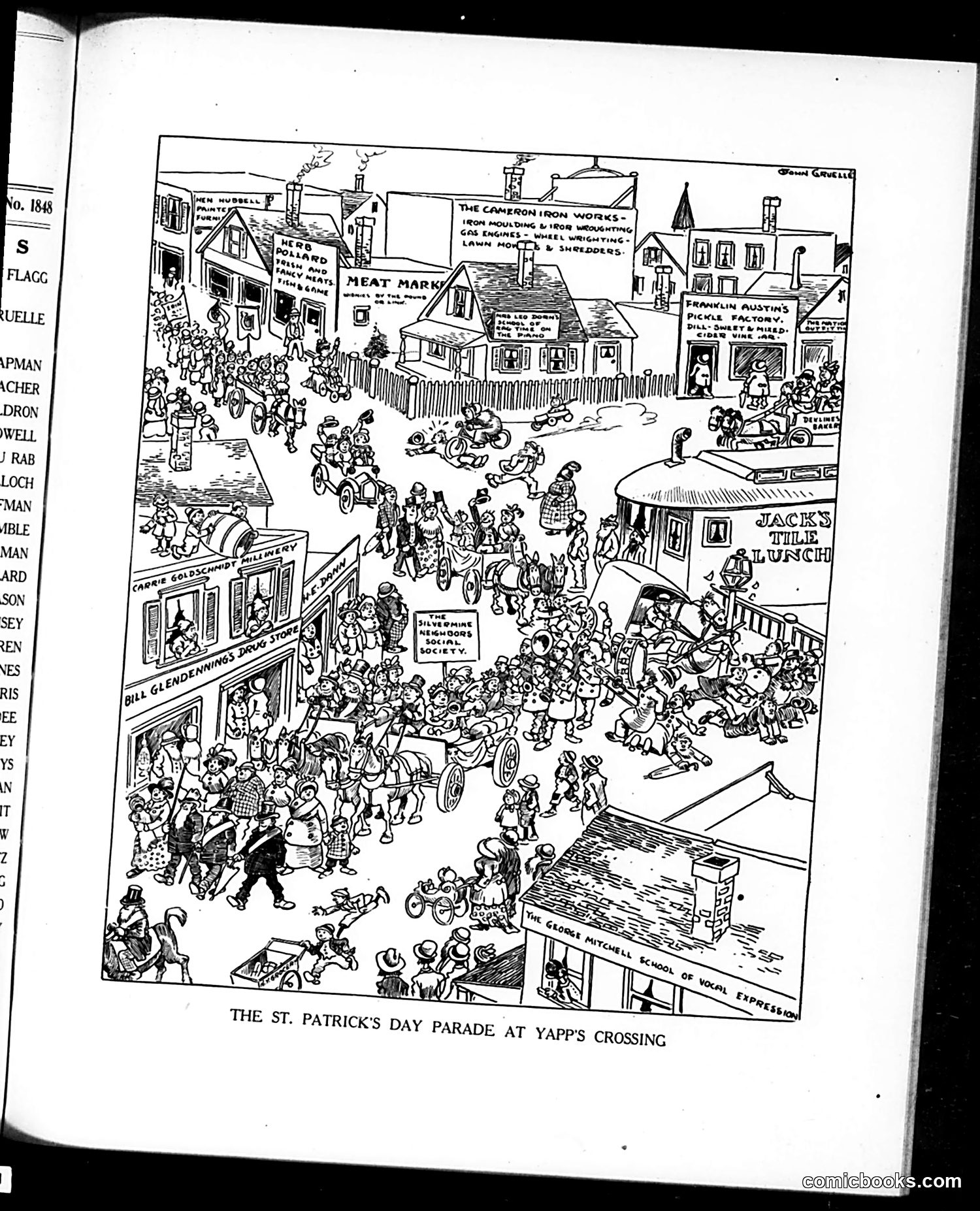
This is a humorous illustration depicting a crowded St. Patrick's Day celebration in what appears to be a small town called "Yapps Crossing." The cartoon satirizes Irish-American holiday festivities through exaggerated, chaotic detail—masses of people, children on tricycles, vendors (including "Jack's Tile Lunch"), and various establishments like "The Cameron Iron Works" and "Pickle Factory." The satire likely mocks the commercialization of St. Patrick's Day and the rowdy, disorderly nature of public celebrations in early 20th-century America. The densely packed scene with its mix of commerce and chaos suggests Judge magazine's critique of ethnic holiday culture and small-town American life—poking fun at both Irish-American traditions and broader commercialization of cultural events.
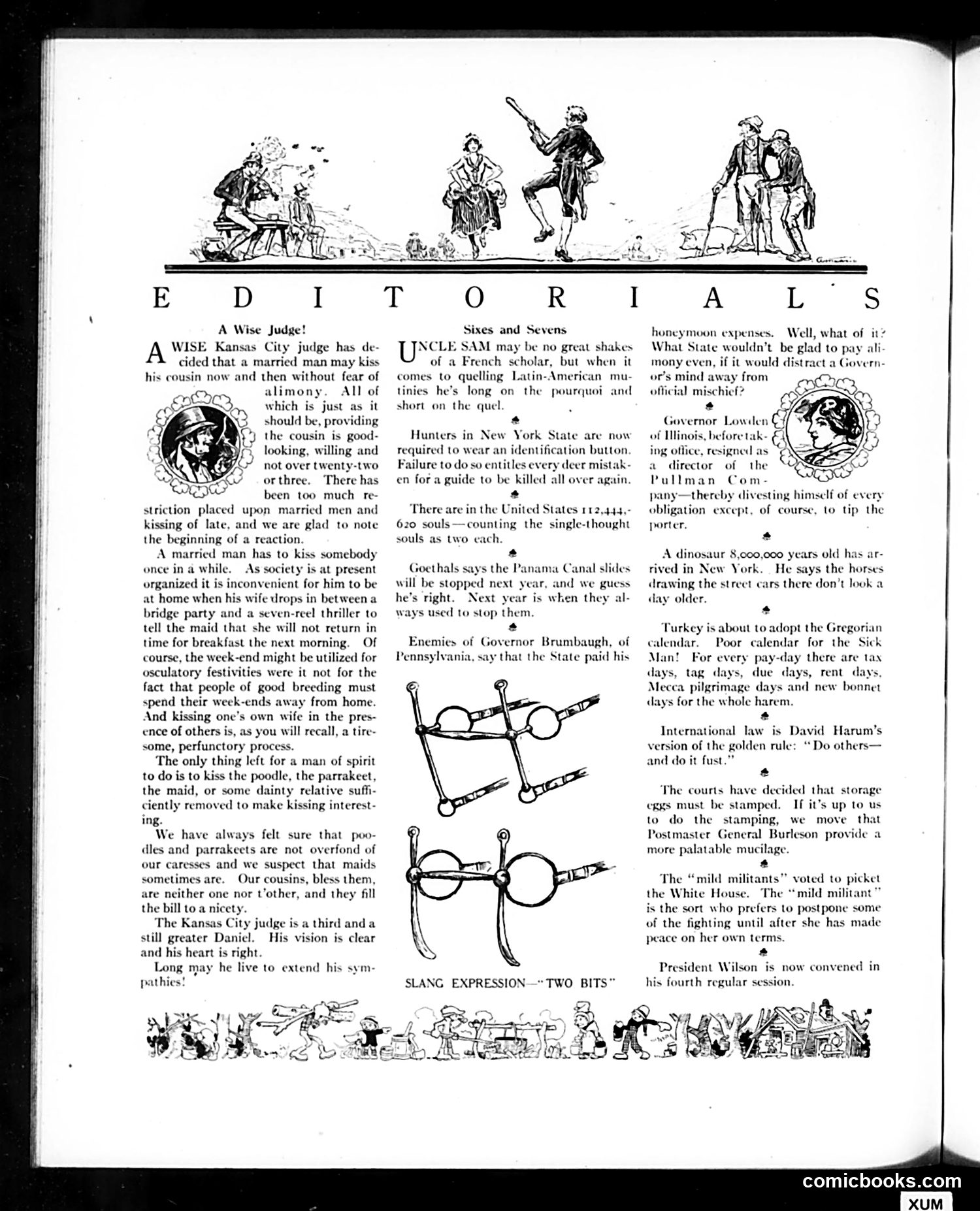
This is an editorials and humor page from Judge magazine featuring several satirical pieces on contemporary issues. The main column "A Wise Judge!" discusses a Kansas City judge's ruling permitting married men to kiss their wives without fear of legal action—a humorous commentary on social propriety and marriage law. "Sixes and Sevens" contains various brief satirical items: mocking Uncle Sam's ignorance compared to French scholars, commenting on New York hunting regulations, and criticizing Governor Lowden of Illinois for resigning as Pullman Company director while remaining involved. The page includes physical gag illustrations labeled "Slang Expression—Two Bits" showing eyeglass-like devices with extended handles—visual puns on the phrase "two bits" (slang for 25 cents). The items reflect early 20th-century American political and social concerns, though precise dating is unclear from the visible text.
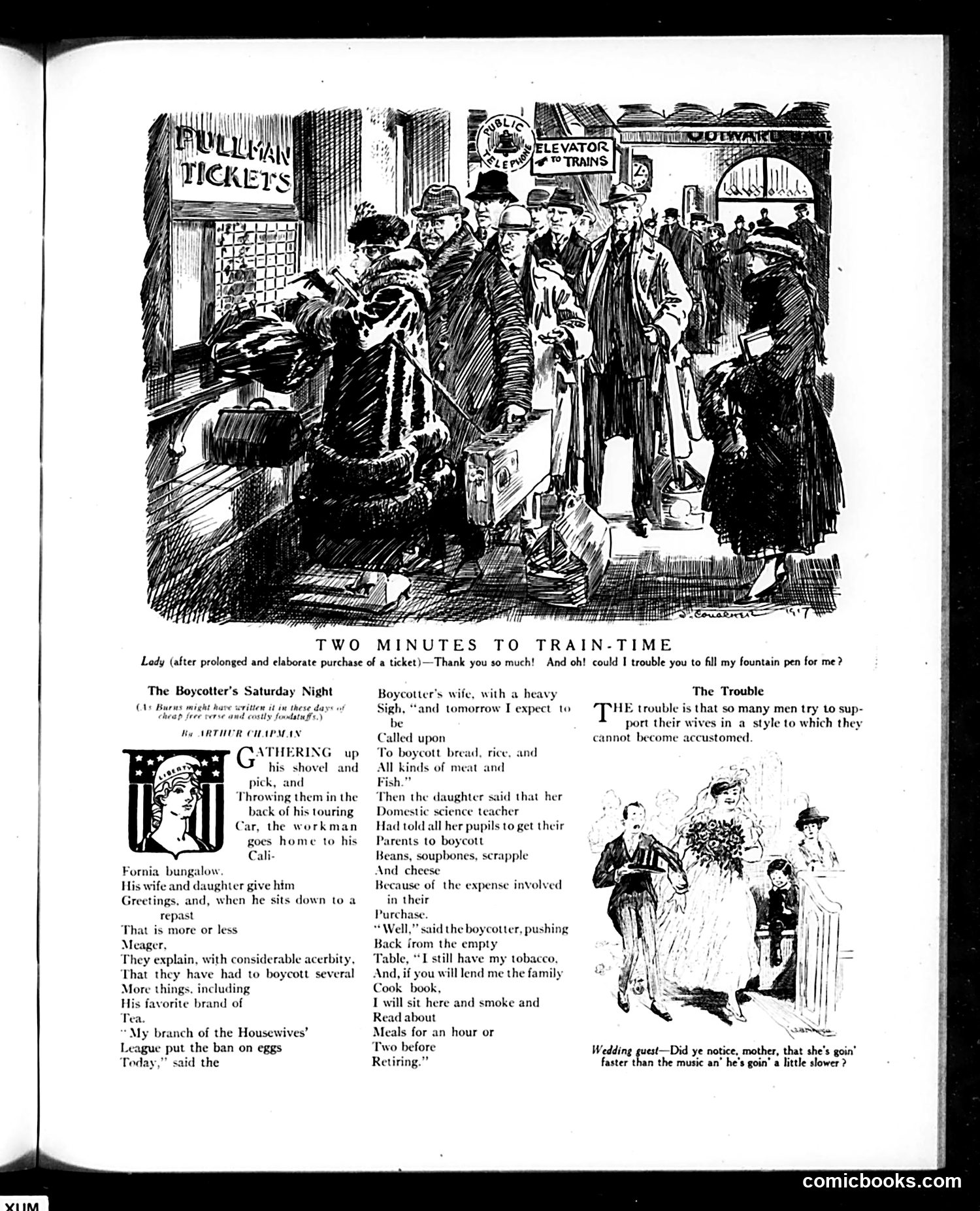
The top cartoon depicts a crowded train station ticket office where a well-dressed woman has made an elaborate, time-consuming purchase. The satire targets the social expectation that wives should be supported in a particular lifestyle—the woman's lengthy transaction (requiring her husband to "fill my fountain pen") exemplifies how such domestic expenses burden men. The accompanying text pieces satirize a "boycotter" husband who attempts to control household spending by boycotting various goods (meat, fish, tea, eggs), only to discover his wife's purchases still exceed his expectations. The humor mocks both the husband's futile attempts at domestic economy and the wife's inability or unwillingness to reduce spending. This reflects early 20th-century gender tensions around household finances and marital authority.
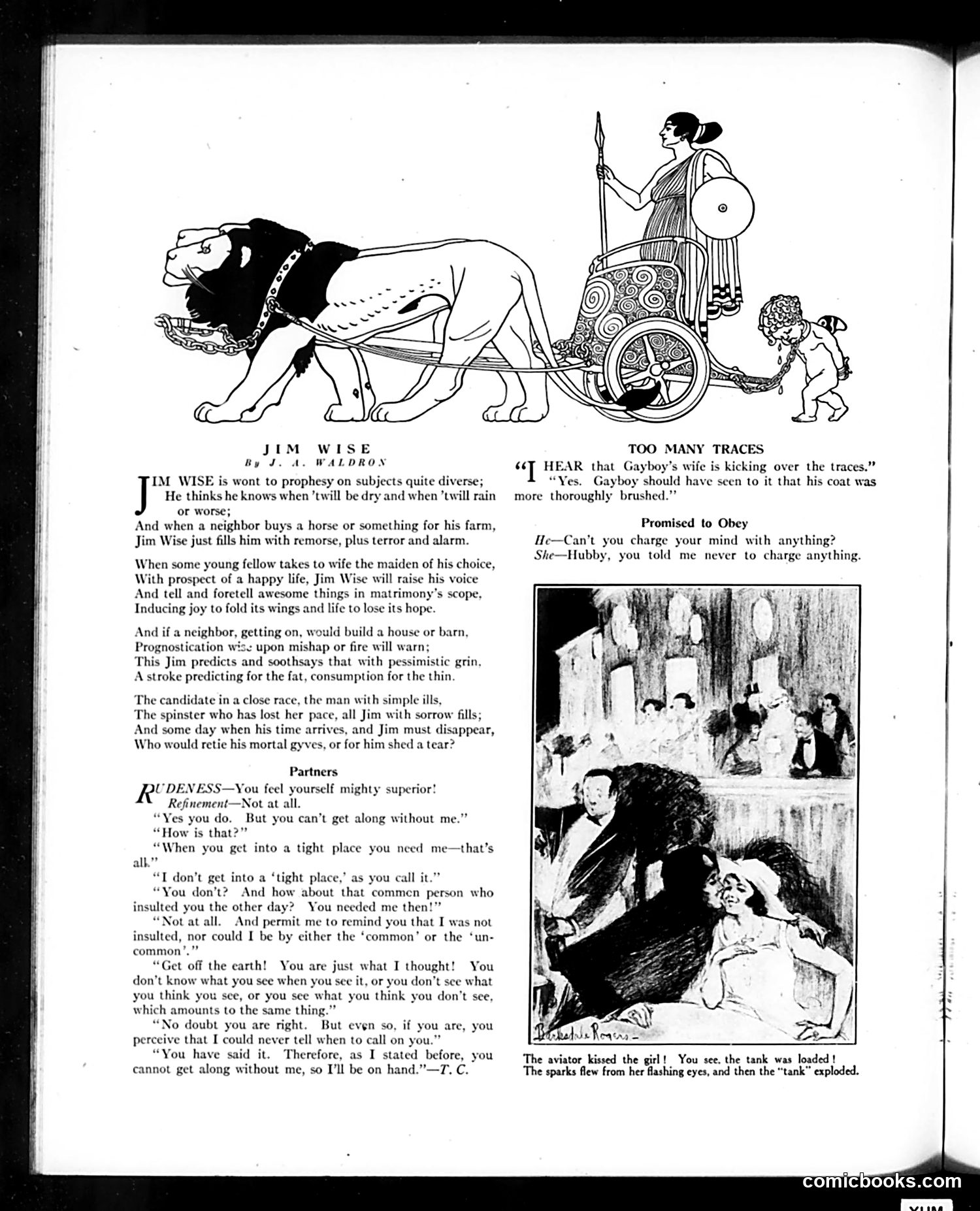
This page contains two unrelated pieces of satirical content: **"Jim Wise"** (top): A poem mocking a rural character prone to making pessimistic predictions about weather, farming, and relationships. The illustration shows Jim harnessed like a beast of burden, pulled by a woman warrior (likely representing Fate or female authority), satirizing his powerlessness and doom-saying nature. **"Too Many Traces"** and **"Promised to Obey"** (bottom): Brief joke dialogues about domestic conflict and an explosion. The accompanying illustration depicts what appears to be a violent domestic incident involving tanks or mechanical devices, though the specific satirical target remains unclear without additional context. The page represents typical Judge magazine fare: social commentary through caricature and wordplay, targeting masculine insecurity and marital discord.
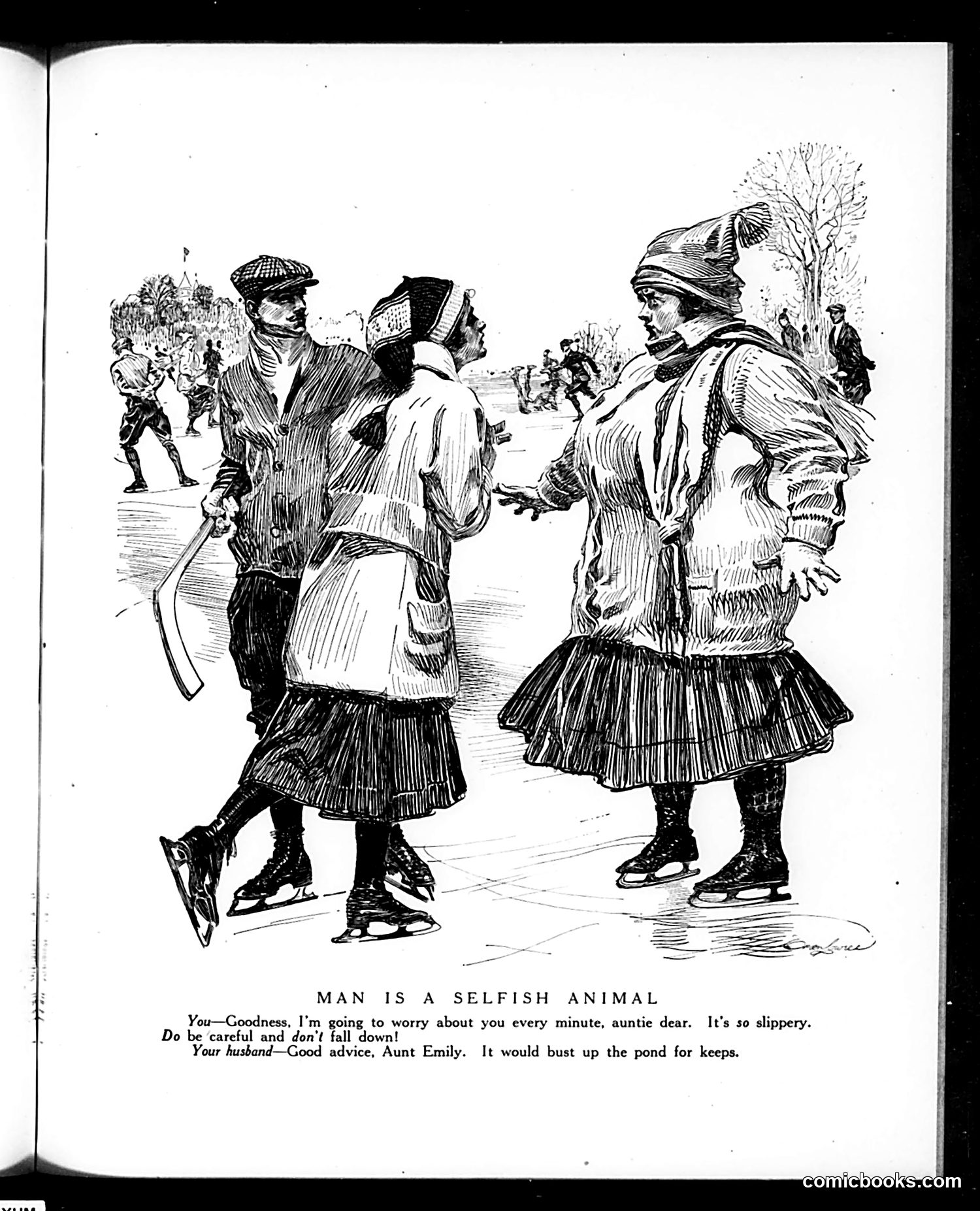
This cartoon satirizes male selfishness and hypocrisy. The scene depicts ice skating, where a woman (presumably a niece, "auntie dear") expresses concern for her aunt's safety on the slippery ice. However, the husband's response reveals his true priorities: he's not worried about his wife falling—he's concerned that if she falls through the ice, it will damage the pond, which appears to be his property or recreation source. The joke exposes the title's thesis: the husband masks indifference to his wife's safety behind practical concern, revealing that his real worry is material loss, not her welfare. This reflects Victorian-era gender dynamics and critiques male self-centeredness disguised as reasonable advice.
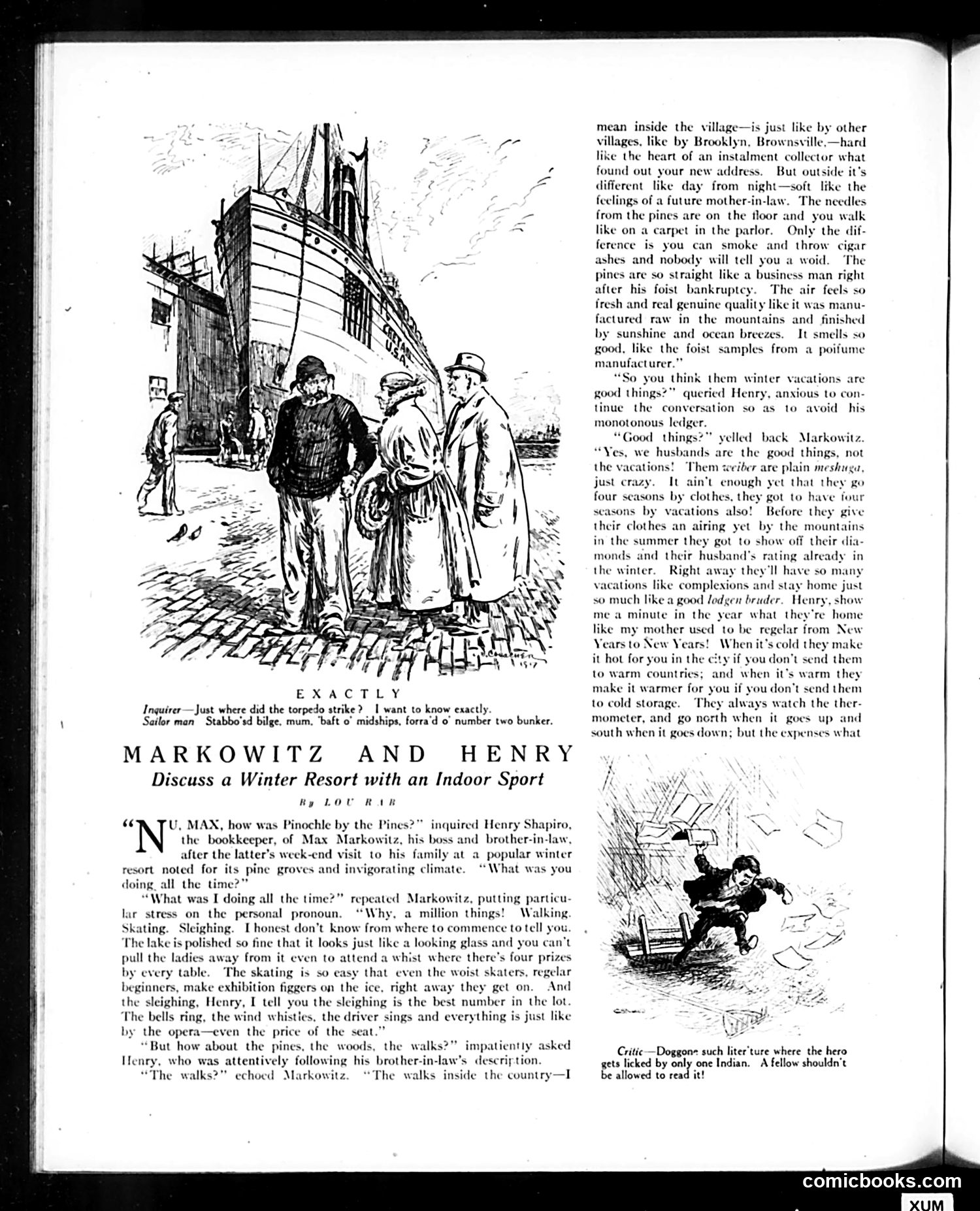
This is a humorous piece from *Judge* magazine featuring two Jewish characters—Max Markowitz (a businessman) and Henry Shapiro (his bookkeeper)—discussing a winter vacation at a pine-grove resort. **The Satire:** Markowitz enthusiastically describes the resort's natural beauty using exaggerated, malapropism-filled Yiddish-inflected English ("regelar," "meshuga," "foist"). Henry then asks about the actual point—the walks and woods—revealing the joke: Markowitz spent the whole time indoors playing cards (Pinochle), not enjoying nature. The secondary joke mocks wives who demand constant vacations to different climates, always complaining about temperature regardless of the season. **The "Exactly" panel** is unrelated political commentary about WWI naval warfare. The tone is affectionate ethnic humor typical of early 20th-century American comedy, depicting working-class Jewish immigrants with distinctive speech patterns as sympathetic, relatable figures.
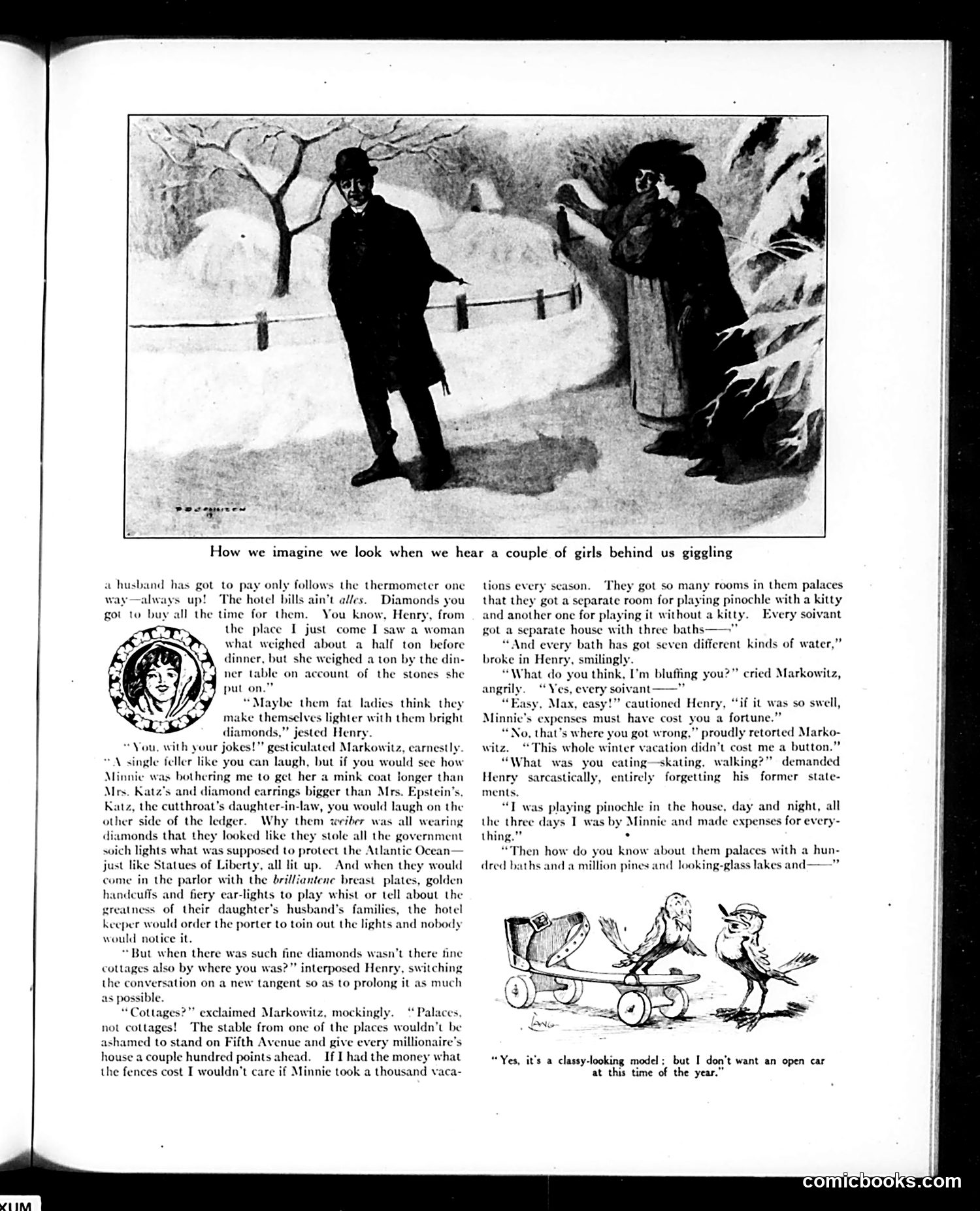
This page satirizes **Jewish immigrant experiences** and social aspirations in early 20th-century America. The main dialogue features two Yiddish-inflected characters—Markowitz and Henry—discussing the material demands of wives and the ostentatious wealth displays of the wealthy. The satire targets **conspicuous consumption**: Markowitz complains that his wife Minnie demands diamonds and mink coats comparable to those worn by wealthy Jewish neighbors (Mrs. Katz, Mrs. Epstein). He boasts about visiting palatial estates with multiple bathrooms and rooms, yet reveals he spent his vacation playing pinochle indoors—the humor deriving from his pretense of sophistication while admitting ignorance of actual luxury. The cartoon at top illustrates the opening joke about overhearing girls giggling, capturing male self-consciousness about appearance. The small cartoon at bottom shows a car salesman's aside about refusing convertible models seasonally—a non sequitur suggesting the commercial world's indifference to customers' vanities. The piece uses ethnic dialect and character stereotypes typical of era humor, mocking both immigrant aspirations and American materialism.
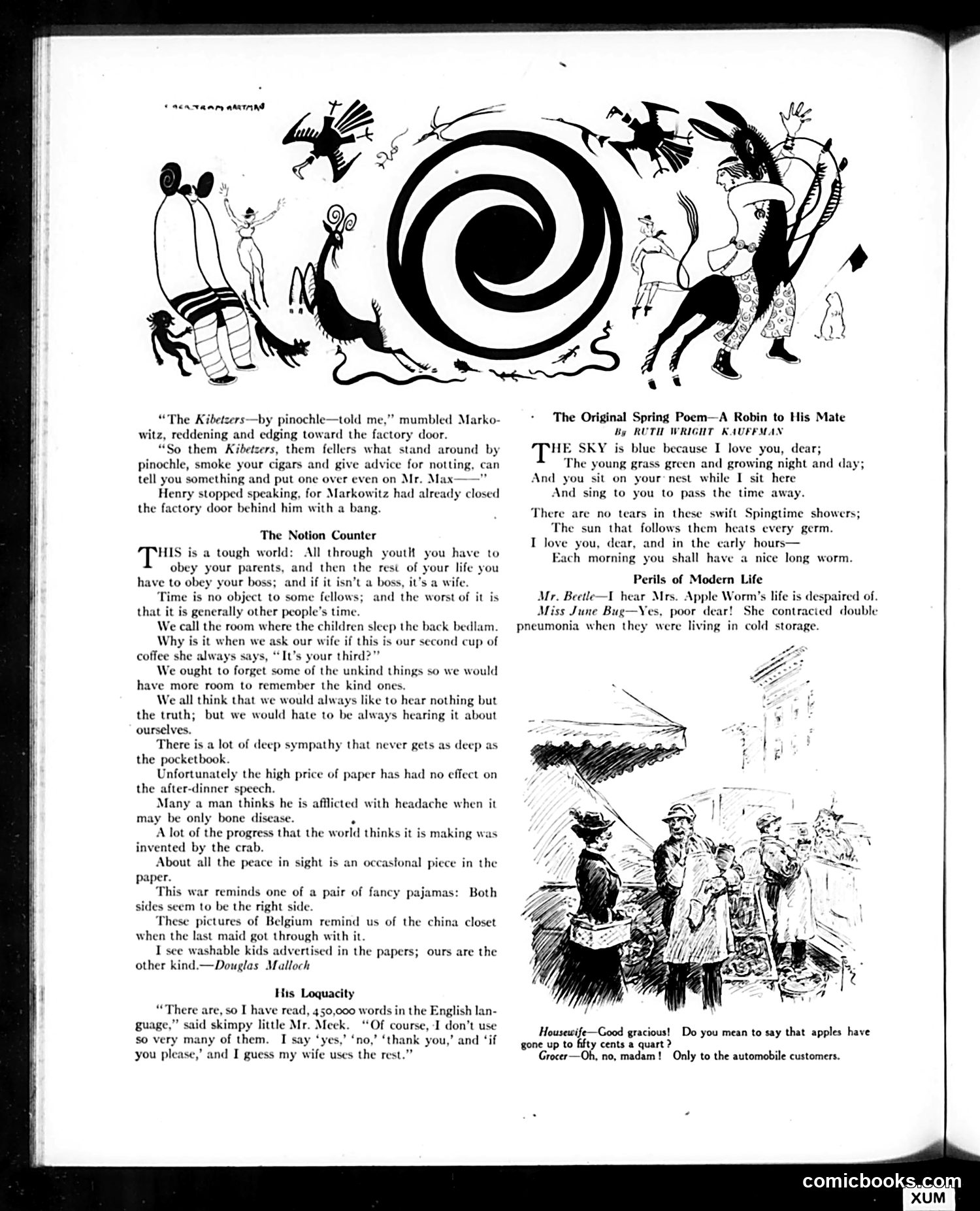
This page contains several short humorous pieces typical of early 20th-century American satirical magazines: **"The Kibitzers"** depicts working-class Jewish immigrants (identified by names like Markowitz). The humor relies on ethnic stereotyping—portraying Yiddish-accented factory workers who offer unsolicited advice at pinochle games. **"The Notion Counter"** offers cynical social commentary on modern life: obedience to authority (parents, bosses, wives), time-wasting, marital friction, and hypocrisy about hearing truth. **"His Loquacity"** jokes about Mr. Meek's minimal vocabulary while his wife apparently uses all 450,000 English words—a dig at nagging wives. **"Perils of Modern Life"** uses anthropomorphized insects to satirize modern anxieties: cold storage threatens health, and inflation affects prices (though automobile owners apparently escape it). The page reflects period attitudes: ethnic humor was mainstream; domestic/marital conflict was stock comedy; inflation was a contemporary concern.
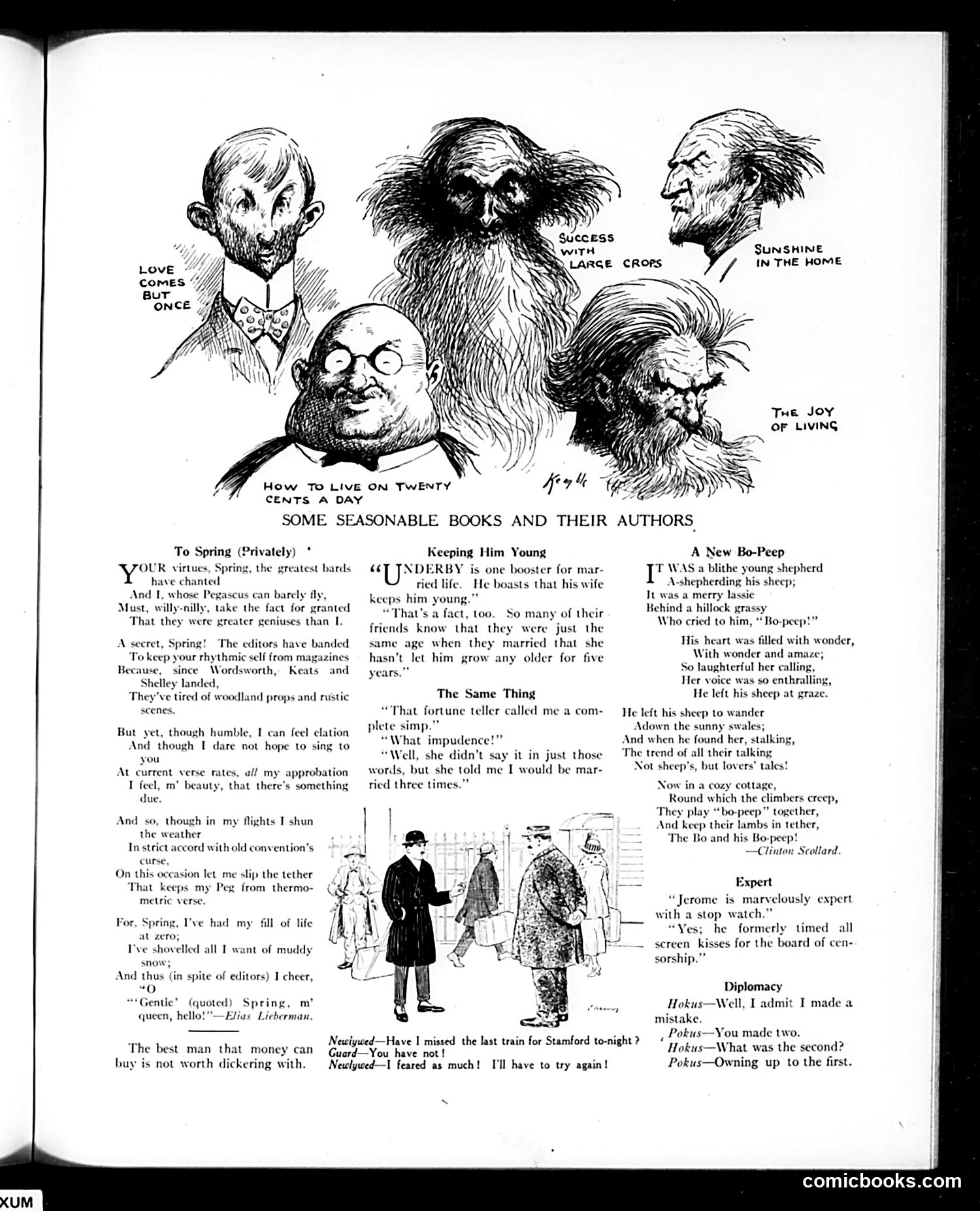
This page from *Judge* magazine features light satirical content typical of early 20th-century American humor. The top section shows five caricatured male heads labeled with life philosophies ("Love Comes But Once," "Success with Large Crops," "Sunshine in the Home," "How to Live on Twenty Cents a Day," "The Joy of Living")—a gentle mockery of self-help literature's earnest promises. The main content includes short humorous pieces and poems about courtship, marriage, and everyday foibles. "Keeping Him Young" jokes that a wife prevents her husband from aging by refusing to let him grow older—absurdist humor. "The Same Thing" pokes fun at fortune tellers' predictions. "A New Bo-Peep" is a whimsical poem about shepherds and romance. A small comic strip shows a newlywed couple missing a train, with the wife joking she'll "try again"—innuendo about marital relations. The final jokes mock expertise, stop-watches, and dishonesty in social situations. Overall, the page reflects genteel Victorian-era satire aimed at middle-class readers, emphasizing marriage, propriety, and mild social commentary rather than sharp political critique.
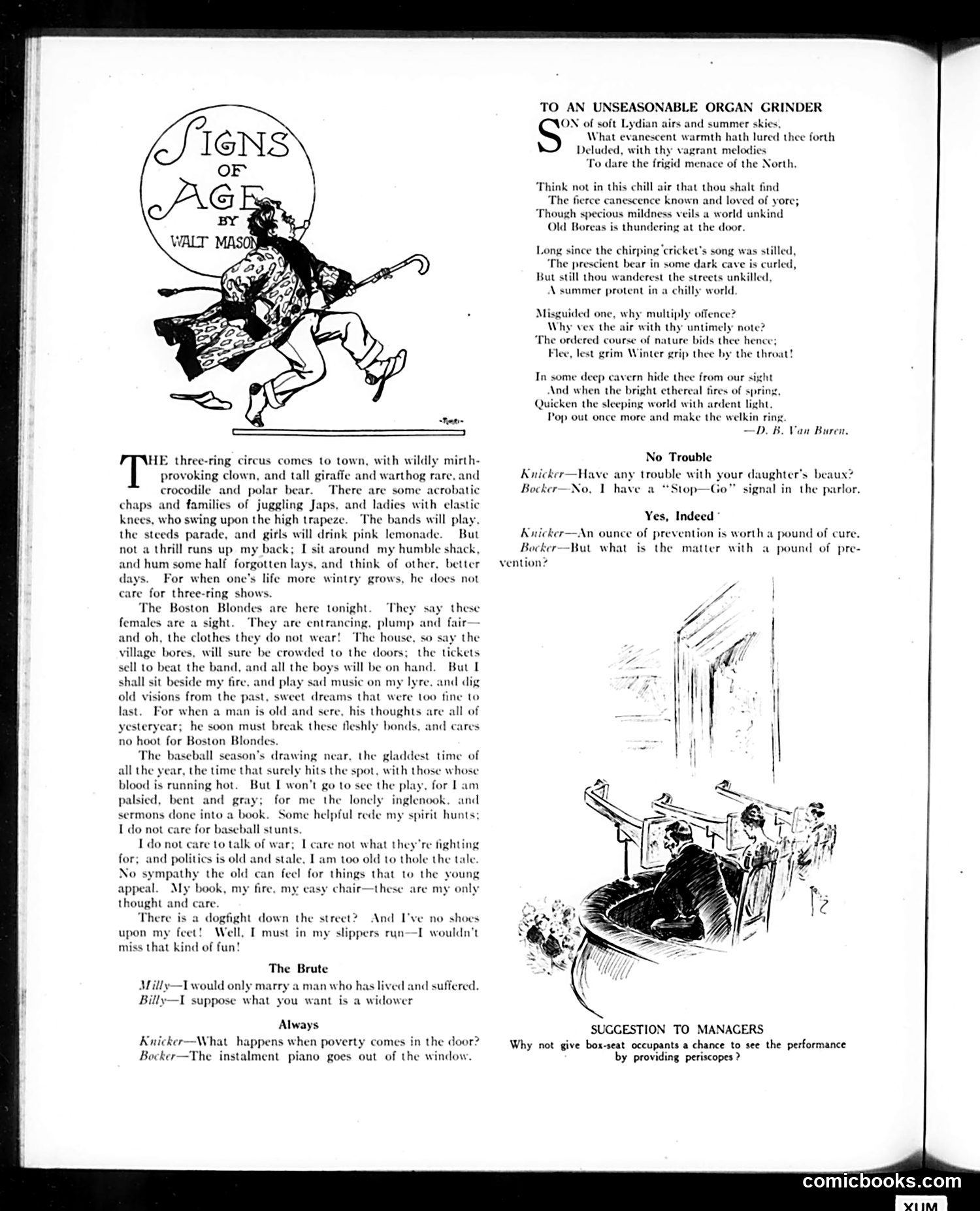
This page from *Judge* contains several satirical pieces reflecting early 20th-century American humor: **Main Story:** "Signs of Age" mocks an elderly curmudgeon who dismisses all modern entertainment—circuses, the attractive "Boston Blondes" (a popular theatrical troupe), baseball, and war news—as unworthy of his attention. The ironic punchline reveals his hypocrisy: he *will* rush out in slippers for a dogfight, exposing that his claimed superiority masks merely selective indulgence in baser pleasures. **Supporting Content:** Brief joke exchanges mock courtship standards, installment debt (the "piano on credit" joke), and theater logistics. A poem sarcastically scolds an organ grinder for playing in winter when nature dictates silence. **Context:** The satire targets Victorian-era pretension—how the aging and "respectable" classes justify moral selectivity by framing certain entertainments as beneath them while pursuing others deemed acceptable. The humor relies on readers recognizing contemporary entertainment references now lost to time.
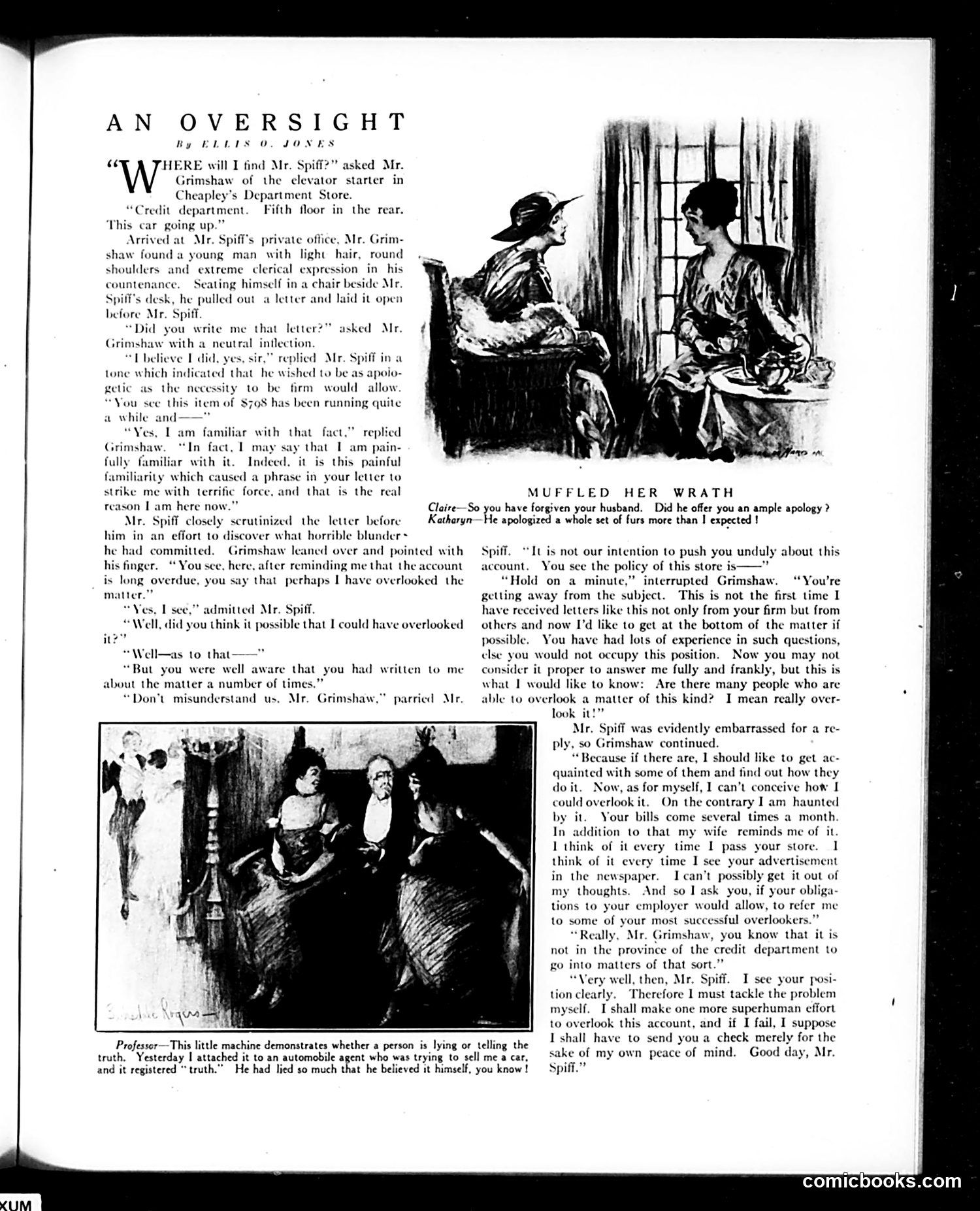
This page contains a satirical short story about the absurdity of debt collection language. Mr. Grimshaw confronts Mr. Spiff, a credit department clerk at a department store, about an overdue $708 account. The satire targets the euphemistic phrase "perhaps I have overlooked the matter"—a polite suggestion that Grimshaw might have simply forgotten to pay. Grimshaw's complaint is that the phrasing is absurd: he cannot genuinely "overlook" a debt he's constantly reminded of through bills, advertisements, and his wife's reminders. The joke exposes the awkward gap between formal business courtesy and reality. By sarcastically asking Spiff to introduce him to other customers who successfully "overlook" debts, Grimshaw highlights the ridiculous pretense of the collection letter's language. The secondary cartoon ("Muffled Her Wrath") shows a wife's anger being soothed by fur coats—a commentary on marriage dynamics and materialism.
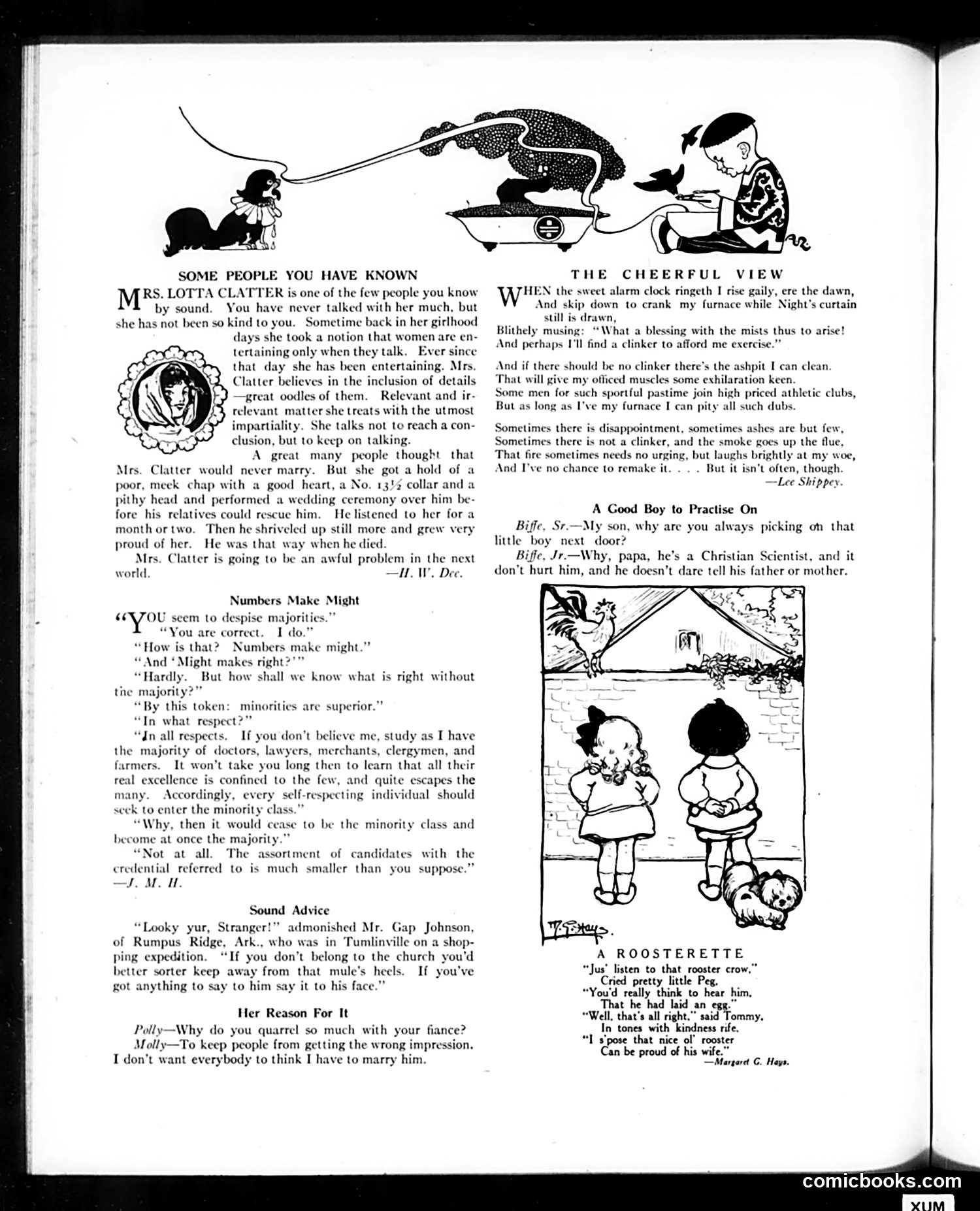
This page from the satirical magazine *Judge* contains several short humorous pieces typical of early 20th-century American humor: **"Mrs. Lotta Clatter"** satirizes an annoying social type—a woman who talks incessantly and relentlessly, treating all topics with equal unimportance. The joke is that she drove her meek husband to an early grave through sheer exhaustion from listening to her. **"Numbers Make Might"** presents a paradoxical philosophical debate: the speaker argues that minorities are superior because excellence concentrates among the few, yet acknowledges that if everyone tried to join the minority class, it would become the majority—an ironic logical trap. **Other pieces** include mild rural humor ("Sound Advice" about a mule), a woman's strategic quarreling with her fiancé to avoid appearing desperate, and jokes about furnace-tending as exercise and a child bullying a Christian Scientist boy (who supposedly won't report it or feel pain). The humor is gentle, domestic, and focused on personality types and social absurdities rather than sharp political satire.
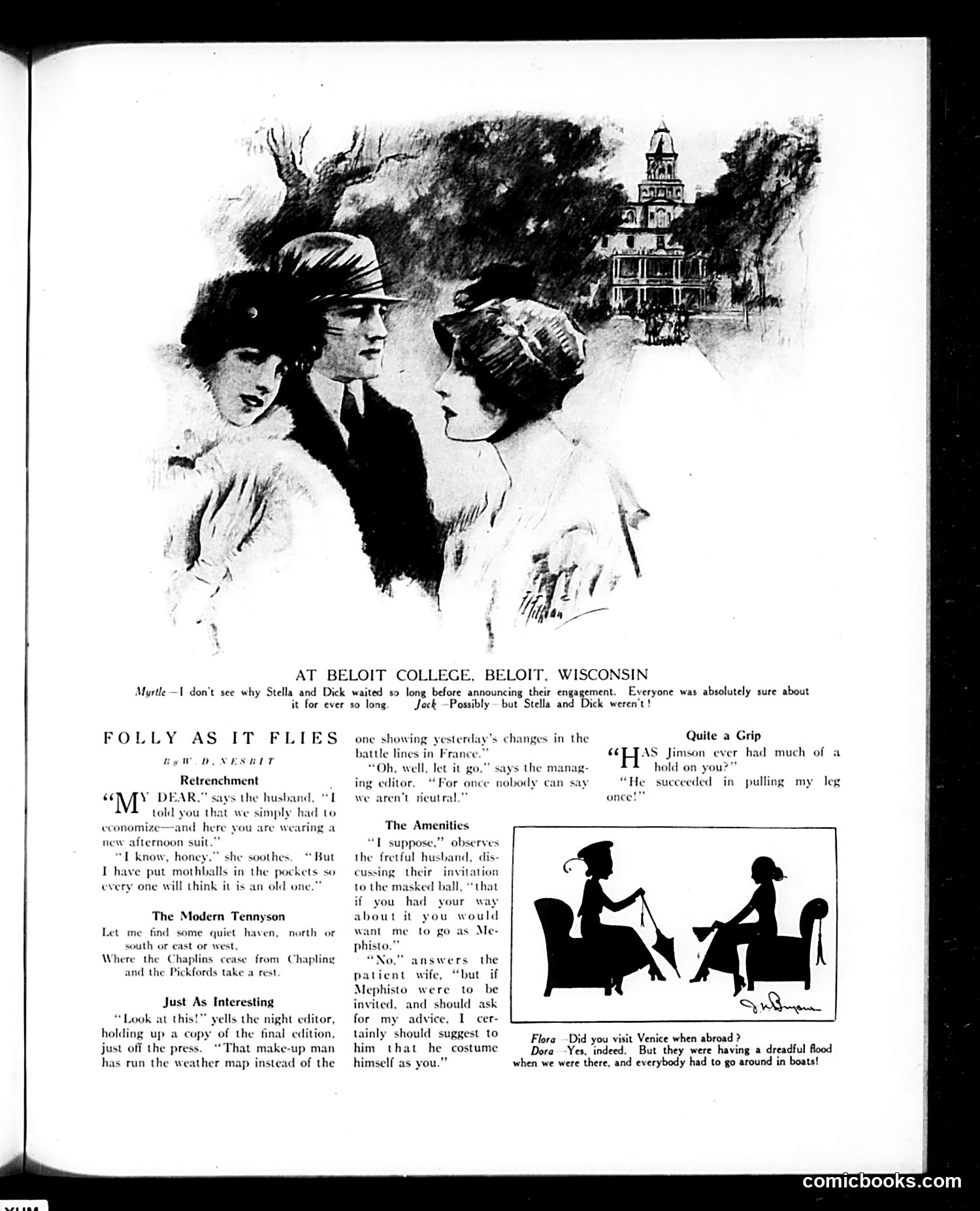
This page from *Judge* magazine contains several short humor pieces typical of early 20th-century satirical magazines: **Top cartoon**: Shows three fashionable people at Beloit College. The joke is about an engagement announcement—the couple's friends assumed they were engaged long before they officially announced it, highlighting how obvious their relationship was to everyone but themselves. **Text humor pieces** include: - "Retrenchment": A wife economizes by wearing a shabby old suit but adds mothballs to trick people into thinking it's genuinely old - "The Modern Tennyson": A parody of Tennyson's poetry, referencing Charlie Chaplin and Mary Pickford (silent film stars), wishing for peace from their fame - "The Amenities": A husband-wife exchange where she insults him by saying Mephisto should dress like him - "Quite a Grip" and "Venice" cartoons: Brief joke exchanges about physical wrestling and flood travel The humor reflects period concerns: fashion economics, celebrity culture, and domestic wit. The cartoons use silhouettes, a common Judge feature.
This is a theater review column featuring dialogue between "the Critic" and "the Tired Business Man" discussing recent Broadway productions. The main subjects are: - **"The Great Divide"**: A revival play praised as excellent American drama, featuring actor Henry Miller in the lead role. It's celebrated for depicting the psychological conflict between Puritan restraint and Western freedom. - **Washington Square Players**: A theatrical company whose latest bill disappointed compared to their previous production, despite strong acting. The Critic praises their earlier work ("Trifles," "The Last Straw") over the new program. The satire's gentle humor comes from the Tired Business Man's earnest attempts to express theatrical appreciation while admitting he feels more than he can articulate—a relatable everyman perspective contrasted with the Critic's more sophisticated analysis. The column reflects early 1900s theater culture, where revival productions and experimental theater companies like the Washington Square Players were significant cultural events for educated audiences.
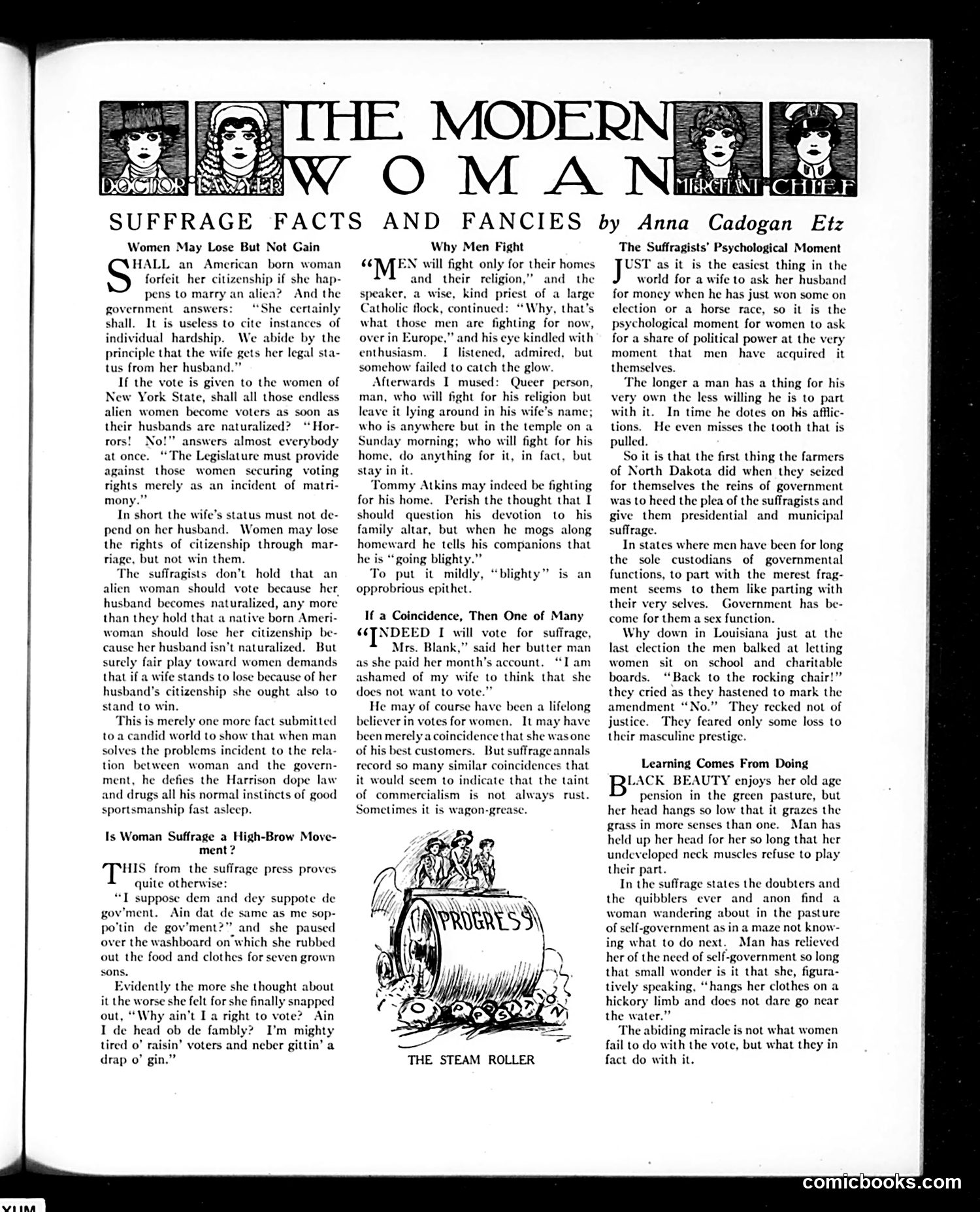
This page from Judge presents satirical commentary on women's suffrage by Anna Cadogan Etz, using ironic arguments to expose inconsistencies in anti-suffrage logic. **Main Arguments:** 1. **Citizenship Paradox**: Women lose citizenship through marriage to aliens but cannot *gain* it the same way—exposing the hypocrisy of making wives' legal status dependent on husbands while denying them voting rights. 2. **Not "High-Brow"**: A working-class woman's colloquial complaint about raising voters without having political power herself counters claims that suffrage is an elite movement. 3. **Men's Hypocrisy**: Men claim to fight for "home and religion" yet neglect both in practice—questioning their moral authority to deny women political voice. 4. **Commercial Corruption**: Supporters' sudden enthusiasm may stem from self-interest (the butter man praising suffrage to a good customer). 5. **Psychological Timing**: The "steam roller" cartoon suggests now is the moment to push suffrage, like asking for money after a win. The satire exposes logical contradictions in patriarchal arguments against women's voting rights.
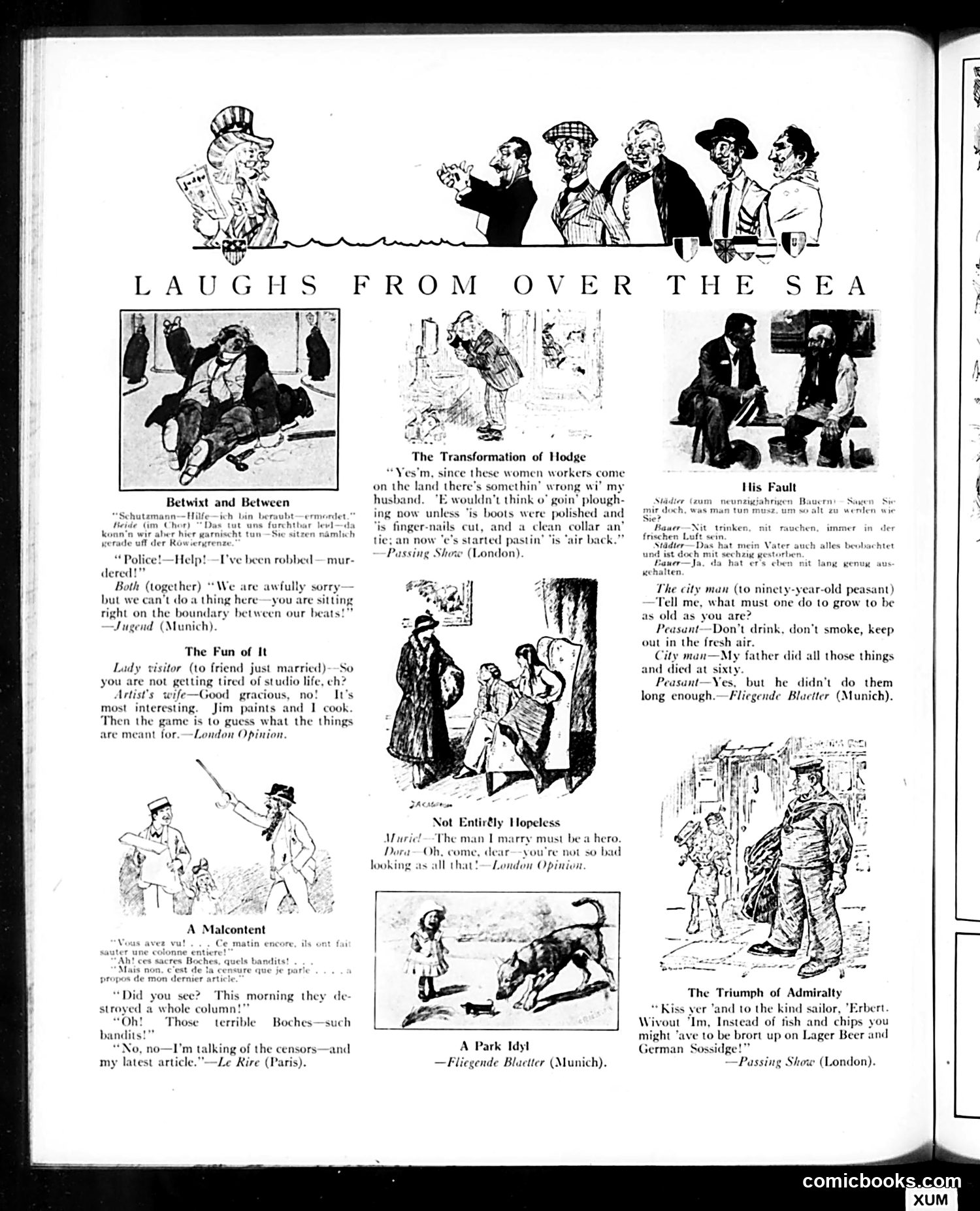
This page collects humorous cartoons from European satirical magazines (German, French, British). Key pieces: **"Betwixt and Between"**: Police from adjoining jurisdictions refuse to help a robbery victim because he's sitting on the boundary between their beats—satirizing bureaucratic buck-passing. **"The Transformation of Hodge"**: A rural wife complains that female farm workers (likely WWI-era land girls) have made her husband vain—he now polishes his boots and grooms himself. Social satire on changing gender roles during wartime labor shortages. **"The Triumph of Admiralty"**: A mother tells her child the British Navy prevents German domination; without it, children would eat German sausage instead of fish and chips—wartime jingoism mocking German food culture. **"His Fault"** and **"Not Entirely Hopeless"**: Light romantic/domestic humor about courtship expectations. The page demonstrates how Judge reprinted European humor to entertain American readers with international perspectives on contemporary wartime concerns and social change.
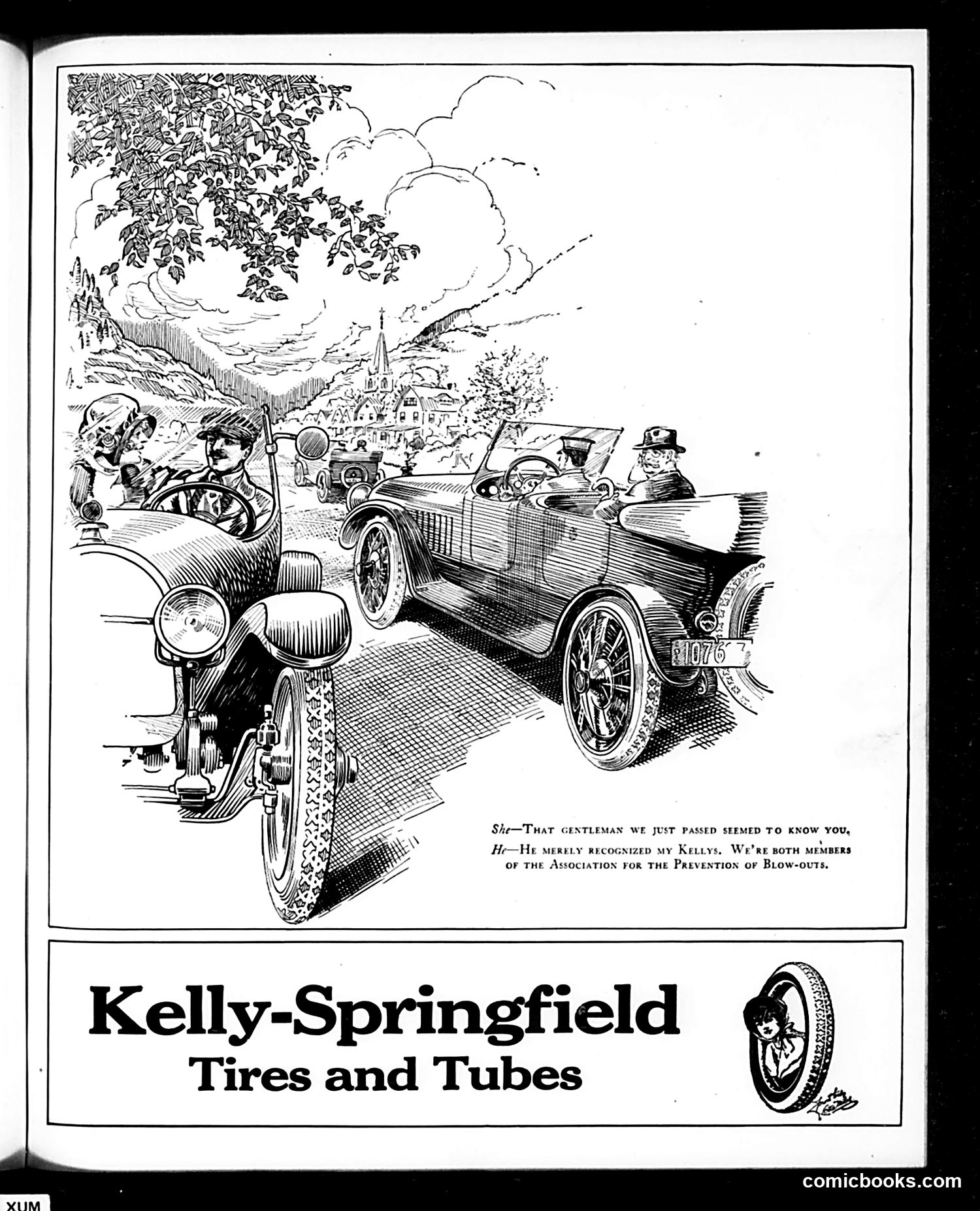
This is a vintage tire advertisement disguised as humor. Two automobiles pass each other on a road, and the drivers greet each other—one recognizing the other's "Kellys" (Kelly-Springfield tires). The joke hinges on a invented fraternal organization: the "Association for the Prevention of Blow-outs." The satire targets tire reliability concerns common in the early automobile era, when tire failures and blowouts were frequent, dangerous occurrences. By treating blow-out prevention as a shared membership badge, the ad humorously positions Kelly-Springfield tires as so dependable that owners form an exclusive club. The illustration shows well-dressed motorists in period cars, emphasizing that reliable tires appeal to genteel drivers. This was typical early-1900s advertising strategy: associating products with social status and safety.
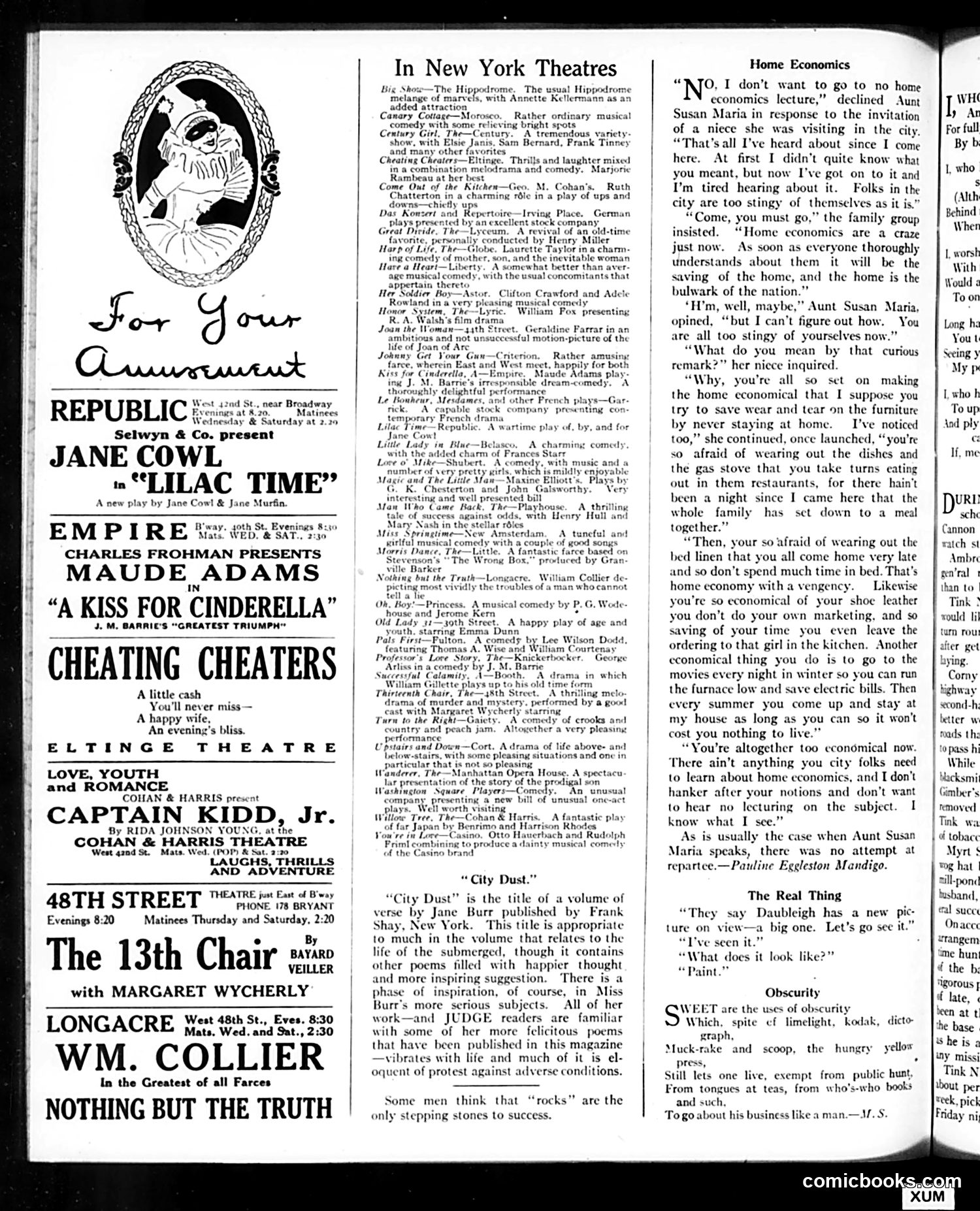
This page is primarily **theatrical advertising** from an early 20th-century New York entertainment section. The left side features the main cartoon—a caricatured face in an oval frame labeled "For Your Amusement," though the specific figure and satire are unclear from the image quality. The bulk of the page comprises advertisements for Broadway theaters and plays (Empire, Republic, Eltinge, etc.) alongside a column reviewing current theatrical productions. The text discusses various shows including comedies, musicals, and dramas popular at the time. On the right side, there's an editorial piece titled "Home Economics" where a character (Susan Maria) declines attending a lecture, arguing that home economics is already well-understood and that families should spend leisure time at restaurants rather than worrying about domestic efficiency—a satirical commentary on contemporary debates about women's domestic labor and modern leisure habits. The page reflects Judge's typical format: mixing entertainment coverage with social commentary on contemporary attitudes.
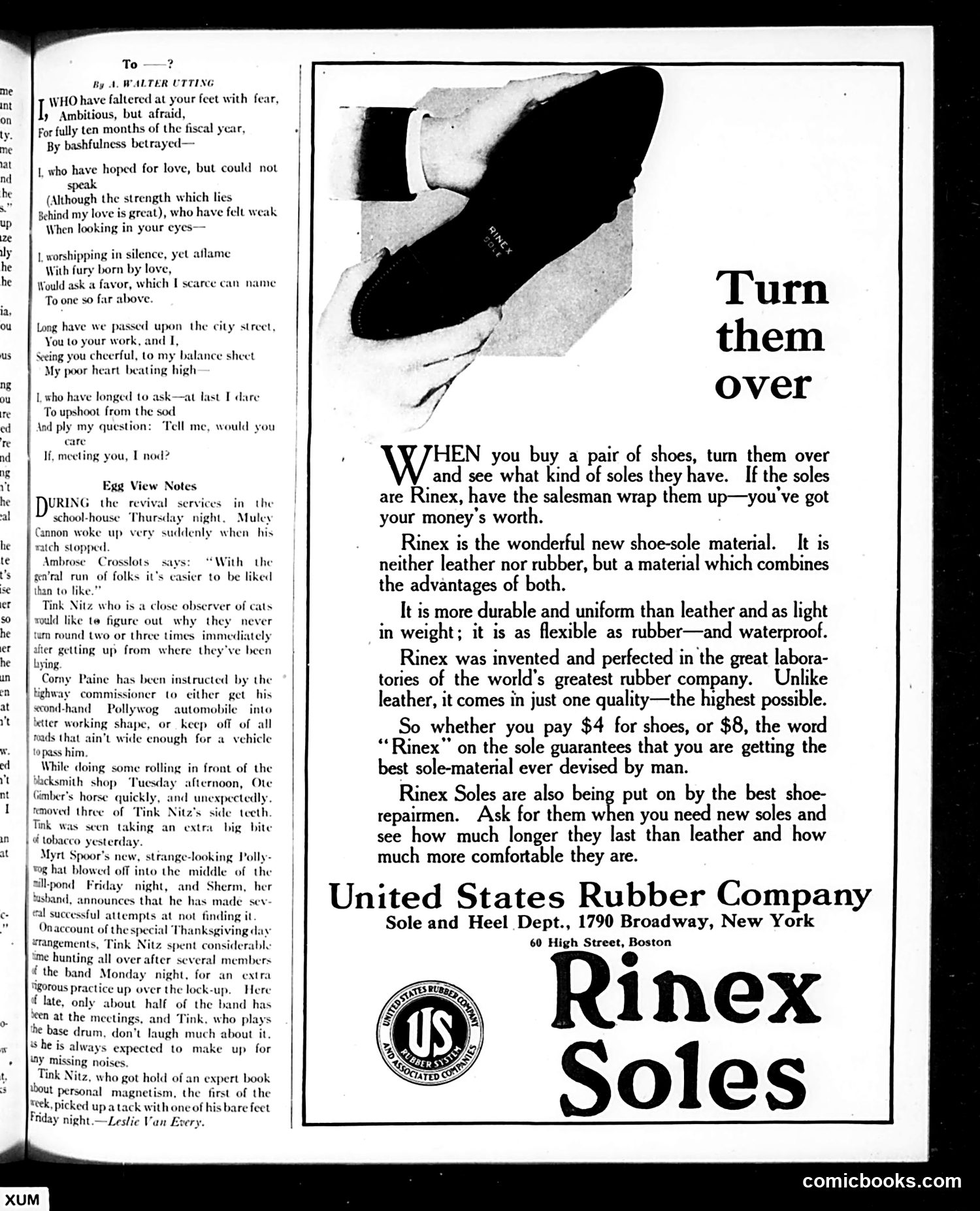
This page contains a poem titled "To —?" by A. Walter Utting, alongside a full-page advertisement for Rinex shoe soles. **The Poem:** A sentimental/comedic piece about an extremely timid suitor who has silently admired someone for ten months but is too bashful to speak. His culminating act of courage is merely to ask if the person would care "if, meeting you, I nod?"—an absurdly minimal gesture. The satire targets Victorian-era romantic timidity and social awkwardness. **"Egg View Notes":** A section of brief rural anecdotes (small-town gossip) featuring characters like Muley Cannon, Corny Paine, and Tink Nitz—typical Judge humor mocking rural/provincial life, incompetence, and mishaps. **The Advertisement:** Occupies roughly half the page, promoting Rinex, a new synthetic shoe-sole material combining rubber and leather properties, manufactured by United States Rubber Company. This is straightforward commercial advertising, not satire. The page represents Judge's typical mix: literary/social satire alongside paying advertisements.
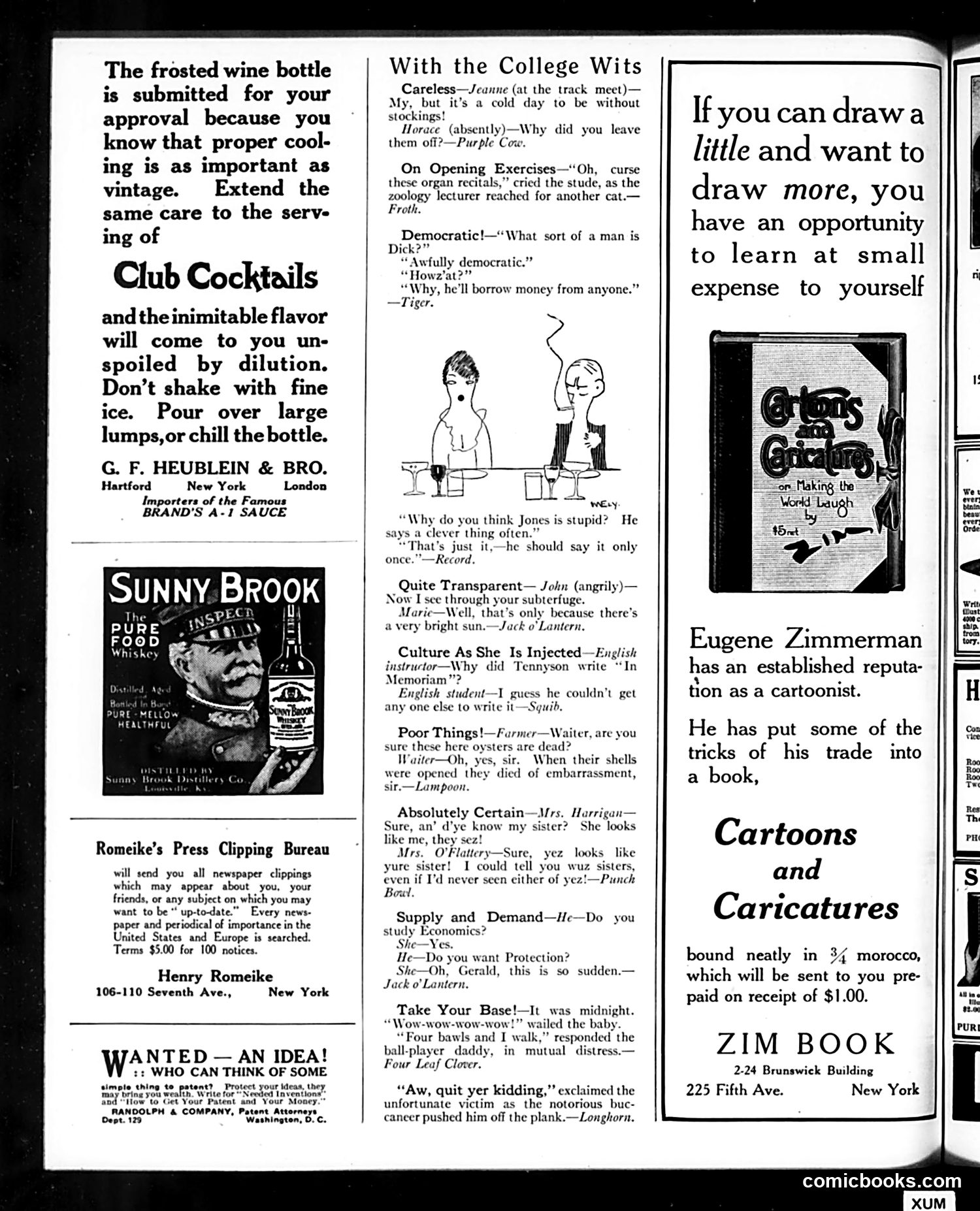
This page is primarily **advertising and promotional content** rather than editorial cartoons. The main elements include: **Advertisements:** - Heublein & Bro. promotes proper cocktail service and chilling methods - Sunny Brook whiskey advertisement - Romeike's Press Clipping Bureau offers newspaper monitoring services - A patent attorney advertisement seeks inventions **"With the College Wits" Section:** A series of brief jokes attributed to college humor magazines (Purple Cow, Froth, Tiger, etc.). These are lighthearted quips about college life—absentminded romance, professors, Irish dialect humor, and courtship. The humor is gentle and topical to collegiate audiences of the era. **Eugene Zimmerman Promotion:** Zimmerman, an established cartoonist, is advertising his instructional book on cartooning techniques, available for $1.00. **Overall Context:** This appears to be a typical Judge magazine page from the early 20th century, mixing commercial advertisements with collegiate humor appealing to educated readers. The content reflects period attitudes, including ethnic humor that would be considered offensive today.
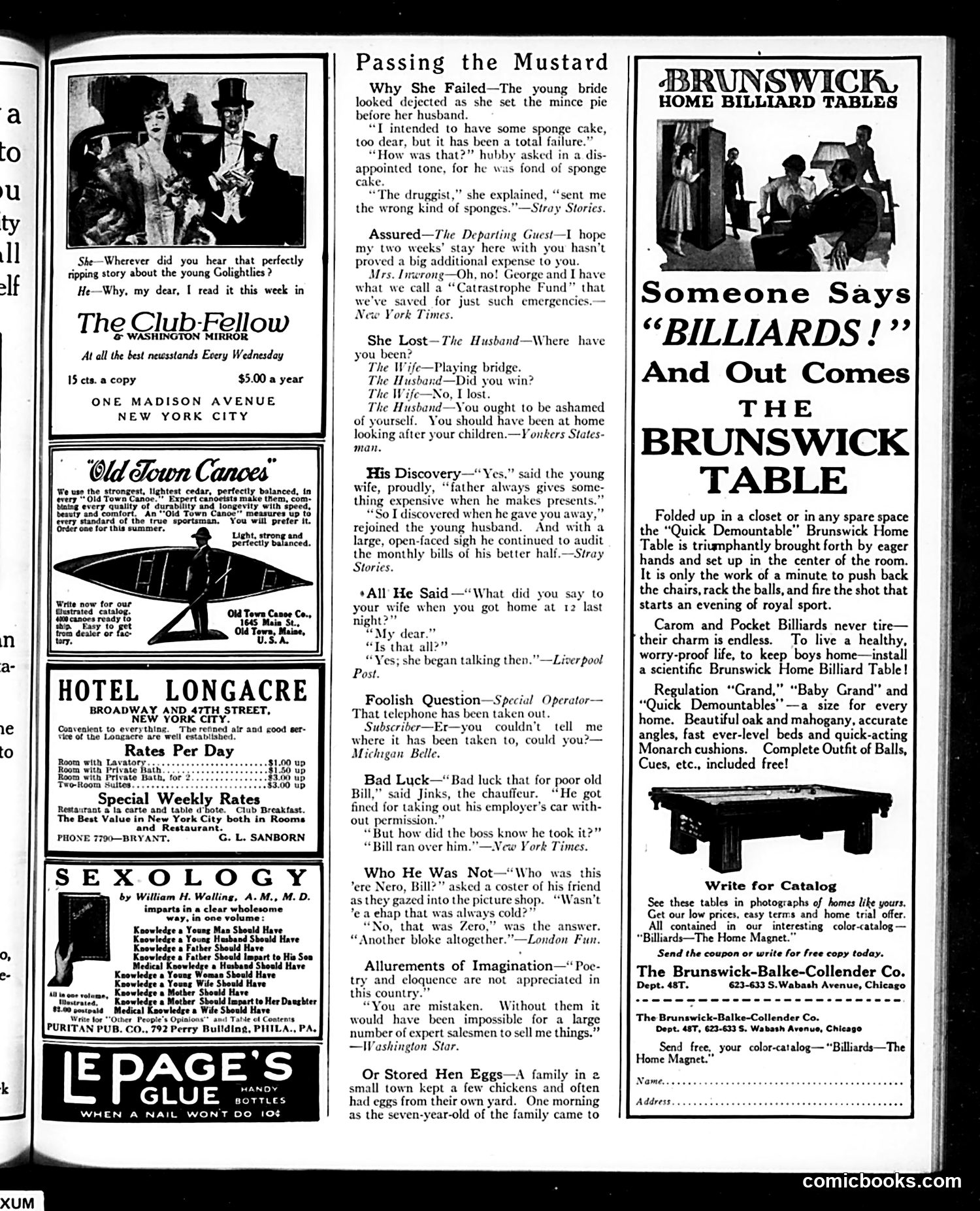
This page is primarily **advertising**, dominated by the large Brunswick Billiards Table advertisement on the right side. The left contains multiple small paid ads (Hotel Longacre, Sexology book, Page's Glue, Old Town Canoes) and a humor section titled "Passing the Mustard." The humor section consists of brief, domestic jokes typical of early 20th-century magazines—featuring newlywed mishaps (the bride's failed sponge cake), marital squabbles over bridge-playing and late nights, and working-class humor (a chauffeur fined for unauthorized car use). These jokes reinforce period gender roles and social expectations: wives should cook and stay home; husbands manage finances. The advertisements target middle-class consumers seeking home comforts, travel, and self-improvement (the Sexology book). The Brunswick ad emphasizes the billiards table as a status symbol providing "healthy, worry-proof life" for the home. The page reflects early 1900s American consumer culture and domestic ideology—no specific political commentary is evident.
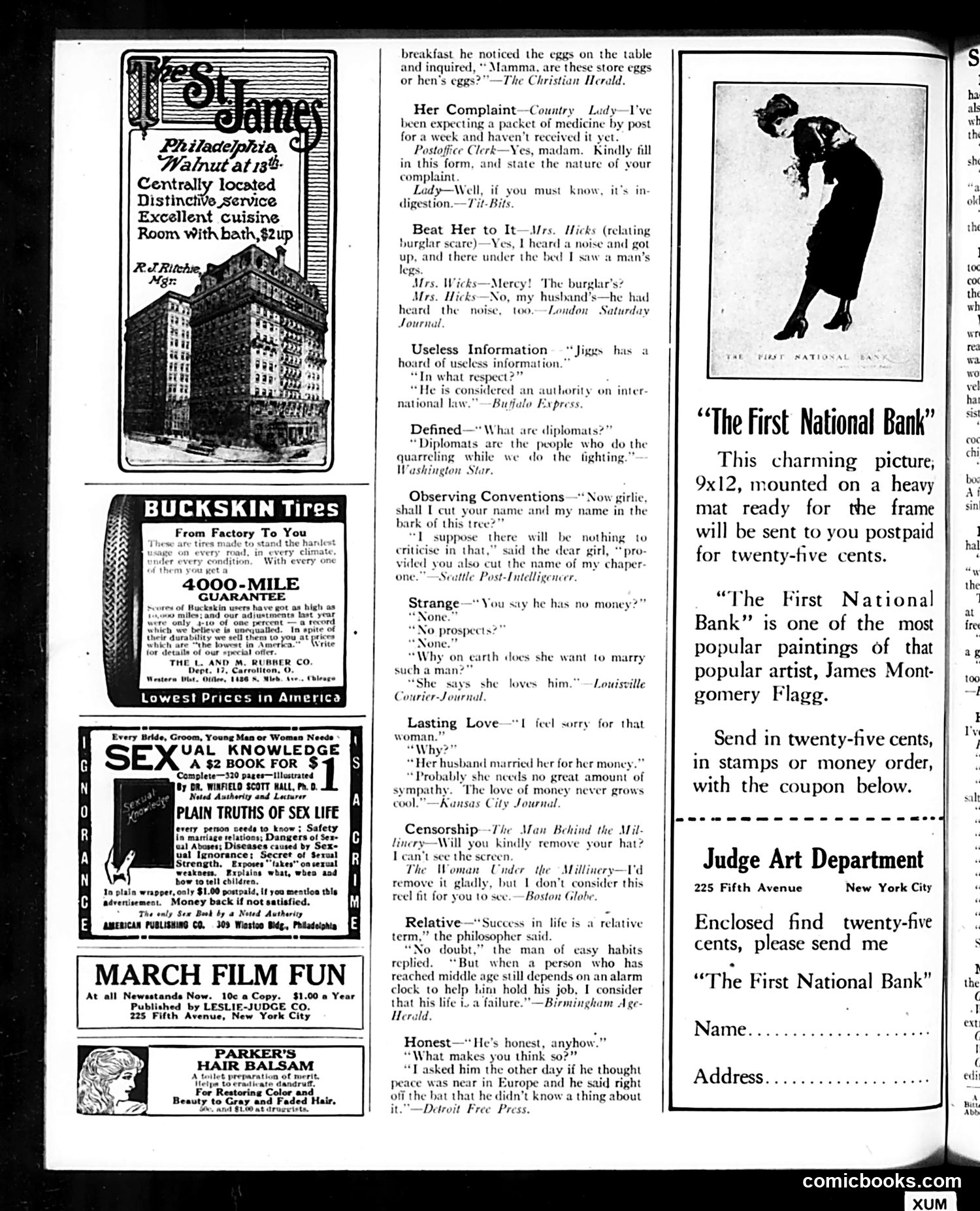
This page is primarily **advertising and humor columns** rather than political cartoons. The content consists of: **Humor Columns**: Brief jokes and anecdotes on domestic life, bureaucracy, and relationships—typical "filler" content of early 20th-century magazines. Topics include: marital confusion (husbands vs. burglars), post office inefficiency, diplomats vs. soldiers, and courtship conventions. These reflect period attitudes toward gender roles and institutions. **Advertisements**: Including a "Sexual Knowledge" book ($2), Buckskin Tires, hair balsam, and March Film Fun—standard commercial offerings. **Art Department Solicitation**: The main featured content promotes a painting titled "The First National Bank" by James Montgomery Flagg (a well-known illustrator of the era), available for 25 cents. The image shows a woman in period dress. **No clear political satire** is evident on this page. It represents routine magazine content—humor, ads, and promotional material—from approximately the 1910s-1920s era, offering little of historical significance beyond reflecting contemporary social attitudes.
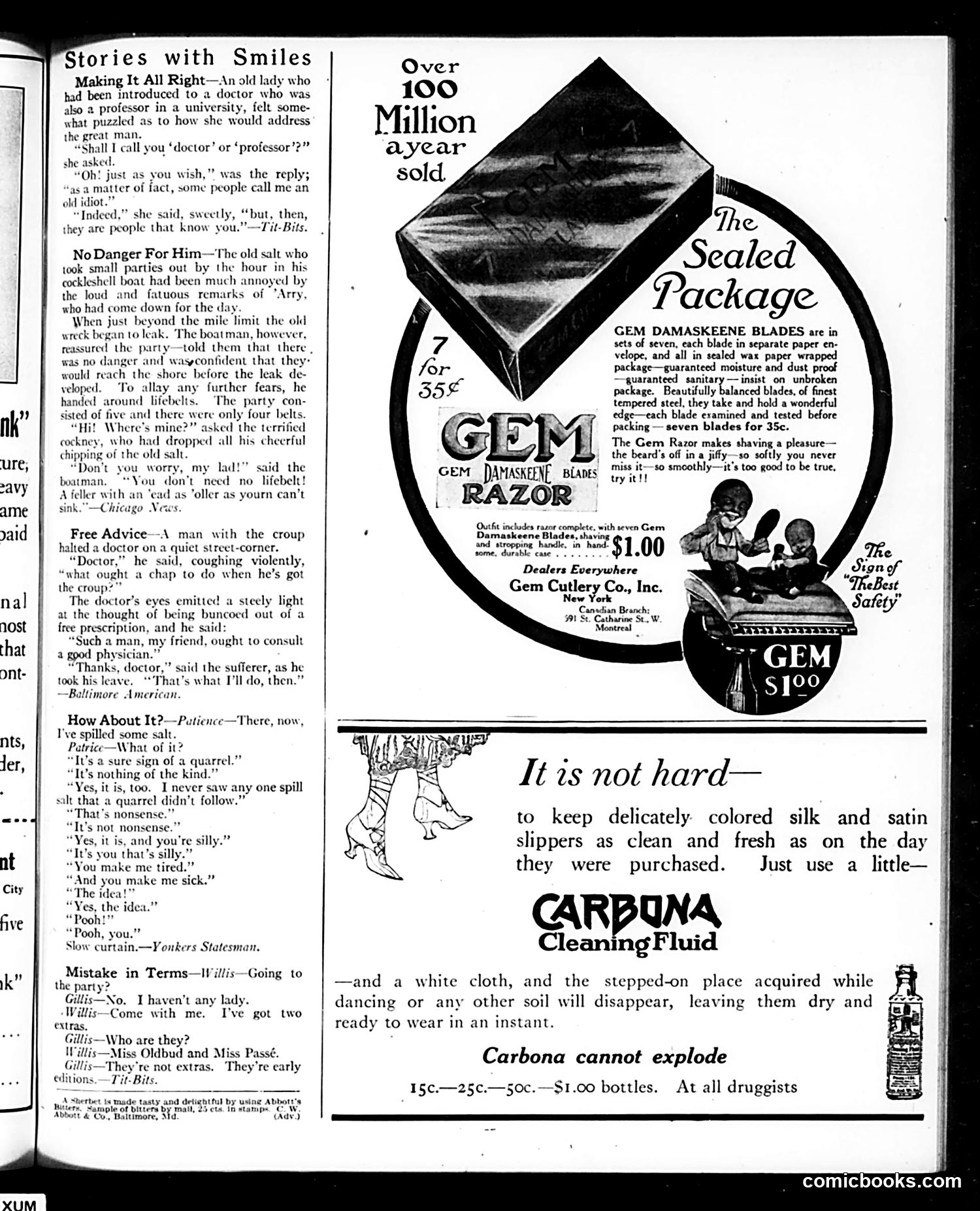
This Judge magazine page contains **short humorous anecdotes** (left side) and **period advertisements** (right side). ## The Humor: The four brief jokes mock social awkwardness and human nature: 1. **"Making It All Right"**: A lady assumes a professor-doctor must be important; he deflates himself by admitting people call him an idiot—the humor lies in his self-deprecation. 2. **"No Danger For Him"**: A boatman reassures panicked passengers about a leaking boat, then admits there's one fewer lifeboat than passengers. The joke: the annoying tourist ('Arry) won't need one because his head floats. 3. **"Free Advice"**: A sick man tries to get free medical advice; the doctor refuses, directing him to consult "a good physician"—absurd circular logic. 4. **"How About It?"**: A couple argues whether spilled salt predicts quarrels—they prove it by quarreling about it. ## The Advertisements: Vintage product pitches for Gem razor blades ($1), Carbona cleaning fluid, and other toiletries—typical early 20th-century consumer goods marketing.
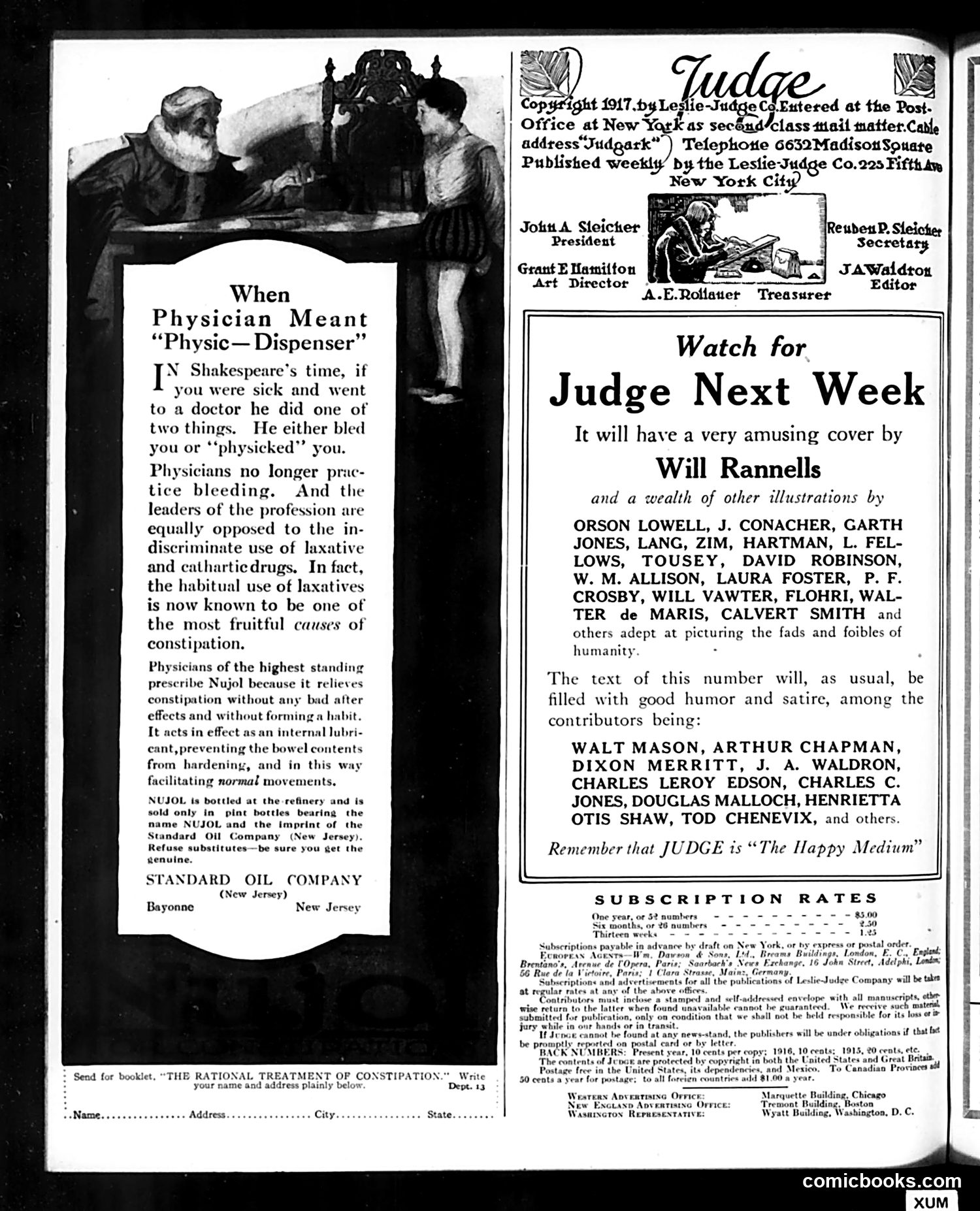
This is primarily an **advertisement and promotional page** for Judge magazine (1917), not a political cartoon. The main content is a **Nujol laxative advertisement** disguised as editorial content. It uses historical framing—comparing modern medicine favorably to Shakespeare's era when doctors "bled" patients or gave harsh "physicks" (purgatives). The ad argues that modern physicians now reject indiscriminate laxative use, positioning Nujol as the enlightened alternative: a mineral oil that lubricates rather than irritates. The satire is subtle: the ad mocks outdated medical practices while promoting a product, using pseudo-scientific authority ("physicians of the highest standing") to legitimize a patent medicine—itself a common target of satirical magazines. The right side previews next week's Judge issue, listing contributing illustrators and writers, emphasizing the magazine's comedic content about "fads and foibles of humanity."
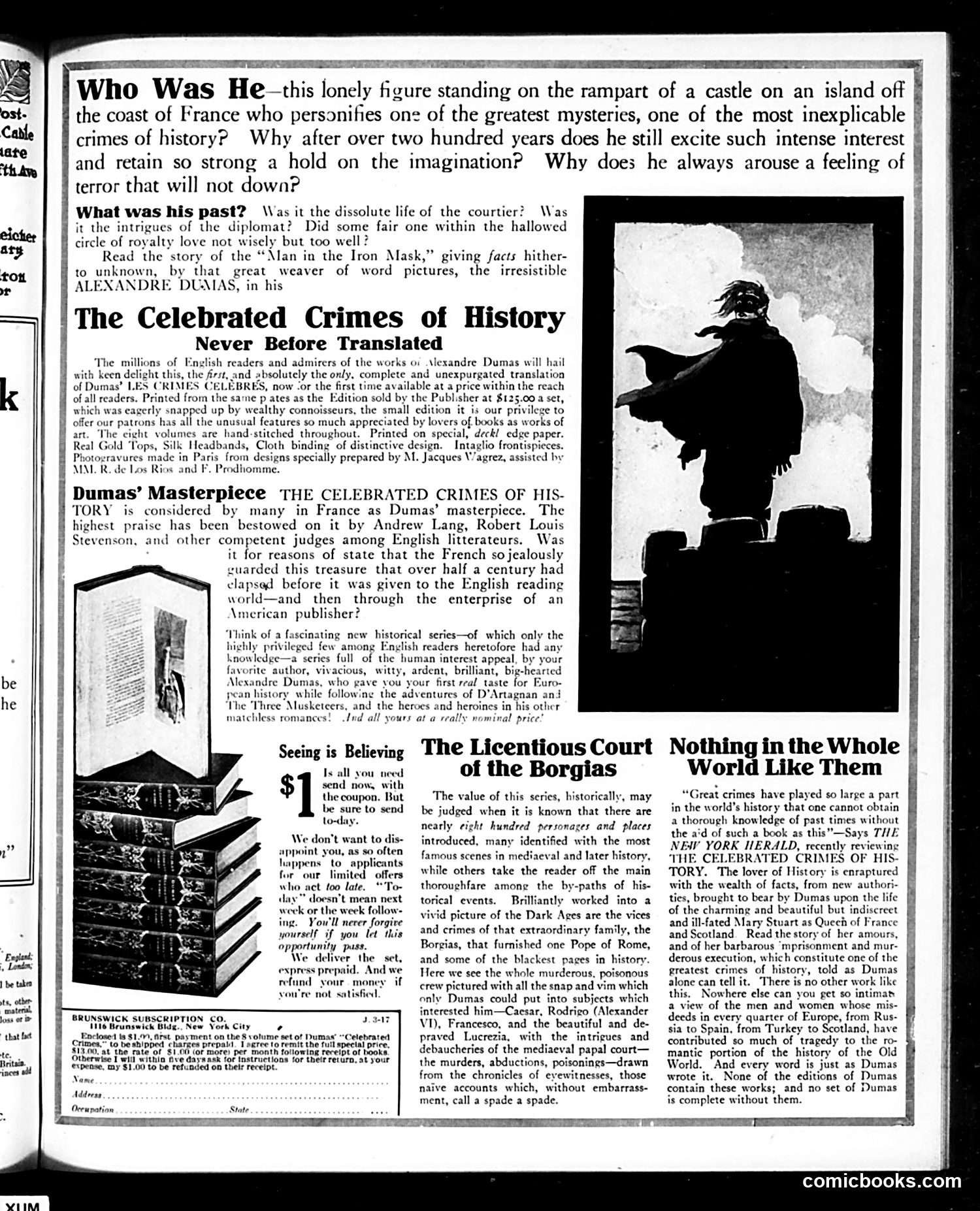
This page is primarily **advertising** for a subscription book set, not a political cartoon. It promotes Alexandre Dumas' *The Celebrated Crimes of History*, a newly translated eight-volume collection published by Brunswick Subscription Company. The imagery features a silhouetted figure on a castle rampart—likely referencing Dumas' famous "Man in the Iron Mask" narrative, which opens the ad. This mysterious prisoner represents the historical intrigue Dumas explores throughout his crime histories. The text emphasizes this work's appeal to educated readers familiar with Dumas' romantic novels (*The Three Musketeers*), now offering serious historical content about famous crimes—including the Borgia court. The ad stresses this is the "first time available at a price within reach" of ordinary readers, previously accessible only to "wealthy connoisseurs." The subscription offer ($13 total, paid monthly) targets middle-class book enthusiasts seeking cultured historical knowledge without prohibitive expense—a marketing approach typical of early 20th-century periodicals like *Judge*.
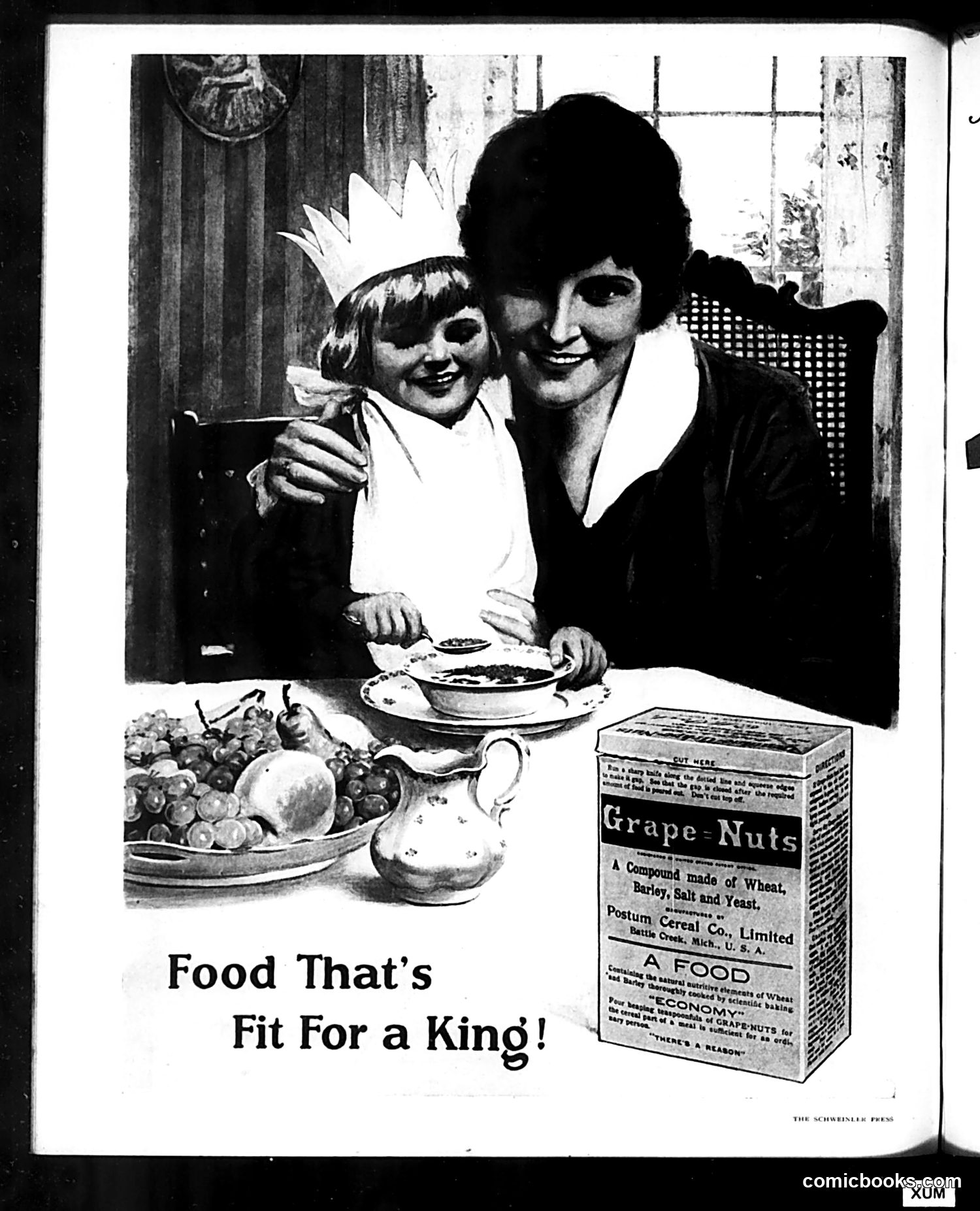
This is a **product advertisement**, not political satire. It promotes "Grape-Nuts," a breakfast cereal made by Postum Cereal Co. Limited (Battle Creek, Michigan). The ad shows an adult and child at a dining table with fresh grapes and other foods, with the tagline "Food That's Fit For a King!" The marketing strategy appeals to aspirational family values—suggesting that serving this wholesome, nutritious cereal elevates one's household to royal standards. The box describes Grape-Nuts as "A Compound made of Wheat, Barley, Salt and Yeast," emphasizing its "scientific" composition and healthful properties—a common early-20th-century advertising claim linking processed foods to nutrition and modernity. This is straightforward commercial messaging, not editorial commentary.