
Judge, 1917-03-17 · page 6 of 28
Judge — March 17, 1917 — page 6: what you’re looking at
What you’re looking at
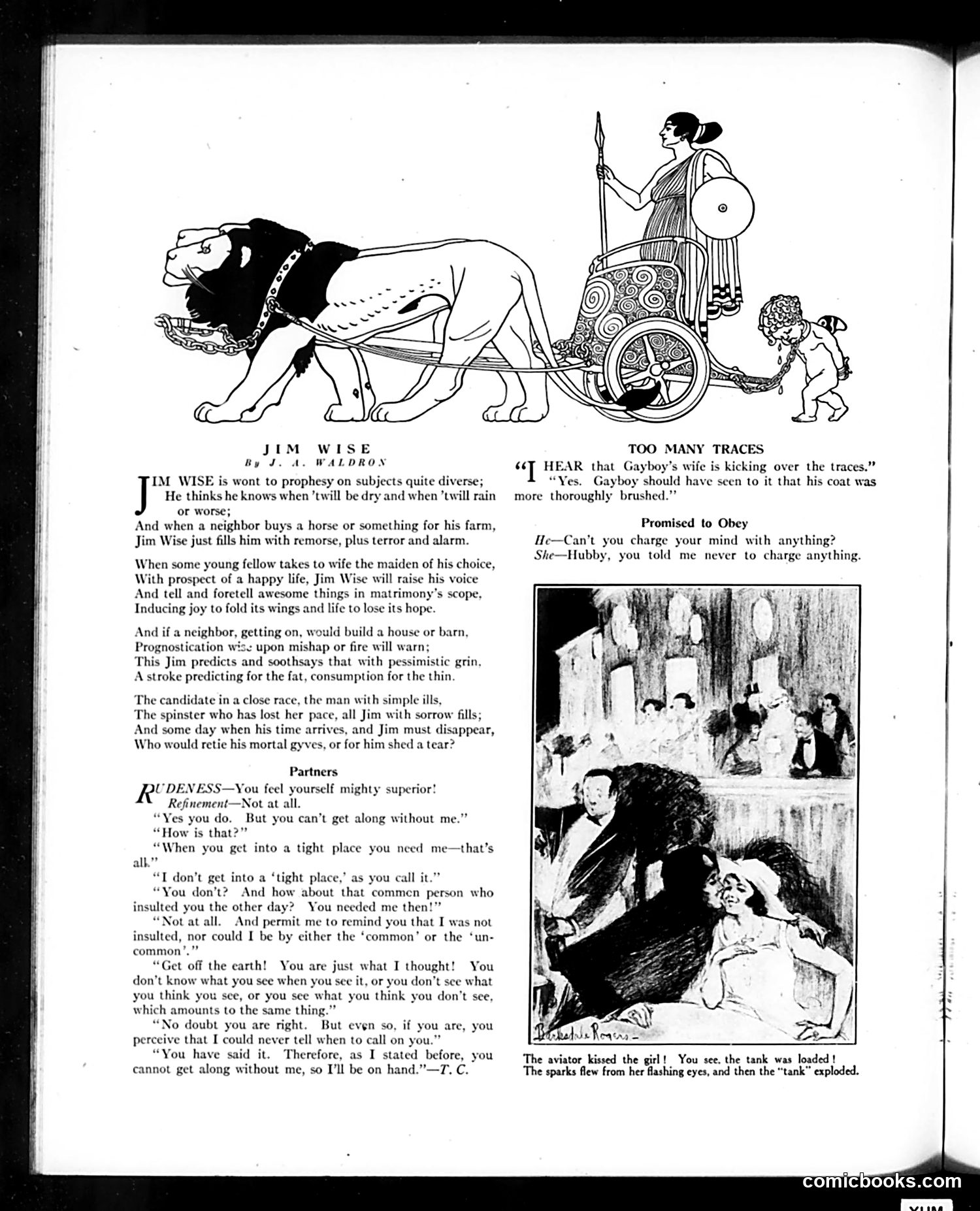
This page contains two unrelated pieces of satirical content: **"Jim Wise"** (top): A poem mocking a rural character prone to making pessimistic predictions about weather, farming, and relationships. The illustration shows Jim harnessed like a beast of burden, pulled by a woman warrior (likely representing Fate or female authority), satirizing his powerlessness and doom-saying nature. **"Too Many Traces"** and **"Promised to Obey"** (bottom): Brief joke dialogues about domestic conflict and an explosion. The accompanying illustration depicts what appears to be a violent domestic incident involving tanks or mechanical devices, though the specific satirical target remains unclear without additional context. The page represents typical Judge magazine fare: social commentary through caricature and wordplay, targeting masculine insecurity and marital discord.
📄 Transcribed text from this page (OCR, searchable)
Machine-transcribed from the original scan — historical spelling and the odd misread are preserved.
IM WISE is wont to prophesy on subjects quite diverse; J He thinks he knows when ’twill be dry and when ’twill rain or worse; And when a neighbor buys a horse or something for his farm, Jim Wise just fills him with remorse, plus terror and alarm. When some young fellow takes to wife the maiden of his choice, With prospect of a happy life, Jim Wise will raise his voice And tell and foretell awesome things in matrimo scope, Inducing joy to fold its wings and life to lose its hope. And if a neighbor, getting on, would build a house or barn, Prognostication wise upon mishap or fire will warn; This Jim predicts and soothsays that with pessimistic grin, A stroke predicting for the fat, consumption for the thin The candidate in a close race, the man with simple ills, The spinster who has lost her pace, all Jim with sorrow fills; And some day when his time arrives, and Jim must disappear, Who would retie his mortal gyves, or for him shed a tear? Partners 1 DEN ESS—Y ou fcel yourself mighty superior! inement—Not at all. “Yes you do. But you can’t get along without me.” fow is that?” “When you get into a tight place you need me—that’s all.” “T don’t get into a ‘tight place,’ as you call it.” “You don’t? And how about that commen person who insulted you the other day? You needed me then!” “Not at all. And permit me to remind you that I was not insulted, nor could I be by cither the ‘common’ or the ‘un- common’.”” “Get off the earth! You are just what I thought! You don’t know what you see when you see it, or you don’t see what you think you see, or you see what you think you don’t see, which amounts to the same thing.” “No doubt you are right. But even so, if you are, you perceive that I could never tell when to call on you.” “You have said it. Therefore, as I stated before, you cannot get along without me, so I’ll be on hand.”—T. C. Y TRACES “J HEAR that Gayboy’s wife is kicking over the traces.’” “Yes. Gayboy should have seen to it that his coat was more thoroughly brushed.”” Promised to Obey He—Can't you charge your mind with anything? She—Hubby, you told me never to charge anything. The aviator kissed the girl! You see. the tank was loaded ! The sparks flew from her lashing eyes, and then the “tank” exploded. micbooks.com