
Judge, 1917-03-17 · page 16 of 28
Judge — March 17, 1917 — page 16: what you’re looking at
What you’re looking at
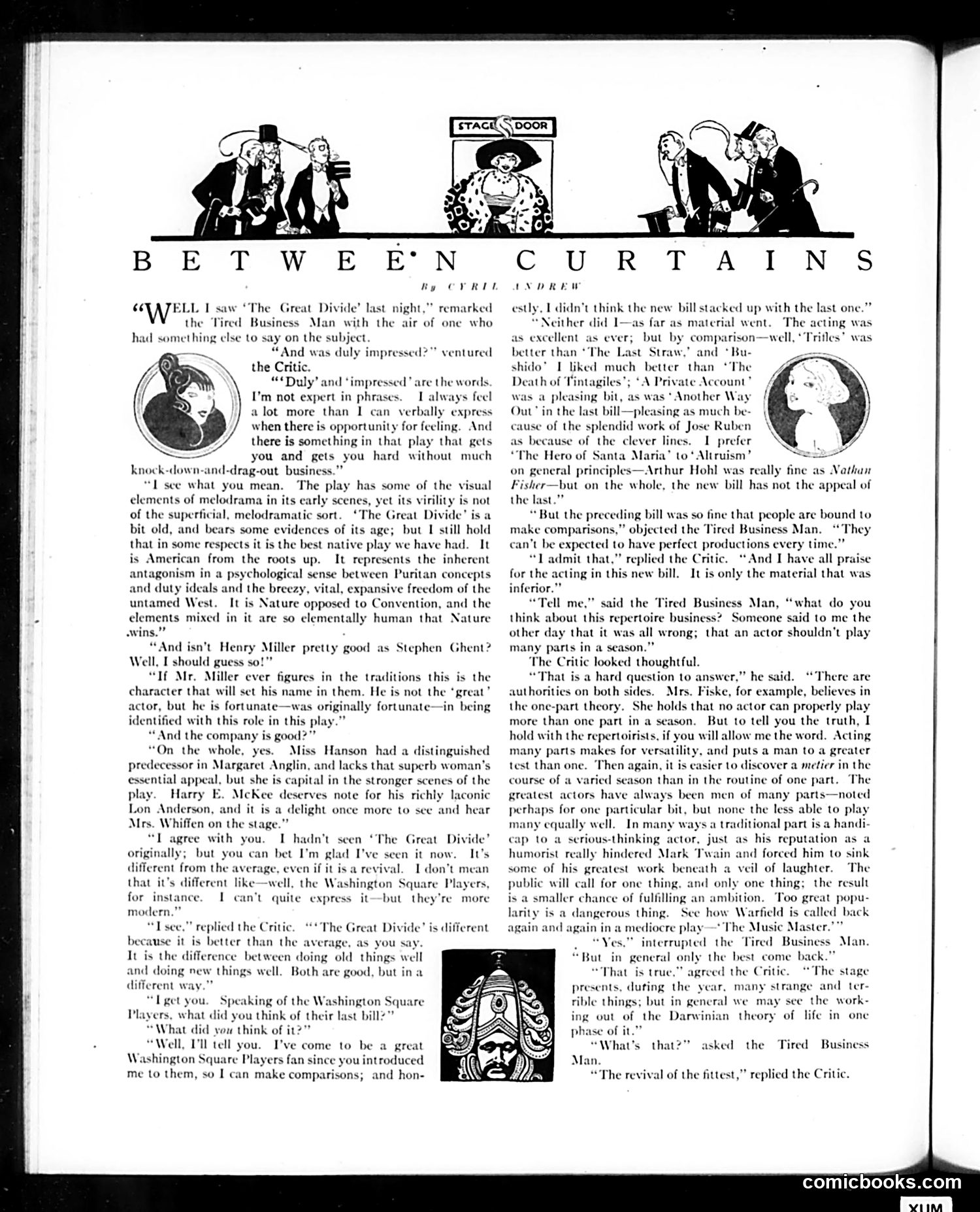
This is a theater review column featuring dialogue between "the Critic" and "the Tired Business Man" discussing recent Broadway productions. The main subjects are: - **"The Great Divide"**: A revival play praised as excellent American drama, featuring actor Henry Miller in the lead role. It's celebrated for depicting the psychological conflict between Puritan restraint and Western freedom. - **Washington Square Players**: A theatrical company whose latest bill disappointed compared to their previous production, despite strong acting. The Critic praises their earlier work ("Trifles," "The Last Straw") over the new program. The satire's gentle humor comes from the Tired Business Man's earnest attempts to express theatrical appreciation while admitting he feels more than he can articulate—a relatable everyman perspective contrasted with the Critic's more sophisticated analysis. The column reflects early 1900s theater culture, where revival productions and experimental theater companies like the Washington Square Players were significant cultural events for educated audiences.
📄 Transcribed text from this page (OCR, searchable)
Machine-transcribed from the original scan — historical spelling and the odd misread are preserved.
BE TWEE‘'N By CYRIL SLL I saw ‘The Great Divide’ last night,” remarke: the Tired Business Man with the air of one who had something else to say on the subject “And was duly impressed?” the Criti “*Duly’ and ‘impressed’ are the words. I'm not expert in phrases. I always feel alot more than I can verbally express when there is opportunity for feeling. And there is something in that play that gets you and gets you hard without much knock-down-and-drag-out business.” “L see what you mean. The play has some of the visual elements of melodrama in its early scenes, yet its virility is not of the superficial, melodramatic sort. ‘The Great Divide’ is a bit old, and bears some evidences of its age; but I still hold that in some respects it is the best native play we have had. It is American from the roots up. It represents the inherent antagonism in a psychological sense between Puritan concepts and duty ideals and the breezy, vital, expansive freedom of the untamed West. It is Nature opposed to Convention, and the elements mixed in it are so elementally human tha -Wwins.”” “And isn't Henry Miller pretty good as Stephen Ghent? Well, I should guess so!” “If Mr. Miller ever figures in the traditions this is the character that will set his name in them. He is not the ‘gr actor, but he is fortunate—was originally fortunate—in be identified with this role in this play.” “And the company is good?” “On the whole, yes. Miss Hanson had a distinguished predecessor in Margaret Anglin, and lacks that superb woman's essential appeal, but she is capital in the stronger scenes of the play. Harry E. McKee deserves note for his richly laconic Lon Anderson, and it is a delight once more to see and hear Mrs. Whiffen on the stage.” “IT agree with you. I hadn't seen ‘The Great Divide’ originally; but you can bet I'm glad I’ve seen it now. It’s different from the average, even if it is a revival. I don’t mean that it’s different like—well, the Washington Square Players, for instance. 1 can't quite express it—but they're more modern.” “Tse.” replied the Critic. “The Great Divide because it is better than the average, as you say. It is the difference between doing old things well and doing new things well. Both are good, but ina different way.” “Lget you. Speaking of the Washington Square Players, what did you think of their last bill?” “What did vou think of it?” “Well, I'll tell you. I’ve come to be a great Washington Square Players fan since you introduced me to them, so I can make comparisons; and hon- ventured N C U RTA tYDREW estly, L didn’t think the new bill stacked up with the last one.” “Neither did I—as far as material went. The acting was as excellent as ever; but by comparison—well, ‘Trifles’ was better than ‘The Last: Straw,’ and *Bu- shido’ I liked much better than he Death of ‘Tintagiles’; ‘A Private Account* was a pleasing bit, as was * Another Way Out’ in the last bill—pleasing as much be- cause of the splendid work of Jose Ruben as because of the clever lines. I prefer “The Hero of Santa Maria’ to‘ Altruism’ on general principles—Arthur Hohl was really fine as Vathan Fisher—but on the whole, the new bill has not the appeal of the last.” “ But the preceding bill was so fine that people are bound to make comparisons,” objected the Tired Business Man. rhey can’t be expected to have perfect productions every time.”” “Ladmit that,” replied the Critic. ‘And I have all praise for the acting in this new bill. It is only the material that was inferior. Tell me,” said the Tired Business Man, “what do you think about this repertoire business? Someone said to me the other day that it was all wrong; that an actor shouldn't play many parts in a season, The Critic looked thoughtful. Phat is a hard question to answer,” he said. “There are authorities on both sides. Mrs. Fiske, for example, believes in the one-part theory, She holds that no actor can properly play more than one part in a season. But to tell you the truth, I hold with the repertoirists, if you will allow me the word. Acting many parts makes for versatility, and puts a man to a greater test than one. Then again, it is casier to discover a metier in the course of a varied season than in the routine of one part. The greatest actors have always been men of many parts—noted perhaps for one particular bit, but none the less able to play many equally well. In many ways a traditional part is a handi- cap to a serious-thinking actor, just as his reputation as a humorist really hindered Mark Twain and forced him to sink some of his greatest work beneath a veil of laughter. The public will call for one thing, and only one thing; the result is a smaller chance of fulfilling an ambition. Too great popu- larity is a dangerous thing. See how Warfield is called back again and again in a mediocre play —"'The Music Master." . Yes." interrupted the Tired Business “But in general only the best come back.”” “That is true.” agreed the Critic. The stage presents, duting the year, many strange and ter- rible things; but in general we may see the work- ing out of the Darwinian theory of life in one Man. phase of “What's Man. “The revival of the fittest that?” asked the Tired Business ” replied the Critic. comicbooks.com