
Judge, 1917-03-17 · page 17 of 28
Judge — March 17, 1917 — page 17: what you’re looking at
What you’re looking at
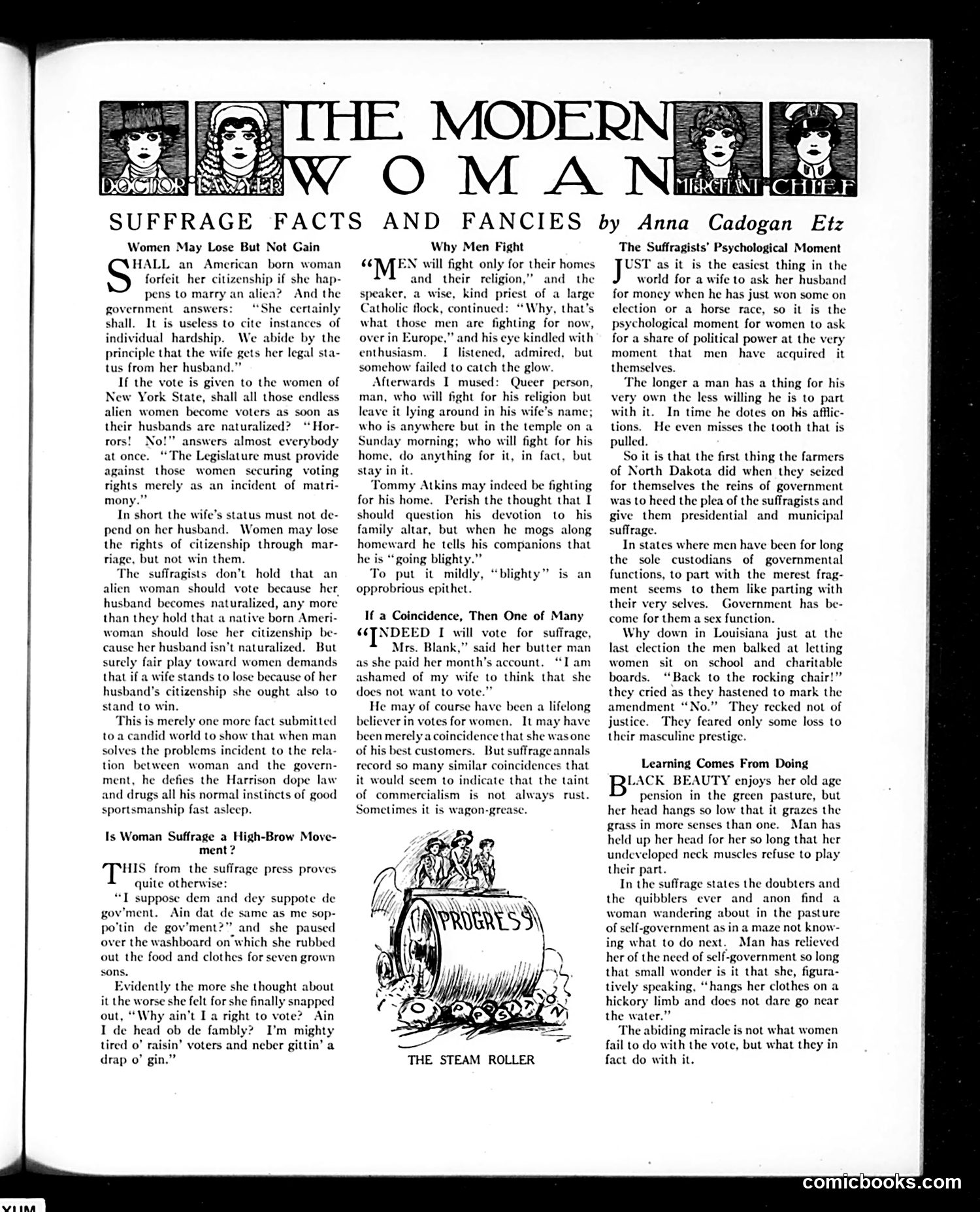
This page from Judge presents satirical commentary on women's suffrage by Anna Cadogan Etz, using ironic arguments to expose inconsistencies in anti-suffrage logic. **Main Arguments:** 1. **Citizenship Paradox**: Women lose citizenship through marriage to aliens but cannot *gain* it the same way—exposing the hypocrisy of making wives' legal status dependent on husbands while denying them voting rights. 2. **Not "High-Brow"**: A working-class woman's colloquial complaint about raising voters without having political power herself counters claims that suffrage is an elite movement. 3. **Men's Hypocrisy**: Men claim to fight for "home and religion" yet neglect both in practice—questioning their moral authority to deny women political voice. 4. **Commercial Corruption**: Supporters' sudden enthusiasm may stem from self-interest (the butter man praising suffrage to a good customer). 5. **Psychological Timing**: The "steam roller" cartoon suggests now is the moment to push suffrage, like asking for money after a win. The satire exposes logical contradictions in patriarchal arguments against women's voting rights.
📄 Transcribed text from this page (OCR, searchable)
Machine-transcribed from the original scan — historical spelling and the odd misread are preserved.
SUFFRAGE FACTS AND FANCIES by Anna Cadogan Etz Women May Lose But Not Gain HALL an American born woman S forfeit her citizenship if she hap- pens to marry an aliea? And the government answers: “She certainly shall. It is useless to cite instances of dual hardship. We abide by the principle that the wife gets her legal sta- tus from her husband.” If the vote is given to the women of New York State, shall all those endless alien women become voters as soon as their husbands are naturalized? “ Hor- rors! No!” answers almost everybody at once. “The Legislature must provide against those women securing voting rights merely as an incident of mat mon In short the wife’s status must not de- pend on her husband. Women may lose the rights of citizenship through mar- riage, but not win them. The suffragists don't hold that an alien woman should vote because her husband becomes naturalized, any more than they hold that a native born Ameri- woman should lose her citizenship be- cause her husband isn’t naturalized. But surely fair play toward women demands that if a wife stands to lose because of her husband’s citizenship she ought also to stand to win. This is merely one more fact submitted to a candid world to show that when man solves the problems incident to the rela- tion between woman and the govern- ment, he defies the Harrison dope law and drugs all his normal instincts of good sportsmanship fast asleep. Is Woman Suffrage a High-Brow Move- ment? HIS from the suffrage press proves quite otherw “T suppose dem and dey suppote de gov’ment. Ain dat de same as me sop- po'tin de gov’ment?” and she paused over the washboard on’which she rubbed out the food and clothes for seven grown sons. Evidently the more she thought about it the worse she felt for she finally snapped out, “Why ain’t La right to vote? Ain I de head ob de fambly? I’m mighty tired o’ raisin’ voters and neber gittin’ a drap o’ gin.” Why Men Fight “ EN will fight only for their homes and their religion,” and the speaker, a wise, kind priest of a large Catholic flock, continued: “Why, that’s what those men are fighting for now, over in Europe,” and his eye kindled with enthusiasm. I listened, admired, but somehow failed to catch the glow. Afterwards I mused: Queer person, man, who will fight for his religion but leave it lying around in his wife’s name; w ho is anywhere but in the temple on y morning; who will fight for his home, do anything for it, in fact, but stay in it. Tommy Atkins may indeed be fighting for his home. Perish the thought that I should question his devotion to his altar, but when he mogs along ‘ard he tells his companions that he is “going blighty. To put it mildly, “blighty” is an opprobrious epithet. If a Coincidence, Then One of Many 6¢TNDEED I will vote for suffrage, Mrs. Blank,” said her butter man as she paid her month’s account. “Iam ashamed of my wife to think that she does not want to vote.”” He may of course have been a lifelong believer in votes for women, It may have been merely a coincidence that she was one of his best customers. But suffrage annals record so many similar coincidences that it would scem to indicate that the taint of commercialism is not always rust. Sometimes it is wagon-greasc. THE STEAM ROLLER The Suffragists’ Psychological Moment UST as it is the easiest thing in the world for a wife to ask her husband for money when he has just won some on election or a horse race, so it is the psychological moment for women to ask for a share of political power at the very moment that men have acquired it themselves. The longer a man has a thing for his very own the less willing he is to part with it. In time he dotes on his affli tions. He even misses the tooth that is pulled. So it is that the first thing the farmers of North Dakota did when they seized for themselves the reins of government was to heed the plea of the suffragists and give them presidential and municipal suffrage. In states where men have been for long the sole custodians of governmental functions, to part with the merest frag- ment seems to them like parting with their very selves. Government has be- come for them a sex function. Why down in Louisiana just at the last election the men balked at letting women sit on school and charitable boards. “Back to the rocking chair!” they cried as they hastened to mark the amendment “No.” They recked not of justice. They feared only some loss to their masculine prestige. Learning Comes From Doing Bick BEAUTY enjoys her old age pension in the green pasture, but her head hangs so low that it grazes the in more senses than one. Man has ad for her so long that her undeveloped neck muscles refuse to play their part. In the suffrage states the doubters and the quibble ever and anon find a woman wandering about in the pasture of self-government as in a maze not know- ing what to do next. Man has relieved her of the need of self-government so long that small wonder is it that she, figura- tively speaking, “hangs her clothes on a hickory limb and does not dare go near the water.”” The abiding miracle is not what women fail to do with the vote, but what they in fact do with it. comicbooks.com