
Judge, 1917-03-17 · page 10 of 28
Judge — March 17, 1917 — page 10: what you’re looking at
What you’re looking at
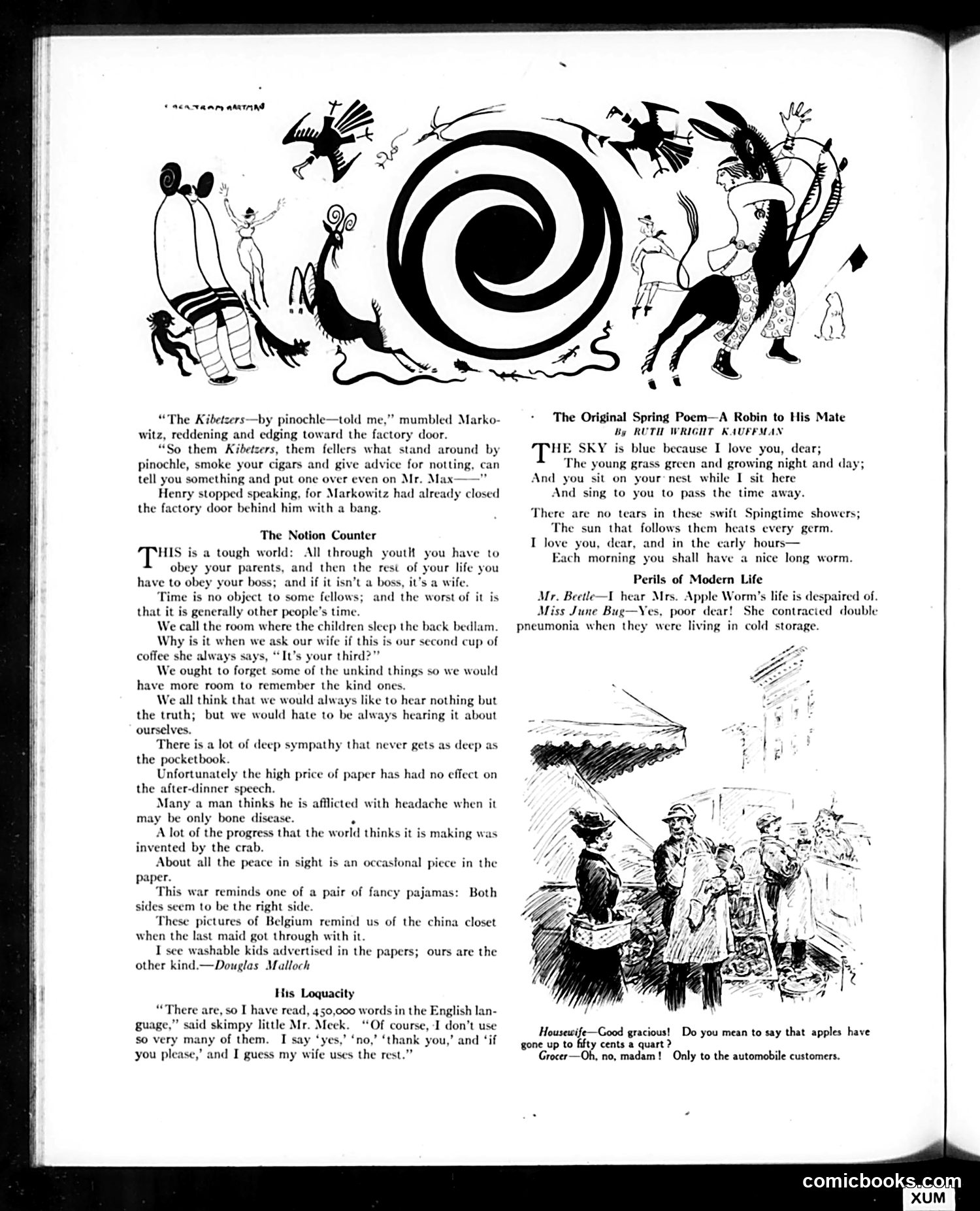
This page contains several short humorous pieces typical of early 20th-century American satirical magazines: **"The Kibitzers"** depicts working-class Jewish immigrants (identified by names like Markowitz). The humor relies on ethnic stereotyping—portraying Yiddish-accented factory workers who offer unsolicited advice at pinochle games. **"The Notion Counter"** offers cynical social commentary on modern life: obedience to authority (parents, bosses, wives), time-wasting, marital friction, and hypocrisy about hearing truth. **"His Loquacity"** jokes about Mr. Meek's minimal vocabulary while his wife apparently uses all 450,000 English words—a dig at nagging wives. **"Perils of Modern Life"** uses anthropomorphized insects to satirize modern anxieties: cold storage threatens health, and inflation affects prices (though automobile owners apparently escape it). The page reflects period attitudes: ethnic humor was mainstream; domestic/marital conflict was stock comedy; inflation was a contemporary concern.
📄 Transcribed text from this page (OCR, searchable)
Machine-transcribed from the original scan — historical spelling and the odd misread are preserved.
7 4 9eR AA AAT G of < * “The Kibetzers—by pinochle—told me,” mumbled Marko- witz, reddening and edging toward the factory door. “So them Kibetzers, them fellers what stand around by pinochle, smoke your cigars and give advice for notting, can tell you something and put one over even on Mr. Max Henry stopped speaking, for Markowitz had already closed the factory door behind him with a bang. The Notion Counter HIS is a tough world: All through youtl you have to obey your parents, and then the rest of your life you ave to obey your boss; and if it isn’t a boss, it’s a wife. Time is no object to some fellows; and the worst of it is that it is generally other people's time We call the room where the children sleep the back bedlam. Why is it when we ask our wife if this is our second cup of coffee she always says, “It’s your third?” We ought to forget some of the unkind things so we would have more room to remember the kind ones. We all think that we would always like to hear nothing but the truth; but we would hate to be always hearing it about ourselves. There is a lot of deep sympathy that never gets as deep as the pocketbook. Unfortunately the high price of paper has had no effect on the after-dinner speech. Many a man thinks he is afflicted with headache when it may be only bone disease. A A lot of the progress that the world thinks it is making was invented by the crab. About all the peace in sight is an occasfonal piece in the paper. his war reminds one of a pair of fancy pajamas: Both sides seem to be the right side. These pictures of Belgium remind us of the china closet when the last maid got through with it. I see washable kids advertised in the papers; ours are the other kind.—Douglas Malloch His Loquacity “There are, so I have read, 450,000 words in the English lan- guage,” said skimpy little Mr. Meek. “Of course, I don’t use so very many of them. I say ‘y no,’ ‘thank you,’ and ‘if you please,’ and I guess my wife uses the rest.” The Original Spring Poem—A Robin to His Mate By RUTH WRIGHT KAUFFMAN HE SKY is blue because I love you, dear; he young grass green and growing night and day; And you sit on your: nest while I sit here And sing to you to pass the time away. There are no tears in these swift Spingtime showers; The sun that follows them heats every germ. I love you, dear, and in the early hours— Each morning you shall have a nice long worm. Perils of Modern Life Mr. Beetle—I hear Mrs. Apple Worm’s life is despaired of. Miss June Bug—Yes, poor di She contracied double pneumonia when they were living in cold storage. Housewife—Good gracious! gone up to fifty cents a quart ? Grocer—Oh, no, madam ! Do you mean to say that apples have Only to the automobile customers. comicbooks,com