
A complete issue · 28 pages · 1917
Judge — March 10, 1917
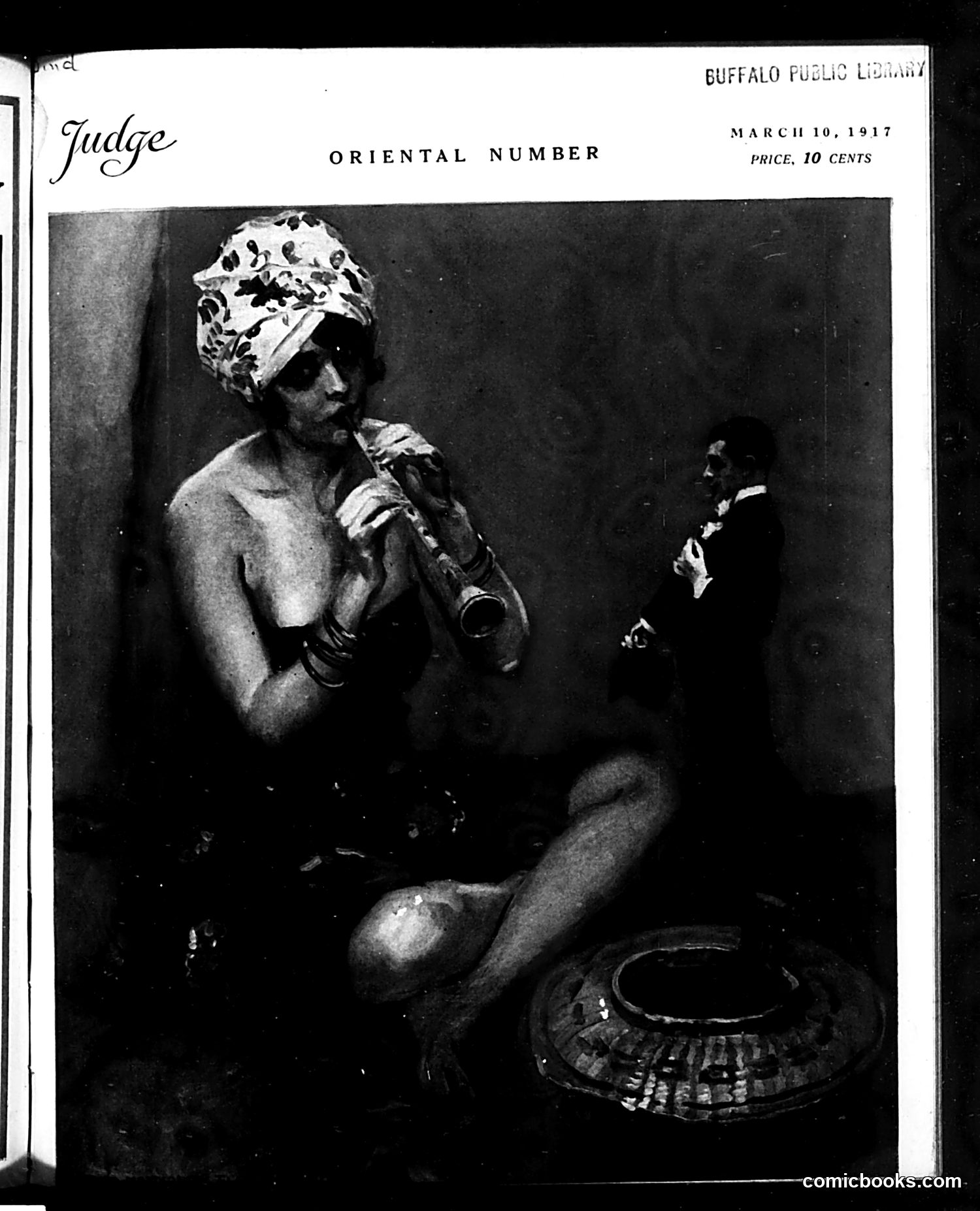
This appears to be the cover of Judge's "Oriental Number" issue. The illustration depicts a figure in stereotypical "Oriental" dress—an ornate turban and draped clothing—playing what appears to be a wind instrument, with a small figure visible in the background. A decorative basket sits nearby. The image reflects early 20th-century American attitudes toward Asia, employing exaggerated costume and caricature typical of that era's entertainment and periodical illustration. Without additional article text, the specific satirical point remains unclear, though the "Oriental Number" designation suggests the issue focused on commentary regarding Asian cultures, trade, or diplomatic relations—topics of contemporary interest in 1917.
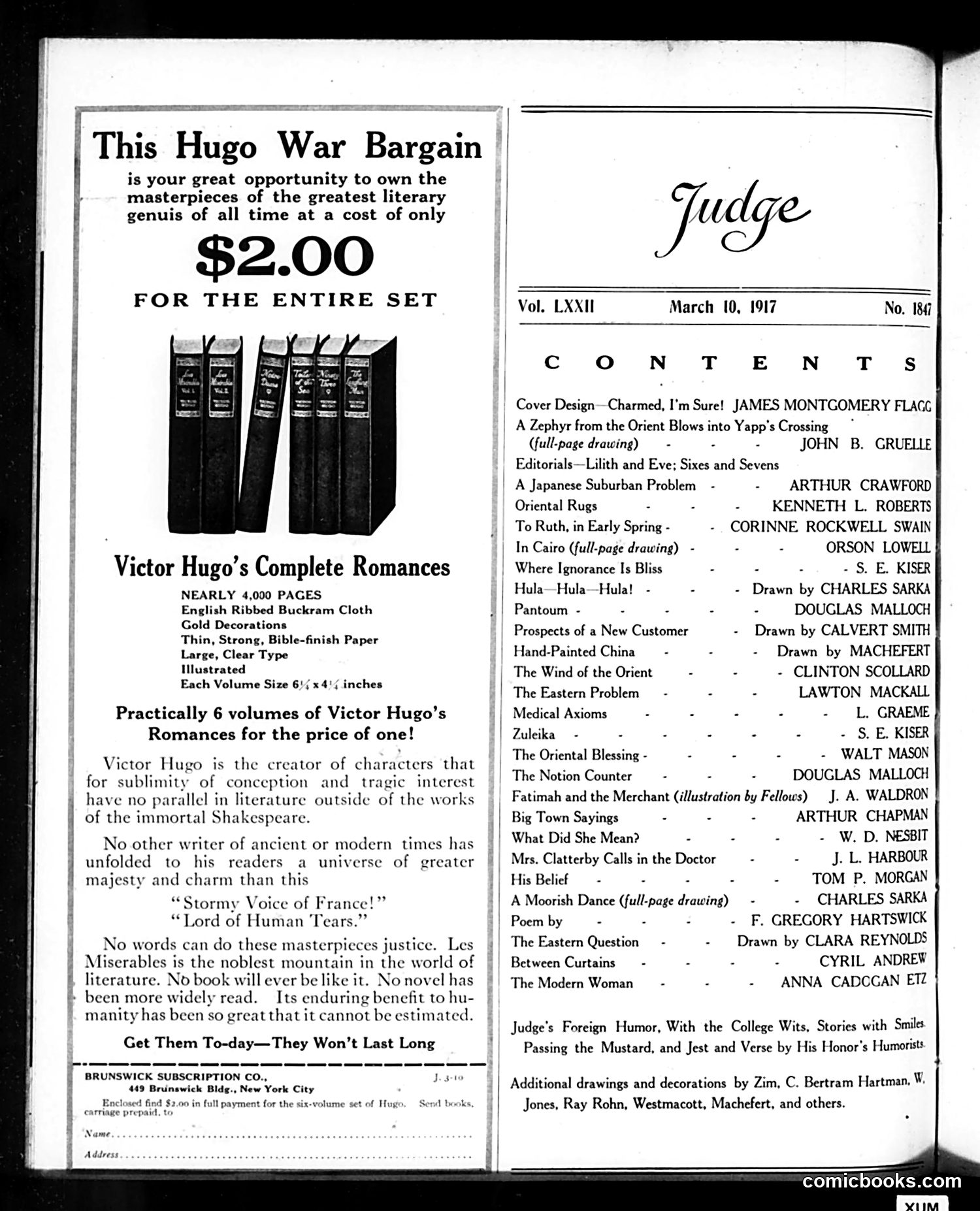
This page is primarily **advertising and table of contents**, not political satire. The left side advertises Victor Hugo's Complete Romances for $2.00—a book deal emphasizing literary prestige ("Stormy Voice of France," "Lord of Human Tears"). The right side lists Judge magazine's contents, featuring illustrations by prominent cartoonists (Sarka, Malloch, Lowell) and articles addressing contemporary topics like "A Japanese Suburban Problem" and "Oriental Rugs"—reflecting early 20th-century American interest in Asia. Without seeing the actual cartoons referenced in the contents, specific satirical targets remain unclear, though the Oriental/Eastern theme appears significant for this 1917 issue date.
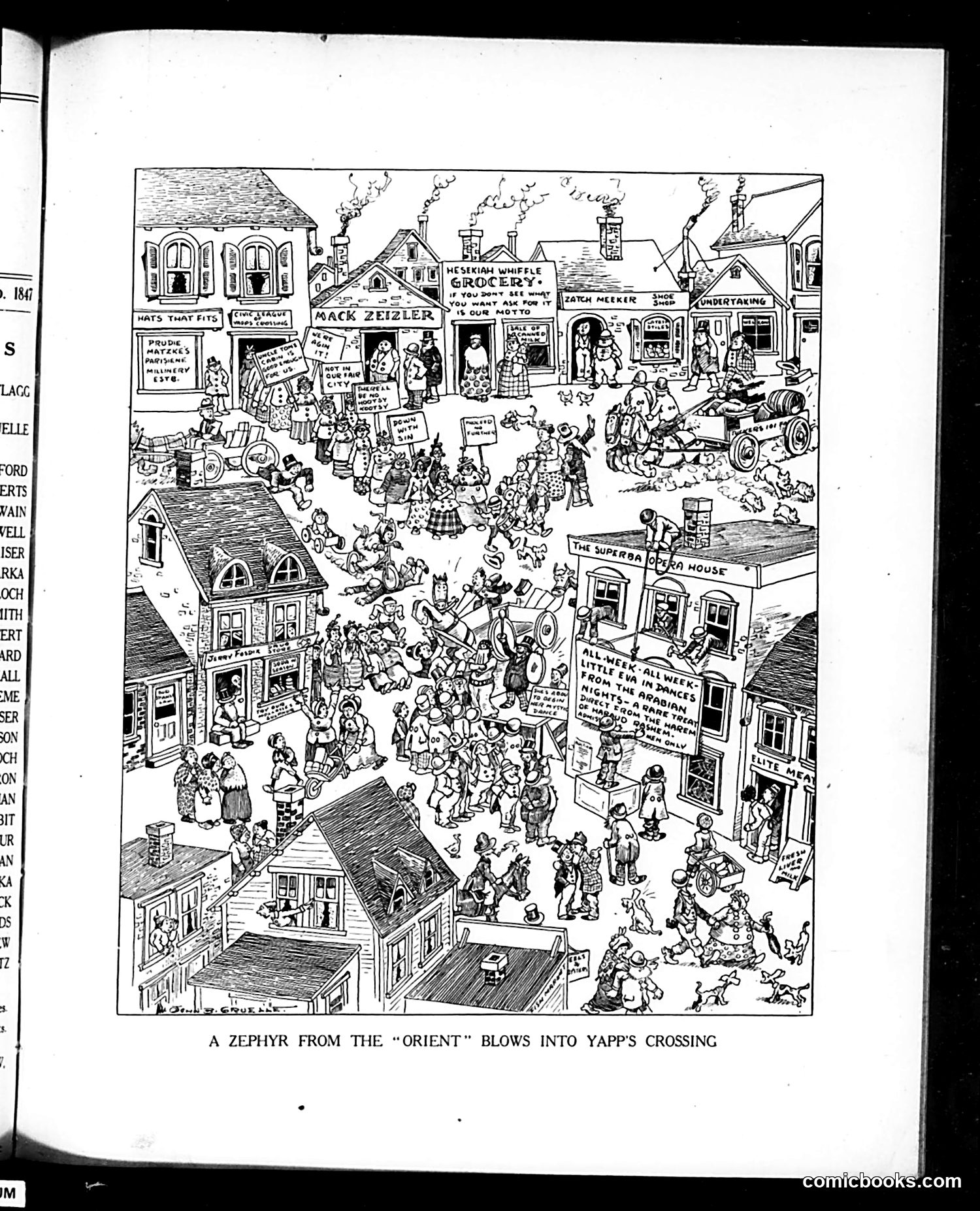
This cartoon depicts a chaotic street scene in what appears to be a small town marketplace. The satire centers on disruption caused by the arrival of the "Orient"—likely referring to a new business or establishment (possibly a ship, store, or entertainment venue). The crowded, disorderly scene with numerous pedestrians, vendors, and activity suggests social upheaval from this newcomer's arrival. Various storefront signs are visible, including "Mack Zeigler" and other businesses, indicating this is commentary on commercial competition or community disruption. The phrase "zephyr" (a gentle wind) is ironic—suggesting a small influence has instead caused considerable turbulence. Without additional context about the specific "Orient" business and "Yapp's Crossing" location, the exact satirical target remains unclear, though it appears to mock local resistance to new commercial forces.
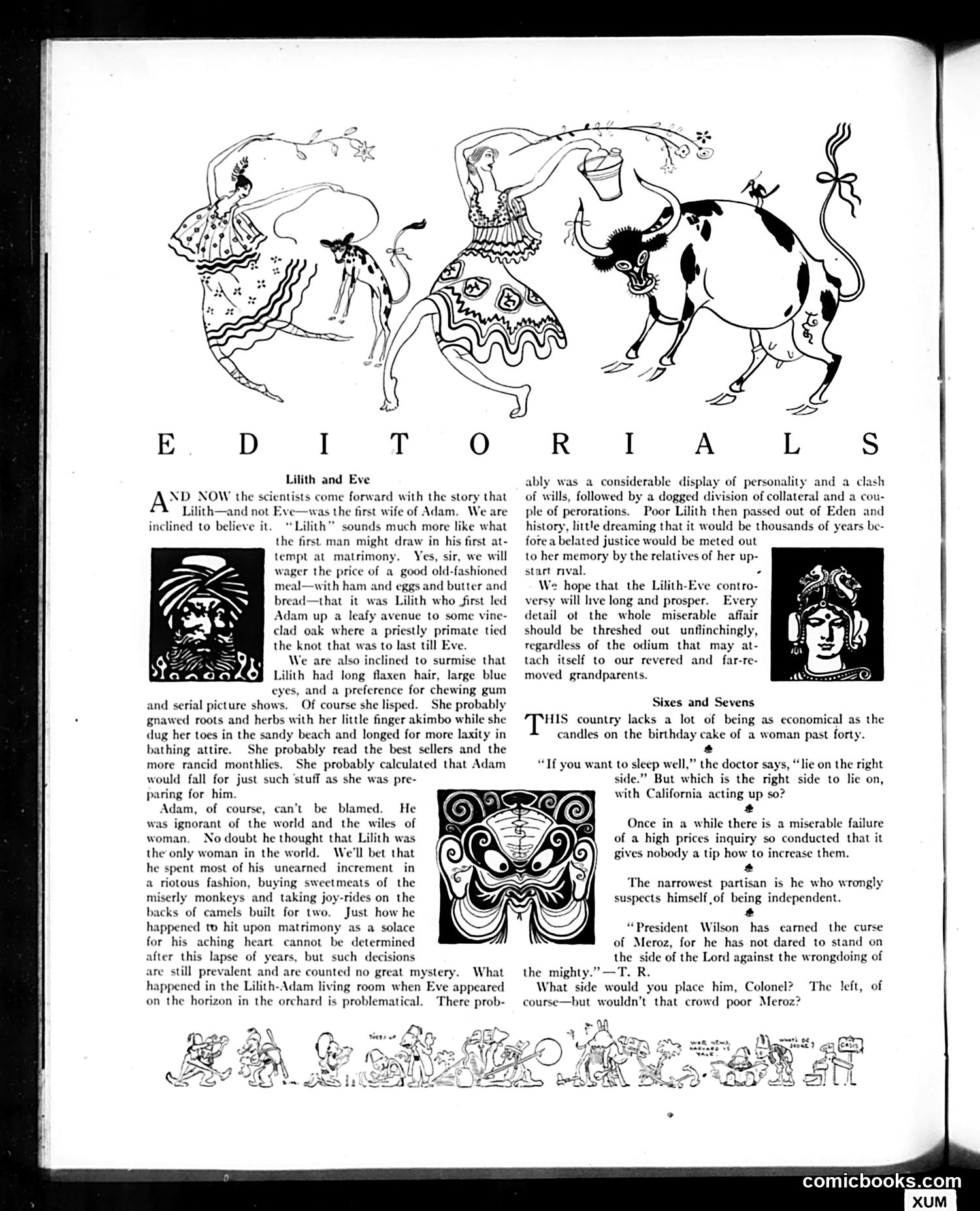
This page combines a whimsical illustrated header ("Editorials") with satirical commentary. The top illustration depicts women in various states of dishevelment with animals—likely satirizing female independence or changing social roles. The "Lilith and Eve" section discusses the first wife of Adam (a biblical/Jewish folklore figure), using her story to comment on marital discord and women's personalities. The piece appears to blame women for relationship failures, a common early-20th-century Judge trope. "Sixes and Sevens" contains brief political jabs, including a reference to President Wilson and someone named Meroz, likely contemporary political figures. The jokes mock political neutrality and positioning during what appears to be WWI-era America. The overall tone reflects Judge's typical conservative, anti-feminist satirical approach of that era.
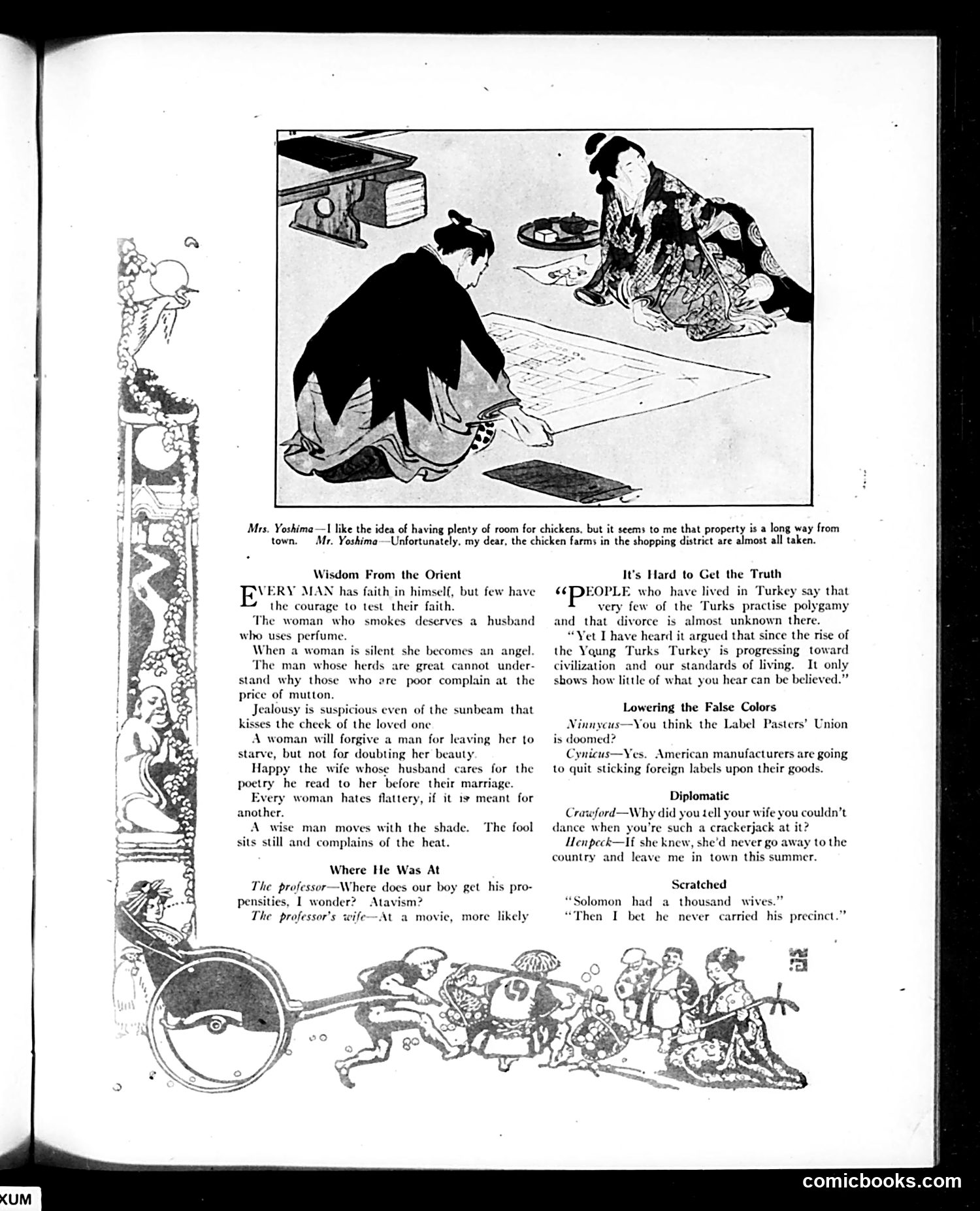
The main cartoon depicts two Japanese figures in traditional dress discussing housing in what appears to be early 20th-century Japan. One man, bent over, represents someone seeking property, while the other (wearing ornate clothing) explains that chicken farms in the shopping district are "almost all taken." The satire likely mocks the rapid Westernization and modernization of Japan during this period, contrasting traditional Japanese aesthetics with contemporary urban development concerns. The surrounding text includes various joke sections ("Wisdom From the Orient," "It's Hard to Get the Truth," "Lowering the False Colors," "Diplomatic," and "Scratched") presenting brief quips about marriage, Turkish customs, labor unions, and domestic humor—typical Judge magazine fare mixing social commentary with vaudeville-style jokes.
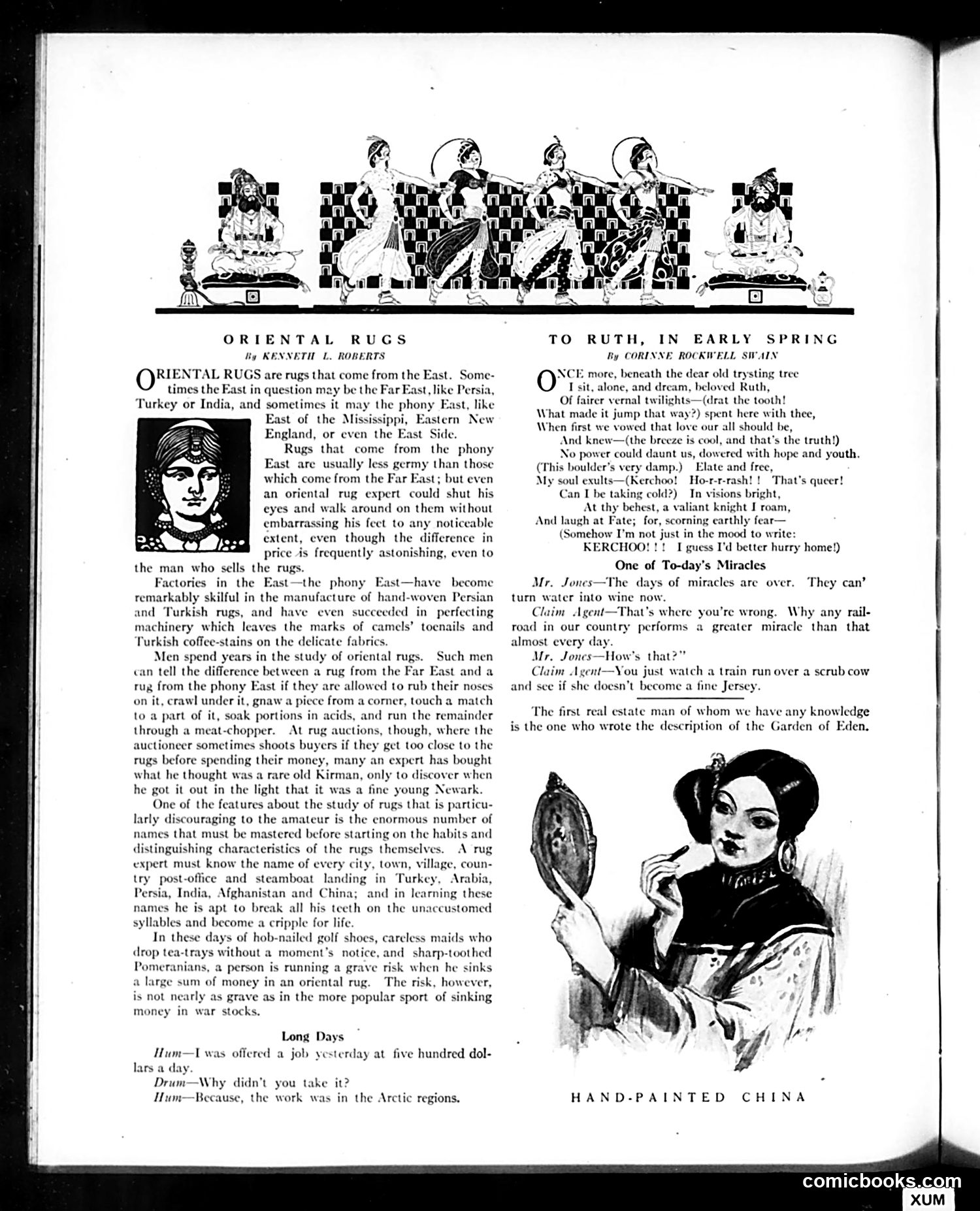
This page contains three distinct pieces: 1. **"Oriental Rugs"** (left): An essay on Persian and Turkish rugs, discussing their manufacture and authentication. The accompanying illustration is a portrait head—likely meant to represent an "Oriental" dealer or expert, using stereotypical artistic conventions of the era. 2. **"To Ruth, in Early Spring"** (right): A romantic poem by Corinne Rockwell Shwin, with no apparent satirical intent. 3. **"Hand-Painted China"** (lower right): An illustration of a woman admiring her reflection in a hand mirror, likely a fashion or vanity-themed cartoon, though the specific satirical point is unclear from the image alone. The page appears primarily content-driven rather than overtly political, focusing on lifestyle topics popular with Judge's affluent readership.
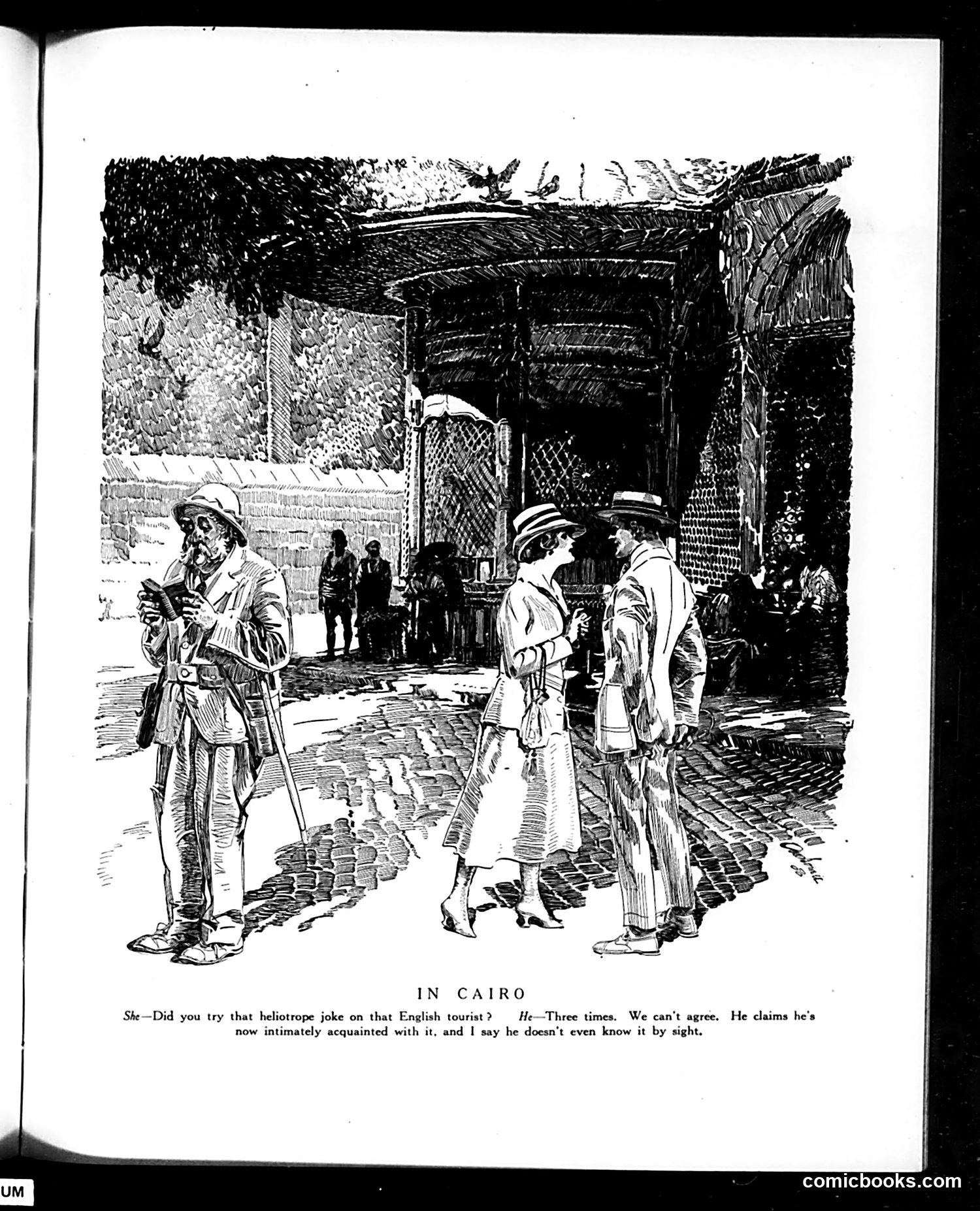
This cartoon satirizes a disagreement between two people in Cairo about whether a joke about heliotrope (a purple flower) has successfully landed with an English tourist. The humor operates on multiple levels: the couple argues over whether the tourist has truly understood the joke or merely pretended to know it—suggesting the tourist's claimed familiarity is false politeness rather than genuine comprehension. The joke itself appears to play on the color "heliotrope," likely a visual or linguistic pun that the English tourist either doesn't grasp or pretends to understand. The setting in Cairo and the reference to an "English tourist" reflect Judge's contemporary audience's familiarity with travel narratives and the stereotype of reserved, polite British travelers abroad who might feign understanding rather than admit confusion. The cartoon mocks both the failed joke and the social awkwardness of cross-cultural interaction.
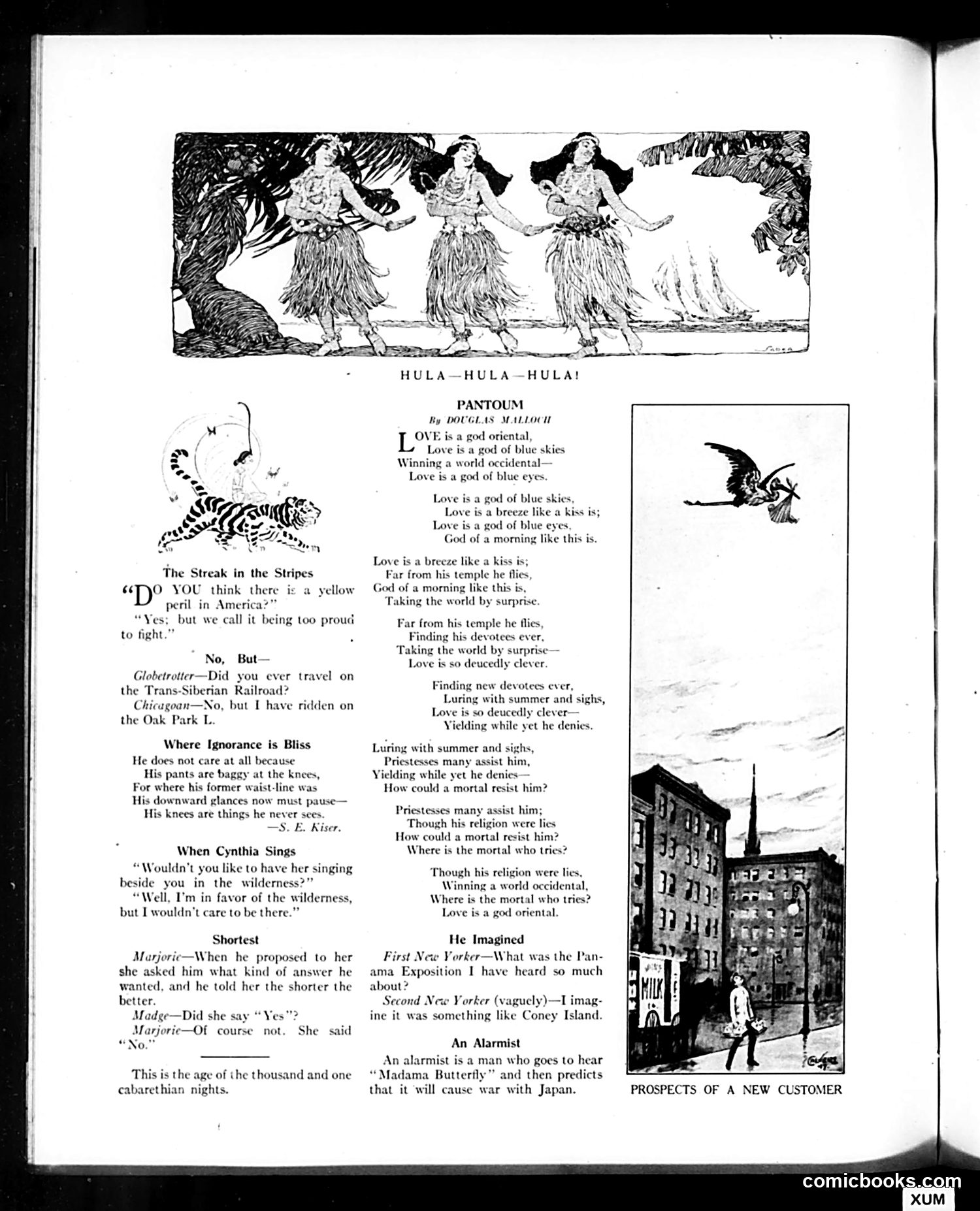
This page from *Judge* contains several short satirical pieces typical of early 20th-century American humor: **"The Streak in the Stripes"** mocks American pride, with a dialogue suggesting Americans are dangerously arrogant about their nation. **"Where Ignorance is Bliss"** and **"When Cynthia Sings"** are gentle domestic humor about obliviousness and courtship preferences—common magazine filler. **"Shortest"** is a brief joke about a woman rejecting a marriage proposal tersely. The page's title references Hawaiian hula dancing, popular in American entertainment of this era. The **"Pantoum" poem** romanticizes love in orientalist terms (blue eyes, Eastern aesthetics)—reflecting early 1900s fascination with "exotic" cultures. **"An Alarmist"** satirizes anxious Americans who see political danger in opera: watching *Madama Butterfly* (set in Japan, depicting a tragic romance) supposedly predicts war with Japan—mocking both jingoism and overreaction to foreign culture. The illustration "Prospects of a New Customer" shows urban tenement life, likely commentary on immigration or poverty.
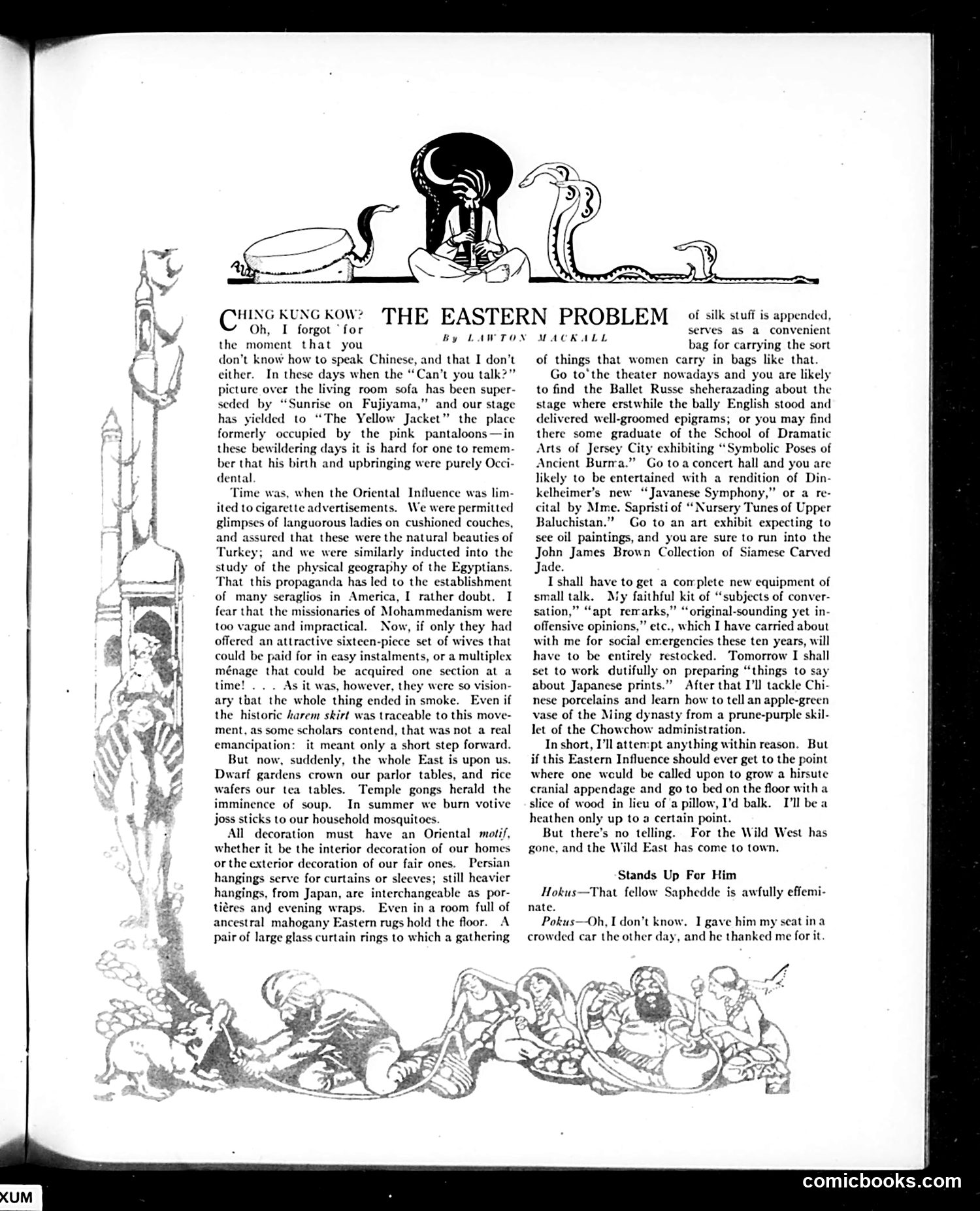
This 1910s-era piece by Lawton mocks the sudden American obsession with "Oriental" decoration and culture. The author sarcastically chronicles how Asian imagery has invaded every aspect of American life—from home décor (dwarf gardens, temple gongs, Persian hangings) to entertainment (the Ballet Russe, "Symbolic Poses of Ancient Burrra"). The satire targets the superficiality and pretentiousness of this trend. The author notes that this "Eastern Influence" was once limited to cigarette ads featuring vague "languorous ladies," but has now become inescapable and mandatory—affecting parlor decoration, fashion, theater, concerts, and art exhibitions. He jokes that he must now acquire entirely new "small talk" about Japanese prints and Ming vases to function socially. The opening cartoon depicts exotic Asian imagery (serpents, dancers, ornate vessels), visualizing this cultural invasion. The humor lies in exposing how Americans uncritically and fashionably embrace Eastern aesthetics without genuine understanding, treating it as mere decoration rather than meaningful cultural engagement.
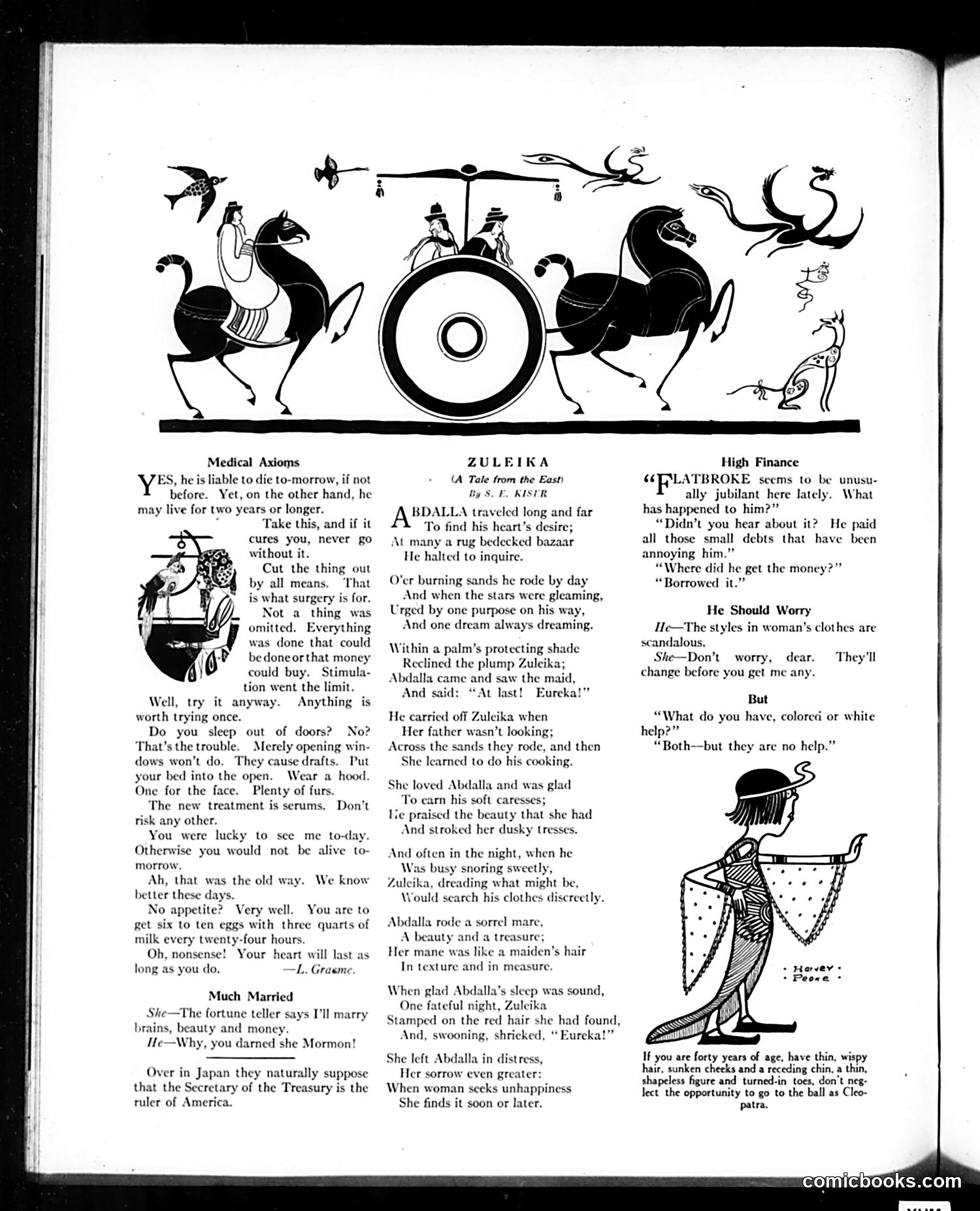
This page contains three distinct satirical pieces: **"Medical Axioms"** mocks contemporary medical practice through absurdist advice—doctors prescribing contradictory treatments, recommending patients sleep outdoors in hoods and furs, or consume massive quantities of eggs and milk. The satire targets early 20th-century medicine's tendency toward extreme, often ineffective interventions and doctors' self-aggrandizing claims about their necessity. **"Zuleika"** is an orientalist romantic tale poking fun at exotic adventure stories popular in the era. The humor lies in its anticlimactic ending: after Abdalla's heroic quest to win the beautiful maiden, she abandons him upon discovering he's been unfaithful—revealed when she finds a woman's hair in his clothing. **"High Finance" and "He Should Worry"** are brief comic dialogues. The first satirizes financial irresponsibility (paying debts by borrowing more). The second jokes about gender relations and fashion, with the husband criticizing women's scandalous clothing while the wife dismisses his concern. The decorative art features orientalist imagery and classical motifs typical of Judge's visual style.
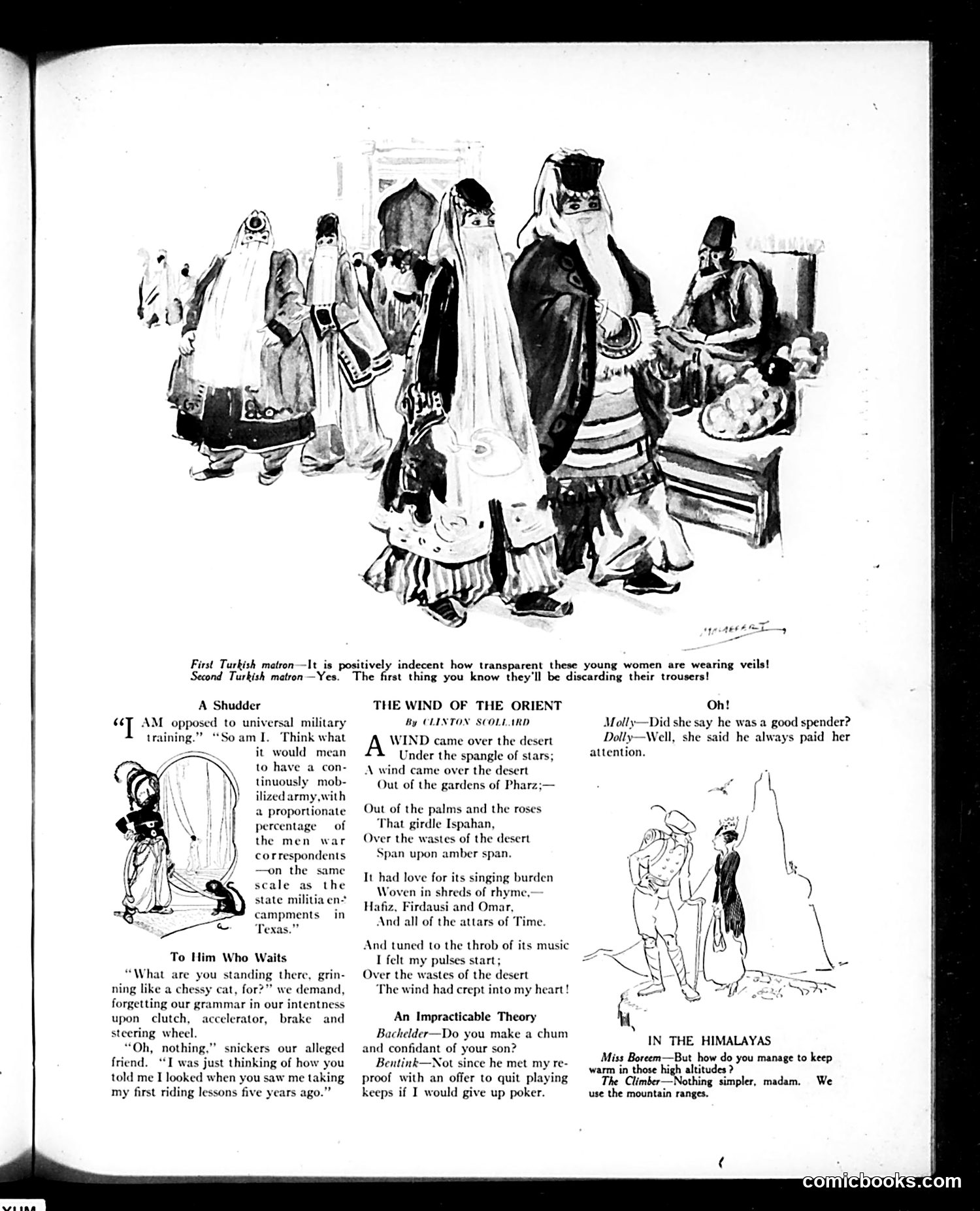
This page contains multiple satirical pieces reflecting early 20th-century attitudes: **Top cartoon:** Two Turkish women discuss young women wearing veils, sarcastically suggesting that transparent veils are "indecent" and the women will soon discard their trousers. This mocks both Western anxieties about Turkish/Muslim women's clothing and orientalist stereotypes. **"A Shudder":** A man opposes universal military training, joking that it would require too many war correspondents. This satirizes contemporary debates over military preparedness and the proliferation of press coverage. **"To Him Who Waits":** A friend grins knowingly about the speaker's poor riding abilities from years past—simple humor about forgotten embarrassments. **"The Wind of the Orient":** A romantic poem referencing Persian poets (Hafiz, Firdausi, Omar), reflecting period fascination with orientalist literature. **Bottom jokes:** Simple puns and domestic humor unrelated to politics or social commentary. The page reflects 1910s-era attitudes toward foreign cultures, military policy, and gender roles.
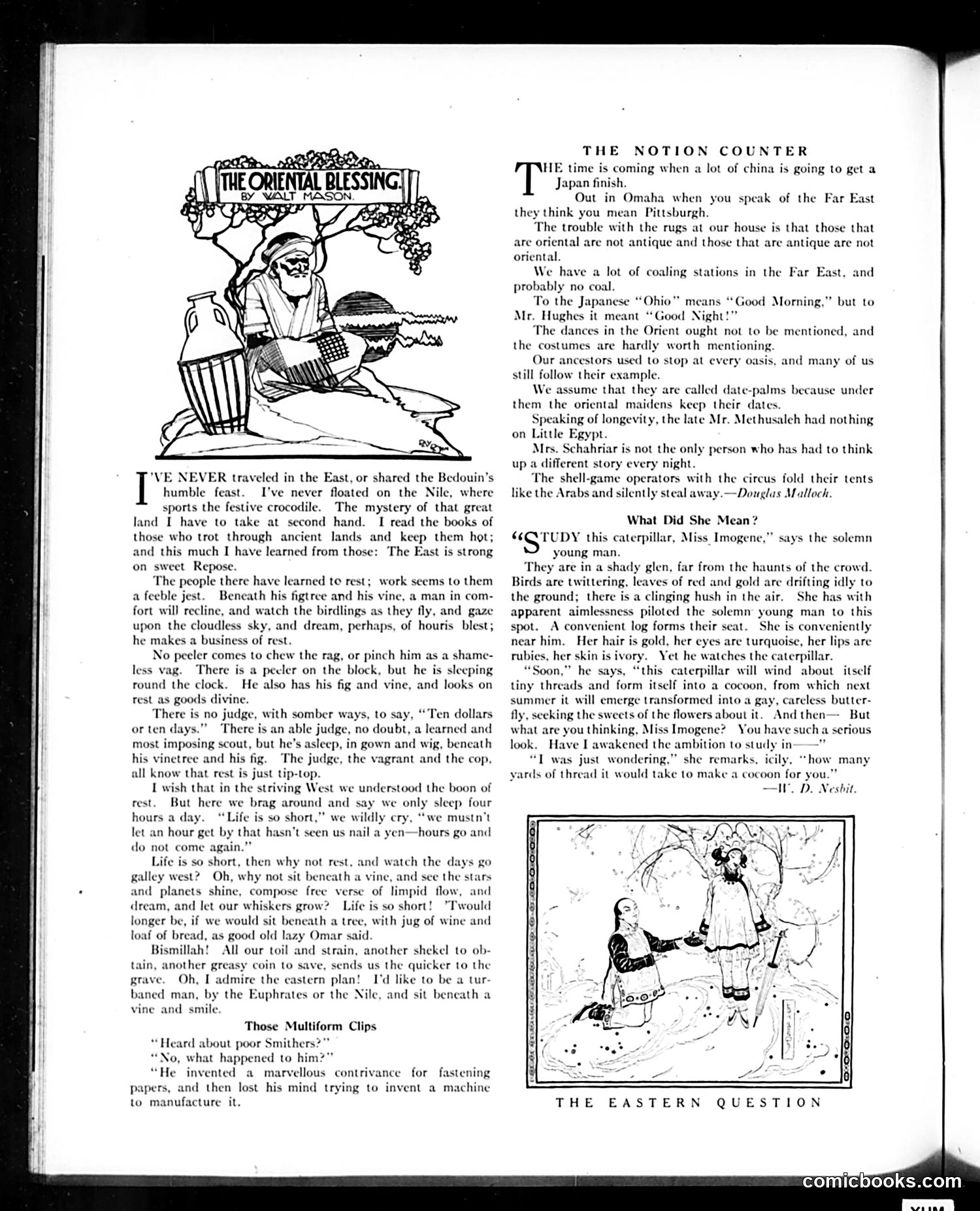
This page contains two distinct satirical pieces from Judge magazine: **"The Oriental Blessing"** (left): A poem mocking American obsession with Eastern leisure while criticizing Western work culture. It romanticizes Middle Eastern rest and relaxation (sitting under fig trees, drinking wine) as superior to American hustle. The satire targets American anxiety and overwork, contrasting it with stereotypical Eastern idleness. **"The Notion Counter"** (right): A collection of witty one-liners poking fun at American ignorance about Asia. Jokes include: confusing "Far East" with Pittsburgh; owning fake Oriental rugs; having military "coaling stations" in Asia with no coal; Japanese language confusion; and references to "Little Egypt" (likely a belly-dancer performer). The final anecdote mocks circus con artists. Both pieces use casual racism and stereotypes typical of early-20th-century American humor, reflecting period attitudes toward Asian cultures as exotic, backwards, or deceptive.
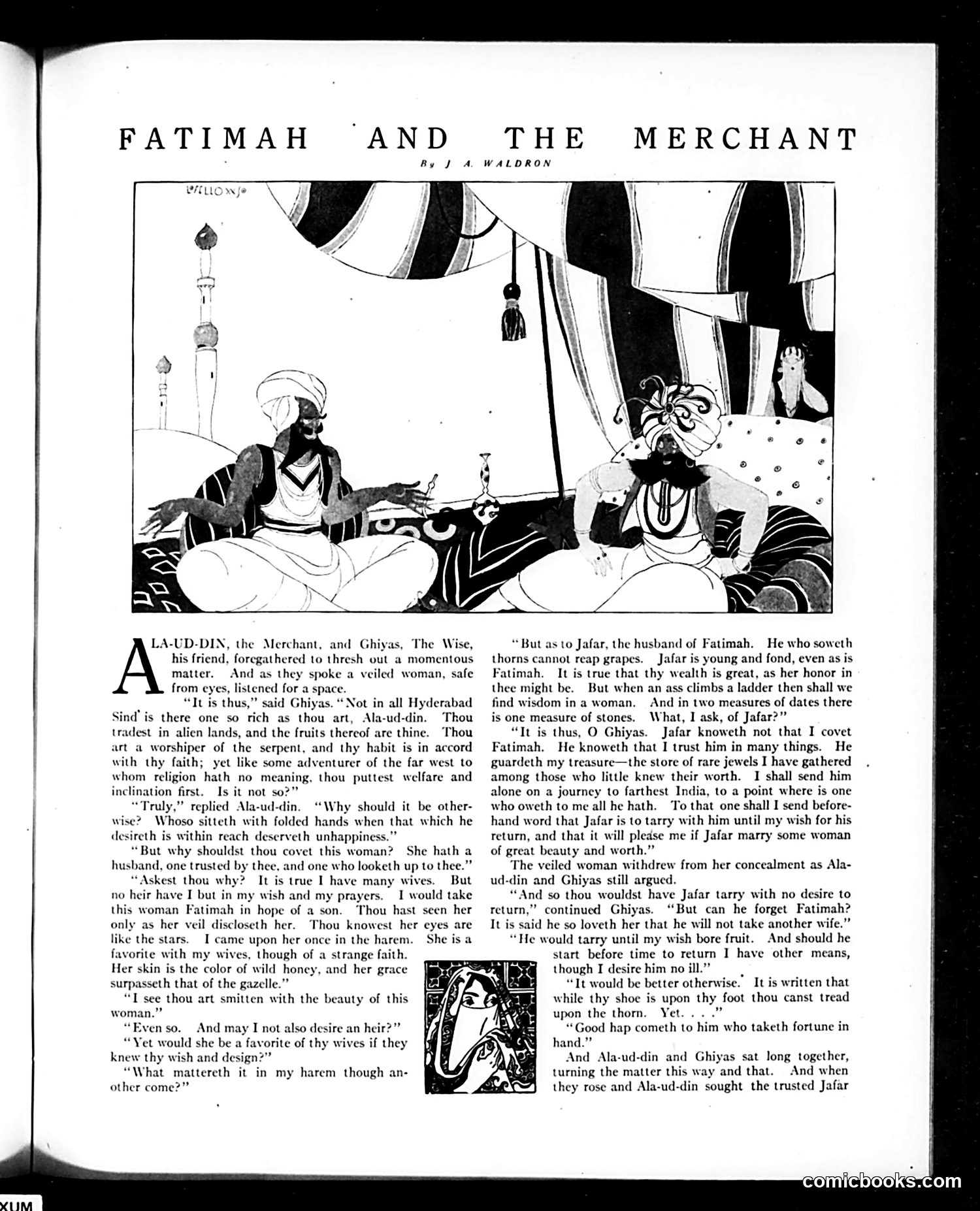
This page presents a serialized story (not a political cartoon) set in what appears to be colonial-era India, featuring dialogue between wealthy merchant Ala-ud-din and his friend Ghiyas about seducing Jafar's wife, Fatimah. The narrative employs orientalist tropes common to early 20th-century American publications: exotic Middle Eastern/Indian setting, veiled women, wealthy merchants, and scheming. The story depicts Ala-ud-din planning to send Jafar away on business to a distant point in India, while arranging for him to be detained there—creating opportunity to seduce Fatimah. The accompanying illustration shows two men in turbans and period dress in an ornate tent setting, with a veiled woman observing from concealment. This represents typical Judge magazine fiction: melodramatic moral tales with orientalist aesthetics that were entertainment for American readers of the period.
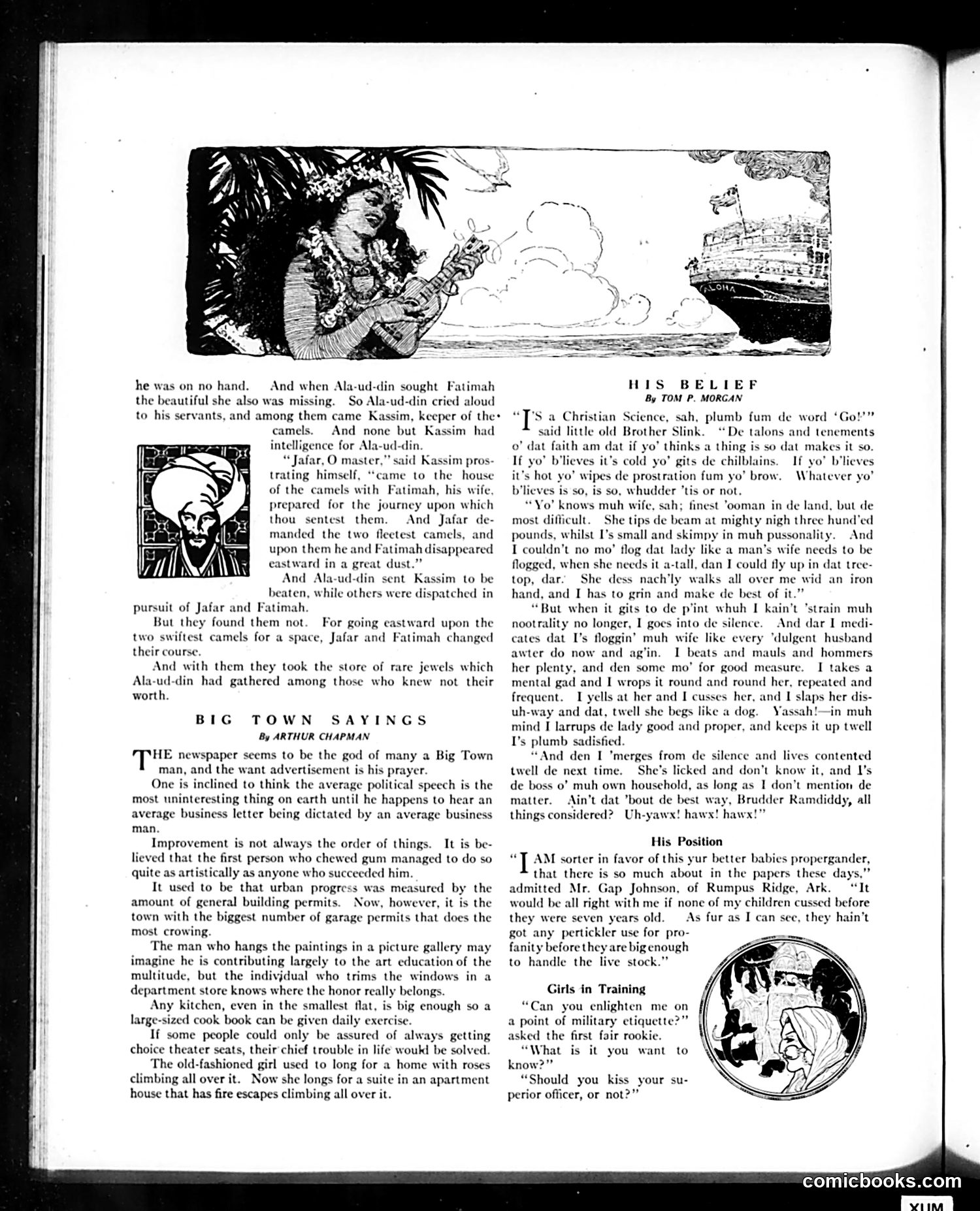
This page contains three distinct pieces of satirical content: 1. **"His Belief"** (right column): A dialect monologue by "Brother Slink," a Black character, mocking Christian Science theology. The satire targets the religion's core tenet that belief shapes reality—suggesting if you believe it's cold, you won't feel cold. Slink applies this absurdly to his marriage, claiming he mentally "beats" his wife in silent meditation rather than physically, satisfying his aggression through imagination alone. The crude dialect and domestic violence subject matter reflect the era's casual racism and misogyny in humor. 2. **"Big Town Sayings"** (left/bottom): Chapman's brief urban observations mock modern commercialism, the newspaper's cultural dominance, and changing values—preferring newspaper ads to prayers, garage permits to civic progress. These are gentle social commentary rather than sharp satire. 3. **The illustrated narrative** (top): An exotic adventure story about Jafar and Fatimah's elopement with stolen jewels, seemingly unrelated to the commentary below. The overall tone reflects Judge magazine's irreverent approach to contemporary society, religion, and race during the early 20th century.
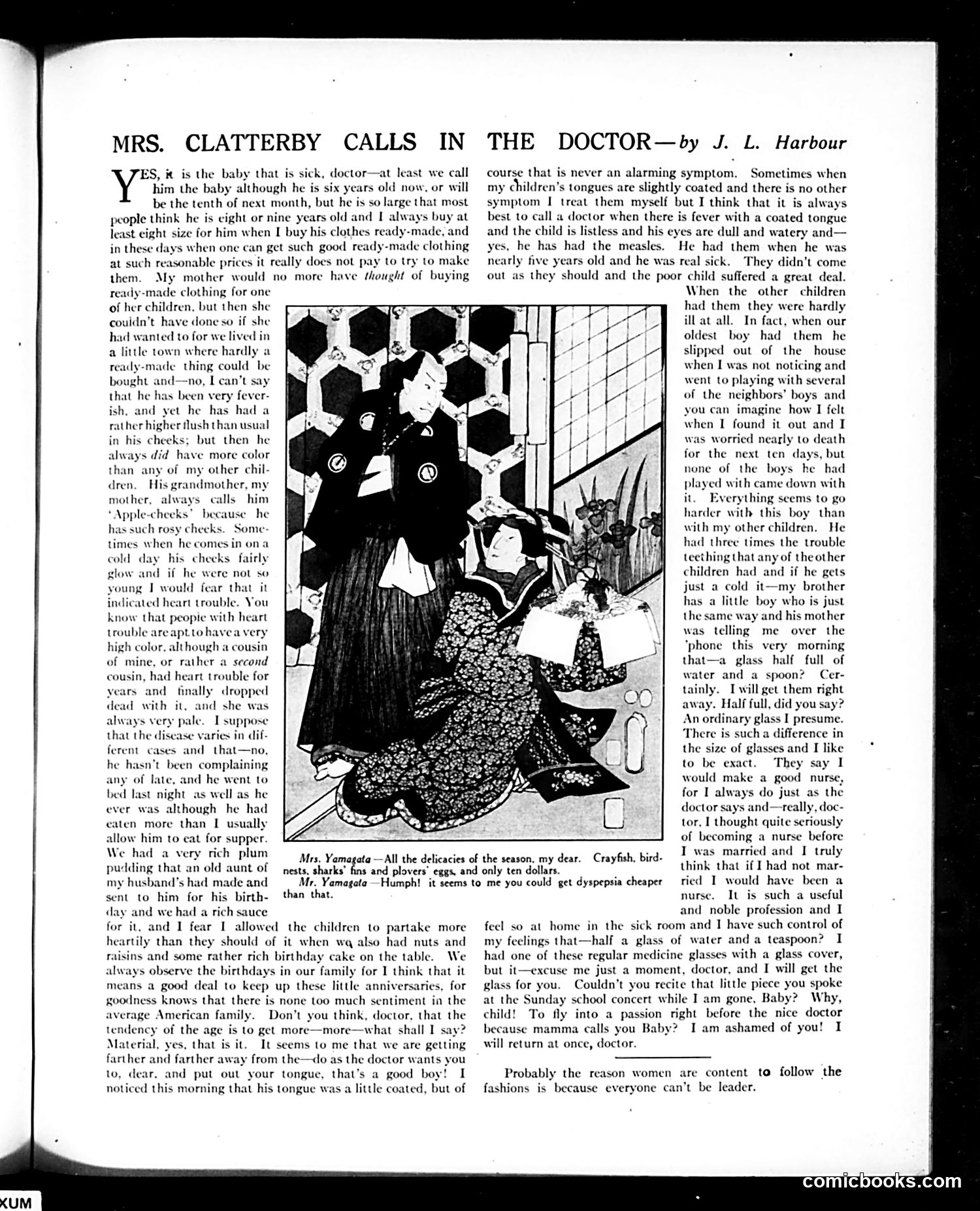
This is a humorous domestic sketch by J.L. Harbour satirizing middle-class parenting anxieties and hypochondria. The illustration shows a worried mother in an exaggerated panic, consulting a doctor about her baby's minor ailment. The satire targets Mrs. Clatterby's tendency to overreact to trivial symptoms—her child has merely a coated tongue—yet she catastrophizes about serious illness. The text reveals she's overly concerned with fashionable child-rearing practices and medical trends, rushing to professional help for minor issues while ignoring her own judgment. The joke mocks both nervous Victorian mothers and the emerging medical professionalization that encouraged patient dependency through unnecessary consultations. The doctor's patient, sensible responses contrast with her escalating worry.
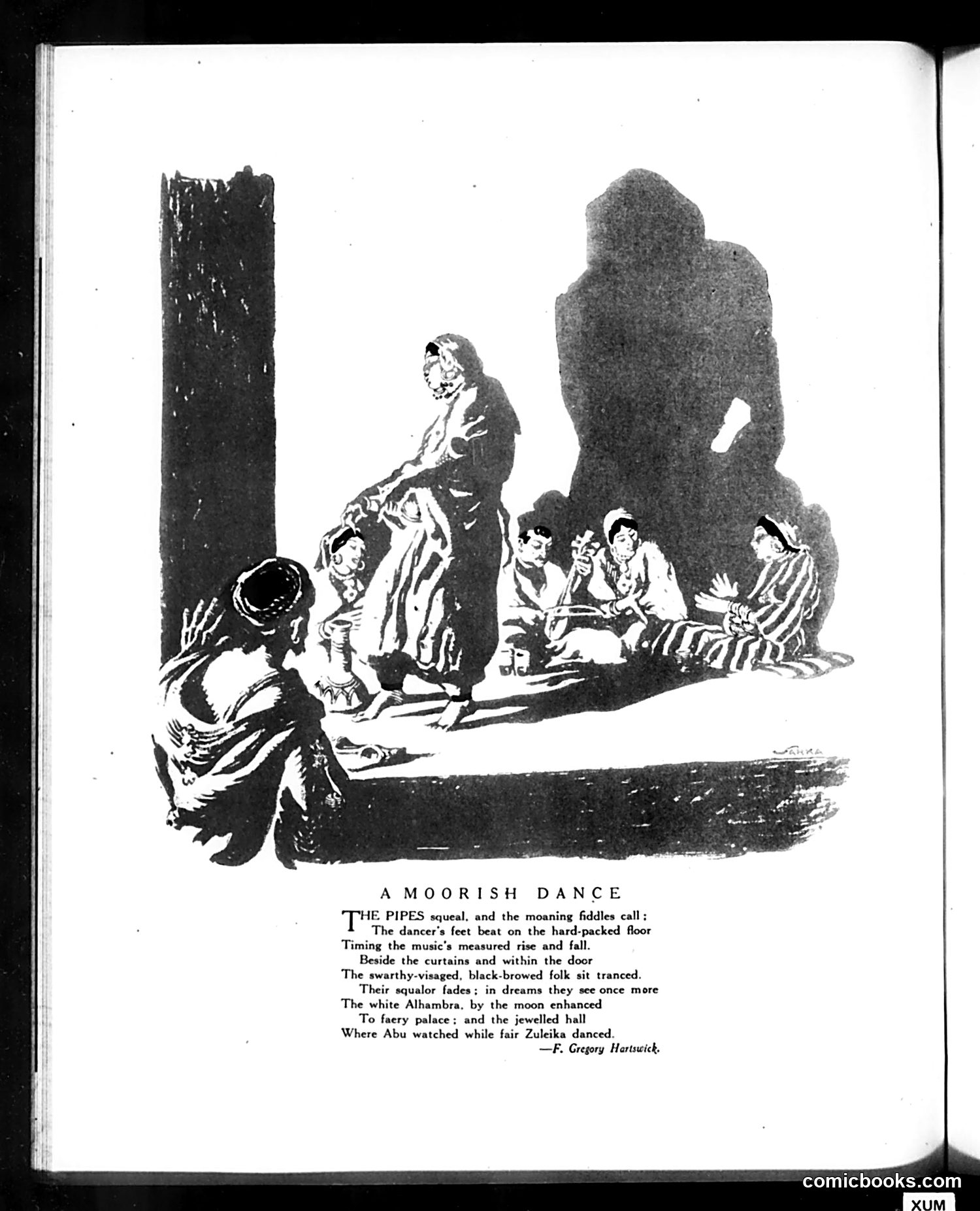
This is a poem illustrated with a dramatic black-and-white drawing, not a political cartoon. The piece is romantic orientalism—a popular late 19th/early 20th-century literary genre. The poem depicts a Moorish dance performance watched by an audience of working-class people ("squalor fades"). The text references the Alhambra palace and characters "Abu" and "Zuleika," invoking exoticized Islamic Spain and the Arabian Nights tradition. The satire appears gentle: the poem suggests that momentarily, through art and imagination, poor spectators can escape their dreary lives and envision themselves in fantastical palaces. It's sentimental rather than sharp-edged critique—typical of Judge's lighter content. The illustration shows the dancer elevated on a platform while seated figures around her are entranced, visualizing the "jewelled hall" of their dreams. The author credits F. Gregory Hartswick.
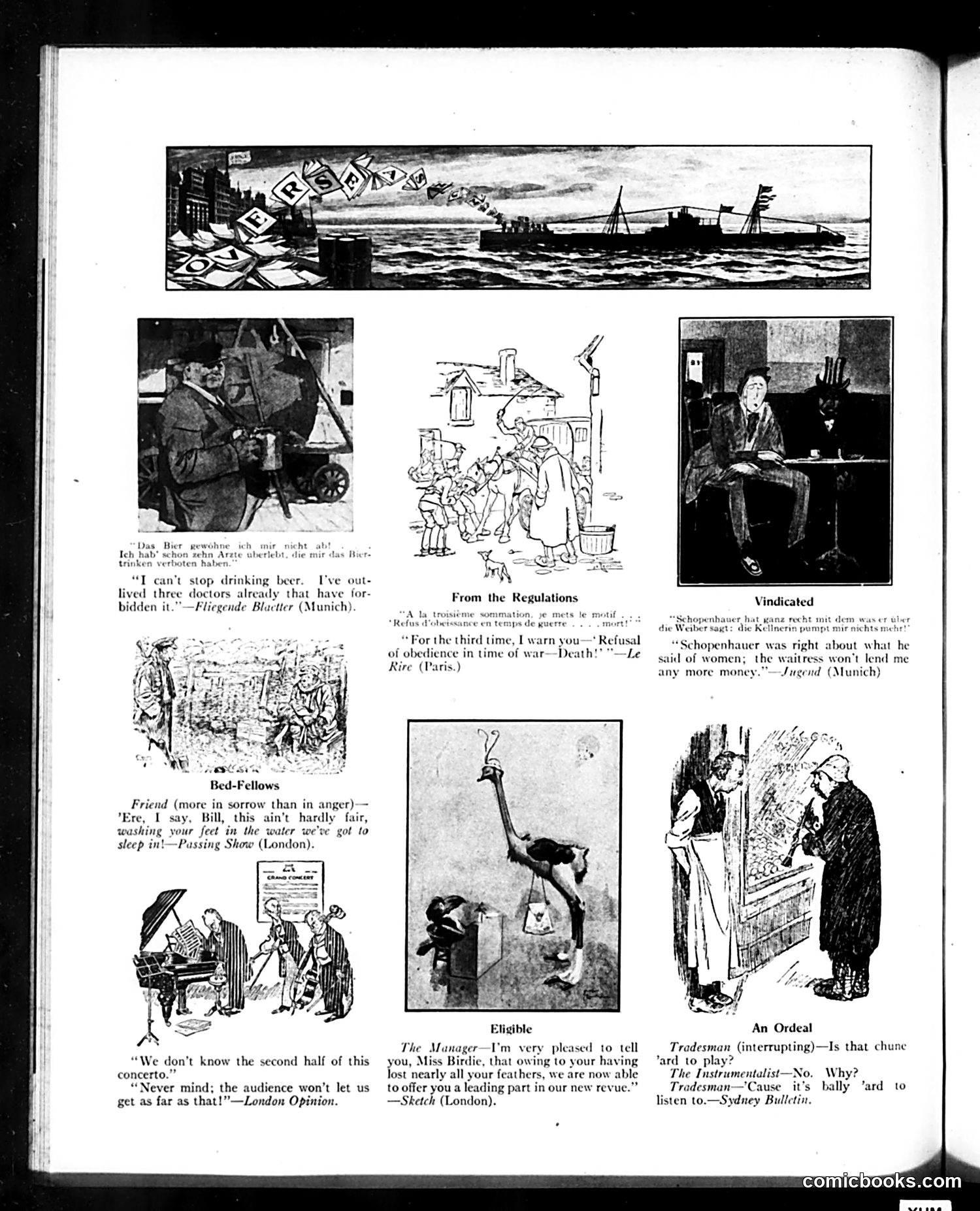
This page compiles humorous short jokes and cartoons from various international satirical publications (Munich, London, Paris, etc.), translated for American readers. The cartoons mock everyday frustrations and social absurdities: - **"Bed-Fellows"**: A drunk man refuses to stop drinking beer despite doctors' warnings, suggesting stubbornness about health advice - **"Eligible"**: A theater manager offers a plucked chicken a leading role—dark humor about reduced circumstances - **"Vindicated"**: References Schopenhauer's misogynistic philosophy about women; a waitress proves him "right" by refusing to lend money - **"An Ordeal"**: A tradesman complains a musical piece is too difficult to listen to (bad musicianship) - **"From the Regulations"**: Military discipline joke about wartime obedience The page reflects early 20th-century magazine humor: working-class frustrations, gender stereotypes, and absurdist situations. The compilation format was typical of Judge, which reprinted international jokes for American audiences.
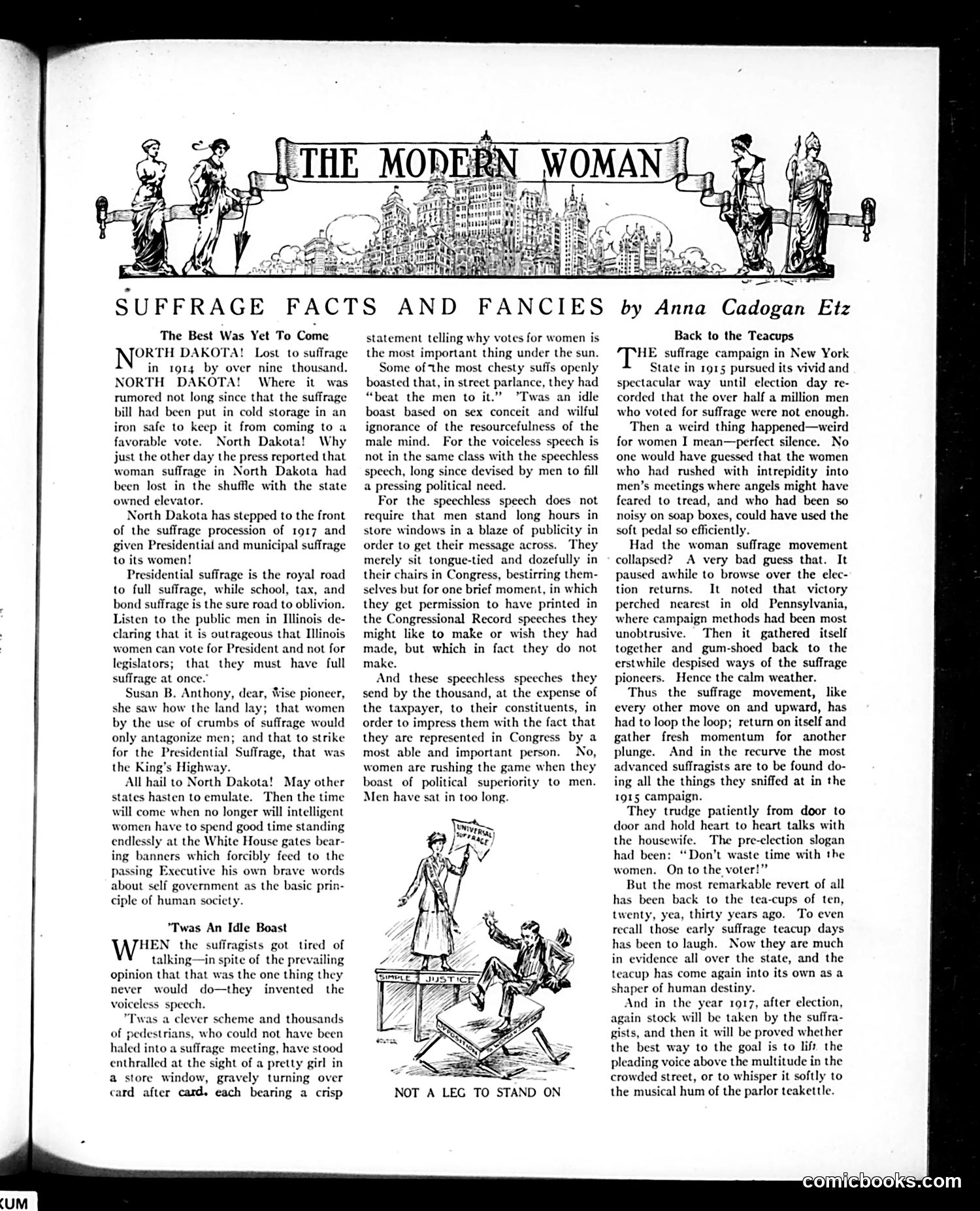
This *Judge* magazine article by Anna Cadogan Etz satirizes both suffragists and anti-suffrage politicians, using sharp irony throughout. **The cartoons mock:** - Male politicians' "voiceless speech"—congressmen who print speeches in the Congressional Record without actually delivering them, then mail them to constituents at taxpayer expense as proof of their importance - The contrast with suffragists' "voiceless speech" window displays, where women physically stand in storefronts holding cards explaining why women deserve votes **The article's stance:** Etz supports suffrage but criticizes suffragists' dramatic tactics. She praises North Dakota's 1917 grant of presidential suffrage as the practical path forward, while mocking congressmen as lazy frauds who achieve political goals without genuine effort. **Key reference:** The New York campaign (likely 1915) where suffragists mobilized intensely but lost, then mysteriously went silent. The satire's point: Women work exhaustingly; men accomplish the same ends effortlessly through legislative sleight-of-hand.
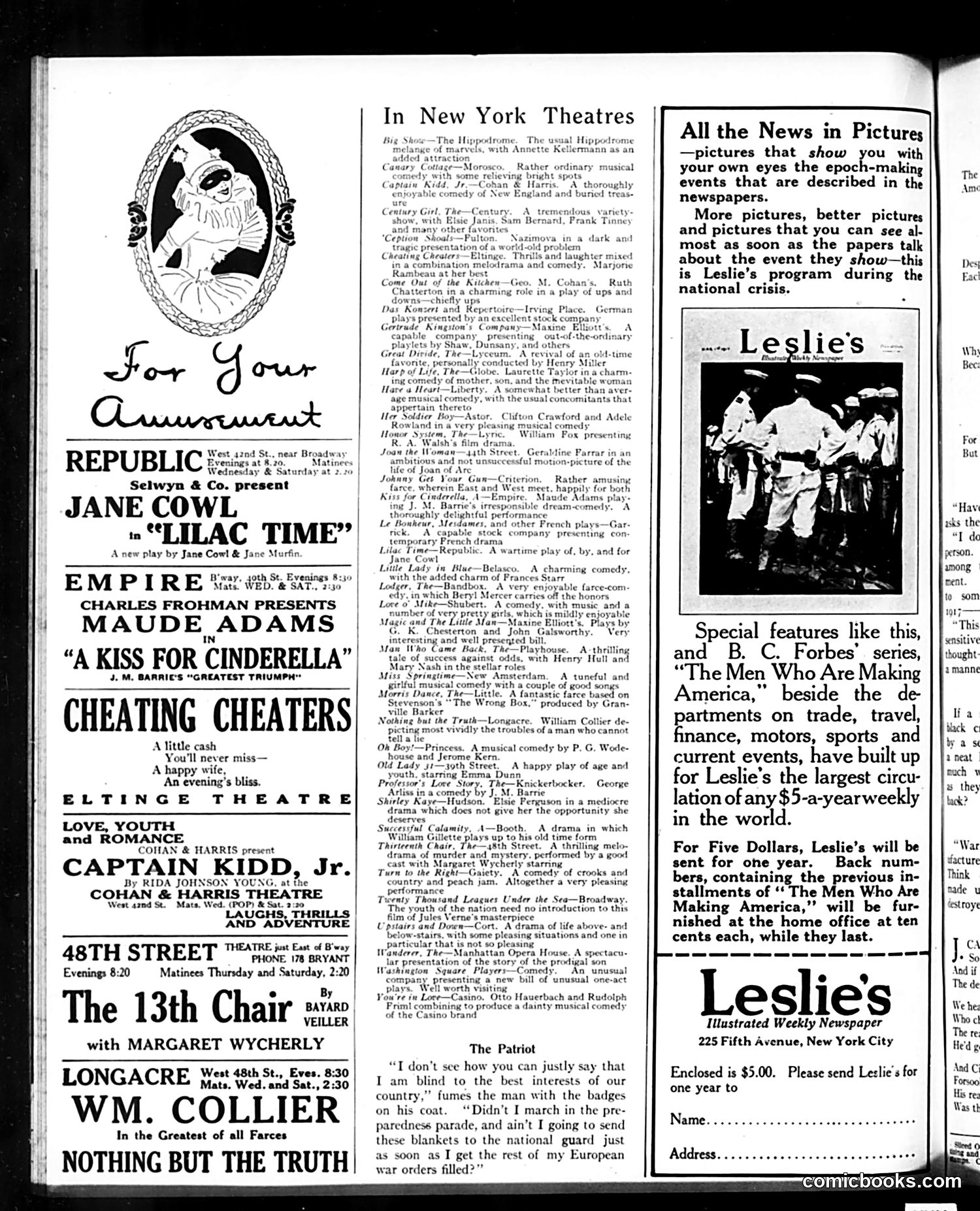
This is primarily a **theater advertisement and review page** from Judge magazine, not a political cartoon page. The left side lists New York theatrical productions (plays and films) with brief critical notes—typical entertainment coverage from the World War I era. The right side advertises **Leslie's Illustrated Weekly Newspaper**, emphasizing its value as a visual news source during the "national crisis" (likely WWI). The advertisement argues Leslie's provides pictures of major events "almost as soon as the papers talk about them," positioning photojournalism as superior to text-only reporting. It promotes special series like "The Men Who Are Making America" and highlights coverage of trade, travel, finance, sports, and current events. The subscription offer ($5/year) appears at bottom. **No significant political cartoon or satire is present on this page.** It's primarily commercial content showcasing entertainment options and a competing news publication's visual journalism approach during wartime.
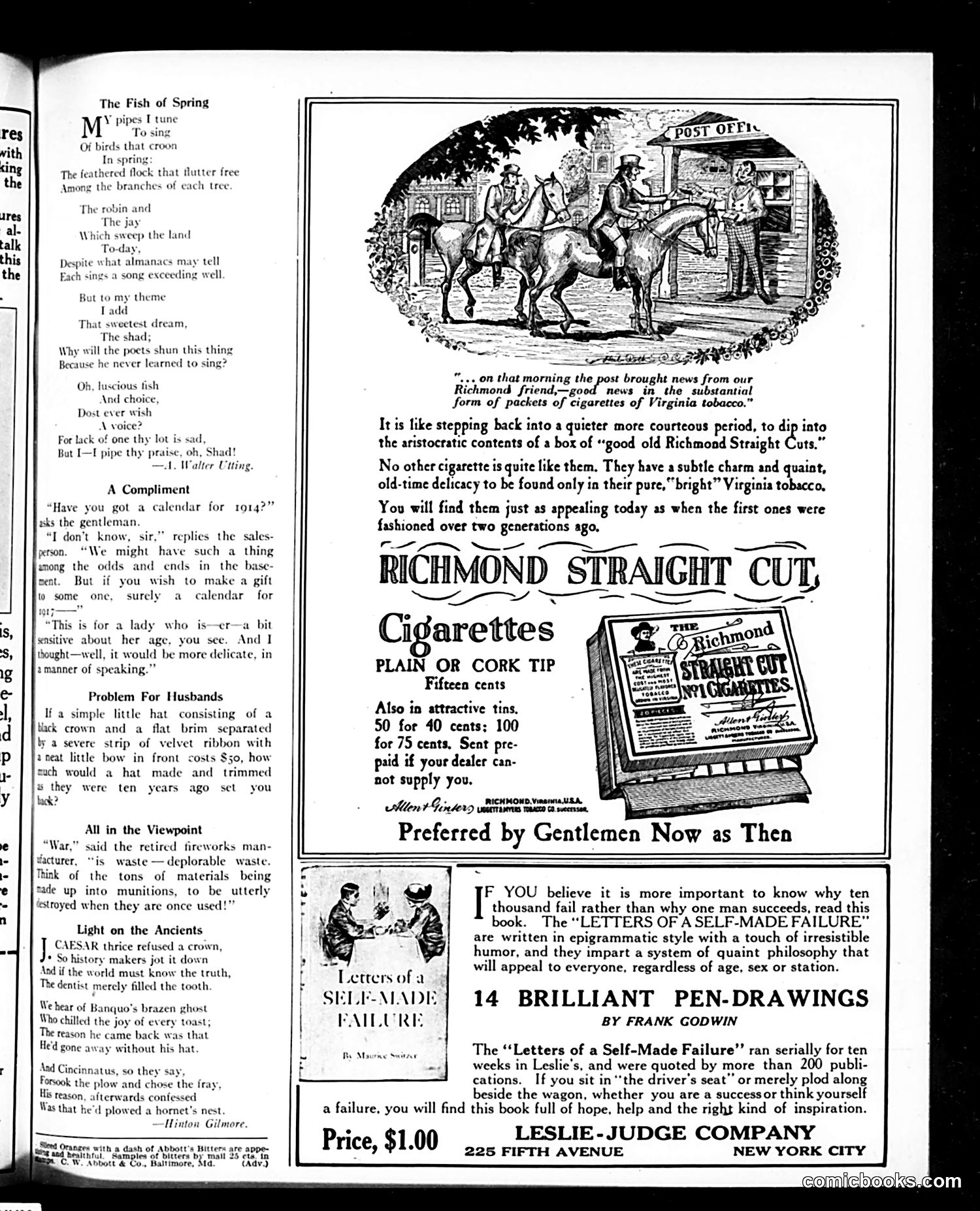
This page combines **light satirical poetry and humor** with **advertising**. The main content includes: **Text sections:** - "The Fish of Spring" — a whimsical poem lamenting that shad fish never learned to sing, so poets ignore them - Brief comedic anecdotes ("A Compliment," "Problem For Husbands," "All in the Viewpoint," "Light on the Ancients") — gentle jokes about calendar-giving etiquette, hat prices, wartime waste, and classical literature **Central illustration:** Shows a rural/small-town scene with a post office and mounted riders, captioning a nostalgic advertisement for **Richmond Straight Cut Cigarettes** — appealing to gentlemanly tradition and "old-time delicacy." **Bottom advertisements:** Promote "Letters of a Self-Made Failure" (a serialized book with pen-drawings by Frank Godwin). The page reflects **early 1910s American humor** — gentle, domestic-focused, with no sharp political edge. The tone is whimsical rather than satirical in the modern sense.
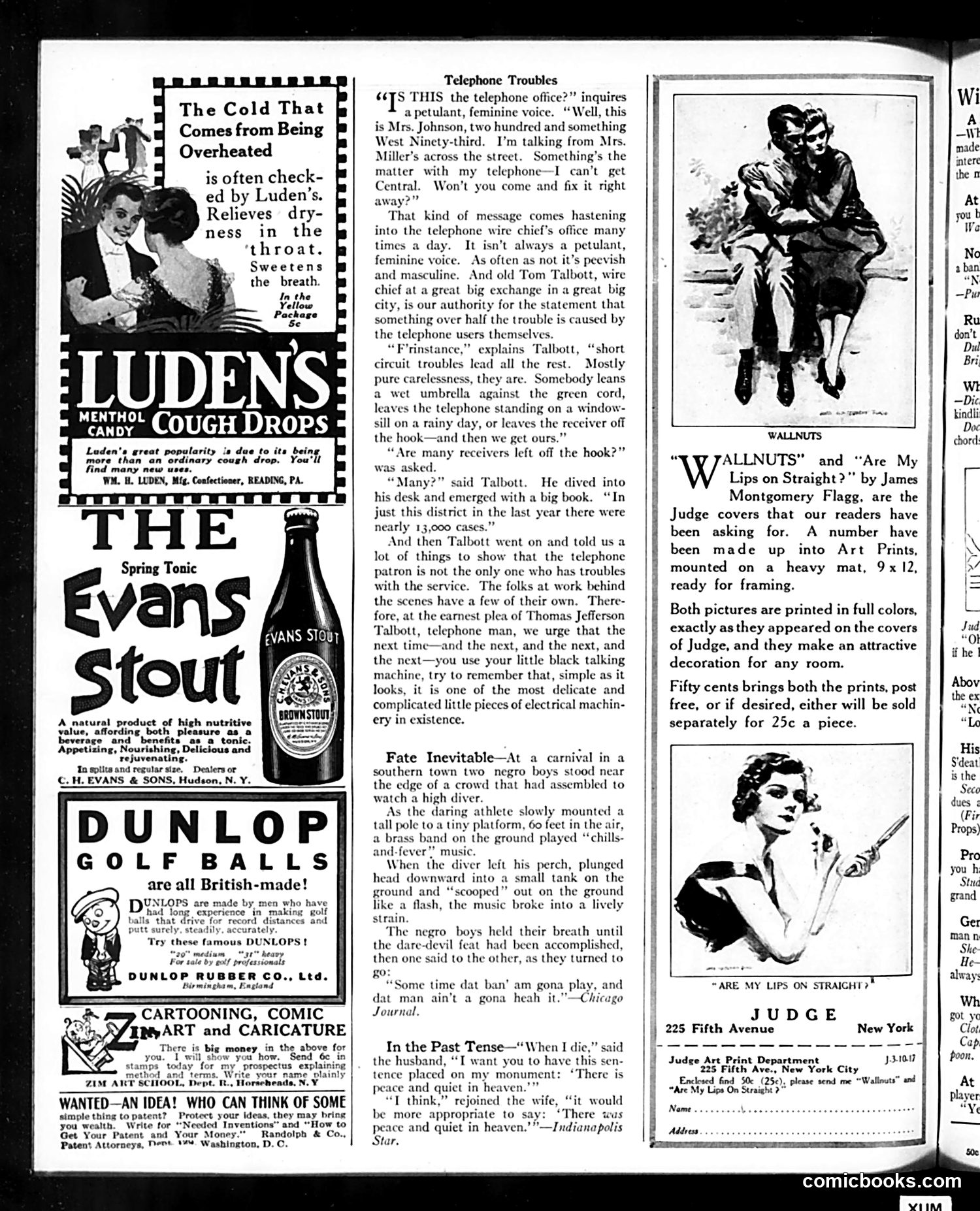
This page contains primarily **advertisements and humorous anecdotes** rather than political satire. The main content is "Telephone Troubles," a lighthearted article about phone service complaints. It features an interview with "Tom Talbott," a telephone exchange wire chief, explaining that **over half of telephone problems stem from user carelessness**—wet umbrellas on cords, receivers left off hooks, phones in rain. The piece gently satirizes impatient customers, particularly women callers demanding immediate repairs, while revealing that phone company employees also struggle with equipment failures. The other brief humor pieces ("Fate Inevitable" and "In the Past Tense") use period-typical racial stereotypes and marital discord jokes, respectively—common comedic tropes of the era but reflecting attitudes modern readers would find offensive. The **advertisements** (Luden's cough drops, Evans Stout, Dunlop golf balls, patent services) dominate the layout, which was typical for Judge's revenue model.
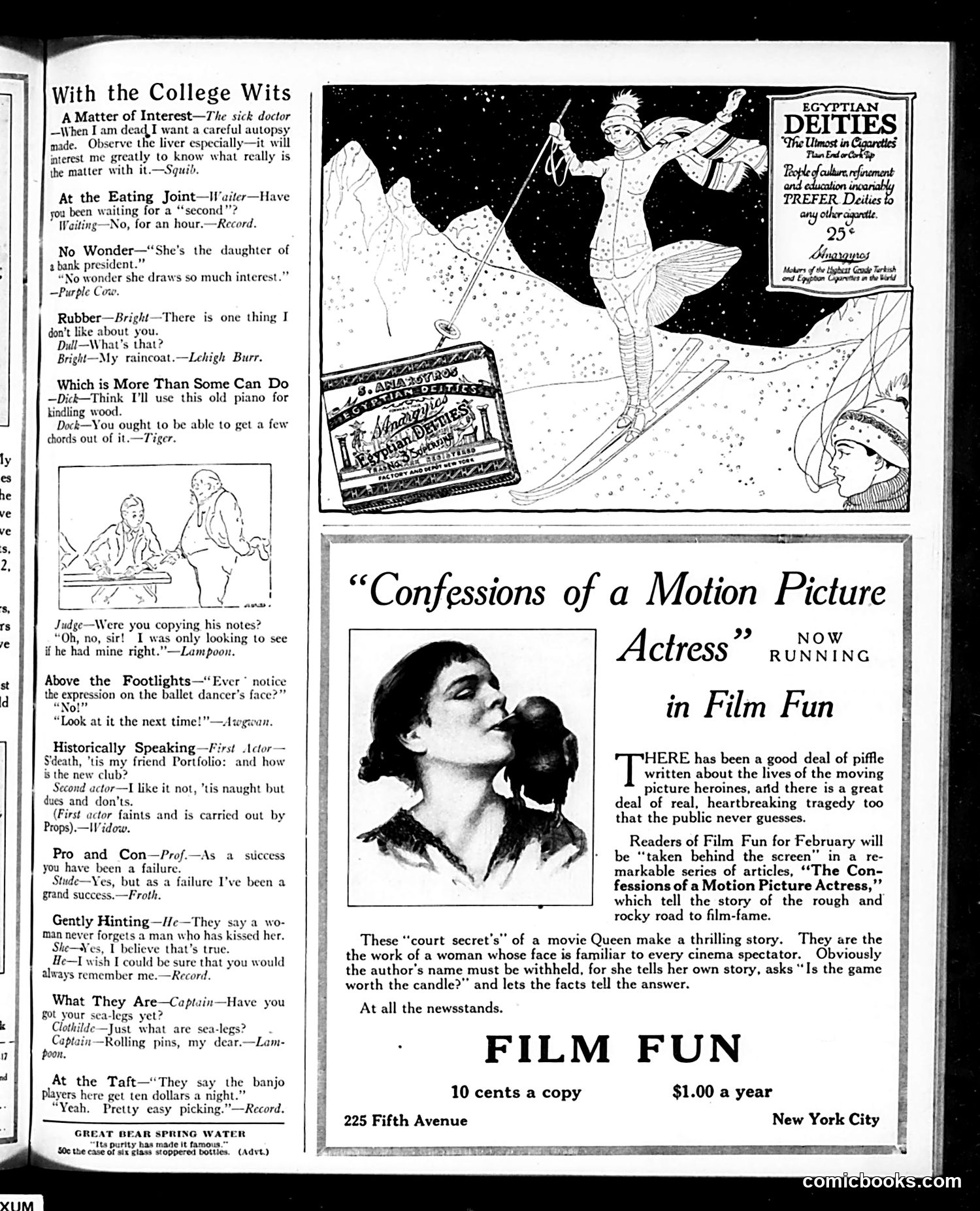
This page from *Judge* magazine contains two distinct sections: **Left side—"With the College Wits":** A series of brief, punny jokes targeting college students and young professionals. These include wordplay about autopsy ("liver"), banking ("interest"), and piano disposal. The humor is lightweight, relying on puns rather than satire—typical filler content for humor magazines of this era. **Right side—Advertisement and article preview:** Promotes *Film Fun* magazine's upcoming "Confessions of a Motion Picture Actress" series. The advertisement plays on public fascination with Hollywood's behind-the-scenes scandals, promising revelations about starlets' "rough and rocky road" while maintaining anonymity. The accompanying illustration shows a glamorous, idealized female figure—contrasting with the text's promise of hidden tragedy. **Historical context:** This reflects early-20th-century interest in motion picture celebrity and the emerging "star system," alongside skepticism about whether actors' public images matched reality. The unnamed actress device was a common marketing tactic for period publications seeking to titillate readers with gossip while avoiding libel.
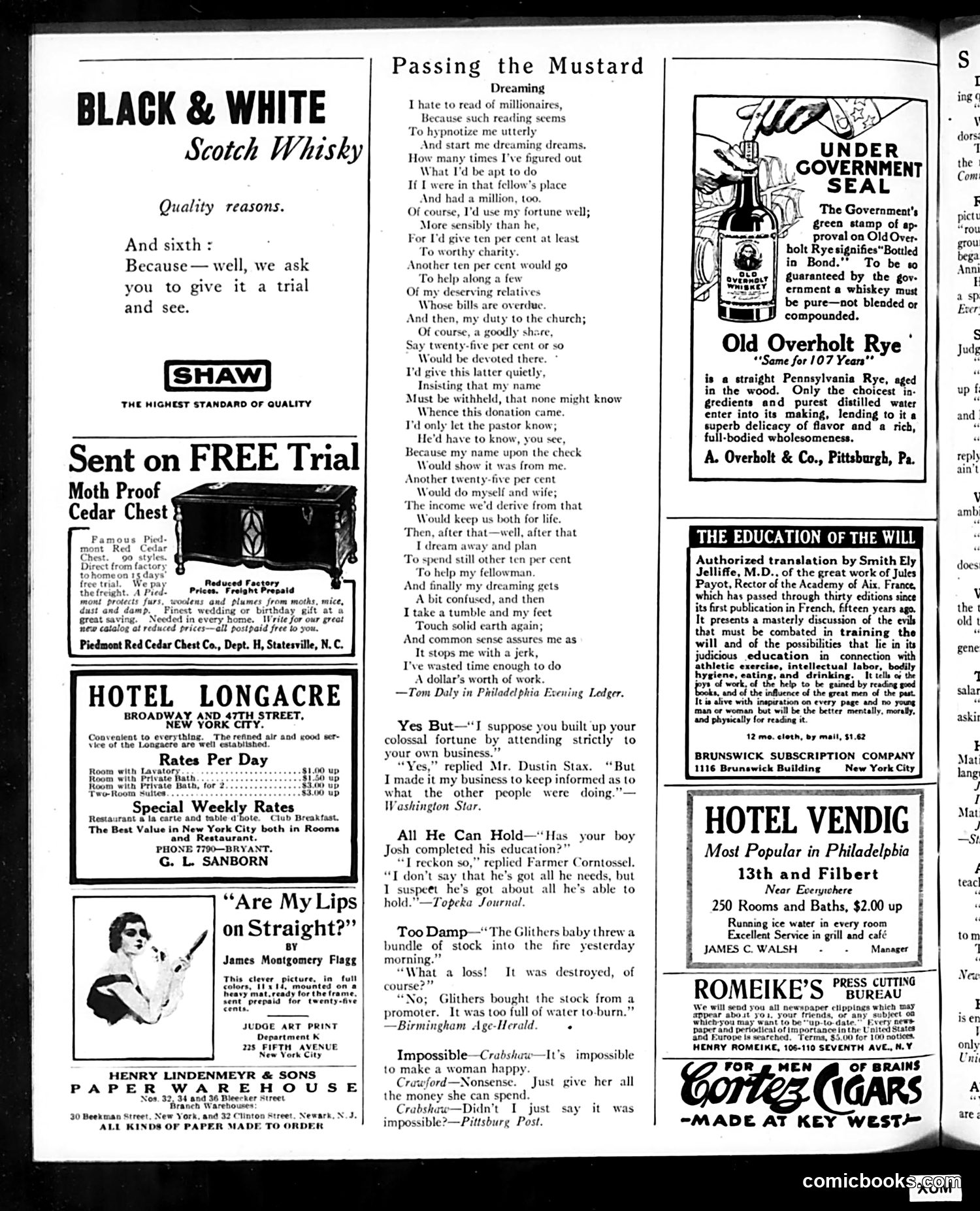
This page is primarily **advertising and humor content**, not political cartoons. The main elements are: **Advertisements** dominate: whisky brands (Black & White Scotch, Old Overholt Rye), hotels, furniture, and paper products typical of early 20th-century magazines. **The "Passing the Mustard" section** contains satirical short pieces poking fun at everyday middle-class attitudes. "Dreaming" mocks wealthy fantasies—a person imagines giving away their hypothetical fortune to charity, church, and relatives, but the detailed mental math reveals self-serving calculations that undermine the premise. "Yes But" jokes about business success and privacy versus curiosity. These reflect mild social satire about greed, hypocrisy, and human nature rather than specific political targets. **James Montgomery Flagg's illustration** titled "Are My Lips on Straight?" appears to be a cosmetic/beauty-related piece. The page reflects *Judge* magazine's general style: lighthearted social commentary on bourgeois life, consumerism, and human foibles, packaged alongside commercial advertising.
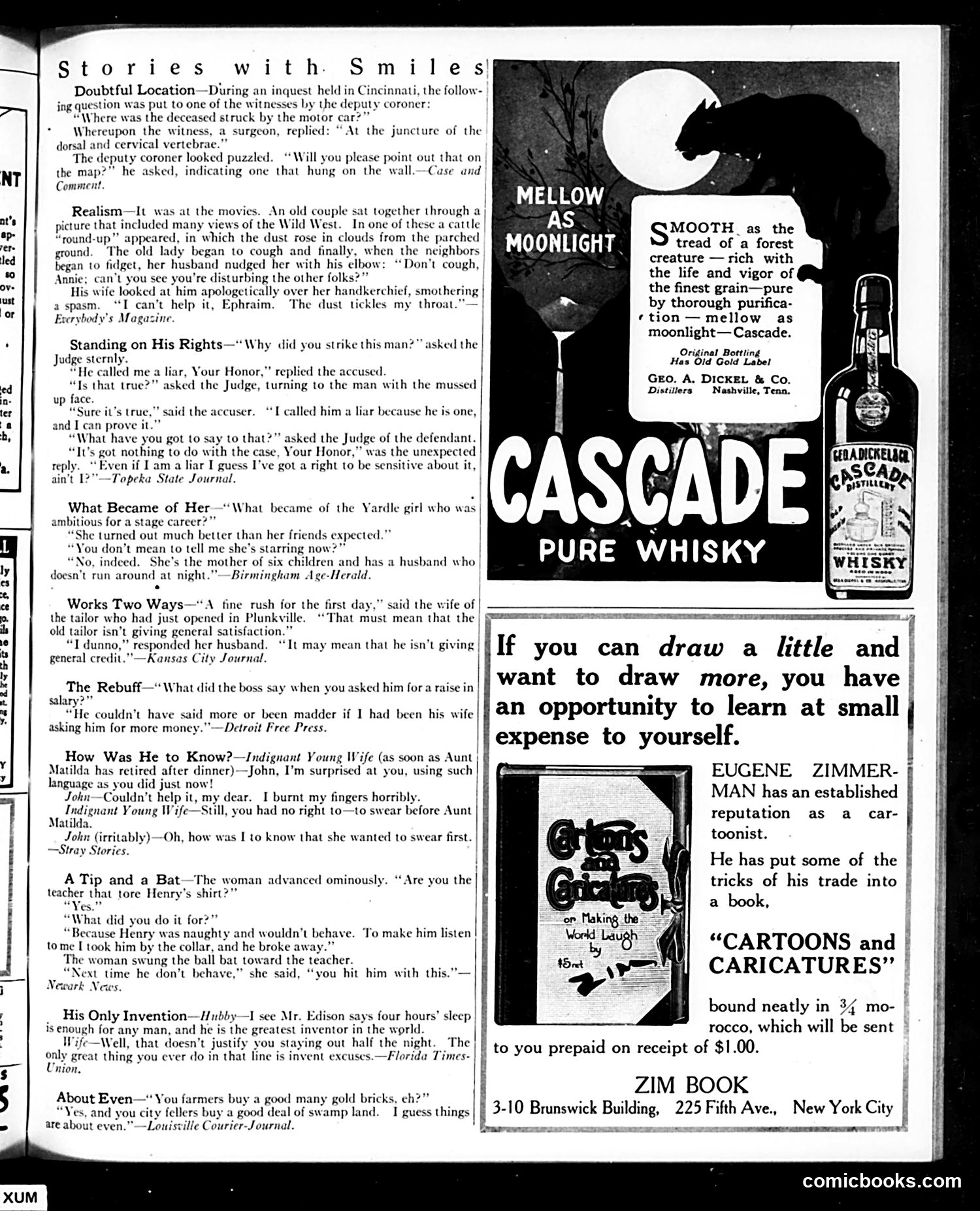
This page features **humorous anecdotes** rather than political cartoons. The jokes satirize everyday American life and social conventions of the early 20th century: **Key themes:** - **Legal absurdity**: A coroner asks a surgeon to point out anatomical injury locations on a wall map—mocking overly literal-minded officials - **Marital dynamics**: Multiple jokes center on wives correcting husbands' behavior (swearing, staying out late), reflecting contemporary gender tensions - **Class/social pretense**: The "Varddle girl" anecdote suggests ambition for stage success is less respectable than becoming a homemaker—a conservative view of women's proper roles - **Rural vs. urban contrast**: References to farmers and small-town tailors suggest nostalgia for simpler times The **Cascade Pure Whisky advertisement** and **Eugene Zimmerman's cartooning instruction book** are commercial content typical of Judge magazine. These aren't sophisticated political satire but rather gentle mockery of domestic life, bureaucratic incompetence, and social conventions that would have resonated with middle-class American readers.
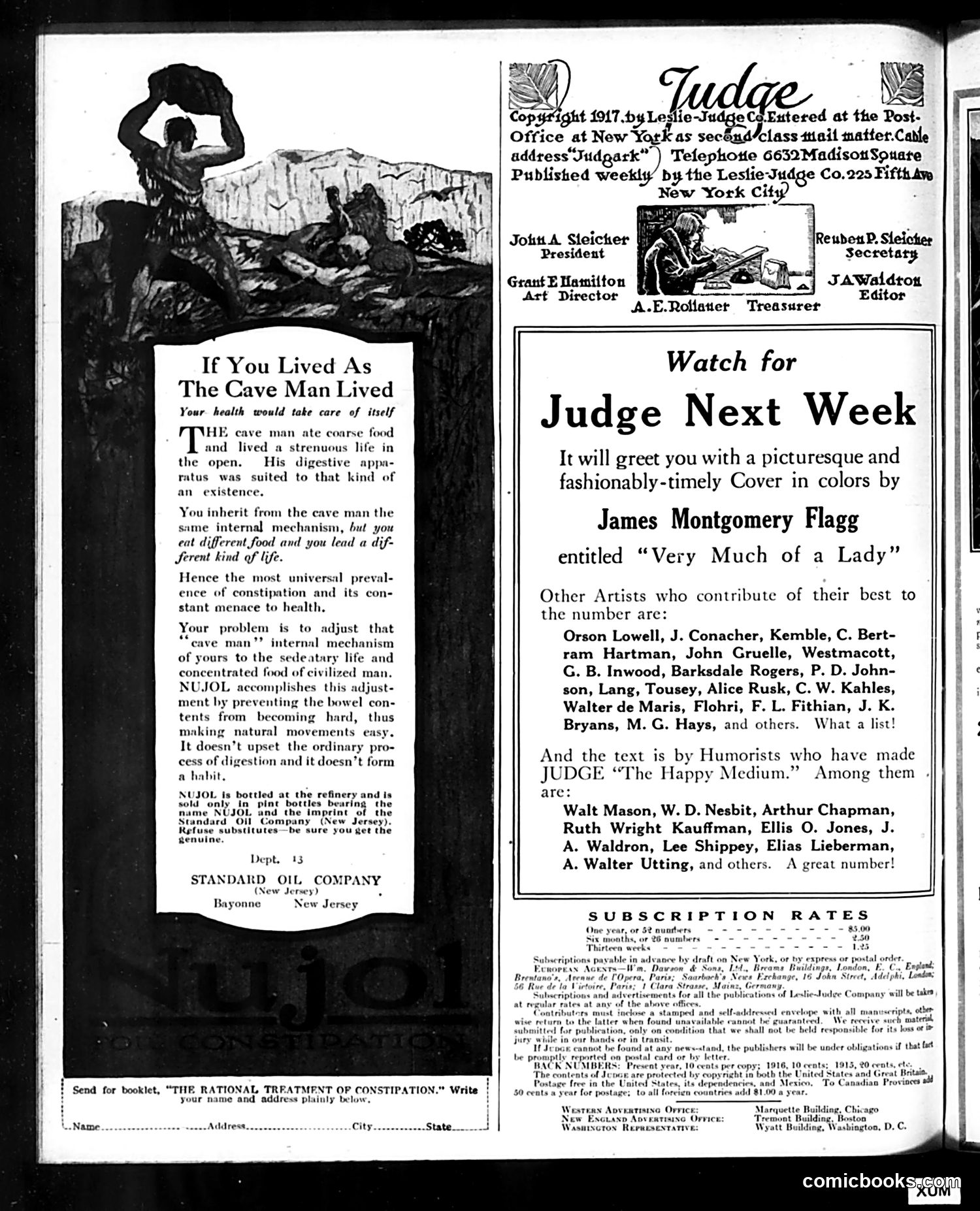
This is primarily a **magazine masthead and advertising page**, not a political cartoon. The left side features a **Standard Oil Company advertisement** for "Nujol," a laxative product. The ad uses pseudo-scientific reasoning: it claims modern people inherit "cave man" digestive systems but eat refined foods, causing constipation. Nujol supposedly solves this by preventing hard bowel movements without forming habits. The accompanying illustration shows a primitive figure in a cave setting, visualizing the "cave man" concept. The right side announces the **next week's Judge cover** by famous illustrator **James Montgomery Flagg**, titled "Very Much of a Lady," along with lists of contributing artists and humor writers. This is standard magazine promotional content. The page reflects **1917 American advertising culture**—using evolutionary pseudoscience and health anxiety to sell patent medicines, a common practice before FDA regulation. There is no political satire present on this particular page.
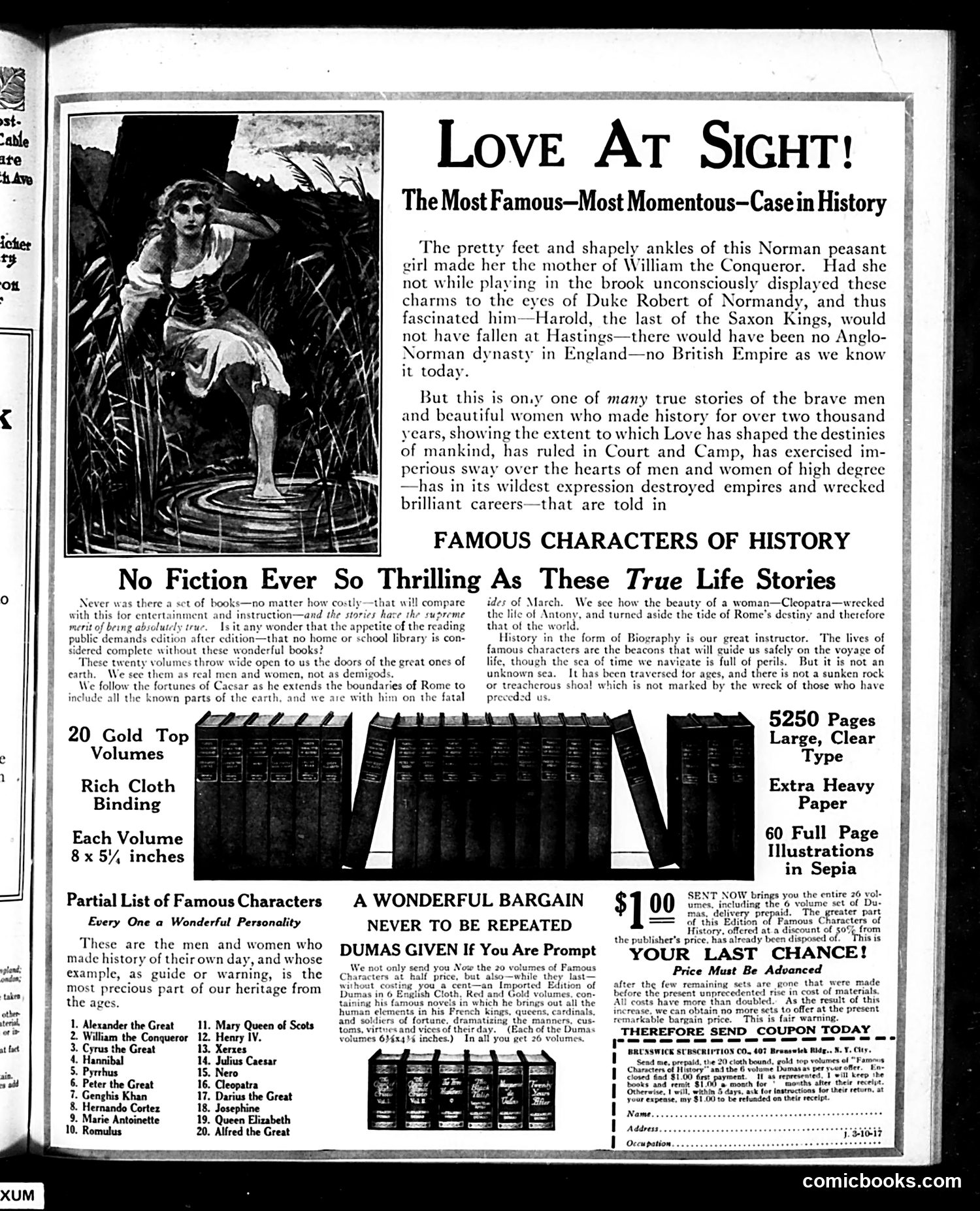
This is primarily a **book advertisement**, not a political cartoon. It promotes a 20-volume encyclopedia titled "Famous Characters of History." The "Love At Sight" headline references a historical anecdote: a Norman peasant girl's physical charms supposedly attracted Duke Robert of Normandy, leading to William the Conqueror's birth—and thereby, the advertisement claims, to the entire Anglo-Norman dynasty and British Empire. The accompanying illustration depicts this girl by a brook. The advertisement uses this romantic historical narrative as a hook to sell the encyclopedia, arguing that history is shaped by such dramatic personal moments. It emphasizes the books contain "true life stories" of famous historical figures—listing figures like Alexander the Great, Cleopatra, and others—presented as biographies rather than fiction. The pitch: these volumes offer entertainment, instruction, and cultural education. The "$1.00" price (with delivery prepaid) is presented as an unprecedented bargain the publisher won't repeat. The urgency ("YOUR LAST CHANCE!") and coupon suggest this is a time-limited mail-order offer.
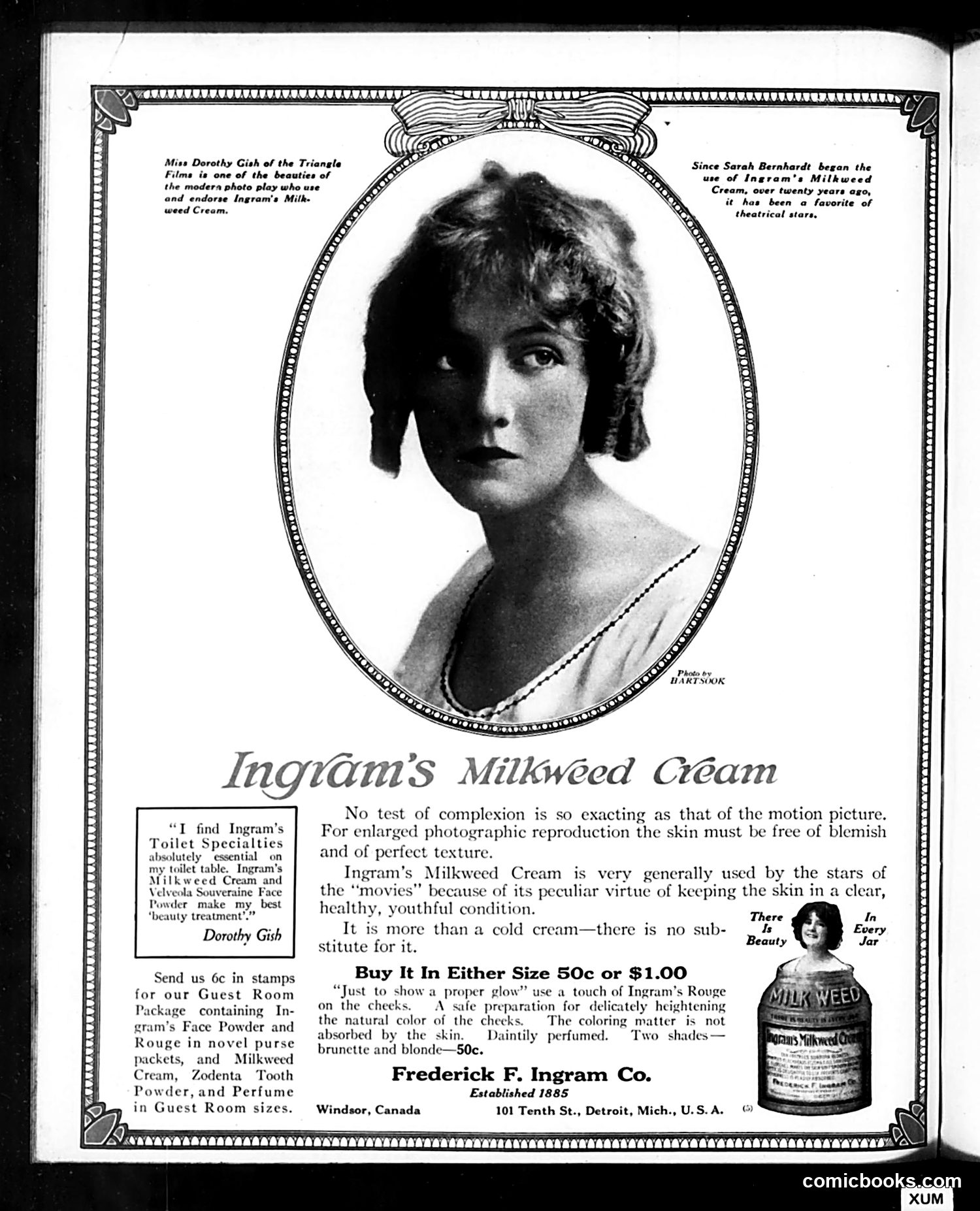
This page is primarily a **beauty product advertisement**, not political satire. It features a formal portrait photograph of actress Dorothy Gish, who endorses Ingram's Milkweed Cream. The advertisement targets early 20th-century vanity by emphasizing that motion picture actors require flawless skin for close-up photography. It claims the product is favored by theatrical stars, including a reference to Sarah Bernhardt (a famous French actress). The copy stresses the cream keeps skin "clear, healthy, youthful"—appealing to consumers' desires to emulate Hollywood glamour. The endorsement structure—using a recognizable actress's photograph and testimonial—was a standard advertising strategy of the era. A sidebar from "Dorothy Gish" claims the product is essential to her beauty routine. This represents how magazines like *Judge* mixed satirical editorial content with conventional advertising to fund operations.