
Judge, 1917-03-10 · page 12 of 28
Judge — March 10, 1917 — page 12: what you’re looking at
What you’re looking at
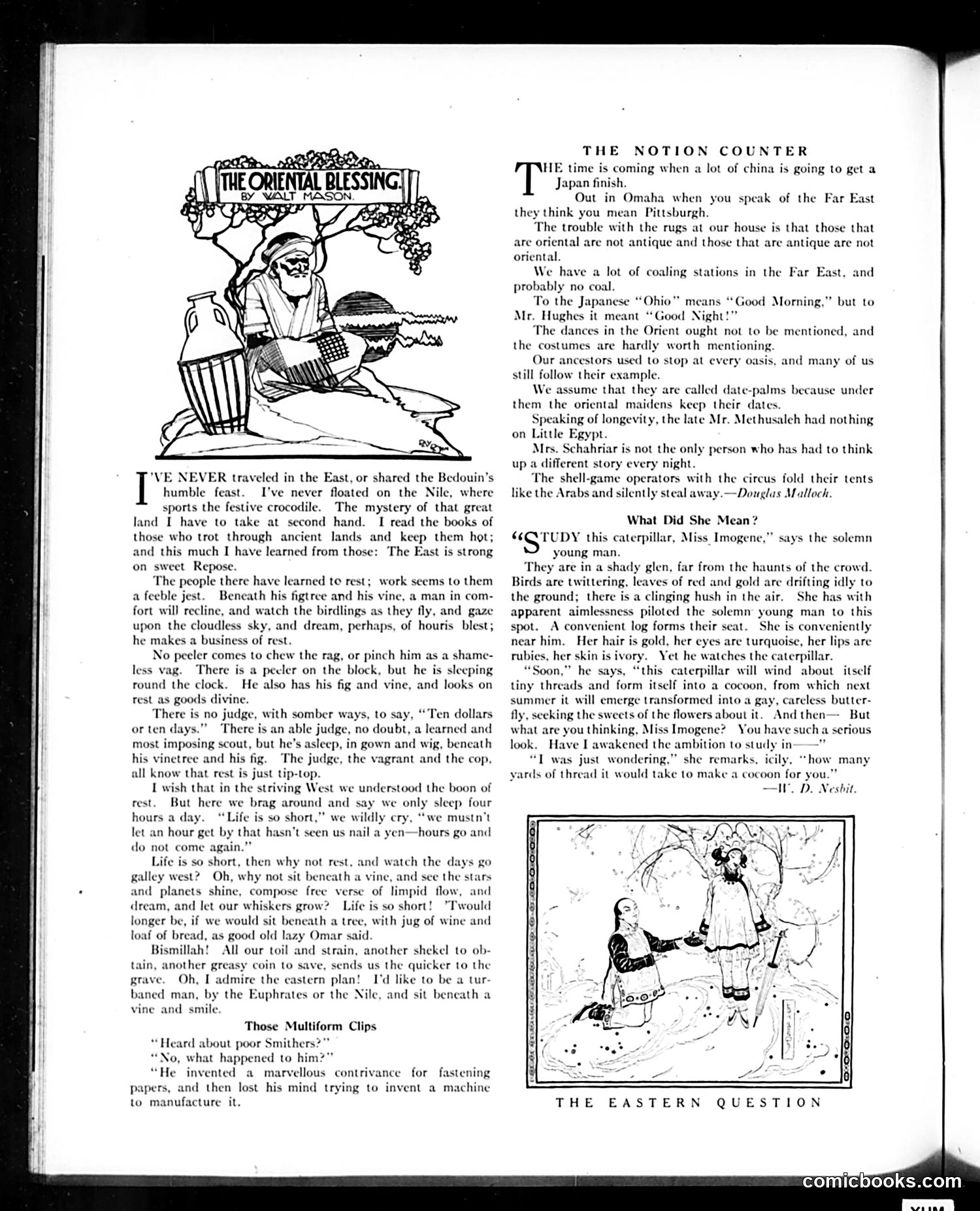
This page contains two distinct satirical pieces from Judge magazine: **"The Oriental Blessing"** (left): A poem mocking American obsession with Eastern leisure while criticizing Western work culture. It romanticizes Middle Eastern rest and relaxation (sitting under fig trees, drinking wine) as superior to American hustle. The satire targets American anxiety and overwork, contrasting it with stereotypical Eastern idleness. **"The Notion Counter"** (right): A collection of witty one-liners poking fun at American ignorance about Asia. Jokes include: confusing "Far East" with Pittsburgh; owning fake Oriental rugs; having military "coaling stations" in Asia with no coal; Japanese language confusion; and references to "Little Egypt" (likely a belly-dancer performer). The final anecdote mocks circus con artists. Both pieces use casual racism and stereotypes typical of early-20th-century American humor, reflecting period attitudes toward Asian cultures as exotic, backwards, or deceptive.
📄 Transcribed text from this page (OCR, searchable)
Machine-transcribed from the original scan — historical spelling and the odd misread are preserved.
I've never floated on the Nile, where The mystery of that great I read the books of and keep them hot; st is strong humble feast. sports the festive crocodile. land I have to take at second hand. those who trot through ancient lands and this much I have learned from those: The E on sweet Repose. I: NEVER traveled in the East, or shared the Bedouin’s The people there have learned to rest; work seems to them a feeble jest. Beneath his figtree and his vine, a man in com- fort will recline, and watch the birdlings as they fly, and gaze upon the cloudless sky, and dream, perhaps, of houris blest; he makes a business of rest. No peeler comes to chew the rag, or pinch him as a shame- less vag. There is a pecler on the block, but he is sleeping round the clock. He also has his fig and vine, and looks on rest as goods divine. There is no judge, with somber ways, to say, “Ten dollars or ten days.” There is an able judge, no doubt, a learned and most imposing scout, but he’s asleep, in gown and wig, beneath his vinetree and his fig. The judge, the vagrant and the cop, all know that rest is just tip-top. I wish that in the striving West we understood the boon of But here we brag around and say we only sleep four “Life is so short,” we wildly cry, “we mustn't hours go and rest hours a day. let an hour get by that hasn’t seen us nail a yen do not come again.” Life is so short, then why not rest, and watch the days go galley west? Oh, why not sit beneath a vine, and see the stars and planets shine, compose free verse of limpid flow, and dream, and let our whiskers grow? Life is so short! "Twould longer be, if we would sit beneath a tree, with jug of wine and loaf of bread, as good old lazy Omar said. Bismillah! All our toil and strain, another shekel to ob- tain, another greasy coin to save, sends us the quicker to the grave. Oh, I admire the castern plan! I'd like to be a tur- baned man, by the Euphrates or the Nile, and sit beneath a vine and smile. Those Multiform Clips “Heard about poor Smithers?” “No, what happened to him?” “He invented a marvellous contrivance for fastening papers, and then lost his mind trying to invent a machine to manufacture it. THE NOTION COUNTER HE time is coming when a lot of china is going to get a T Japan finish. Out in Omaha when you sp they think you mean Pittsburgh. The trouble with the rugs at our house is that those that are oriental are not antique and those that are antique are not oriental. We have a lot of coaling stations in the Far East, and probably no coal. To the Japanese “Ohio” means “Good Morning, Mr. Hughes it meant ‘Good Night!” The dances in the Orient ought not to be mentioned, and the costumes are hardly worth mentioning. Our ancestors used to stop at every oasis, and many of us still follow their example. We assume that they are called date-palms because under them the oriental maidens keep their dates. Speaking of longevity, the late Mr. Methusaleh had nothing on Little Egypt. Mrs. Schahriar is not the only person who has had to think up a different story every night. The shell-game operators with the circus fold their tents like the Arabs and silently steal away.—Douglas Malloch. k of the Far East but to What Did She Mean? 66QTUDY this caterpillar, Miss Imogene,” says the solemn young man. They are in a shady glen, far from the haunts of the crowd. Birds are twittering, leaves of red and gold are drifting idly to the ground; there is a clinging hush in the air. She has with apparent aimlessness piloted the solemn young man to this spot. A convenient log forms their seat. She is conveniently near him. Her hair is gold, her eyes are turquoise, her lips are rubies, her skin is iv Yet he watches the caterpillar. “Soon,” he says, “this caterpillar will wind about itself tiny threads and form itself into a cocoon, from which next summer it will emerge transformed into a gay, careless butter- fly, seeking the sweets of the flowers about it. And then But what are you thinking, Miss Imogene? You have such a serious look. Have I awakened the ambition to study in ” “LT was just wondering,” she remarks, icily, “how many yards of thread it would take to make a cocoon for you.” —W. D. Neshit. TED TOR A DORE THE EASTERN QUESTION comicbooks.com