
Judge, 1917-03-10 · page 13 of 28
Judge — March 10, 1917 — page 13: what you’re looking at
What you’re looking at
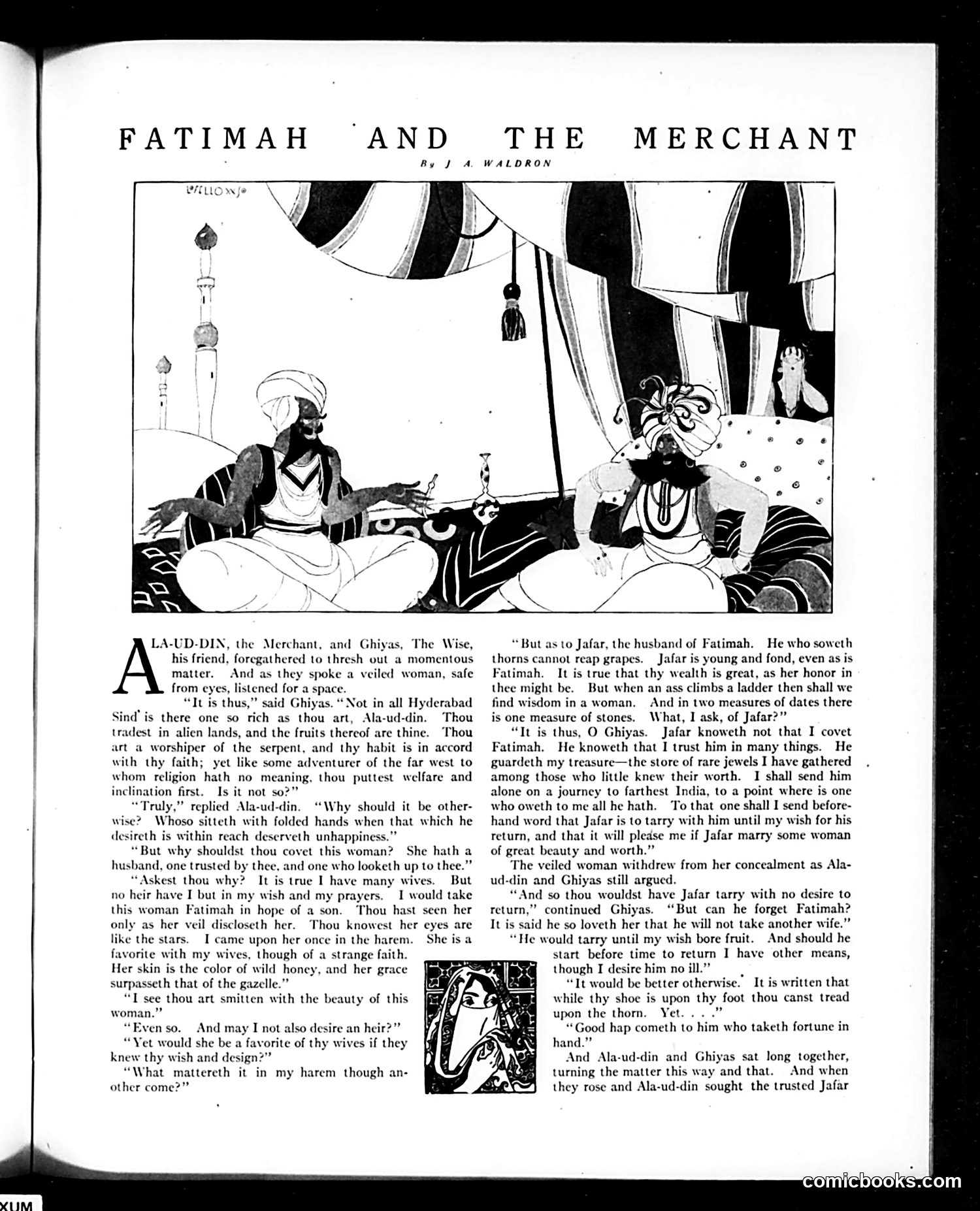
This page presents a serialized story (not a political cartoon) set in what appears to be colonial-era India, featuring dialogue between wealthy merchant Ala-ud-din and his friend Ghiyas about seducing Jafar's wife, Fatimah. The narrative employs orientalist tropes common to early 20th-century American publications: exotic Middle Eastern/Indian setting, veiled women, wealthy merchants, and scheming. The story depicts Ala-ud-din planning to send Jafar away on business to a distant point in India, while arranging for him to be detained there—creating opportunity to seduce Fatimah. The accompanying illustration shows two men in turbans and period dress in an ornate tent setting, with a veiled woman observing from concealment. This represents typical Judge magazine fiction: melodramatic moral tales with orientalist aesthetics that were entertainment for American readers of the period.
📄 Transcribed text from this page (OCR, searchable)
Machine-transcribed from the original scan — historical spelling and the odd misread are preserved.
AND FATIMAH LA-UD-DIN, the Merchant, and Ghiyas, The Wise, his friend, foregathered to thresh out a momentous matter. And as they spoke a veiled woman, safe from eyes, listened for a space. “It is thus,” said Ghi; Not in all Hyderabad Sind’ is there one so rich as thou art, Ala-ud-din. Thou tradest in alien lands, and the fruits thereof are thine. Thou art a worshiper of the serpent, and thy habit is in accord with thy faith; yet like some adventurer of the far west to whom religion hath no meaning, thou puttest welfare and inclination first. Is it not so?” “Truly,” replied Ala-ud-din. “Why should it be other- wise? Whoso sitteth with folded hands when that which he desireth is within reach deserveth unhappiness.” “But why shouldst thou covet this woman? She hath a hush und, one trusted by thee, and one who looketh up to thee.” st thou why? It is true I have many wives. But ave I but in my wish and my prayers. I would take an Fatimah in hope of a son. ‘Thou hast seen her only as her veil discloseth her. Thou knowest her eyes are like the stars. I came upon her once in the harem. She is a favorite with my wives, though of a strange faith. Her skin is the color of wild honey, and her grace surpasseth that of the gazelle.” “T see thou art smitten with the beauty of this woman.” “Even so. “Yet would she be a favorite of thy knew thy wish and design?” “What mattereth it in my harem though an- other come?” And may I not also desire an heir?” ives if they THE MERCHANT By J A. WALDRON “But as to Jafar, the husband of Fatimah. He who soweth thorns cannot reap grapes. Jafar is young and fond, even as is Fatimah. It is true that thy wealth is great, as her honor in thee might be. But when an ass climbs a ladder then shall we find wisdom in a woman. And in two measures of dates there is one measure of stones. What, I ask, of Jafar?” “It is thus, O Ghiyas. Jafar knoweth not that I covet Fatimah. He knoweth that I trust him in many things. He guardeth my treasure—the store of rare jewels I have gathered among those who little knew their worth. I shall send him alone on a journey to farthest India, to a point where is one who oweth to me all he hath. To that one shall I send before- hand word that Jafar is to tarry with him until my wish for his return, and that it will pledse me if Jafar marry some woman of great beauty and worth.” The veiled woman withdrew from her concealment as Ala- ud-din and Ghiyas still argued. “And so thou wouldst have Jafar tarry with no desire to return,” continued Ghiyas. “But can he forget Fatimah? It is said he so loveth her that he will not take another wife.” “He would tarry until my wish bore fruit. And should he start before time to return I have other means, though I desire him no ill.”” “Tt would be better otherwise.” It is written that while thy shoe is upon thy foot thou canst tread upon the thorn. Yet... .” “Good hap cometh to him who taketh fortune in hand.” And Ala-ud-din and Ghiyas sat long together, turning the matter this way and that. And when they rose and Ala-ud-din sought the trusted Jafar