
A complete issue · 28 pages · 1917
Judge — February 3, 1917
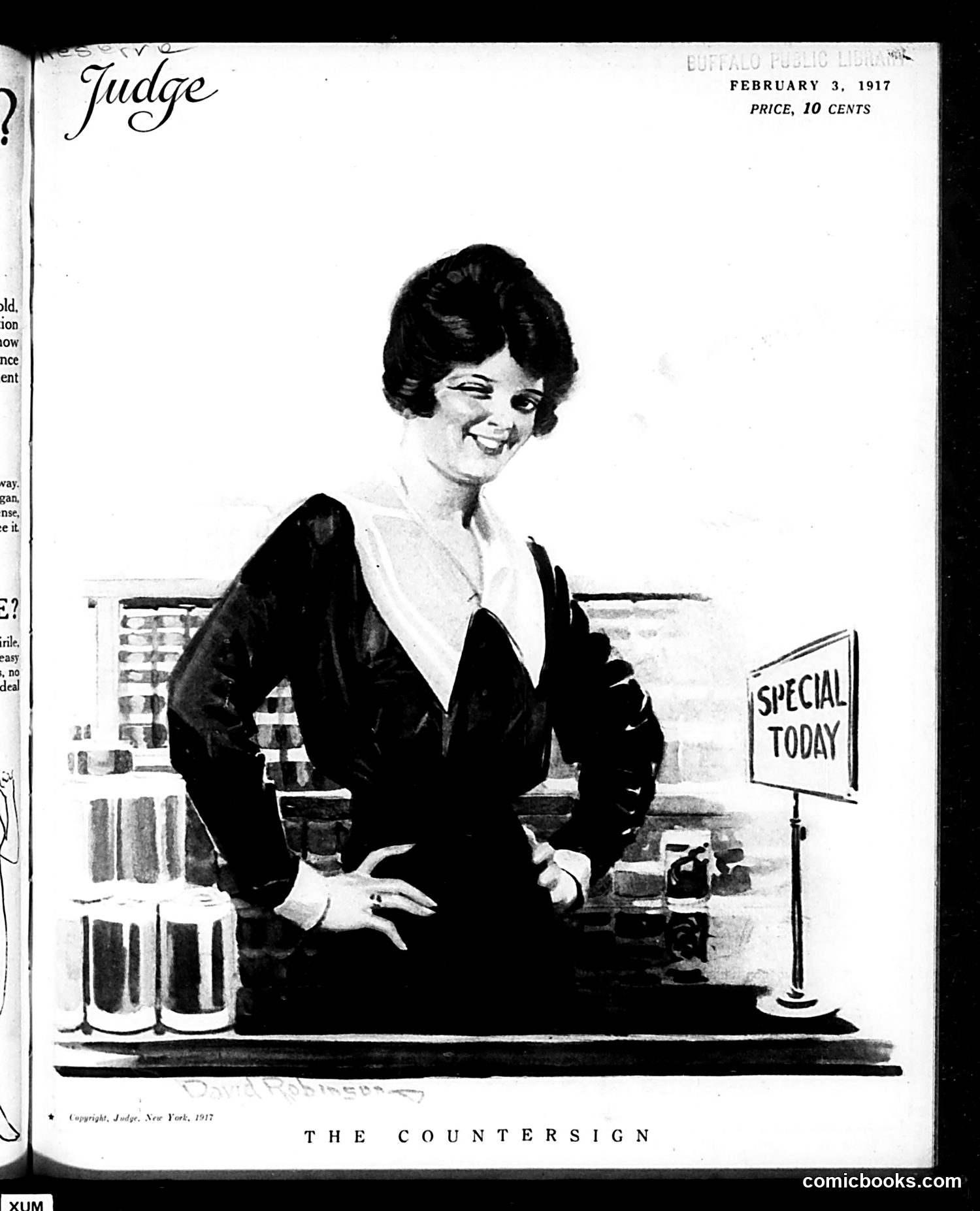
This cartoon depicts a smiling woman at a store counter displaying merchandise with a "SPECIAL TODAY" sign. The title "The Countersign" is a pun: it plays on "counter sign" (a password or verification) while showing an actual store counter. The joke appears to satirize retail advertising and sales tactics of the era. The woman's knowing smile and prominent display suggest she's promoting goods through charm and marketing rather than genuine value. The "SPECIAL TODAY" sign—a common retail practice—is being mocked as a formulaic sales technique. The exact product being sold remains unclear from the image, but the cartoon critiques how merchants use attractive presentation and urgency ("TODAY") to move merchandise, a consumer culture concern relevant to 1917.
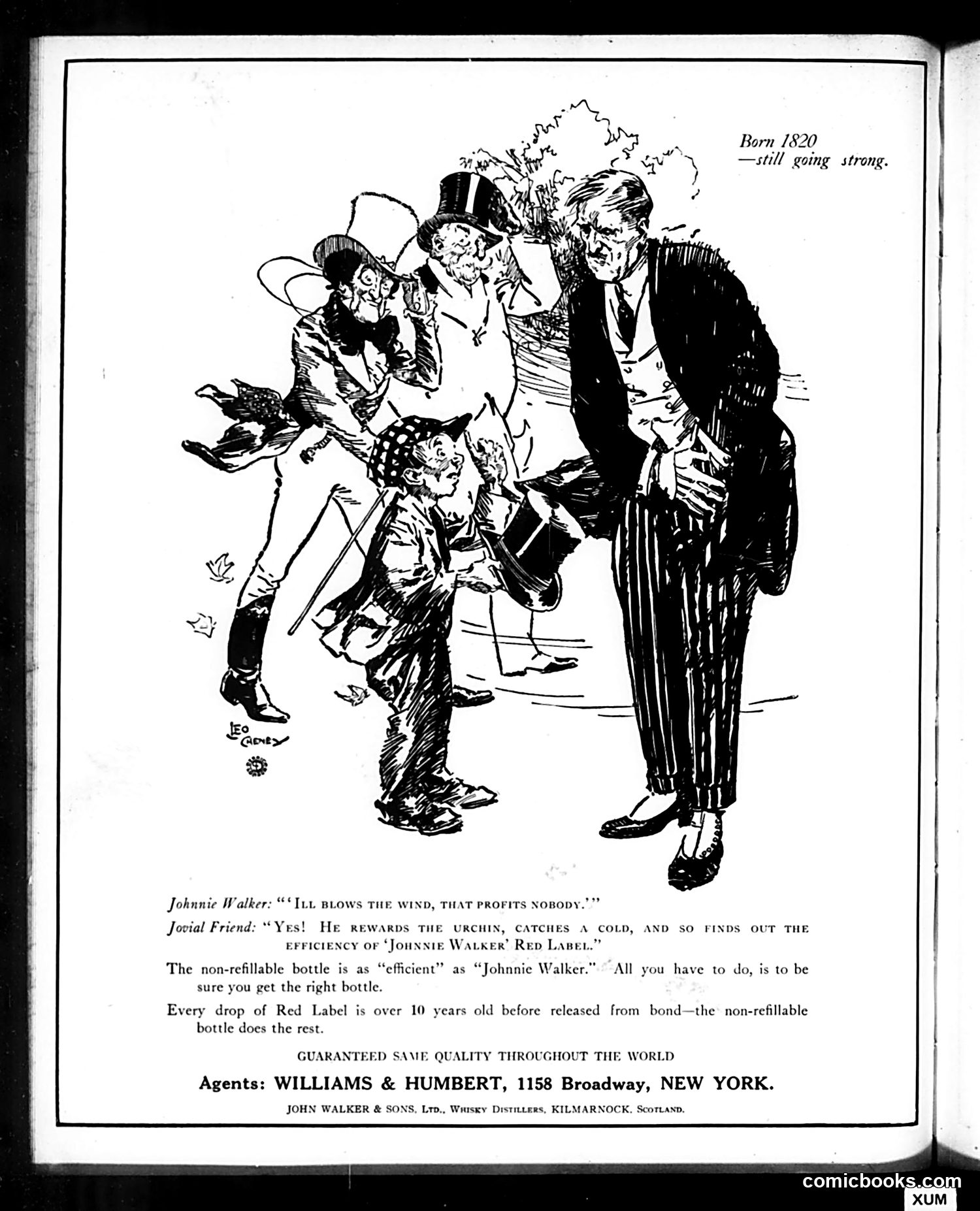
This is primarily a **Johnnie Walker whisky advertisement** disguised as satirical content. The cartoon depicts three caricatured men observing a figure labeled as representing "Johnnie Walker" (the whisky brand's mascot—a striding man in top hat). The "joke" plays on the brand's slogan and mascot: one character says the wind "profits nobody," while another responds that Johnnie Walker "rewards the urchin, catches a cold" and discovers "the efficiency of Johnnie Walker Red Label." The satire appears to mock the contradiction between the whisky's advertised quality and actual outcomes, but this is ultimately **advertising copy masquerading as editorial humor**. The real message: the non-refillable bottle ensures quality, and agents Williams & Humbert in New York can supply it. Born 1820, "still going strong."
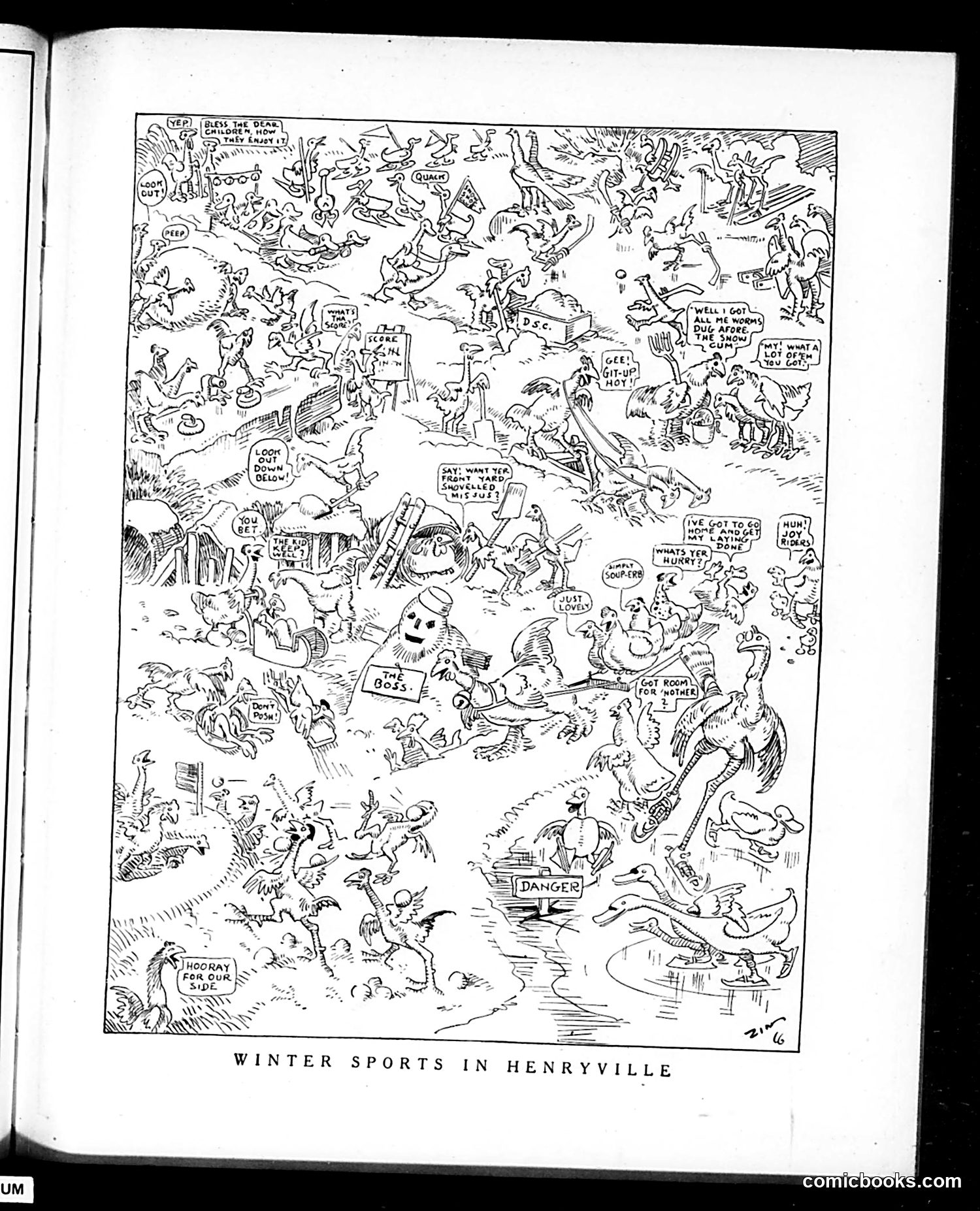
This is a crowded, comedic illustration depicting winter recreational chaos in what appears to be a small town called "Henryville." The scene shows numerous figures engaged in various winter activities—sledding, skating, and general merriment—rendered in deliberately chaotic, overlapping compositions typical of Judge magazine's slapstick humor. The cartoon satirizes amateur winter sports participation through exaggerated mishaps: collisions, tumbles, and comic disasters populate the scene. Speech bubbles capture characters' bewildered reactions to the mayhem. A "Danger" sign near water suggests skating hazards. The overall point appears to be mockery of recreational winter sports and their inherent dangers, presented as entertainment through the cartoonist's busy, frenetic drawing style emphasizing physical comedy and disorder.
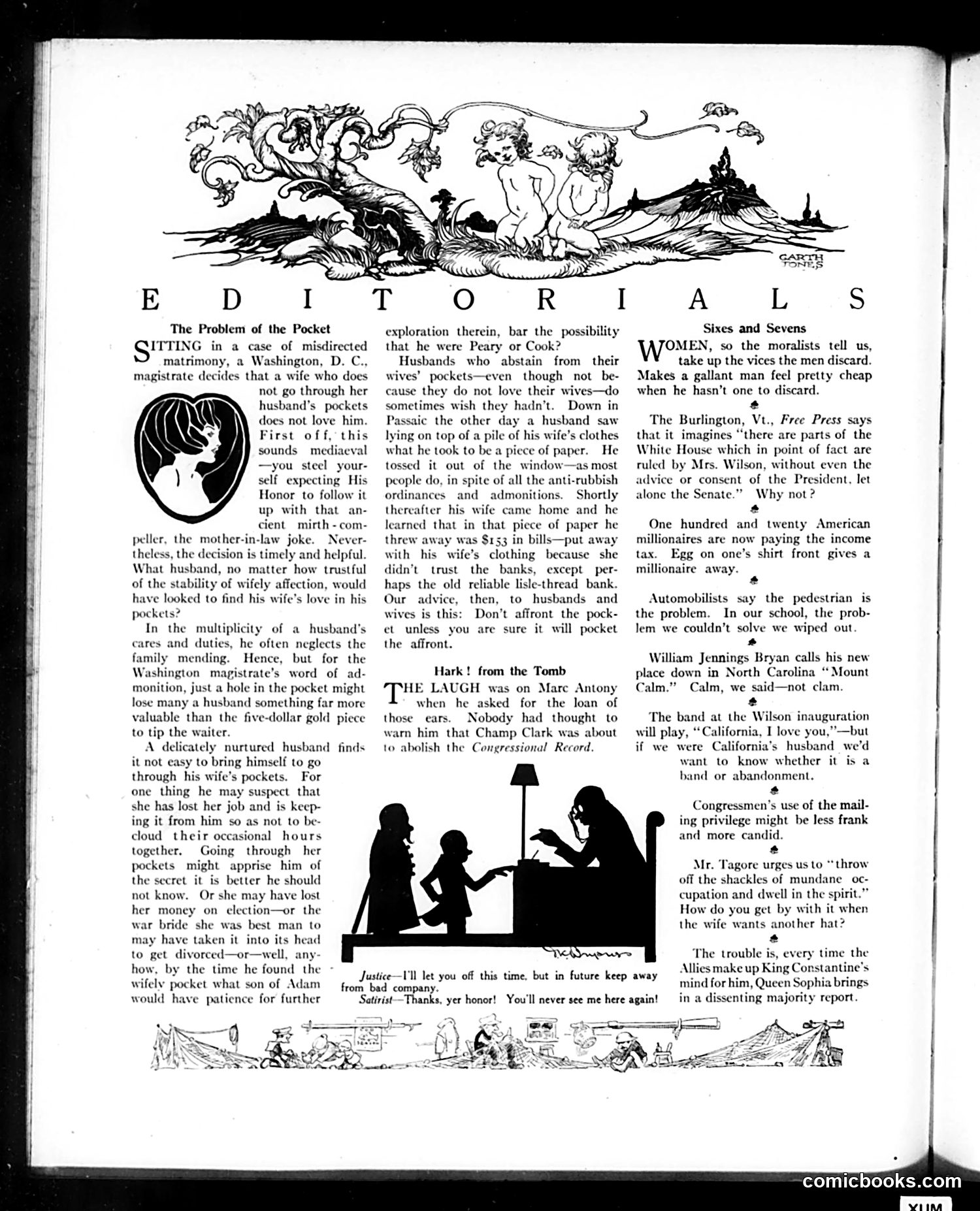
This Judge magazine page contains three satirical commentary pieces on early 20th-century American social issues: 1. **"The Problem of the Pocket"**: Mocks husbands who lose money or hide purchases from wives, suggesting wives should check pockets to catch infidelity or financial dishonesty. The humor targets marital trust issues. 2. **"Hark! from the Tomb"**: References Marc Antony's plea from Shakespeare, criticizing a husband's loan request. The silhouette cartoon shows a wife scolding a husband about bad company, with her warning he'll never see her again. 3. **"Sixes and Sevens"**: Brief social commentary on wealthy women finding cheap thrills, American millionaires, pedestrian safety, and political figures like William Jennings Bryan and King Constantine. The overall tone satirizes gender relations, financial disputes, and contemporary politics.
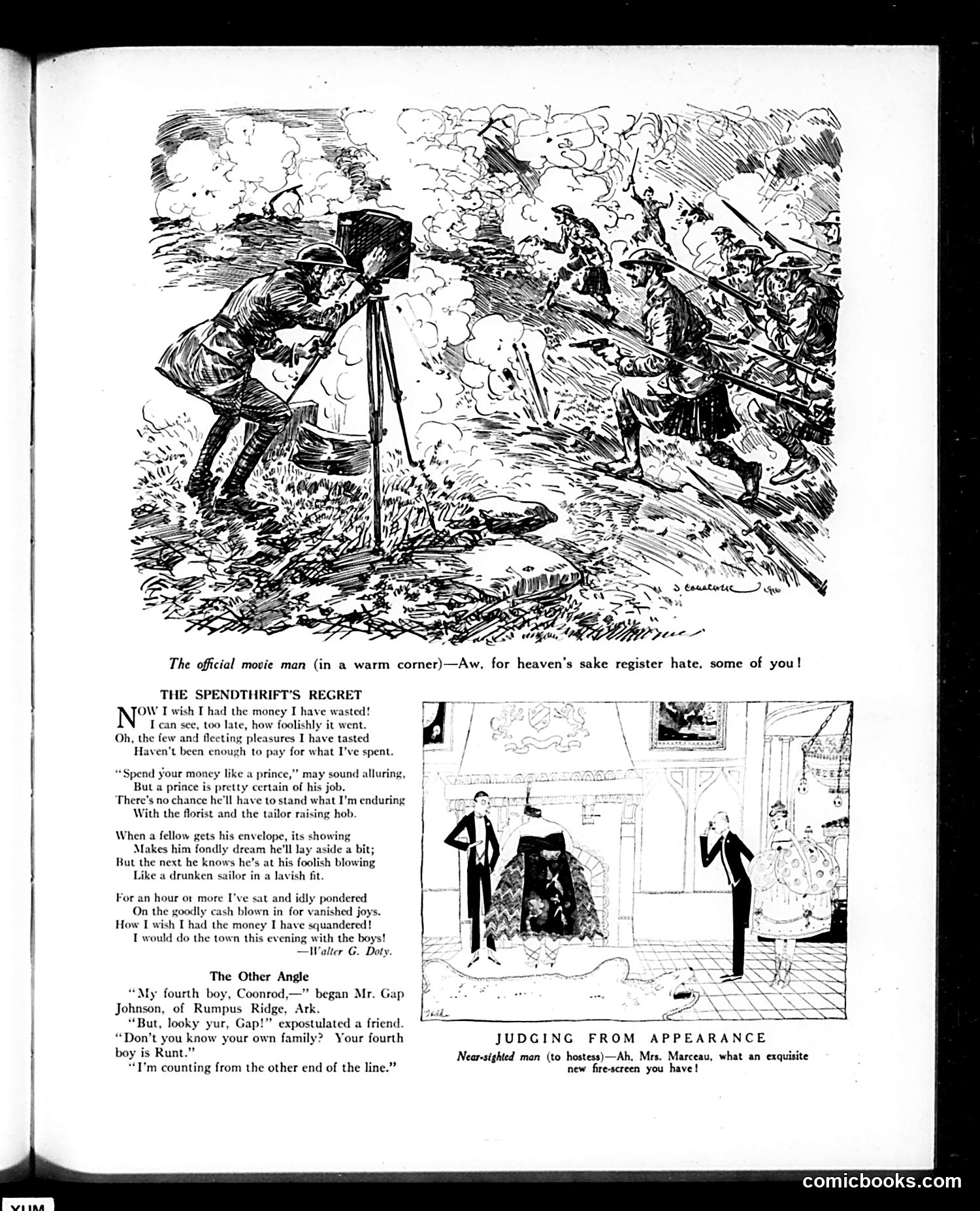
**Top Cartoon:** A military scene depicting soldiers in trench warfare with explosions. The caption mocks an "official movie man" (war correspondent/filmmaker) documenting combat, suggesting such documentarians were insensitive to soldiers' suffering—"register hate, some of you!" **Middle Section:** "The Spendthrift's Secret" is a poem by Walter G. Doty about financial regret, lamenting wasted money and pleasures. It reflects early 20th-century middle-class anxiety about personal finances and restraint. **Bottom Comic:** "Judging from Appearance" shows two well-dressed men evaluating a third. The hostess comments on his "exquisite new fire-screen," implying his appearance masks inferior qualities—satirizing surface judgments and pretense in social settings. Both pieces critique waste, vanity, and superficial values typical of Judge's social satire.
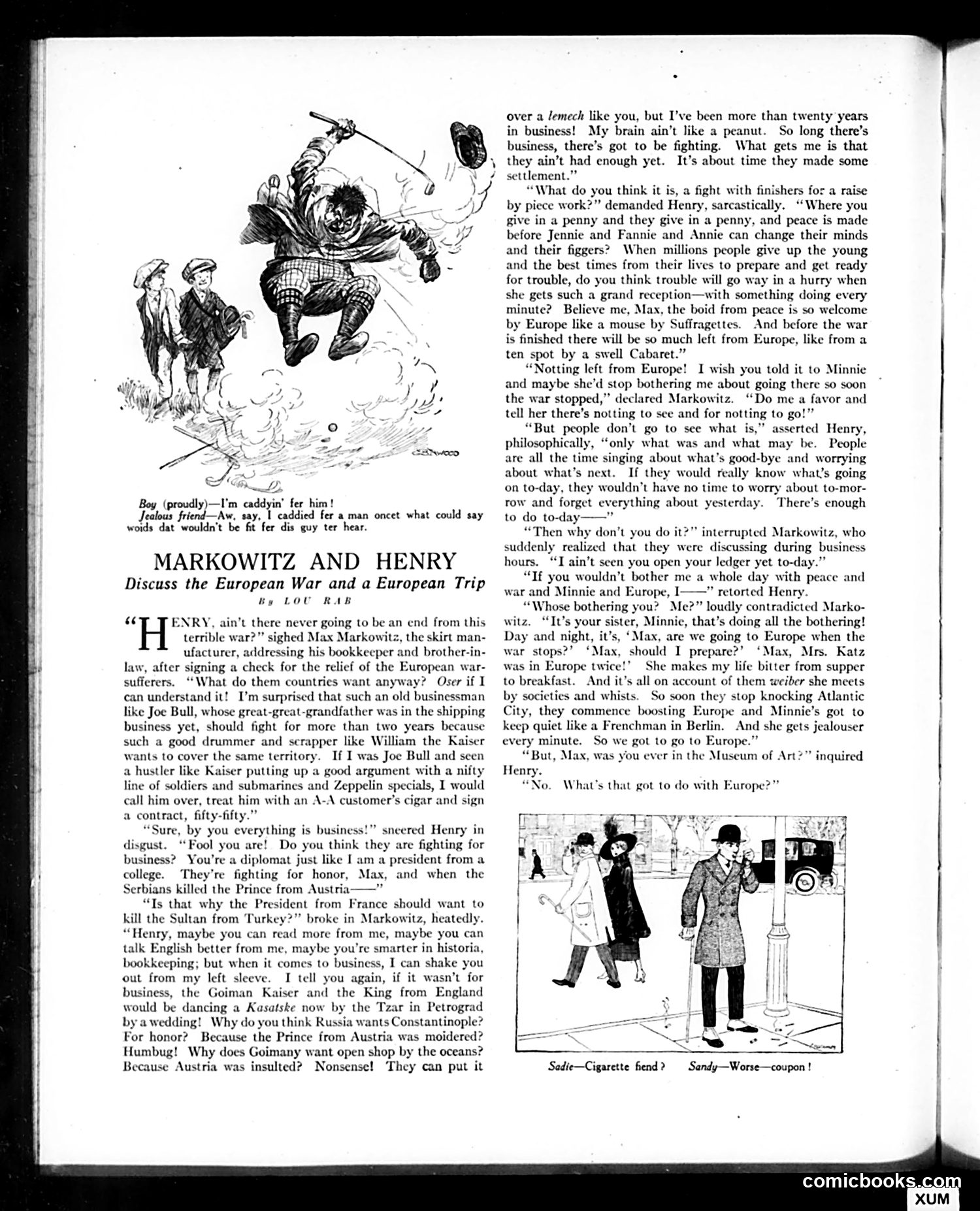
This page features a comedic debate between Max Markowitz (a Jewish skirt manufacturer) and Henry (his brother-in-law and bookkeeper) about World War I and European travel. The satire operates on multiple levels: **The Setup:** Max views the war through a businessman's lens—as territorial competition over "customers" that could be settled by contract negotiation. Henry insists it's about honor, citing the assassination that triggered the conflict. **The Satire's Point:** Both perspectives are mocked. Max's reduction of geopolitical conflict to commercial transaction is absurd; Henry's idealistic explanations about honor collapse when pressed (Why would France attack Turkey for Serbia's sake?). **The Jewish Immigrant Voice:** The Yiddish-inflected English ("lemech," "moidered," "Kasatske") reflects early 20th-century immigrant humor, making the characters relatable to Judge's audience while satirizing their limited comprehension of European power politics. **The Subtext:** The debate implies Americans (especially immigrant businessmen) fundamentally misunderstand European motivations—whether mercenary or honorable—and should perhaps reconsider visiting a devastated continent.
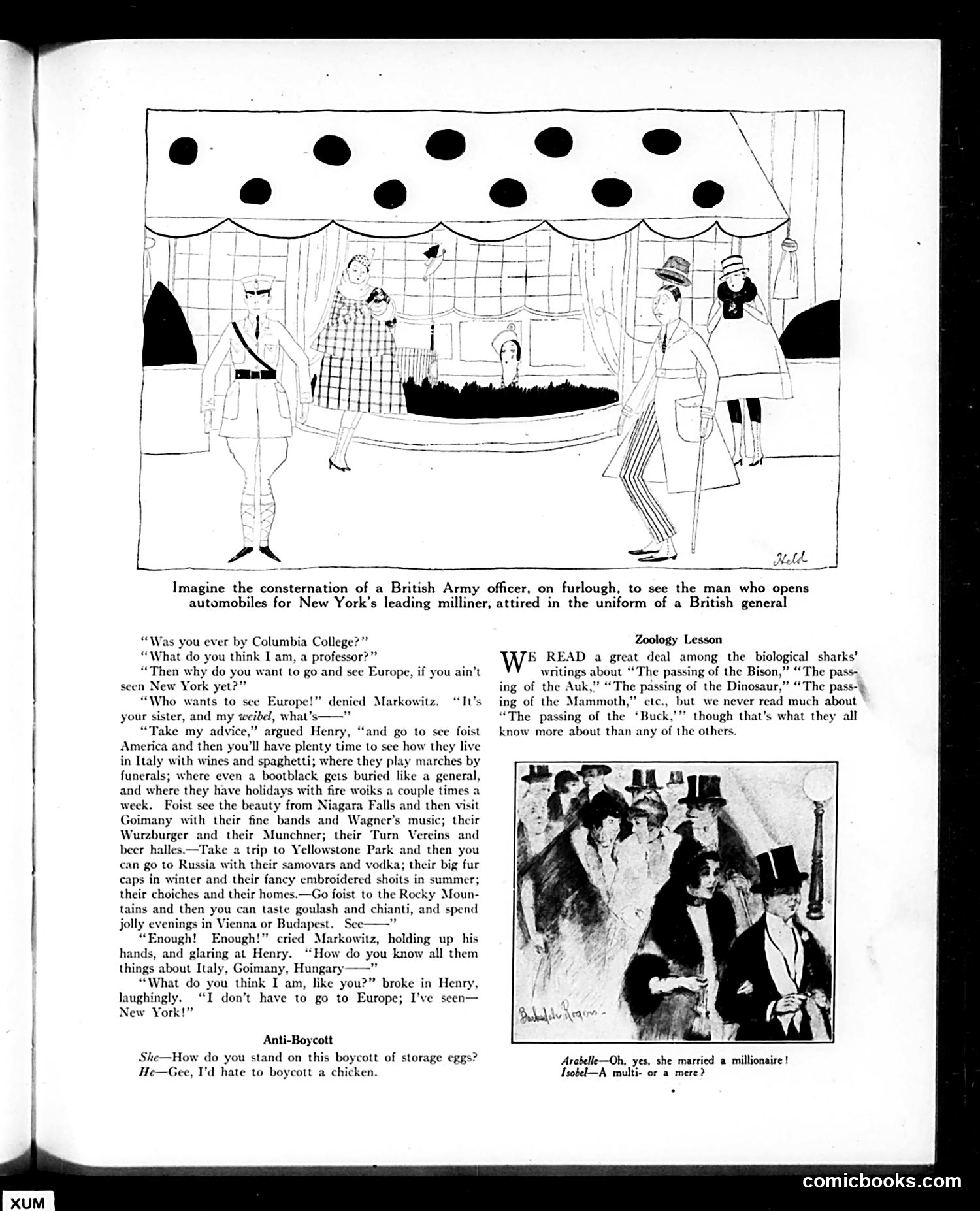
**Main Cartoon (top):** Satirizes New York's class pretensions. A British Army officer is shocked to see a New York milliner's doorman dressed in a British general's uniform—mocking how wealthy Americans ape European military formality and status symbols. **Dialogue Scene (left):** Two working-class New Yorkers debate travel. Henry argues one should explore America first (Niagara Falls, Yellowstone, Rocky Mountains) before Europe. Markowitz's sister wants European travel. The joke: Henry claims he's "seen" Europe already—just by observing New York's diverse immigrant populations (Italian, German, Russian communities), suggesting New York itself contains "all of Europe" through immigration. **"Anti-Boycott" (bottom left):** A mild pun about boycotting eggs versus chickens. **"Zoology Lesson" (right):** A play on naturalists' writings about extinct animals. The joke: nobody writes about "the passing of the Buck" (money/wealth), yet that's what people actually understand best—a cynical comment on materialism.
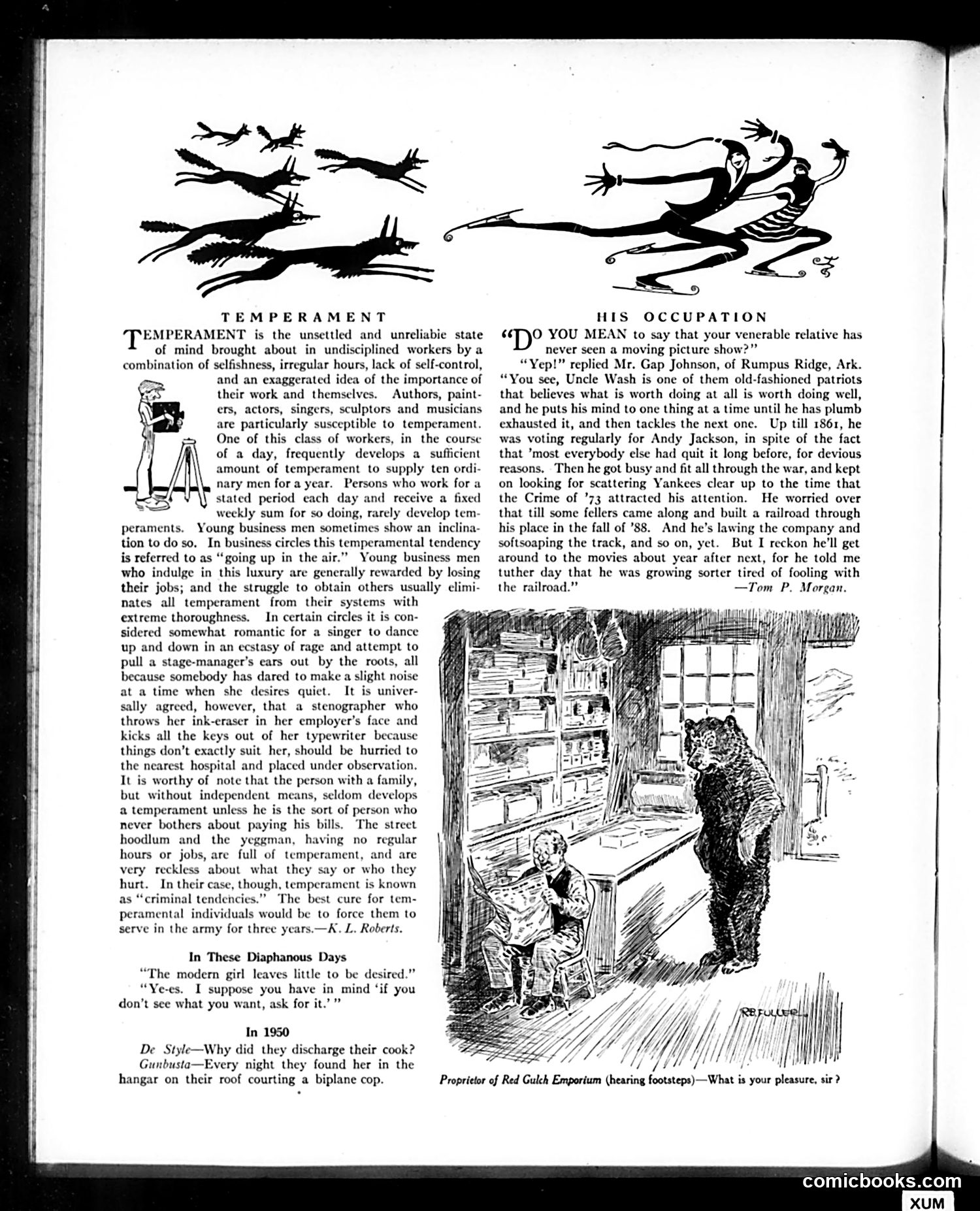
This page contains three distinct satirical pieces typical of early 20th-century Judge magazine: **"Temperament"** attacks artistic pretension. The essay mocks actors, singers, and musicians for their emotional volatility and self-importance, contrasting them unfavorably with disciplined workers. It notes ironically that stenographers throwing ink erasers should be hospitalized, while singers destroying property is considered "romantic." The point: artistic temperament is merely undisciplined selfishness disguised as sensitivity. **"His Occupation"** features Uncle Wash, a backwoods character who focuses obsessively on one thing at a time—voting for Andrew Jackson decades after his death, then fighting the Civil War, then fighting railroad litigation. The joke satirizes rural stubbornness and irrelevance; Uncle Wash won't reach movies until 1950. **"In 1950"** is a brief joke about modern girls' sexual permissiveness and the "biplane cop" (unclear reference, possibly racy double meaning). All three pieces mock contemporary social types: pretentious artists, rural ignorance, and changing female morality.
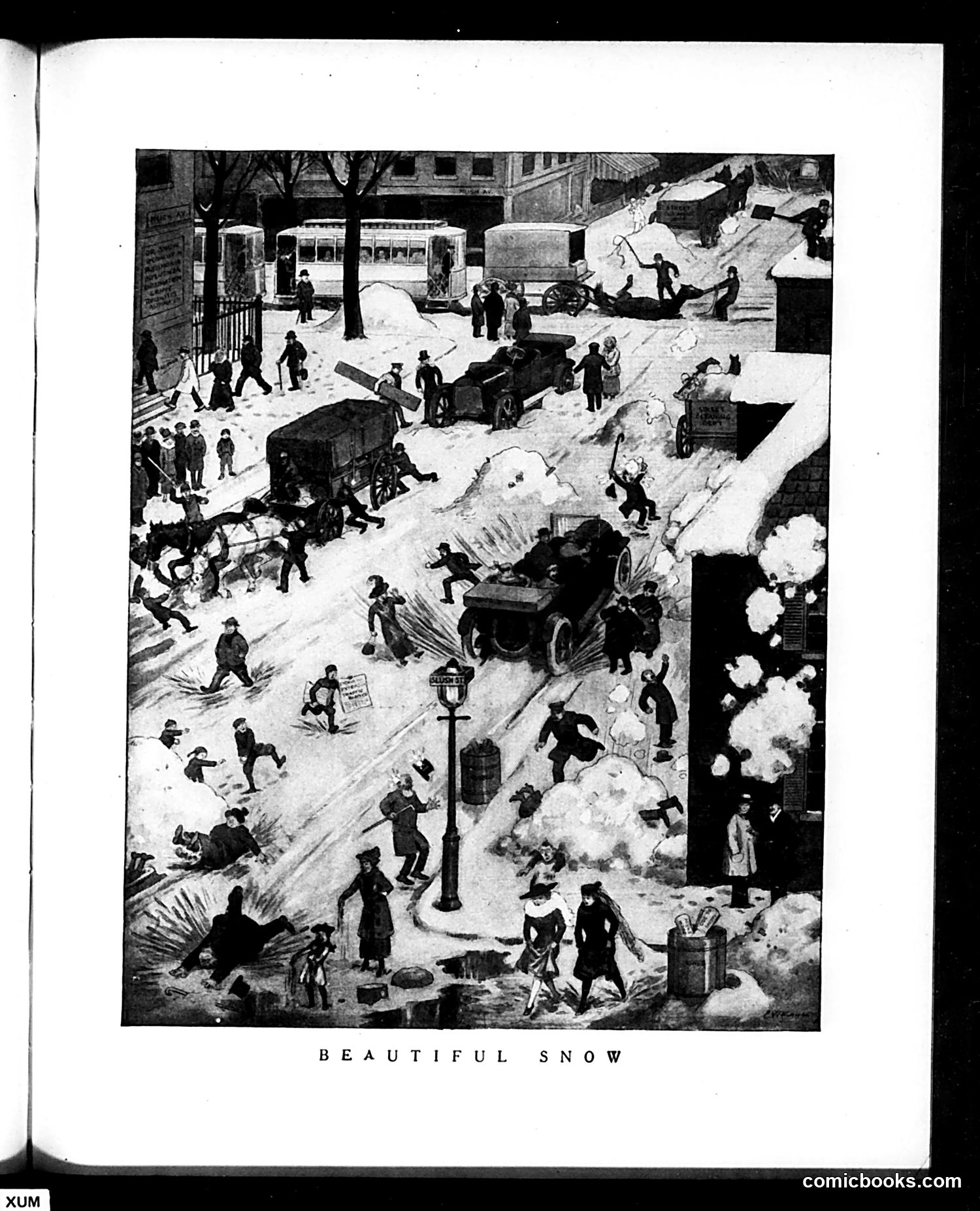
This is a winter street scene titled "Beautiful Snow," depicting an urban snow day with numerous figures engaged in various activities—sledding, playing, sweeping snow, operating carts and wagons, and general winter recreation across a snowy cityscape with buildings and a street lamp visible. The title appears ironic: while the image celebrates winter activities, the cartoon likely satirizes the practical difficulties snow creates for city dwellers—blocked streets, difficult transportation, labor required for snow removal, and the contrast between romantic notions of "beautiful" snow and its actual urban inconveniences. The busy, crowded composition emphasizes the chaos and disruption snow causes to normal city life. Without additional text or context, the specific satirical target remains unclear, but the piece appears to critique idealizations of winter weather.
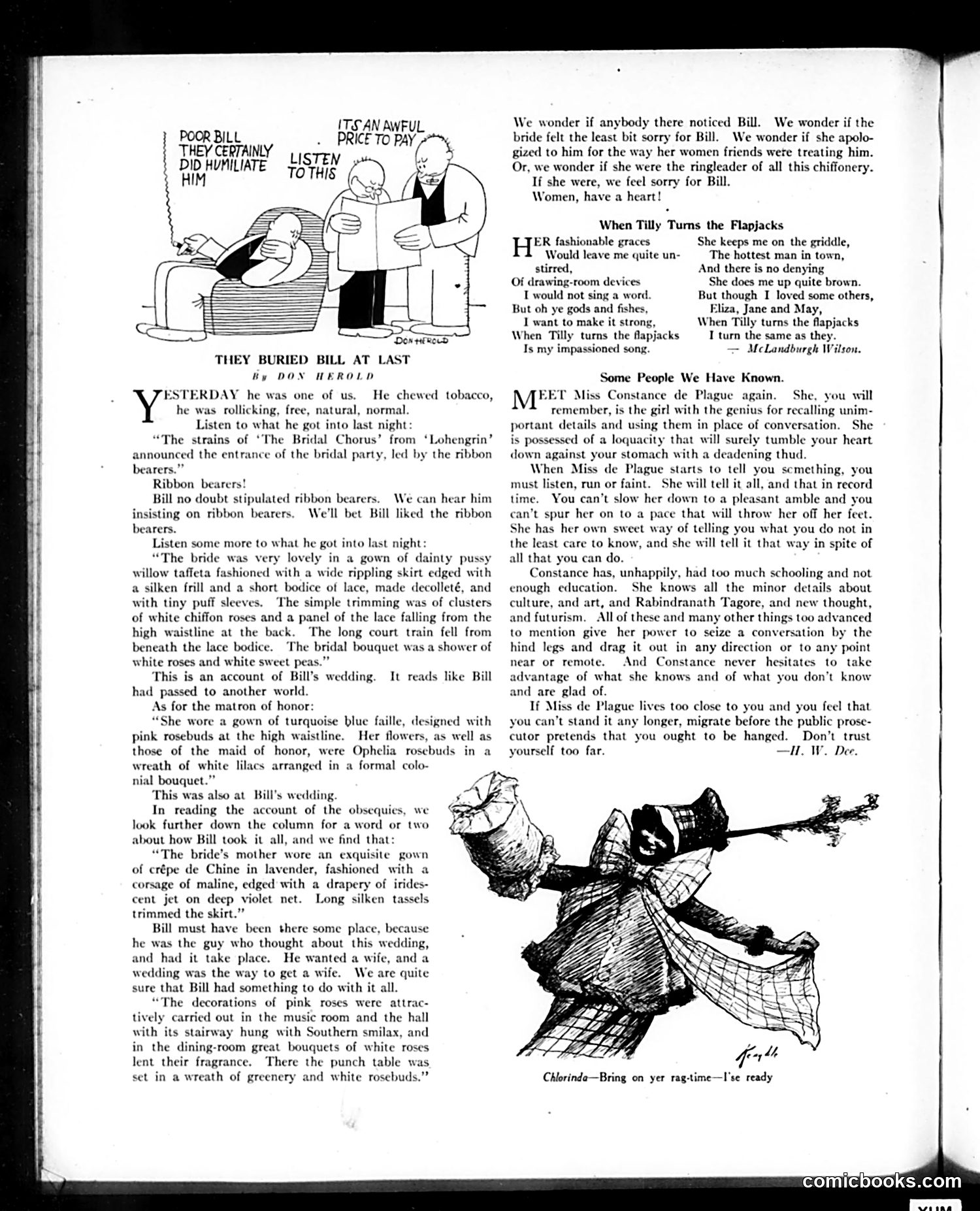
This Don Herold piece satirizes how marriage transforms an ordinary man into someone unrecognizable. "Bill" was once a normal, tobacco-chewing fellow—"one of us." But his wedding has effectively killed that identity. The satire's target: the elaborate, feminized ritual of upper-class weddings. The text mockingly catalogs excessive details—ribbon bearers, "dainty pussy willow taffeta," "Ophelia rosebuds," the bride's mother's lavender crepe de Chine gown—suggesting Bill has been consumed by his wife's social ambitions and the event's ornate femininity. The dark joke: Bill disappears entirely from his own wedding account. He wanted a wife and got one, but at the cost of his freedom and identity. The closing plea—"Women, have a heart!"—frames marriage as something women inflict on men. This reflects 1920s masculine anxiety about matrimony and shifting gender dynamics, presented as comedy about the loss of male identity to female domesticity.
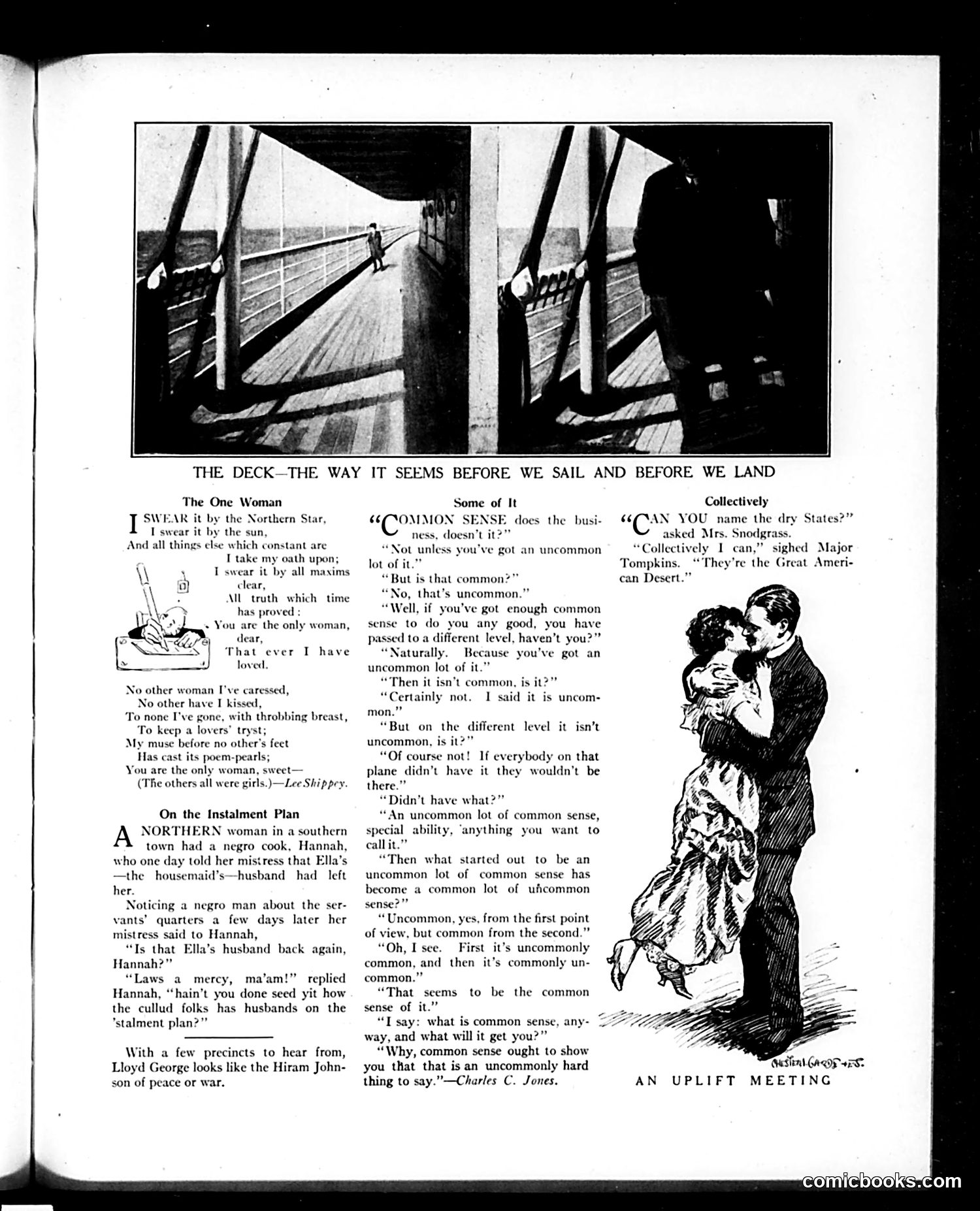
This Judge magazine page contains three distinct satirical pieces: **"The One Woman"** (left): A sentimental love poem by Lee Shippey—straightforward romantic verse, not satirical. **"On the Instalment Plan"** (center): Racial satire depicting a Northern woman asking her Black cook Hannah about her servant colleague Ella's husband. Hannah's response—that "cullud folks has husbands on the 'stalment plan'"—is a crude racist joke suggesting Black men abandon their wives in installments (leaving and returning). This reflects period stereotypes and the magazine's casual racism. **"Some of It" / "Common Sense" dialogue** (center-right): A philosophical wordplay piece about whether "common sense" is actually common or uncommon—circular logic humor. **"Dry States"** (bottom right): A brief joke about naming "dry states" (states under Prohibition), with Major Tompkins naming "the Great American Desert"—a humorous deflection. The page exemplifies Judge's mix of sentimental verse, casual racism, and intellectual wordplay typical of early 20th-century American satirical magazines.
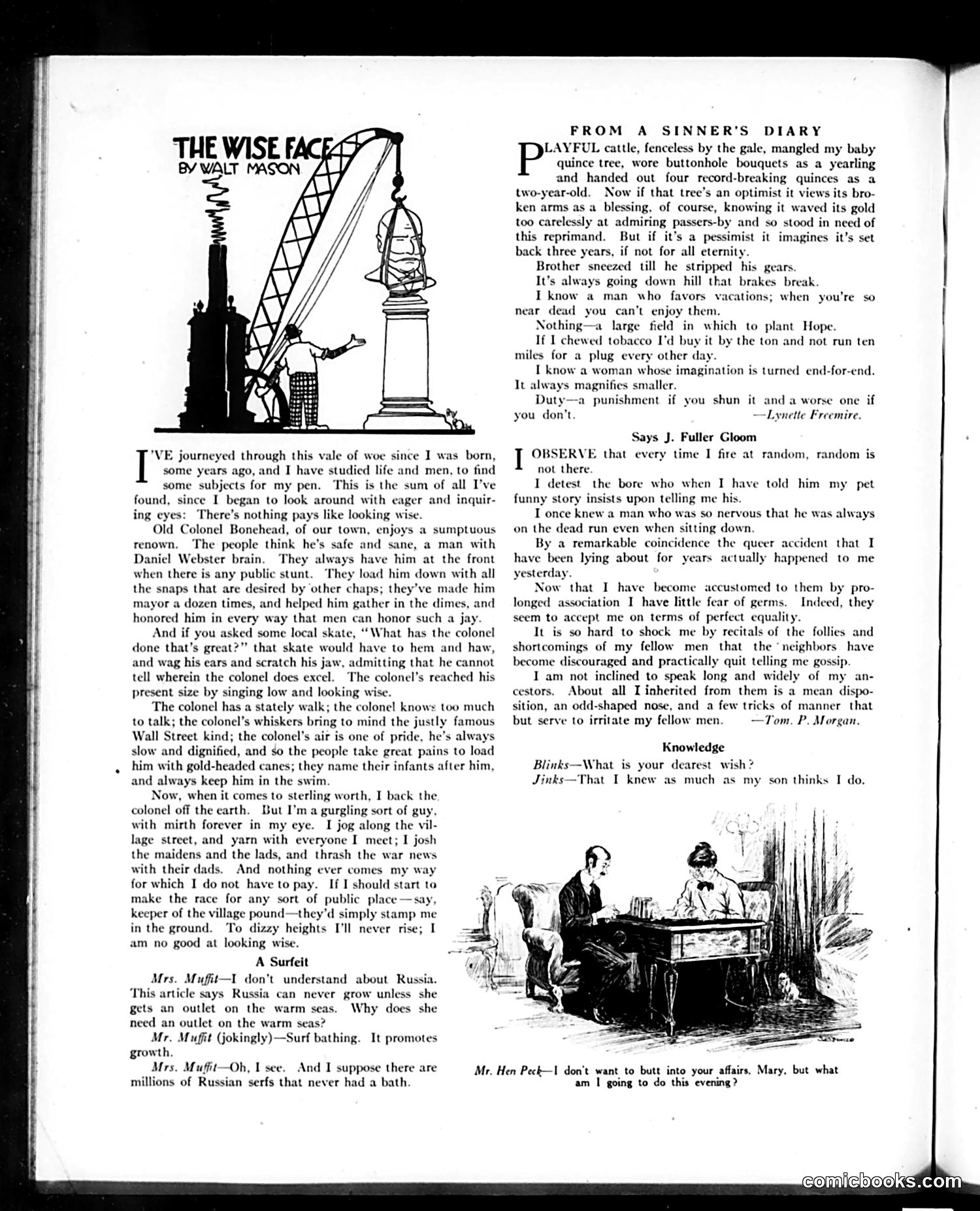
**"The Wise Face" (by Walt Mason):** This poem satirizes "Colonel Bonehead," a small-town figure who gains prominence and public honors despite having no demonstrable accomplishments. The satire targets how appearance and demeanor—"looking wise," dignified bearing, fancy whiskers—can fool the public into granting power and respect to mediocre people. The narrator contrasts the colonel's success with his own failures, suggesting that genuine merit and humor don't advance one socially or politically. **"A Surfeit" dialogue:** This brief joke mocks Russian geopolitical discourse of the era. When Mrs. Muffit asks why Russia needs "an outlet on warm seas," her husband jokes "Surf bathing"—absurdist humor playing on the serious 19th-century debate about Russian imperial expansion and access to ice-free ports. **"From a Sinner's Diary":** Cynical aphorisms about human nature, success, and disappointment—typical of Judge's sardonic tone targeting American social pretension and hypocrisy.
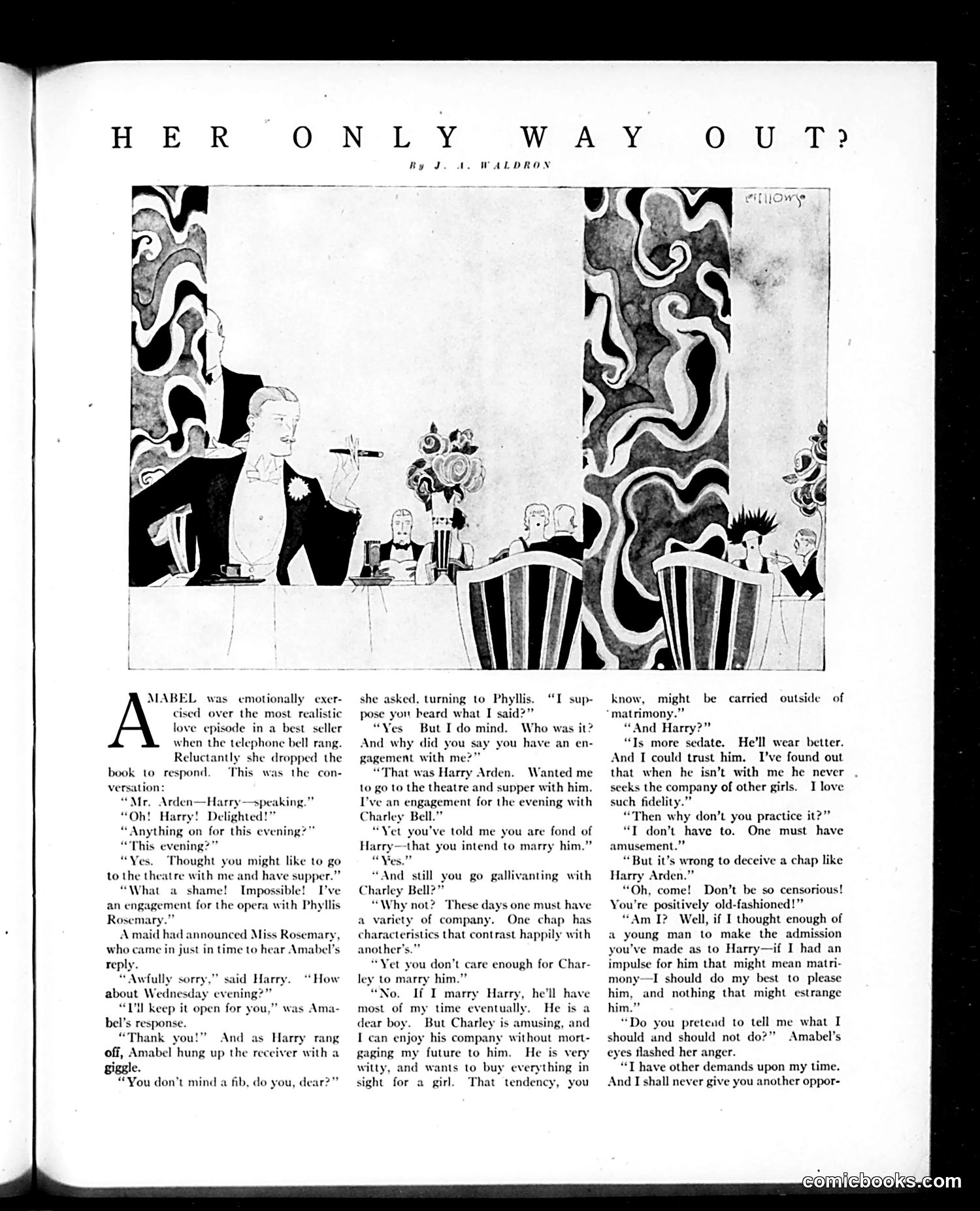
This is a short fiction piece, not a political cartoon. It depicts a social satire about modern courtship and female independence in the early 20th century. **The scenario:** Mabel receives a phone call from Harry Arden, whom she's apparently engaged to marry. She lies, claiming she has an opera engagement with Phyllis Rosemary, when actually she's seeing another man, Charley Bell. When Phyllis arrives and hears the lie, she challenges Mabel's behavior. **The satire:** Mabel defends her deception by arguing that modern women need "variety" in male companionship—Harry is "sedate" and reliable (marriage material), while Charley is "amusing" and generous. She refuses Phyllis's moral objections as "old-fashioned." **The critique:** The story satirizes the new modern woman's casual attitude toward romantic deception and her compartmentalized approach to relationships, treating courtship as shopping for different male qualities rather than based on genuine commitment.
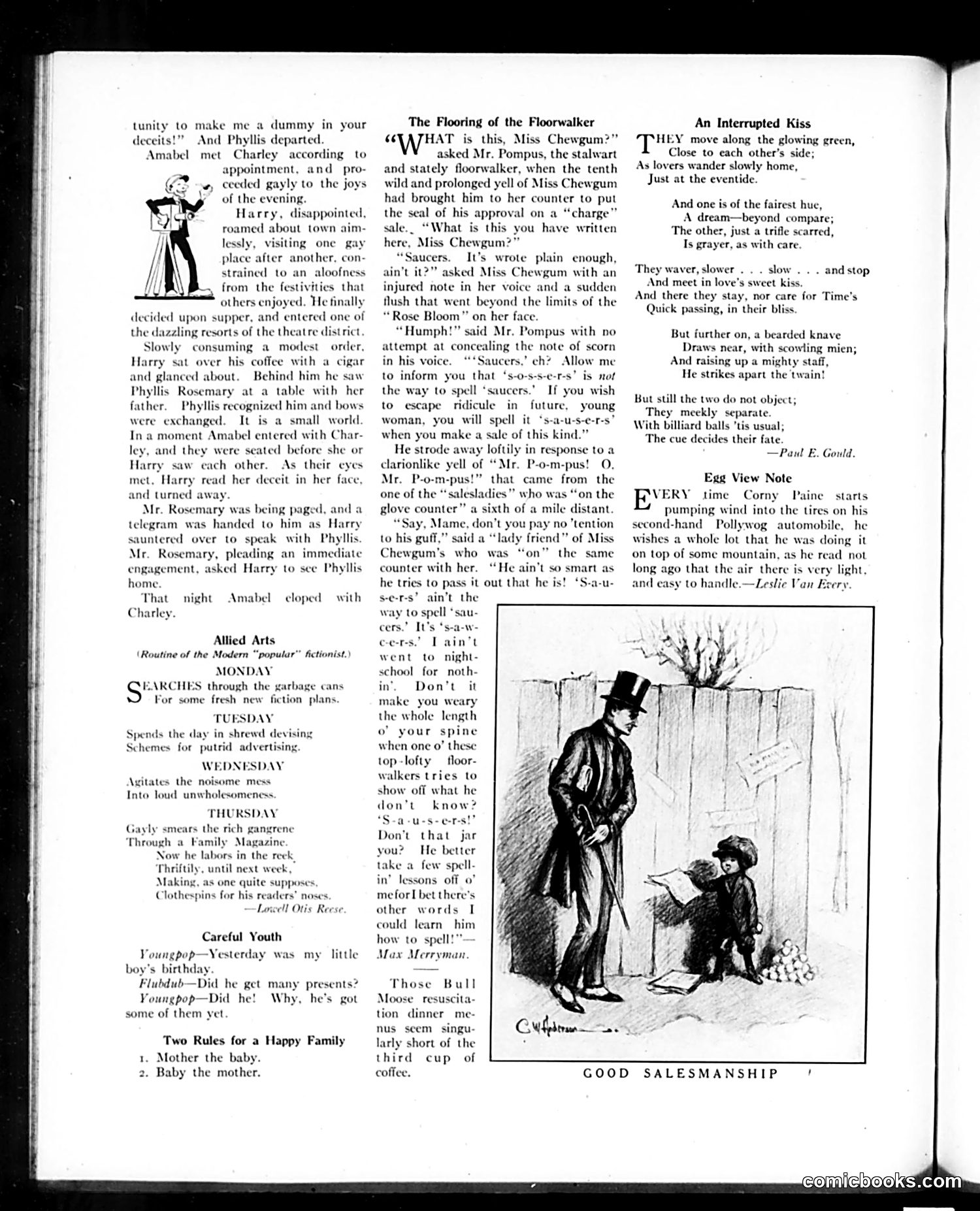
This page contains three satirical pieces from *Judge* magazine: **"The Flooring of the Floorwalker"** mocks a pretentious department store floorwalker (supervisor) named Mr. Pompus who condescendingly corrects a salesgirl's spelling of "saucers." The joke satirizes workplace hierarchy and performative authority—Pompus smugly insists the correct spelling is "s-a-u-s-e-r-s," but a coworker points out he's wrong, spelling it "s-a-w-c-e-r-s," then listing other words he mispronounces. The satire targets bosses who use minor corrections to assert dominance over working-class employees. **"Allied Arts"** parodies popular fiction writers as mercenary hacks: they search garbage for plot ideas, devise advertising schemes, stir up sensationalism, and sell their work to family magazines—all while readers metaphorically hold "clothespins for their noses." Minor items include jokes about infidelity, a child's birthday presents, family dynamics, and a reference to "Bull Moose" (Theodore Roosevelt's 1912 Progressive Party) dinner menus being suspiciously short.
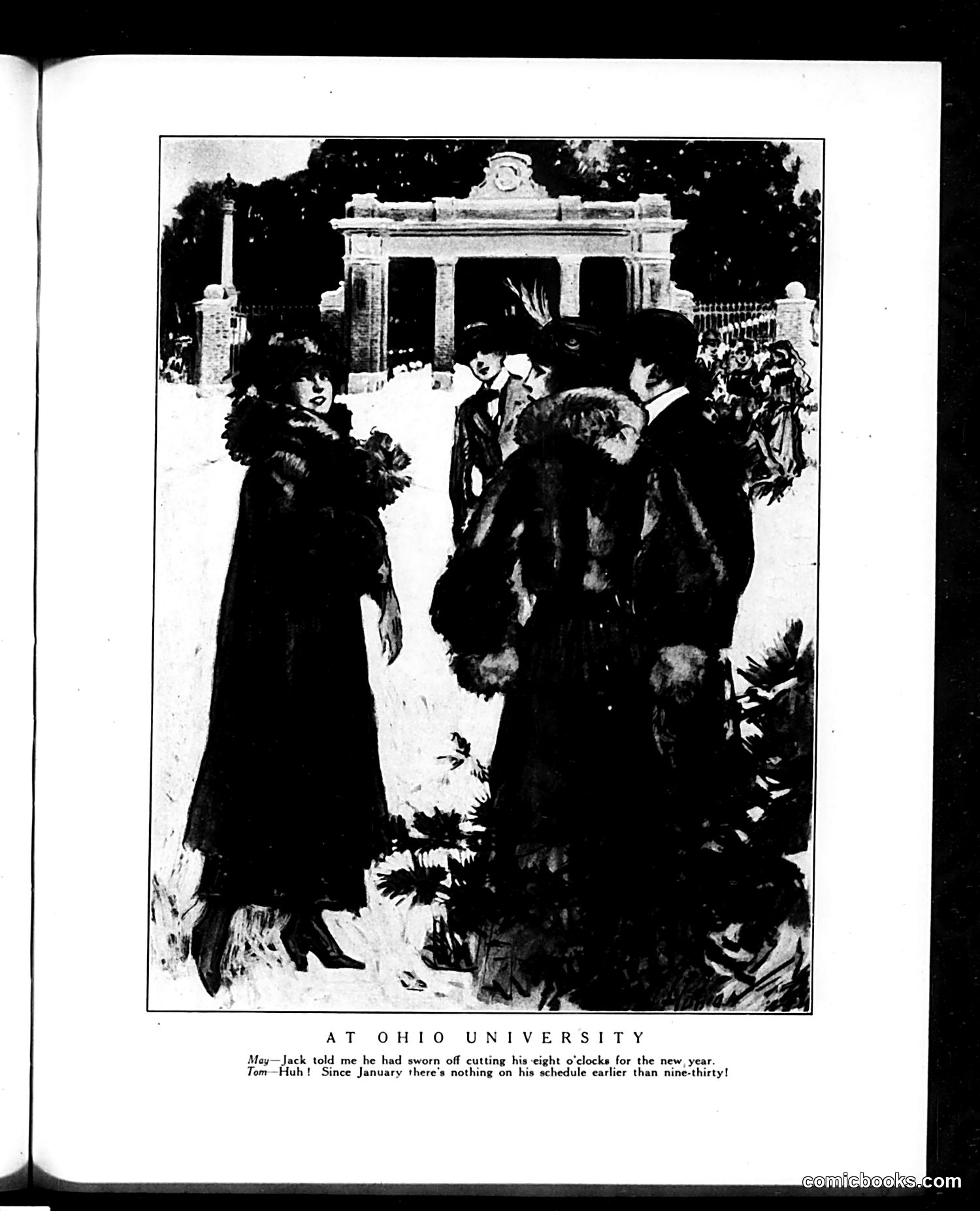
This is a humorous college scene at Ohio University depicting a conversation between two male students (May and Tom) about their classmate Jack's New Year's resolution. The joke plays on the gap between Jack's stated intention and his actual behavior. Jack claimed he'd "sworn off cutting" (skipping) his 8 a.m. classes starting in the new year. However, Tom reveals that since January, Jack has conveniently arranged his entire schedule so nothing starts before 9:30 a.m. The satire mocks the common human tendency to make earnest resolutions while simultaneously finding clever workarounds to avoid actually keeping them. Rather than discipline himself to attend early classes, Jack simply removed them from his schedule entirely—technically keeping his resolution while completely circumventing its spirit.
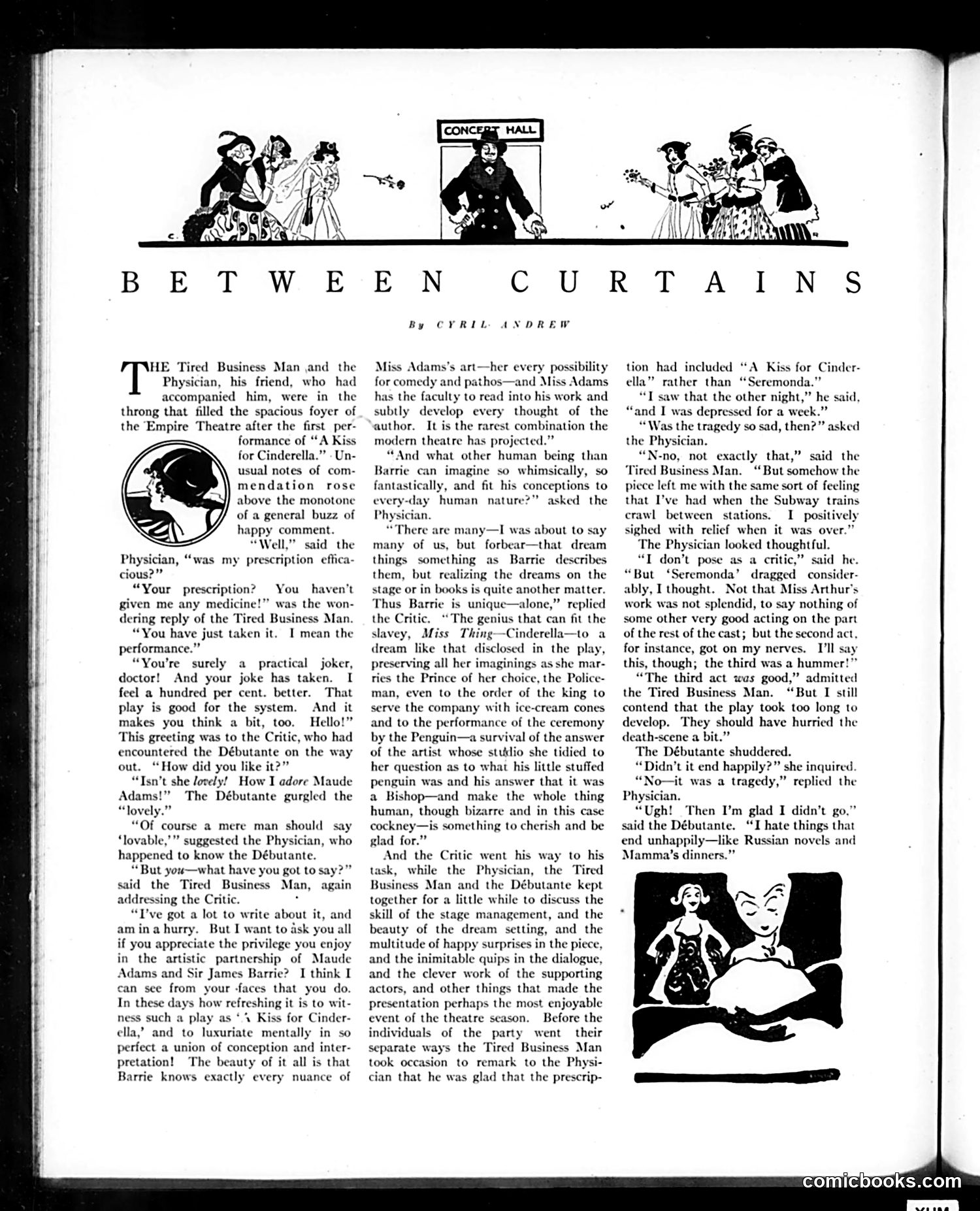
This page reviews J.M. Barrie's play *"A Kiss for Cinderella,"* starring the famous actress Maude Adams. The article is framed as a dialogue among theater-goers leaving the Empire Theatre after opening night: a Tired Business Man, a Physician, a Débutante, and a Critic. The satire operates on multiple levels: The Physician prescribes theater as medicine for the exhausted businessman. The Critic delivers effusive praise for Barrie and Adams's artistic partnership, emphasizing their perfect synchronization—Barrie's whimsical imagination matched with Adams's ability to realize his vision. The piece celebrates the play's fantastical elements (the Penguin performing the marriage ceremony, ice-cream cones) while maintaining emotional authenticity. The humor lies in the Physician's observation that mere "entertainment" is actually therapeutic, and in contrasting this uplifting experience with depressing plays like "Seremonda"—implying theater's genuine social value during what was likely the post-WWI period.
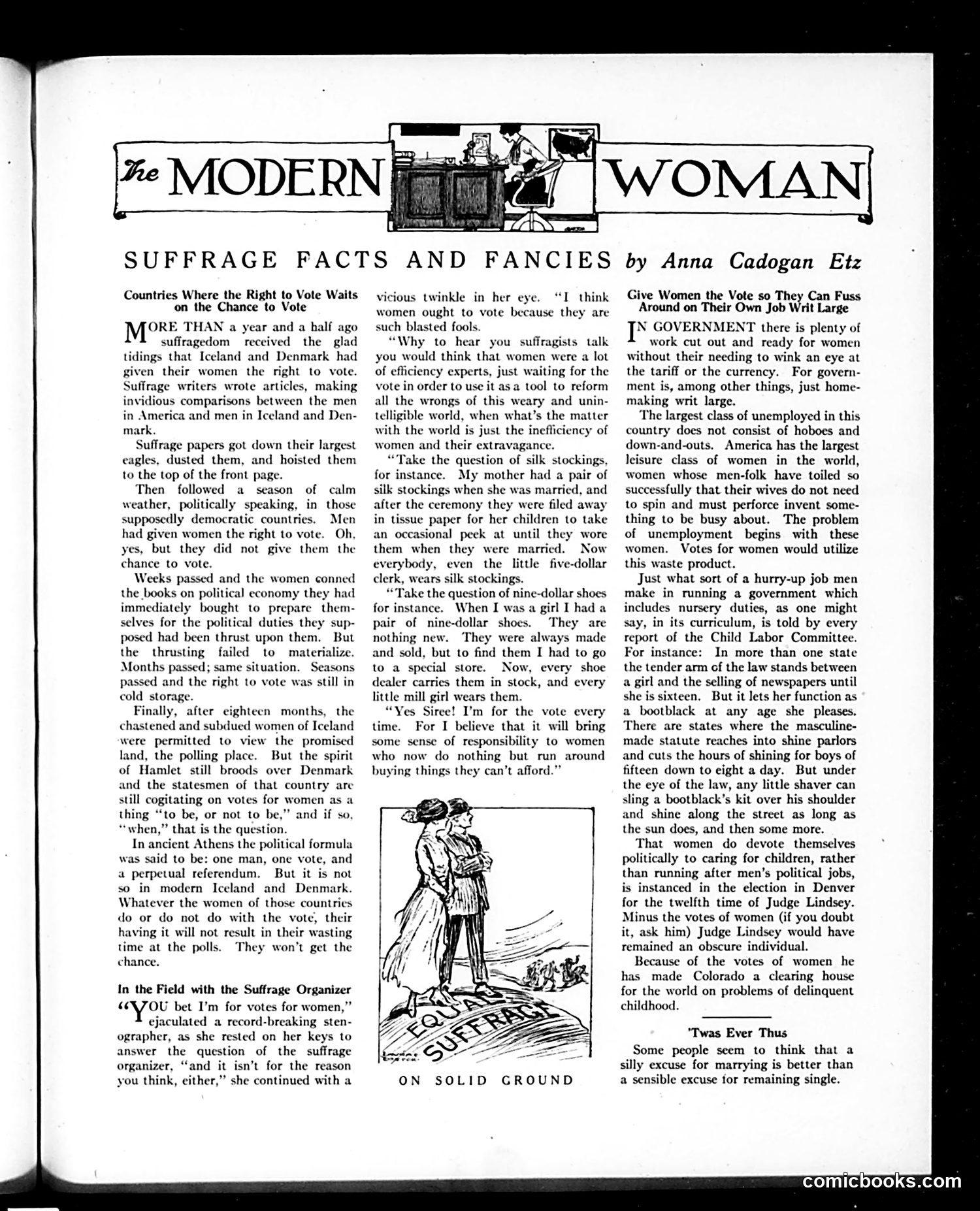
This page from *Judge* magazine presents anti-suffrage satire by Anna Cadogan Etz. The main cartoon shows a woman standing on "Suffrage" ground, symbolizing women's hollow victory. The text mocks women's suffrage through multiple angles: Iceland and Denmark granted women voting rights but indefinitely delayed actual polling access—a biting example of meaningless gestures. The stenographer character ridicules female voters as economically irresponsible, citing women's allegedly frivolous consumption of silk stockings and expensive shoes as proof they shouldn't vote. The final section sarcastically suggests women should focus on domestic duties ("home-making writ large") rather than politics. The satire's core argument: women lack the judgment for civic participation and waste resources on luxuries. This represents mainstream anti-suffrage sentiment of the era, portraying female enfranchisement as both impractical and socially dangerous.
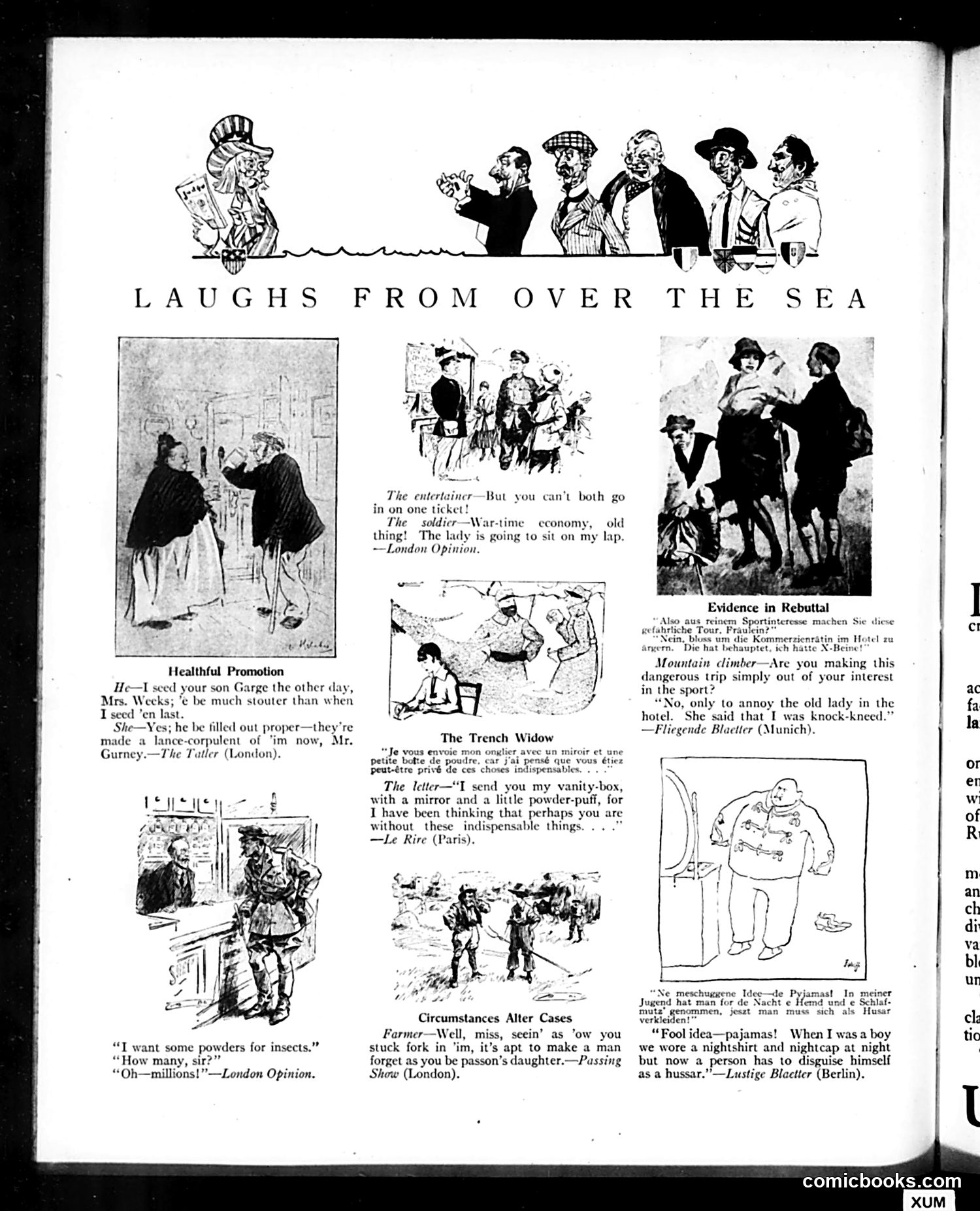
This page collects humorous cartoons and jokes from European publications (London, Paris, Munich, Berlin) during World War I, arranged around themes of wartime life and social change. The jokes satirize: - **Class and propriety**: A soldier's cheeky suggestion that a lady sit on his lap at entertainment (mocking wartime casualness and rationing) - **Gender roles**: References to women's cosmetics and appearance as "indispensable" even during war; women's newfound mobility (mountain climbing to annoy hotel ladies) - **Military culture**: A farmer's dark humor about a woman who stabbed a soldier—suggesting wartime violence has eroded moral judgment - **Fashion absurdity**: A complaint that modern pajamas force men to "disguise" themselves as hussars (cavalry soldiers), mocking changing sleepwear styles The cartoons reflect how WWI disrupted traditional social hierarchies and conventions. The "over the sea" framing suggests Judge was presenting foreign humor as exotic entertainment for American readers unfamiliar with European wartime experiences and attitudes.
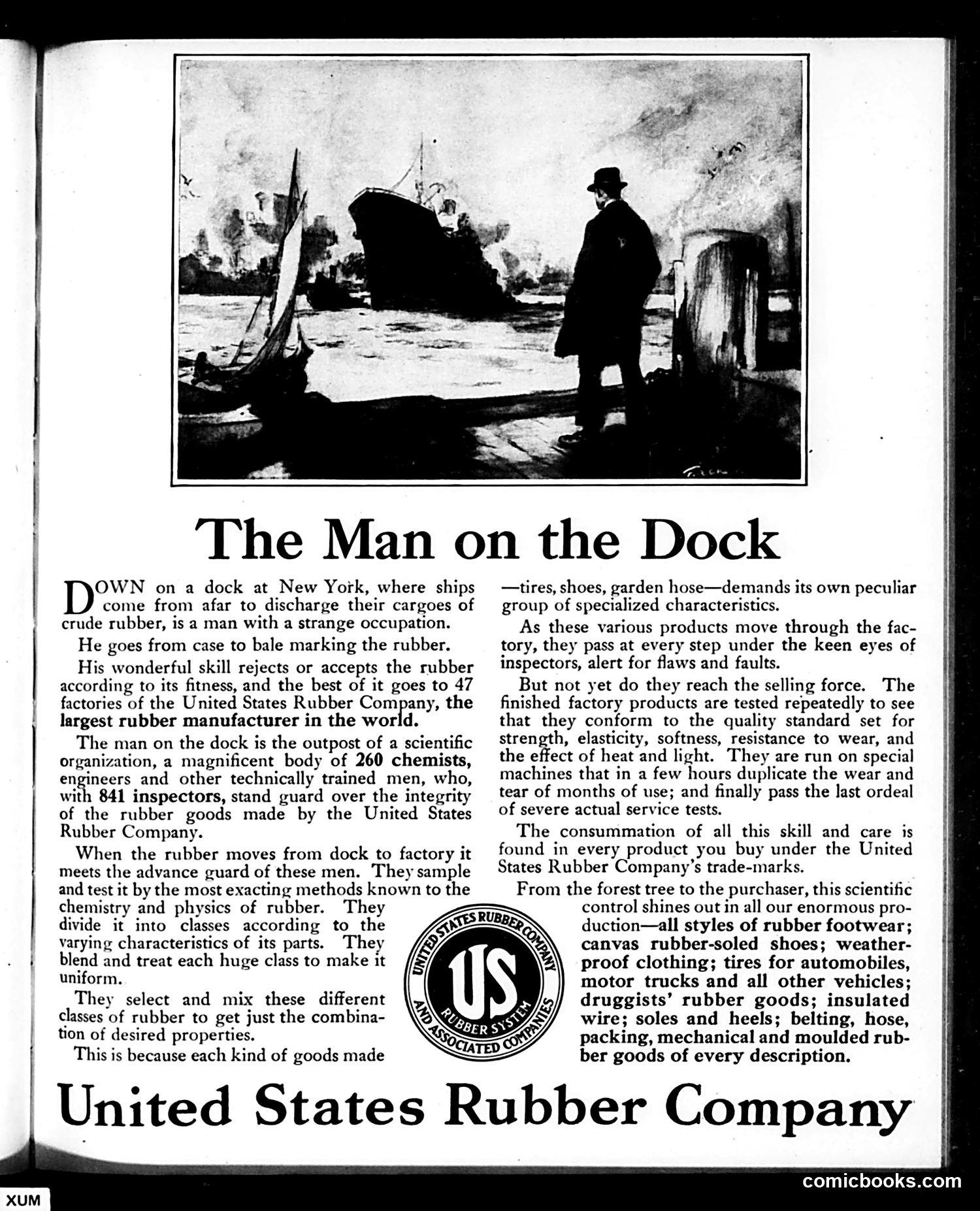
This is **not a cartoon or satire**, but rather a **corporate advertisement** for the United States Rubber Company, presented as an earnest editorial feature. The "man on the dock" is a quality-control inspector at New York's rubber-import facilities. The piece celebrates his role within an elaborate quality-assurance system: 260 chemists, 841 inspectors, and rigorous testing protocols that evaluate rubber from arrival through final product distribution. The narrative promotes corporate competence and scientific rigor as selling points—emphasizing that U.S. Rubber's products (tires, footwear, hoses, insulation) undergo extensive testing for "strength, elasticity, softness, resistance to wear." **The context modern readers miss**: This represents early 20th-century corporate "trust-building" advertising, when companies used *Judge* magazine's credibility to position industrial quality control as evidence of integrity—reassuring consumers about mass-produced goods during an era of frequent product failures and food/safety scandals.
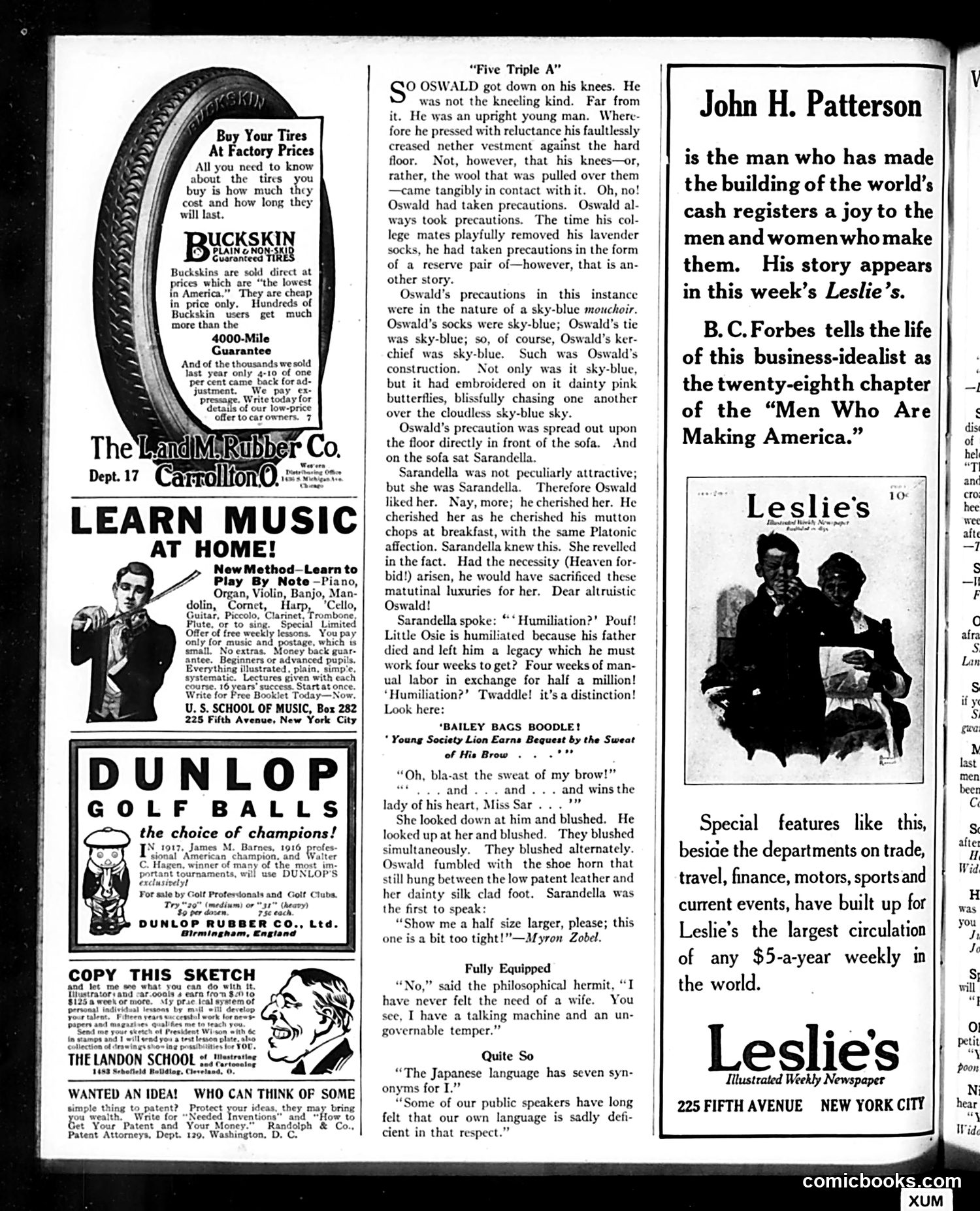
This page is primarily advertising with a serialized fiction story. The main narrative, "Five Triple A," depicts young society characters navigating class anxieties in the early 20th century. **The satire:** Oswald is an obsessively fastidious upper-class man—his entire wardrobe (socks, tie, kerchief) matches in sky-blue with embroidered butterflies. He kneels on an elaborate handkerchief to protect his clothes. The joke targets pretentious gentlemen's excessive concern with appearance and propriety. **The social commentary:** Sarandella mocks Oswald's shame about inheriting wealth requiring only four weeks of "manual labor" to claim. She sardonically calls this a "distinction" rather than humiliation—satirizing wealthy young men's anxiety about appearing idle or undeserving of inheritance. The narrative mocks both aristocratic fastidiousness and the anxiety surrounding old-money privilege during an era of growing class tension.
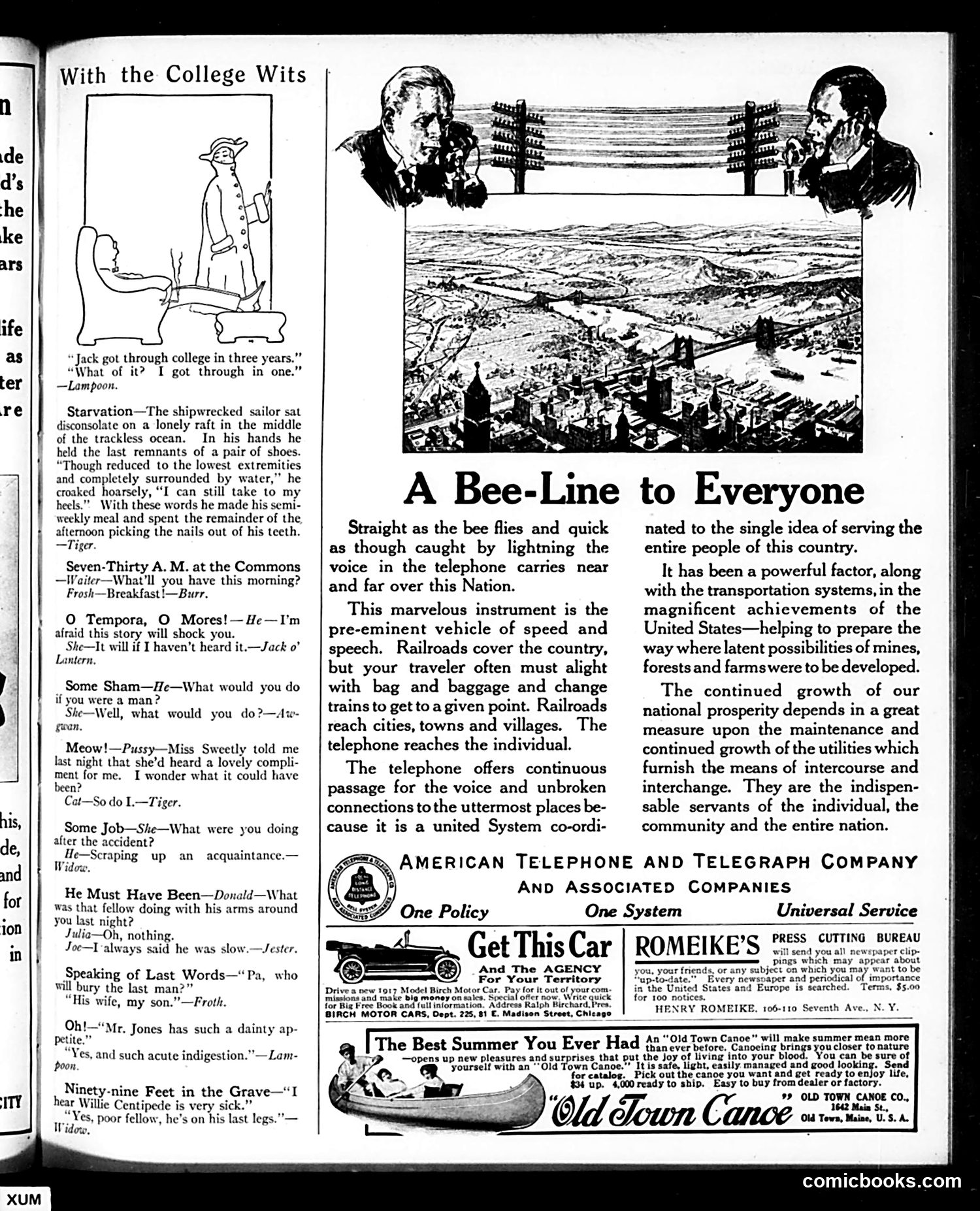
This page from *Judge* magazine consists primarily of **college humor and advertising** rather than political satire. **The "College Wits" section** features brief, punchy jokes sourced from various college publications (*Lampoon*, *Tiger*, *Jester*, etc.). These jokes mock college students' laziness (getting through college quickly), dining hall food quality, romantic mishaps, and wordplay. The humor is light and domestic rather than political. **The main feature** is a full-page **advertisement for American Telephone and Telegraph Company**, presenting the telephone as essential infrastructure connecting the nation. The image shows two businessmen conversing across a landscape, symbolizing instantaneous cross-country communication. The text emphasizes the telephone's superiority over railroads for individual connectivity. **Bottom advertisements** promote a 1917 Birch Motor Car and "Old Town Canoe" for summer recreation. There is **no identifiable political cartoon or satirical commentary** on this page. It reflects early 20th-century American optimism about technology and consumer goods.
This page is primarily **advertising and filler content**, not political satire. The main feature is a promotion for "Film Fun," Judge's sister publication, advertising a serialized article titled "Confessions of a Motion Picture Actress"—a melodramatic exposé promising to reveal the "rough and rocky road to film-fame" of an unnamed actress. The bulk of the page consists of **brief jokes and witticisms** on domestic and social topics (typewriter cleaning, burglars, headaches, work ethic) typical of early-20th-century humor magazines. These are not satirizing specific political figures or events, but rather poking fun at general human behavior and gender dynamics. The **advertisements**—Cook's Imperial Champagne and a "Law Study at Home" course—are typical period ads with no satirical intent. There is **no discernible political cartoon or sustained satire** on this page. It functions as a magazine filler combining light humor with advertising.
This is primarily a magazine page of early 20th-century advertising with brief humorous fillers interspersed. **The main humor content** ("Shear Steal") consists of short satirical pieces on various social topics. Most notably: - **"Where Weegee Failed"**: A joke about a Ouija board ("weegee board") that gets a man in trouble when he uses it as a false alibi for staying out late—ironic since the mystical board supposedly "answers all questions," it fails him when he needs it most. - **"Government Ownership"**: A woman supports government railroad ownership; the joke is her reasoning is purely selfish—she wants leverage to complain to conductors about seating. The page is otherwise dominated by period advertisements for household products (Carbona cleaning fluid), patent medicines, cigars, whiskey, and correspondence courses. The cartoons are small and decorative rather than politically significant. This reflects Judge's mix of social satire and commercial content typical of early 20th-century magazines.
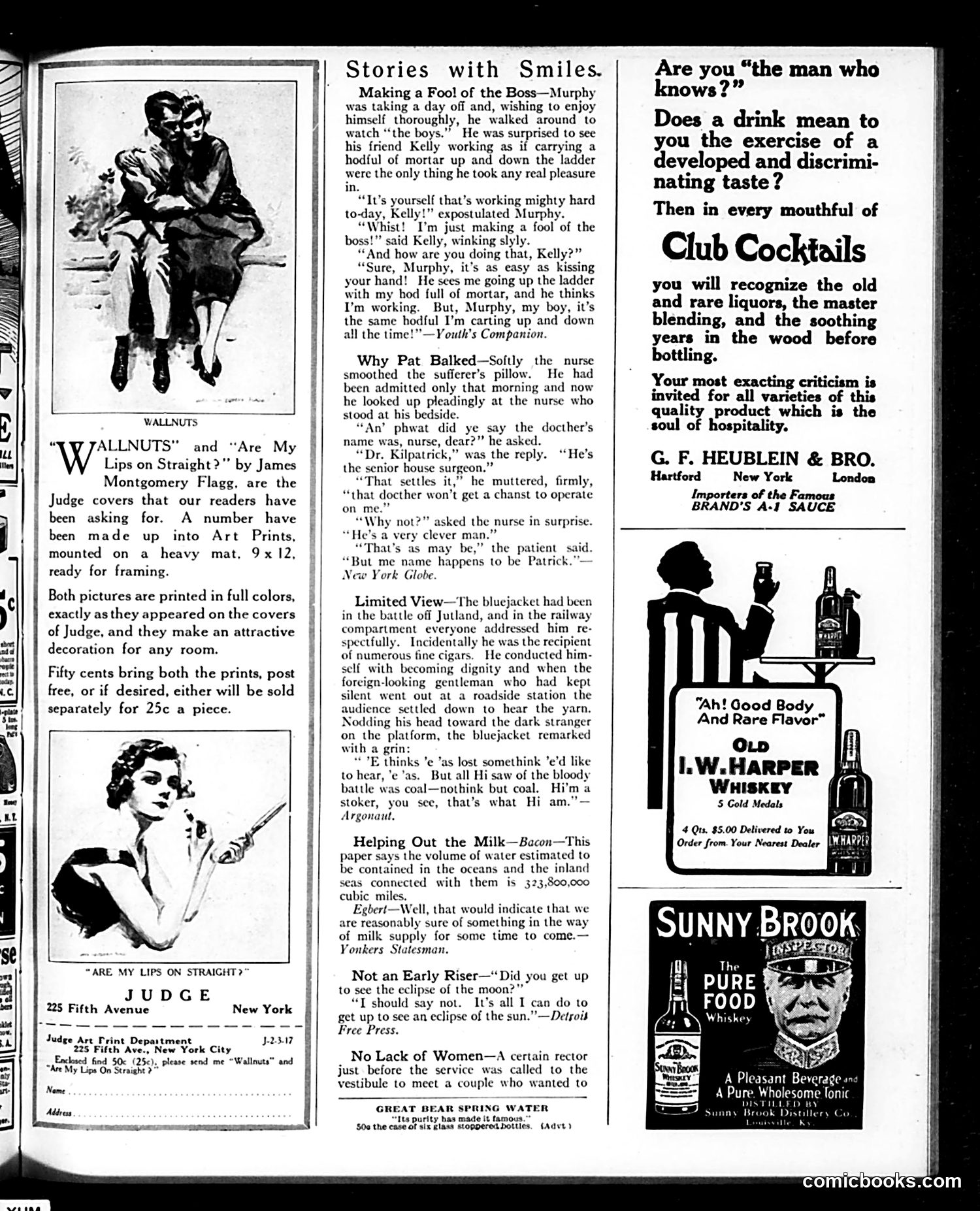
This page from *Judge* (likely early 1920s, based on references to WWI's "battle off Jutland") contains humorous short stories and advertisements rather than political cartoons. The **stories with smiles** include Irish-immigrant humor ("Making a Fool of the Boss," "Why Pat Balked"), typical of early 20th-century American publications. The jokes rely on ethnic stereotypes—Irish workers and patients named Patrick or Kilpatrick. Other anecdotes satirize wartime conditions ("Limited View" mocks a WWI sailor who saw only coal as a stoker) and general absurdity (a milk supply joke about oceanic water volume; someone too tired to see eclipses). The **art print advertisements** promote Judge cover illustrations by James Montgomery Flagg—"Wallnuts" and "Are My Lips on Straight?"—showing flapper-era imagery typical of the period. The **liquor advertisements** (Club Cocktails, Old I.W. Harper Whiskey, Sunny Brook) are notable as Prohibition was enacted in 1920, making their prominence historically significant—this likely predates Prohibition's enforcement or represents early resistance to it.
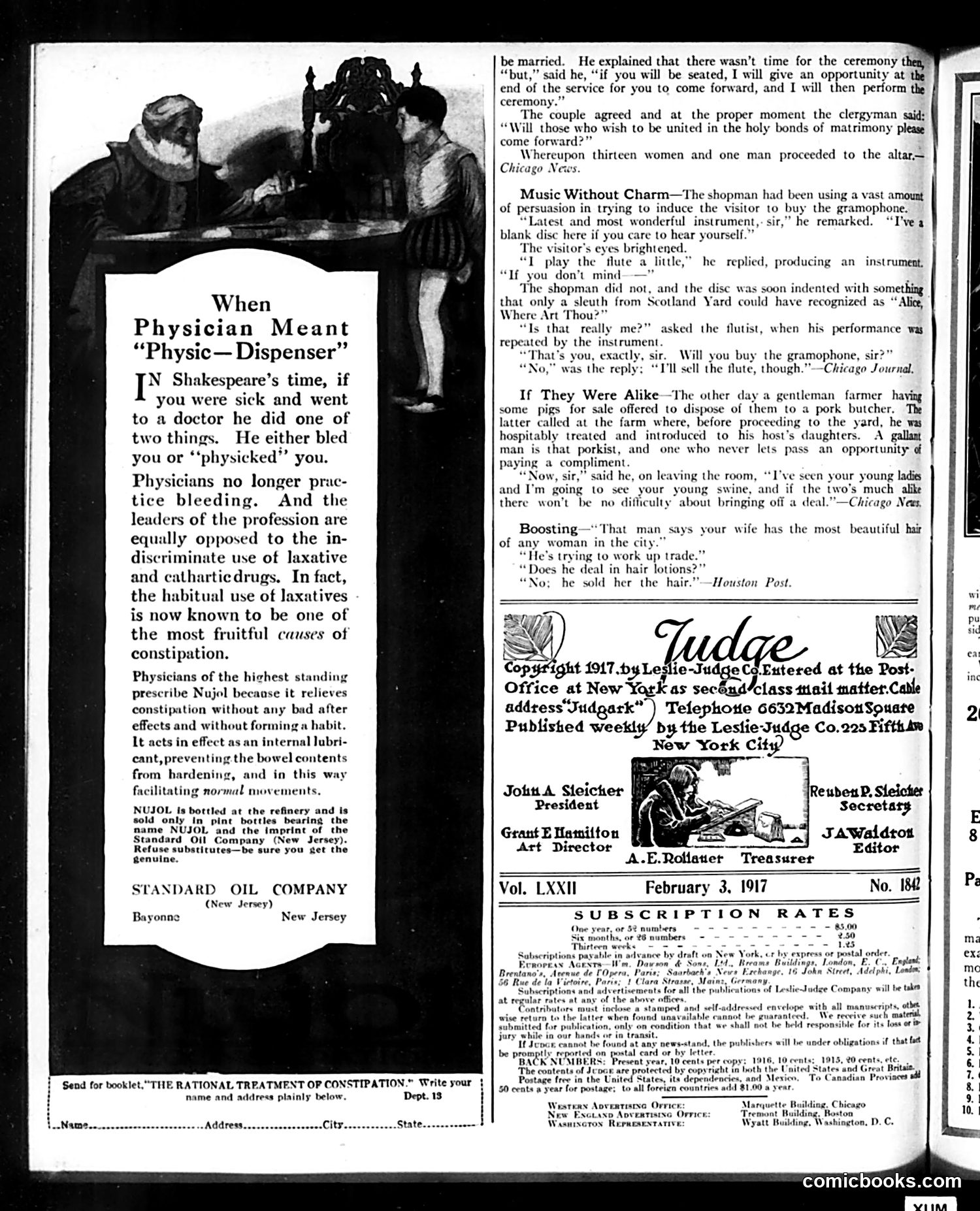
This is primarily a **Standard Oil Company advertisement** for Nujol laxative, occupying the left side of the page. It uses a historical/educational hook: a comparison between Renaissance physicians who bled patients or administered harsh "physicks" (laxatives) and modern doctors who prefer Nujol—positioned as a gentler, non-habit-forming lubricant treatment for constipation. The right side contains **humorous anecdotes** unrelated to the ad, typical of Judge magazine's satirical content: - A clergyman performs unexpected marriages at a service - A gramophone salesman tries selling an instrument that records poorly - A pork butcher compliments a farmer's daughters with unfortunate double meaning - A man credits a hair dealer with his wife's "beautiful hair" These brief jokes target social pretension, commercial hucksterism, and awkward compliments. The page is typical early-20th-century magazine content mixing advertising with light comedy.
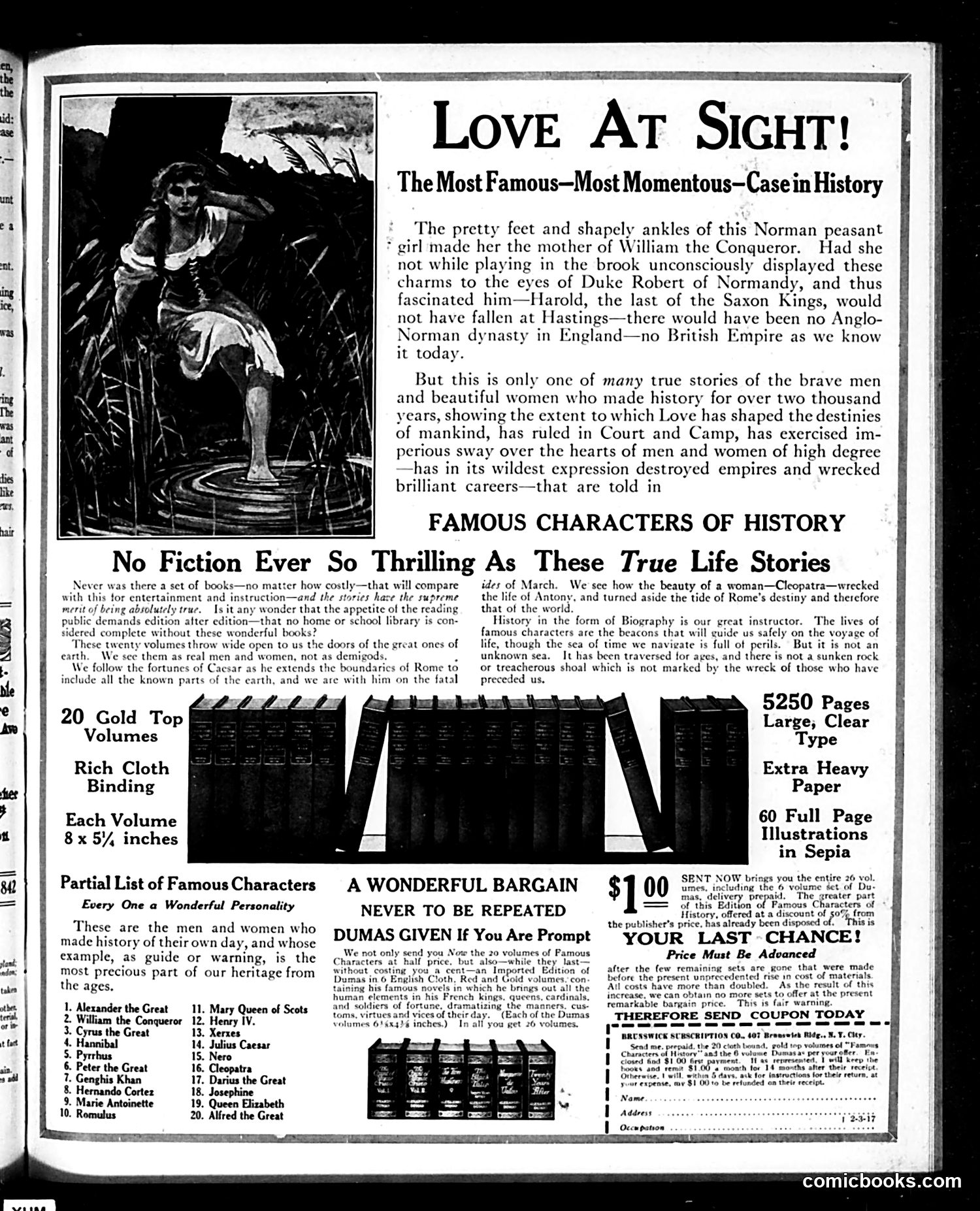
This is primarily a **book advertisement**, not a political cartoon. It promotes a 20-volume set titled "Famous Characters of History" by Alexandre Dumas. The page uses a historical "love at first sight" framing device: it opens with an anecdote about a Norman peasant girl whose beauty captivated Duke Robert of Normandy, ultimately leading to William the Conqueror and the Anglo-Norman dynasty in England. This sets up the book's larger thesis—that **romantic attraction and personal relationships have shaped historical events**. The advertisement emphasizes that these are "true life stories" (not fiction), featuring famous historical figures like Alexander the Great, Julius Caesar, Cleopatra, and others listed on the page. It positions biography as moral instruction for readers. The sales pitch is aggressive: a "wonderful bargain never to be repeated" at $1.00, with a free imported Dumas edition included if ordered promptly. The phrase "YOUR LAST CHANCE! Price Must Be Advanced" creates urgency typical of period advertising. This reflects late 19th/early 20th-century publishing culture emphasizing both entertainment and edification through biography.
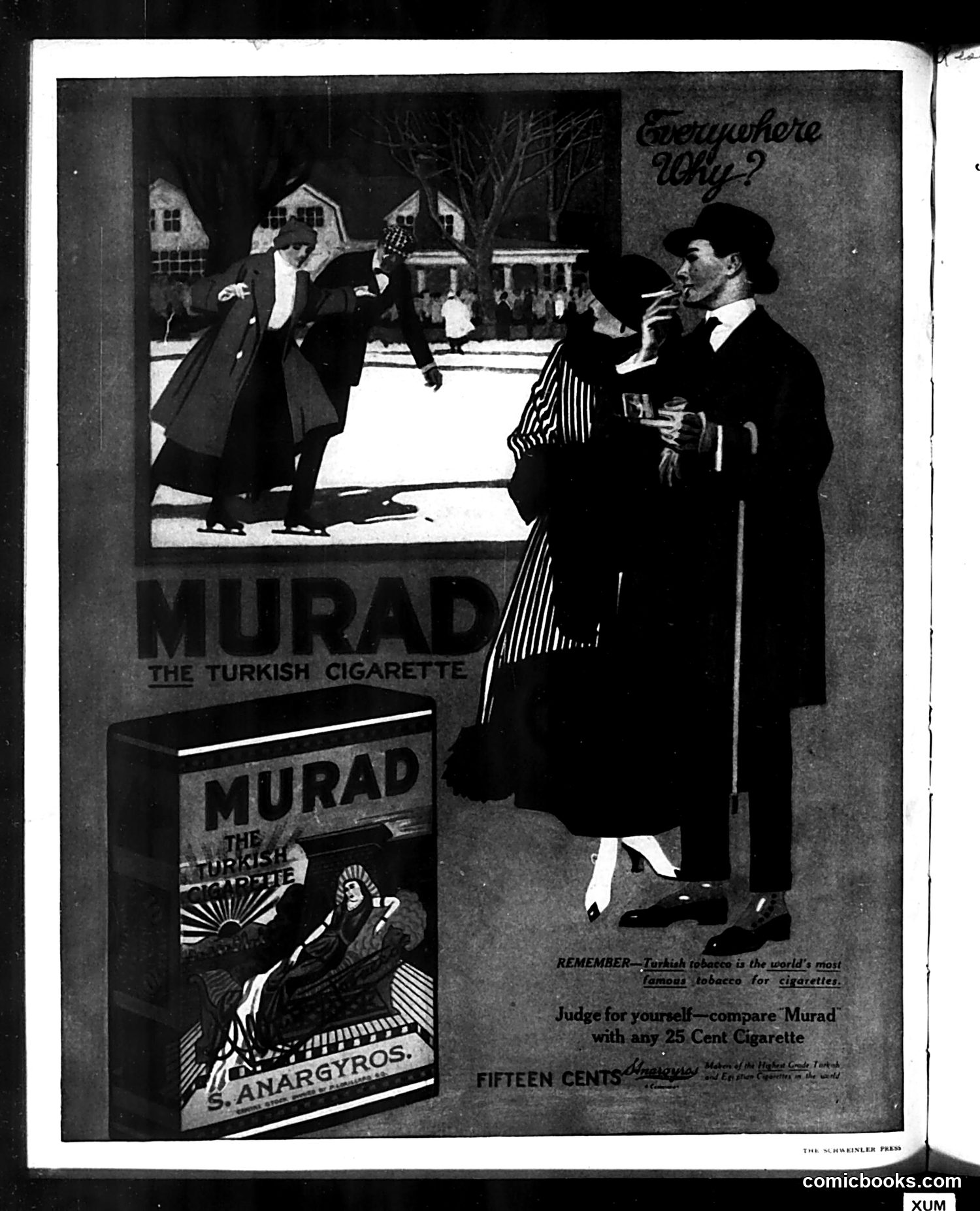
This is primarily a **cigarette advertisement for Murad brand Turkish cigarettes**, not political satire. The page features two well-dressed men in formal attire examining a Murad cigarette package, with text asking "Everywhere why?" The advertisement emphasizes that Turkish tobacco was "the world's most famous tobacco for cigarettes" and invites consumers to "Judge for yourself—compare Murad with any .25 Cent Cigarette" at fifteen cents per package. The background scene shows what appears to be a winter social gathering or party, establishing an aspirational lifestyle context for the product. This reflects early 20th-century cigarette marketing that associated smoking with sophistication and social status, before widespread health concerns about tobacco emerged.