
Judge, 1917-02-03 · page 19 of 28
Judge — February 3, 1917 — page 19: what you’re looking at
What you’re looking at
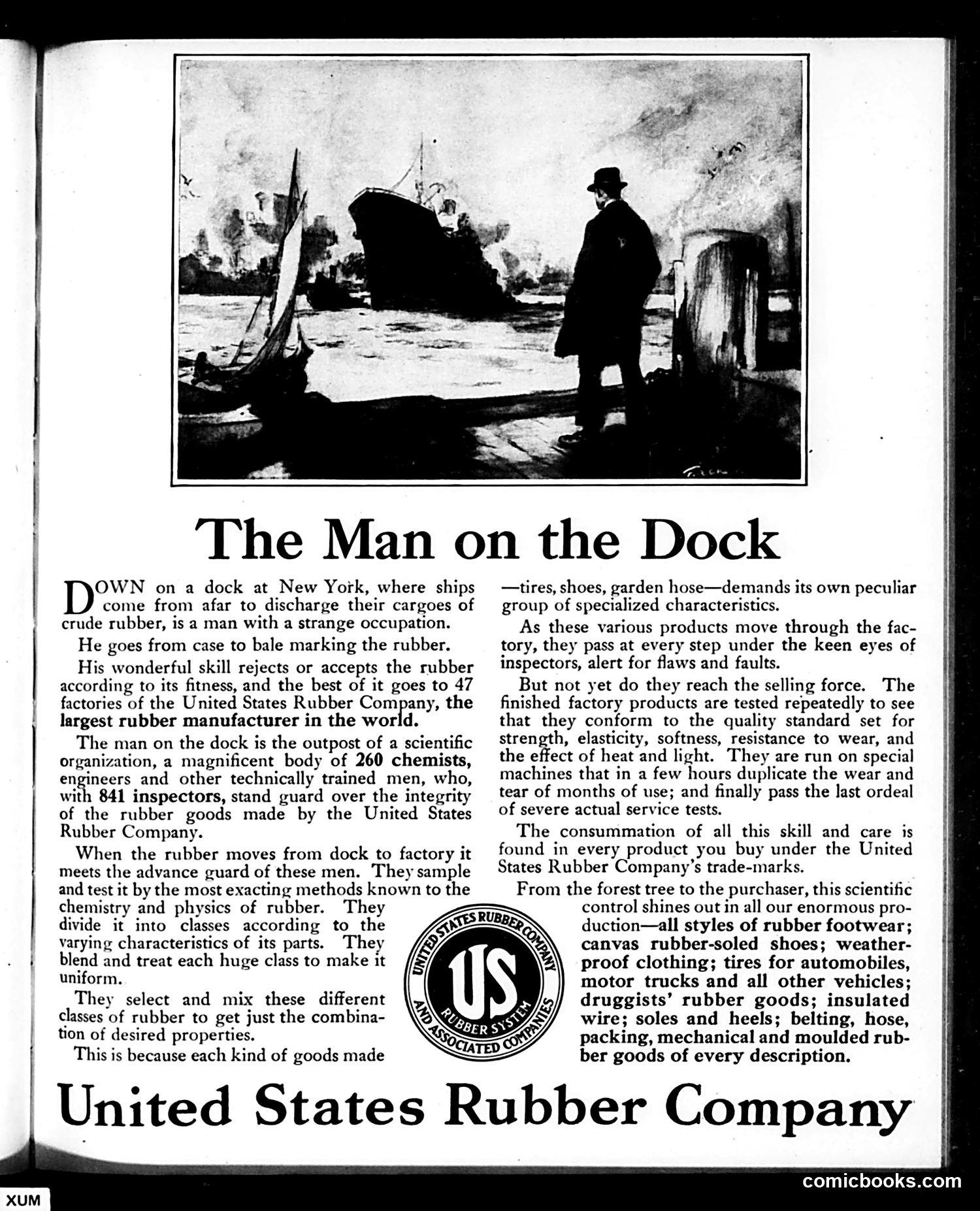
This is **not a cartoon or satire**, but rather a **corporate advertisement** for the United States Rubber Company, presented as an earnest editorial feature. The "man on the dock" is a quality-control inspector at New York's rubber-import facilities. The piece celebrates his role within an elaborate quality-assurance system: 260 chemists, 841 inspectors, and rigorous testing protocols that evaluate rubber from arrival through final product distribution. The narrative promotes corporate competence and scientific rigor as selling points—emphasizing that U.S. Rubber's products (tires, footwear, hoses, insulation) undergo extensive testing for "strength, elasticity, softness, resistance to wear." **The context modern readers miss**: This represents early 20th-century corporate "trust-building" advertising, when companies used *Judge* magazine's credibility to position industrial quality control as evidence of integrity—reassuring consumers about mass-produced goods during an era of frequent product failures and food/safety scandals.
📄 Transcribed text from this page (OCR, searchable)
Machine-transcribed from the original scan — historical spelling and the odd misread are preserved.
XUM The Man on the Dock OWN on a dock at New York, where ships come from afar to discharge their cargoes of crude rubber, is a man with a strange occupation. He goes from case to bale marking the rubber. His wonderful skill rejects or accepts the rubber according to its fitness, and the best of it goes to 47 factories of the United States Rubber Company, the largest rubber manufacturer in the world. The man on the dock is the outpost of a scientific organization, a magnificent body of 260 chemists, engineers and other technically trained men, who, with 841 inspectors, stand guard over the integrity of the rubber goods made by the United States Rubber Company. When the rubber moves from dock to factory it meets the advance guard of these men. They sample and test it by the most exacting methods known to the chemistry and physics of rubber. They divide it into classes according to the varying characteristics of its parts. They blend and treat each huge class to make it uniform. They select and mix these different classes of rubber to get just the combina- tion of desired properties. This is because each kind of goods made —tires, shoes, garden hose—demands its own peculiar group of specialized characteristics. As these various products move through the fac- tory, they pass at every step under the keen eyes of inspectors, alert for flaws and faults. But not yet do they reach the selling force. The finished factory products are tested repeatedly to see that they conform to the quality standard set for strength, elasticity, softness, resistance to wear, and the effect of heat and light. They are run on special machines that in a few hours duplicate the wear and tear of months of use; and finally pass the last ordeal of severe actual service tests. The consummation of all this skill and care is found in every product you buy under the United States Rubber Company’s trade-marks. From the forest tree to the purchaser, this scientific control shines out in all our enormous pro- duction—all styles of rubber footwear; canvas rubber-soled shoes; weather- proof clothing; tires for automobiles, motor trucks and all other vehicles; druggists’ rubber goods; insulated wire; soles and heels; belting, hose, packing, mechanical and moulded rub- ber goods of every description. United States Rubber Company comicbooks.com