
Judge, 1917-02-03 · page 8 of 28
Judge — February 3, 1917 — page 8: what you’re looking at
What you’re looking at
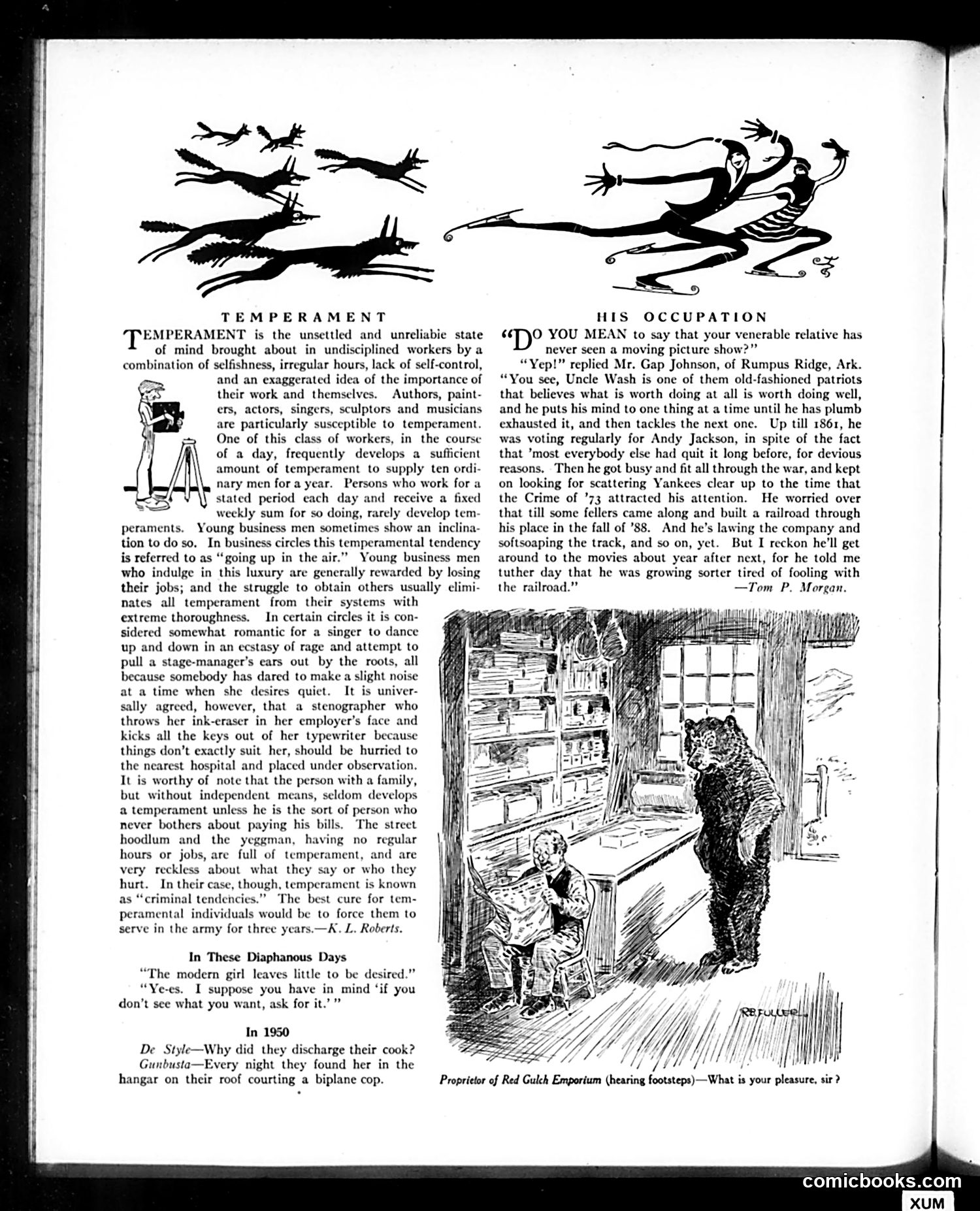
This page contains three distinct satirical pieces typical of early 20th-century Judge magazine: **"Temperament"** attacks artistic pretension. The essay mocks actors, singers, and musicians for their emotional volatility and self-importance, contrasting them unfavorably with disciplined workers. It notes ironically that stenographers throwing ink erasers should be hospitalized, while singers destroying property is considered "romantic." The point: artistic temperament is merely undisciplined selfishness disguised as sensitivity. **"His Occupation"** features Uncle Wash, a backwoods character who focuses obsessively on one thing at a time—voting for Andrew Jackson decades after his death, then fighting the Civil War, then fighting railroad litigation. The joke satirizes rural stubbornness and irrelevance; Uncle Wash won't reach movies until 1950. **"In 1950"** is a brief joke about modern girls' sexual permissiveness and the "biplane cop" (unclear reference, possibly racy double meaning). All three pieces mock contemporary social types: pretentious artists, rural ignorance, and changing female morality.
📄 Transcribed text from this page (OCR, searchable)
Machine-transcribed from the original scan — historical spelling and the odd misread are preserved.
TEMPERAMENT “TEMPERAMENT is the unsettled and unreliabie state of mind brought about in undisciplined workers by a combination of selfishness, irregular hours, lack of self-control, GR and an exaggerated idea of the importance of Ay their work and themselves. Authors, paint- ers, actors, singers, sculptors and musicians are particularly susceptible to temperament. 7 One of this class of workers, in the course / of a day, frequently develops a sufficient amount of temperament to supply ten ordi- nary men fora year. Persons who work for a cy stated period each day and receive a fixed weekly sum for so doing, rarely develop tem- peraments. Young business men sometimes show an inclina- tion to do so. In business circles this temperamental tendency is referred to as “going up in the ai Young business men who indulge in this luxury are gencrally rewarded by losing their jobs; and the struggle to obtain others usually elimi- nates all temperament from their syst with extreme thoroughness. In certain circles con- sidered somewhat romantic for a singer to dance up and down in an ecstasy of rage and attempt to pull a stage-manager’s ears out by the roots, all because somebody has dared to make a slight noise at a time when she desires quiet. It is univer- sally agreed, however, that a stenographer who throws her ink-eraser in her employer's face and kicks all the keys out of her typewriter because things don’t exactly suit her, should be hurried to the nearest hospital and placed under observation, It is worthy of note that the person with a family, but without independent means, seldom develops a temperament unless he is the sort of person who never bothers about paying his bills. The street hoodlum and the yeggman, having no regular hours or jobs, are full of temperament, and are very reckless about what they say or who they hurt. In their case, though, temperament is known as “criminal tendencies.” The best cure for tem- peramental individuals would be to force them to serve in the army for three years.—K. L. Roberts. In These Diaphanous Days “The modern girl leaves little to be desired.” “Ye-es, I suppose you have in mind ‘if you don’t see what you want, ask for it.’” In 1950 De Style—Why did they discharge their cook? Gunbusta—Every night they found her in the hangar on their roof courting a biplane cop. HIS OCCUPATION 660 YOU MEAN to say that your venerable relative has never seen a moving picture show?” “Yep!” replied Mr. Gap Johnson, of Rumpus Ridge, Ark. “You see, Uncle Wash is one of them old-fashioned patriots that believes what is worth doing at all is worth doing well, and he puts his mind to one thing at a time until he has plumb exhausted it, and then tackles the next one. Up till 1861, he was voting regularly for Andy Jackson, in spite of the fact that ’most everybody else had quit it long before, for devious reasons. Then he got busy and fit all through the war, and kept on looking for scattering Yankees clear up to the time that the Crime of ’73 attracted his attention. He worried over that till some fellers came along and built a railroad through his place in the fall of ’88. And he’s lawing the company and softsoaping the track, and so on, yet. But I reckon he'll get around to the movies about year after next, for he told me tuther day that he was growing sorter tired of fooling with the railroad.” —Tom P. Morgan. Proprietor of Red Gulch Emporium (hearing footsteps)—What is your pleasure, sir? comicbooks.com