
Judge, 1917-02-03 · page 11 of 28
Judge — February 3, 1917 — page 11: what you’re looking at
What you’re looking at
This Judge magazine page contains three distinct satirical pieces: **"The One Woman"** (left): A sentimental love poem by Lee Shippey—straightforward romantic verse, not satirical. **"On the Instalment Plan"** (center): Racial satire depicting a Northern woman asking her Black cook Hannah about her servant colleague Ella's husband. Hannah's response—that "cullud folks has husbands on the 'stalment plan'"—is a crude racist joke suggesting Black men abandon their wives in installments (leaving and returning). This reflects period stereotypes and the magazine's casual racism. **"Some of It" / "Common Sense" dialogue** (center-right): A philosophical wordplay piece about whether "common sense" is actually common or uncommon—circular logic humor. **"Dry States"** (bottom right): A brief joke about naming "dry states" (states under Prohibition), with Major Tompkins naming "the Great American Desert"—a humorous deflection. The page exemplifies Judge's mix of sentimental verse, casual racism, and intellectual wordplay typical of early 20th-century American satirical magazines.
📄 Transcribed text from this page (OCR, searchable)
Machine-transcribed from the original scan — historical spelling and the odd misread are preserved.
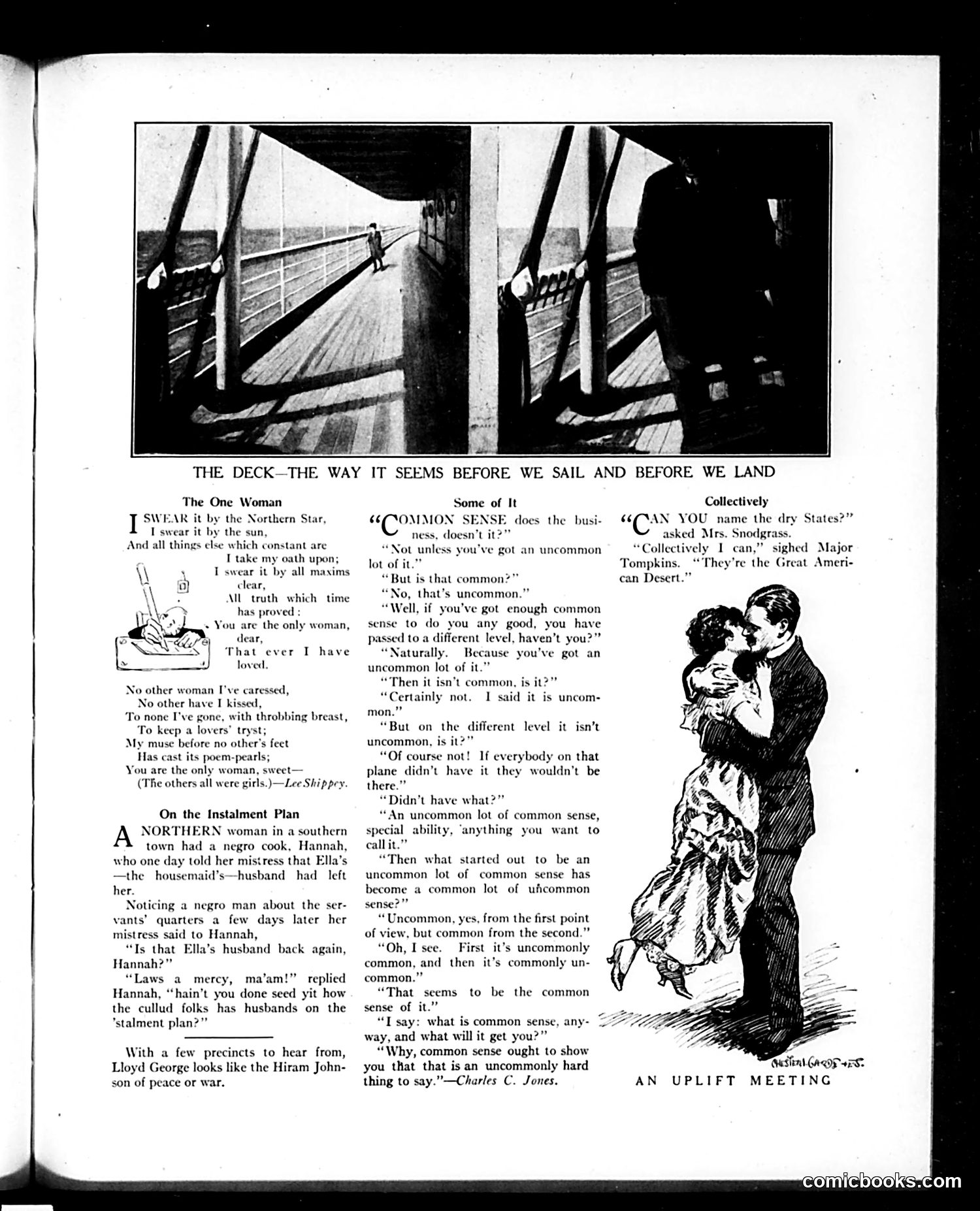
The One Woman SWEAR it by the Northern § I swear it by the sun, And all things else which constant are T take my oath upon; TL swear it by all maxims 0) clear, i AIL truth which time has proved : pang: You are the only woman, | That ever I have — loved ar, her woman I've caressed, ‘0 other have I kissed, To none I've gone, with throbbing breast, To keep a lovers’ tryst; My muse before no other's feet Has cast its poem-pearls; You are the only woman, sweet— (The others all were girls.) —LeeShippey. On the Instalment Plan NORTHERN woman in a southern town had a negro cook, Hannah, who one day told her mistress that Ella’s —the housemaid’s—husband had _ left her. Noticing a negro man about the ser- vants’ quarters a few days later her mistress said to Hannah, “Ts that Ella’s husband back again, Hannah?” “Laws a mercy, ma’am!” replied Hannah, “hain’t you done seed yit how the cullud folks has husbands on the ’stalment plan?” With a few precincts to hear from, Lloyd George looks like the Hiram John- son of peace or war. ze . THE DECK—THE WAY IT SEEMS BEFORE WE SAIL AND BEFORE WE LAND Some of It 66(°OMMON SENSE does the busi- ness, doesn’t it?” “Not unless you've got an uncommon lot of it.” “But is that common?” “No, that’s uncommon.”” Well, if you've got enough common sense to do you any good, you have d to a different level, haven’t you?” Naturally. Because you've got an uncommon lot of it.” hen it isn’t common, is it? “Certainly not. I said it is uncom- mon.” “But on the different level it isn’t uncommon, is it?” “Of course not! If everybody on that plane didn’t have it they wouldn't be there.” “Didn't have what?” “An uncommon lot of common sense, special ability, ‘anything you want to call it. “Then what started out to be an uncommon lot of common sense has become a common lot of ufcommon pas: “Uncommon, yes, from the first point of view, but common from the second.” “Oh, I see. First it’s uncommonly common, and then it’s commonly un- common.” “That seems to be the common sense of it.” “I say: what is common sense, any- way, and what will it get you?” “Why, common sense ought to show you that that isan uncommonly hard thing to say.”—Charles C. Jones. “Colle Tompkins. can Desert.” Z Collectively 66Q°AN YOU name the dry States?” asked Mrs. Snodgrass. iv AN UPLIFT MEETING ly 1 can,” sighed Major “They're the Great Ameri-