
Judge, 1917-02-03 · page 16 of 28
Judge — February 3, 1917 — page 16: what you’re looking at
What you’re looking at
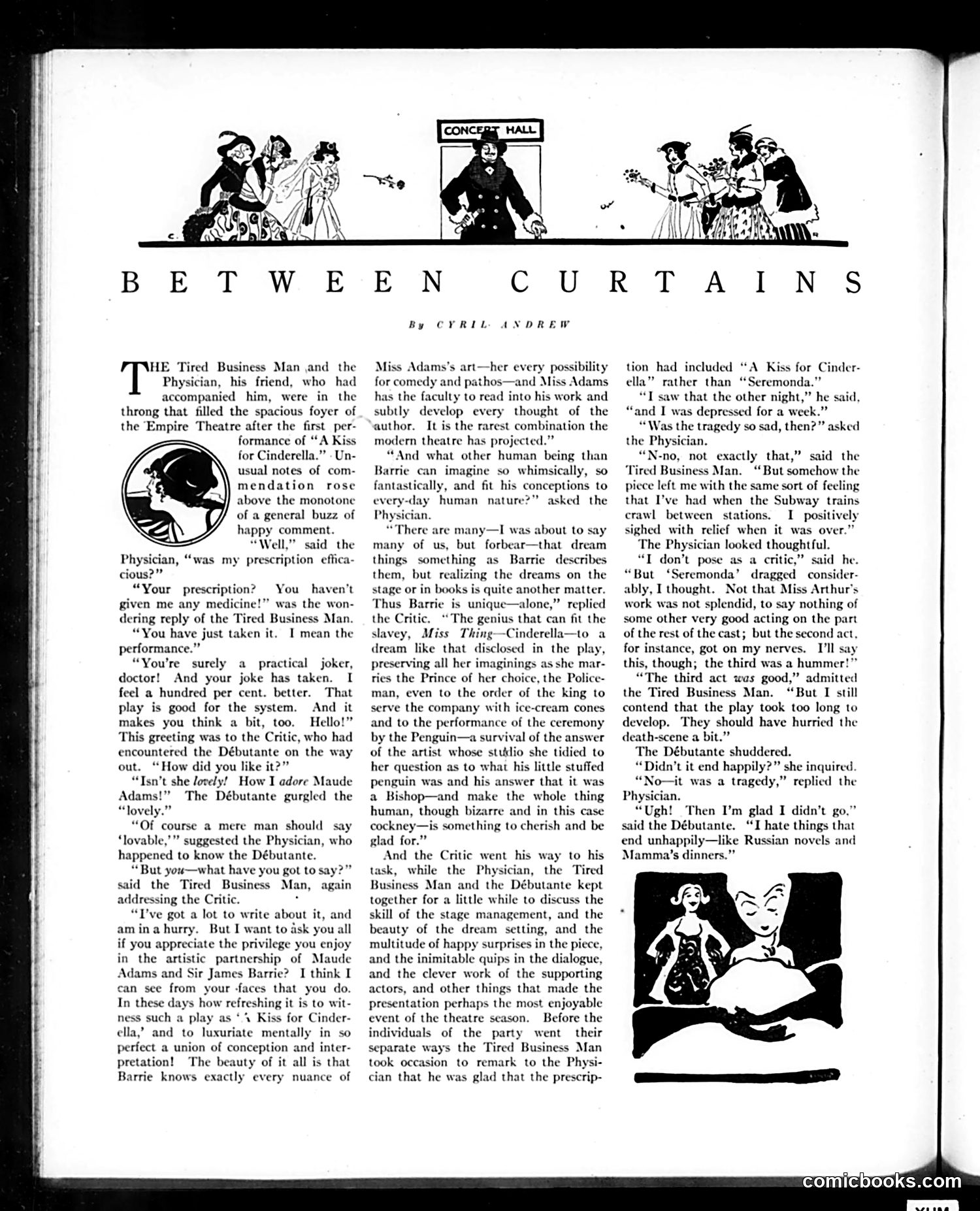
This page reviews J.M. Barrie's play *"A Kiss for Cinderella,"* starring the famous actress Maude Adams. The article is framed as a dialogue among theater-goers leaving the Empire Theatre after opening night: a Tired Business Man, a Physician, a Débutante, and a Critic. The satire operates on multiple levels: The Physician prescribes theater as medicine for the exhausted businessman. The Critic delivers effusive praise for Barrie and Adams's artistic partnership, emphasizing their perfect synchronization—Barrie's whimsical imagination matched with Adams's ability to realize his vision. The piece celebrates the play's fantastical elements (the Penguin performing the marriage ceremony, ice-cream cones) while maintaining emotional authenticity. The humor lies in the Physician's observation that mere "entertainment" is actually therapeutic, and in contrasting this uplifting experience with depressing plays like "Seremonda"—implying theater's genuine social value during what was likely the post-WWI period.
📄 Transcribed text from this page (OCR, searchable)
Machine-transcribed from the original scan — historical spelling and the odd misread are preserved.
BE TWE HE Tired Business Man and the Ph; n, his friend, who had anied him, were in the throng that filled the spacious foyer of the Empire Theatre after the first per- formance of “A Ki: for Cinderella.” -Un- usual notes of com- mendation rose above the monotone of a general buzz of happy comment. “Well,” said the Physician, “was my prescription eff cious?” “Your prescription? You haven't given me any medicine!” was the won- dering reply of the Tired Business Man. “You have just taken it. I mean the performance.” “You're surely a practical joker, doctor! And your joke has taken. I feel a hundred per cent. better. That play is good for the system. And it makes you think a bit, too. Hello!” This greeting was to the Critic, who had encountered the Débutante on the way out. “How did you like it?” “Isn't she lovely! How I adore Maude Adams!” The Débutante gurgled the “lovely.” “Of course a mere man should say ‘lovable,’” suggested the Physician, who happened to know the Débutante. “But you—what have you got to say?” said the Tired Business Man, again addressing the Critic. . “T've got a lot to write about it, and am ina hurry. But I want to ask you all if you appreciate the privilege you en, in the artistic partnership of Maude Adams and Sir James Barrie? I think I see from your -faces that you do. In these days how ref: ig it is to wit- ness such a play as ‘4 Kiss for Cinder- ella,’ and to luxuriate mentally in so perfect a union of conception and inter- pretation! The beauty of it all is that Barrie knows exactly every nuance of EN By CYRIL, ANDREW Miss Adams’s art—her every possibility for comedy and pathos—and Miss Adams has the faculty to read into his work and subtly develop every thought of the author. It is the rarest combination the modern theatre has projected.” “And what other human being than Barrie can imagine so whimsically, so Ily, and fit his conceptions to asked the There are many—I was about to say many of us, but forbear—that dream gs something Barrie describes them, but realizing the dreams on the stage or in books is quite another matter. Thus Barrie is unique—alone,” replied the Critic. “The genius that can fit the slavey, Miss Thing—Cinderella—to a dream like that disclosed in the p! preserving all her imaginings ries the Prince of her choice, the Police- man, even to the order of the king to serve the company with ice-cream cones and to the performance of the ceremony by the Penguin—a survival of the answer of the artist who her question as to little stuffed penguin was and his answer that it was a Bishop—and make the whole thing hui though bizarre and in this case cockney—is something to cherish and be glad for.” And the Critic went his way to his task, while the Physician, the Tired Business } and the Débutante kept together for a little while to discuss the skill of the stage management, and the beauty of the dream setting, and the multitude of happy surprises in the piece, and the inimitable quips in the dialogue, and the clever work of the supporting actors, and other things that made the presentation perhaps the most enjoyable event of the theatre season. Before the individuals of the party went their separate ways the Tired Business Man took occasion to remark to the Physi- cian that he was glad that the prescrip- CURTAIN S tion had included “A Kiss for Cinder- ella” rather than “Seremonda.” “T saw that the other night,” he said, “and I was depressed for a week.” “Was the tragedy so sad, then?” asked the Physician. “N-no, not exactly that,” said the ‘Tired Business Man. “But somehow the piece left me with the same sort of feeling that I’ve had when the Subway | crawl between stations. I posi! sighed with relief when it was over.’ The Physician looked thoughtful. “T don’t pose as a critic,’ “But ‘Seremonda’ dragged ably, I thought. Not that Miss Arthur's work was not splendid, to say nothing of some other very good acting on the part of the rest of the cast; but the second act for instance, got on my nerves. I'll sa this, though; the third was a hummer “The third act wes good,” admitted the Tired Business Man. “But I still contend that the play took too long to develop. They should have hurried the death-scene a bit.” The Débutante shuddered. “Didn’t it end happily?” she inquired. “No—it was a tragedy,” replied the Then I’m glad I didn’t go.” said the Débutan “T hate things tha end unhappily—like Russian novel Mamma’s dinners.” Ccomicbooks.com