
Judge, 1917-02-03 · page 10 of 28
Judge — February 3, 1917 — page 10: what you’re looking at
What you’re looking at
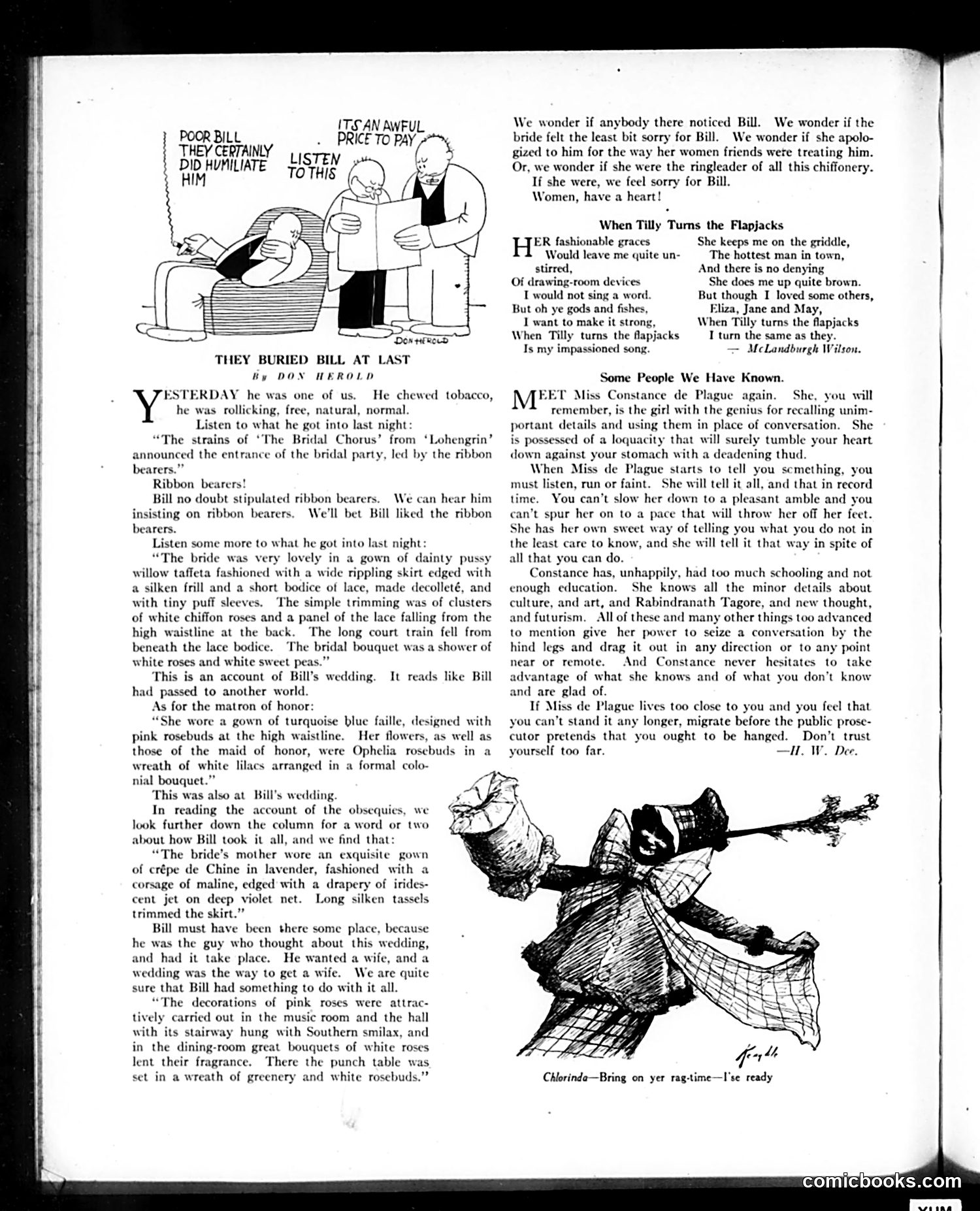
This Don Herold piece satirizes how marriage transforms an ordinary man into someone unrecognizable. "Bill" was once a normal, tobacco-chewing fellow—"one of us." But his wedding has effectively killed that identity. The satire's target: the elaborate, feminized ritual of upper-class weddings. The text mockingly catalogs excessive details—ribbon bearers, "dainty pussy willow taffeta," "Ophelia rosebuds," the bride's mother's lavender crepe de Chine gown—suggesting Bill has been consumed by his wife's social ambitions and the event's ornate femininity. The dark joke: Bill disappears entirely from his own wedding account. He wanted a wife and got one, but at the cost of his freedom and identity. The closing plea—"Women, have a heart!"—frames marriage as something women inflict on men. This reflects 1920s masculine anxiety about matrimony and shifting gender dynamics, presented as comedy about the loss of male identity to female domesticity.
📄 Transcribed text from this page (OCR, searchable)
Machine-transcribed from the original scan — historical spelling and the odd misread are preserved.
ITSAN AWFUL POOR BILL . PRICE Te | THEY CERTAINLY aoe as ae 7. Dow HERD THEY BURIED BILL AT LAST Hy DON HEROLD ESTERDAY he was one of us. He chewed tobacco, Y he was rollicking, free, natural, normal. Listen to what he got into last night: “The strains of ‘The Bridal Chorus’ from ‘Lohengrin’ announced the entrance of the bridal party, led by the ribbon bearers.”” Ribbon bearers! Bill no doubt stipulated ribbon bearers. We can hear him insisting on ribbon bearers, We'll bet Bill liked the ribbon bearers. Listen some more to what he got into last night: “The bride was very lovely in a gown of dainty pussy willow taffeta fashioned with a wide rippling skirt edged with a silken frill and a short bodice of lace, made decolleté, and with tiny puff slee The simple trimming was of clusters of white chiffon roses and a panel of the lace falling from the high waistline at the back. The long court train fell from beneath the lace bodice. The bridal bouquet was a shower of white roses and white sweet pe This is an account of Bill’s wedding. It reads like Bill had passed to another world. As for the matron of honor: “She wore a gown of turquoise blue faille, designed with pink rosebuds at the high waistline. Her flowers, as well as those of the maid of honor, were Ophelia roscbuds in a wreath of white lilacs arranged in a formal colo- nial bouquet.” This w so at Bill's wedding. In reading the account of the obsequies, we look further down the column for a word or two about how Bill took it all, and we find that: “The bride’s mother wore an exquisite gown of crépe de Chine in lavender, fashioned with a corsage of maline, edged with a drapery of irides- cent jet on deep violet net. Long silken tassels trimmed the skirt.” Bill must have been there some place, because he was the guy who thought about this wedding, and had it ta place. He wanted a wife, and a wedding was the way to get a wife. We are quite sure that Bill had something to do with it all. “The decorations of pink roses were attrac- tively carried out in the music room and the hall with its stairway hung with Southern smilax, and in the dining-room great bouquets of white roses lent their fragrance. There the punch table was set in a wreath of greenery and white rosebuds.” We wonder if anybody there noticed Bill. We wonder if the bride felt the least bit sorry for Bill. We wonder if she apolo- gized to him for the way her women friends were treating him. Or, we wonder if she were the ringleader of all this chiffonery. If she were, we feel sorry for Bill. Women, have a heart! When Tilly Turns the Flapjacks Hr fashionable graces She keeps me on the griddle, Would leave me quite un- The hottest man in town, stirred, And there is no denying Oi drawing-room devices She does me up quite brown. T would not sing a word. But though I loved some others, But oh ye gods and fishes, Fliza, Jane and May, I want to make it strong, When Tilly turns the flapjacks When Tilly turns the flapjacks T turn the same as they. Is my impassioned song. — McLandburgh Wilson. Some People We Have Known. EET Miss Constance de Plague again. She, you will remember, is the girl with the genius for recalling unim- portant details and using them in place of conversation. She is possessed of a loquacity that will surely tumble your heart down against your stomach with a deadening thud. When Miss de Plague starts to tell you semething, you must listen, run or faint. She will tell it all, and that in record time. You can’t slow her down to a pleasant amble and you can’t spur her on to a pace that will throw her off her feet. She has her own sweet way of telling you what you do not in the t care to know, and she will tell it that way in spite of all that you can do. Constance has, unhappily, had too much schooling and not enough education. She knows all the minor details about culture, and art, and Rabindranath Tagore, and new thought, and futurism. All of these and many other things too advanced to mention give her power to seize a conversation by the hind legs and drag it out in any direction or to any point near or remote. And Constance never hesitates to take advantage of what she knows and of what you don’t know and are glad of. If Miss de Plague lives too close to you and you feel that you can’t stand it any longer, migrate before the public prose- cutor pretends that you ought to be hanged. Don’t trust yourself too far. —.W. Dee. fet Chlorinda—Bring on yer rag-time—I'se ready icbooks.com