
A complete issue · 28 pages · 1916
Judge — July 8, 1916
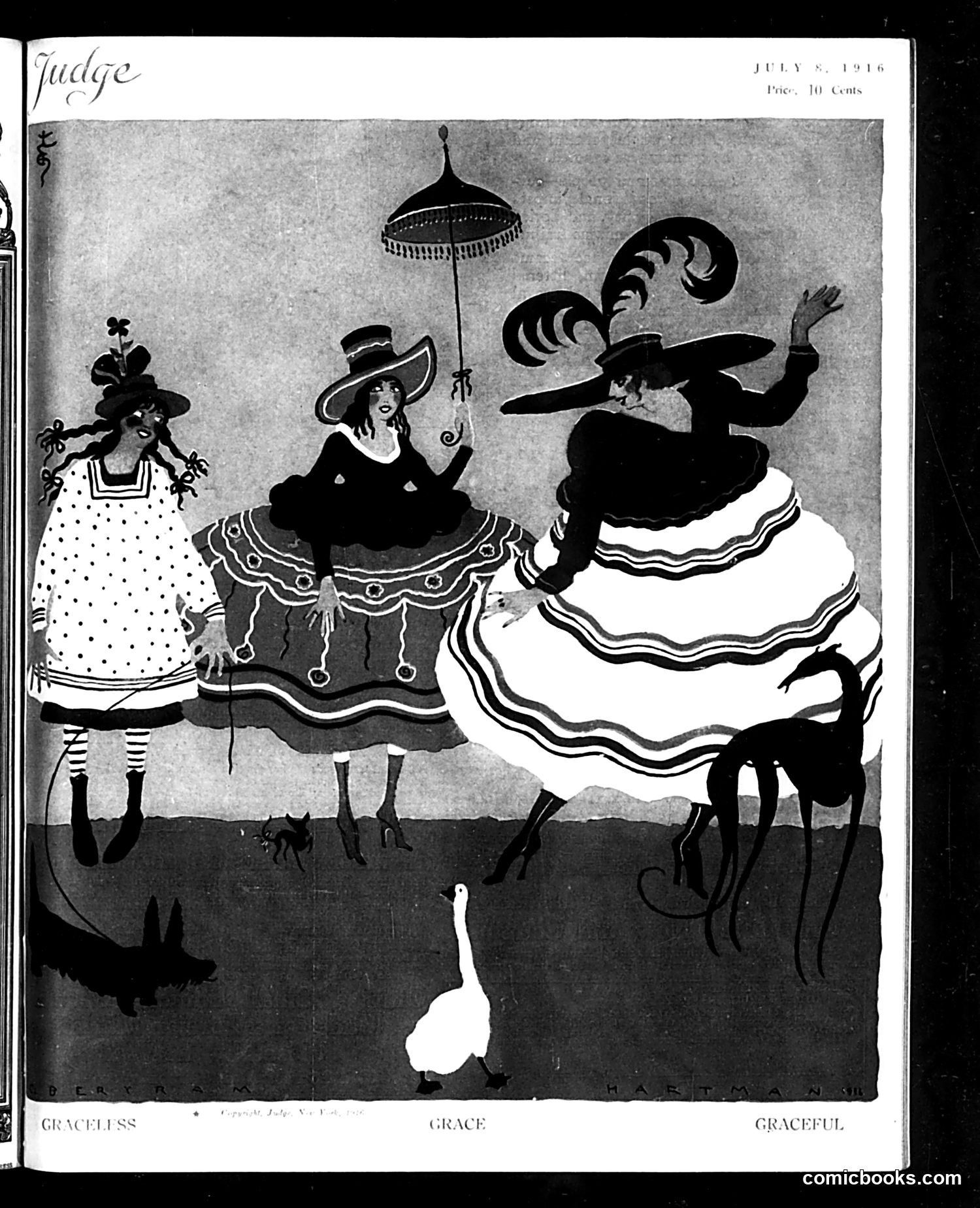
This satirical illustration plays on the concept of "grace" through three female figures labeled "Graceless," "Grace," and "Graceful." The cartoon appears to be social commentary on women's fashion and deportment of the 1916 era. The leftmost figure wears an ornate, polka-dotted dress with an elaborate feathered hat—depicted as awkward and unfashionable ("Graceless"). The middle figure holds a parasol in a more composed pose. The rightmost, presented as the ideal "Graceful" woman, displays an exaggerated silhouette with voluminous ruffled skirts and an ostentatious feathered hat, suggesting that contemporary high fashion, despite its pretensions, was actually rather absurd and ungraceful. The cartoon satirizes prevailing beauty standards and the vanity of fashion-conscious women of the period.
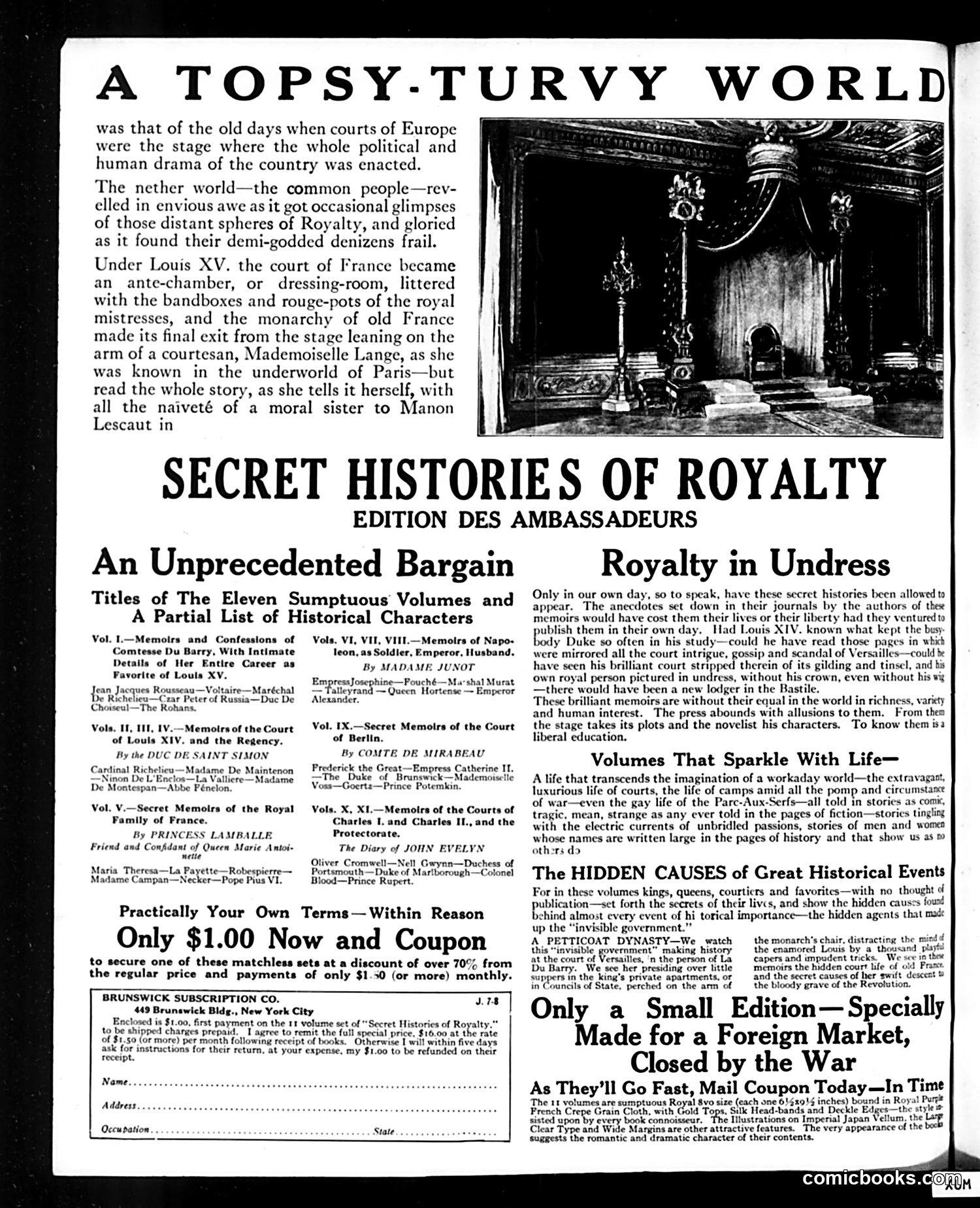
This page is primarily **advertising, not satire or political commentary**. It promotes a mail-order book set called "Secret Histories of Royalty: Edition Des Ambassadeurs"—supposedly scandalous memoirs about European courts, particularly Louis XV's France and court intrigues. The ad emphasizes sensational content: royal mistresses, hidden scandals, and "secret histories" of historical figures. The marketing claims these are rare volumes "closed by the war" and made "for a foreign market," suggesting exclusivity. The decorative image appears to be an ornate royal interior, likely meant to evoke the luxurious court settings described in the promised books. This reflects early 20th-century American consumer culture's appetite for European aristocratic gossip—positioned as daring, forbidden knowledge for adventurous readers.
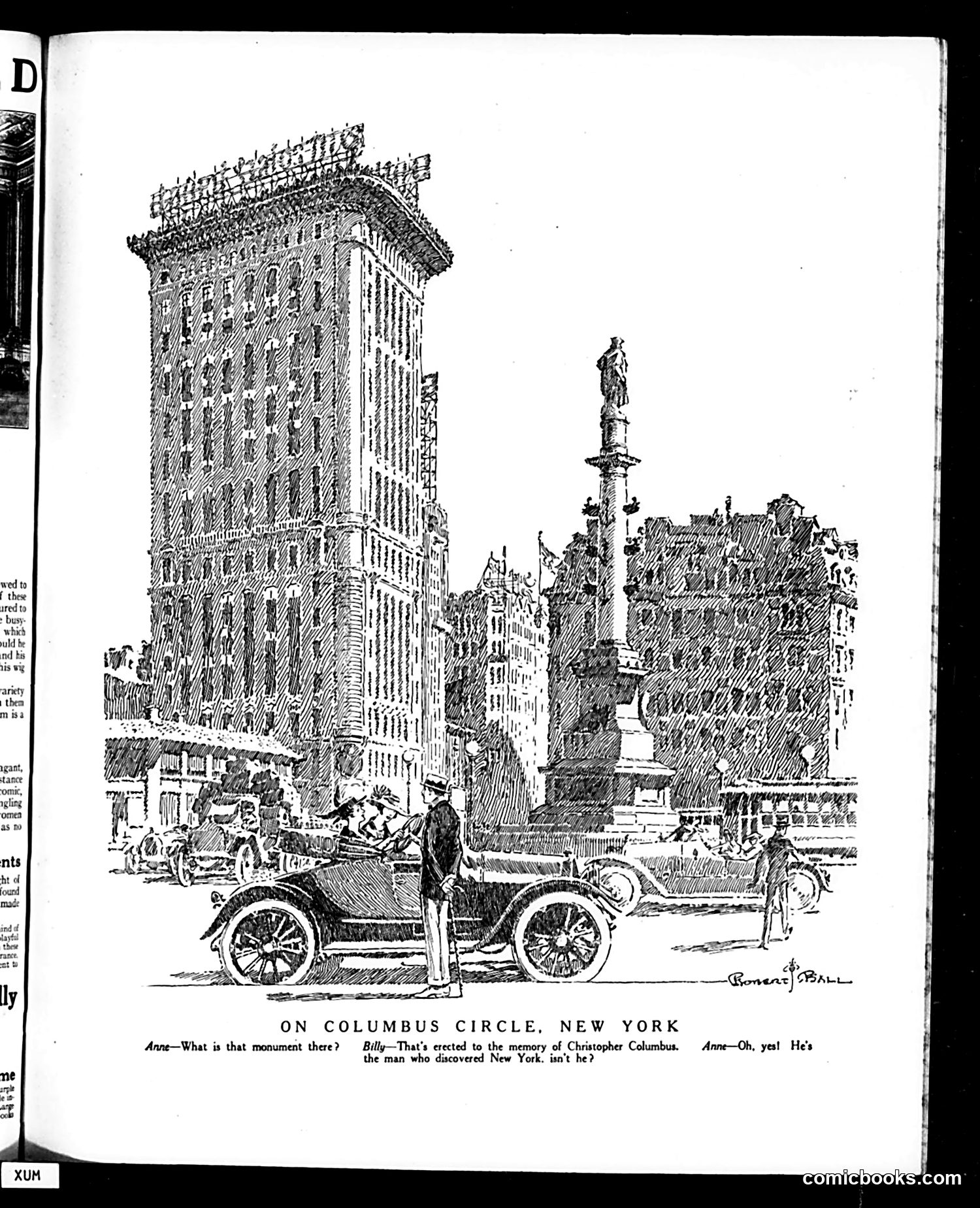
This cartoon depicts Columbus Circle in Manhattan with its iconic tall building (the former Hotel Imperial), the Columbus Monument, and early 1900s automobiles. The dialogue between two characters—Anne and Billy—centers on the monument erected to Christopher Columbus, the explorer credited with discovering New York (and America). The humor is gentle and educational rather than biting satire. Billy corrects Anne's ignorance about the monument's purpose, explaining it commemorates Columbus's discovery of New York. Anne's surprised response ("Oh, yes!") suggests she didn't know who the monument honored. This reflects Judge magazine's sometimes didactic approach—using humor to inform readers about civic landmarks and historical figures rather than delivering sharp political critique.
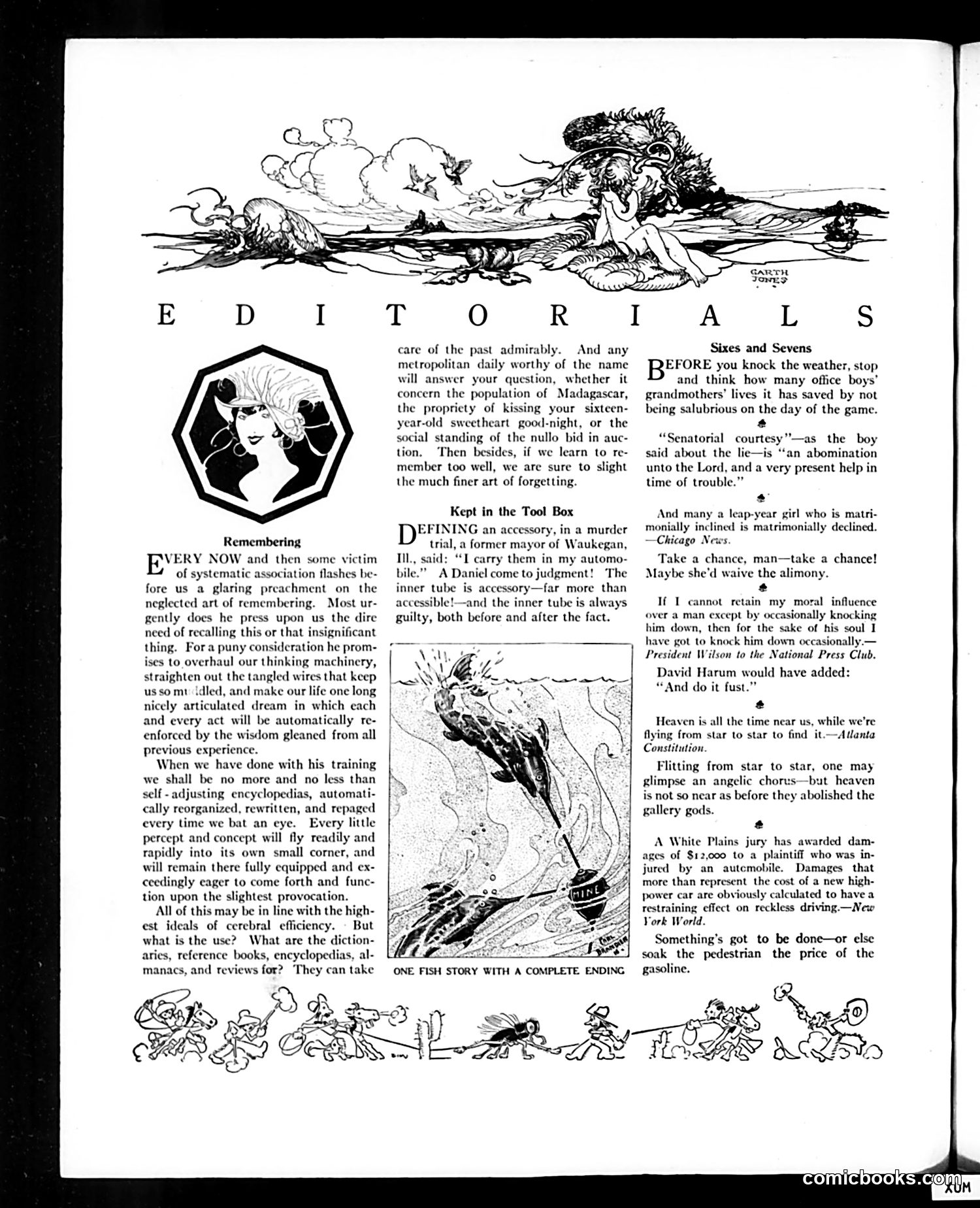
This page contains satirical commentary rather than political cartoons. The "Editorials" section includes several humorous observations: **"Remembering"** mocks systematic forgetting as a valuable skill, suggesting people should train themselves to forget unpleasant memories—a satirical jab at human nature and selective memory. **"Kept in the Tool Box"** references a murder trial involving a Waukegan, Illinois mayor, where debate centered on whether an automobile's inner tube qualified as an "accessory" to the crime. The satire critiques legal technicalities and overly precise definitions in courtroom arguments. **"Sixes and Sevens"** offers various witty observations about social behavior and driving safety, including a quip about reckless drivers and a White Plains jury awarding damages in an automobile accident case. The illustrations support these social commentaries with whimsical artwork.
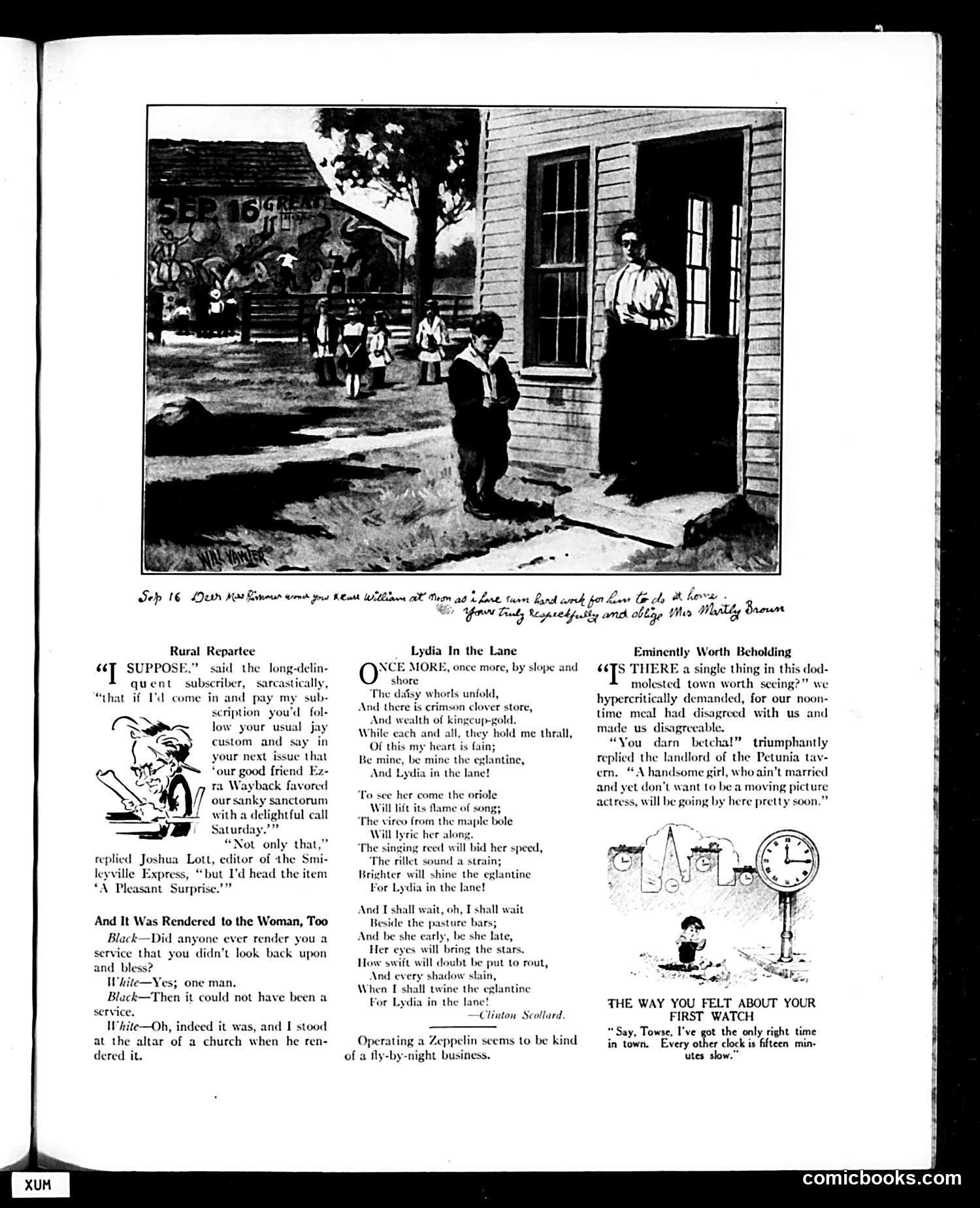
This page contains three distinct pieces of satirical content: 1. **"Rural Repartee"**: A cartoon dialogue mocking rural/small-town America, featuring caricatured rustic characters (drawn with exaggerated features typical of early 20th-century humor). The exchange ridicules unsophisticated country folk who misunderstand urban customs and modern conveniences. 2. **"Lydia in the Lane"**: A sentimental poem by Clinton Scollard celebrating a rural woman named Lydia, presented as earnest rather than satirical. 3. **"Eminently Worth Beholding"**: A brief satirical anecdote mocking a landlord's pretentious demand that a female tenant not become a movie actress—suggesting contempt for both cinema and women's professional ambitions. The page reflects early 20th-century urban middle-class attitudes: disdain for rural simplicity and emerging mass entertainment.
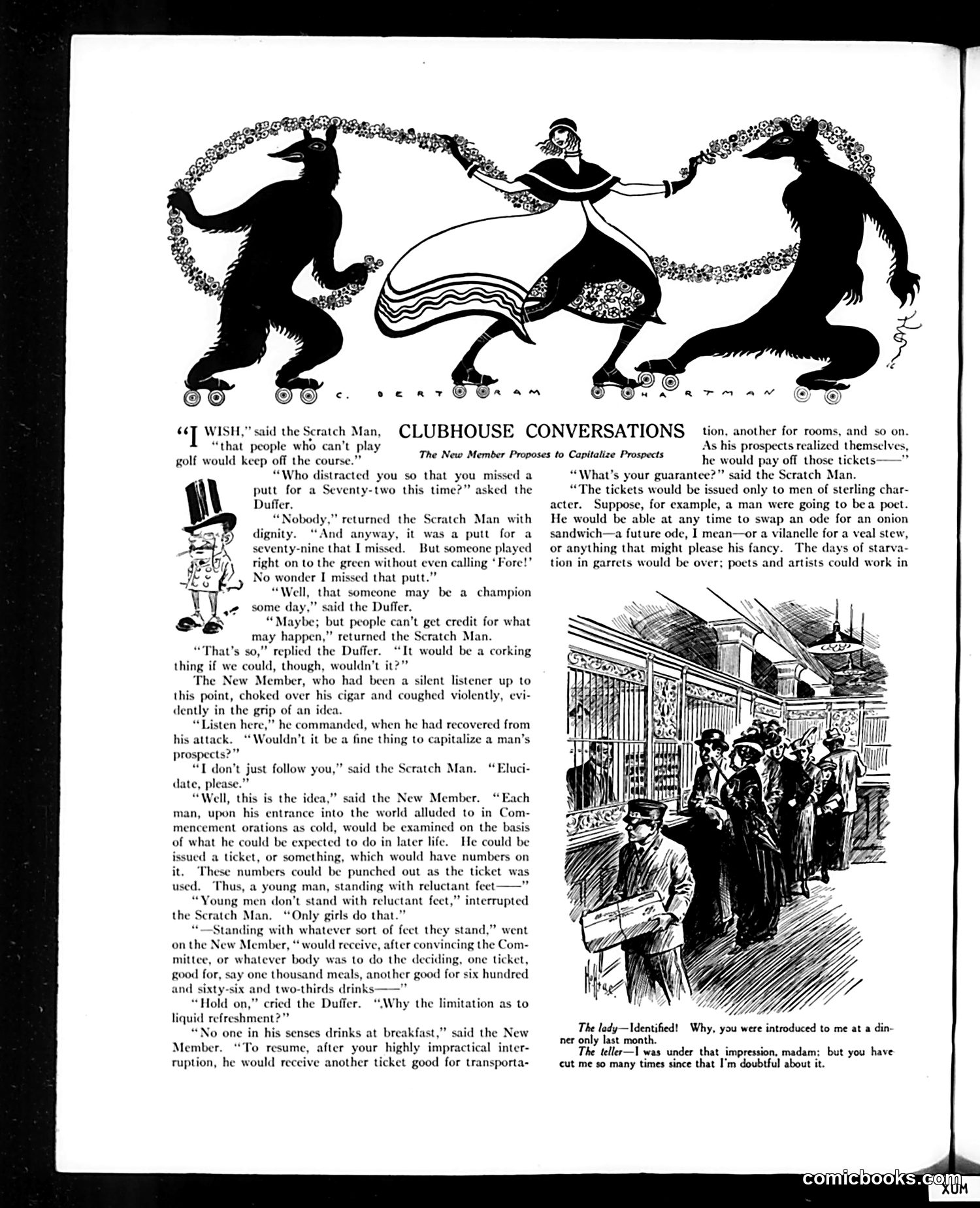
This Judge magazine piece satirizes an idealistic proposal by a naive "New Member" at an exclusive golf club. The conversation between three golfers—the Scratch Man (skilled player), the Duffer (poor player), and the New Member—centers on a scheme to issue "tickets" representing a person's future earning potential at birth. The New Member proposes guaranteeing young people access to meals, drinks, transportation, and housing based on predicted character and prospects. They could exchange future accomplishments (poems, artwork) for present necessities. The established club members mock this utopian idea as impractical—particularly questioning guarantees of character and the absurd limitation on drinks. The satire targets Progressive Era social reform schemes and naive economic proposals that ignore human nature, corruption, and practical enforcement problems. The bottom cartoon about mistaken social recognition adds gentle commentary on clubhouse pretension.
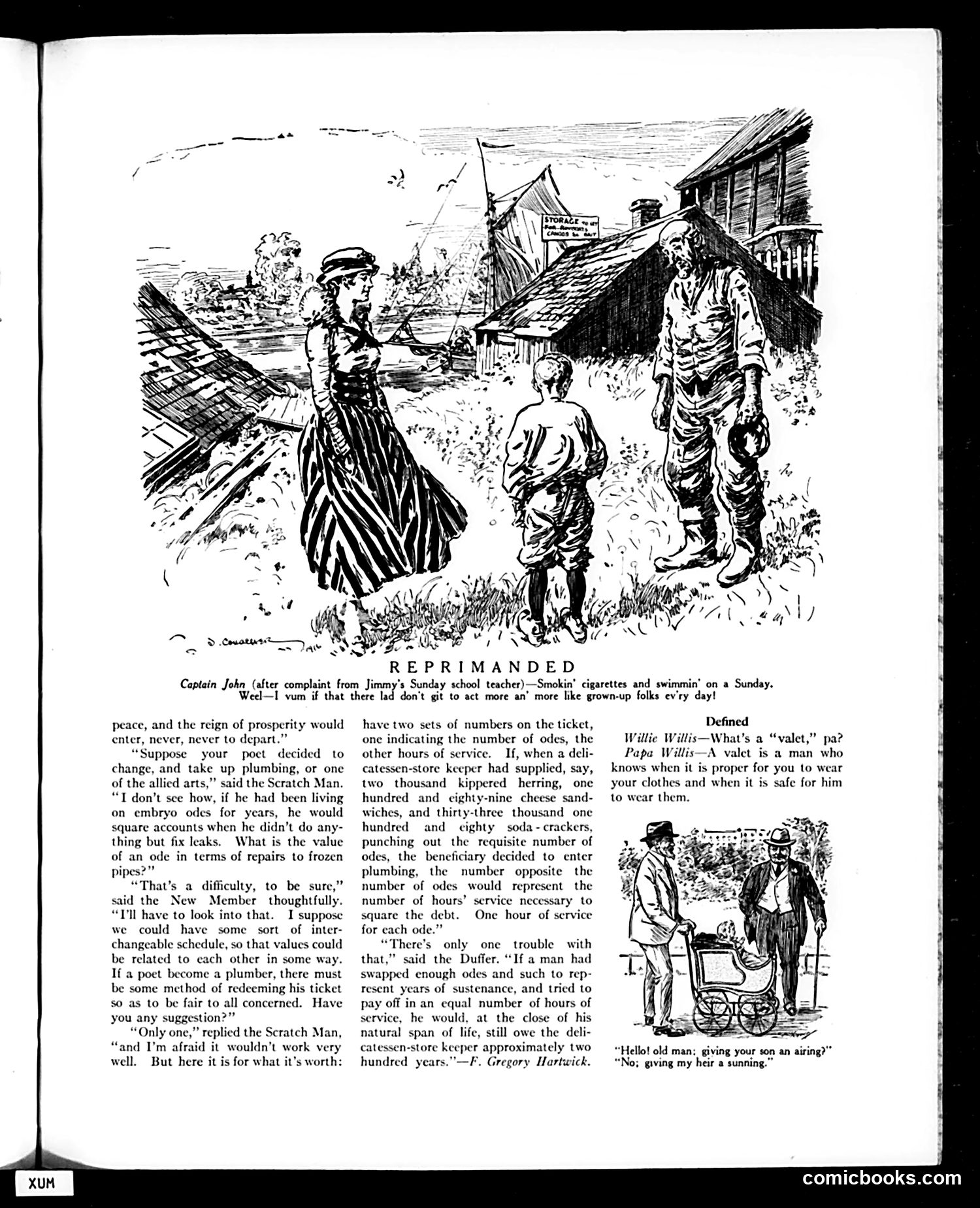
The top cartoon, "REPRIMANDED," depicts a father (Captain John) scolding his son Jimmy for smoking cigarettes and swimming on Sunday—violations of strict Victorian Sabbath observance. The humor lies in the father's hypocrisy: he's simultaneously engaging in these same "sinful" activities while lecturing the boy about proper Sunday behavior. This satirizes the era's rigid religious standards and parental double standards. The bottom two illustrations are brief comedic exchanges. "Defined" jokes about a valet's role—a servant who manages a gentleman's wardrobe and decides when clothes are appropriate to wear versus when the valet himself may borrow them. The final cartoon plays on "airing" (taking a child outside) versus "sunning" (getting a tan), with the wealthy father euphemistically referring to his heir's outing as "sunning," suggesting leisure rather than mere outdoor exercise. All three pieces reflect turn-of-the-century American social pretensions and class attitudes.
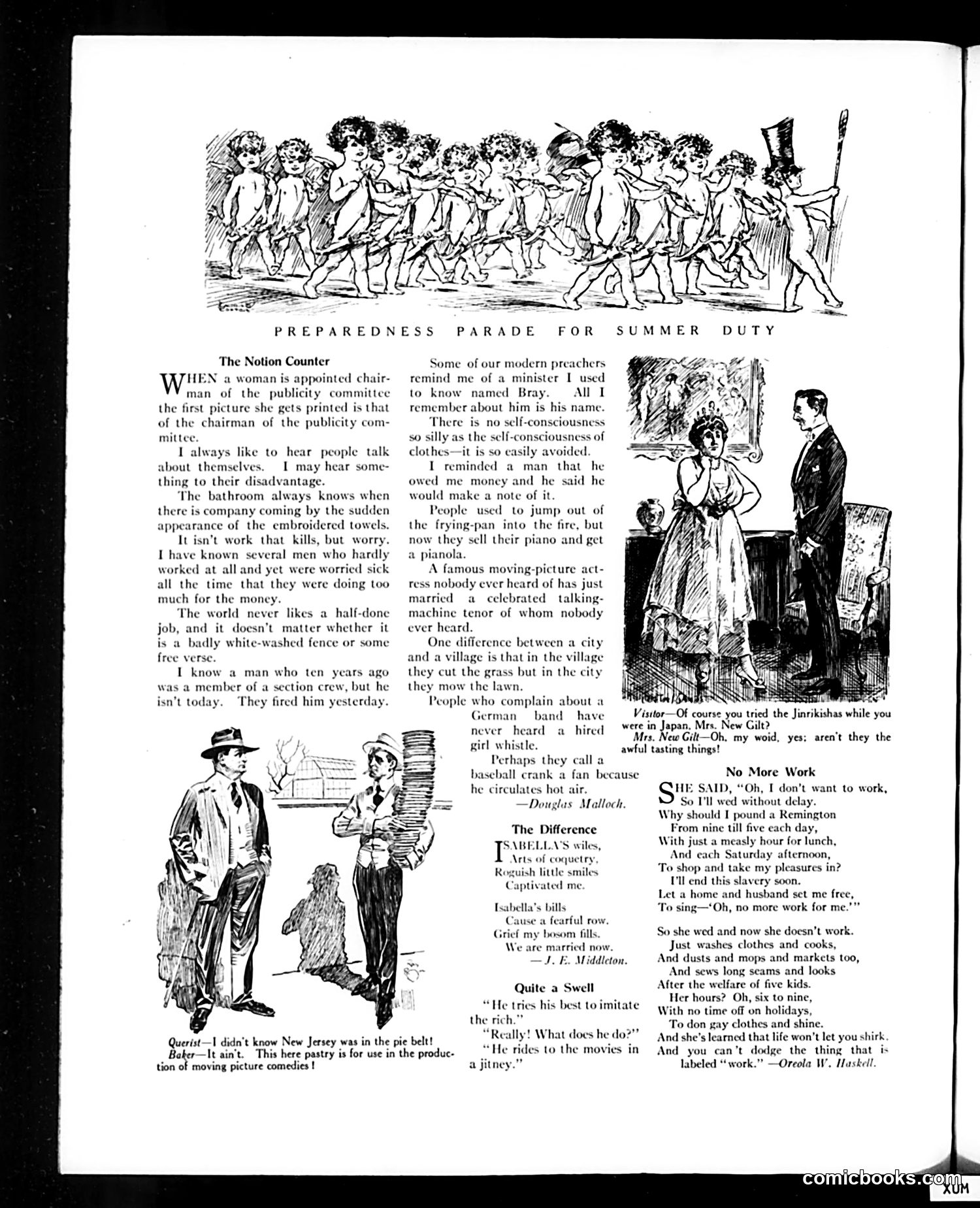
This page from *Judge* magazine contains several short satirical pieces mocking early 1900s social conventions and gender roles. **"Preparedness Parade for Summer Duty"** (top): A humorous illustration of cherubs/putti marching, likely satirizing overly earnest "preparedness" campaigns of the era. **"The Notion Counter"**: A rambling commentary on human nature—vanity, self-consciousness about clothes, worry, and social pretense. The anecdote about a man fired from a section crew after ten years away satirizes job insecurity. **"No More Work"**: The main satirical point: a woman refuses to work at a typewriter, preferring marriage for "freedom," only to discover housework with five children means laboring from 6 a.m. to 9 p.m. with no days off. The satire critiques both women's unrealistic expectations of marriage and society's devaluation of domestic labor as "work." The other pieces ("The Difference," "Quite a Swell") offer light observations on courtship and class pretension. The quarry joke references New Jersey's pastry as movie prop material.
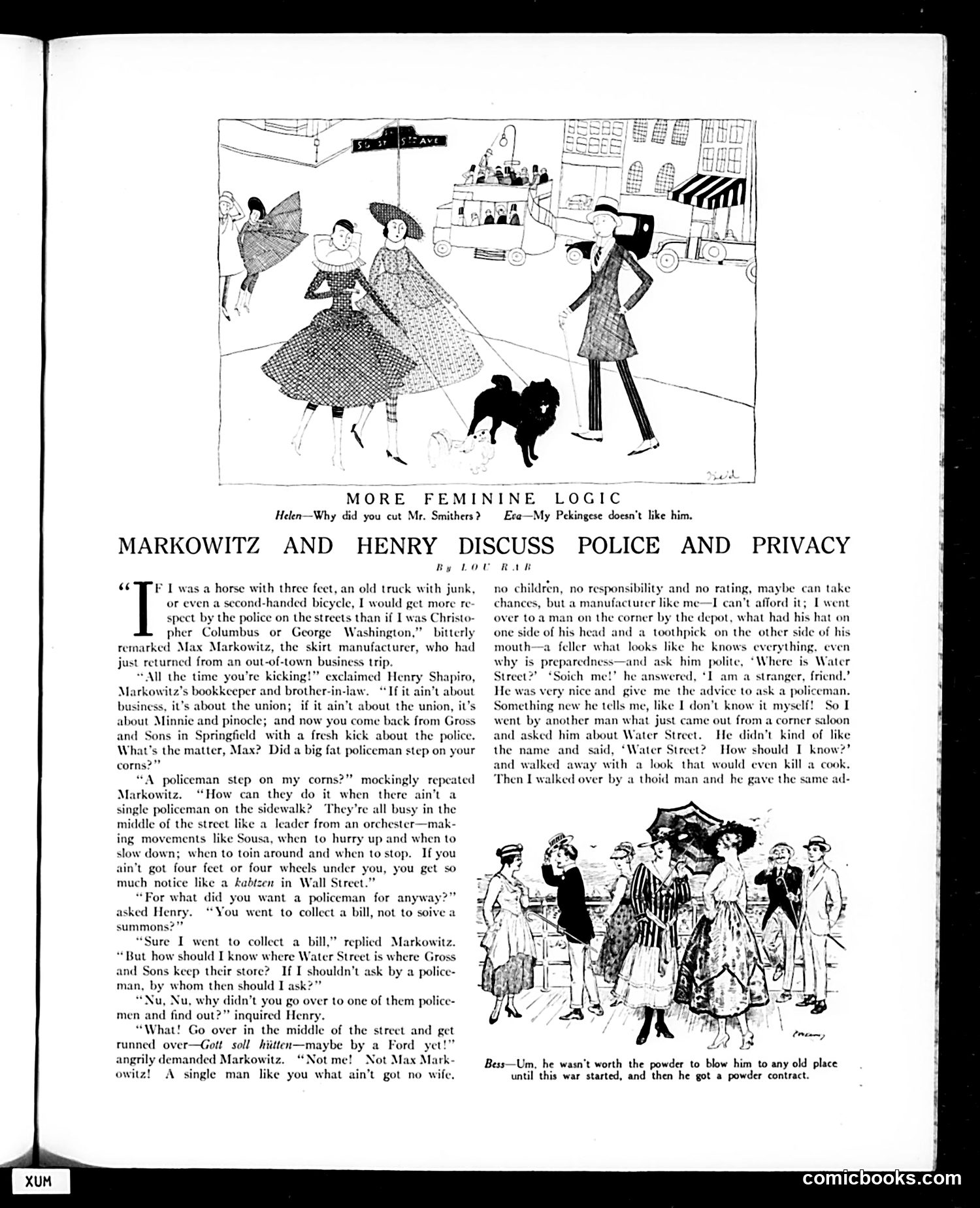
**The Cartoons:** The top cartoon satirizes women's superficial logic: a woman rejects a suitor solely because her Pekingese dog dislikes him—absurd reasoning played for humor. **The Main Article:** This is a humorous dialogue between Max Markowitz (a skirt manufacturer) and Henry Shapiro (his bookkeeper/brother-in-law) complaining about police inefficiency. Markowitz gripes that police only direct traffic in street centers (like orchestra conductors) and ignore pedestrians trying to ask directions. When he needed to find Water Street, he couldn't safely approach a busy officer and received unhelpful responses from random strangers instead. **The Satire:** The piece mocks early 20th-century urban police priorities—traffic control over public service—while showcasing Yiddish-inflected dialogue typical of Judge's ethnic humor. The casual mention of "Gott soll hütten" and distinctive speech patterns mark these as Jewish immigrant characters, reflecting Judge's comedic portrayal of immigrant communities. **Bottom Cartoon:** The caption about powder contracts appears unrelated to the main text, likely continuing another article.
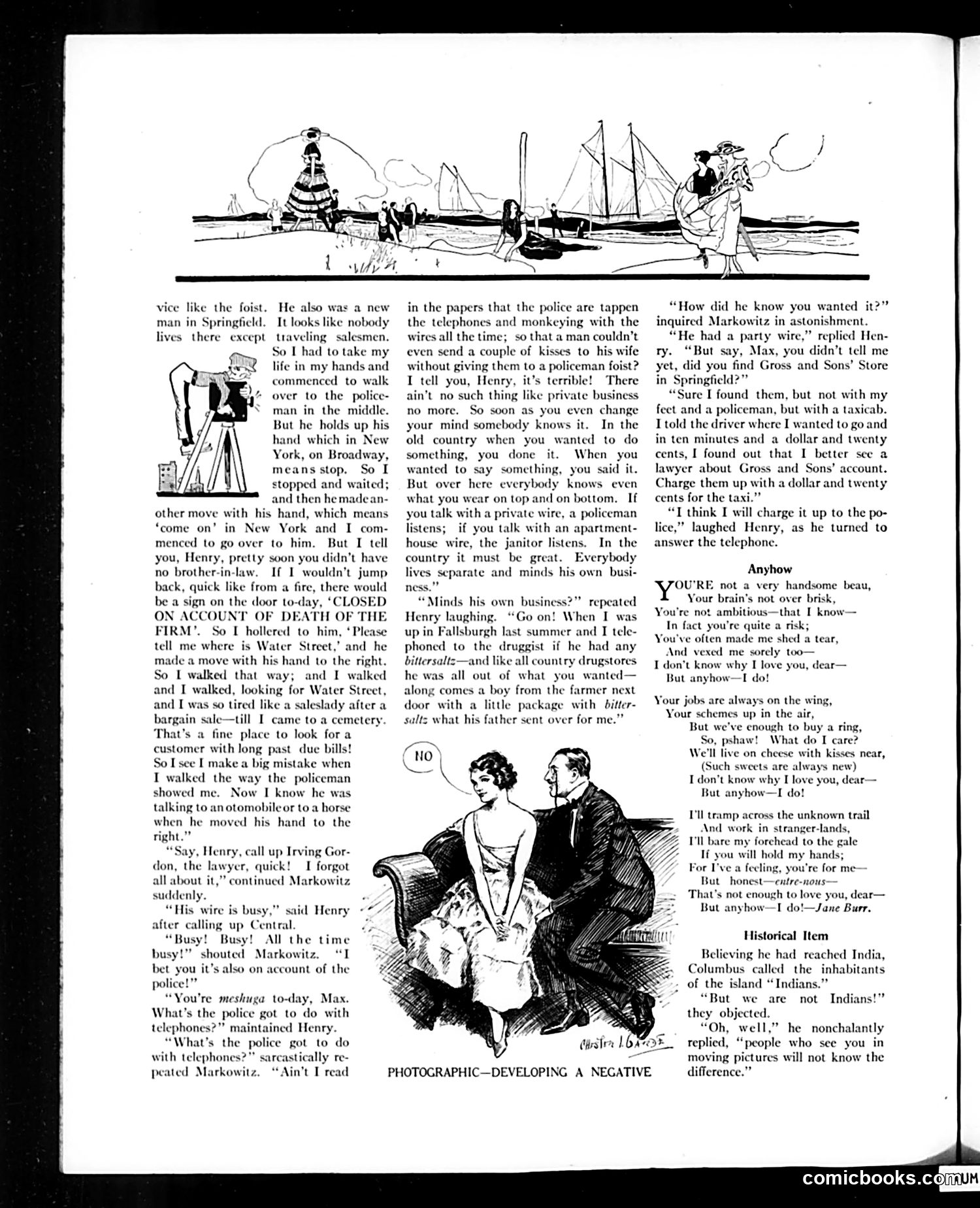
This Judge magazine page satirizes early 20th-century anxieties about government surveillance and loss of privacy. The narrative features a Yiddish-accented character named Markowitz complaining about police controlling traffic via hand signals on Broadway, which he absurdly interprets as evidence of broader government interference in citizens' lives. The satire works on multiple levels: Markowitz conflates unrelated issues (traffic cops, telephone monopolies, party-line eavesdropping) into a paranoid conspiracy theory about privacy invasion. The "Historical Item" references Columbus and "Indians," suggesting the satirist is mocking unfounded immigrant anxieties by comparing them to Columbus's miscalculation. The humor relies on ethnic caricature—the malapropisms ("meshuga," "foist," "bittersaltz") and the working-class Jewish perspective—to distance "respectable" readers from these concerns, implying Markowitz's worries are immigrant overreaction rather than legitimate criticism of emerging surveillance infrastructure.
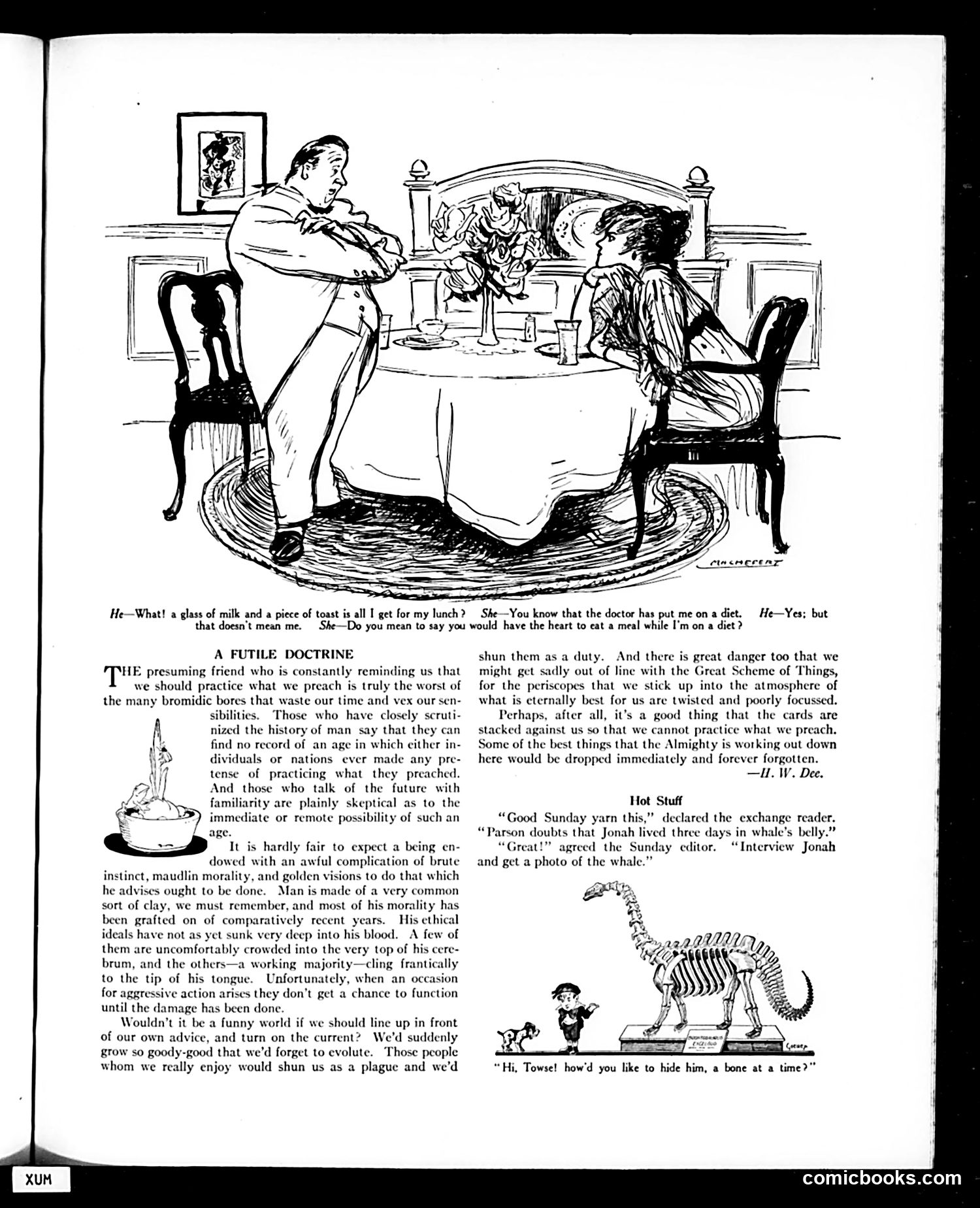
The top cartoon satirizes marital hypocrisy: a husband complains about sparse lunch (milk and toast) while his wife explains the doctor put her on a diet. He objects to eating a full meal while she suffers—yet the accompanying essay "A Futile Doctrine" mocks exactly this kind of performative morality. The essay argues that humans constantly *preach* virtue but never *practice* it, and that's actually beneficial. If people truly lived by their own advice, society would stagnate. The piece cynically suggests moral ideals are superficial—merely "grafted on" to human nature and clinging precariously to our tongues. The "Hot Stuff" section jokes about journalistic sensationalism: editors discuss interviewing the Biblical prophet Jonah and photographing the whale that swallowed him—treating impossible folklore as reportable news. It mocks credulous or exaggerated journalism of the era.
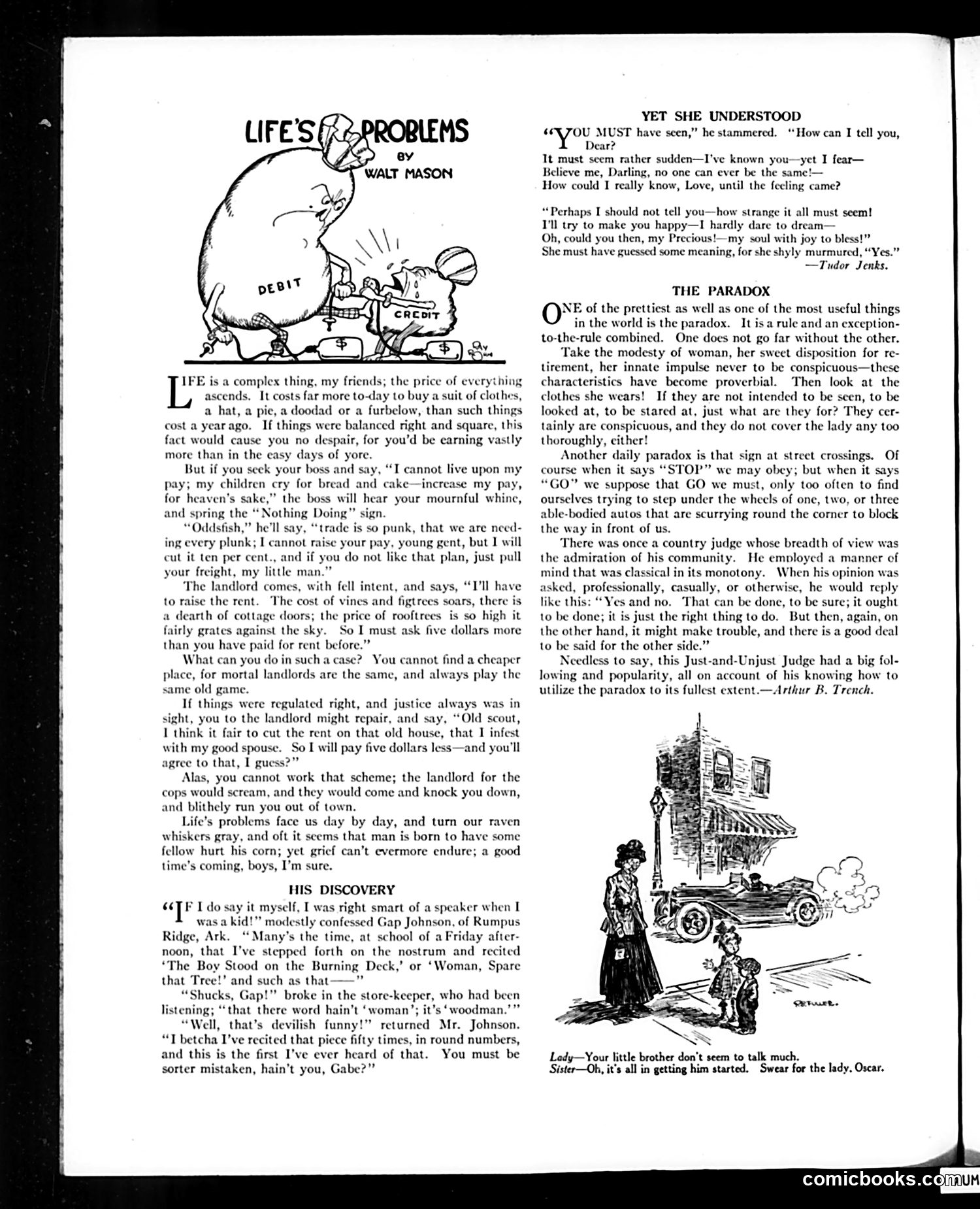
The cartoon depicts a bloated figure labeled "DEBIT" crushing a tiny figure labeled "CREDIT," illustrating the essay's theme: the cost of living has risen dramatically, but wages have not kept pace. Mason's essay satirizes the economic squeeze facing ordinary workers. Landlords raise rents citing increased property costs; employers cut wages claiming business is bad ("trade is punk"). Workers have no recourse—they cannot negotiate rent reductions or find cheaper housing, as landlords control the system and can call police to enforce evictions. The piece critiques economic inequality and powerlessness. While acknowledging life's hardships, Mason offers resigned optimism ("a good time's coming, boys"). The page also includes lighter pieces: "His Discovery" (a rustic anecdote about misremembering poetry), and "Yet She Understood" (romantic verse). These contrast with Mason's pointed social commentary on class and economic injustice.
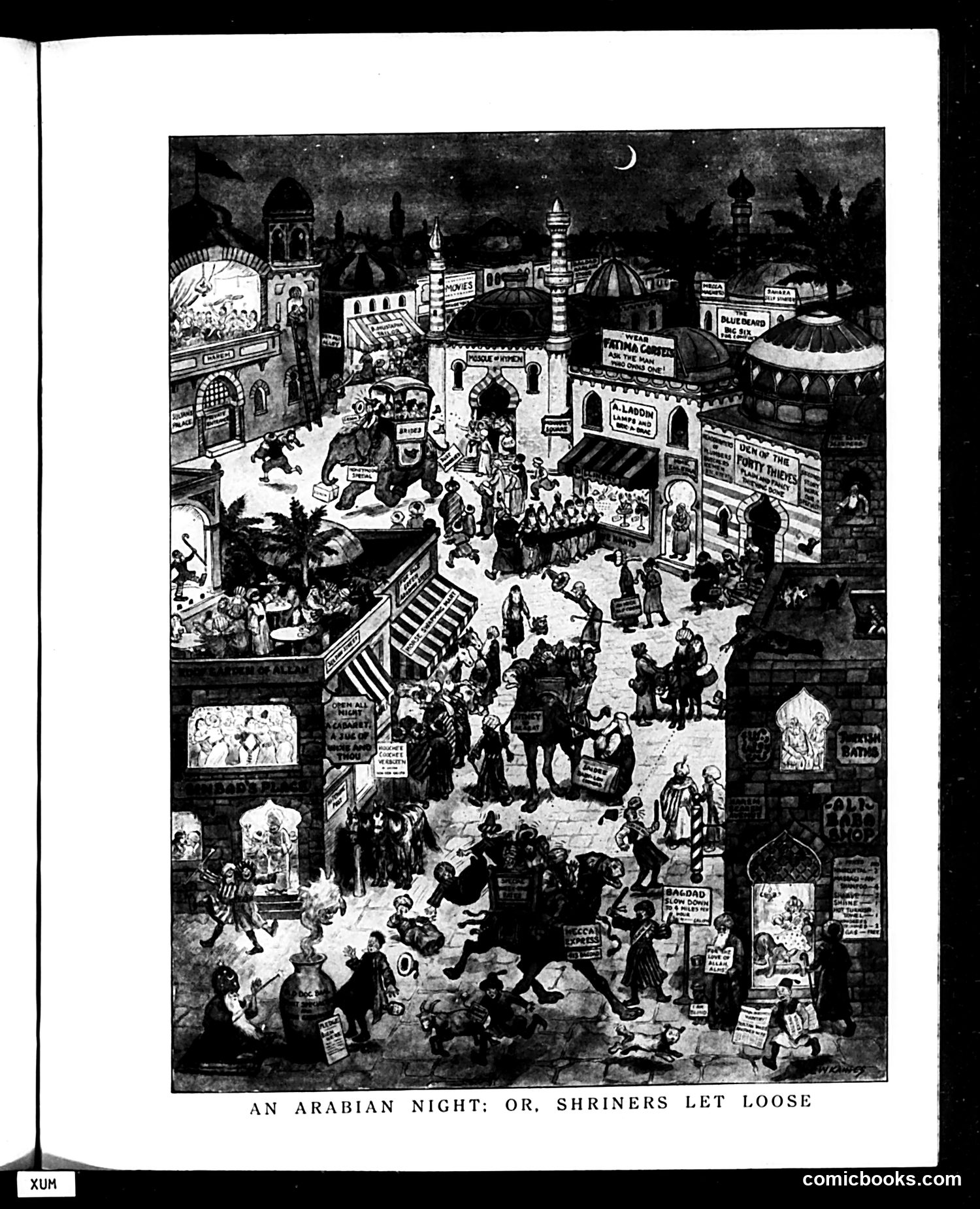
This is a satirical illustration of a chaotic Middle Eastern-themed bazaar or marketplace. The title's punchline mocks the Shriners—members of a fraternal organization known for exotic-themed parades and costumes. The cartoon depicts them "let loose" in an Arabian setting, suggesting wild, unrestrained behavior. The crowded scene shows numerous figures in various costumes and dress, carnival attractions, storefronts with signs, and general pandemonium. The crescent moon overhead reinforces the "Arabian night" setting. The satire appears to ridicule both the Shriners' theatrical pageantry and, implicitly, orientalist fantasy—depicting the scene as absurd spectacle rather than authentic culture. The specific historical context and which Shriner event this references remains unclear without additional documentation.
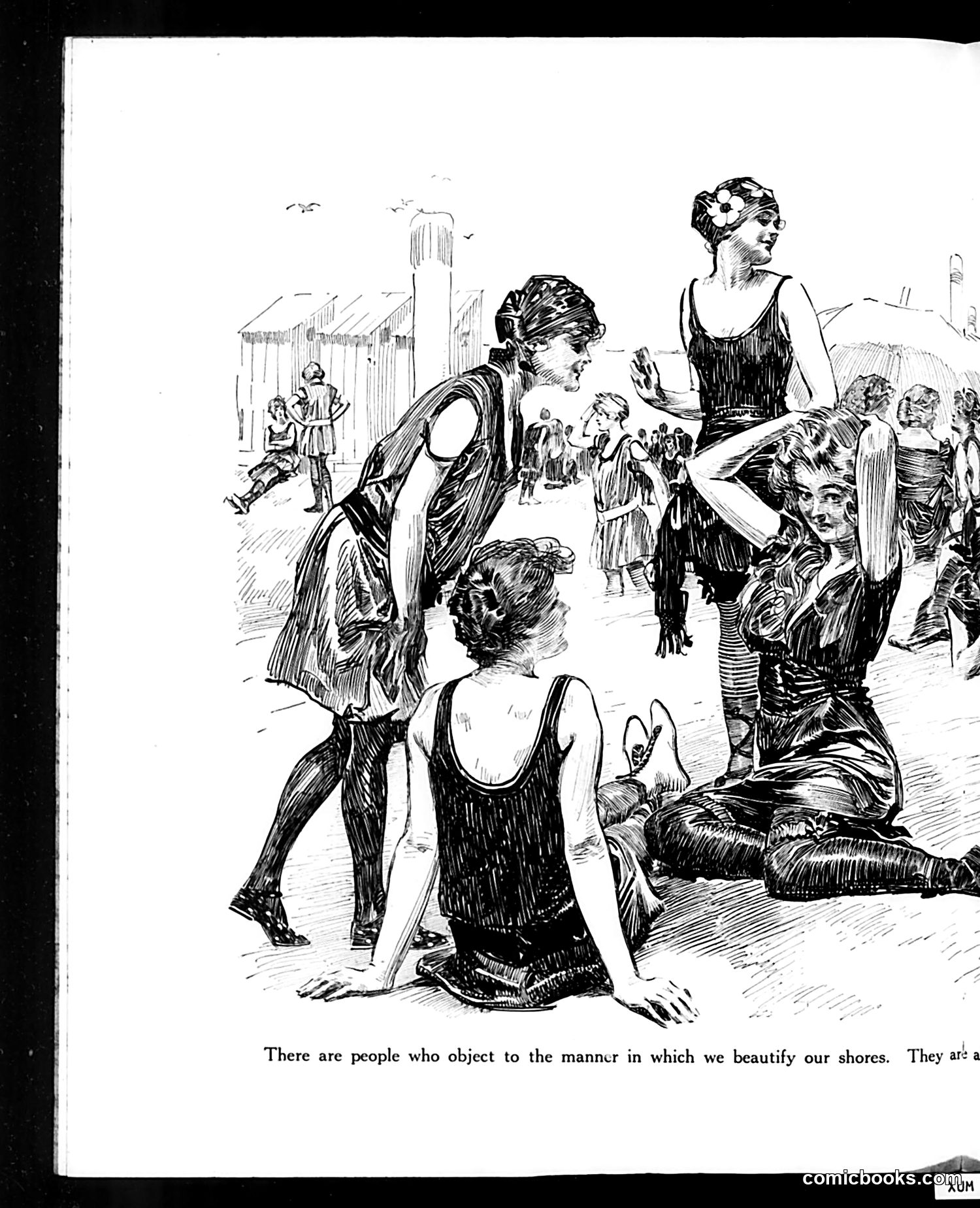
This cartoon satirizes debates over public beach development and swimwear standards in early 20th-century America. The scene depicts women in bathing costumes at a crowded beach, with the caption referencing objections to "the manner in which we beautify our shores." The satire appears to target conservative critics who opposed: 1. **Modern swimwear** - the revealing bathing suits worn by the women 2. **Public beach culture** - the growing popularity of seaside recreation The crowded beach and casually dressed figures suggest the artist supports this modern leisure activity, while mocking those who found such public displays of women's bodies morally objectionable. This reflects early-century tensions between progressive urban recreation culture and traditional moral standards.
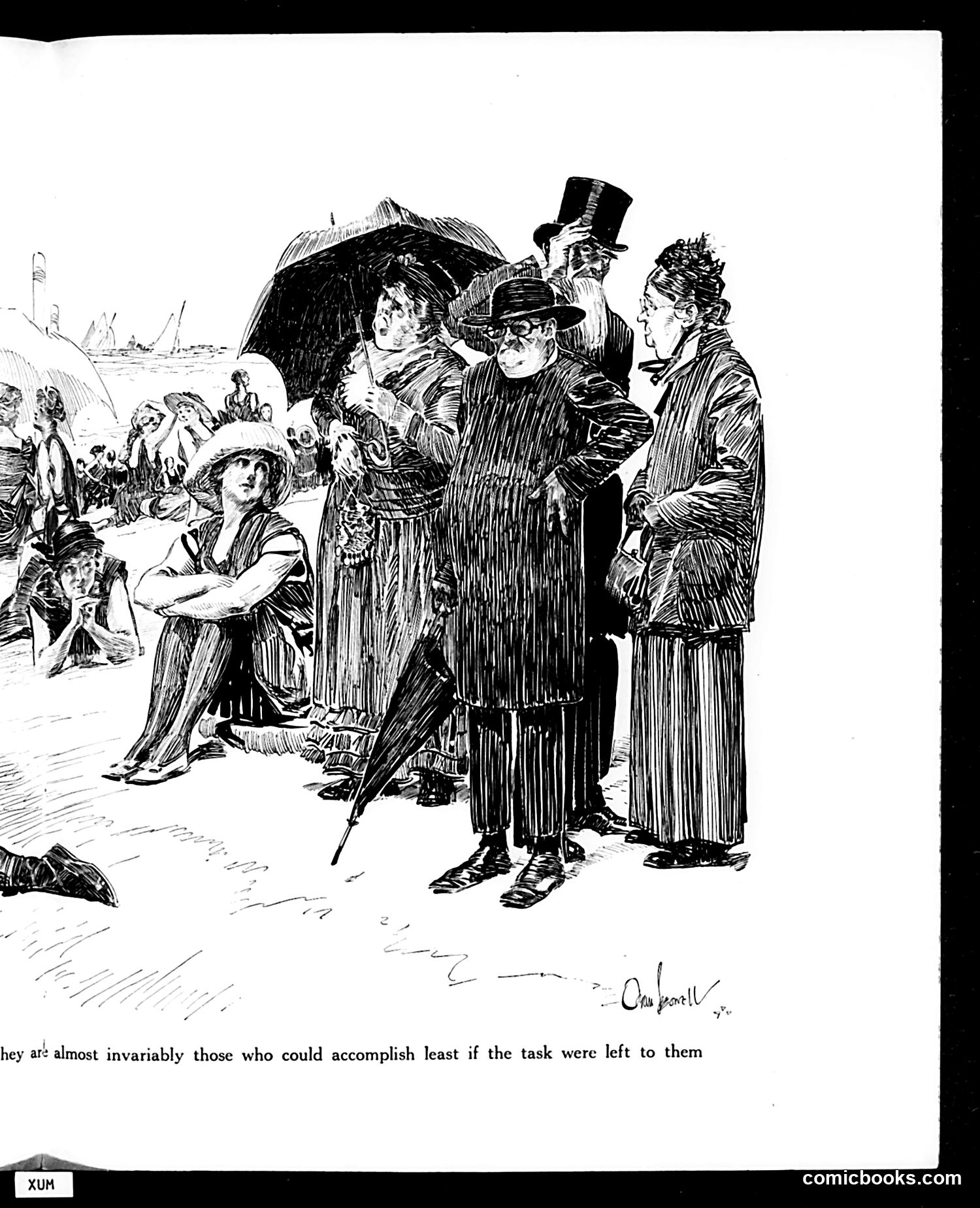
This appears to be a satirical illustration from *Judge* magazine depicting a beach or seaside scene. The central figures are three well-dressed men in formal attire (top hats and coats), standing prominently while other beachgoers occupy the background. The accompanying text—"they are almost invariably those who could accomplish least if the task were left to them"—suggests social satire about incompetent authority figures or bureaucrats. The contrast between the formally-dressed central figures and the casual beachgoers implies criticism of pompous officials or wealthy elites who wield power despite lacking actual capability. The artist's signature reads "Chappell." Without additional context about the publication date or specific political events referenced, the precise target remains unclear, though the satire appears directed at ineffectual leadership or class pretension.
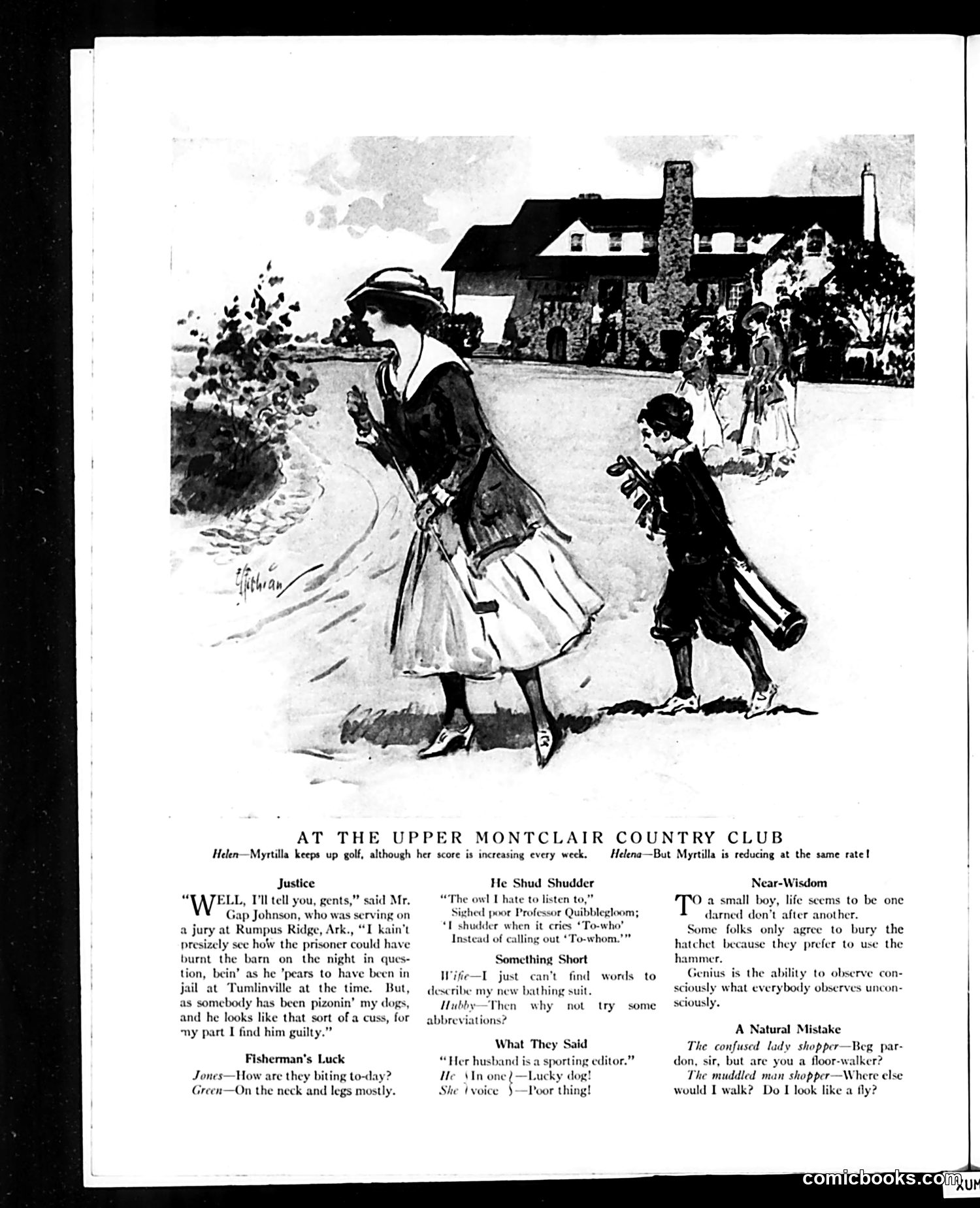
This page from *Judge* magazine contains several short satirical pieces mocking early 20th-century American society: **"Justice"** satirizes rural jury incompetence: a backwoods juror admits the defendant has an alibi but votes guilty anyway out of personal grudge—mocking flawed judicial systems in small towns. **"At the Upper Montclair Country Club"** jokes about wealthy women's vanity: Helen notes her friend Myrtilla's golf scores worsen while she "reduces" (diets) at the same rate—implying her efforts are futile. **"He Shud Shudder"** is wordplay about a professor's grammatical annoyance with owls' cries. **"Near-Wisdom"** offers cynical observations about life's tedium and human nature. **"A Natural Mistake"** features a pun: a confused shopper mistakes a man for a "floor-walker" (department store employee), and he jokes he doesn't "walk" like a "fly." The humor relies on class observation, linguistic jokes, and gentle mockery of contemporary manners.
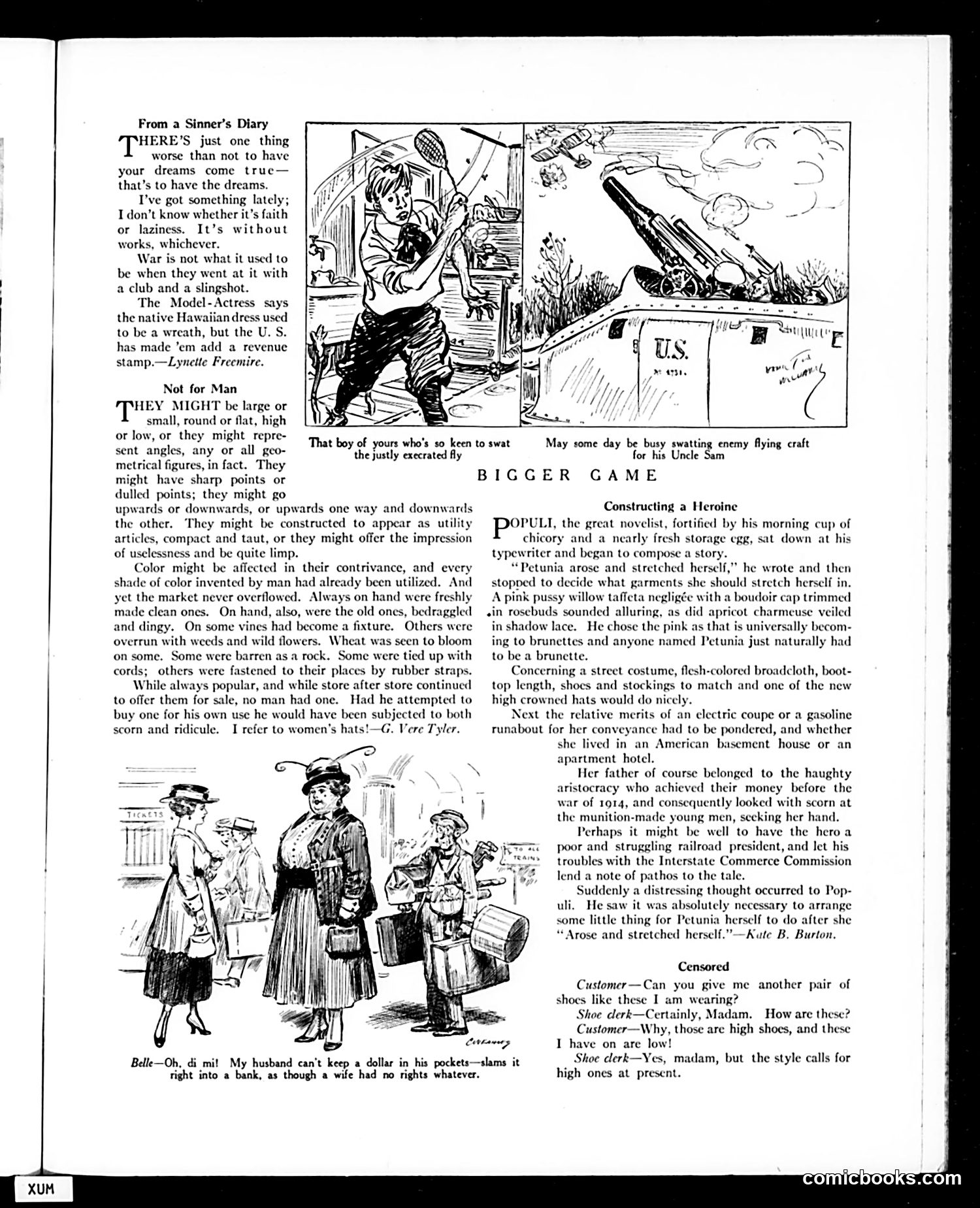
This page contains three satirical pieces mocking early 20th-century American life and literature. **"From a Sinner's Diary"** offers cynical observations about modern warfare (no longer hand-to-hand combat) and consumer culture—specifically that Hawaiian wreaths, once natural items, now require U.S. revenue stamps, reflecting commercialization. **"Not for Man"** is a lengthy satirical essay about women's hats. The joke: hats are perpetually manufactured, sold, and worn by women, yet no man would dare purchase one for himself without ridicule. It's commentary on gendered fashion norms and the absurdity of hat-obsessed female consumerism. **"Constructing a Heroine"** mocks overwrought 1920s fiction writing. A novelist ("Popult") laboriously decides trivial details about his female character Petunia—her negligée color, shoes, car type—but realizes he's forgotten to give her anything meaningful to *do* in the story. It satirizes how female characters in popular literature are defined by appearance and romance rather than agency. The cartoon illustrations support these themes about gender, consumption, and social pretension.
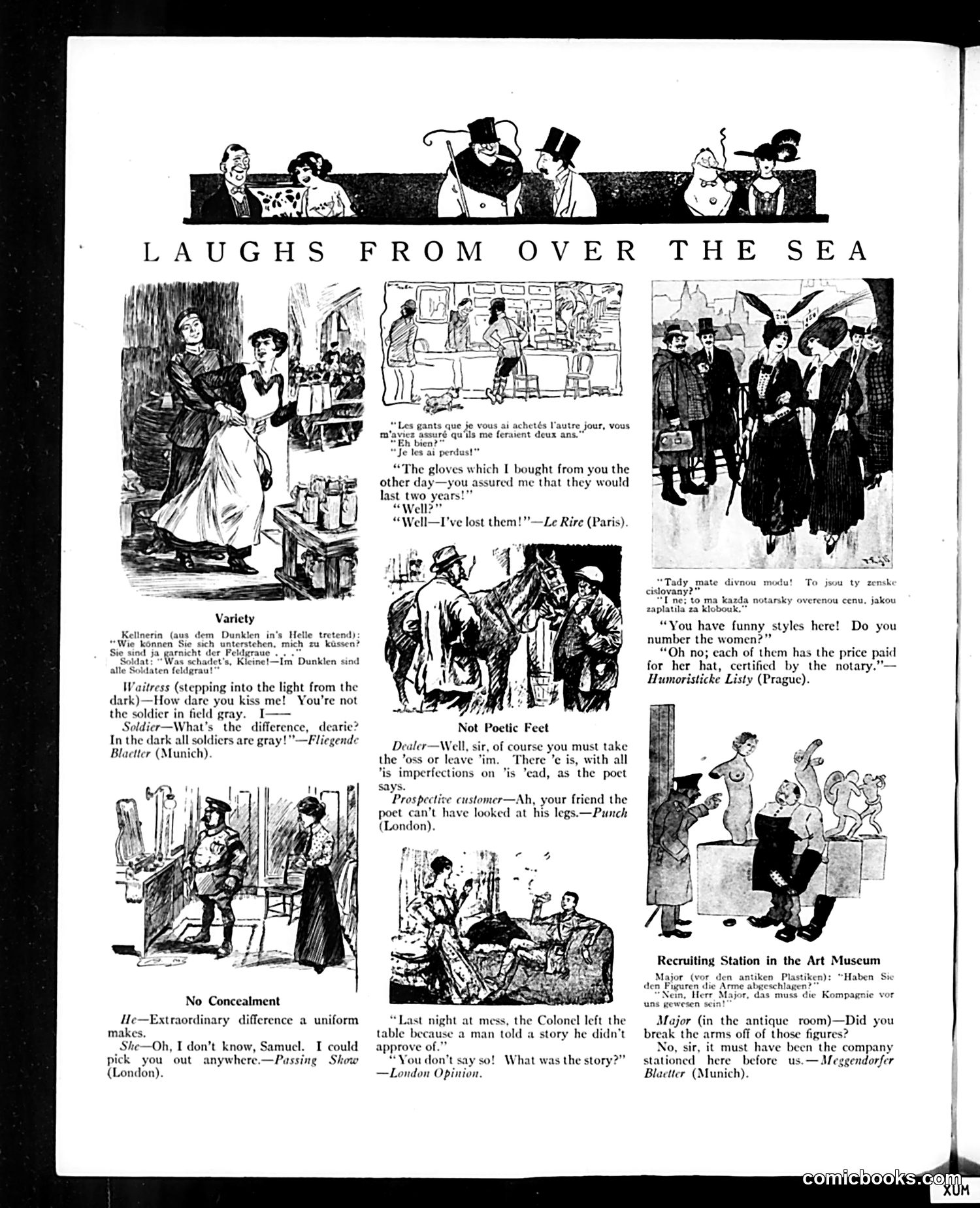
This page collects translated humor from European satirical magazines, demonstrating early 20th-century international comedy trade. The jokes reflect period concerns: **gender and commerce** (a Prague piece jokes that women are priced like hats, valued by notary certificates); **WWI military life** (a soldier's indistinguishability in uniform; officers' mess conduct); and **class/social awkwardness** (a prospective customer insults a disabled horse-seller; recruiting occurs even in art museums). The humor relies on **period assumptions**: women as commodities, physical disability as comedy fodder, the absurdity of wartime recruitment. Most references are obscure without original context—the specific publications (Fliegende Blätter, Punch, Le Rire) and their readerships are now unfamiliar. The page shows how Judge circulated European humor to American readers, suggesting shared Anglo-European satirical sensibilities during the WWI era.

This is a **Schlitz beer advertisement**, not a cartoon or satire. It's a straightforward product pitch using scientific-sounding claims to sell beer. The ad argues that Schlitz's brown bottles protect beer from ultraviolet light damage, preserving quality better than competitors' clear or light bottles. This is presented as fact: UV rays damage beer's "nutritive value," but brown glass prevents this degradation, making Schlitz taste superior. The tagline references Milwaukee's brewing industry reputation ("The Beer That Made Milwaukee Famous"), positioning Schlitz as the city's premier product. For modern readers: this represents early 20th-century advertising's use of pseudo-scientific language to justify brand superiority—a marketing tactic that persists today. The claim about UV protection is actually legitimate, but the "nutritive value" language sounds quaint now. The ad assumes readers will accept technical-sounding explanations as persuasive marketing.
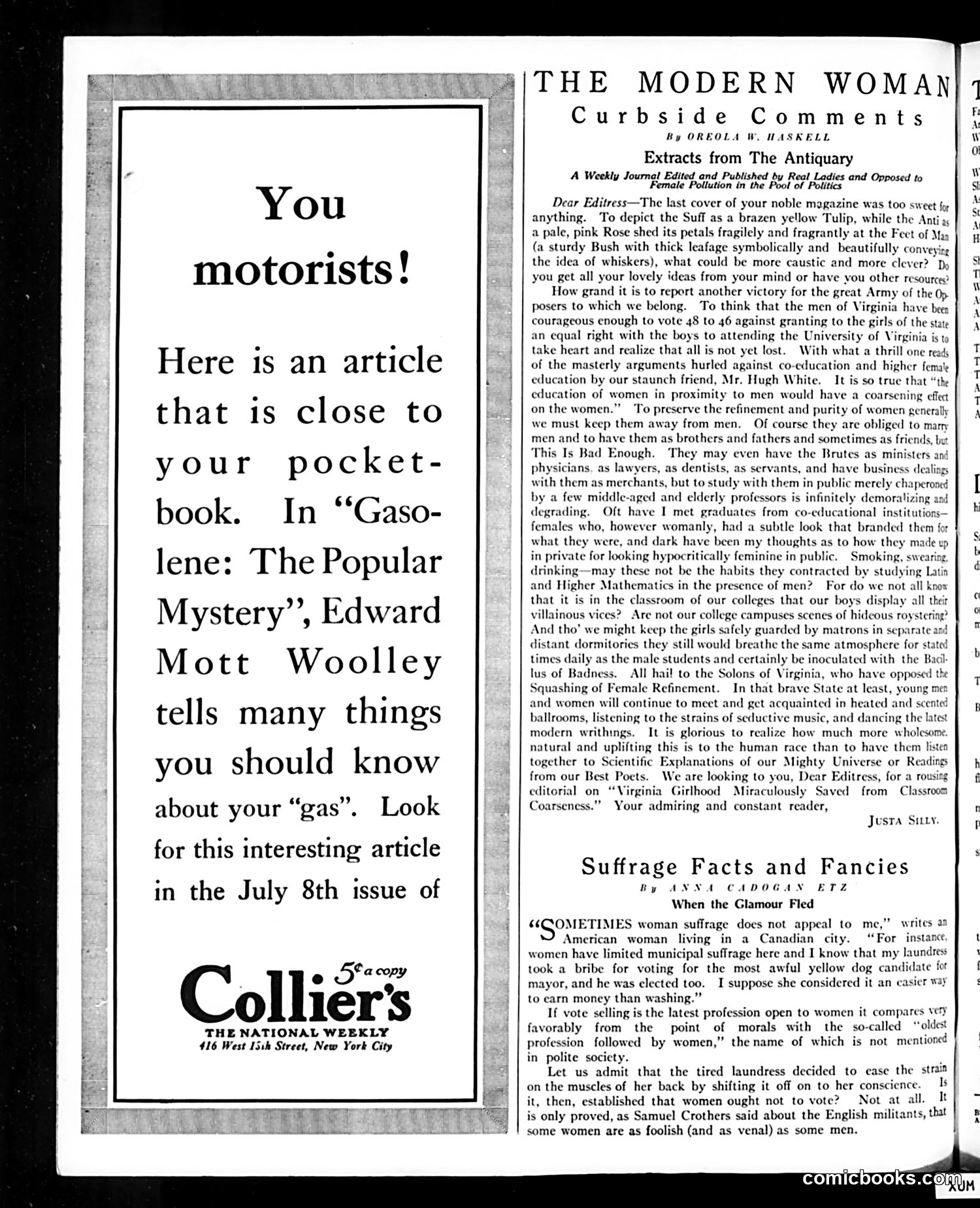
This page contains a **Collier's magazine advertisement** (left) promoting an article about gasoline for motorists, alongside **satirical commentary on women's suffrage and education** (right). The right side features "The Modern Woman: Curbside Comments"—a **mock letter** praising Virginia's rejection of co-education at the University of Virginia. The satire is biting: the author, writing as "Justa Silly," sarcastically celebrates keeping women away from men's educational proximity, claiming it preserves female "refinement." The piece mocks anti-suffrage arguments by exaggerating their absurdity—suggesting that studying Latin near men corrupts women into smoking and drinking. This reflects early 20th-century debates: opponents of women's education and voting rights claimed such participation would "coarsen" women and damage society. The satirist exposes this logic as ridiculous by taking it to extremes, implying these restrictions are actually about control, not protection. The page also advertises "Suffrage Facts and Fancies," indicating *Judge* engaged actively with contemporary women's rights controversies, using satire to critique conservative opposition.
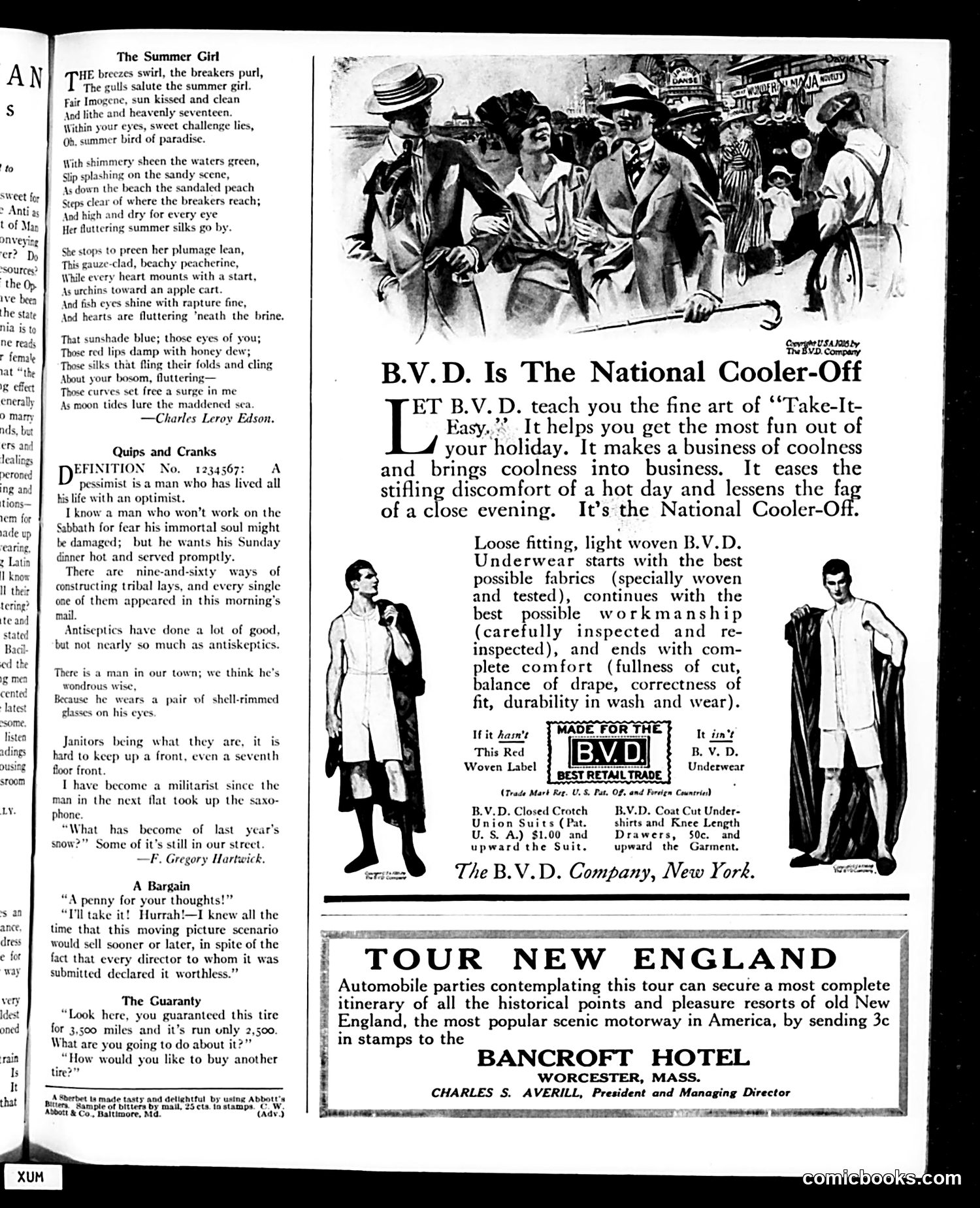
This page contains poetry and humorous short pieces typical of Judge magazine's satirical content, plus advertising. **"The Summer Girl"** is romantic verse celebrating an idealized young woman at the beach—fair, seventeen, in fashionable summer dress. The poem romanticizes her effect on observers ("fish eyes shine with rapture fine"). This represents early 20th-century idealization of feminine beauty and leisure. **"Quips and Cranks"** offers brief satirical observations on contemporary life: pessimism, religious hypocrisy (a man avoiding Sabbath work but demanding hot Sunday dinner), the abundance of submitted magazine submissions, and modern annoyances like saxophone-playing neighbors. These target recognizable social types and frustrations. **The B.V.D. underwear advertisement** uses humor and period language ("cooler-off," "take-it-easy") to market loose-fitting men's undergarments as relief from summer heat and formality. The ad emphasizes quality construction and comfort. The remaining small ads (tire guarantee joke, New England tourism) are filler typical of magazine pages. Overall, this represents Judge's mix of light satire, romance, and commercial content from the 1910s-20s era.
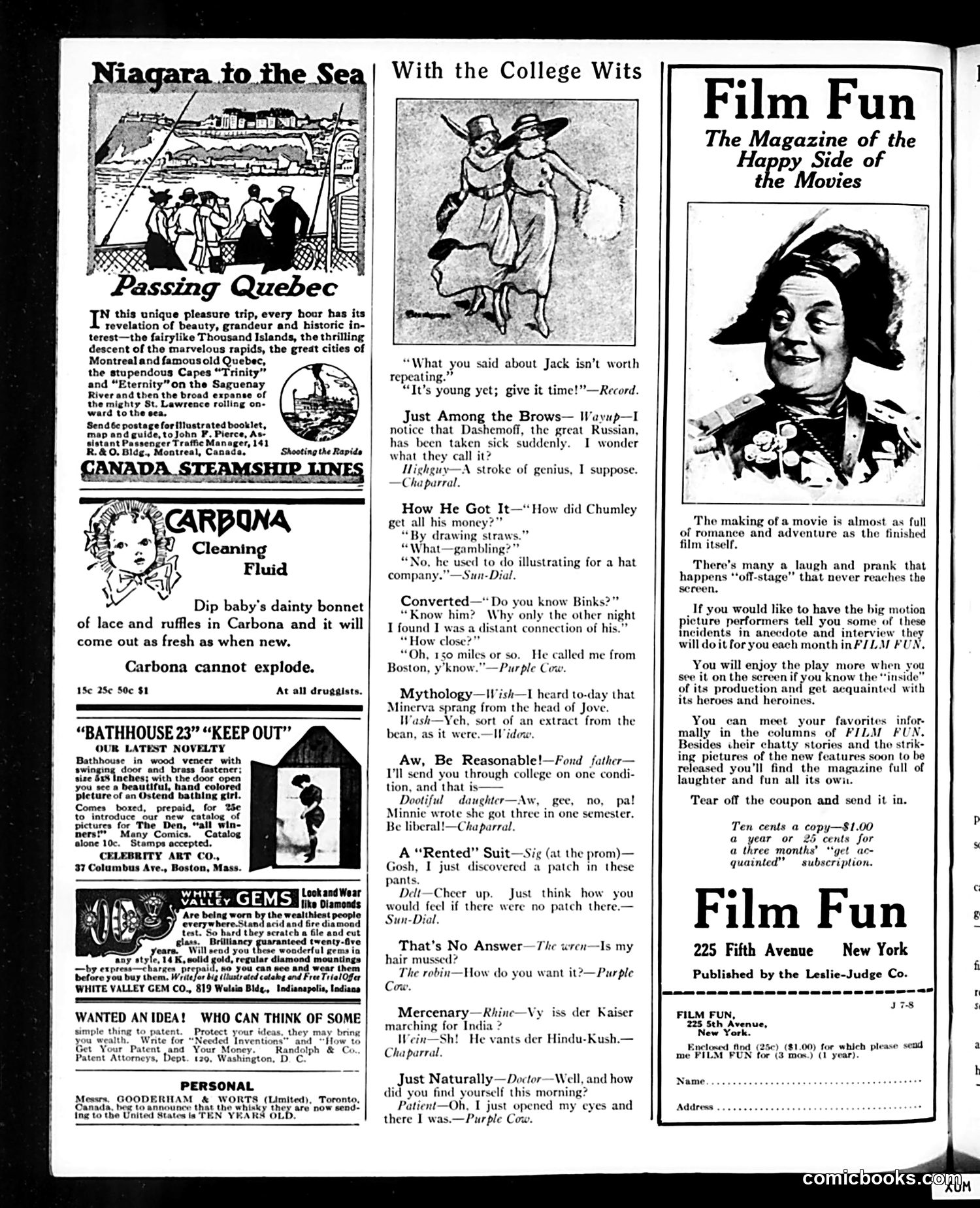
This is primarily a **magazine advertisements and humor page** from *Judge*, a satirical publication. The left side features travel and product ads (steamship cruises, cleaning fluid, novelty items, patent services), while the center and right contain collegiate humor—short joke exchanges popular in early 20th-century magazines. The "College Wits" jokes are gentle wordplay with no political content: puns about drawing straws, a Russian composer's illness called a "stroke of genius," a man drawing for a hat company, and misheard connections. These reflect **campus humor conventions** of the era—punchy one-liners attributed to college publications like *The Purple Cow* and *Chaparral*. The right side advertises *Film Fun* magazine, emphasizing behind-the-scenes movie anecdotes. There's **no identifiable political satire** on this page—it's primarily commercial content with lightweight collegiate wordplay typical of the period.
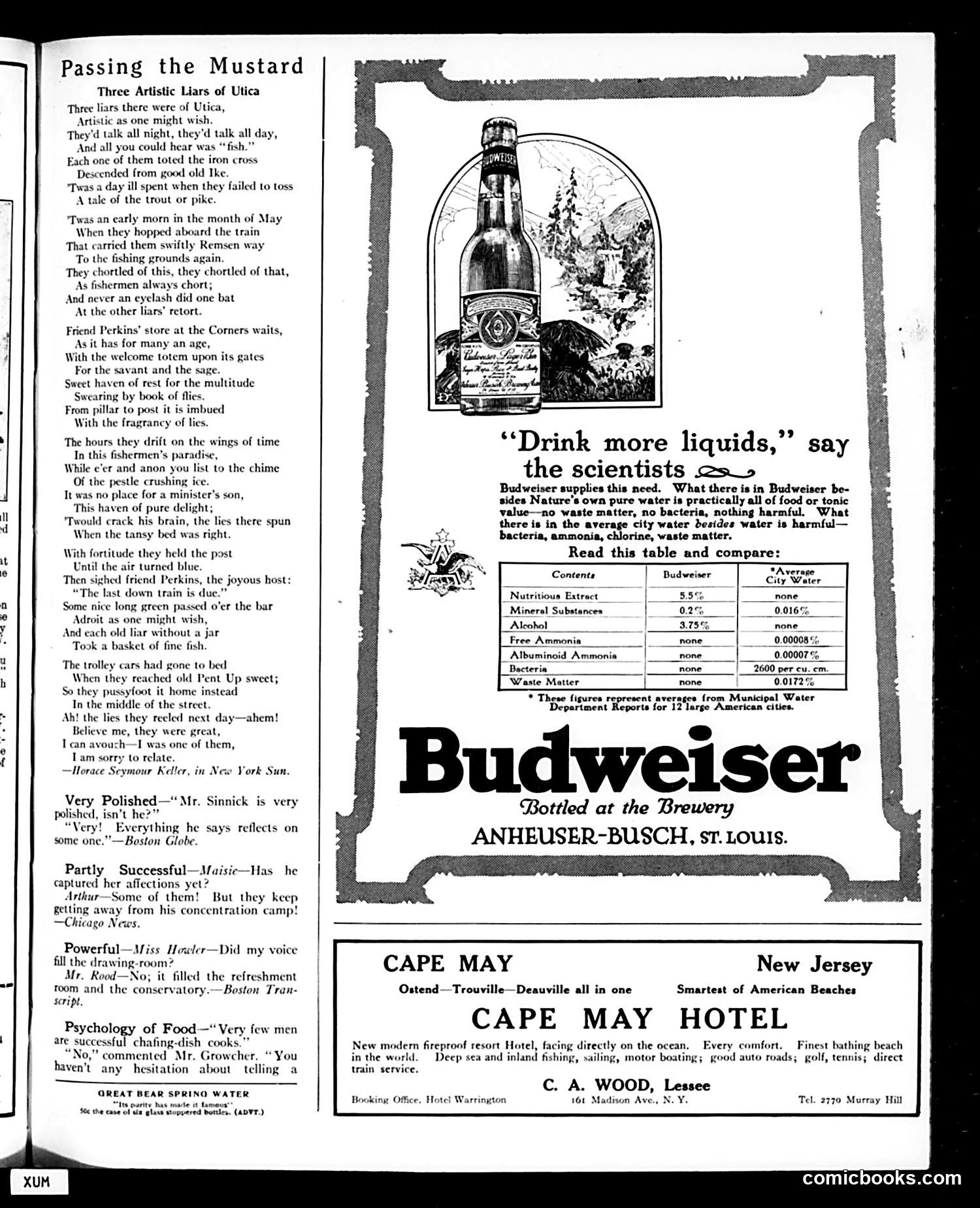
This page contains a humorous poem by Horace Seymour Keller about three fictional fishermen from Utica who are compulsive liars. The satire mocks the tendency of fishing enthusiasts to exaggerate their catches and tell tall tales. The poem follows three men who take a train to fishing grounds, spend the day at "Friend Perkins' store" (apparently a local gathering place) spinning increasingly elaborate lies, then return home with modest catches while claiming they'll relay even grander stories the next day. The narrator reveals himself as complicit in this tradition ("I was one of them, I am sorry to relate"), suggesting this is a universal male vice—the compulsion to embellish fishing adventures regardless of actual success. The page otherwise contains short joke items and advertisements (Budweiser, Cape May Hotel), typical of Judge magazine's format.
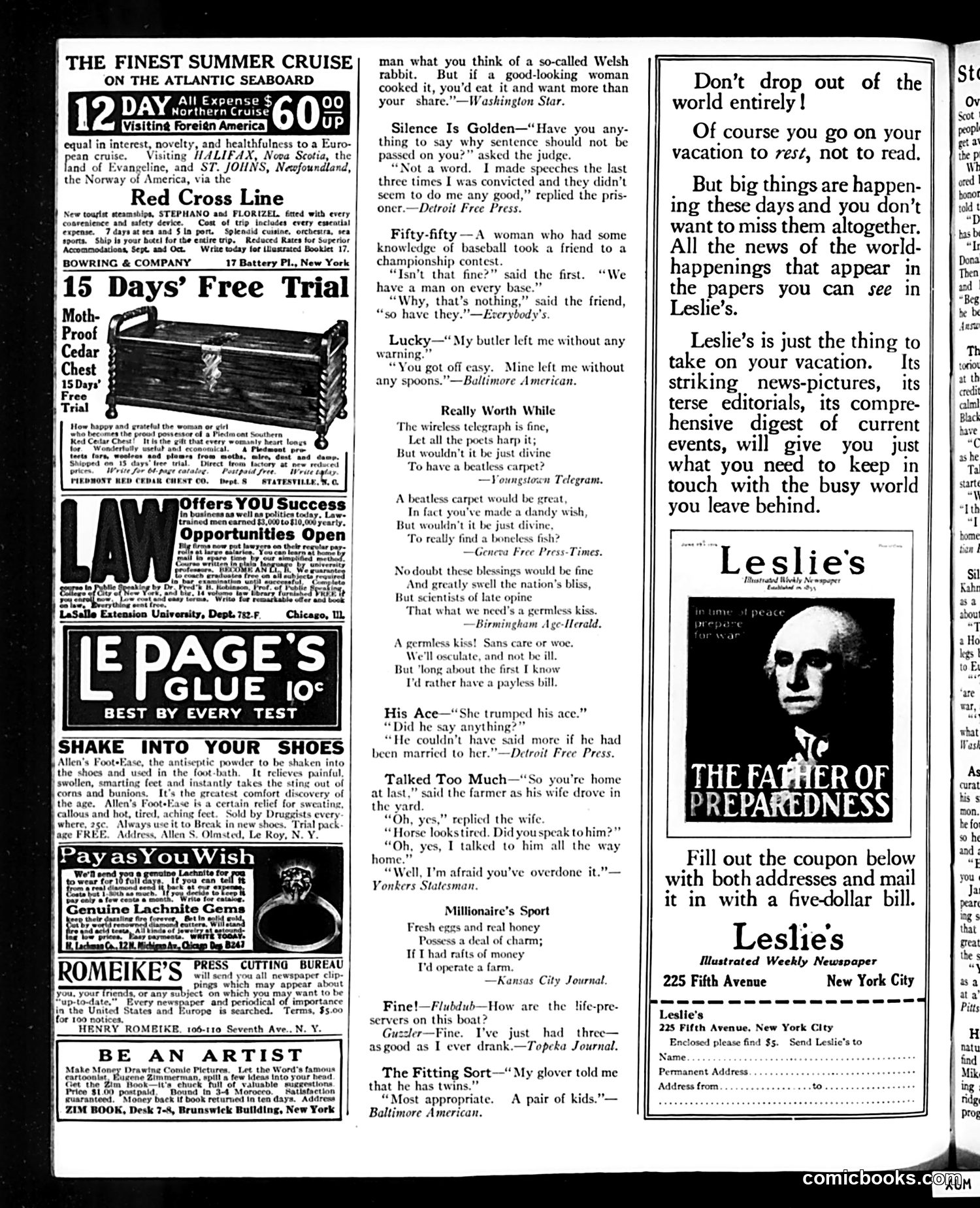
This page is primarily **advertisements and humorous filler content** rather than political satire. The main elements are: **Advertisements** dominate: cruise lines, cedar chests, glue, foot powder, law school opportunities, and artist instruction courses typical of early 20th-century magazines. **Humor section** ("Really Worth While"): A series of short, whimsical jokes and verse playing on modern conveniences—wireless telegraphs, beatless carpets, germless kisses, payless bills. These mock the era's obsession with technological progress and labor-saving devices by imagining absurd "improvements." **One substantive advertisement**: A Leslie's Illustrated Weekly Newspaper promotion featuring "The Father of Preparedness"—likely promoting military readiness content, a relevant concern in the pre-WWI era. The jokes reflect early 1900s concerns: gender relations, marriage, technology, and domestic life. There's no identifiable political cartoon or major satirical target—just lightweight social humor and commercial content typical of Judge's advertising-heavy pages.
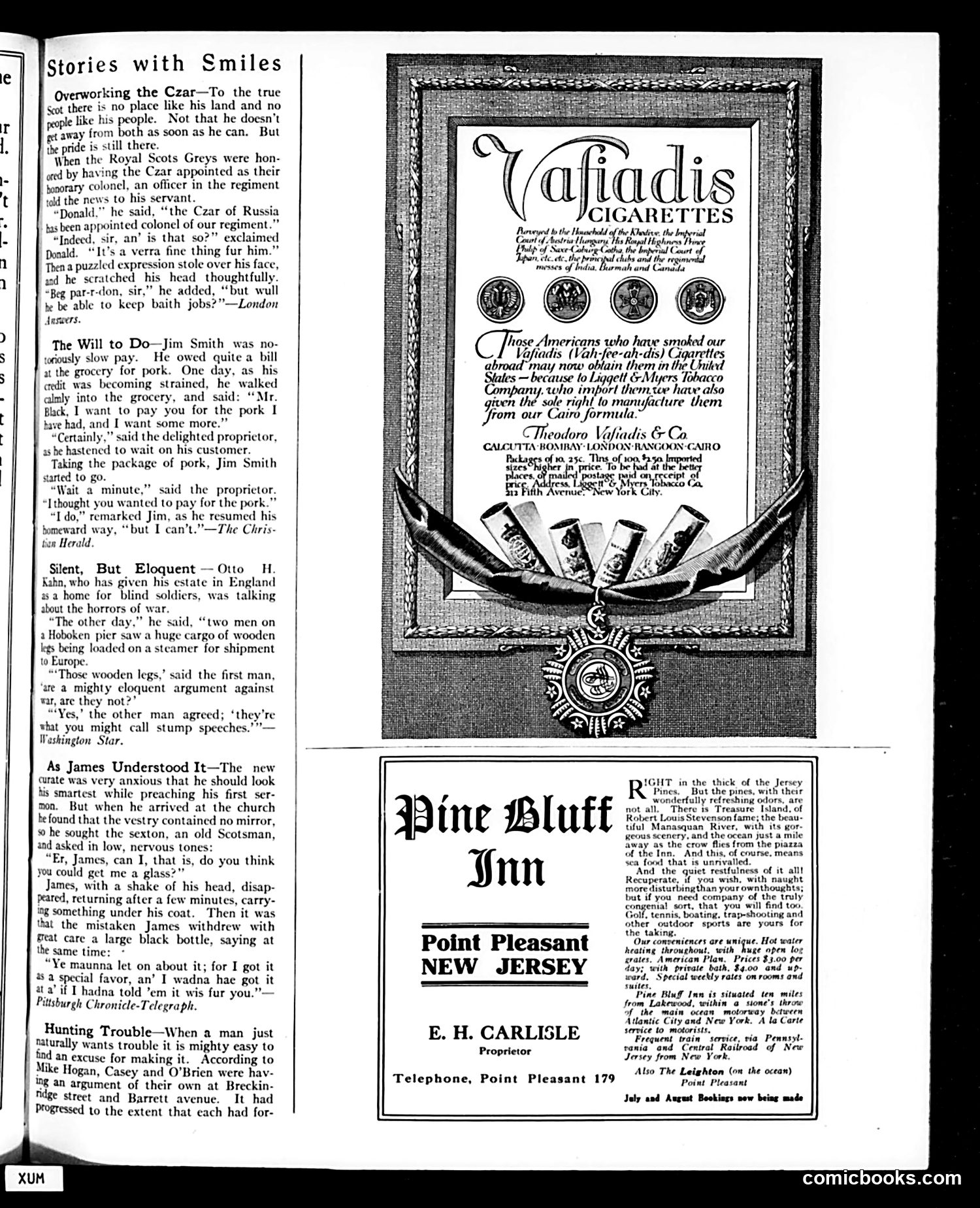
This page primarily contains **humorous short stories** rather than political cartoons. The "Stories with Smiles" section features anecdotes satirizing cultural stereotypes and class dynamics: 1. **"Overworking the Czar"**: A Scottish servant's innocent question—whether the Russian Czar can hold two jobs simultaneously—gently mocks both Scottish literalism and imperial pretension. 2. **"The Will to Do"**: A deadbeat customer's wordplay about paying for pork is simple comedic irony about credit and deception. 3. **"Silent But Eloquent"**: A pun about "stump speeches" (wooden legs/prosthetics for war casualties) satirizes war's human cost through dark humor about amputees. The remaining stories use similar gentle satire about miscommunication and character flaws. The page also includes **period advertisements**—for Vafiadis cigarettes and Pine Bluff Inn—typical of Judge magazine's content. There are no identifiable political figures or sharp partisan commentary visible on this particular page.
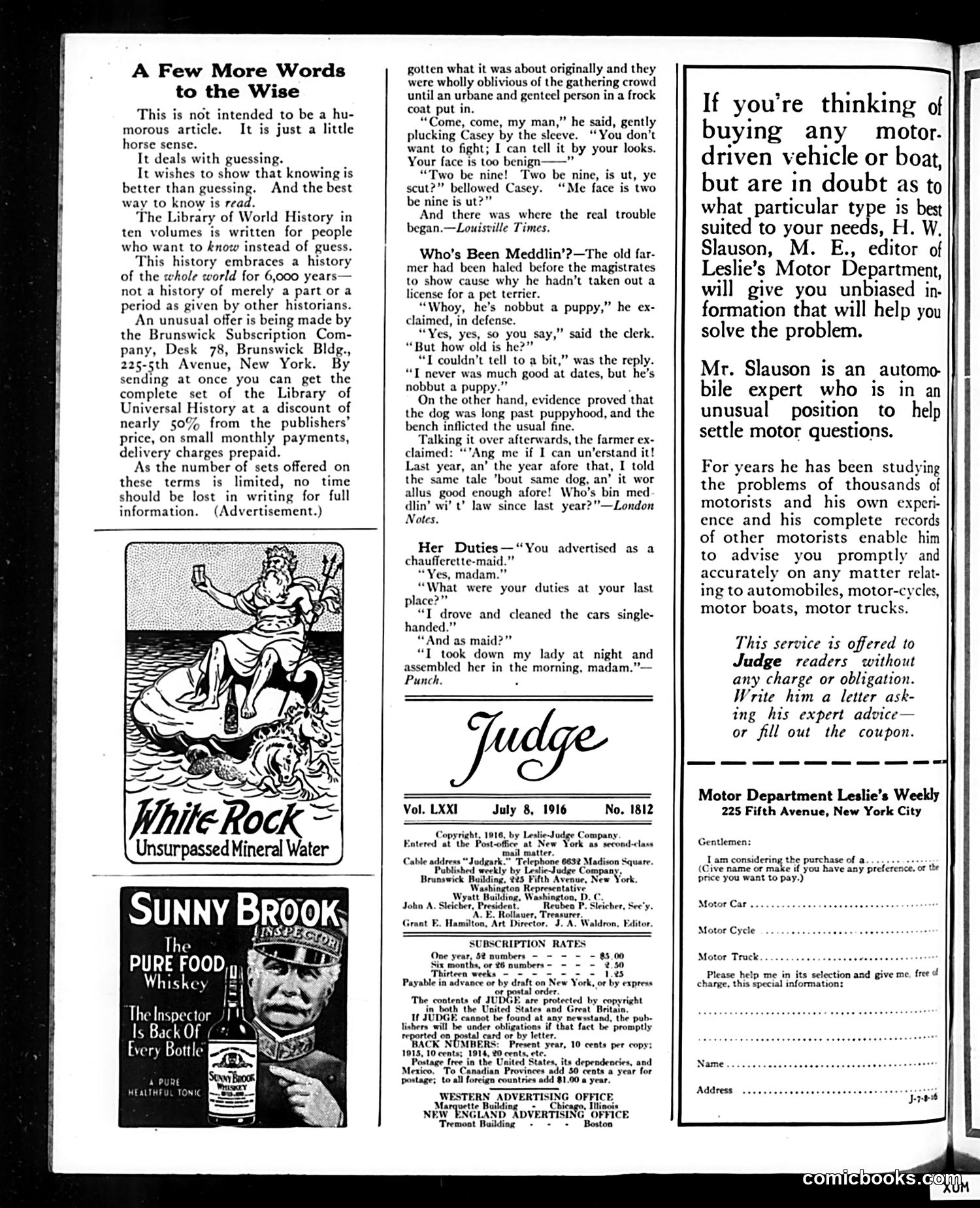
This page is primarily **advertising and editorial content** rather than political satire. The visible elements include: **Text sections:** Three brief humorous anecdotes (likely reprinted from other publications like *Louisville Times*, *London Notes*, and *Punch*). These are gentle jokes about miscommunication—an Irishman misunderstanding an accent, a farmer confused about dog licensing laws, and a maid's awkward phrasing about her duties. None contain political content. **Advertisements:** - White Rock mineral water (with classical female figure) - Sunny Brook whiskey (featuring "The Inspector" character, likely referencing food purity debates of the era) - Leslie's Motor Department service (offering automobile advice) **Editorial:** Subscription information and a pitch for the "Library of World History" encyclopedic set. The page reflects early 1900s concerns (food safety regulation via whiskey "inspection," automobile ownership becoming mainstream) but contains **no apparent political cartoons or partisan satire**—it's a typical magazine contents/advertising page.
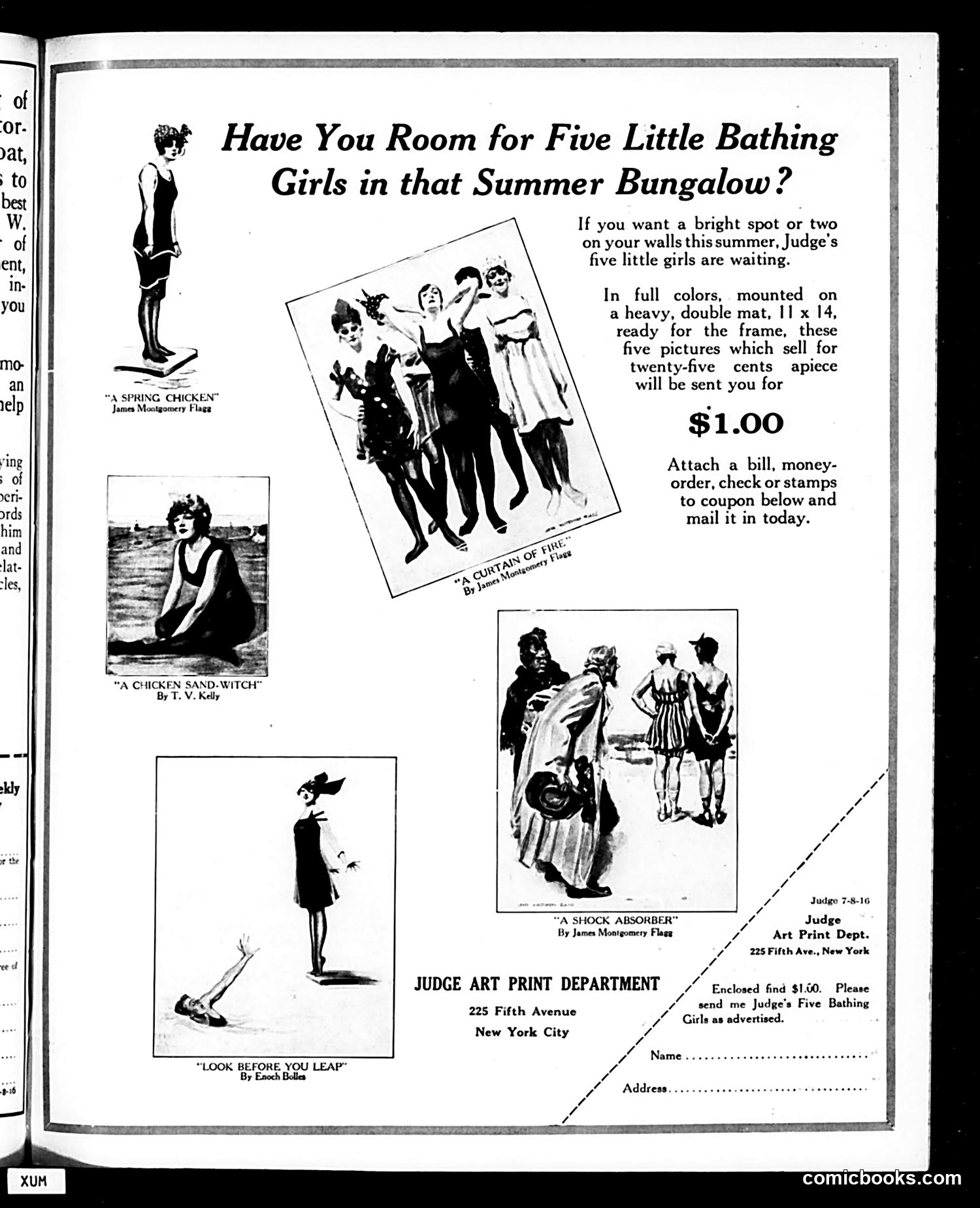
This is primarily an **advertisement** for art prints rather than political satire. Judge magazine is selling five colored illustrations featuring young women in bathing suits—titled "A Spring Chicken," "A Chicken Sand Witch," "A Curtain of Fire," "A Shock Absorber," and "Look Before You Leap"—created by popular illustrators James Montgomery Flagg and Enoch Bolles. The pitch targets summer homeowners, suggesting these prints would brighten bungalow walls during vacation season. At twenty-five cents each ($1.00 for the set), they represent affordable decoration. The illustrations appear to be lighthearted, mildly risqué depictions typical of 1910s-era Judge humor—showing women in various swimming or beach situations with suggestive or playful titles. This reflects the era's bathing beauty trend in popular magazines, where illustrated women in swimwear were common commercial content rather than considered obscene.
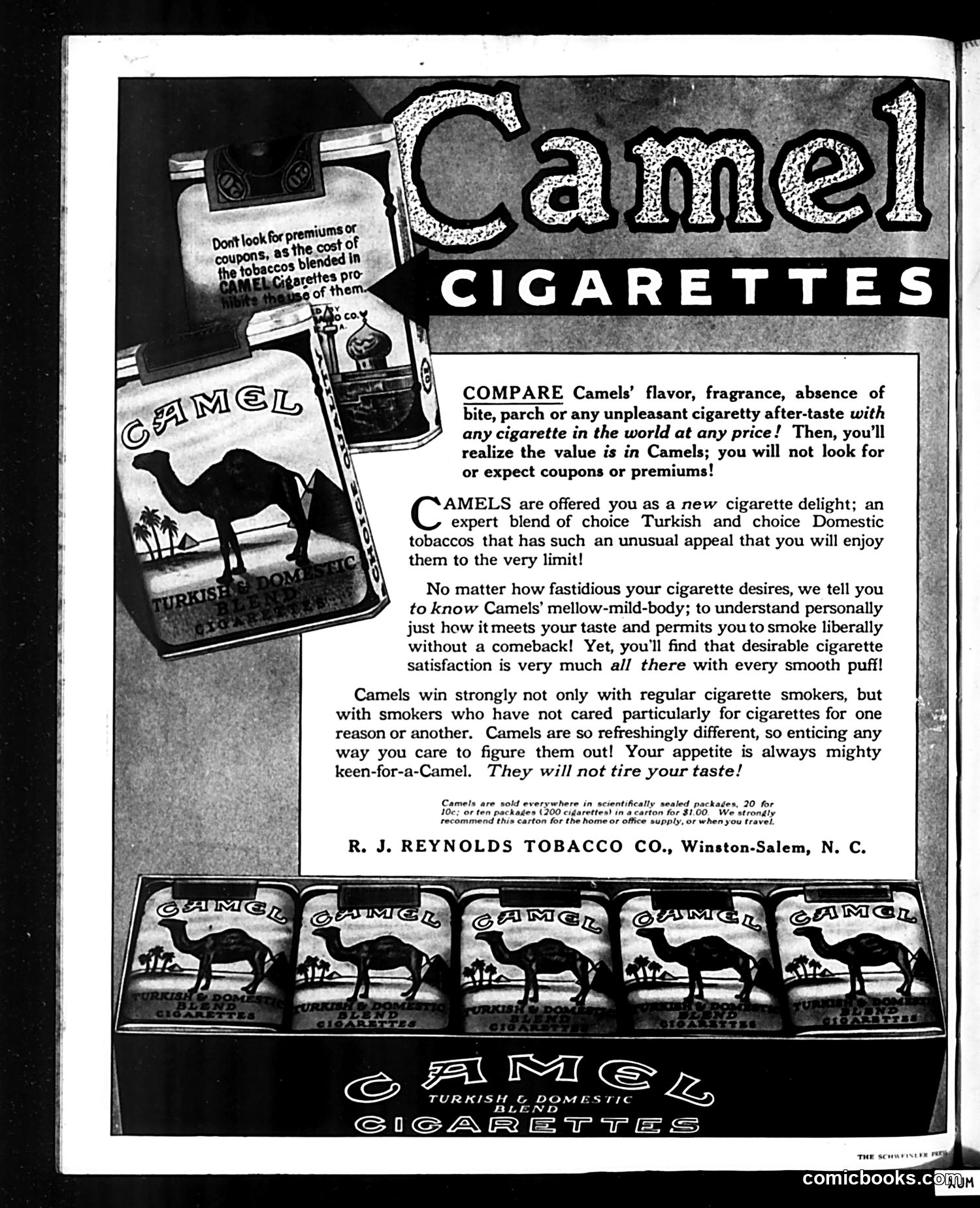
This is **not a cartoon or satire**—it's a full-page **cigarette advertisement** for Camel cigarettes by R.J. Reynolds Tobacco Company, appearing in *Judge* magazine. The ad features the iconic Camel logo (a dromedary camel in desert scenery) and makes marketing claims typical of 1920s tobacco advertising: that Camels have superior "flavor, fragrance" and won't "tire your taste." It emphasizes that buyers shouldn't expect coupons or premiums—they're paying for quality tobacco instead. The text highlights Camels as a "new cigarette delight" blending Turkish and domestic tobaccos, and claims the product appeals even to non-smokers. **For modern readers**: This represents an era when cigarette companies advertised openly in mainstream publications without health warnings, targeting broad audiences including those skeptical of smoking. The appeal to quality and sophistication—rather than honesty about addiction or health risks—was standard practice.