
Judge, 1916-07-08 · page 9 of 28
Judge — July 8, 1916 — page 9: what you’re looking at
What you’re looking at
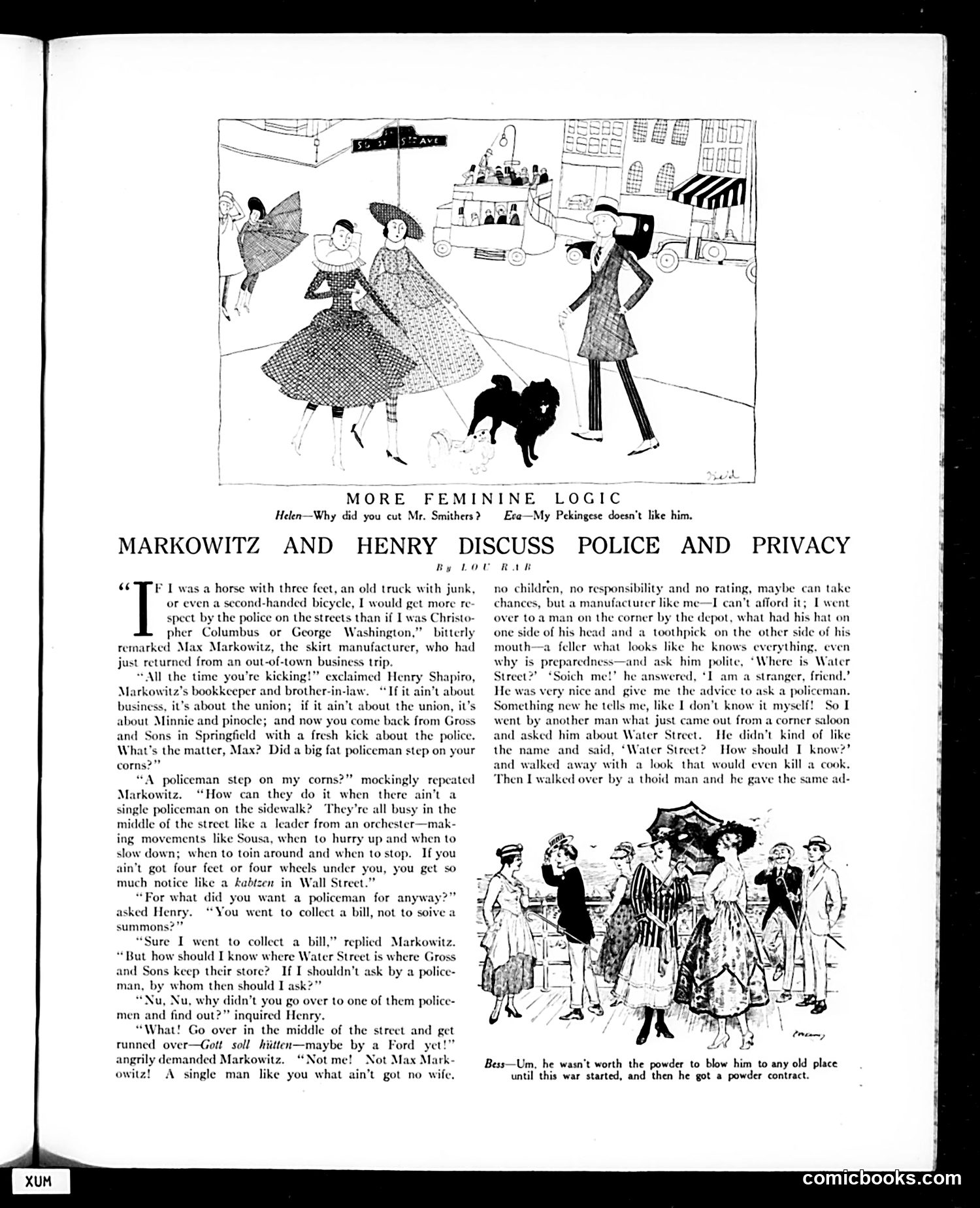
**The Cartoons:** The top cartoon satirizes women's superficial logic: a woman rejects a suitor solely because her Pekingese dog dislikes him—absurd reasoning played for humor. **The Main Article:** This is a humorous dialogue between Max Markowitz (a skirt manufacturer) and Henry Shapiro (his bookkeeper/brother-in-law) complaining about police inefficiency. Markowitz gripes that police only direct traffic in street centers (like orchestra conductors) and ignore pedestrians trying to ask directions. When he needed to find Water Street, he couldn't safely approach a busy officer and received unhelpful responses from random strangers instead. **The Satire:** The piece mocks early 20th-century urban police priorities—traffic control over public service—while showcasing Yiddish-inflected dialogue typical of Judge's ethnic humor. The casual mention of "Gott soll hütten" and distinctive speech patterns mark these as Jewish immigrant characters, reflecting Judge's comedic portrayal of immigrant communities. **Bottom Cartoon:** The caption about powder contracts appears unrelated to the main text, likely continuing another article.
📄 Transcribed text from this page (OCR, searchable)
Machine-transcribed from the original scan — historical spelling and the odd misread are preserved.
MORE FEMININE Helen—Why did you cut Mr. Smithers? LOGIC Eva—My Pekingese doesn't like him. MARKOWITZ AND HENRY DISCUSS POLICE AND PRIVACY By “ F I was a horse with three feet, an old truck with junk, , L would get more re: spect by the police on the strects ‘than if I was Christo- pher Columbus or George Washington,” bitterly remarked Max Markowitz, the skirt manufacturer, who had just returned from an out-of-town business trip. “All the time you're kicking!” exclaimed Henry Shapiro, Markowitz’s bookkeeper and brother-in-law. “If it ain’t about business, it’s about the union; if it ain’t about the union, it’s about Minnie and pinocle; and now you come back from Gross. and Sons in Springfield with a fresh kick about the police. What's the matter, Max? Did a big fat policeman step on your corns?” “A policeman step on my corns?” mockingly repeated Markowitz. “How can they do it when there ain't a single policeman on the sidewalk? They're all busy in the middle of the street like a leader from an orchester—mak- ing movements like Sousa, when to hurry up and when to slow down; when to toin around and when to stop. If you ain't got four fect or four wheels under you, you get so much notice like a kadtzen in Wall Street.” For what did you want a policeman for anyway?” asked Henry. “You went to collect a bill, not to soive a summons?” “Sure I went to collect a bill,” replied Markowitz. “But how should I know where Water Street is where Gross and Sons keep their store? If I shouldn't ask by a police- man, by whom then should I ask?” “Nu, Nu, why didn’t you go over to one of them police- men and find out?” inquired Henry. “What! Go over in the middle of the street and get runned over—Gott soll hiitlen—maybe by a Ford yet!” angrily demanded Markowitz. “Not me! Not Max Mark- owitz! A single man like you what ain’t got no wife, Loe RAR no children, no responsibility and no rating, maybe can take chances, but a manufacturer like me—I can’t afford it; [went over toa man on the corner by the depot, what had his hat on one side of his head and a toothpick on the other side of his mouth—a feller what looks like he knows everything, even why is preparedness—and ask him pelt “Where is Water Street?” ‘Soich me!’ he answered, ‘I am a stranger, friend.’ He was very nice and give me the au to ask a policeman, Something new he tells me, like I don’t know it myself! So I went by another man what just came out from a corner saloon and asked him about Water Street. He didn’t kind of like the name and said, ‘Water Street? How should I know?’ and walked away with a look that would even kill a cook. ‘Then I walked over by a thoid man and he gave the same ad- Bess—Um, he wasn't worth the powder to blow him to any old place until this war started, and then he got a powder contract. comicbooks.com