
Judge, 1916-07-08 · page 10 of 28
Judge — July 8, 1916 — page 10: what you’re looking at
What you’re looking at
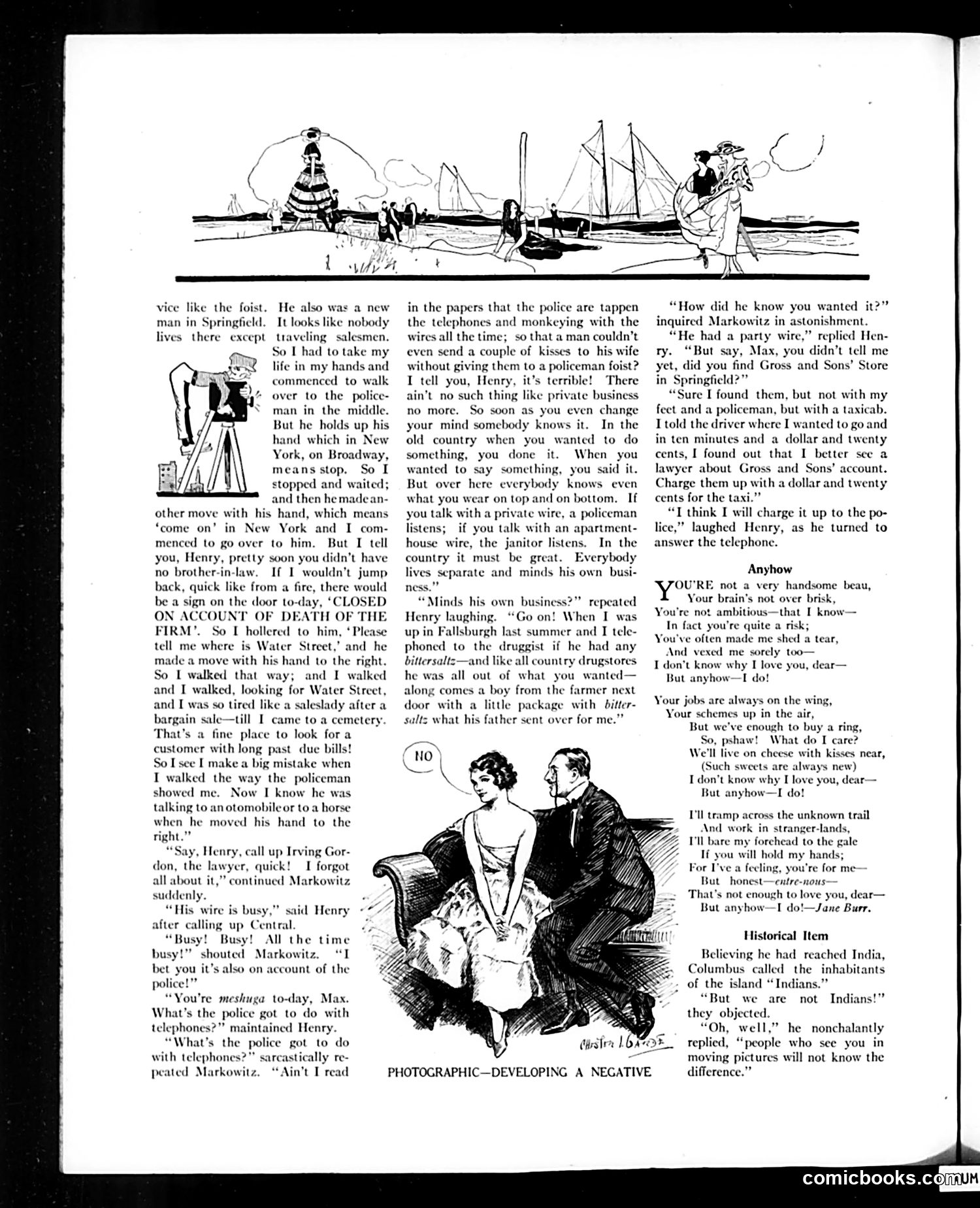
This Judge magazine page satirizes early 20th-century anxieties about government surveillance and loss of privacy. The narrative features a Yiddish-accented character named Markowitz complaining about police controlling traffic via hand signals on Broadway, which he absurdly interprets as evidence of broader government interference in citizens' lives. The satire works on multiple levels: Markowitz conflates unrelated issues (traffic cops, telephone monopolies, party-line eavesdropping) into a paranoid conspiracy theory about privacy invasion. The "Historical Item" references Columbus and "Indians," suggesting the satirist is mocking unfounded immigrant anxieties by comparing them to Columbus's miscalculation. The humor relies on ethnic caricature—the malapropisms ("meshuga," "foist," "bittersaltz") and the working-class Jewish perspective—to distance "respectable" readers from these concerns, implying Markowitz's worries are immigrant overreaction rather than legitimate criticism of emerging surveillance infrastructure.
📄 Transcribed text from this page (OCR, searchable)
Machine-transcribed from the original scan — historical spelling and the odd misread are preserved.
He also was a new It looks like nobody traveling salesmen. So I had to take my life in my hands and commenced to walk over to the police- man in the middle. But he holds up his hand which in New York, on Broadway, me stop. So I stopped and waited; nd then hemadean- other move with his hand, which means ‘come on’ in New York and I com- menced to go over to him. But I tell you, Henry, pretty soon you didn’t have no brother-in-law. If I wouldn’t jump back, quick like from a fire, there would be a sign on the door to-day, ‘CLC ON ACCOUNT OF DEATH OF THE FIRM’. So I hollered to him, ‘Please tell me where is Water Street,’ and he made a move with his hand to the right. So I walked that way; and I walked and I walked, looking for Water Street, and I was so tired like a saleslady after a argain sale—till I came to a cemetery. That’s a fine place to look fora customer with long past due bills! So I see I make a big mistake when I walked the way the policeman showed me. Now I know he was talking to an otomobile or to a horse when he moved his hand to the right. “Say, Henry, call up Irving Gor- don, the lawyer, quick! I forgot all about it,” continued Markowitz suddenly. “His wire is busy,” said Henry after calling up Central. “Busy! Busy! All the time shouted Markowitz, “I bet you it’s also on account of the vice like the foist. man in Springfield. lives there except police “You're meshuga to-day, Max. What's the police got to do with telephones?” maintained Henry. “What's the police got to do with telephones?” sarcastically re- peated Markowitz. “Ain't I read in the papers that the poli the telephones and monkeying with the wires all the time; so that a man couldn’t even send a couple of kisses to his wife without giving them to a policeman foist? I tell you, Henry, it’s terrible! There ain’t no such thing like private business no more. So soon as you even change your mind somebody knows it. In the ¢ are tappen old country when you wanted to do something, you done i wanted to say something, But over here everybody knows even what you wear on top and on bottom. If you talk with a private wire, a policeman When you ou said it. listens; if you talk with an apartment- house wire, the janitor listens. In the country it must be great. Everybody lives separate and minds his own busi. ness.”” “Minds his own business?” repeated Henry laughing. “Go on! When I was up in Fallsburgh last summer and I tele- phoned to the druggist if he had any bittersaltz—and like all country drugstore: he was all out of what you wanted— along comes a boy from the farmer next door with a little package with bitter- salts what his father sent over for me.” PHOTOGRAPHIC—DEVELOPING A NEGATIVE “How did he know you wanted it?” inquired Markowitz in astonishment. “He had a party wire,” replicd Hen- ry But say, Max, you didn’t tell me yet, did you find Gross and Sons’ Store in Springfield?” “Sure [found them, but not with my fect and a policeman, but with a taxicab. I told the driver where I wanted to go and in ten minutes and a dollar and twenty cents, I found out that I better see a lawyer about Gross and Sons’ account. Charge them up with a dollar and twenty cents for the taxi “T think I will charge it up to the po- lice,” laughed Henry, as he turned to answer the telephone. Anyhow OU'RE not a very handsome beau, Your brain's not over brisk, You're not ambitious—that I know— In fact you're quite a risk; You've often made me shed a tear, And vexed me sorely too— I don’t know why I love you, dear— But anyhow—I do! Your jobs are always on the wing, Your schemes up in the air, But we've enough to buy a ring, pshaw! What do I care? We'll live on cheese with kisses near, (Such sweets are always new) I don’t know why I love you, dear— But anyhow—I do! L'll tramp across the unknown trail And work in stranger-lands, I'll bare my forehead to the gale Tf you will hold my hands; For I've a feeling, you're for me But honest—entre-nous— That's not enough to love you, dear— But anyhow—I do!—Jane Burr. Historical Item Believing he had reached India, Columbus called the inhabitants of the island “Indians.” “But we are not they objecte: “Oh, well,” he nonchalantly replied, “people who see you in moving pictures will not know the difference.” Indians!” comicbooks.comi