
Judge, 1916-07-08 · page 6 of 28
Judge — July 8, 1916 — page 6: what you’re looking at
What you’re looking at
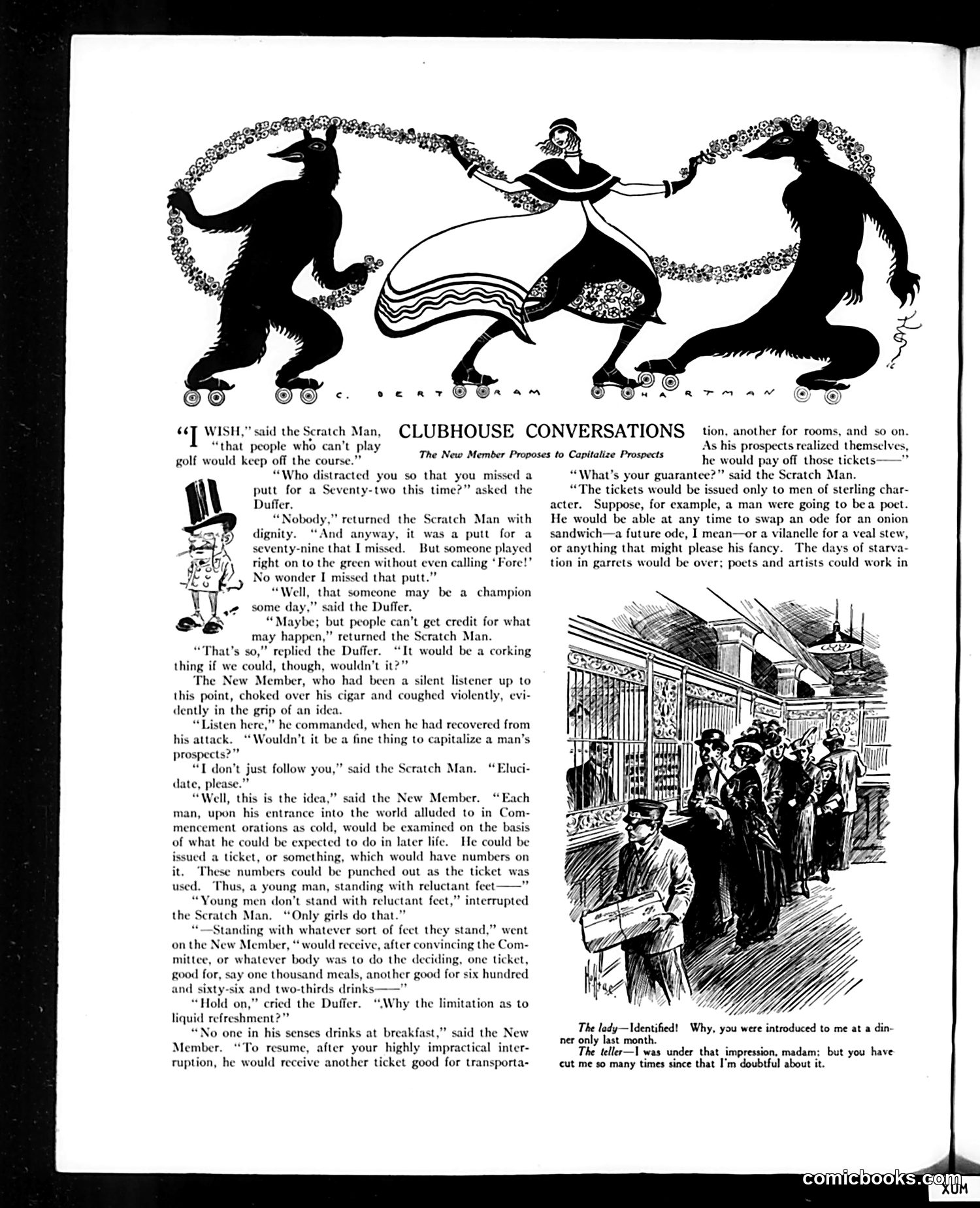
This Judge magazine piece satirizes an idealistic proposal by a naive "New Member" at an exclusive golf club. The conversation between three golfers—the Scratch Man (skilled player), the Duffer (poor player), and the New Member—centers on a scheme to issue "tickets" representing a person's future earning potential at birth. The New Member proposes guaranteeing young people access to meals, drinks, transportation, and housing based on predicted character and prospects. They could exchange future accomplishments (poems, artwork) for present necessities. The established club members mock this utopian idea as impractical—particularly questioning guarantees of character and the absurd limitation on drinks. The satire targets Progressive Era social reform schemes and naive economic proposals that ignore human nature, corruption, and practical enforcement problems. The bottom cartoon about mistaken social recognition adds gentle commentary on clubhouse pretension.
📄 Transcribed text from this page (OCR, searchable)
Machine-transcribed from the original scan — historical spelling and the odd misread are preserved.
CLUBHOUSE CONVERSATIONS The New Member Proposes to Capitalize Prospects golf would keep off the course.” “Who distracted you so that you missed a putt for a Seventy-two this time?” asked the Duffer. “Nobody,” returned the Scratch Man with 5) dignity. ‘‘And anyway, it was a putt for a ane seventy-nine that I missed. But someone played gFoly) right on to the green without even calling ‘Fore!’ ee b> No wonder I missed that putt.” y “Well, that someone ma 42 some day,” said the Duffer. Qa . “Maybe; but people can’t get credit for what may happen,” returned the Scratch Man. “That's so,” replied the Duffer thing if we could, though, wouldn’t it?” “It would be a corking The New Member, who had been a silent listener up to this point, choked over his cigar and coughed violently, evi- dently in the grip of an i¢ “Listen here,” he commanded, when he had recovered from his attack. “Wouldn't it be a fine thing to capitalize a man’s Prospects?” “T don’t just follow you,” date, pleas “Well, this is the idea man, upon his entrance into the world mencement orations as cold, would be examined on the basis of what he could be expected to do in later life. He could be issued a ticket, or something, which would have numbers on it. These numbers could be punched out as the ticket was used. Thus, a young man, standing with reluctant feet sd “Young men don’t stand with reluctant feet,” interrupted the Scratch Man. “Only girls do that.” “—Standing with whatever sort of fect they stand,” went on the New Member, “ would receive, after convincing the Com- mittee, or whatever body was to do the deciding, one ticket, good for, say one thousand meals, another good for six hundred and sixty-six and two-thirds drinks— “Hold on,” cried the Duffer. “Why the limitation as to liquid refreshment?” “No one in his senses drinks at breakfast,” said the New Member. “To resume, after your highly impractical inter- ruption, he would receive another ticket good for transporta- be a champion aid the Scratch Man. “Eluci- said the New Member. ach alluded to in Com- tion, another for rooms, and so on. As his prospects realized themselve: he would pay off those tickets ——” “What’s your guarantee?” said the Scratch Man. “The tickets would be issued only to men of sterling char- acter. Suppose, for example, a man were going to bea poet. He would be able at any time to swap an ode for an onion sandwich—a future ode, I mean—or a vilanelle for a veal stew, or anything that might please his fancy. The days of star tion in garrets would be over; poets and artists could work in The lady—Identified! Why, you were introduced to me at a din- ner only last month. The teller—1 was under that impression, madam; but you have cut me so many times since that I'm doubtful about it.