
Judge, 1916-07-08 · page 8 of 28
Judge — July 8, 1916 — page 8: what you’re looking at
What you’re looking at
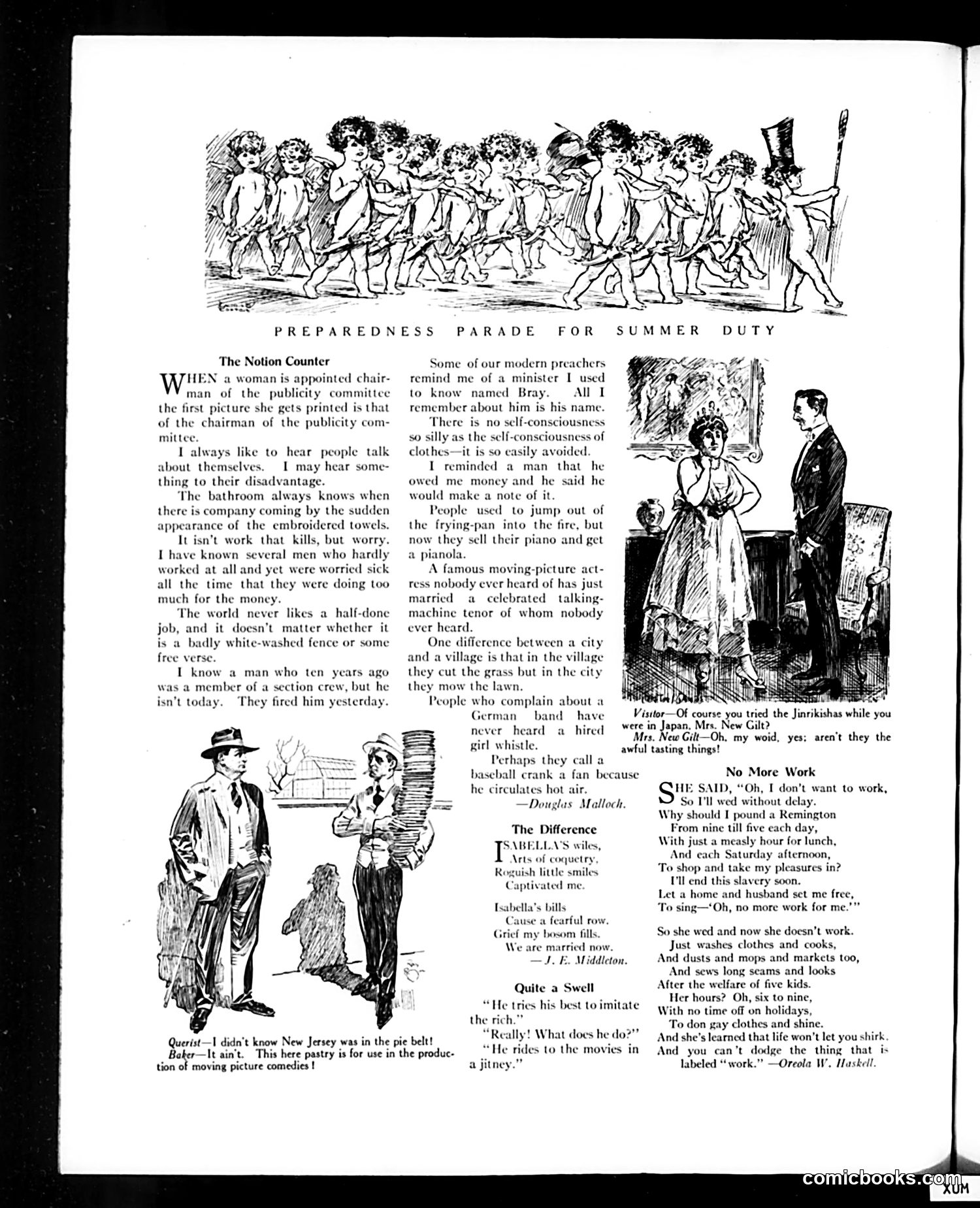
This page from *Judge* magazine contains several short satirical pieces mocking early 1900s social conventions and gender roles. **"Preparedness Parade for Summer Duty"** (top): A humorous illustration of cherubs/putti marching, likely satirizing overly earnest "preparedness" campaigns of the era. **"The Notion Counter"**: A rambling commentary on human nature—vanity, self-consciousness about clothes, worry, and social pretense. The anecdote about a man fired from a section crew after ten years away satirizes job insecurity. **"No More Work"**: The main satirical point: a woman refuses to work at a typewriter, preferring marriage for "freedom," only to discover housework with five children means laboring from 6 a.m. to 9 p.m. with no days off. The satire critiques both women's unrealistic expectations of marriage and society's devaluation of domestic labor as "work." The other pieces ("The Difference," "Quite a Swell") offer light observations on courtship and class pretension. The quarry joke references New Jersey's pastry as movie prop material.
📄 Transcribed text from this page (OCR, searchable)
Machine-transcribed from the original scan — historical spelling and the odd misread are preserved.
PREPAREDNESS The Notion Counter a woman is appointed chair- n of the publicity committee the first picture she gets printed is that of the chairman of the publicity com- mittee. I always like to hear people talk about themselves. [1 may hear some- thing to their disadvantage. The bathroom always knows when there is company coming by the sudden appearance of the embroidered towels. It isn’t work that kills, but worry. Ihave known several men who hardly worked at all and yet were worried sick all the time that they were doing too much for the mone: The world never likes a half-done job, and it doesn’t: matter whether it is a badly white-washed fence or some free verse. I know a man who ten years ago was a member of a section crew, but he isn’t today. They fired him yesterday. Querist—I didn’t know New Jersey was in the pie belt! Baker—It ain't. This here pastry is for use in the produc- tion of moving picture comedies ! PARADE FOR Some of our modern preachers remind me of a minister I used to know named Bray. All I remember about him is his name. There is no self-consciousness so silly as the self-consciousness of clothes—it is so casily avoided. I reminded a man that he owed me money and he said he would make a note of it People used to jump out of the frying-pan into the fire, but now they sell their piano and get a pianola. A famous moving-picture act- ress nobody ever heard of has just married celebrated talking- machine tenor of whom nobody ever heard. One difference between a city and a village is that in the village they cut the grass but in the city they mow the lawn. People who complain about a German band have never heard a hired girl whistle. Perhaps they call a baseball crank a fan because he circulates hot air. —Douglas Malloch. The Difference I ABELLA'S wiles, Arts of coquetry Roguish little smiles Captivated Isabella’s bills Cause a fearful row. my bosom fills We are married now. —J. E. Middleton. Quite a Swell “He tries his best to imitate the rich.” “Really! What does he do?” “He rides to the movies in ajitney.” SUMMER were in Mrs. awful tasting things! DUTY een. Mrs. New Gilt? Gilt—Oh, my woid, yes; aren't they the No More Work HE SAID, “Oh, I don’t want to work, So I'll wed without de Why should I pound a Remington From nine till five each day, With just a measly hour for lunch, And each Saturday afternoon, To shop and take my pleasures in? T'll end this slavery soon. Let a home and husband set me free, To sing—‘Oh, no more work for me.’" So she wed and now she doesn’t work. Just washes clothes and cooks, And dusts and mops and markets too, And sews long seams and looks After the welfare of five kids. Her hours? Oh, six to nine, With no time off on holiday: To don gay clothes and shine. And she's learned that life won't let you shirk And you can’t dodge the thing that is labeled “work.” —Oreola W. Haskell