
Judge, 1916-07-08 · page 12 of 28
Judge — July 8, 1916 — page 12: what you’re looking at
What you’re looking at
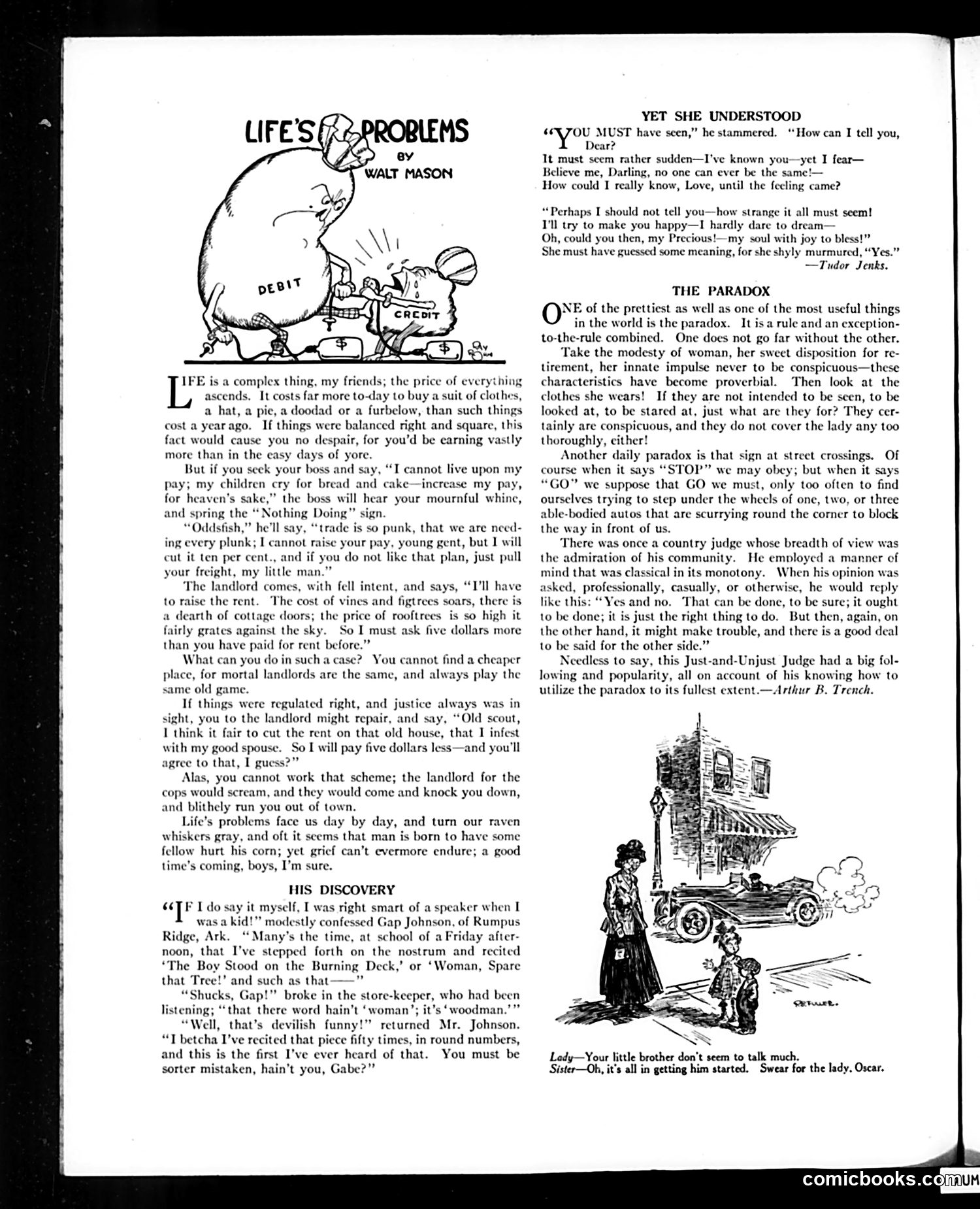
The cartoon depicts a bloated figure labeled "DEBIT" crushing a tiny figure labeled "CREDIT," illustrating the essay's theme: the cost of living has risen dramatically, but wages have not kept pace. Mason's essay satirizes the economic squeeze facing ordinary workers. Landlords raise rents citing increased property costs; employers cut wages claiming business is bad ("trade is punk"). Workers have no recourse—they cannot negotiate rent reductions or find cheaper housing, as landlords control the system and can call police to enforce evictions. The piece critiques economic inequality and powerlessness. While acknowledging life's hardships, Mason offers resigned optimism ("a good time's coming, boys"). The page also includes lighter pieces: "His Discovery" (a rustic anecdote about misremembering poetry), and "Yet She Understood" (romantic verse). These contrast with Mason's pointed social commentary on class and economic injustice.
📄 Transcribed text from this page (OCR, searchable)
Machine-transcribed from the original scan — historical spelling and the odd misread are preserved.
IFE is a complex thing, my friends; the price of everything L ascends. It costs far more to-day to buy a suit of cloth a hat, a pie, a doodad or a furbelow, than such things cost a yearago. If things were balanced right and square, this fact would cause you no despair, for you’d be earning vastly more than in the easy days of yore. But if you seck your boss and say upon my pay; my children cry for bread and cake—increase my pay, for heaven's sake,” the boss will hear your mournful whine, and spring the “Nothing Doing” sign. “Oddsfish,” he'll say, “trade is so punk, that we are need- ing every plunk; I cannot raise your pay, young gent, but I will cut it ten per cent., and if you do not like that plan, just pull your freight, my little ma: The landlord comes, with fell intent, and M have to raise the rent. The cost of vines and figtrees soars, there is a dearth of cottage doors; the price of rooftrees is so high it fairly grates against the sky. So I must ask five dollars more than you have paid for rent before.” What can you do in such a case? You cannot find a cheaper place, for mortal landlords are the same, and always play the same old game. If things were regulated right, and justice always was in sight, you to the landlord might repair, and say, “ I think it fair to cut the rent on that old house, that I with my good spouse. So I will pay five dollars less—and you'll agree to that, I guess?” Alas, you cannot work that scheme; the landlord for the cops would scream, and they would come and knock you down, and blithely run you out of town. Life’s problems face us day by day, and turn our raven whiskers gray, and oft it seems that man is born to have some fellow hurt his corn; yet grief can’t evermore endure; a good time’s coming, boys, I’m sure. HIS DISCOVERY it myself, I right smart of a speaker when I was a kid!” modestly confessed Gap Johnson, of Rumpus Ridge, Ark. ‘‘Many’s the time, at school of a Friday after- noon, that I’ve stepped forth on the nostrum and recited ‘The Boy Stood on the Burning Deck,’ or ‘Woman, Spare that Tr and such as that——" “Shucks, Gap!” broke in the store-keeper, who had been listening; “that there word hain’t ‘woman’; it’s ‘woodman. “Well, that’s devilish funny!” returned Mr. Johnson. “T betcha I've recited that piece fifty times, in round number: and this is the first I've ever heard of that. You must be sorter mistaken, hain’t you, Gabe?” STF Ido YET SHE UNDERSTOOD ‘OU MUST have scen,” he stammered. “How can I tell you, De It must scem rather sudden—I've known you—yet I fear— Believe me, Darling, no one can ever be the same! How could I really know, Love, until the feeling came? “Perhaps I should not tell you—how strange it all must seem! T'll try to make you happy—I hardly dare to dream— Oh, could you then, my Precious!—my soul with joy to bless!” She must have guessed some meaning, for she shyly murmured, “Yes.” —Tudor Jenks. THE PARADOX NE of the prettiest as well as one of the most useful things in the world is the paradox. It is a rule and an exception- to-the-rule combined. One does not go far without the other. Take the modesty of woman, her sweet disposition for re- tirement, her innate impulse never to be conspicuous—these characteristics have become proverbial. Then look at the clothes she wears! If thi y are not intended to be scen, to be looked at, to be stared at, just what are they for? They cer- tainly are conspicuous, and they do not cover the lady any too thoroughly, either! Another daily paradox is that sign at street crossings. Of course when it says “STOP” we may obey; but when it says “GO” we suppose that GO we must, only too often to find ourselves trying to step under the wheels of one, two, or three able-bodied autos that are scurrying round the corner to block the way in front of us. There was once a country judge whose breadth of view was the admiration of his community. He employed a manner of mind that was classical in its monotony. When his opinion was asked, professionally, casually, or otherwise, he would reply like this: “Yes and no. That can be done, to be sure; it ought to be done; it is just the right thing to do. But then, again, on the other hand, it might make trouble, and there is a good deal to be said for the other side.” Needless to say, this Just-and-Unjust Judge had a big fol- lowing and popularity, ail on account of his knowing how to utilize the paradox to its fullest extent.—Arthur B. Trench. Ledy—Your little brother don’t seem to talk much. Sister—Oh, it’s all in getting him started. Swear for the lady, Oscar. comicbooks.comily