
Judge, 1916-07-08 · page 17 of 28
Judge — July 8, 1916 — page 17: what you’re looking at
What you’re looking at
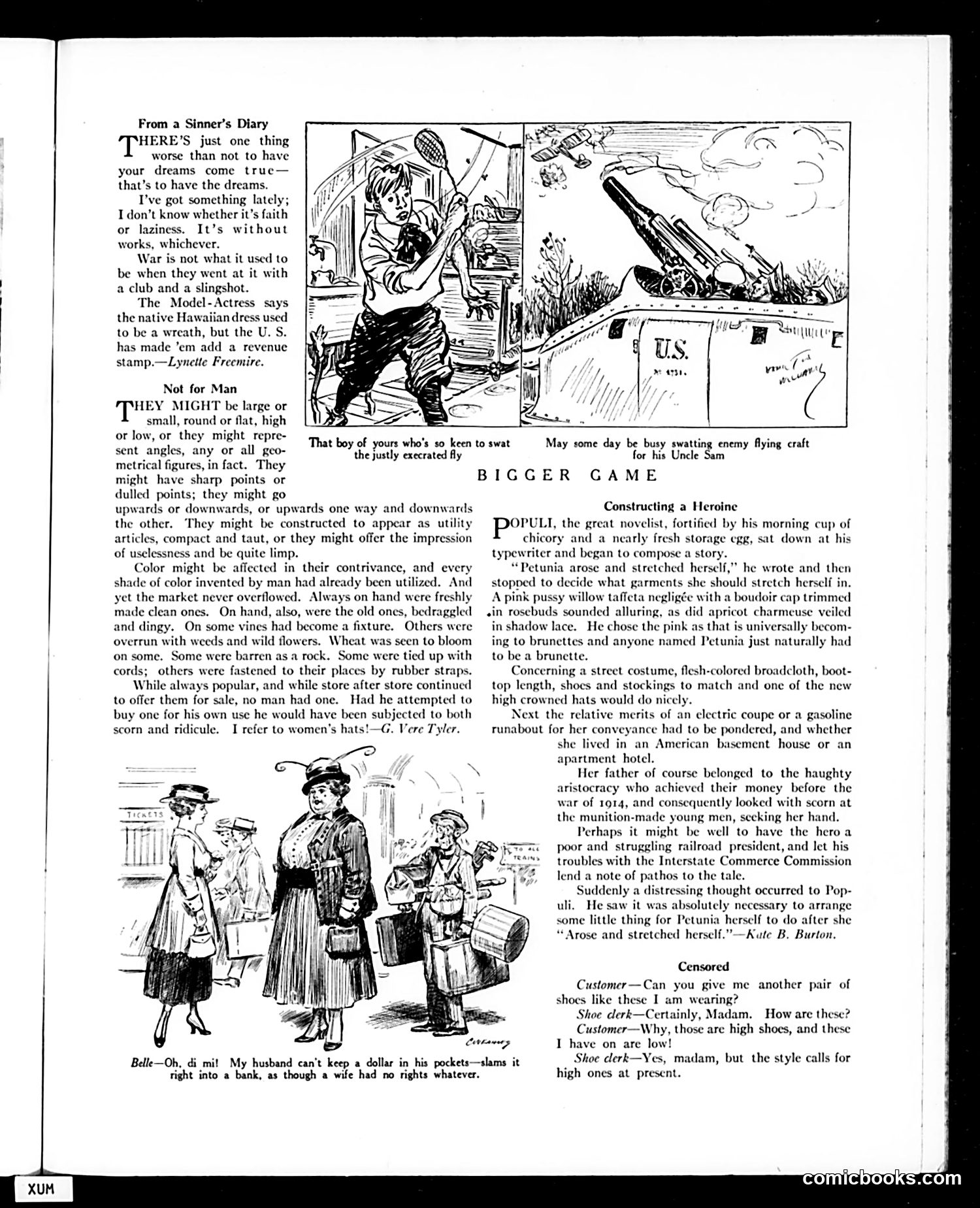
This page contains three satirical pieces mocking early 20th-century American life and literature. **"From a Sinner's Diary"** offers cynical observations about modern warfare (no longer hand-to-hand combat) and consumer culture—specifically that Hawaiian wreaths, once natural items, now require U.S. revenue stamps, reflecting commercialization. **"Not for Man"** is a lengthy satirical essay about women's hats. The joke: hats are perpetually manufactured, sold, and worn by women, yet no man would dare purchase one for himself without ridicule. It's commentary on gendered fashion norms and the absurdity of hat-obsessed female consumerism. **"Constructing a Heroine"** mocks overwrought 1920s fiction writing. A novelist ("Popult") laboriously decides trivial details about his female character Petunia—her negligée color, shoes, car type—but realizes he's forgotten to give her anything meaningful to *do* in the story. It satirizes how female characters in popular literature are defined by appearance and romance rather than agency. The cartoon illustrations support these themes about gender, consumption, and social pretension.
📄 Transcribed text from this page (OCR, searchable)
Machine-transcribed from the original scan — historical spelling and the odd misread are preserved.
XUM From a Sinner’s Diary HERE’S just one thing worse than not to have your dreams come true— that’s to have the dreams. I’ve got something lately; I don’t know whether it’s faith or laziness. It’s without works, whichever. War is not what it used to be when they went at it with a club and a slingshot. The Model-Actress says the native Hawa to be a wreath, but the U. S. has made ’em add a revenue stamp.—Lynetle Freemire. Not for Man HEY MIGHT be large or small, round or flat, high or low, or they might repre- sent angles, any or all gco- metrical figures, in fact. They might have sharp points or dulled points; they might go upwards or downwards, or upwards one way and downwards the other. They might be constructed to appear as utility articles, compact and taut, or they might offer the impression of uselessness and be quite limp. Color might be affected in their contrivance, and every shade of color invented by man had already been utilized. And yet the market never overflowed. Always on hand were freshly made clean ones. On hand, also, were the old ones, bedraggled and dingy. On some vines had become a fixture. Others were overrun with weeds and wild flowers. Wheat was seen to bloom on some. Some were barren as a rock. Some were tied up with others were fastened to their places by rubber straps. hile always popular, and while store after store continued to offer them for sale, no man had one. Had he attempted to buy one for his own use he would have been subjected to both scorn and ridicule. I refer to women’s hats!—G. Vere Tyler. the justly execrated Ay Cebbavees Belle—Oh, di mi! My husband can’t keep a dollar in his pockets—slams it right into a bank, as though a wife had no rights whatever. That boy of yours who's so keen to swat May some day be busy swatting enemy flying craft for his Uncle Sam BIGGER GAME Constructing a Heroine OPULT, the great novelist, fortified by his morning cup of chicory and a nearly fresh storage egg, sat down at his typewriter and began to compose a story. “Petunia arose and stretched herself,” he wrote and then stopped to decide what garments she should stretch herself in. A pink pussy willow taffeta negligée with a boudoir cap trimmed in rosebuds sounded alluring, as did apricot charmeuse veiled in shadow lace. He chose the pink as that is universally becom- ing to brunettes and anyone named Petunia just naturally had to be a brunette. Concerning a street costume, flesh-colored broadcloth, boot- top length, shoes and stockings to match and one of the new high crowned hats would do nicely. Next the relative merits of electric coupe or a gasoline runabout for her conveyance had to be pondered, and whether she lived in an American basement house or an apartment hotel. Her father of course belonged to the haughty aristocracy who achieved their money before the war of 1914, and consequently looked with scorn at the munition-made young men, secking her hand. Perhaps it might be well to have the hero a poor and struggling railroad president, and let his troubles with the Interstate Commerce Commission lend a note of pathos to the tale. Suddenly a distressing thought occurred to Pop- uli, He saw it was absolutely necessary to arrange some little thing for Petunia herself to do after she “Arose and stretched herself.” —Aute B. Burton, Censored Customer—Can you give me another pair of shoes like these I am wearing? Shoe derk—Certainly, Madam. How are the: Customer—Why, those are high shoes, and these I have on are low! Shoe derk—Yes, madam, but the style calls for high ones at present.