
A complete issue · 28 pages · 1916
Judge — April 8, 1916
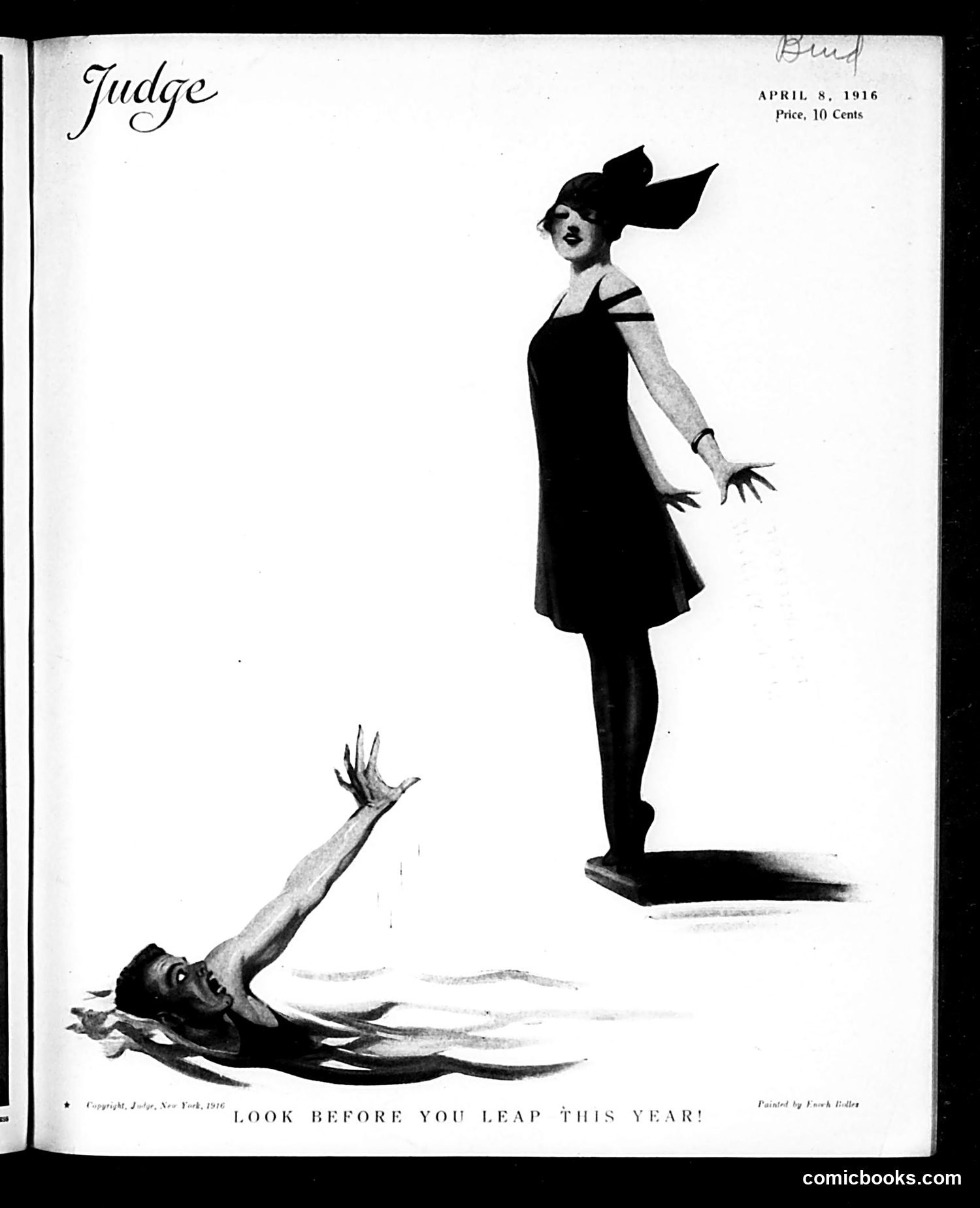
This Judge magazine cover from April 8, 1916 depicts a cautionary scene relevant to that election year. A elegantly dressed woman stands confidently on a platform while a man below reaches upward desperately, appearing to have already leaped or fallen. The caption "Look Before You Leap This Year!" serves as political advice, likely warning voters to carefully consider their choices in the 1916 presidential election rather than act impulsively. The visual metaphor—one figure stable and composed, the other in distress—suggests consequences of hasty decision-making. Without additional context identifying the specific figures, the cartoon appears to be general commentary on the importance of deliberate voting rather than commentary on particular candidates or issues.
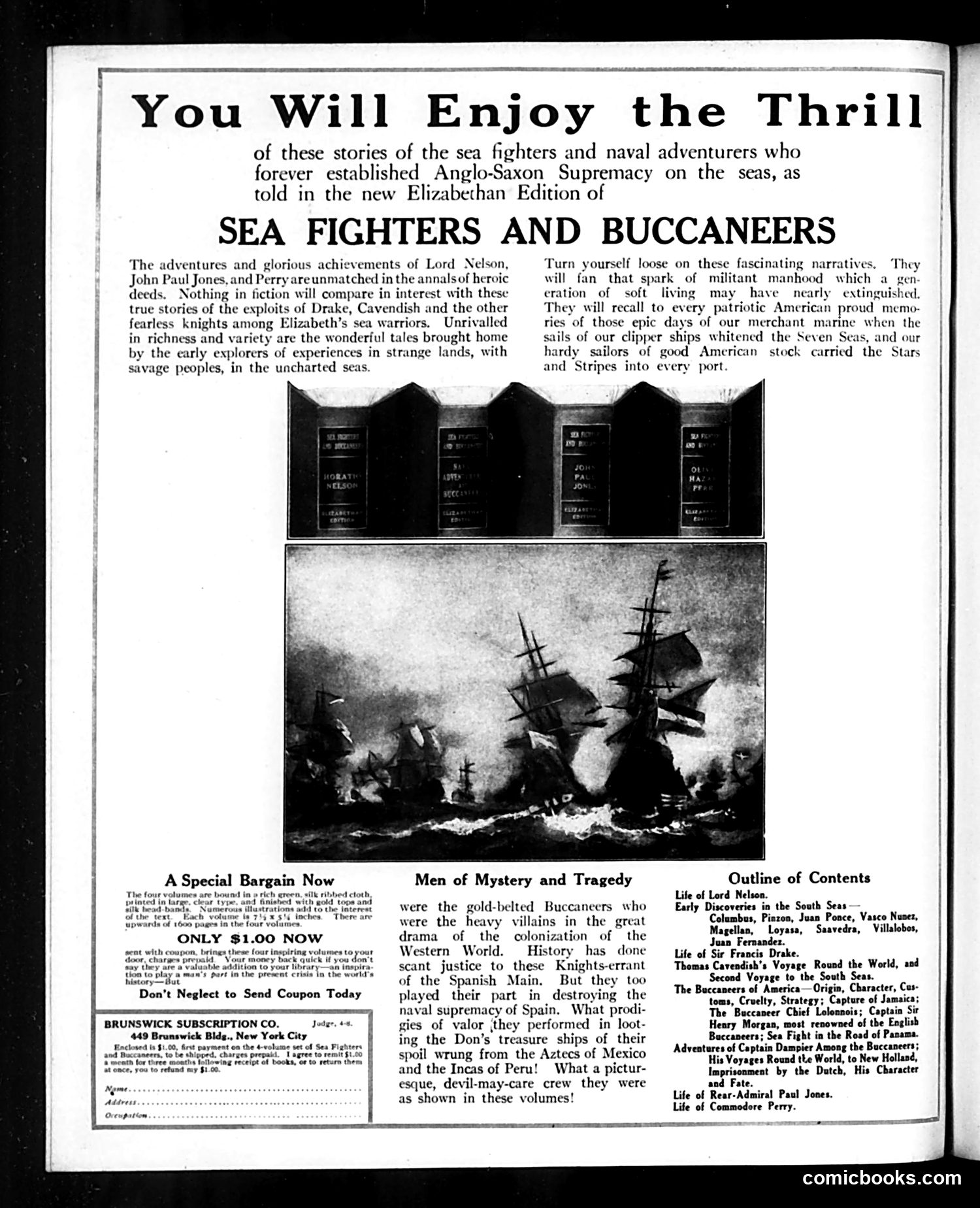
This page is primarily **advertising, not satire or cartoon content**. It's a full-page advertisement for "Sea Fighters and Buccaneers," an Elizabethan Edition book set published by Brunswick Subscription Co. The ad promotes stories about historical naval figures—Lord Nelson, John Paul Jones, and Perry—and famous privateers like Drake and the Buccaneers who supposedly defended Anglo-Saxon naval supremacy. The dramatic illustration shows silhouetted sailing ships in naval combat. The text appeals to patriotic American sentiment, referencing "merchant marine" ships and the Stars and Stripes. A subscription coupon appears at bottom left. This reflects early-20th-century marketing that weaponized historical narratives to promote national pride and commercial book sales.
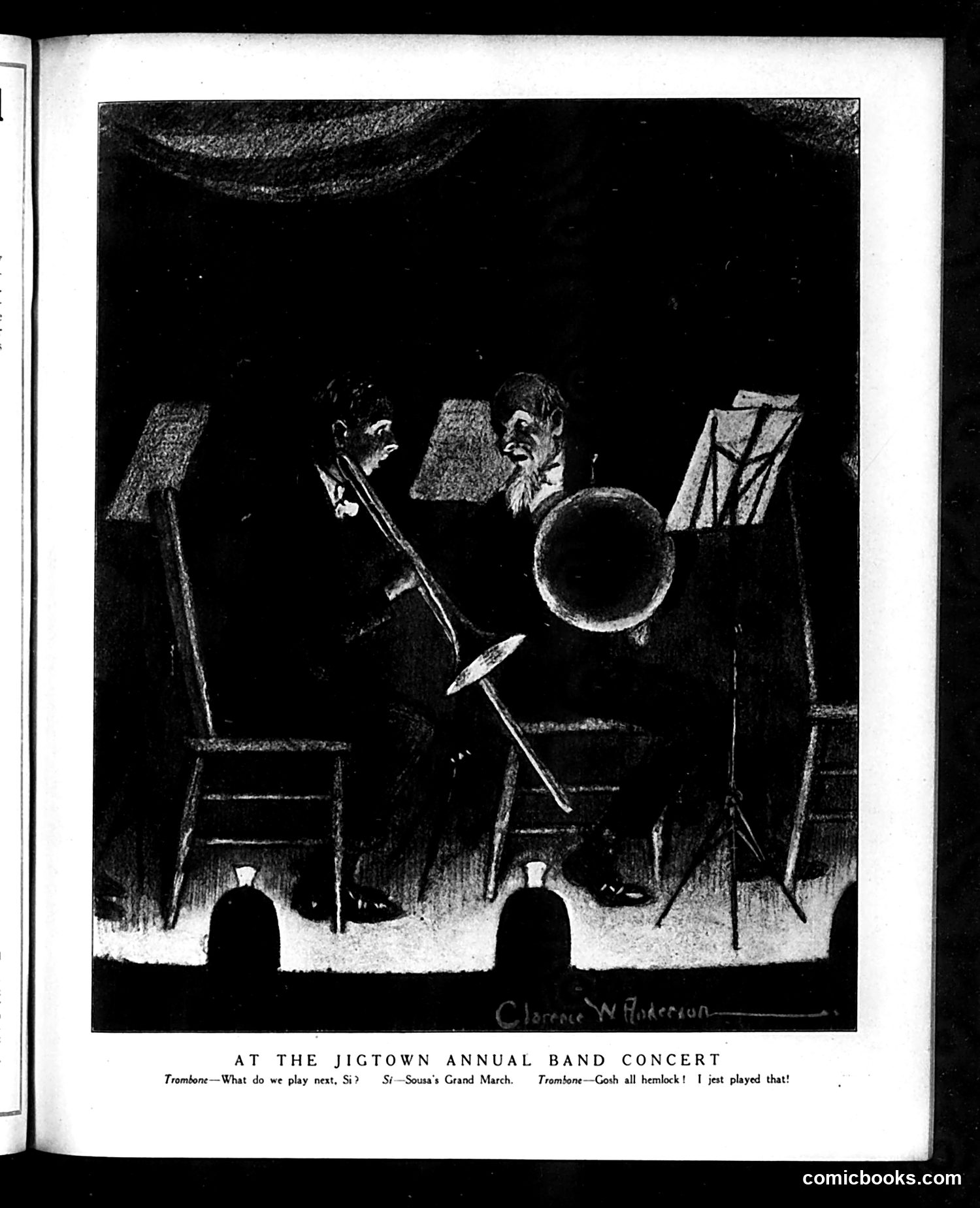
This cartoon satirizes a amateur or community band performance. The title "Jigtown" appears to reference a colloquial (and likely derogatory) place name, suggesting mockery of a working-class or rural community. The humor centers on musical incompetence: one musician asks "What do we play next, Sir?" while another responds about "Sousa's Grand March," and a trombonist boasts "Gosh all hemlock! I jest played that!"—indicating the musicians are confused about what piece they're performing and lack basic coordination. The cartoonist ridicules both the performers' ineptitude and, by extension, their social class. This reflects Judge magazine's typical approach: satirizing working-class culture and institutions for educated, elite readers' amusement.
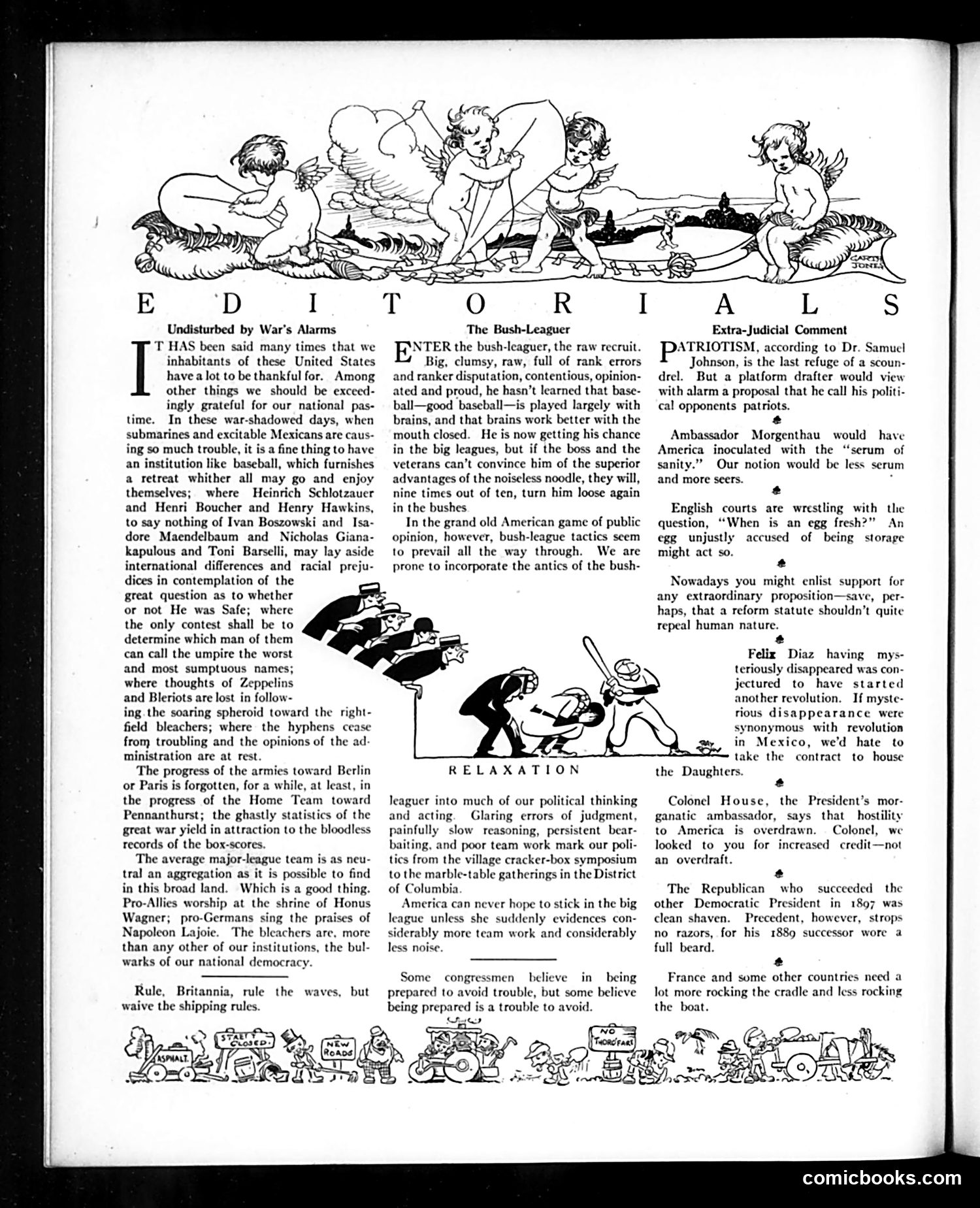
This page from *Judge* contains three distinct editorials with accompanying illustrations critiquing American society during wartime (likely WWI era, given references to war's disruptions). **"Undisturbed by War's Alarms"** satirizes baseball's "bush-leaguers"—inexperienced players—as metaphors for incompetent political thinking. The author argues these minor-league tactics have infected American politics and governance. **"The Bush-Leaguer"** specifically mocks raw recruits and poor judgment in leadership, using baseball terminology to criticize how politicians bungle serious matters. **"Extra-Judicial Comment"** attacks opportunistic political proposals exploiting wartime fears. It references patriotism being misused to justify questionable policies, with specific jabs at proposals by Ambassador Morgentbau and Colonel House regarding America's diplomatic standing. The cartoons use sports analogies to ridicule incompetent governance.
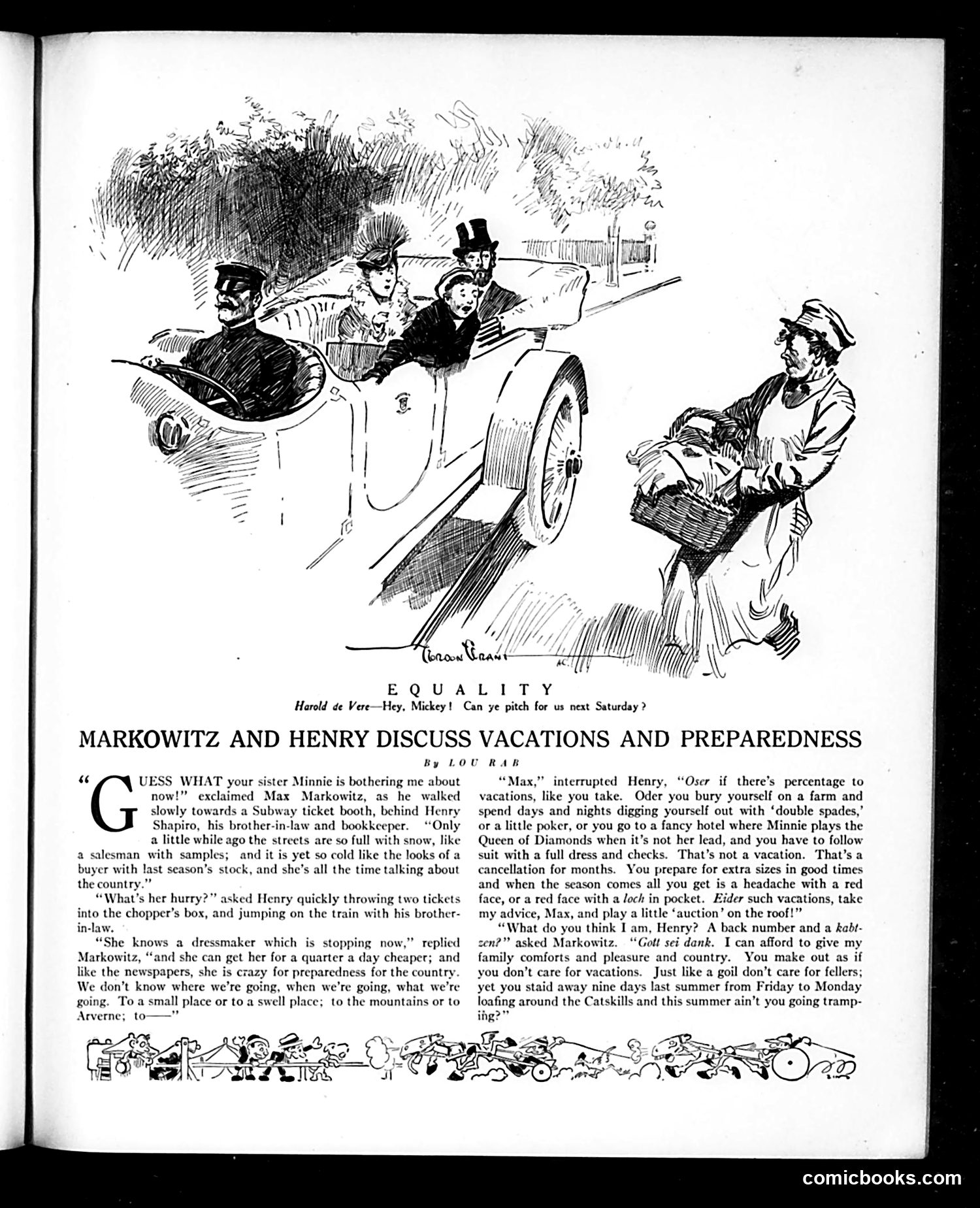
The top cartoon titled "Equality" satirizes class differences through a visual joke: wealthy people in a fancy automobile cheerfully pass a working-class man carrying a large basket, with the caption "Harold de Vere—Hey, Mickey! Can ye pitch for us next Saturday?" The satire is subtle—despite their obvious social and economic superiority (demonstrated by their automobile, formal dress, and top hats), the wealthy characters address the working-class man familiarly and casually, as if they're peers. This mocks the pretense of "equality" while visually demonstrating stark class separation. The joke suggests that the wealthy only adopt democratic familiarity when they need something from working people (here, apparently baseball ability), revealing the hollowness of claimed social equality during this era.
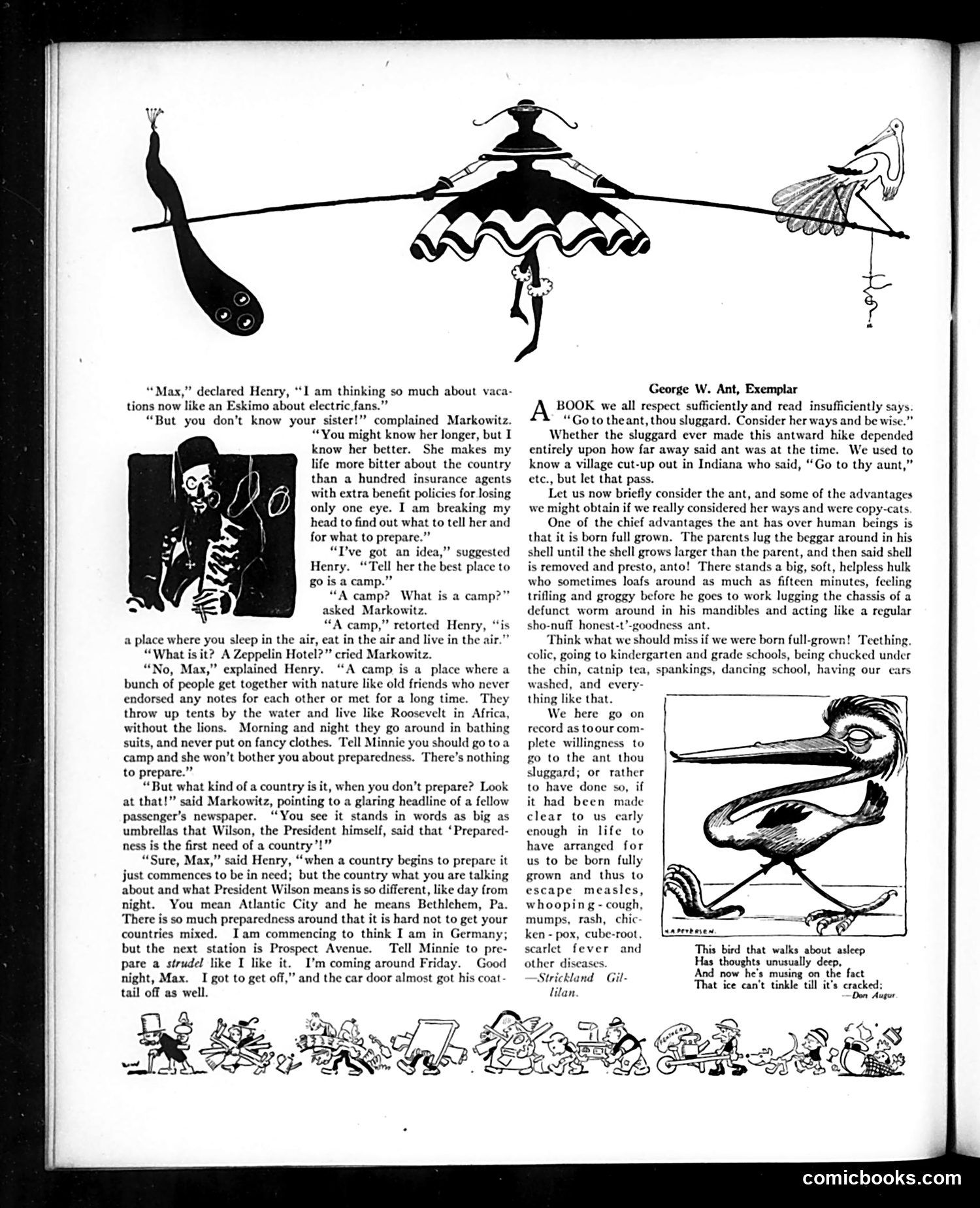
This page contains two satirical pieces typical of early 20th-century Judge magazine humor. **"Max" Dialogue (Left):** A conversation between Henry and Markowitz about vacation camps, with underlying commentary on President Wilson's "Preparedness" doctrine. When Markowitz cites Wilson's statement that "Preparedness is the first need of a country" (referencing pre-WWI defense buildup), Henry distinguishes between military preparedness and personal relaxation—suggesting the political debate over U.S. intervention feels intrusive even to ordinary citizens. The humor mocks both Markowitz's anxiety and the pervasive national preparedness rhetoric. **"George W. Ant, Exemplar" (Right):** A humorous essay on ant behavior that inverts the Biblical proverb about learning from ants' industry. Instead of praising ants' work ethic, the author jokes about advantages of being born full-grown (skipping infancy, education, discipline), using absurdist logic to satirize human child-rearing and social conventions. The accompanying insect illustrations appear decorative. Both pieces employ Jewish-immigrant dialect humor (Markowitz) and whimsical social commentary characteristic of Judge's target audience.
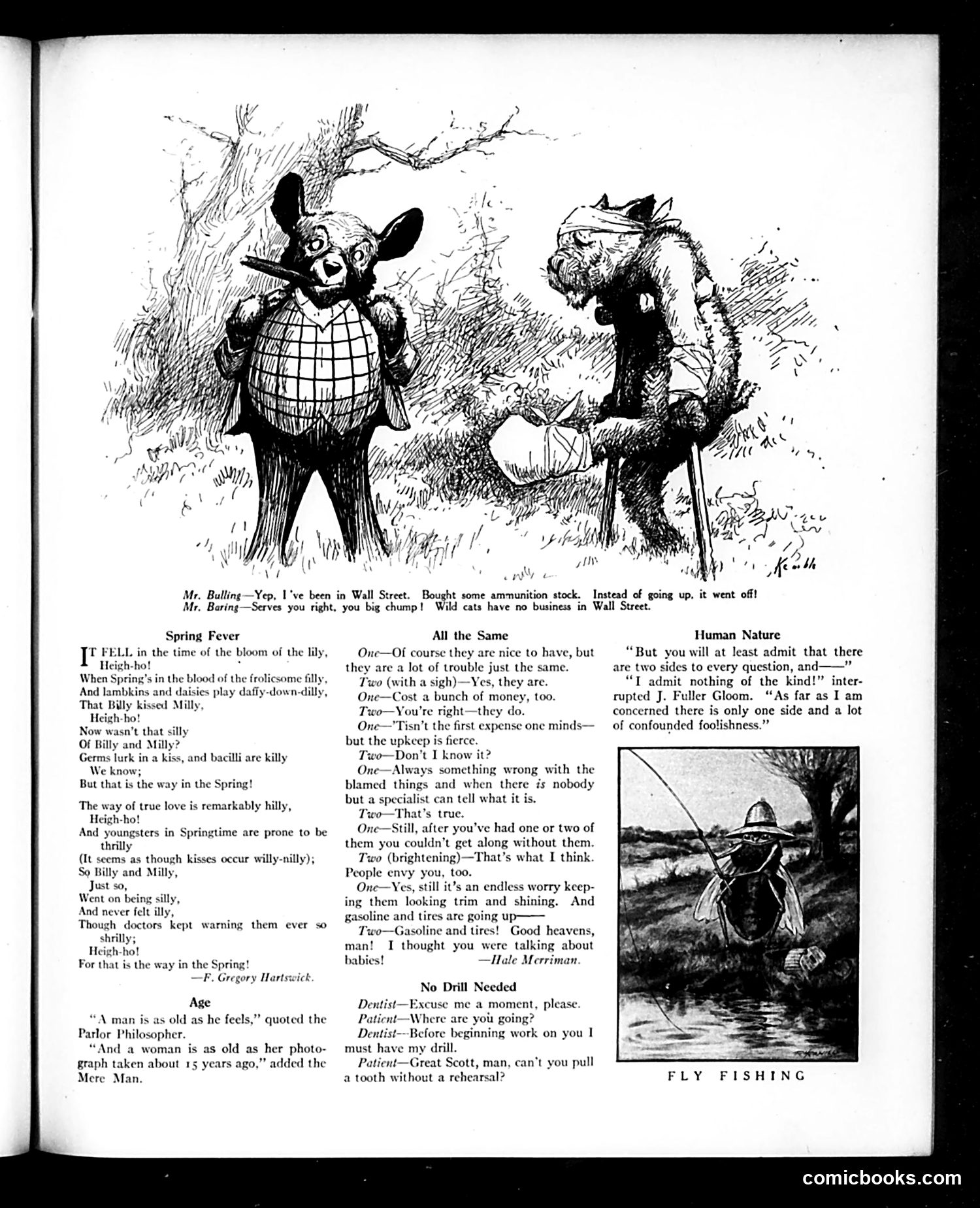
The top cartoon depicts two men discussing Wall Street investments. Mr. Bulling brags about buying "ammunition stock" on Wall Street, but it "went off" instead of going up—a pun suggesting his investment literally exploded rather than appreciated. Mr. Baring mocks him for this misfortune, implying Wall Street speculation is foolish and dangerous. Below are humorous pieces: "Spring Fever" jokes about young lovers ignoring health warnings about germs spread by kissing; an "Age" quip suggests women lie about their appearance via old photographs; and "All the Same" uses cars as a metaphor—two speakers discuss how troublesome and expensive they are, yet indispensable, before one realizes they were discussing babies, not automobiles, a comedic misunderstanding. These satirize romantic folly, vanity, and domestic realities.
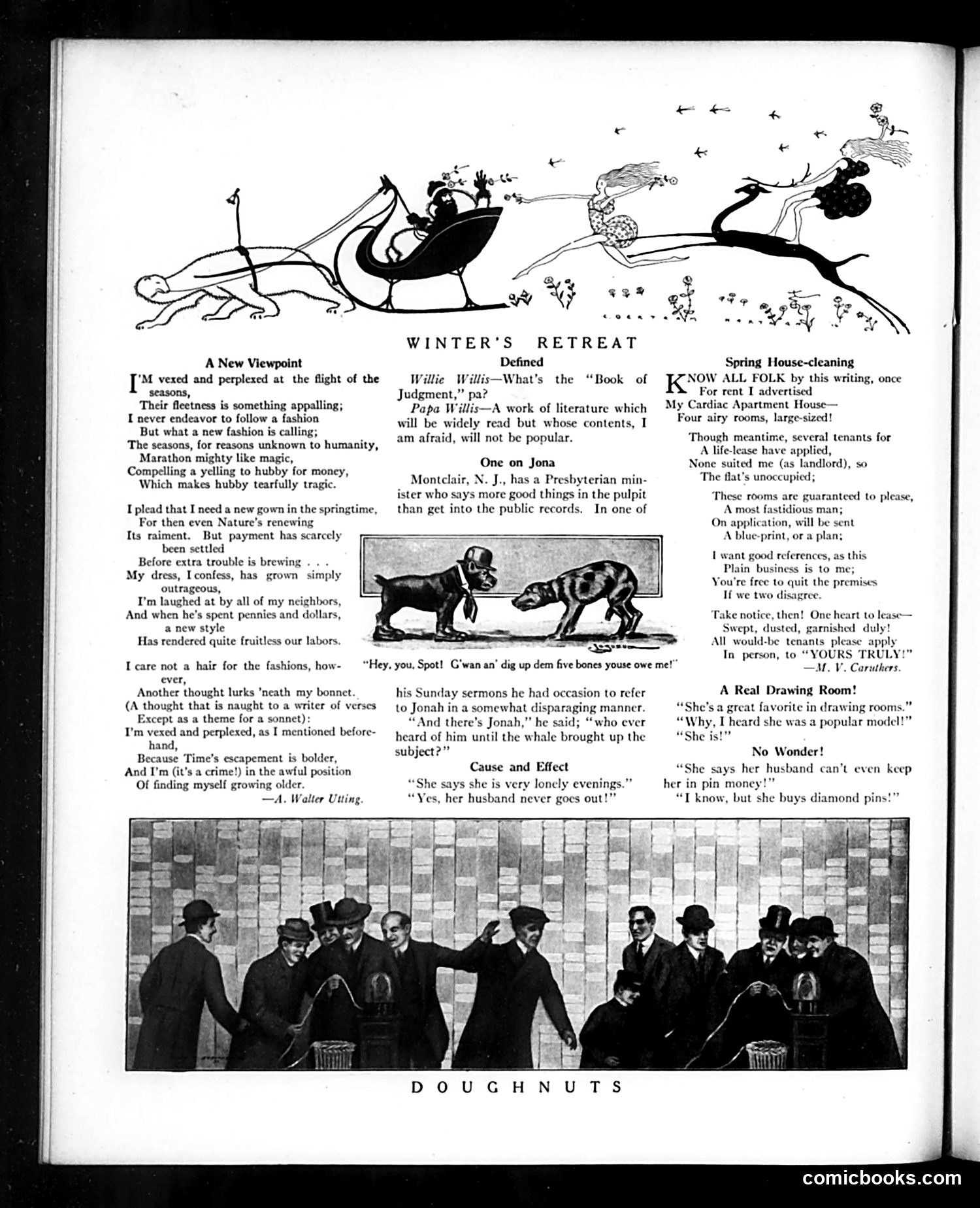
This page contains multiple satirical pieces typical of early 20th-century American humor: **"A New Viewpoint"** (poem, left): Mocks women's constant demands for new fashions and gowns. The satire targets both female consumerism and the financial burden on husbands, presenting the speaker as exasperated by fashion's relentless cycles and the aging process. **"Winter's Retreat" and related jokes** (center): Light wordplay defining literary and religious references—distinguishing between what's popular versus good literature, and mocking a Presbyterian minister's sermon about Jonah. **Top cartoon**: Shows a dog demanding repayment of bones, likely satirizing financial debts or marital money disputes through animal humor. **Bottom photograph**: Labeled "Doughnuts," depicts men in formal dress around what appears to be a pile of doughnuts—the humor likely derives from the incongruity of refined gentlemen and cheap street food. **Right column**: Includes advertisements for apartment rental and humorous dialogue about women's spending habits and materialism. The overall tone reflects period satirizing of consumer culture, gender relations, and social pretension.
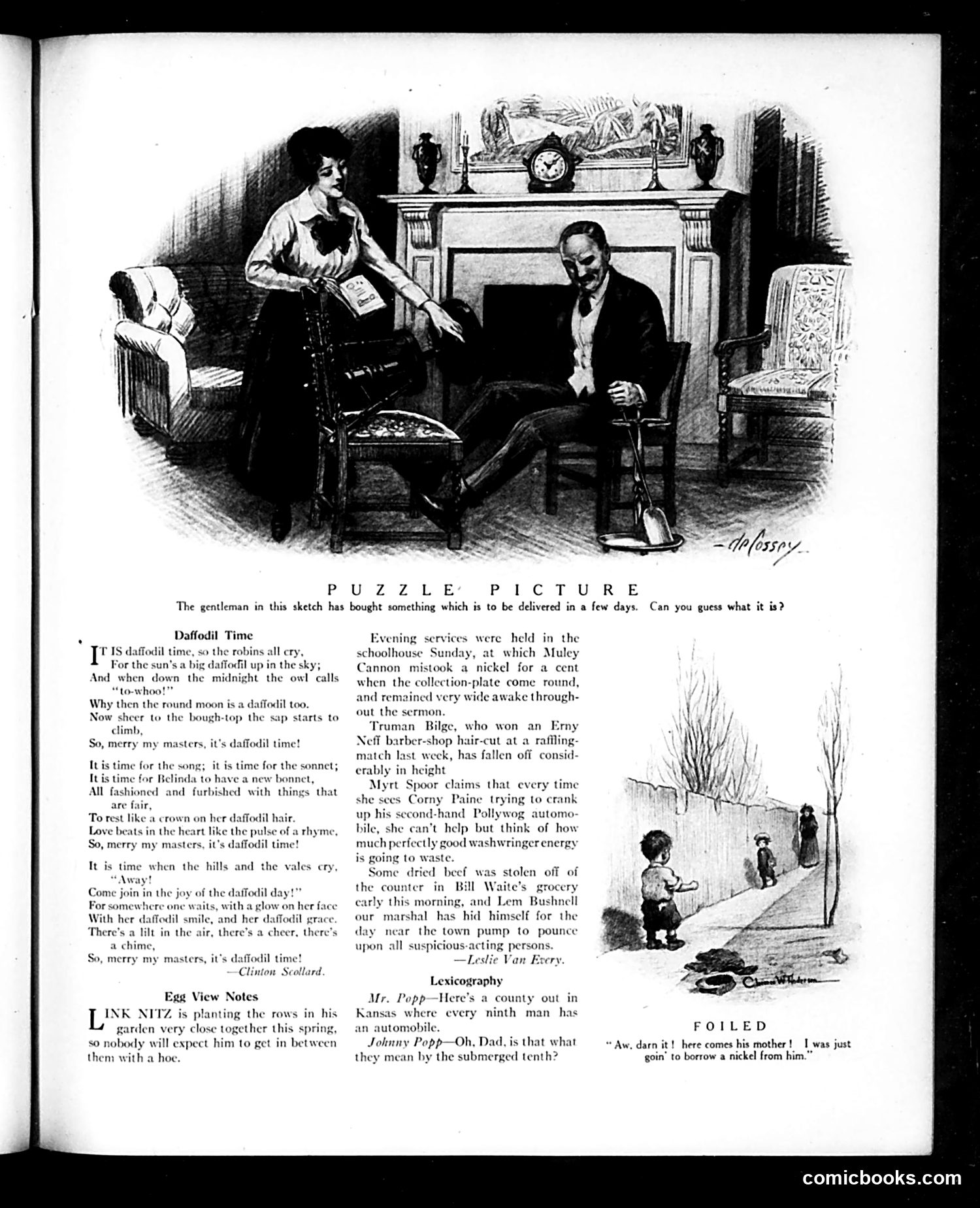
The top sketch is a visual riddle: a well-dressed gentleman has purchased something to be delivered soon. The answer appears to be an **automobile**—a luxury item of the era requiring advance ordering. This reflects the early 1900s fascination with cars as novel, expensive purchases. The bottom cartoon, titled "Foiled," depicts two boys caught in mischief. One was apparently about to borrow a nickel from the other when the borrower's mother unexpectedly arrives, thwarting the plan. The humor centers on a common childhood scenario: attempting petty theft disguised as borrowing, foiled by parental supervision. Both pieces are lighthearted satirical observations of everyday life—one mocking the aspirational materialism of car-ownership, the other poking fun at juvenile delinquency and the universal childhood experience of being caught by a parent at an awkward moment.
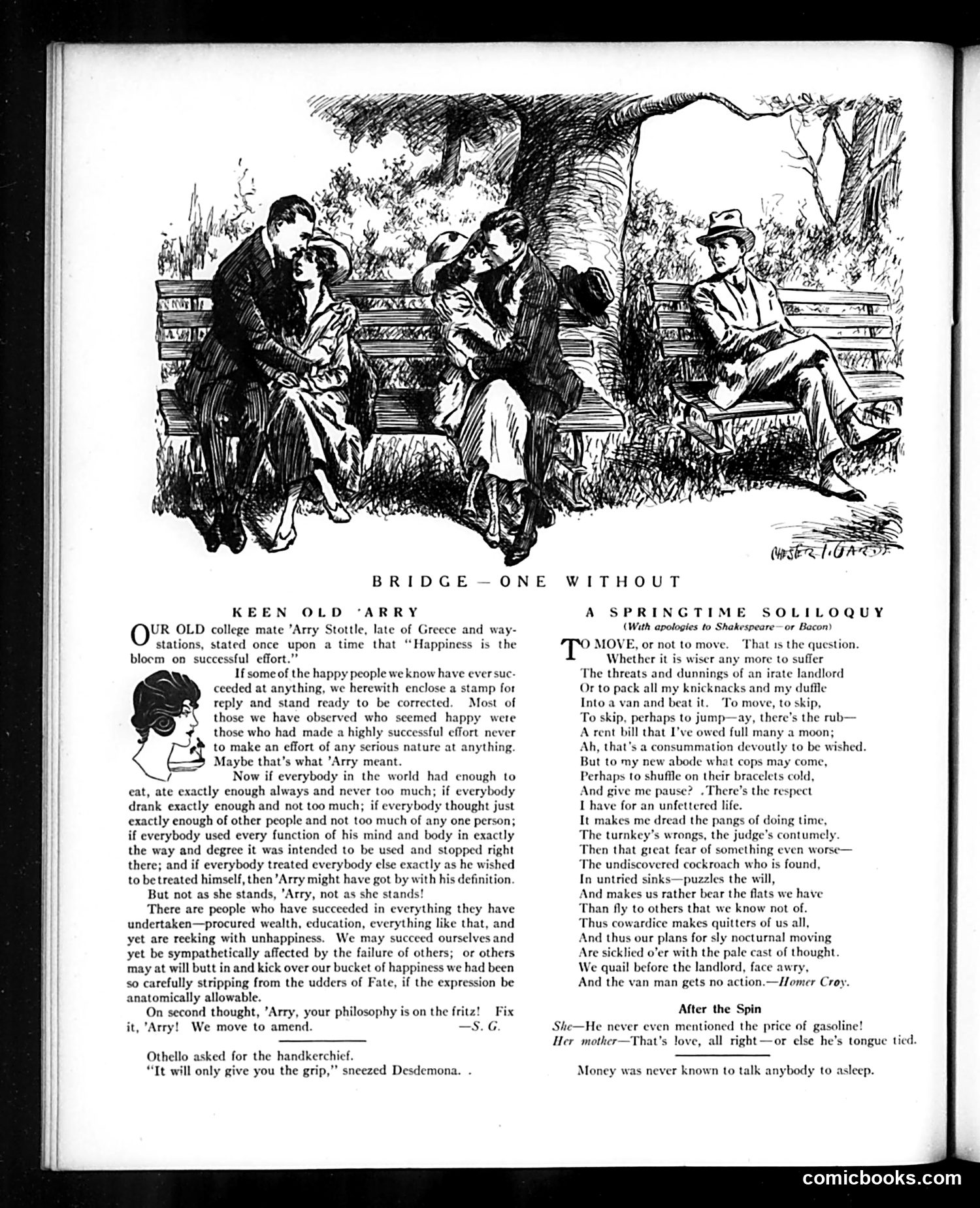
This page contains humorous social commentary rather than political satire. The main cartoon depicts men on park benches discussing philosophy—likely referencing a character named "'Arry" (Harry) who claims "happiness is the bloom on successful effort." The text argues this is naive: truly happy people often avoid serious effort, and external circumstances (others' failures, landlords, bills) disrupt happiness regardless of personal success. Below are two literary parodies: "A Springtime Soliloquy" mimics Hamlet's existential speech but applies it to evading rent and moving without being caught by police—a joke about urban poverty and landlord-tenant conflicts of the era. The final section, "After the Spin," jokes about romantic courtship and materialism, noting a suitor's silence about gasoline costs suggests either genuine love or dishonesty. The satire targets working-class anxieties about money, housing instability, and romantic expectations in early 20th-century America.
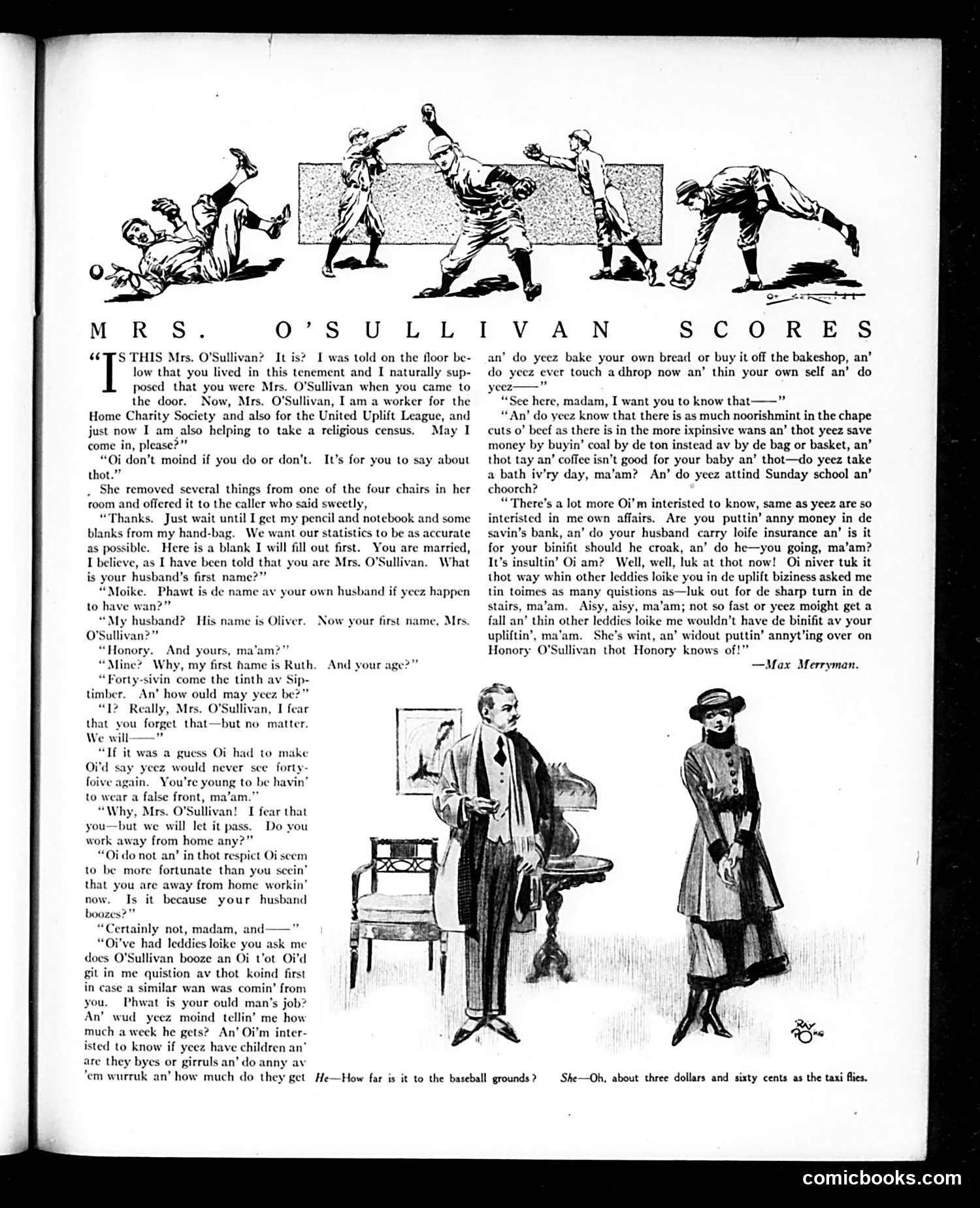
This satirical piece mocks well-intentioned but intrusive charitable workers and "uplift" reformers of the early 1900s. A condescending visitor from a charity organization interrogates Mrs. O'Sullivan—an Irish immigrant woman in a tenement—with endless personal questions about her finances, housekeeping, children, and husband's drinking, claiming to gather statistics. Mrs. O'Sullivan deflects with sharp humor and Irish dialect, turning the tables by asking equally invasive questions back (including a jab about the visitor's "false front," implying a wig). When the visitor finally delivers sanctimonious advice about nutrition and savings, Mrs. O'Sullivan leaves mid-sermon, unimpressed. The satire targets the era's patronizing approach to poverty: reformers viewed poor immigrants as problems to be fixed rather than people deserving dignity. The cartoon's title "Scores" suggests Mrs. O'Sullivan wins this encounter through wit and refusal to be lectured.
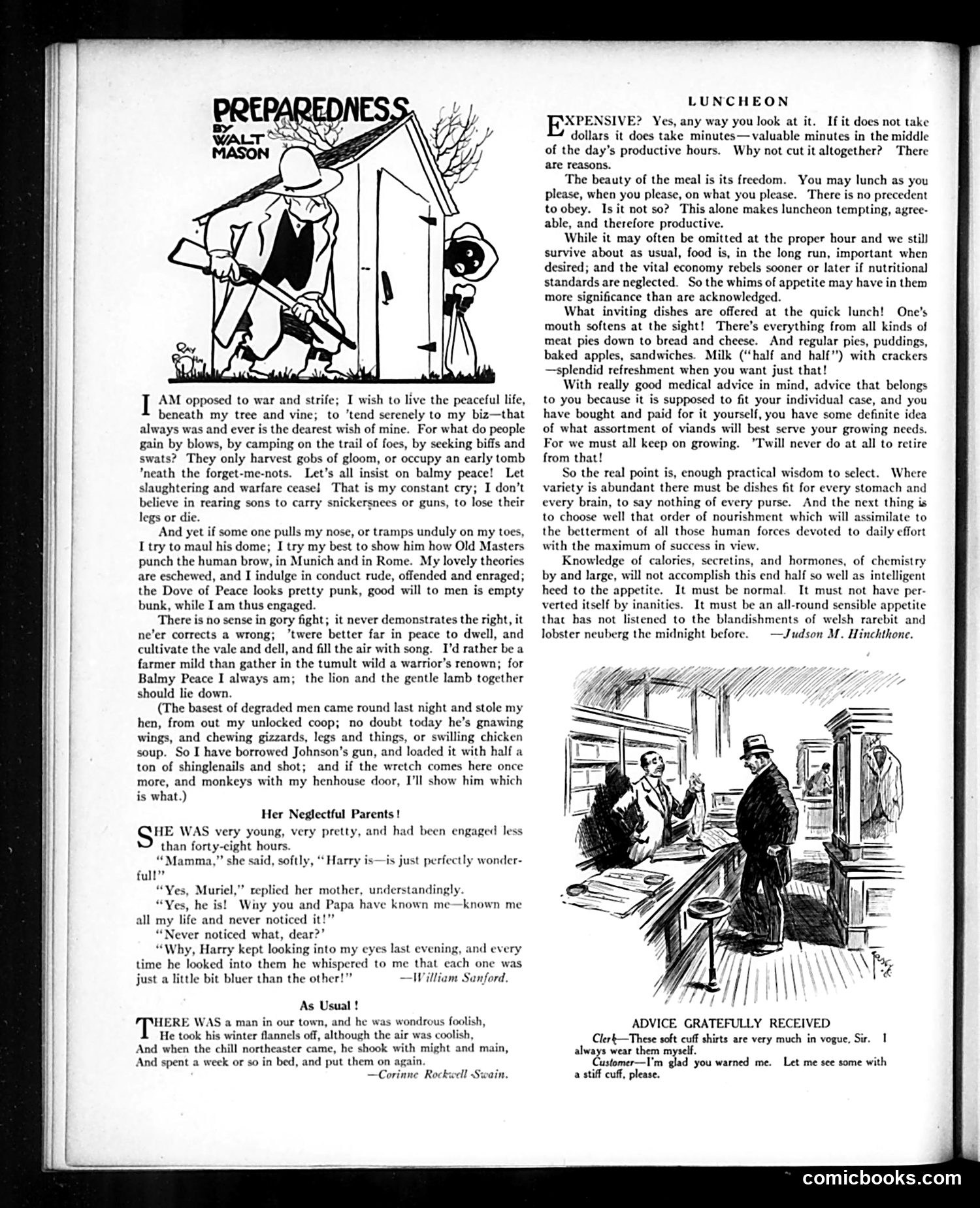
This cartoon satirizes pacifist hypocrisy during the pre-WWI period (likely 1910s). The illustration shows a man armed with a rifle and various weapons, contradicting his own pacifist poem. The text presents a peace-loving farmer who philosophically opposes war, violence, and militarism—he wants only to tend his farm quietly. However, the ironic twist appears in parentheses: when someone steals his chicken, he immediately arms himself with a borrowed gun loaded with nails and shot, ready to violently confront the thief. **The satire's point**: Americans claimed to oppose war and militarism while simultaneously maintaining they'd fight if personally provoked. The cartoon criticizes this contradiction—suggesting that pacifist ideals collapse instantly when self-interest is threatened. It questions whether genuine pacifism exists or whether it's merely convenient posturing that evaporates under pressure. The cartoon's title, "Preparedness," likely references contemporary debates about military readiness, suggesting that even supposed pacifists ultimately embrace the "preparedness" mindset.
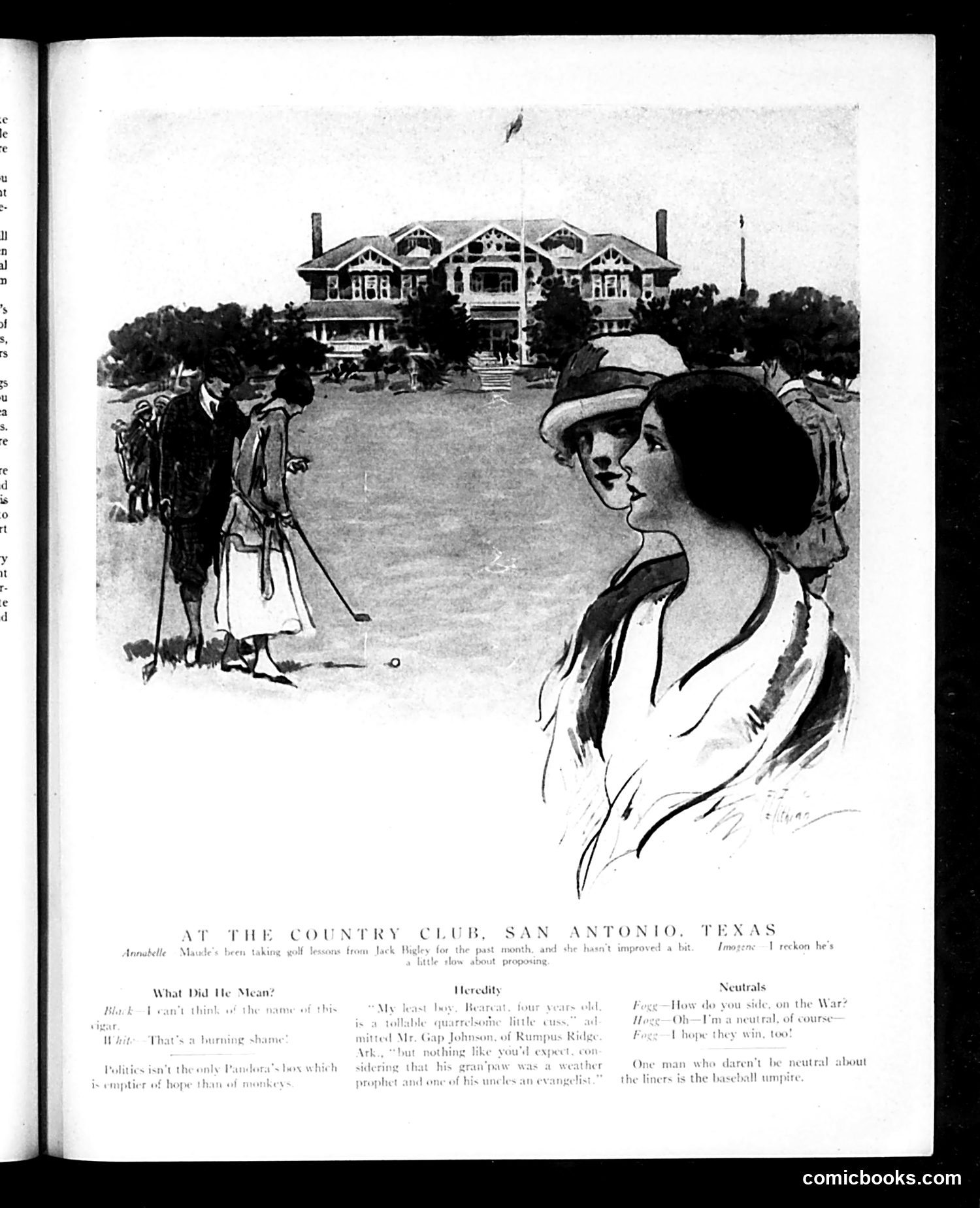
This is a social commentary cartoon set at a San Antonio country club. The illustration shows women observing a golf lesson, with dialogue below addressing three perspectives on a male golfer's poor performance. **The satire:** - **"What Did He Mean?"**: A woman dismisses the golfer's excuse about his cigar, calling it a "burning shame" - **"Heredity"**: Another woman attributes his poor play to genetics, mentioning his grandmother was a "weather prophet" (implying inherited incompetence) - **"Neutrals"**: The final characters hope both sides "win" in an apparent reference to WWI neutrality debates The cartoon satirizes how people rationalize failure differently—through immediate excuses, hereditary determinism, or detached neutrality. It reflects early-20th-century anxieties about inherited traits and contemporary debates over America's WWI stance, wrapped in leisured country-club humor.
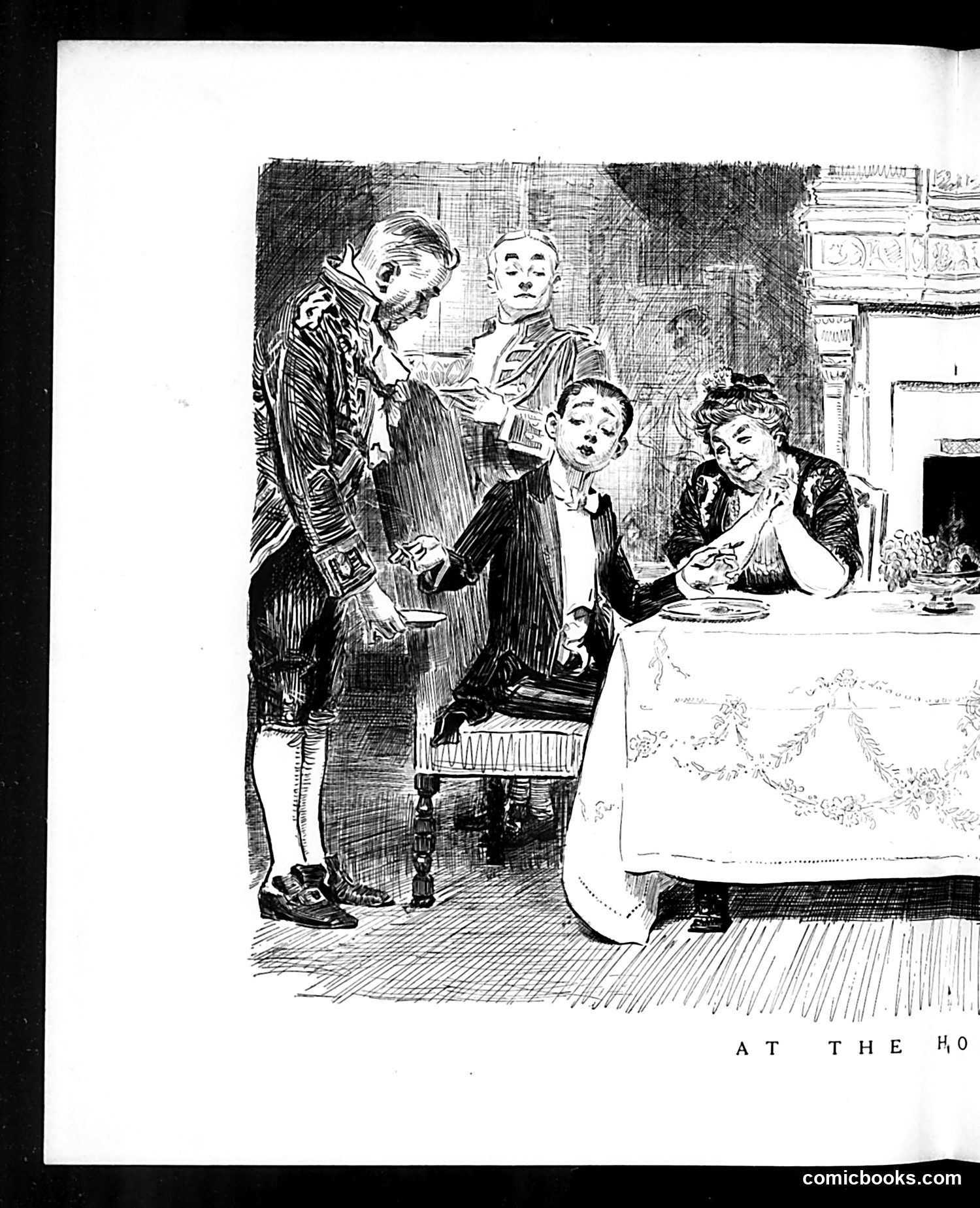
This is a black and white sketch from *Judge* magazine showing a domestic scene titled "AT THE HO[ME]" (text cut off). The illustration depicts what appears to be a family gathering: an older gentleman in formal attire stands with a young boy, while a woman sits at a table eating, and another figure is visible in the background. The style and clothing suggest late 19th or early 20th century. Without the complete caption or additional context visible on the page, I cannot definitively identify the specific political or social satire intended. The scene appears to be domestic/social commentary, but the particular joke or reference remains unclear from the image alone. The OCR text provided only shows the publication source, not the article title or explanation.
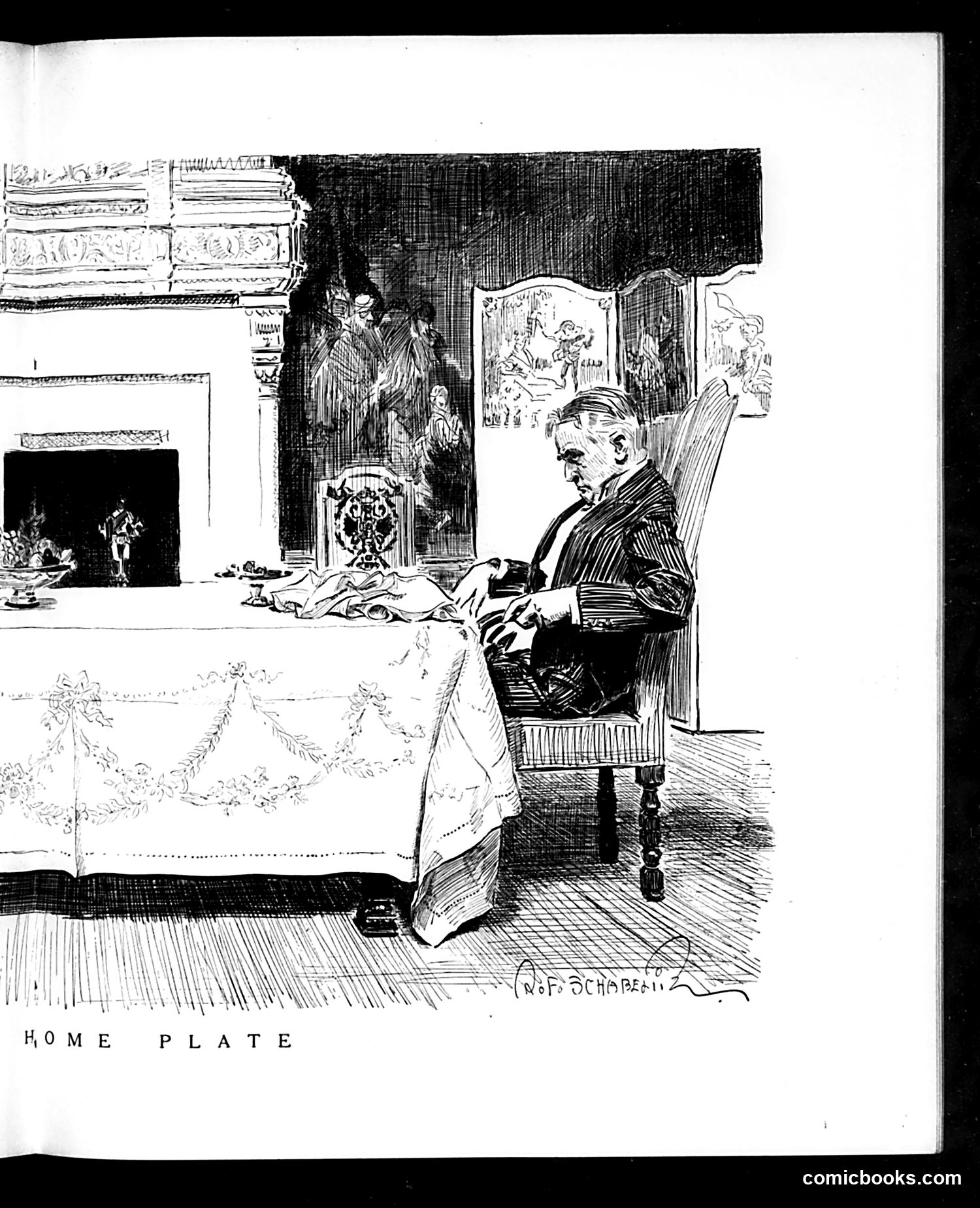
This cartoon, signed by what appears to be "Schaefelit," depicts an elderly man seated in a chair, holding what looks like architectural plans or documents. He's positioned in an ornate interior with a fireplace, decorative elements, and garland visible. The title "HOME PLATE" is a pun—suggesting both a domestic setting and baseball's home plate. The cartoon likely satirizes something about home ownership, architectural ambition, or domestic life among the wealthy or prominent. However, without additional context about the specific issue of *Judge* magazine or the historical moment, I cannot definitively identify the figure or the precise social/political target of the satire. The elaborate domestic setting suggests commentary on domestic pretension or real estate matters.
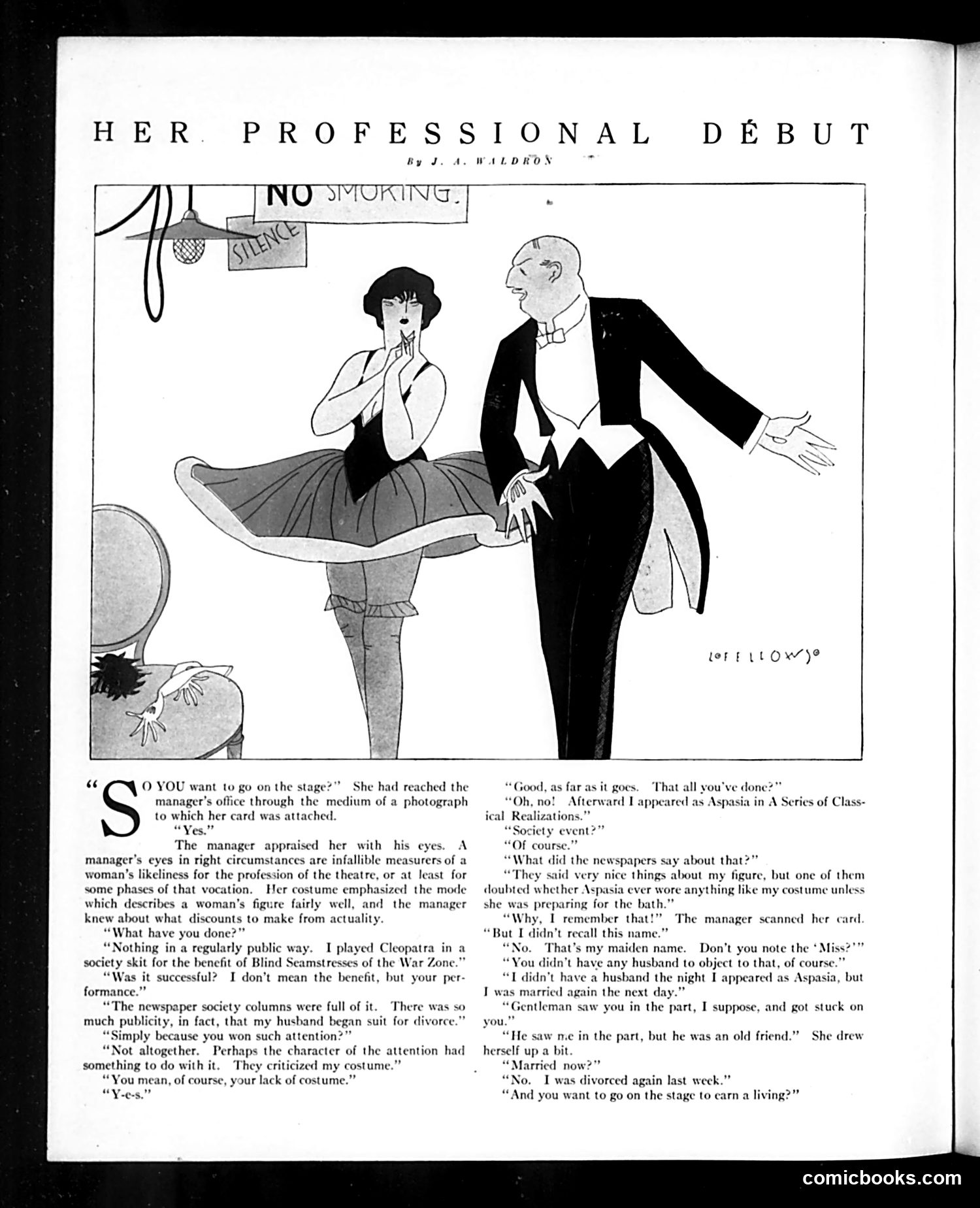
This satirical story mocks a woman seeking theatrical work through the lens of 1920s social attitudes. The humor centers on her checkered personal history: she gained notoriety performing as Cleopatra and Aspasia (a famous Greek courtesan) in society benefits, drawing newspaper attention—but primarily for her scanty costumes rather than her acting talent. The satire targets how she's been married and divorced twice in rapid succession, with men becoming "stuck on" her after seeing her provocative stage performances. The manager's questions expose the irony: she claims to want stage work for income, yet her "success" derives entirely from attracting male attention through costume (or lack thereof) rather than professional merit. The cartoon mocks both her naïveté about theatrical respectability and society's double standard—simultaneously criticizing women's scanty stage costumes while being captivated by them. It satirizes the intersection of marriage, divorce, and women's limited economic opportunities in that era.
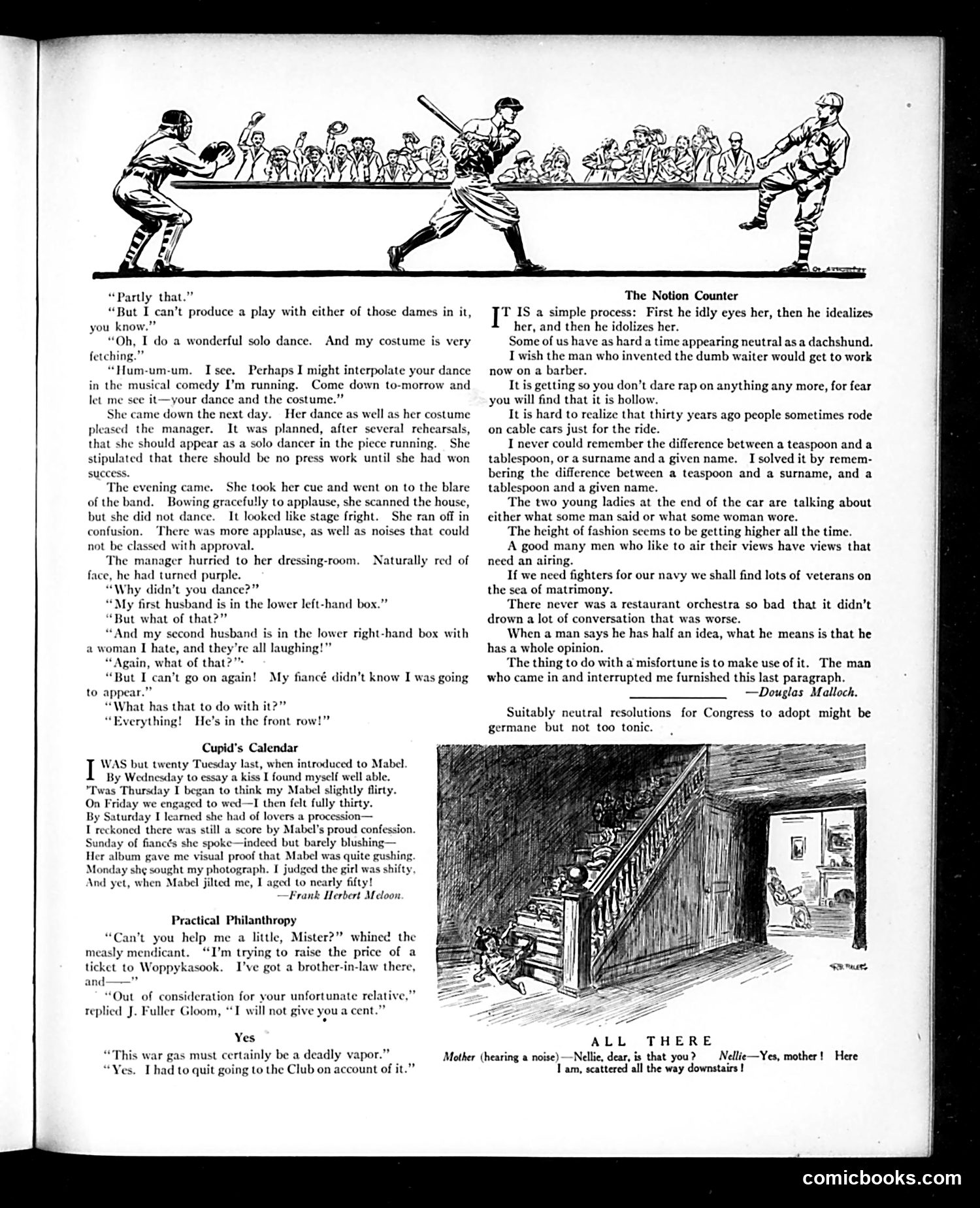
**Top Cartoon (Baseball Scene):** The illustration depicts a baseball game with a batter, catcher, and fielder. This appears to be a generic sports cartoon, likely humorous commentary on baseball rather than specific political satire. **Main Story/Dialogue:** A theatrical anecdote about a female performer hired for a solo dance in a musical comedy. The joke: she freezes on stage due to stage fright, then reveals she has three men in the audience—her first husband (left box), second husband with a woman she hates (right box), and her fiancé (front row)—making it impossible to perform. This satirizes women's complicated romantic entanglements and the absurdity of theatrical melodrama. **"Cupid's Calendar":** A humorous poem by Frank Herbert Meloon chronicling a man's rapidly changing feelings about "Mabel" over one week—from initial attraction to engagement to discovering her romantic history—ending with him aging from thirty to fifty when she jilts him. It mocks both female promiscuity and male gullibility in romance. **Other Sections:** "The Notion Counter" contains short witticisms; "Practical Philanthropy" jokes about refusing charity; other brief satirical pieces about wartime and social observations.
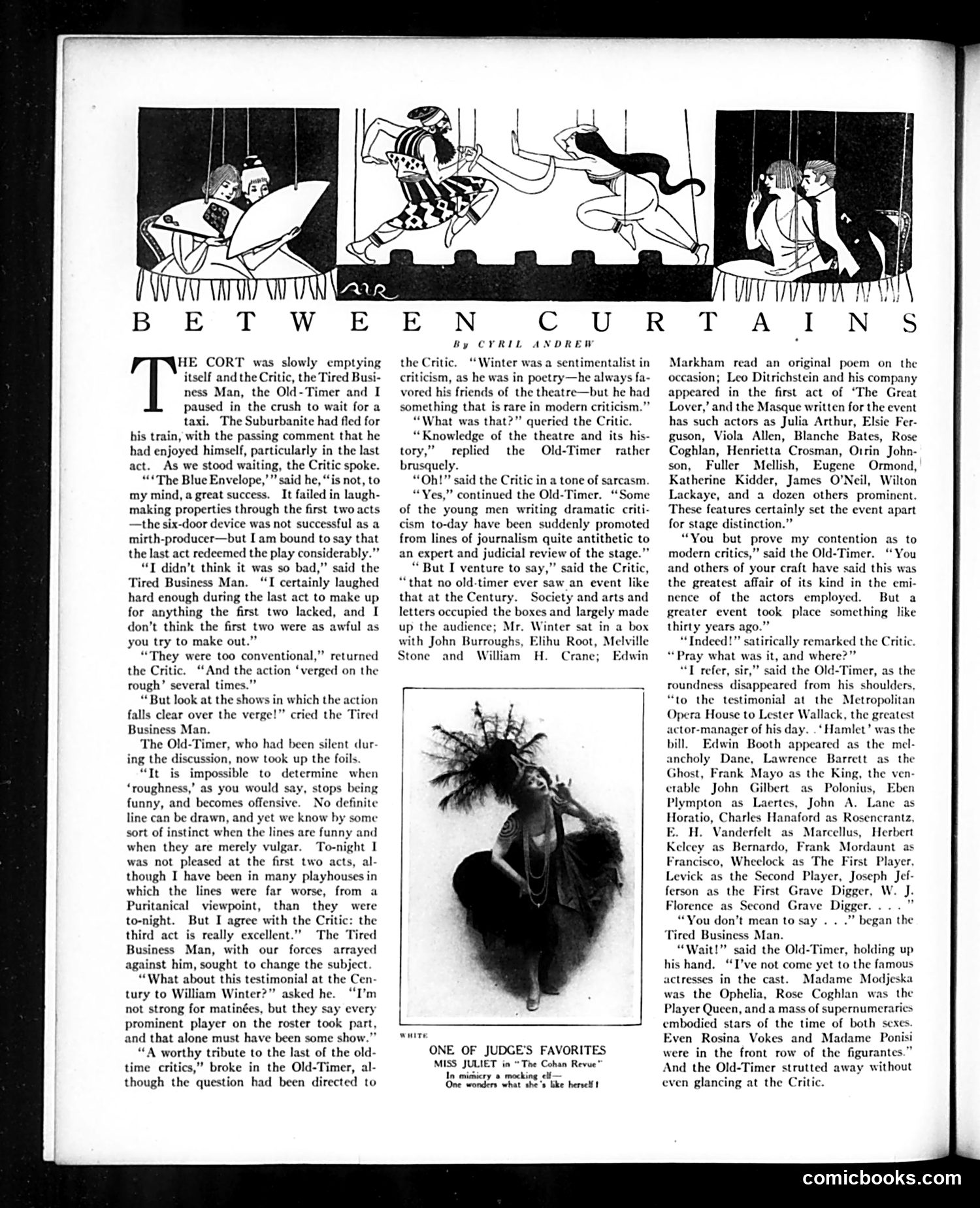
This is a theatrical debate piece by Cyril Andrew featuring four characters discussing a play called "The Blue Envelope" and a testimonial dinner for critic William Winter. **The Setup**: The characters—a Critic, Tired Business Man, Old-Timer, and narrator—argue about the play's quality, particularly debating whether its humor works or crosses into vulgarity. **Key Point**: The Old-Timer defends William Winter (a real, prominent 19th-century theater critic) as possessing rare "knowledge of the theatre and its history," contrasting him favorably with younger drama critics promoted from general journalism who lack theatrical expertise. **The Satire**: The piece mocks modern critics' superficiality while praising Winter's authority. Winter's testimonial dinner apparently featured prominent actors and society figures, which the Old-Timer uses to argue that modern critics overstate such spectacles' significance—proving they lack Winter's genuine understanding. The photograph shows "Miss Juliet" from "The Cohan Revue," captioned satirically questioning whether her real self matches her stage persona.
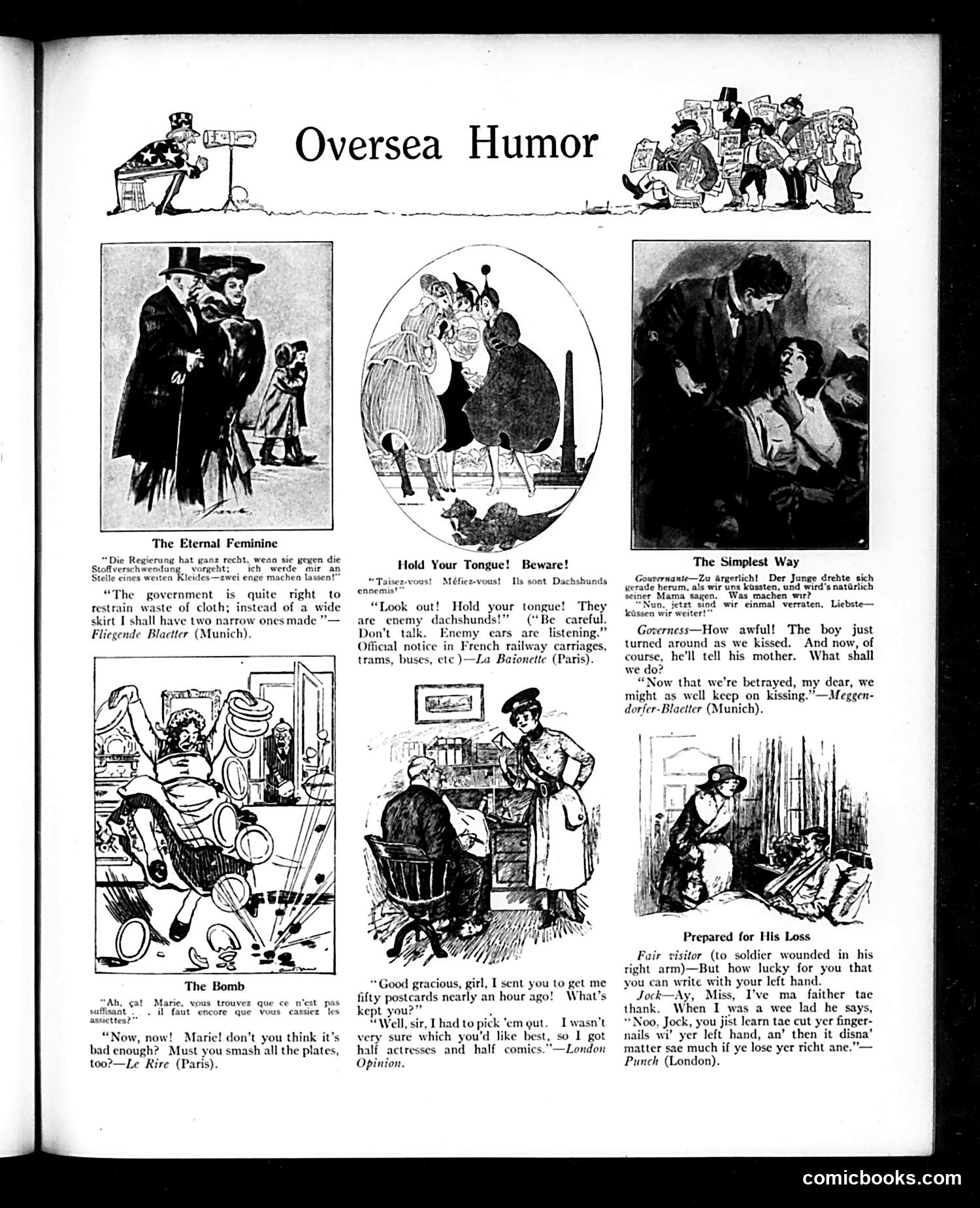
This page collects humorous cartoons from European publications, likely from WWI, demonstrating how different nations satirized wartime conditions: **"The Eternal Feminine"** (Munich): German satire on cloth rationing—a woman claims she'll obey restrictions by wearing two narrow skirts instead of one wide one, mocking superficial compliance. **"The Bomb"** (Paris): A maid causes domestic chaos breaking dishes; her employer questions whether the breakage itself contradicts wartime conservation efforts—French humor about the absurdity of rationing logic. **"Hold Your Tongue! Beware!"** (Paris): References official notices warning against careless talk on public transport, joking that dachshunds (German dogs) are enemy spies—satirizing paranoia about German espionage. **"The Simplest Way"** (Munich): Dark humor about a governess and soldier caught kissing by a boy; resigned to exposure, they continue kissing anyway. **"Prepared for His Loss"** (London): Scottish soldier jokes his father's childhood training (cutting nails with his left hand) prepared him for losing his right arm—gallows humor about war injuries.
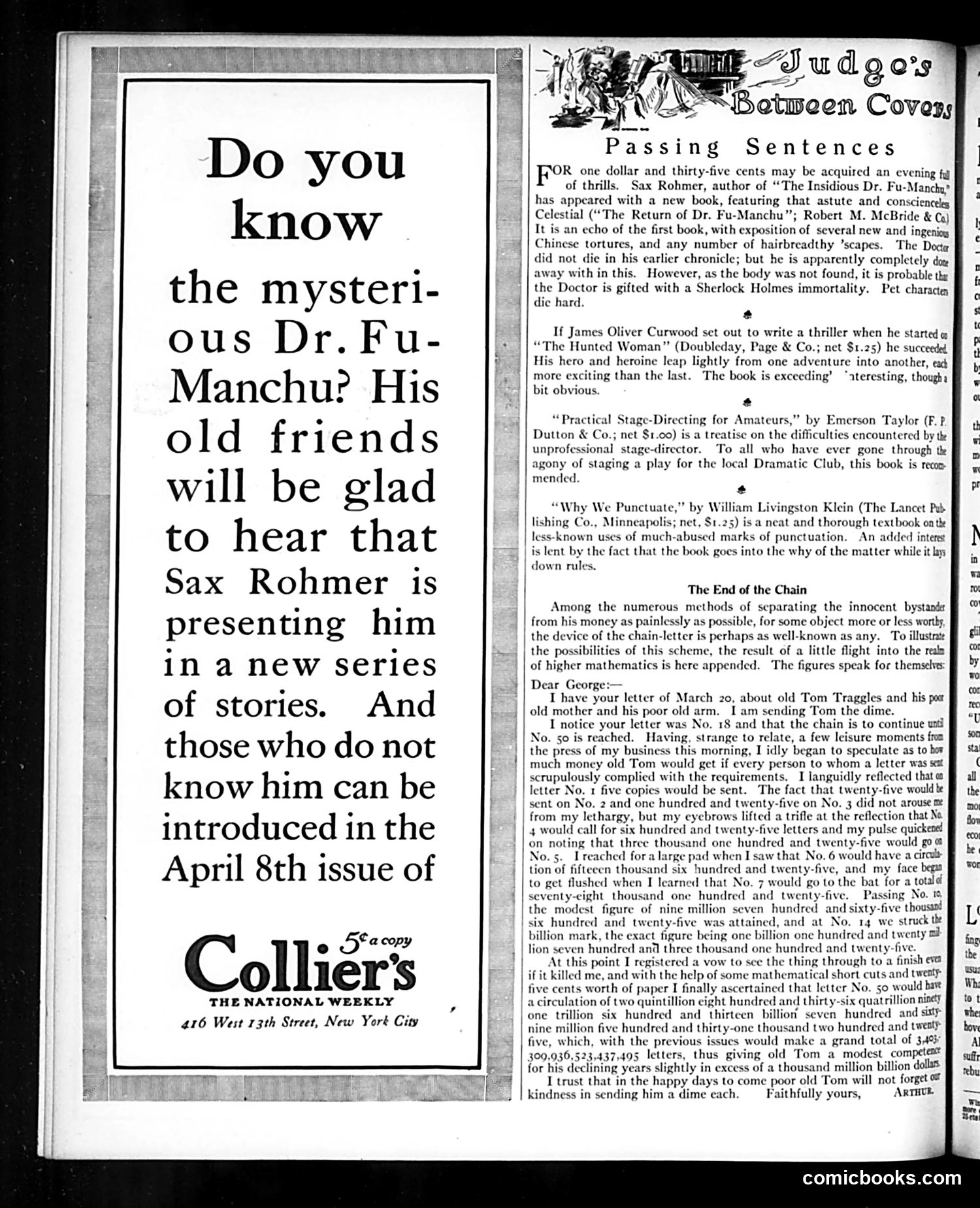
This page primarily contains **book reviews and advertising**, not political cartoons. The left side is a **Collier's magazine advertisement** promoting Sax Rohmer's new Dr. Fu-Manchu series (debuting April 8th). Dr. Fu-Manchu was a popular pulp-fiction villain—a "mysterious Oriental" character embodying common early-20th-century racist stereotypes about "insidious" Asian threats. The ad targets existing fans while introducing new readers to this sensational adventure series. The right side, "Judgo's Between Covers," reviews several books including Rohmer's *Return of Dr. Fu-Manchu*, James Oliver Curwood's thriller *The Hunted Woman*, and guides on stage-directing and punctuation. Below that sits "The End of the Chain," a humorous mathematical illustration of chain-letter mathematics—showing how exponential growth quickly reaches astronomical numbers (billions of letters by step 14), satirizing the scheme's absurdity and the naive optimism of chain-letter participants.
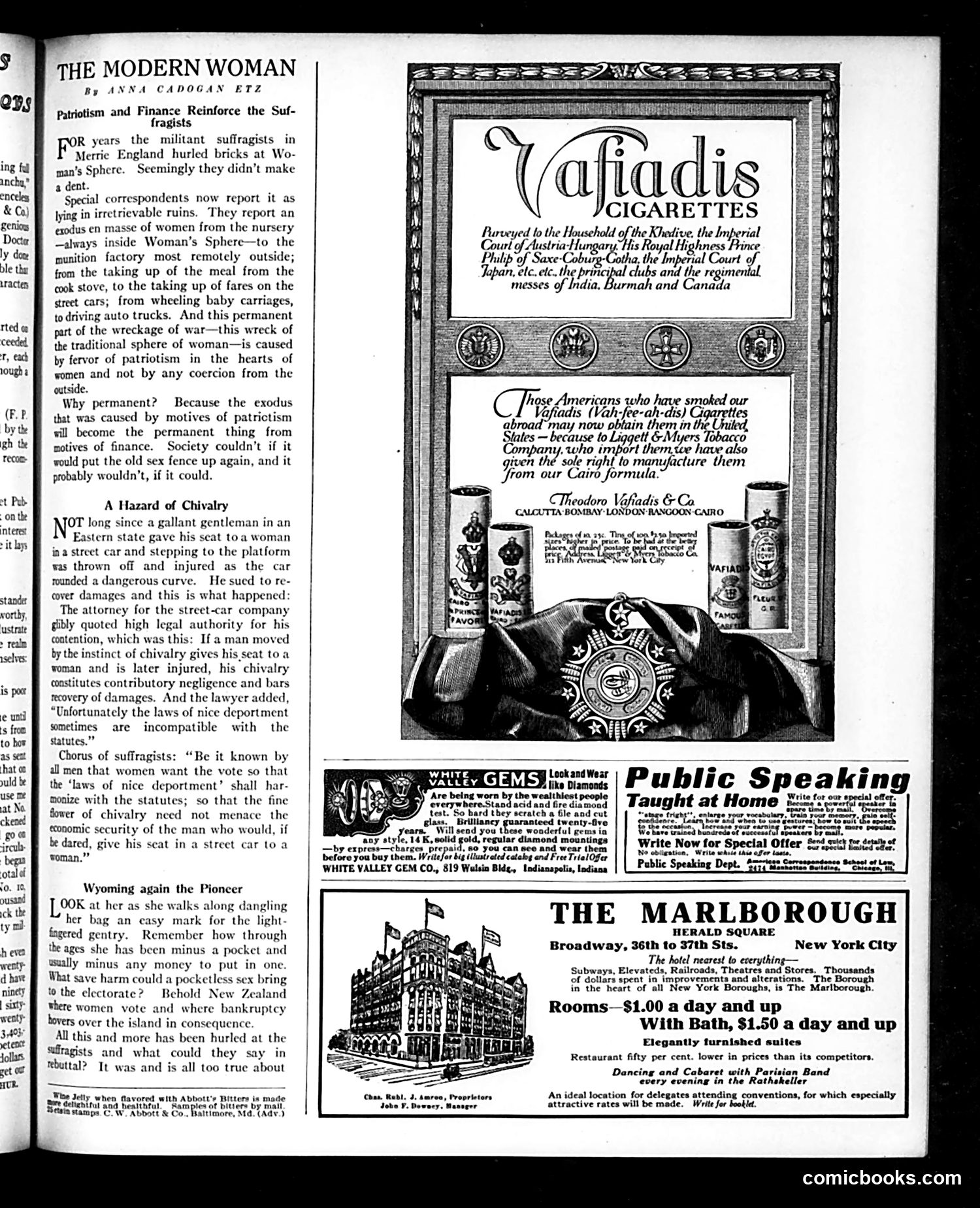
This page satirizes the women's suffrage movement through two distinct pieces: **"The Modern Woman" article** argues that female suffragists' wartime work in munitions factories and other industrial jobs (replacing men serving in WWI) has permanently altered women's traditional domestic sphere. The author suggests this economic necessity—not coercion—will make women's workforce participation permanent, and that women need voting rights to align laws with their new economic reality. **"A Hazard of Chivalry" anecdote** mocks chivalry's incompatibility with modern law. A man injured after giving his streetcar seat to a woman cannot sue because courts ruled his "contributory negligence" (based on chivalrous instinct) bars recovery. The suffragists' retort: women need the vote to reconcile outdated social customs with modern legal statutes. Both pieces use irony to argue suffragists have legitimate grievances—patriotism and economic necessity have changed women's roles, yet legal and social systems haven't adapted. The page's advertisements for luxury goods (cigarettes, gems) contrast sharply with these arguments about women's economic and legal inequality.
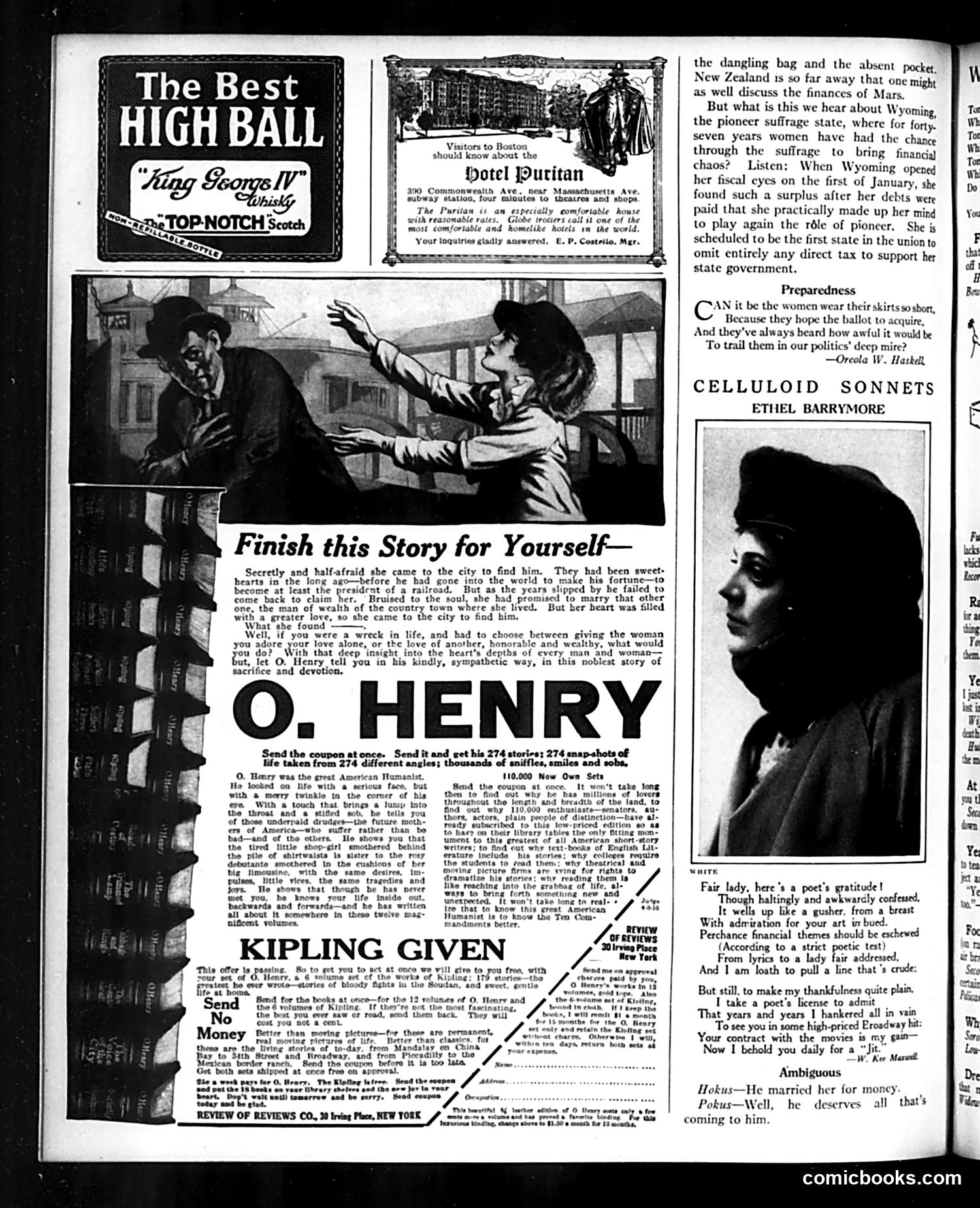
This page mixes **advertisements and editorial content** typical of early 20th-century Judge magazine. The main feature is an **O. Henry story promotion**—a serialized fiction piece readers are invited to "finish yourself." The narrative involves a woman reuniting with an old sweetheart who's become a railroad president, creating a moral dilemma between love and financial security. O. Henry was marketed as "the great American Humanist" for writing sympathetically about working-class struggles and urban life. The **political satire** appears in the right column under "Preparedness," which references Wyoming's women's suffrage. The piece mocks Wyoming's "pioneer suffrage state" status (women could vote there since 1869) by sardonically noting that despite 47 years of female voting power, Wyoming merely accumulated a budget surplus—implying women voters haven't revolutionized politics as suffrage advocates claimed. This represents **anti-suffrage satire**, dismissing women's political participation as ineffectual. The page also advertises a bundled book offer: purchasing O. Henry's complete works includes free Kipling volumes.
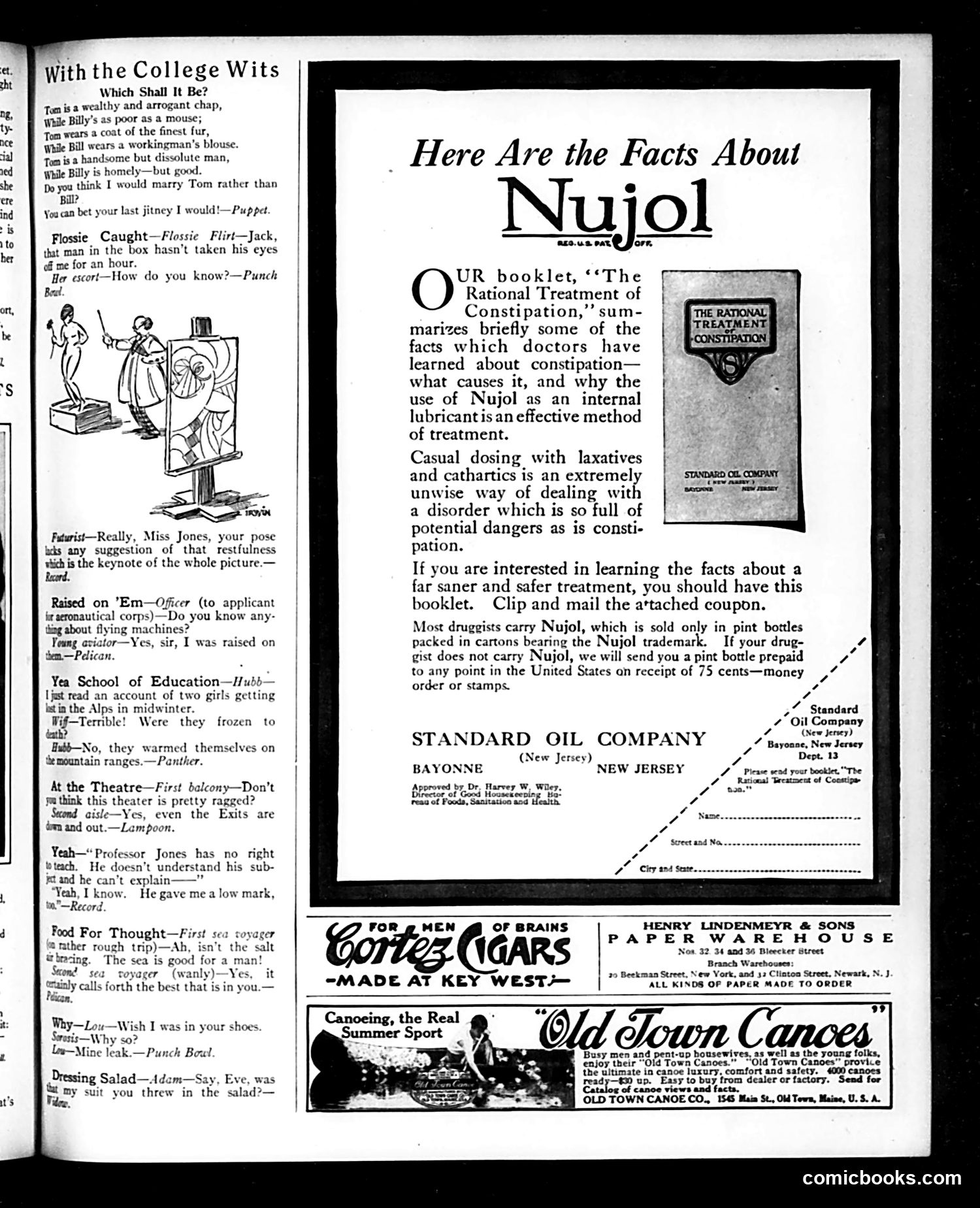
This page mixes humorous short jokes with period advertisements. The left side features "College Wits"—brief comedic exchanges about courtship, theater, education, and daily life. The humor relies on wordplay and social observations typical of early-20th-century American satire (references to "jitney" suggest WWI-era dating). The dominant content is a **Nujol advertisement**—a mineral oil laxative. The ad addresses constipation candidly, positioning Nujol as a safe "internal lubricant" against "casual dosing with laxatives and cathartics." This reflects early-1900s advertising's willingness to discuss bodily functions directly, before mid-century advertising became more euphemistic. Secondary advertisements include cigars ("Gorreo's"), paper warehouse services, and Old Town Canoes. The Nujol coupon is clipped from the page for reader response—standard direct-mail advertising of the era. The page exemplifies Judge's mixed content model: satirical humor mixed with commercial sponsorship, no clear political cartoon present.
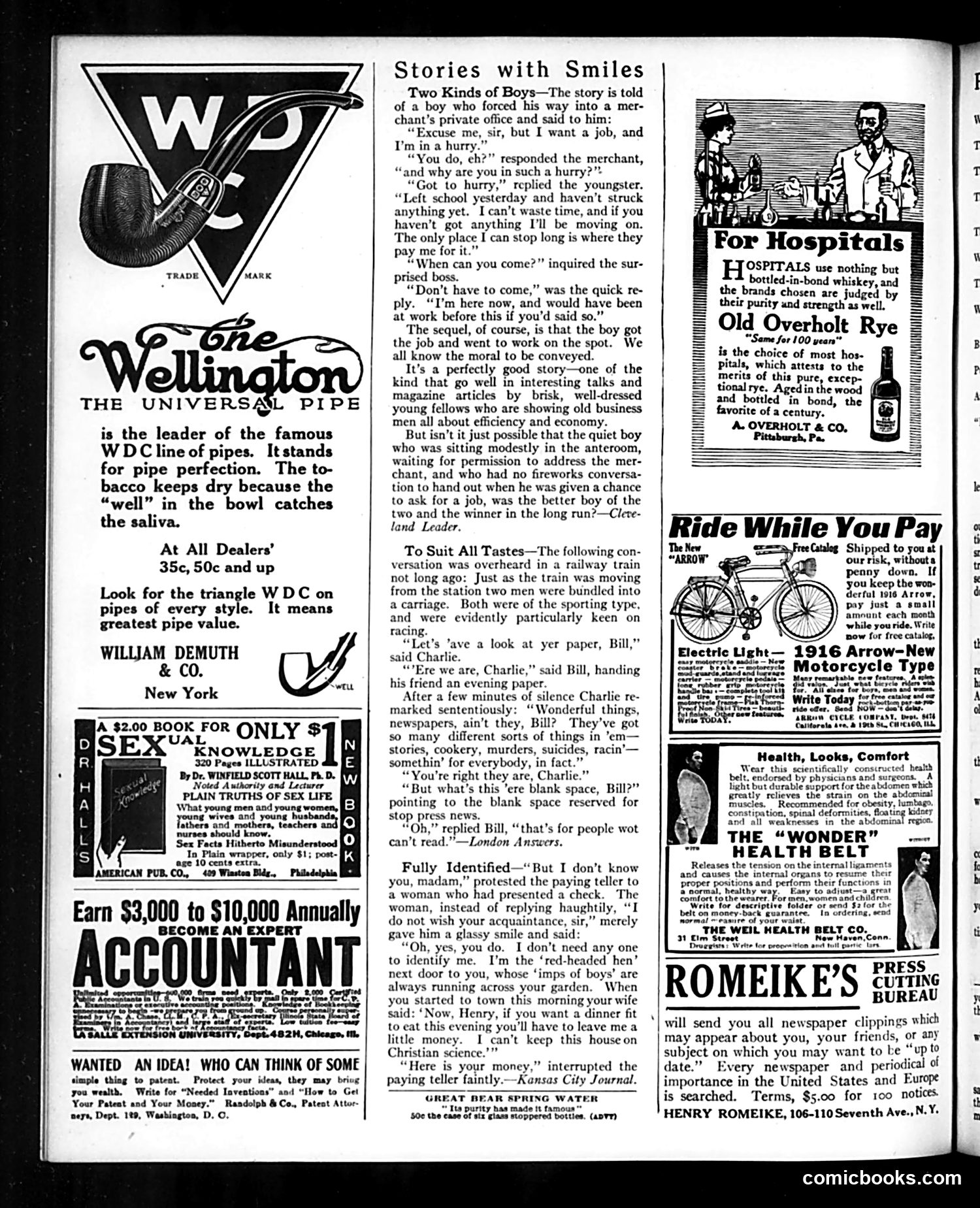
This page is primarily **advertisements and light humor pieces**, not political cartoons. The content includes: **"Stories with Smiles"** section contains two anecdotes: 1. A contrast between an aggressive, pushy boy and an implied modest boy seeking employment—suggesting the quiet boy's patience and restraint are superior virtues despite surface appearances. 2. A railway conversation between two working-class men ("Bill" and "Charlie") discussing a newspaper's diverse content. **Visual elements**: The Wellington pipe advertisement dominates the left side; other ads promote books on sex education, accounting correspondence courses, and patent services—typical early-20th-century trade publications. **Right-side advertisements** hawk motorcycles, whiskey for hospitals, and a newspaper clipping service. The humor is gentle and moralistic rather than satirical—promoting traditional values of humility and hard work over flashy self-promotion. There are no identified political figures or sharp social criticism; this appears to be a general-interest humor and advertising publication rather than political satire.
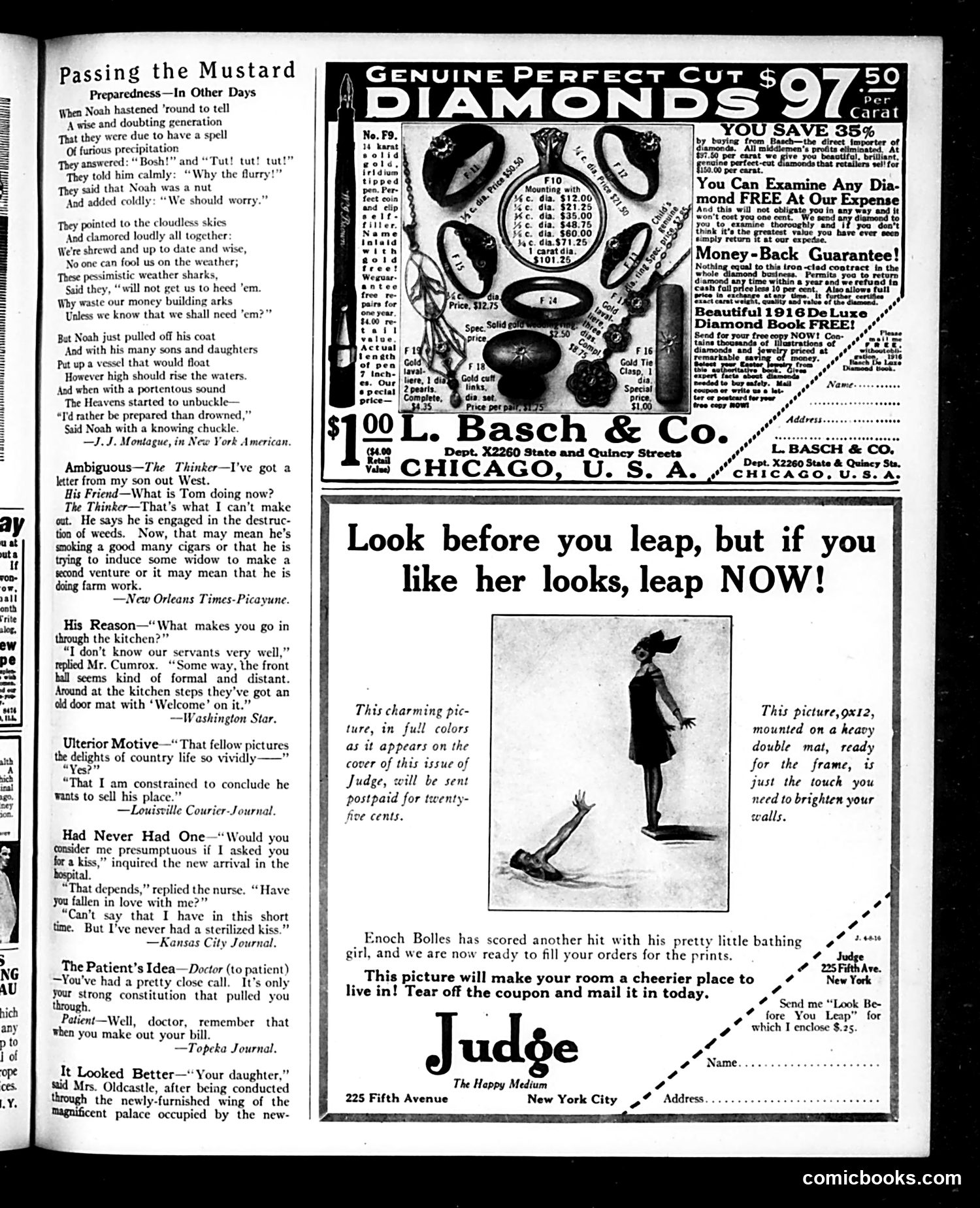
This page is primarily **advertising and humor columns** rather than political satire. The main content includes: **"Passing the Mustard" poem**: A Noah's Ark allegory about preparedness. The joke: people ignore warnings of danger (the flood), dismissing them as unnecessary worry. This likely references contemporary "preparedness" debates—possibly about military readiness or infrastructure investments that critics dismissed as alarmist. **Short humor columns**: Various jokes about misunderstandings and social situations (a son's cryptic letter about "weed destruction," servants' formality, a patient asking a sterilized kiss). **Large advertisements**: L. Basch & Co. selling "perfect cut diamonds" at $97.50/carat, and Judge magazine promoting bathing-girl prints by Enoch Bolles with the suggestive headline "Look before you leap, but if you like her looks, leap NOW!"—playing on romantic/marital themes. The page reflects early 20th-century consumer culture and gentle, genteel humor rather than sharp political commentary.
This is primarily an **advertising and humor-anecdote page** rather than a political cartoon page. The content consists of: **Humor Anecdotes:** Short jokes about social pretension (a hostess praising someone's "vocabulary" as decoration), children's education, and marriage—typical satirical observations of middle-class life. **Advertisements:** The page features vintage product ads including Heublein Club Cocktails, Evans' Ale, Le Page's Glue, and Carbona Cleaning Fluid—all marketed with early-20th-century appeals to modern convenience and sophistication. **Notable context:** The date (April 1916) places this during WWI, though no war content appears here. The ads reveal period attitudes: servants are referenced casually, and products emphasize labor-saving for affluent households. The humor is gentle social satire about vanity and human nature rather than sharp political commentary. No specific political figures or events are referenced or caricatured on this particular page.
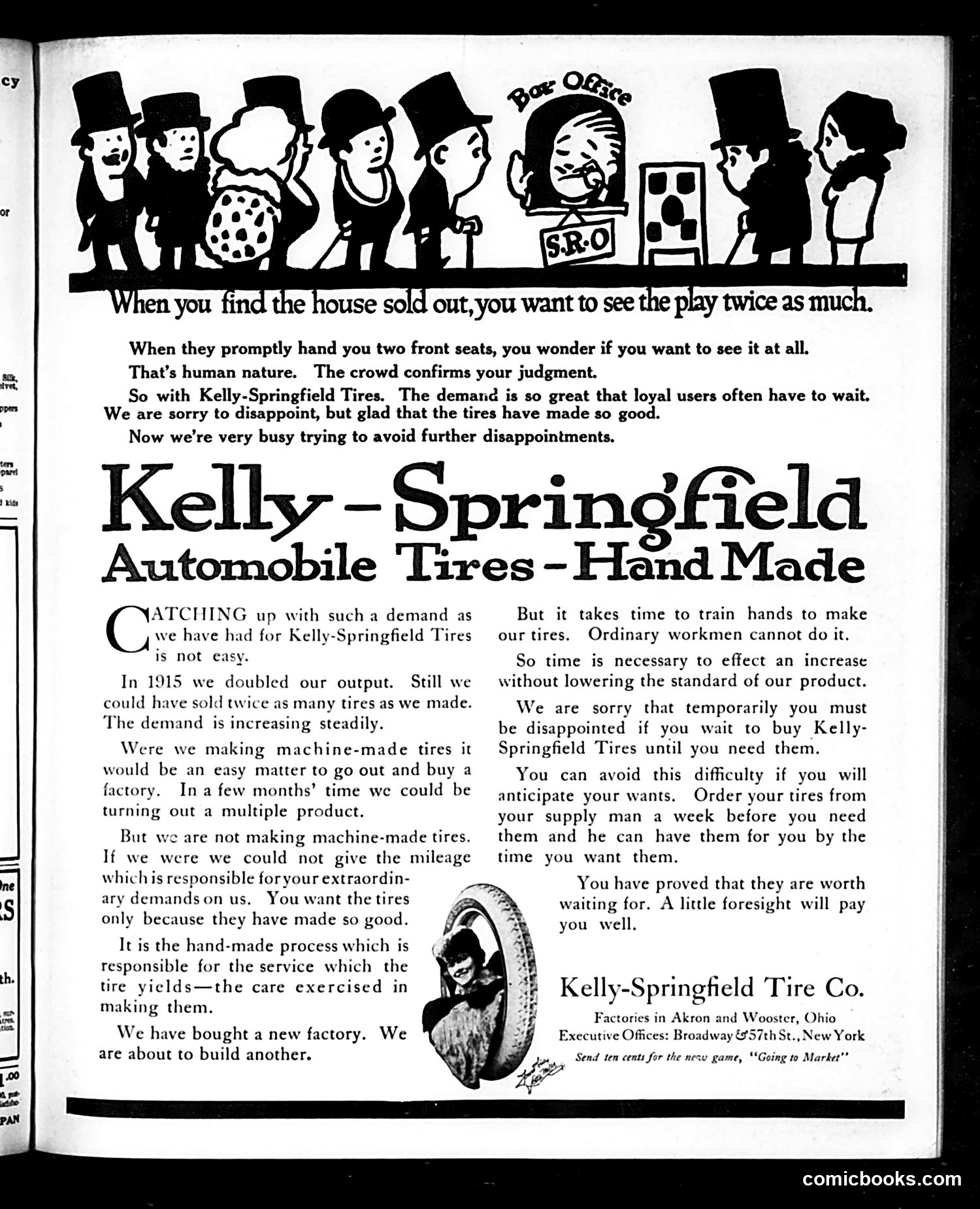
This is primarily a **Kelly-Springfield Tire Company advertisement**, not satire. The cartoon at the top uses humor to introduce the pitch. **The cartoon's setup**: Shows silhouetted figures at a theater box office marked "S.R.O." (Standing Room Only). The joke plays on human psychology—when you get hard-to-get front-row seats, you paradoxically wonder if you want them. The crowd's enthusiasm confirms the tickets' value. **The advertisement's message**: Kelly-Springfield applies this logic to their product. High demand means customers must wait for tires, but this actually proves quality. Rather than switch to mass production (machine-made tires), the company insists on hand-crafted manufacturing, which requires training skilled workers—hence production delays are unavoidable. **The appeal to readers**: Buy tires in advance to avoid disappointment; the wait proves the product's superiority. This reflects early 1910s manufacturing philosophy where "handmade" signified quality over industrial efficiency—a pitch unlikely to work in modern consumer culture, where speed and availability are paramount.
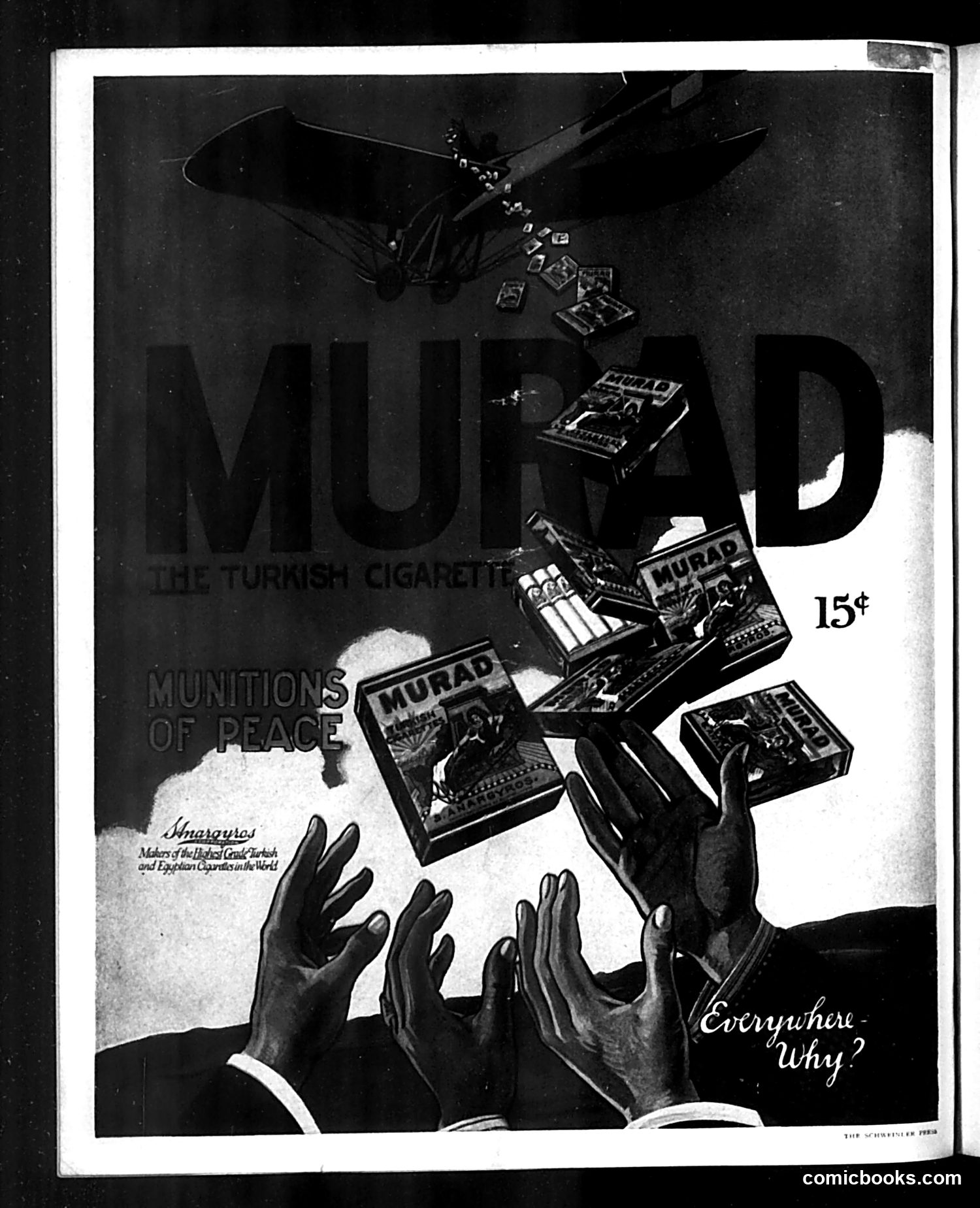
This is a cigarette advertisement rather than political satire. It promotes **Murad Turkish cigarettes** at 15¢, positioning them as "The Turkish Cigarette" with the slogan "Munitions of Peace" and "Everywhere—Why?" The imagery depicts multiple hands reaching upward toward boxes of Murad cigarettes, suggesting universal desire and accessibility. The advertisement appears to use militaristic language ("munitions," "peace") in a tongue-in-cheek manner—a common marketing approach of the era when such language was considered clever wordplay rather than problematic. The byline credits **Smagovies** as maker of the highest grade Turkish and Egyptian cigarettes. This represents early 20th-century cigarette marketing, before tobacco health warnings existed, using aspirational imagery to promote consumption across audiences.