
Judge, 1916-04-08 · page 10 of 28
Judge — April 8, 1916 — page 10: what you’re looking at
What you’re looking at
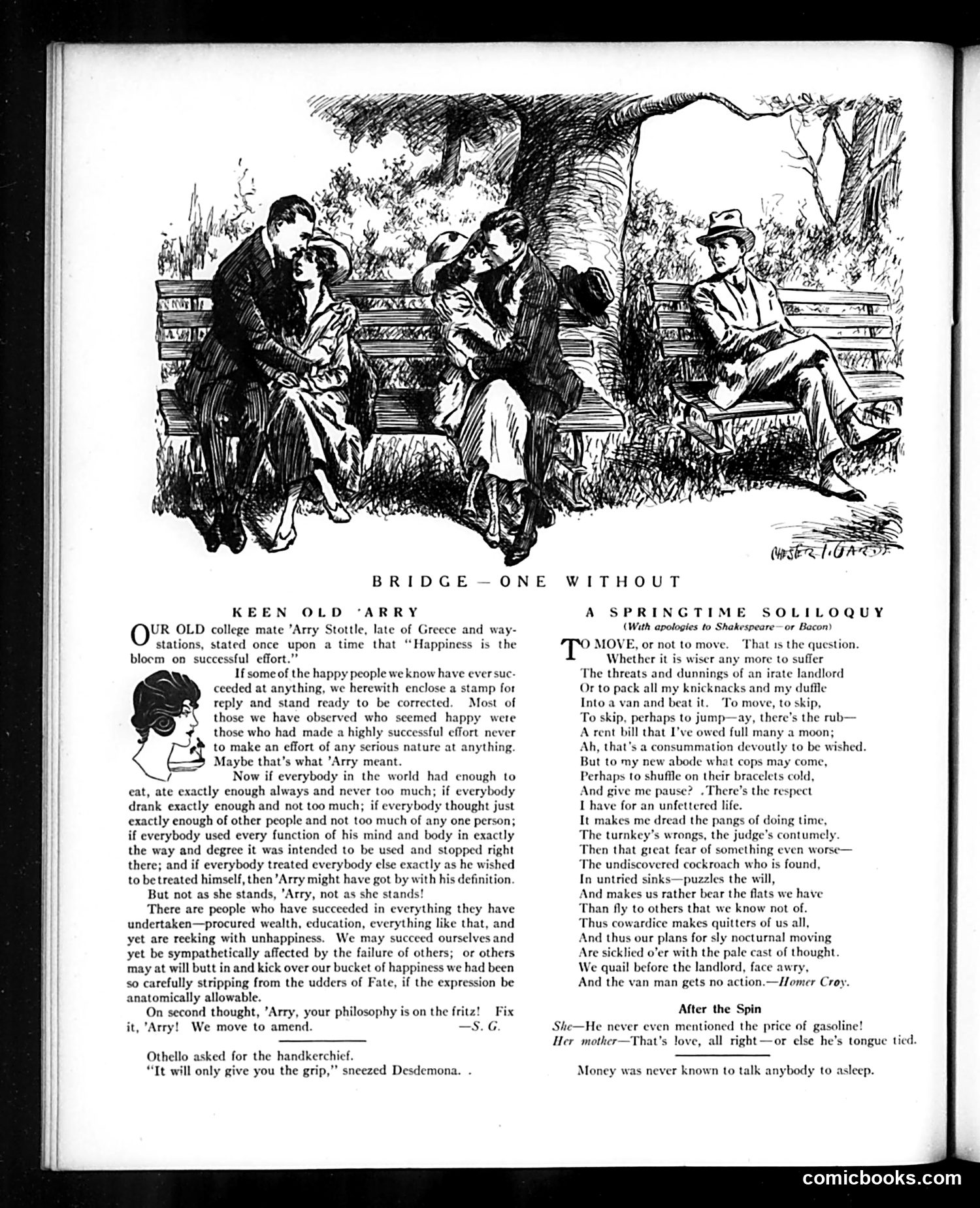
This page contains humorous social commentary rather than political satire. The main cartoon depicts men on park benches discussing philosophy—likely referencing a character named "'Arry" (Harry) who claims "happiness is the bloom on successful effort." The text argues this is naive: truly happy people often avoid serious effort, and external circumstances (others' failures, landlords, bills) disrupt happiness regardless of personal success. Below are two literary parodies: "A Springtime Soliloquy" mimics Hamlet's existential speech but applies it to evading rent and moving without being caught by police—a joke about urban poverty and landlord-tenant conflicts of the era. The final section, "After the Spin," jokes about romantic courtship and materialism, noting a suitor's silence about gasoline costs suggests either genuine love or dishonesty. The satire targets working-class anxieties about money, housing instability, and romantic expectations in early 20th-century America.
📄 Transcribed text from this page (OCR, searchable)
Machine-transcribed from the original scan — historical spelling and the odd misread are preserved.
BRIDGE—ONE WITHOUT KEEN OLD ‘ARRY UR OLD college mate ’Arry Stottle, late of Greece and way- Stations, stated once upon a time that “Happiness is the bloem on successful effort.” If some of the happy people we know have ever suc- ceeded at anything, we herewith enclose a stamp for reply and stand ready to be corrected. Most of those we have observed who seemed happy were those who had made a highly successful effort never ¢® to make an effort of any serious nature at anything. —& Maybe that’s what ’Arry meant. / Now if everybody in the world had cnough to eat, ate exactly enough always and never too much; if everybody drank exactly enough and not too much; if everybody thought just exactly enough of other people and not too much of any one person; if everybody used every function of his mind and body in exactly the way and degree it was intended to be used and stopped right there; and if everybody treated everybody else exactly as he wished to betreated himself, then ’Arry might have got by with his definition. But not as she stands, 'Arry, not as she stand There are people who have succeeded in everything they have undertaken—procured wealth, education, everything like that, and yet are recking with unhappiness. We may succeed ourselves and yet be sympathetically affected by the failure of others; or others may at will butt in and kick over our bucket of happiness we had been so carefully stripping from the udders of Fate, if the expression be anatomically allowable. On second thought, ’Arry, your philosophy is on the fritz! Fix it, 'Arry! We move to amend. —S. G. Othello asked for the handkerchief. “Tt will only give you the grip,” sneezed Desdemona. . A SPRINGTIME SOLILOQUY (With apologies to Shakespeare~or Bacon) ) MOVE, or not to move. That 1s the question. Whether it is wiser any more to suffer The threats and dunnings of an irate landlord Or to pack all my knicknacks and my dufile Into a van and beat it. To move, to skip, To skip, perhaps to jump—ay, there's the rub— A rent bill that I’ve owed full many a moon; Ah, that's a consummation devoutly to be wished. But to my new abode what cops may come, Perhaps to shuffle on their bra And give me pause? . Ther I have for an unfettered life. It makes me dread the pangs of doing time, The turn! 's wrongs, the judge's contumely. Then that great fear of something even worse— The undiscovered cockroach who is found, In untried sinks—puzzles the will, And makes us rather bear the flats we have Than fly to others that we know not of. Thus cowardice makes quitters of us all, And thus our plans for sly nocturnal moving Are sicklied o’er with the pale cast of thought. We quail before the landlord, face awry, And the van man gets no action.—Homer Croy. After the Spin She—He never even mentioned the price of gasoline! Her mother—That’s love, all right—or else he’s tongue tied. Money was never known to talk anybody to asleep. comicbooks.com