
Judge, 1916-04-08 · page 4 of 28
Judge — April 8, 1916 — page 4: what you’re looking at
What you’re looking at
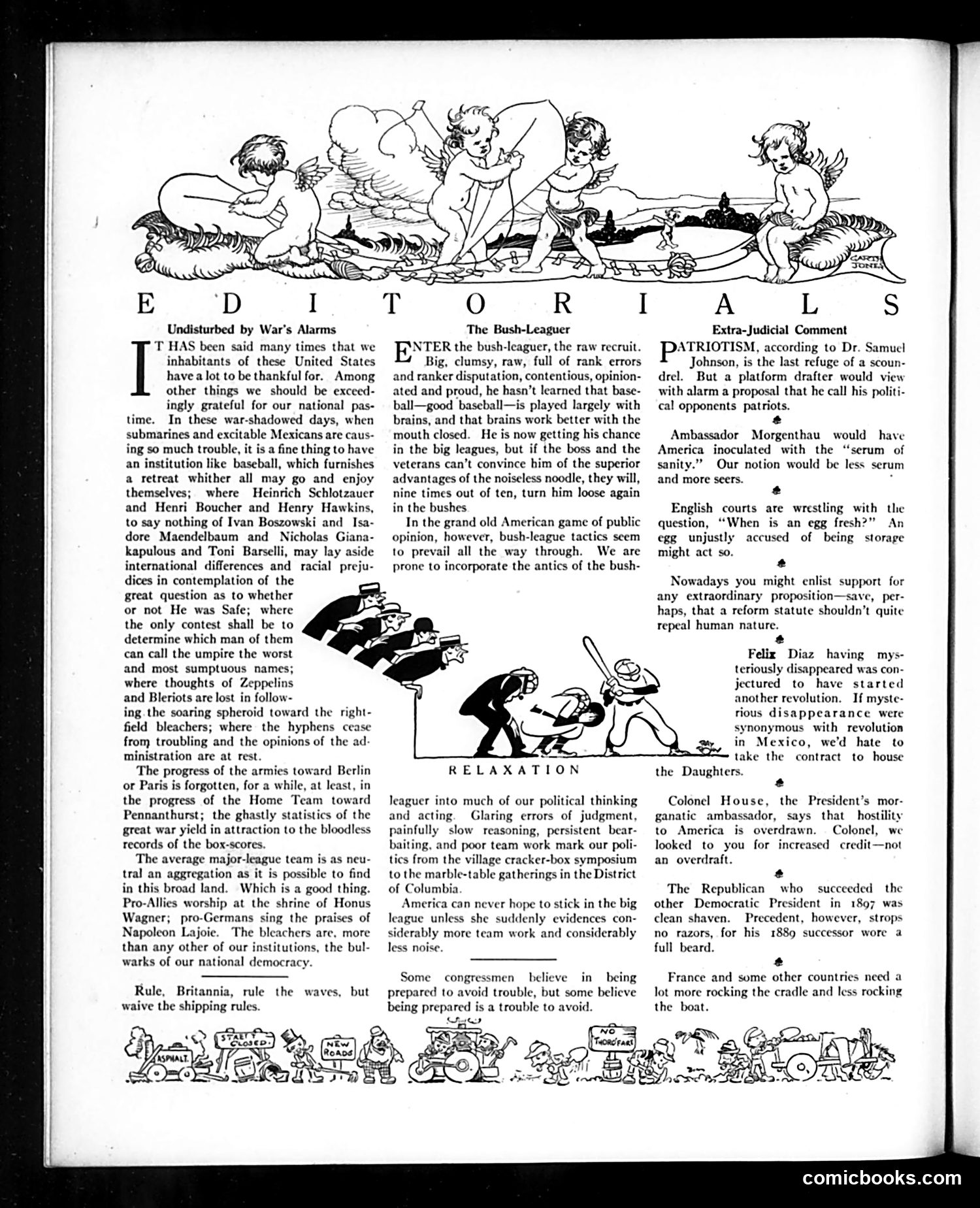
This page from *Judge* contains three distinct editorials with accompanying illustrations critiquing American society during wartime (likely WWI era, given references to war's disruptions). **"Undisturbed by War's Alarms"** satirizes baseball's "bush-leaguers"—inexperienced players—as metaphors for incompetent political thinking. The author argues these minor-league tactics have infected American politics and governance. **"The Bush-Leaguer"** specifically mocks raw recruits and poor judgment in leadership, using baseball terminology to criticize how politicians bungle serious matters. **"Extra-Judicial Comment"** attacks opportunistic political proposals exploiting wartime fears. It references patriotism being misused to justify questionable policies, with specific jabs at proposals by Ambassador Morgentbau and Colonel House regarding America's diplomatic standing. The cartoons use sports analogies to ridicule incompetent governance.
📄 Transcribed text from this page (OCR, searchable)
Machine-transcribed from the original scan — historical spelling and the odd misread are preserved.
Undisturbed by War's Alarms T HAS been said many times that we inhabitants of these United States have a lot to be thankful for. Among other things we should be exceed- ingly grateful for our national pas- time. In these war-shadowed days, when submarines and excitable Mexicans are caus- ing so much trouble, it is a fine thing to have an institution like baseball, which furnishes a retreat whither all may go and enjoy themselves; where Heinrich Schlotzauer and Henri Boucher and Henry Hawkins, to say nothing of Ivan Boszowski and Isa- dore Maendelbaum and Nicholas Giana- kapulous and Toni Barselli, may lay aside international differences and racial preju- dices in contemplation of the great question as to whether or not He was Safe; where the only contest shall be to determine which man of them can call the umpire the worst and most sumptuous names; where thoughts of Zeppelins and Bleriots are lost in follow- ing the soaring spheroid toward the right- field bleachers; where the hyphens cease from troubling and the opinions of the ad- ministration are at rest. The progress of the armies toward Berlin or Paris is forgotten, for a while, at least, in the progress of the Home Team toward Pennanthurst; the ghastly statistics of the great war yield in attraction to the bloodless records of the box-scores. The average major-league team is as neu- tral an aggregation as it is possible to find in this broad land. Which is a good thing. Pro-Allies worship at the shrine of Honus Wagner; pro-Germans sing the praises of Napoleon Lajoie. The bleachers are, more than any other of our institutions, the bul- warks of our national democracy. Rule, Britannia, rule the waves, but waive the shipping rules. The Bush-Leaguer NTER the bush-leaguer, the raw recruit. Big, clumsy, raw, full of rank errors and ranker disputation, contentious, opinion- ated and proud, he hasn’t learned that base- ball—good baseball—is played largely with brains, and that brains work better with the mouth closed. He is now getting his chance in the big leagues, but if the boss and the veterans can’t convince him of the superior advantages of the noiseless noodle, they will, nine times out of ten, turn him loose again in the bushes, In the grand old American game of public opinion, however, bush-league tactics seem to prevail all the way through. We are prone to incorporate the antics of the bush- r\ RELAXATION leaguer into much of our political thinking and acting. Glaring errors of judgment, painfully slow reasoning, persistent bear- baiting, and poor team work mark our poli- tics from the village cracker-box symposium to the marble-table gatherings in the District of Columbia America can never hope to stick in the big league unless she suddenly evidences con- siderably more team work and considerably less noise. Some congressmen believe in being prepared to avoid trouble, but some believe being prepared is a trouble to avoid. = Extra-Judicial Comment P*TRIOTISM, according to Dr. Samuel Johnson, is the last refuge of a scoun- drel. But a platform drafter would view with alarm a proposal that he call his politi- cal opponents patriots. 2 Ambassador Morgenthau would have America inoculated with the “serum of sanity.” Our notion would be less serum and more seers. 2 English courts are wrestling with the question, “When is an egg fresh?” An egg unjustly accused of being storage might act so. s Nowadays you might enlist support for any extraordinary proposition—save, per- haps, that a reform statute shouldn’t quite repeal human nature. 2 Felix Diaz having mys- teriously disappeared was con- jectured to have started another revolution. If myste- rious disappearance were synonymous with revolution in Mexico, we'd hate to take the contract to house the Daughters. Colonel House, the President’s mor- ganatic ambassador, says that hostility to America is overdrawn. Colonel, we looked to you for increased credit—not an overdraft. ¢ The Republican who succeeded the other Democratic President in 1897 was clean shaven. Precedent, however, strops no razors, for his 1889 successor wore a full beard. cd France and some other countries need a lot more rocking the cradle and less rocking the boat. comicbooks.com