
Judge, 1916-04-08 · page 18 of 28
Judge — April 8, 1916 — page 18: what you’re looking at
What you’re looking at
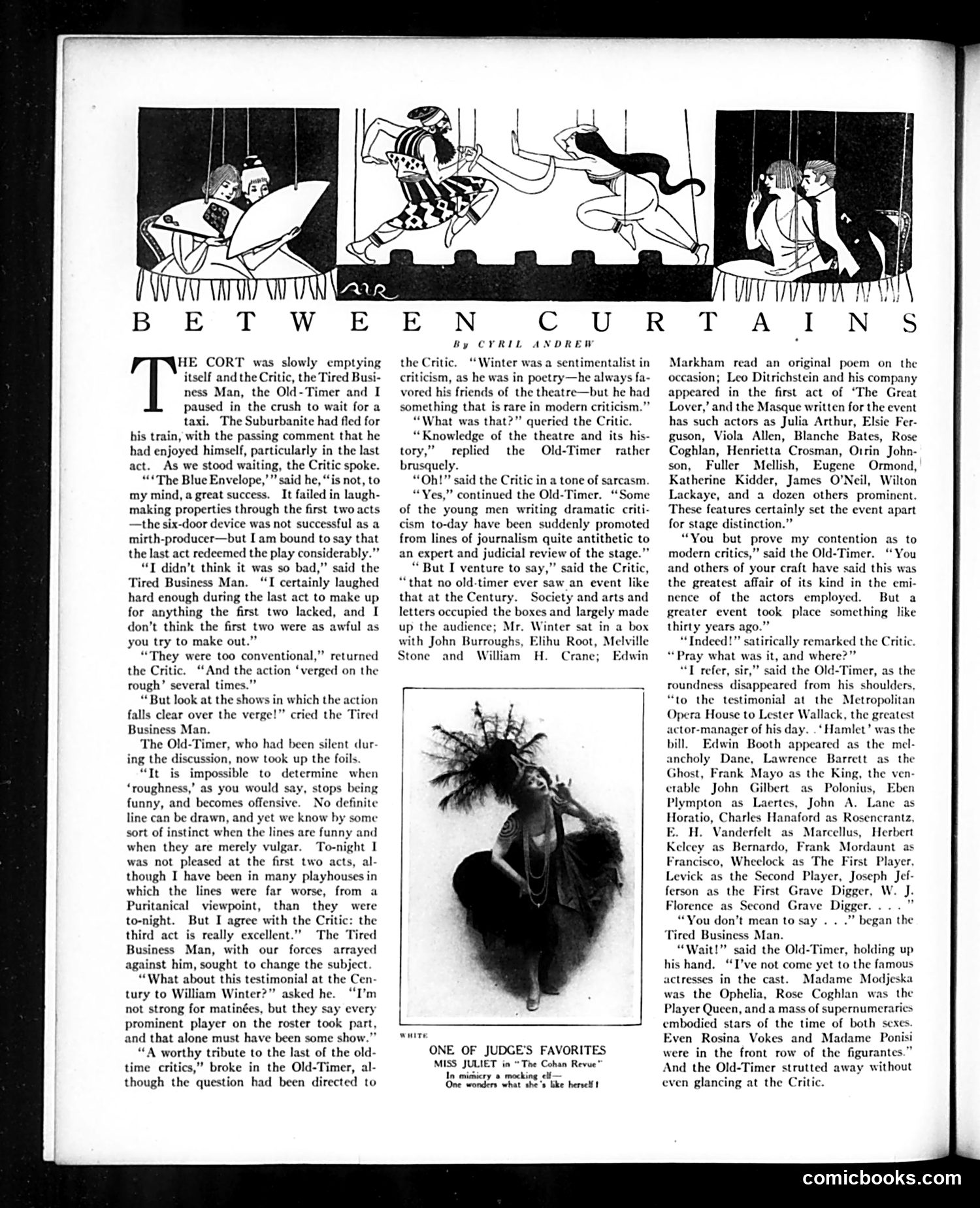
This is a theatrical debate piece by Cyril Andrew featuring four characters discussing a play called "The Blue Envelope" and a testimonial dinner for critic William Winter. **The Setup**: The characters—a Critic, Tired Business Man, Old-Timer, and narrator—argue about the play's quality, particularly debating whether its humor works or crosses into vulgarity. **Key Point**: The Old-Timer defends William Winter (a real, prominent 19th-century theater critic) as possessing rare "knowledge of the theatre and its history," contrasting him favorably with younger drama critics promoted from general journalism who lack theatrical expertise. **The Satire**: The piece mocks modern critics' superficiality while praising Winter's authority. Winter's testimonial dinner apparently featured prominent actors and society figures, which the Old-Timer uses to argue that modern critics overstate such spectacles' significance—proving they lack Winter's genuine understanding. The photograph shows "Miss Juliet" from "The Cohan Revue," captioned satirically questioning whether her real self matches her stage persona.
📄 Transcribed text from this page (OCR, searchable)
Machine-transcribed from the original scan — historical spelling and the odd misread are preserved.
T HE CORT was slowly emptying itself and the Critic, the Tired Busi- ness Man, the Old-Timer and I paused in the crush to wait for a taxi. The Suburbanite had fled for his train, with the passing comment that he had enjoyed himself, particularly in the last act. As we stood waiting, the Critic spoke. “The Blue Envelope,’” said he, “is not, to my mind, a great success. It failed in laugh- making properties through the first two acts —the six-door device was not successful as a mirth-producer—but I am bound to say that the last act redeemed the play considerably.” “T didn’t think it was so bad,” said the Tired Business Man. “TI certainly laughed hard enough during the last act to make up for anything the first two lacked, and I don’t think the first two were as awful as you try to make out.” “They were too conventional,” returned the Critic. “And the action ‘verged on the rough’ several times.” “But look at the shows in which the action falls clear over the verge!” cried the Tired Business Man. The Old-Timer, who had been silent dur- ing the discussio “It is impos to ‘roughness,’ as you would say. funny, and becomes offensiv line can be drawn, and yet we ) sort of instinct when the lines are funn when they are merely vulgar. was not pleased at the first two acts, al- though I have been in many playhouses in which the lines were far worse Puritanical viewpoint, than they were to-night. But I agree with the Critic: the third act is really excellent.” The Tired Business Man, with our forces arrayed against him, sought to change the subject “What about this testimonial at the tury to William Winter?” asked he. not strong for matinées, but they say every prominent player on the roster took part, and that alone must have been some show.” “A worthy tribute to the last of the old- time critics,” broke in the Old-Timer, al- though the question had been directed to determine when stops being No definite By CYRIL ANDREW e Critic. “Winter was a sentimentalist in m, as he was in poetry—he always fa- vored his friends of the theatre—but he had something that is rare in modern criticism.” “What that?” queried the C: 4 “Knowledge of the theatre and its his- tory,” replied the Old-Timer rather uely. “Oh!” said the Critic in a tone of sarcasm. “Yes,” continued the Old-Timer. “Some of the young men writing dramatic criti- cism to-day have been suddenly promoted from lines of journalism quite antithetic to an expert and judicial review of the stage.” “But I venture to say,” said the Cr “that no old-timer ever saw an event like that at the Century. Society and arts and letters occupied the boxes and largely made up the audience; Mr. Winter sat in a box with John Burroughs, Elihu Root, Melville Stone and William H. Crane; Edwin ware ONE OF JUDGE'S FAVORITES MISS JULIET in “The Cohan Revue” In michicry © mocking elf — One wonders what she’s like herself t I N § kham read an original poem on the jon; Leo Ditrichstein and his company appeared in the first act of ‘The Great Lover,’ and the Masque written for the event has such actors as Julia Arthur, Elsie Fer- guson, Viola Allen, Blanche Bates, Rose Coghlan, Henrietta Crosman, Otrin John- son, Fuller Mellish, Eugene Ormond, Katherine Kidder, James O'Neil, Wilton Lackaye, and a dozen others prominent. These features certainly set the event apart for stage distinction.” “You but prove my contention as to modern critics,” said the Old-Timer. “You and others of your craft have said this was the greatest affair of its kind in the emi- nence of the actors employed. But a greater event took place something like thirty years ago.” “Indeed!” satirically remarked the Critic. “Pray what was it, and where?” “T refer, sir,” said the Old-Timer, as the roundness disappeared from his shoulders, “to the testimonial at the Metropolitan Opera House to Lester Wallack, the greatest actor-manager of his day. .‘ Hamlet’ was the bill. Edwin Booth appeared as the mel- ancholy Dane, Lawrence Barrett as the Ghost, Frank Mayo as the King, the ven- erable John Gilbert as Polonius, Eben npton as rtes, John A. Lane as io, Charles Hanaford as Rosencrantz, Vanderfelt Marcellus, Herbert as Bernardo, Frank Mordaunt as isco, Wheelock as The First Player, Levick as the Second Player, Joseph Jef- ferson as the st Grave Digger, W. J. Florence as Second Grave Digger... .” “You don’t mean to say . . .” began the Tired Business Man. “Wait!” said the Old-Timer, holding up his hand. “I’ve not come yet to the famous actresses in the cast. Madame Modjeska was the Ophelia, Rose Coghlan was the Player Queen, and a mass of supernumeraties embodied stars of the time of both sexes. Even Rosina Vokes and Madame Ponisi were in the front row of the figurantes.” And the Old-Timer strutted away without even glancing at the Critic. comicbooks.com