
A complete issue · 28 pages · 1916
Judge — February 26, 1916
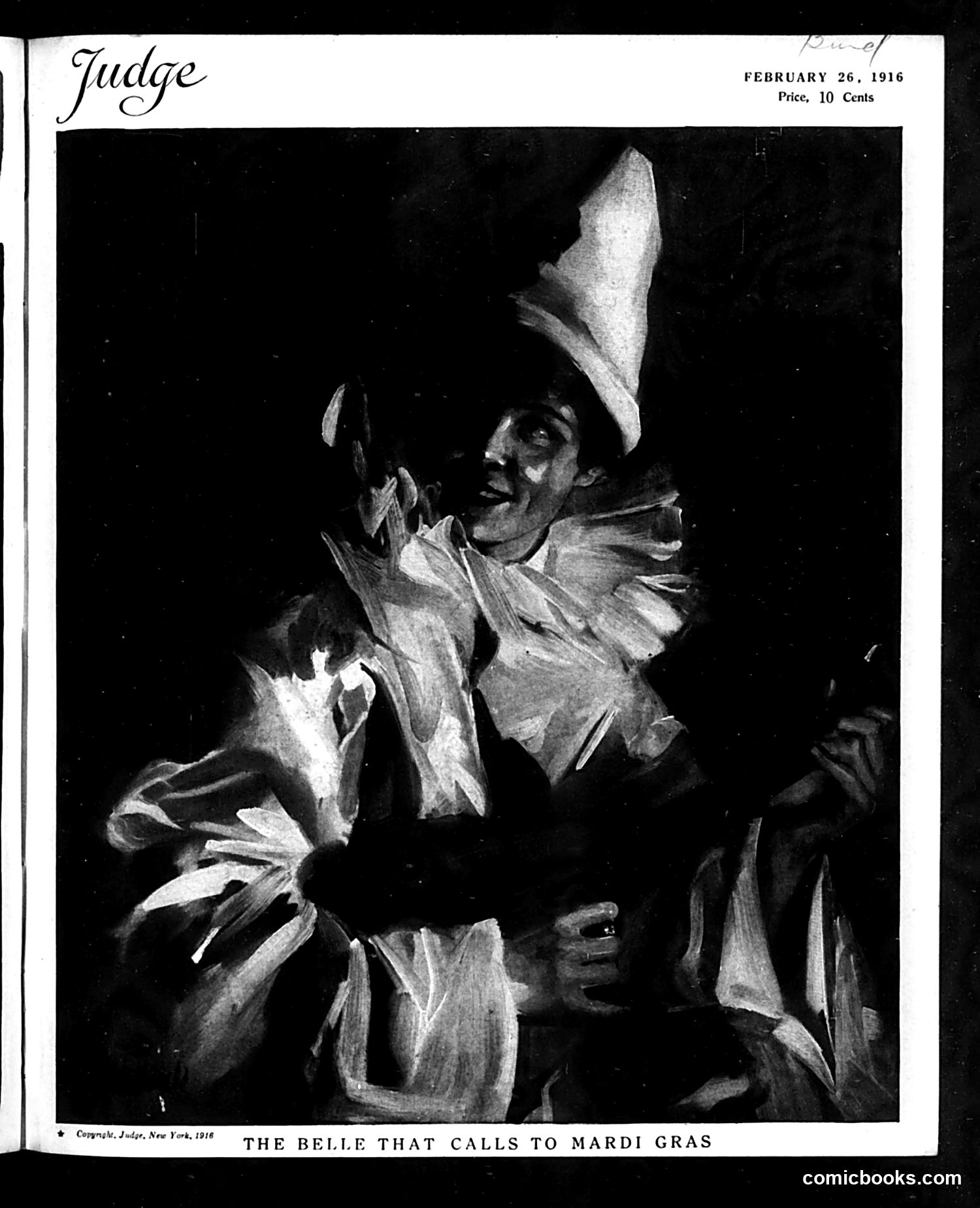
This February 1916 *Judge* cartoon depicts a figure in theatrical Mardi Gras costume—tall pointed hat and ruffled collar—seemingly calling or beckoning. The title's wordplay ("belle" suggesting both an attractive woman and the literal bell sound) plays on Mardi Gras traditions of New Orleans celebration. The image appears to be satirizing either the carnival season itself or perhaps someone's attraction to or promotion of Mardi Gras festivities. The dramatic lighting and theatrical presentation emphasize the spectacle and excess associated with the event. Without additional context identifying the specific figure, the cartoon's precise political target remains unclear, though it likely comments on contemporary American attitudes toward Southern traditions or perhaps critiques consumption and revelry.
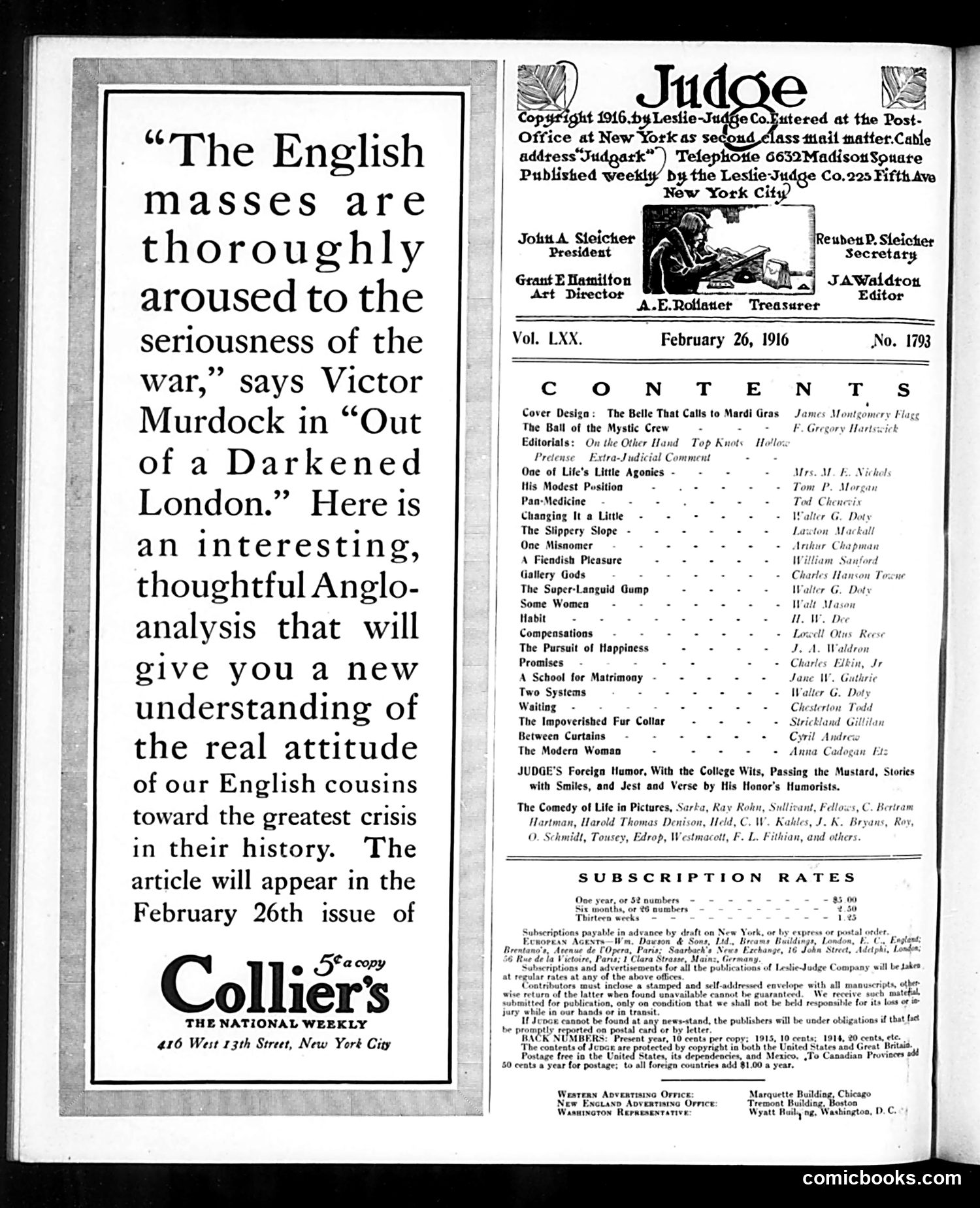
This page is primarily **advertising and editorial matter** rather than political cartoons. The left side advertises Collier's magazine, promoting an article by Victor Murdock analyzing English attitudes toward World War I—specifically how the English public has become "thoroughly aroused to the seriousness of the war." The right side shows Judge's masthead and table of contents for Vol. LIX, No. 1793 (February 26, 1916). The contents list numerous humorous articles, stories, and illustrated features typical of Judge's satirical offerings. Notable is reference to "Foreign Humor" and college-related comedy pieces. The magazine was published during America's pre-WWI period, when debate over intervention remained active. The Murdock article reference reflects contemporary interest in European perspectives on the ongoing conflict.
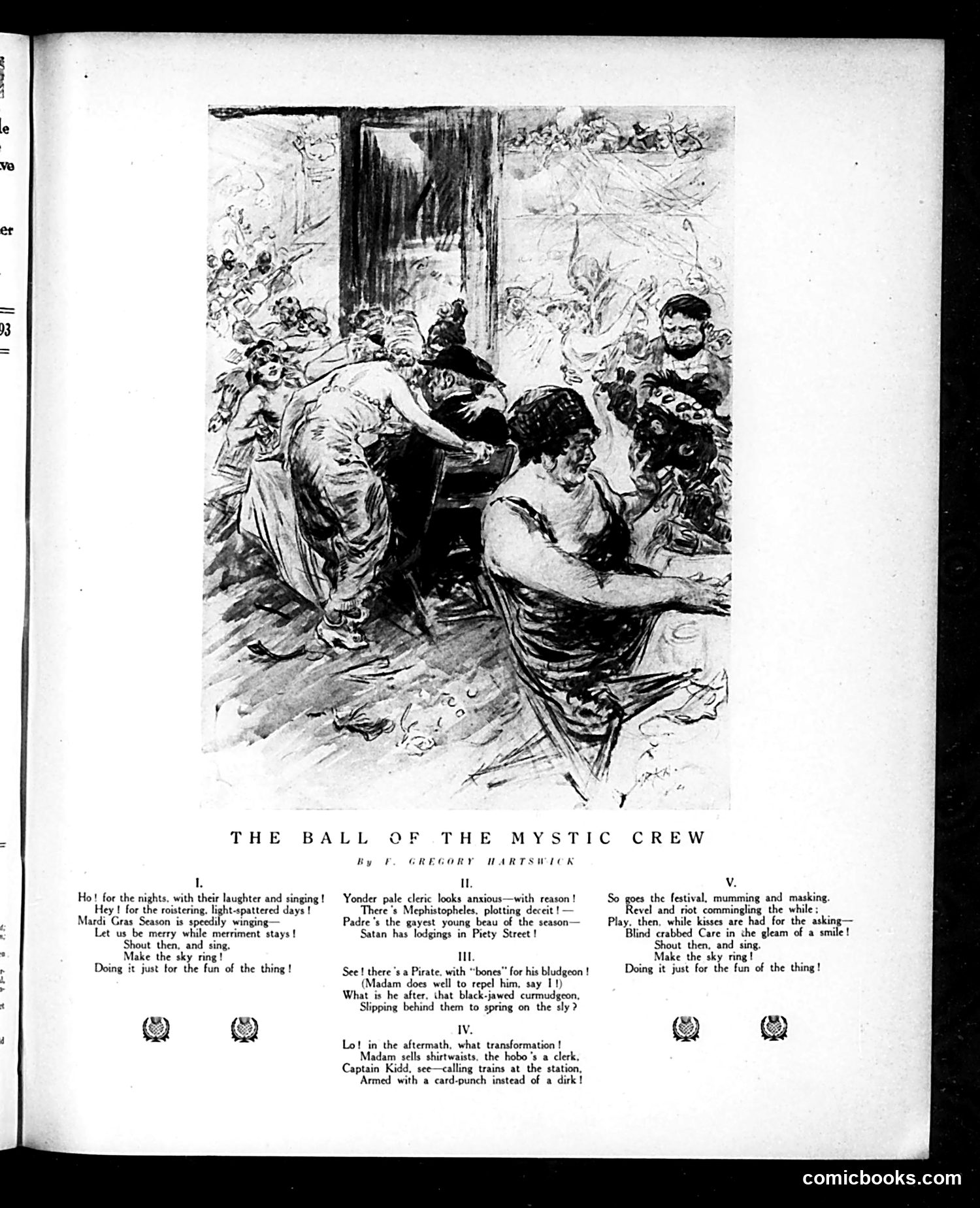
This satirical illustration depicts a chaotic, crowded scene at what appears to be a disreputable establishment or gathering. The poem's five sections mock various characters and situations, including references to "Mephistopheles," a "Pirate," and transformations occurring "in the aftermath." The satire seems to target urban nightlife and low establishments, with characters including what the text identifies as "Madam," "Captain Kidd," and references to "hobos" becoming "clerks." The repeated refrain "Make the sky ring!" suggests drunken revelry. Without additional historical context, the specific political or social targets remain unclear, though the imagery suggests Judge magazine's typical mockery of urban vice, criminality, and moral decay in late 19th/early 20th-century America.
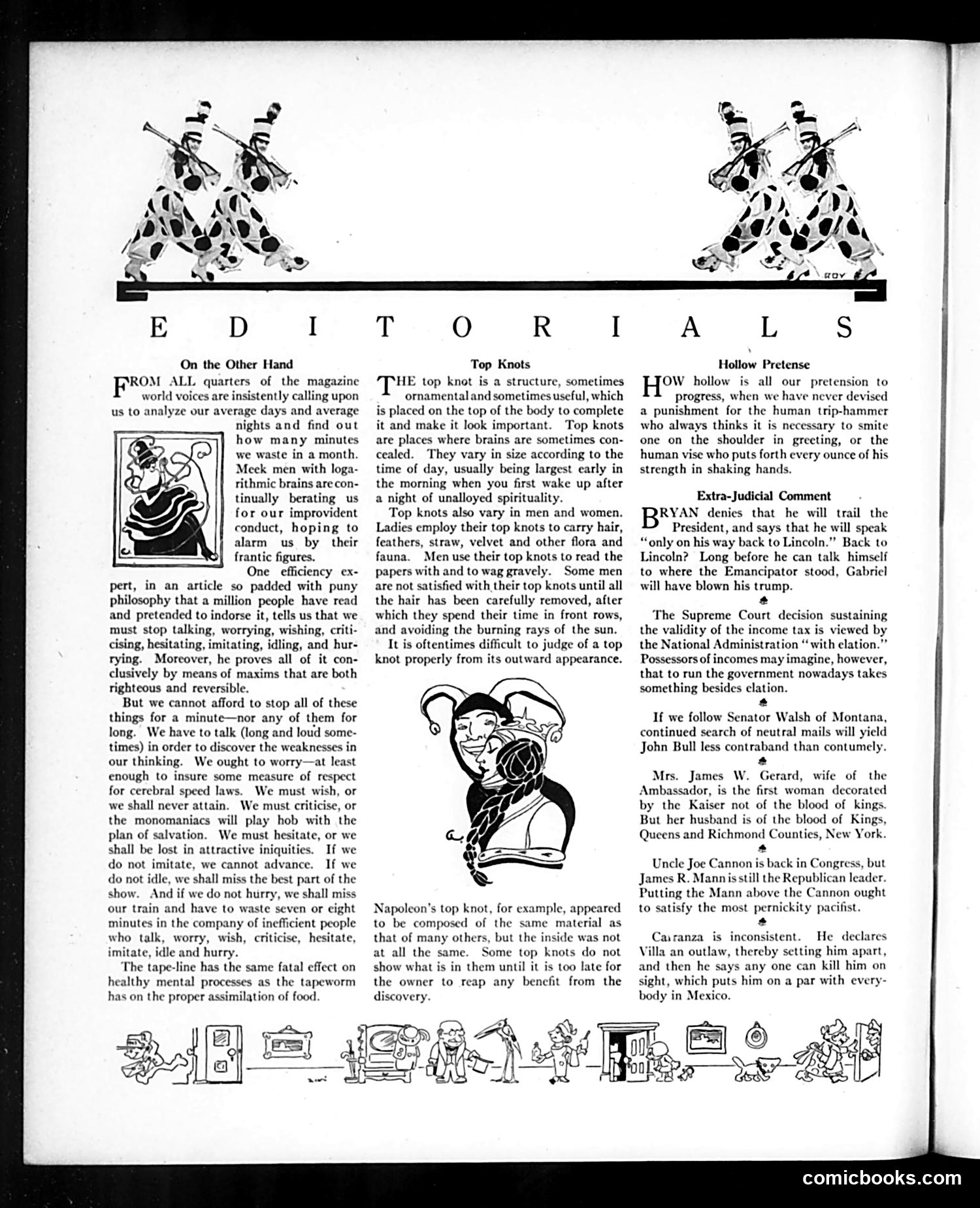
This page contains three distinct sections of political commentary from an early 20th-century American satirical magazine. **"On the Other Hand"** critiques inefficiency in magazine publishing and government, arguing against wasting time on trivial matters. **"Top Knots"** discusses hairstyles as social indicators, noting variations by gender and class. The text suggests top knots reflect character and mental state. **"Hollow Pretense"** attacks what appears to be a political figure (possibly Bryan, based on reference) for claiming he'll return to Lincoln while pursuing personal ambitions elsewhere. **"Extra-Judicial Comment"** includes brief political jabs: criticism of Bryan's motives, Supreme Court decisions on the National Administration, and commentary on Senator Walsh of Montana, Ambassador Gerard's wife, and figures like Uncle Joe Cannon and James R. Mann—all contemporary political personalities. The illustrations are decorative and don't clearly identify specific individuals.
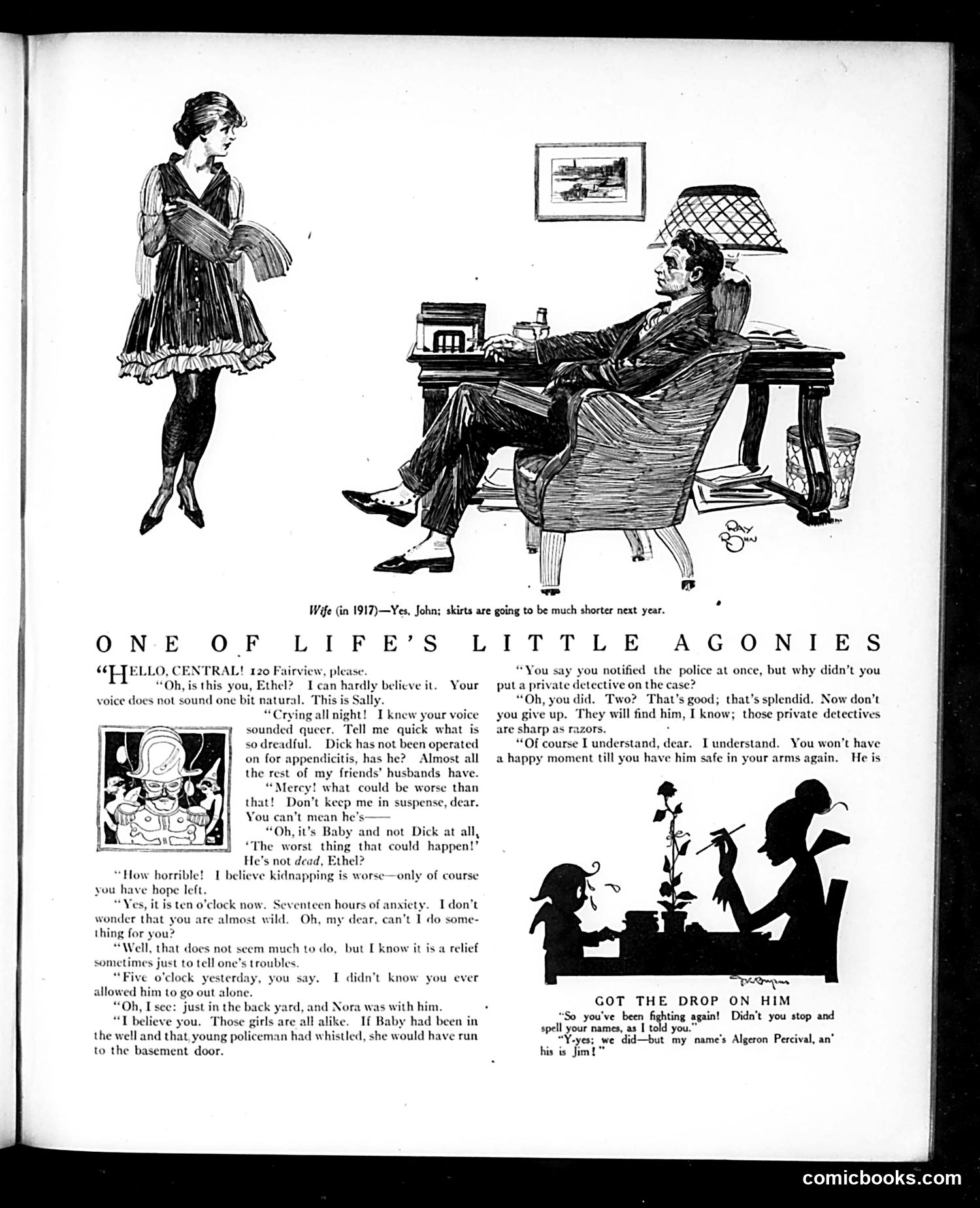
This page contains two satirical pieces from Judge magazine (dated 1917 based on the caption). **Top cartoon**: Shows a husband at his desk dismissing his wife's concern about shorter skirts. The satire mocks the husband's obliviousness to fashion changes and contemporary anxieties about women's clothing becoming more revealing—a real social controversy during WWI era. **"One of Life's Little Agonies"**: A dialogue story where a woman reports her baby is missing. The husband dismisses her concerns, attributing the child's absence to normal play. The satire targets husbands' indifference to domestic crises and their tendency to minimize serious family matters as trivial. **"Got the Drop on Him"**: A silhouette illustration depicting domestic conflict, likely showing marital discord where a wife has gained advantage over her husband. These pieces satirize early 20th-century gender relations and domestic tensions.
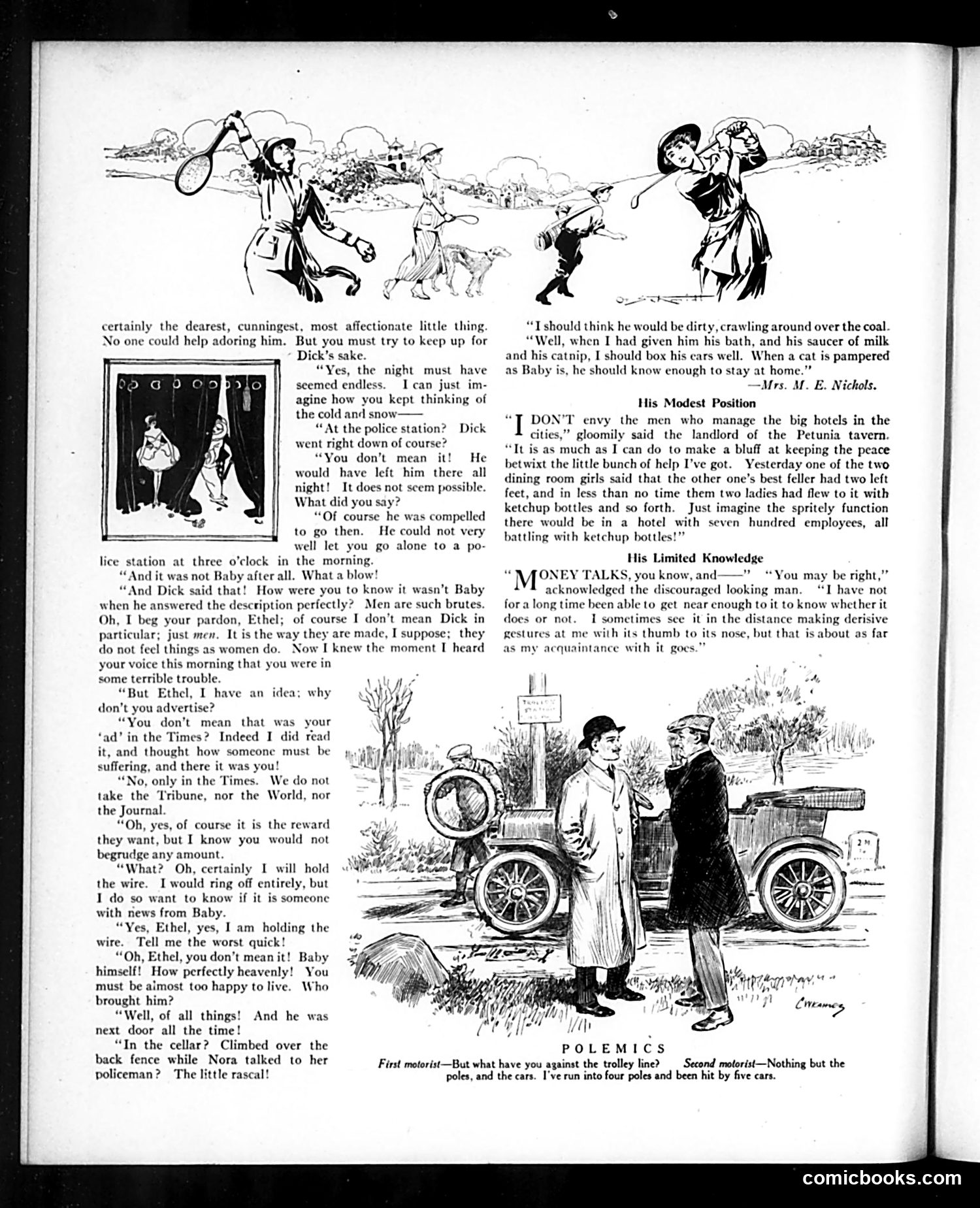
This page contains several satirical pieces typical of early 20th-century American humor: **Main Story ("His Modest Position")**: A hotel landlord complains about managing staff, claiming his job is harder than running large city hotels. The joke satirizes working-class complaints—he boasts of his "modest" position while exaggerating petty workplace drama (dining room girls fighting with ketchup bottles). **"His Limited Knowledge"**: A discouraged man admits he's so poor he can only see money "in the distance" making gestures at him—satirizing economic hardship and the inaccessibility of wealth to the struggling working class. **"Polemics" (bottom cartoon)**: Two motorists argue about traffic hazards. One blames trolley lines; the other claims cars are worse, having hit "four poles and been hit by five cars"—satirizing the early automotive era's traffic chaos and drivers' defensive excuses. **Top story**: Involves a lost baby (cat) found in a neighbor's cellar—gentle domestic satire about overwrought worry. The overall tone mocks class anxieties, workplace frustrations, and emerging modern inconveniences.
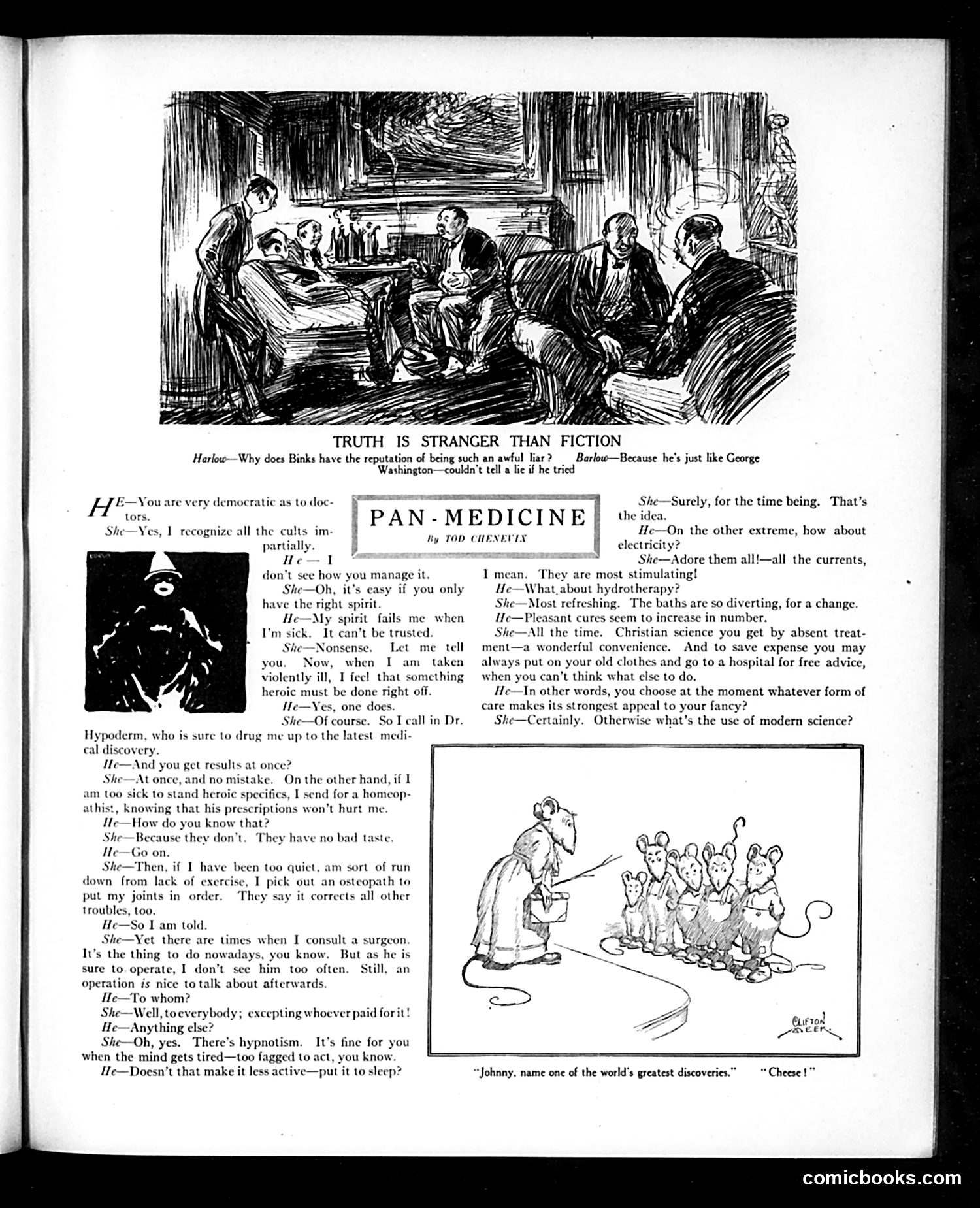
**Top Cartoon**: A brief joke playing on the saying "George Washington couldn't tell a lie." The humor suggests that Binks is such a habitual liar that even the moral standard set by Washington couldn't reform him. **Main Content - "Pan-Medicine"**: A satirical dialogue between a man and woman discussing modern medical treatments. The woman describes consulting various practitioners—allopathic doctors (who prescribe drugs), homeopaths (whose harmless remedies can't hurt), osteopaths (for joint correction), surgeons (for talk value afterward), and hypnotists (for mental fatigue). The satire mocks the era's medical pluralism and the fashionable tendency to try every available cure indiscriminately. The woman's casual adoption of contradictory treatments—from aggressive drug therapy to gentle homeopathy—exposes how people selected medicine based on trend rather than logic. **Bottom Cartoon**: A woman presents laboratory mice, claiming "Johnny, name one of the world's greatest discoveries"—implying that modern science's greatest achievement is merely producing laboratory mice, satirizing overconfidence in contemporary scientific progress.
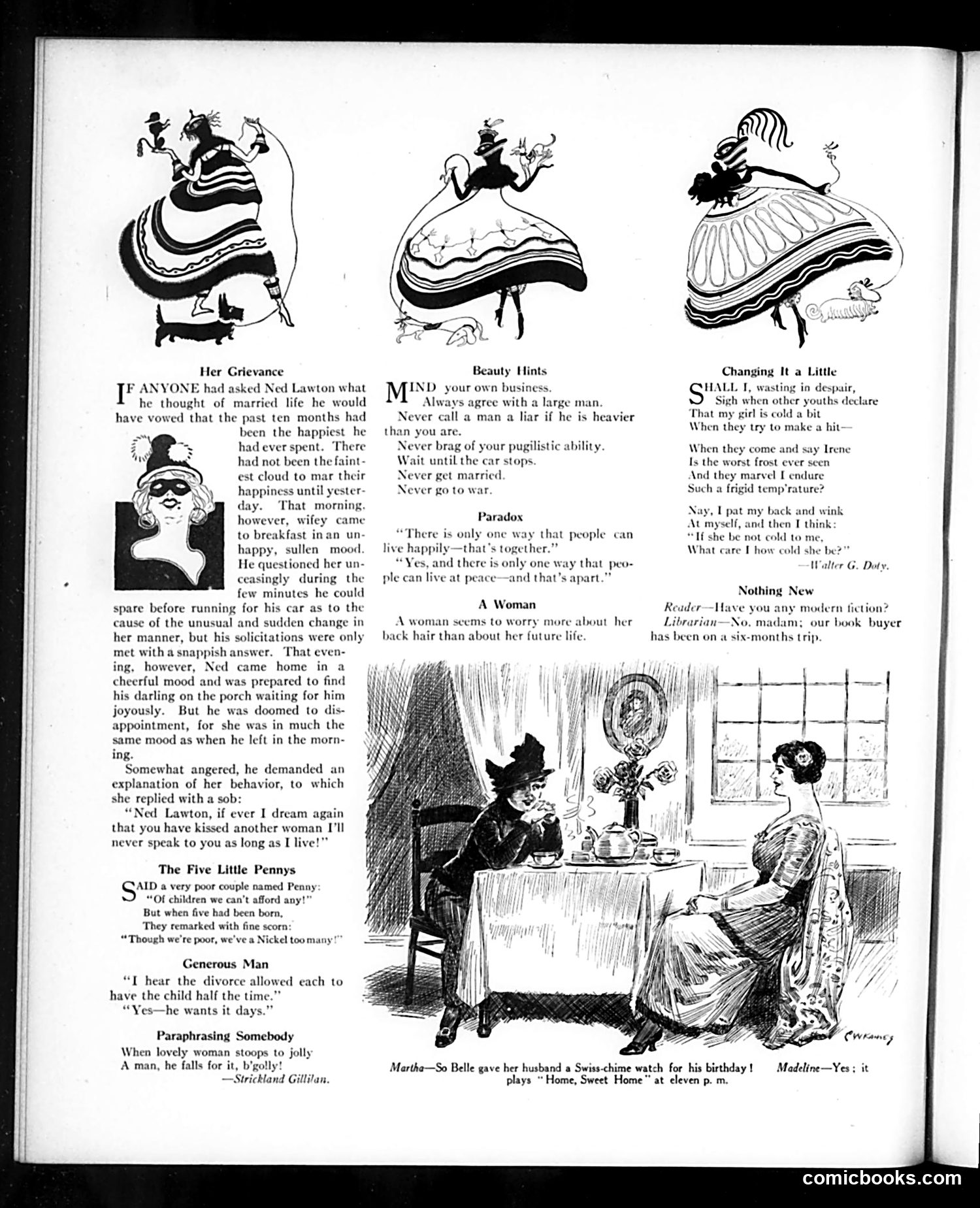
This page from *Judge* (an American satirical weekly) contains multiple short humorous pieces mocking early 20th-century social conventions: **"Her Grievance"**: A newlywed wife refuses to speak to her husband after dreaming he kissed another woman. The satire ridicules women's emotional irrationality and the absurdity of punishing men for dream behavior. **"Beauty Hints"**: Ironic advice including "Never get married" and "Never go to war"—mocking self-help literature while suggesting marriage is undesirable. **"The Five Little Pennys"**: A poor couple complains about having five children, pun on "penny/pennies," mocking working-class family planning struggles. **Illustration "A Woman"**: Shows a woman primping her hair while a visitor waits, satirizing women's vanity about appearance over substance. The page targets stereotypical female behaviors (irrationality, vanity, chattiness) and marriage itself—typical turn-of-the-century humor reflecting anxieties about gender roles and domestic life.
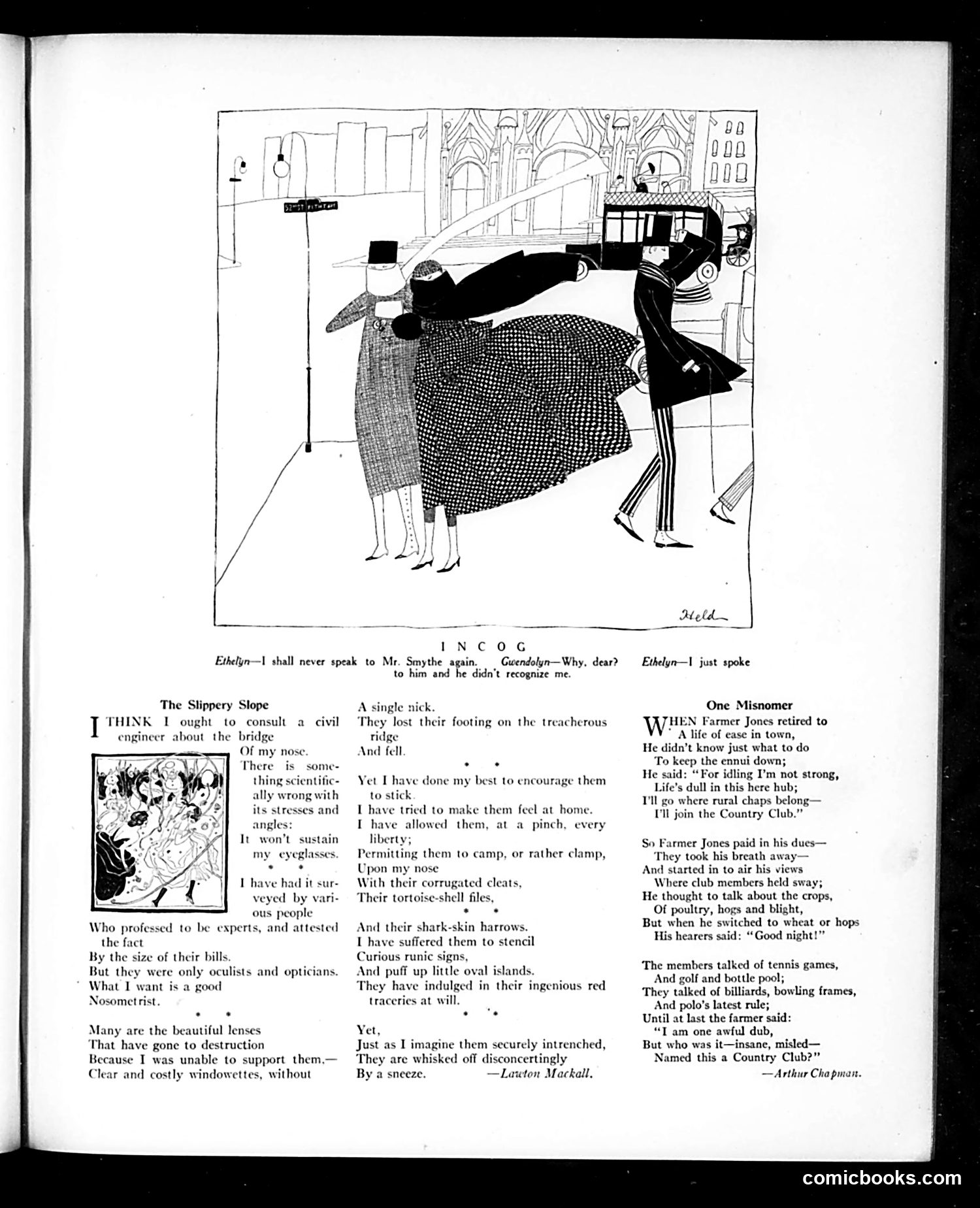
This page contains three satirical pieces mocking early 20th-century urban pretension: **"INCOG" cartoon**: A woman in disguise (wearing a large checkered coat and hat) encounters Mr. Smythe on a city street, but he doesn't recognize her. The satire targets the superficiality of social recognition—suggesting identity depends entirely on appearance and fashion rather than actual character. **"The Slippery Slope"**: A humorous monologue about eyeglasses repeatedly falling off one's nose due to its inadequate bridge. The joke invents a fictional specialist ("Nosometrist") to mock the proliferation of pseudo-scientific experts and specialists charging high fees for dubious services—a common target of Judge's satire. **"One Misnomer"**: A poem mocking a retired farmer who joins a prestigious "Country Club" expecting rural camaraderie, only to discover it's an exclusive urban social club where members discuss tennis, golf, and polo. The satire critiques the misleading name and the pretentious gap between rural identity and urban sophistication. All three pieces ridicule class anxieties and social climbing in Jazz Age America.
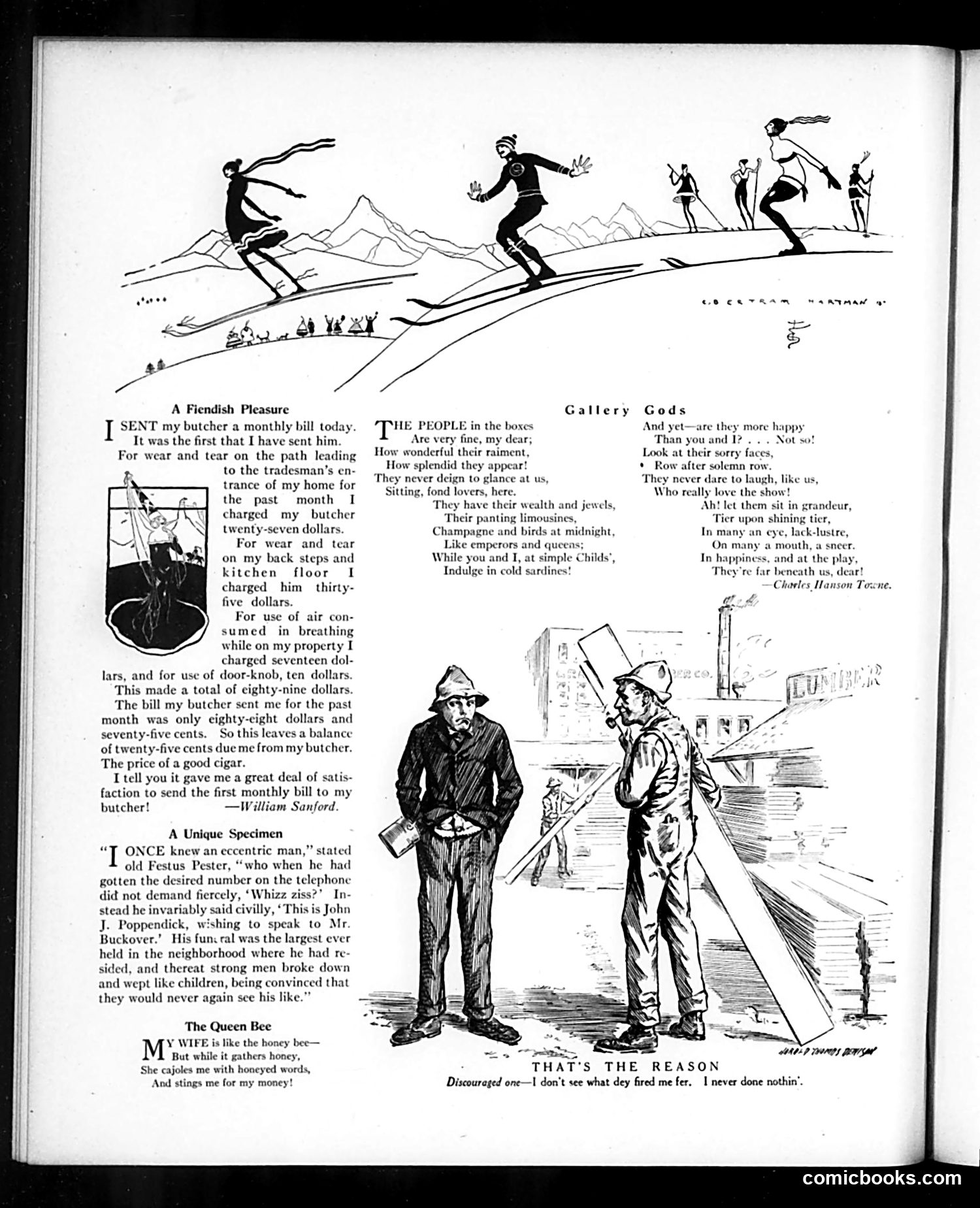
This page contains three humorous pieces satirizing social pretension and domestic life: **"A Fiendish Pleasure"** mocks a homeowner's petty revenge—he bills his butcher for "wear and tear" on his property and air consumed while visiting, totaling $89 against the butcher's $88.75 bill. The joke is the absurdity of nickel-and-diming a tradesman and the narrator's smug satisfaction over 25 cents. **"A Unique Specimen"** celebrates a rare man of genuine civility who said "please" to telephone operators, becoming beloved. It's gentle satire on how courtesy has become so rare it's noteworthy. **"Gallery Gods"** (poem by Charles Hanson Towne) contrasts theater patrons in expensive boxes—wealthy but miserable, forbidden to laugh freely—with ordinary lovers in cheaper seats who genuinely enjoy the show. The satire targets upper-class pretension and emotional coldness masked by displays of wealth. **"That's the Reason"** (bottom cartoon) shows a discouraged worker claiming he "never done nothin'"—ironic commentary on unemployment or firing, though the specific context is unclear. The page overall satirizes class divisions, social pretension, and domestic absurdity.
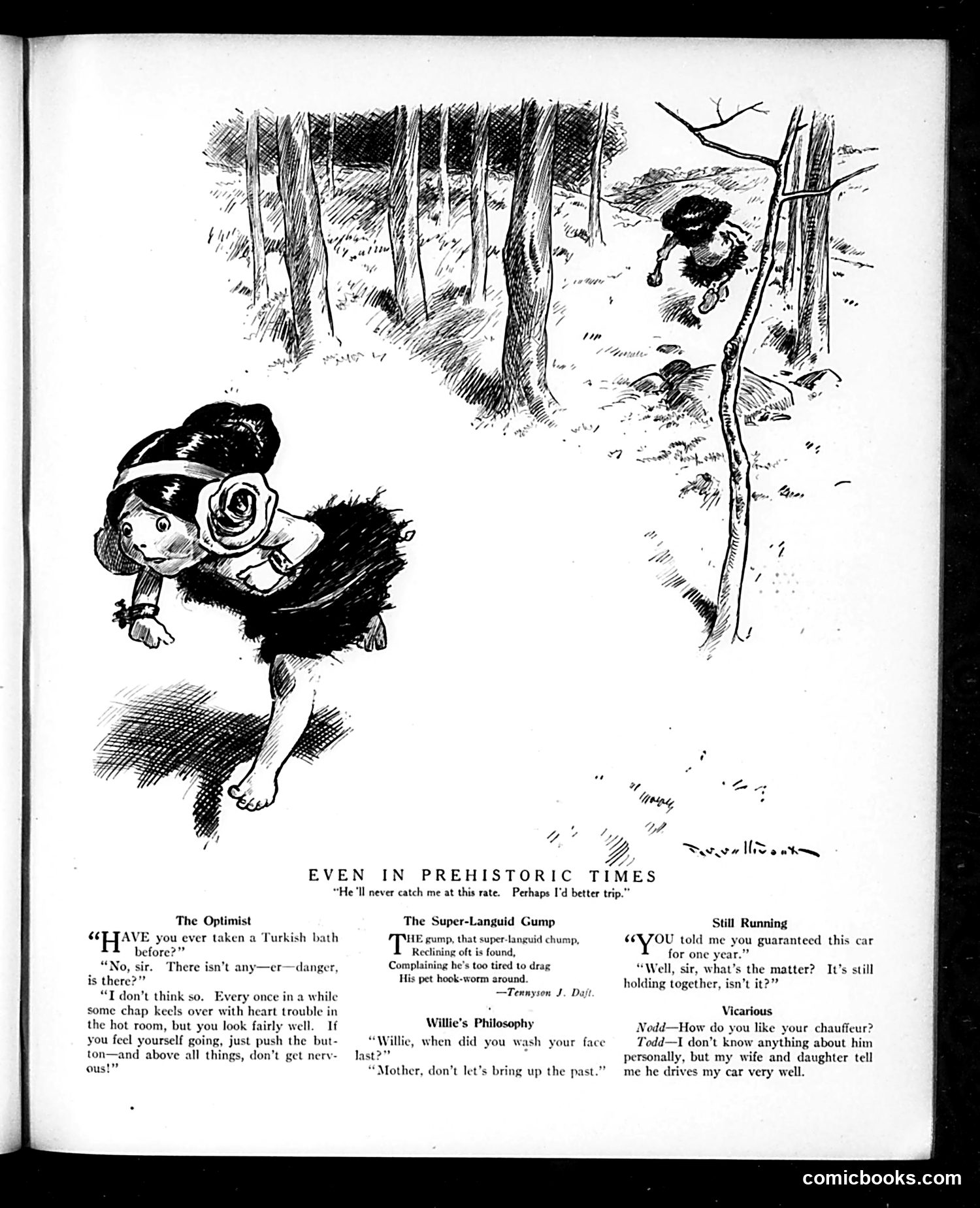
This page contains six separate humor pieces typical of early 20th-century American satirical magazines: **"Even in Prehistoric Times"** shows a caveman fleeing, with the caption suggesting timeless human anxieties about being caught. **"The Optimist"** satirizes forced cheerfulness—a man reassuring someone about Turkish baths while casually mentioning people "keel over with heart trouble," then telling them not to get nervous. The joke mocks blind optimism masking genuine danger. **"The Super-Languid Gump"** ridicules excessive laziness and hypochondria—complaining too tired to even handle a pet hookworm (a parasitic disease). **"Willie's Philosophy"** is a child's joke about avoiding accountability by refusing to discuss past misbehavior. **"Still Running"** mocks deceptive car salesmen: a guarantee means the car merely "holds together," not that it actually functions properly. **"Vicarious"** jokes about a husband's detachment from his own vehicle—he only knows about his car's performance through his wife and daughter's secondhand accounts. All six pieces reflect contemporary concerns about commercialism, health fads, and consumer deception.
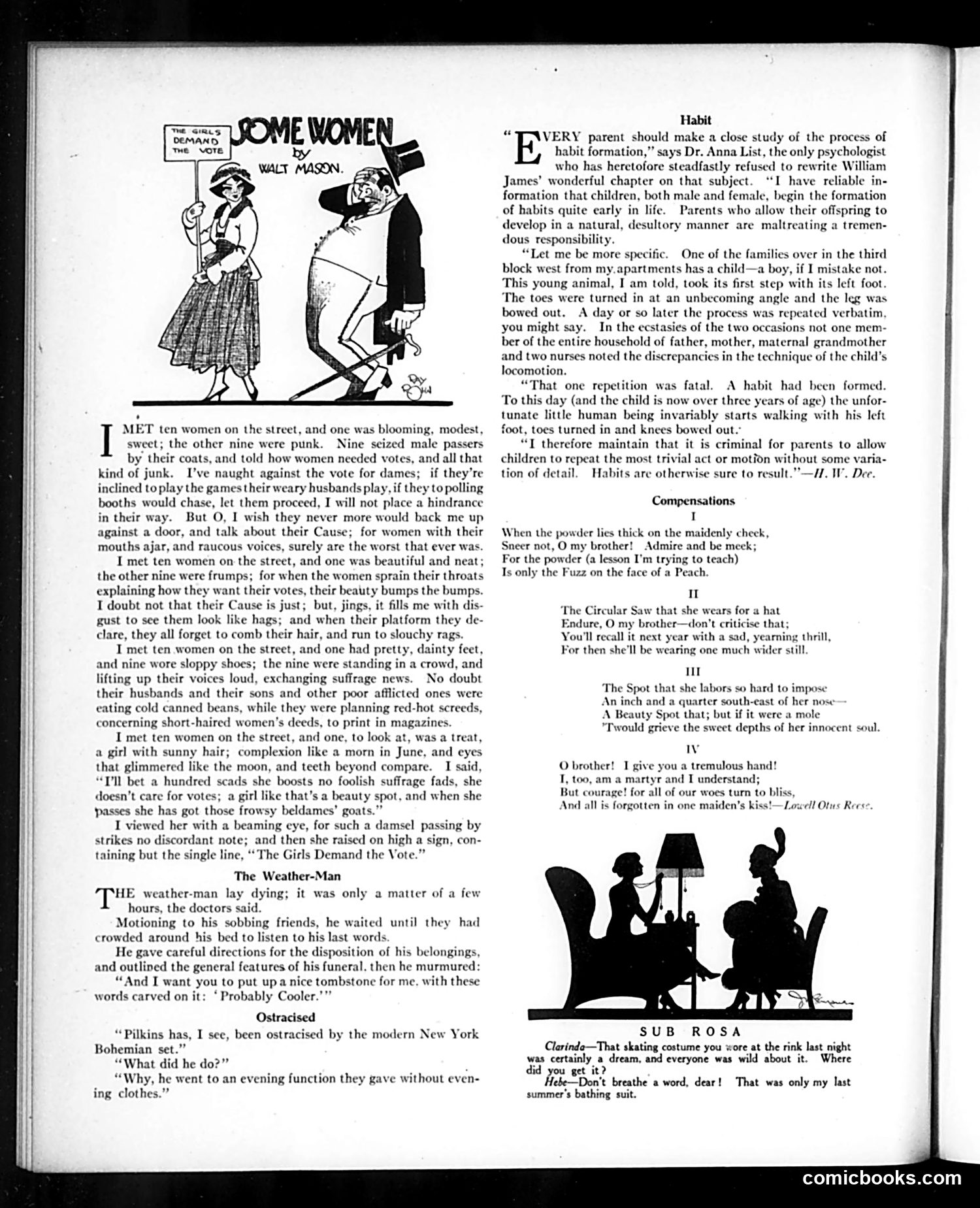
**Top Cartoon ("Some Women"):** This anti-suffrage cartoon mocks women's suffrage advocates by contrasting their appearances and behavior with "proper" womanhood. The cartoonist presents a misogynistic critique: of ten women encountered, only one is attractive and modest—the others are portrayed as unkempt, loud, and shrill "hags" who neglect their appearance while demanding votes. The final irony: even the beautiful woman turns out to support suffrage ("The Girls Demand the Vote"). The satire attacks women activists as unfeminine, neglectful of domestic duties, and aesthetically objectionable—a common anti-suffrage argument of the era. **"The Weather-Man" and "Ostracised":** Brief humorous anecdotes unrelated to suffrage. **"Habit" Section:** A serious essay on child development, discussing how early habits form and parental responsibility. The page reflects early 20th-century satirical opposition to women's voting rights through gendered ridicule.
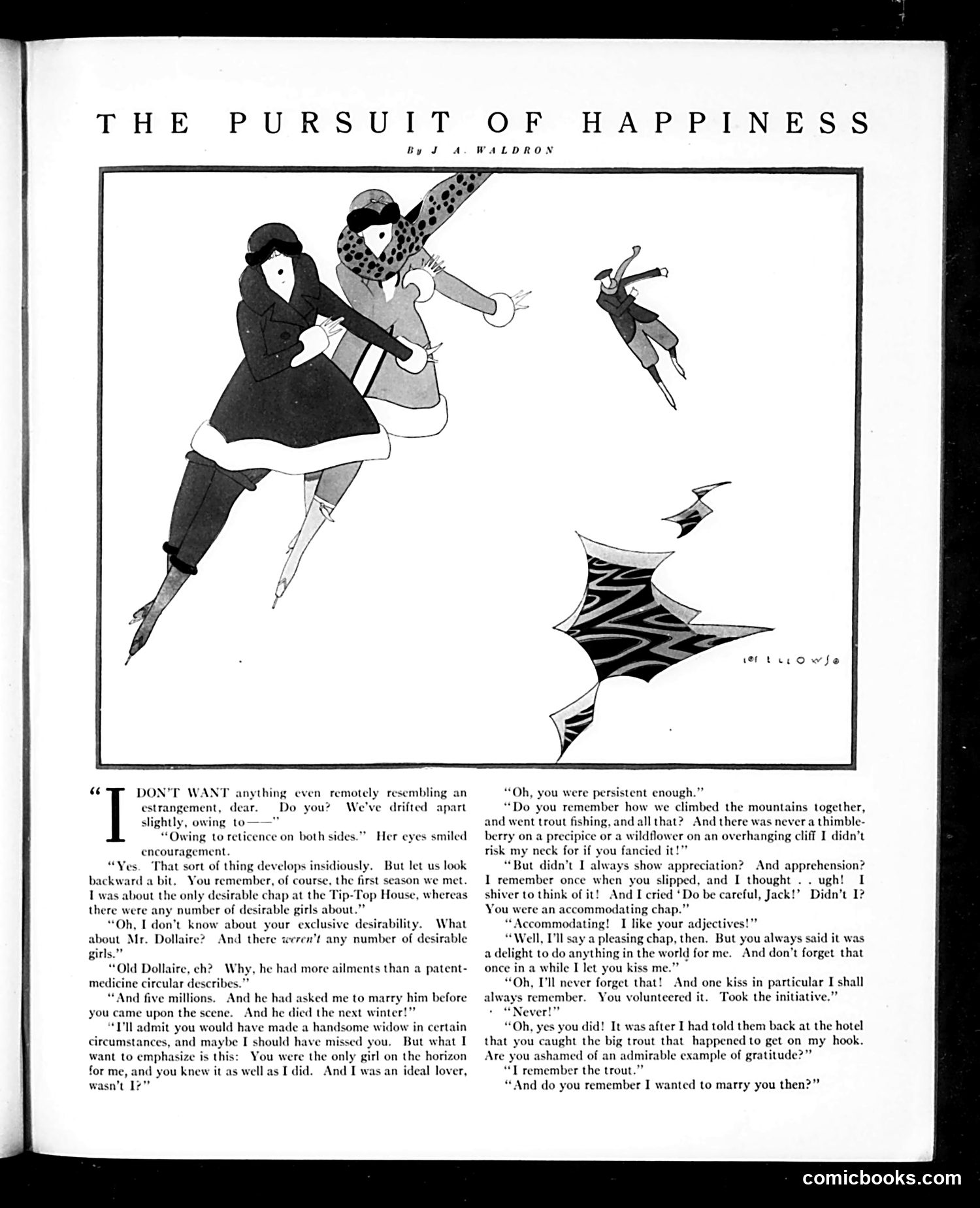
This page depicts a domestic quarrel between a couple, illustrated by artist J.A. Waldron. The narrative dialogue shows two people—apparently a man and woman—rehashing their romantic history and grievances. The satire targets early 20th-century courtship dynamics and marriage expectations. The woman references a wealthy suitor ("Old Dollaire") she rejected for the protagonist, while the man emphasizes his devotion and sacrifices (mountain climbing, trout fishing). The couple bickers over who showed proper appreciation: he claims ideal devotion; she counters with faint praise ("pleasing chap," "accommodating"). The cartoon's humor lies in exposing the performative nature of romance—both parties keeping score, using favors as currency, and rewriting history to justify present dissatisfaction. The title ironically suggests happiness is elusive when love becomes transactional. The illustration shows the couple floating/flying, perhaps suggesting their relationship has become unmoored from reality.
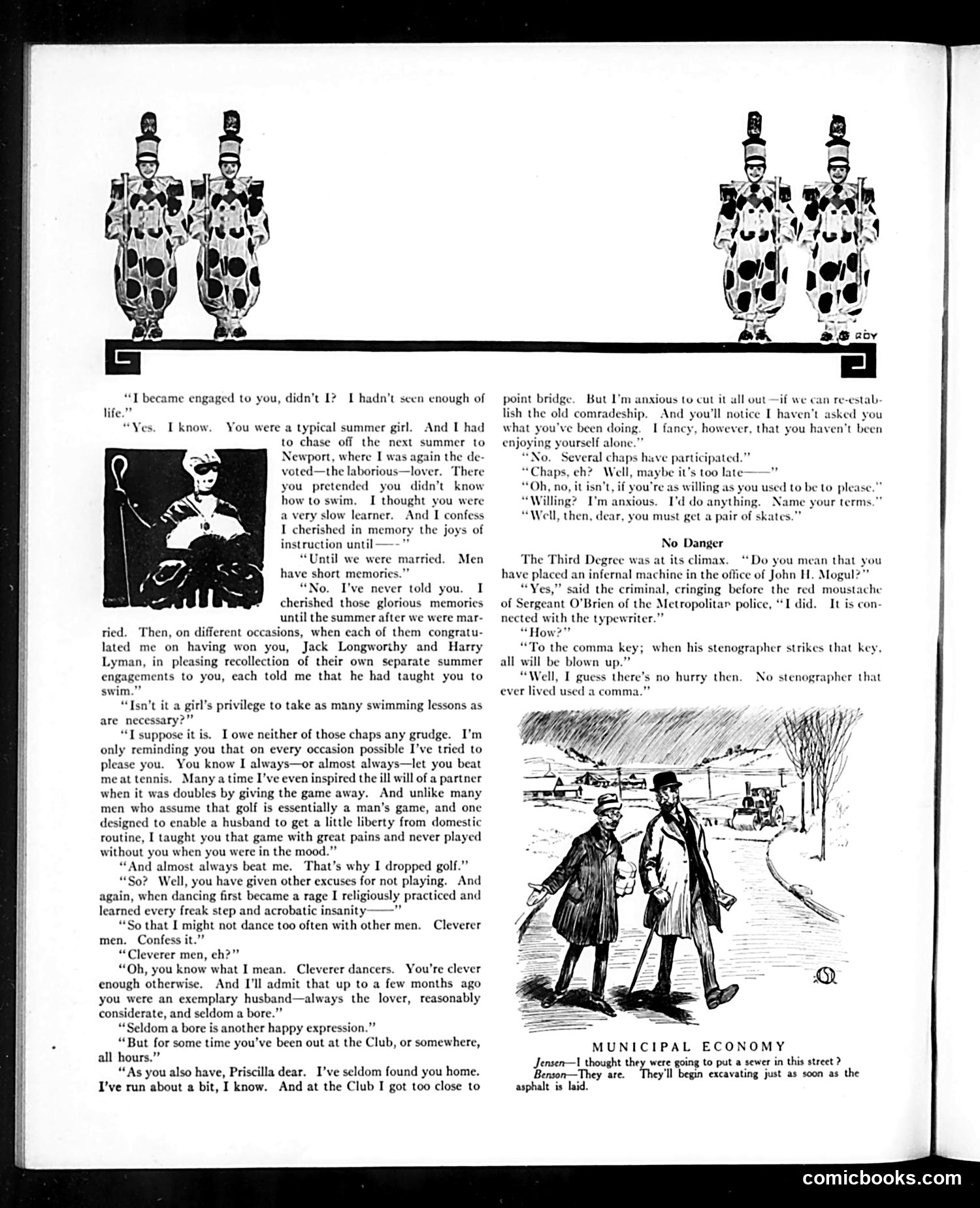
This page contains two distinct satirical pieces: **Main Story (top)**: A marital dialogue where a husband confronts his wife about her premarital romantic history. She had claimed ignorance of swimming, accepting "lessons" from multiple men (Jack Longworthy and Harry Lyman), later revealed to be suitors. The satire targets the "typical summer girl"—a social type from the leisure class who played naive to attract male attention and romantic attention during Newport season. The husband's grievances (she beat him at tennis, quit golf, entertained other dancers) mock both her manipulation and his desperate attempts to please her. The resolution—"you must get a pair of skates"—suggests reconciliation through shared activity. **"No Danger" cartoon (middle)**: A brief joke about police interrogating a criminal who planted an "infernal machine" (bomb) in a businessman's office, rigged to the typewriter's comma key. The punchline satirizes stenographers' poor grammar: no secretary would ever use a comma, so the bomb is harmless. **"Municipal Economy" cartoon (bottom)**: Quick gag about bureaucratic inefficiency—a sewer won't be installed until *after* newly laid asphalt is torn up.
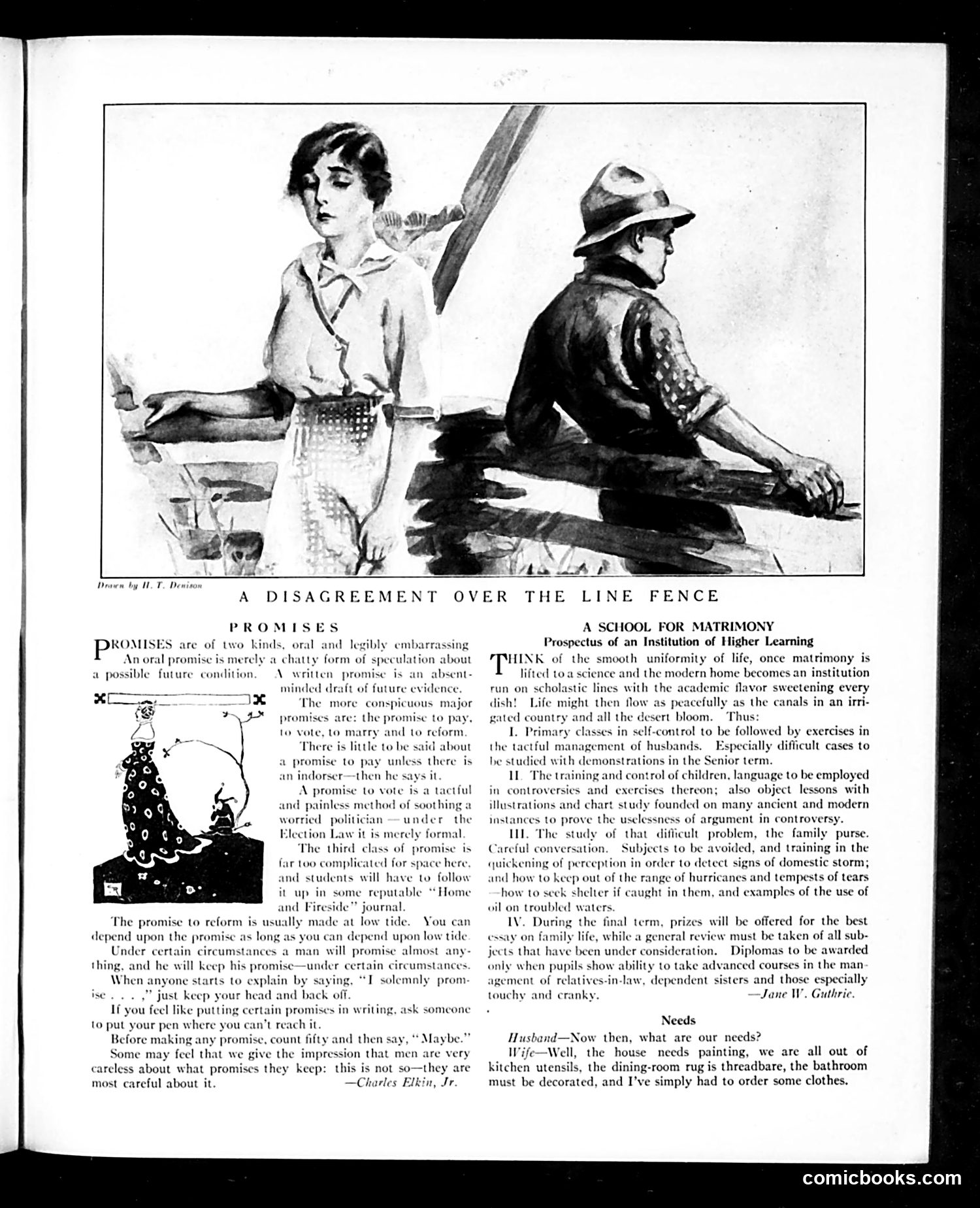
The top illustration shows a domestic dispute between a man and woman over a property boundary—a common neighborhood conflict. The satire critiques how couples handle disagreements, likely reflecting early-20th-century marital tensions. The accompanying text mocks "promises" as unreliable, particularly marriage vows and political pledges. It's cynical about human nature: promises to reform are made "at low tide" (desperation); written promises need witnesses; and men are paradoxically both careless *and* careful about keeping them. "A School for Matrimony" satirizes the idea of systematizing marriage through education—treating matrimony as an academic discipline with courses in managing husbands, controlling children, and managing finances. The humor lies in treating domestic life as a solvable science when it clearly isn't. The "Needs" dialogue concludes by showing the wife's practical concerns (home repairs, furnishings) contrasting with the husband's presumed expectations, reinforcing the page's theme: marriage promises clash with reality.
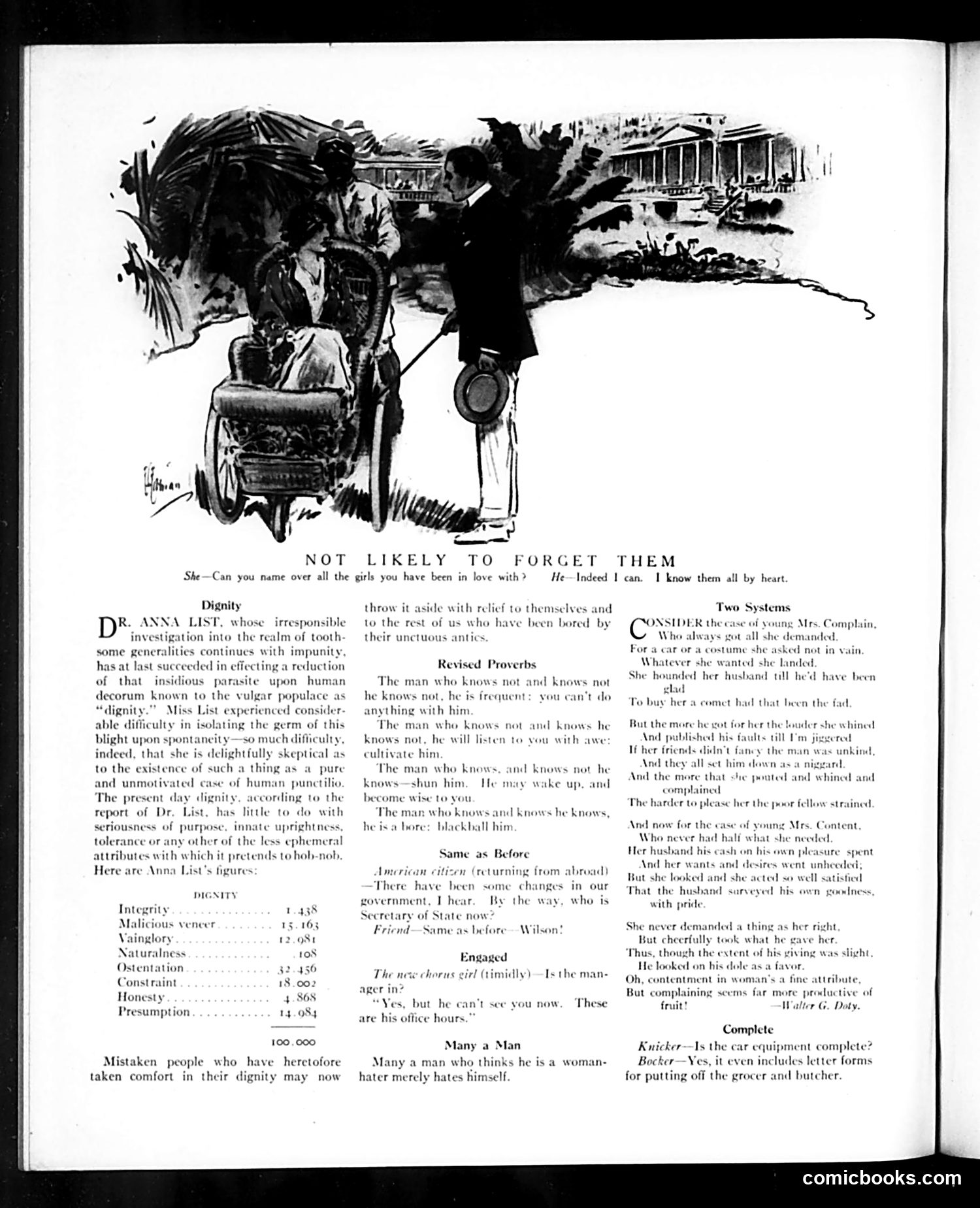
**Main Cartoon (top):** Illustrates "Dr. Anna List's" investigation into modern dignity. The figure shown represents the erosion of genuine dignity in contemporary society—depicted as a hollow, collapsing structure. The point is satirical: what people call "dignity" today is mostly pretense (malicious veneer, vainglory, constraint, presumption) rather than authentic virtue (integrity, honesty, naturalness). **Content Below:** The page includes aphorisms mocking modern behavior—men who are ignorant but don't know it, chorus girls seeking advancement, and citizens returning from abroad who've forgotten American government details (referencing the Wilson administration). **"Two Systems"** sketch contrasts Mrs. Complain (constantly demanding, making her husband miserable) with Mrs. Content (satisfied with little, enabling her husband's happiness). The satire targets women's materialism and complaining as destructive to relationships. The humor relies on early-20th-century gender stereotypes and social commentary typical of Judge's satirical approach.
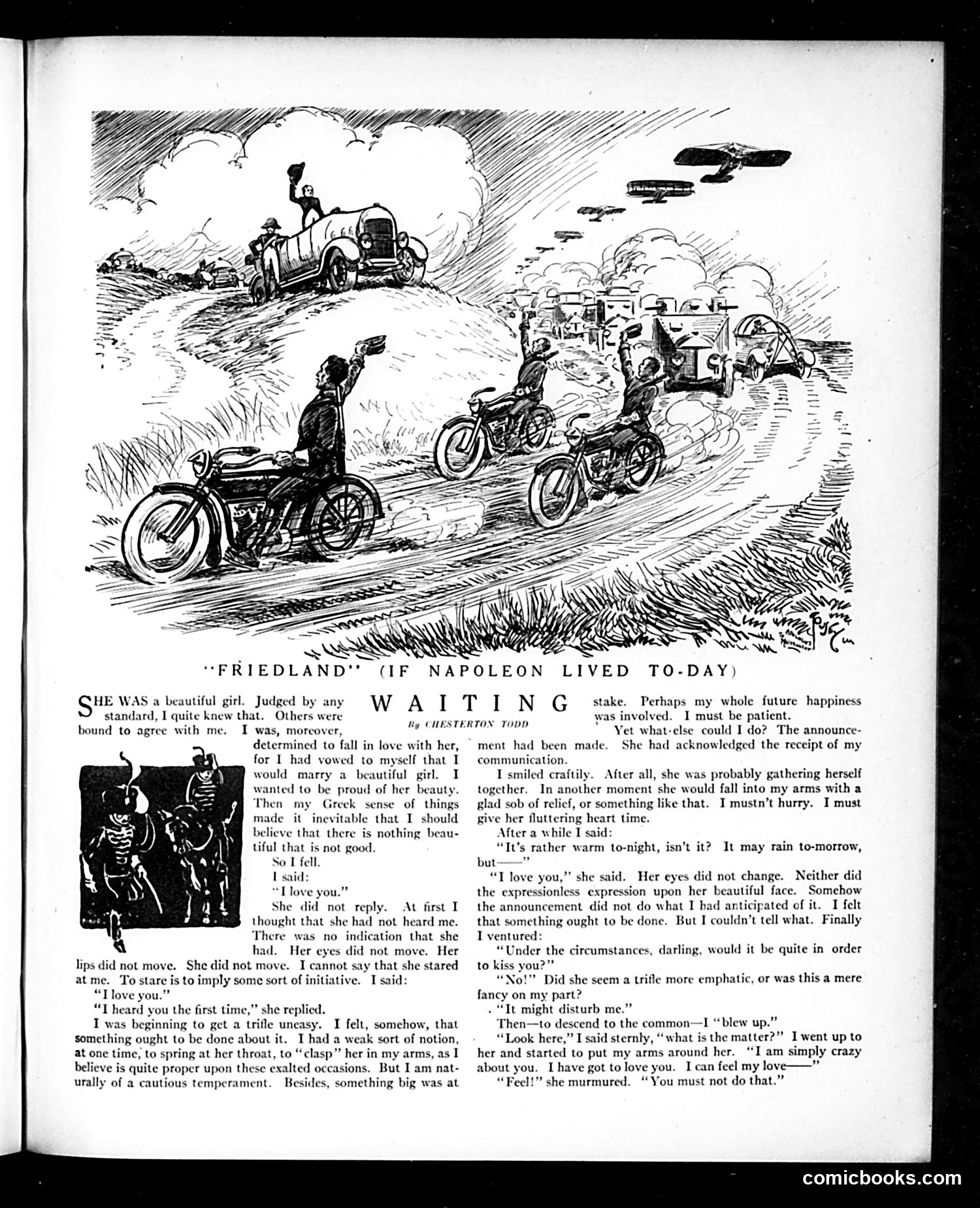
This page contains two distinct elements: an illustration titled **"Friedland" (If Napoleon Lived To-Day)** showing motorcycles and military vehicles in a modernized warfare scene, and a romantic short story by Chesterton Todd titled "Waiting." The illustration satirizes what warfare might look like if Napoleon commanded modern (1920s-era) transportation—motorcycles and trucks replacing cavalry and cannons, with aircraft overhead. This is a humorous "what-if" fantasy about historical figures in contemporary times. The story itself is a romantic comedy about a man's frustration when his declaration of love receives only polite acknowledgment rather than passionate reciprocation. The woman's cool, logical responses ("I heard you the first time") mock both sentimental romance conventions and the gap between male romantic expectations and female emotional reserve. The satire critiques overwrought romantic gestures and male presumption.
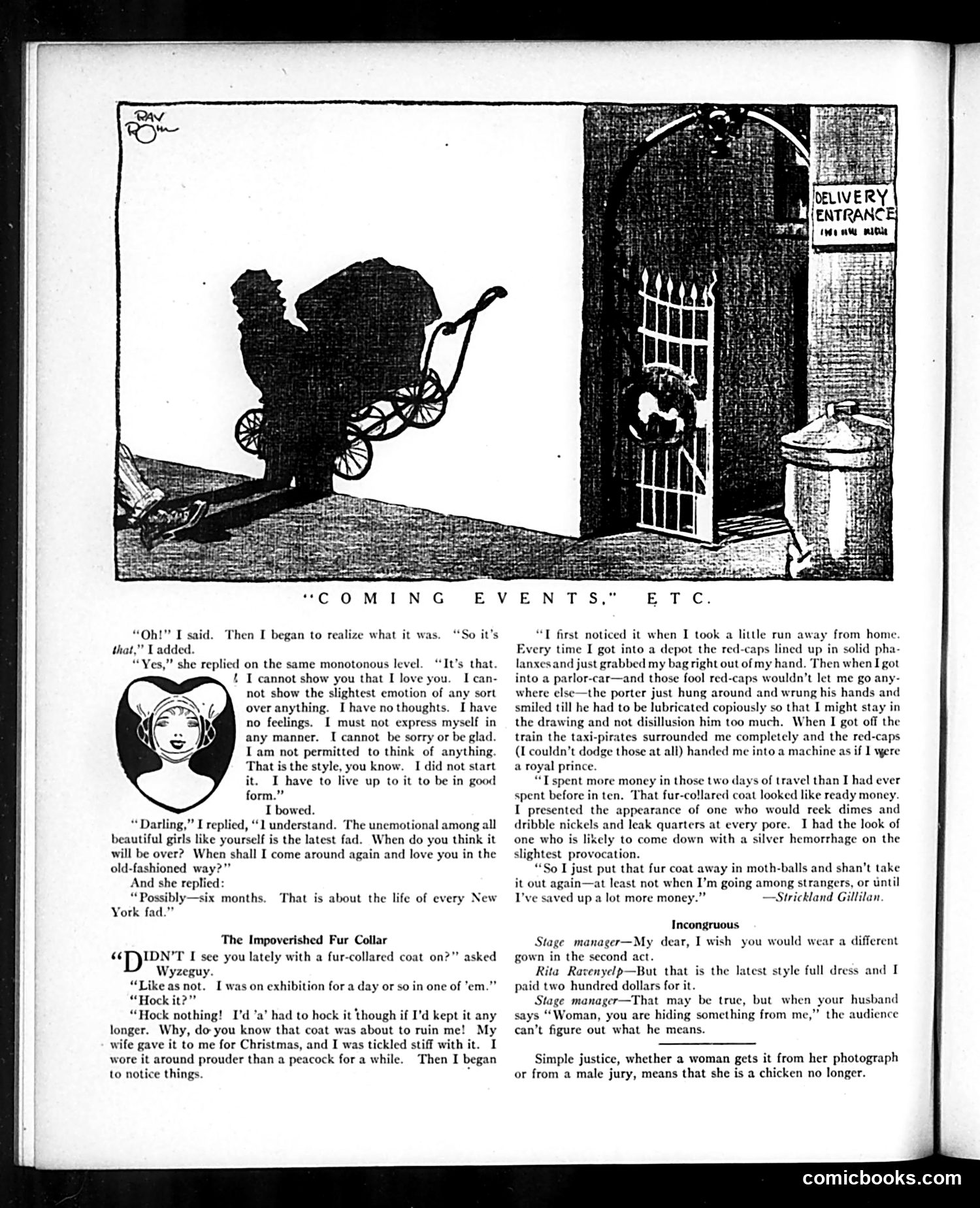
This page contains three satirical pieces about 1920s social conventions and gender dynamics: **"Coming Events" (top cartoon):** Shows a woman with a baby carriage entering a delivery entrance. The accompanying dialogue mocks the fashionable "unemotional" aesthetic among wealthy young women—a fad where showing feelings or enthusiasm was considered uncouth. The satire suggests this affectation is absurdly restrictive and performative. **"The Impoverished Fur Collar":** A man complains that wearing an expensive fur-collared coat while traveling caused service workers (porters, taxi drivers, bellhops) to treat him as wealthy and relentlessly extract tips. The satire critiques both the conspicuous display of wealth and the predatory service industry practices that exploit it. **"Incongruous":** A stage manager notes that an actress's expensive modern dress undermines her character's dramatic moment (being scolded by her "husband"). This mocks the disconnect between high fashion and theatrical authenticity. All three pieces satirize the superficiality and social anxieties of 1920s upper-class life.
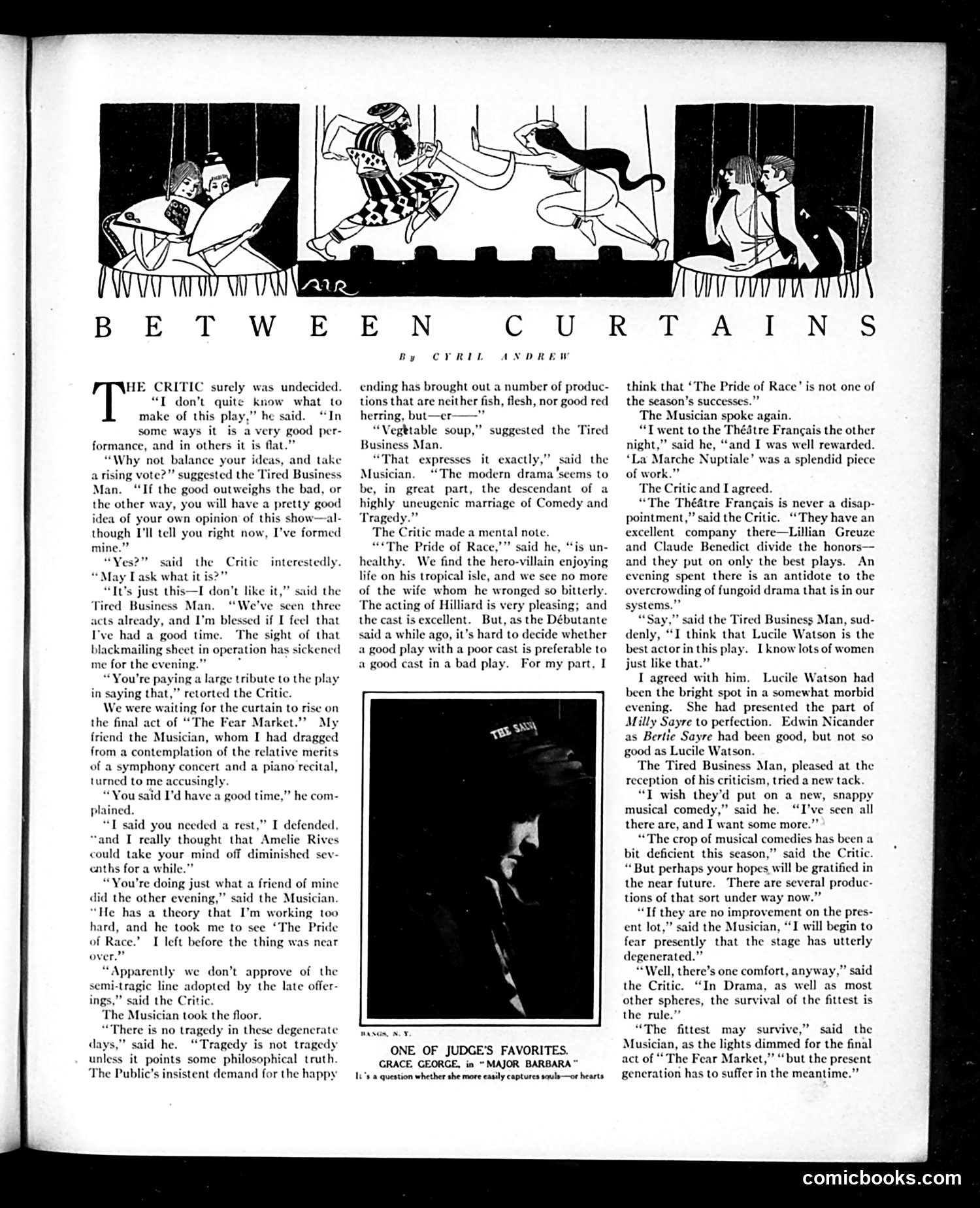
This is a theater criticism piece by Cyril Andrew featuring three stock characters debating contemporary Broadway productions. The **Critic**, **Tired Business Man**, and **Musician** discuss plays including "The Pride of Race," "The Fear Market," and "Major Barbara." The satire critiques modern theater's shift toward sentimental comedies over genuine tragedy. The Musician argues that contemporary drama lacks philosophical depth, resulting in "highly uneugenic marriage[s] of Comedy and Tragedy"—hybrid plays that are neither fish nor fowl. The group collectively laments this "fungoid drama" flooding American stages. The page includes a photograph of actress Grace George in "Major Barbara," presented as a superior theatrical offering. The dialogue suggests elite theatergoers prefer French productions (the Théâtre Français) and performances by skilled actresses like Lucile Watson over the mediocre contemporary American output. The cartoon header depicts theatrical scenes with acrobatic performers, reinforcing the theme of theatrical entertainment quality.
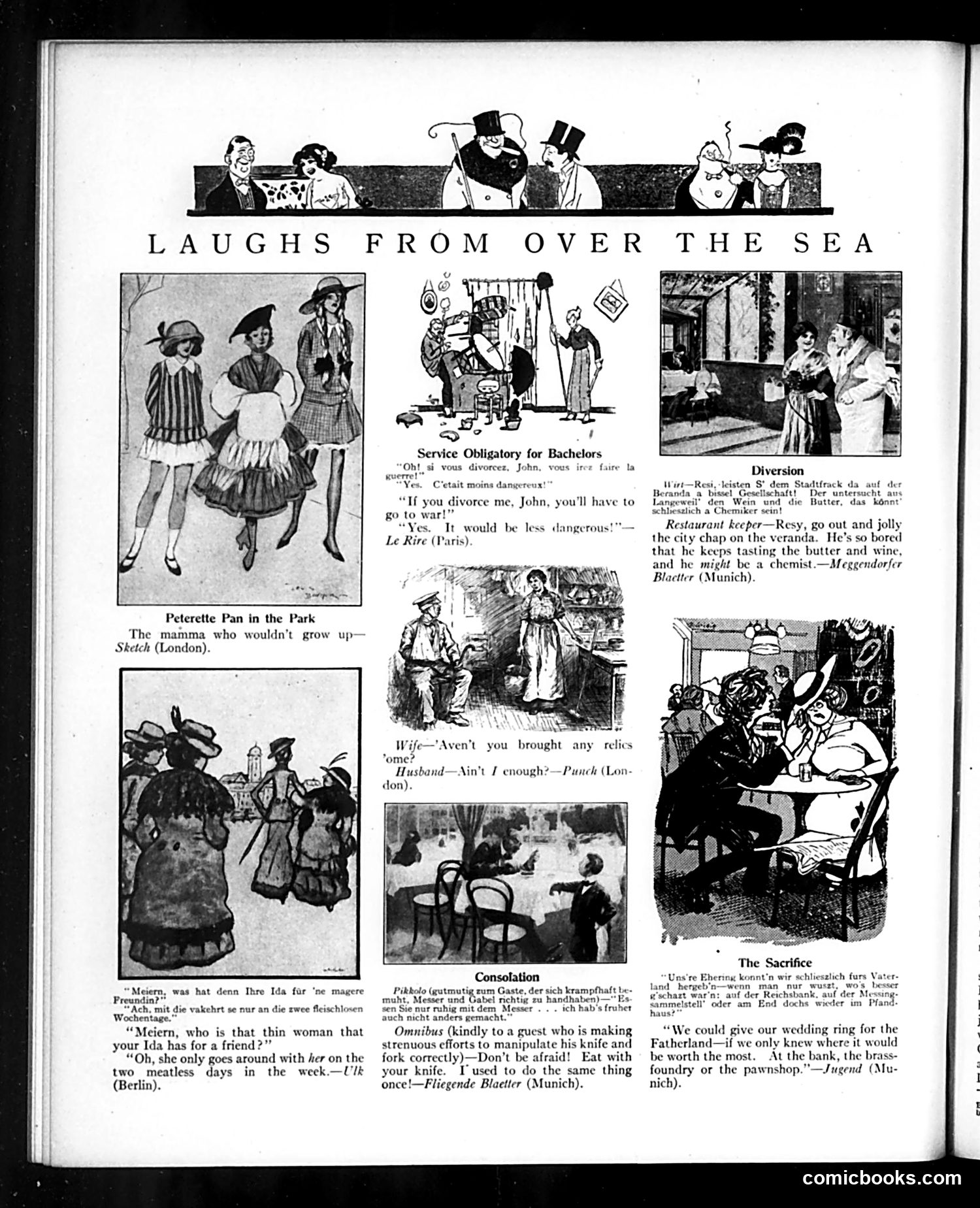
This page collects satirical cartoons from European publications (French, German, British) about WWI-era social conditions. Key themes: **Food rationing**: Multiple jokes mock meatless days and food scarcity during wartime ("Peterette Pan" shows a thin woman; the Berlin joke depicts wartime dietary restrictions). **Marital conflict**: A French cartoon jokes that divorce threats lose credibility when war requires male soldiers—a darkly humorous reference to conscription. **Class and dining**: German cartoons mock nouveau-riche diners struggling with etiquette and overly-cautious restaurant staff, suggesting social upheaval or anxiety about changing social hierarchies during wartime. **Economic desperation**: "The Sacrifice" shows couples debating whether to pawn their wedding ring, selling it to banks or foundries rather than jewelers—satirizing wartime financial hardship and the collapse of traditional values. Overall, the page presents European gallows humor about WWI's material deprivation, social disruption, and moral compromises. The "overseas" framing suggests Judge's American audience found European wartime struggles both amusing and culturally distant.
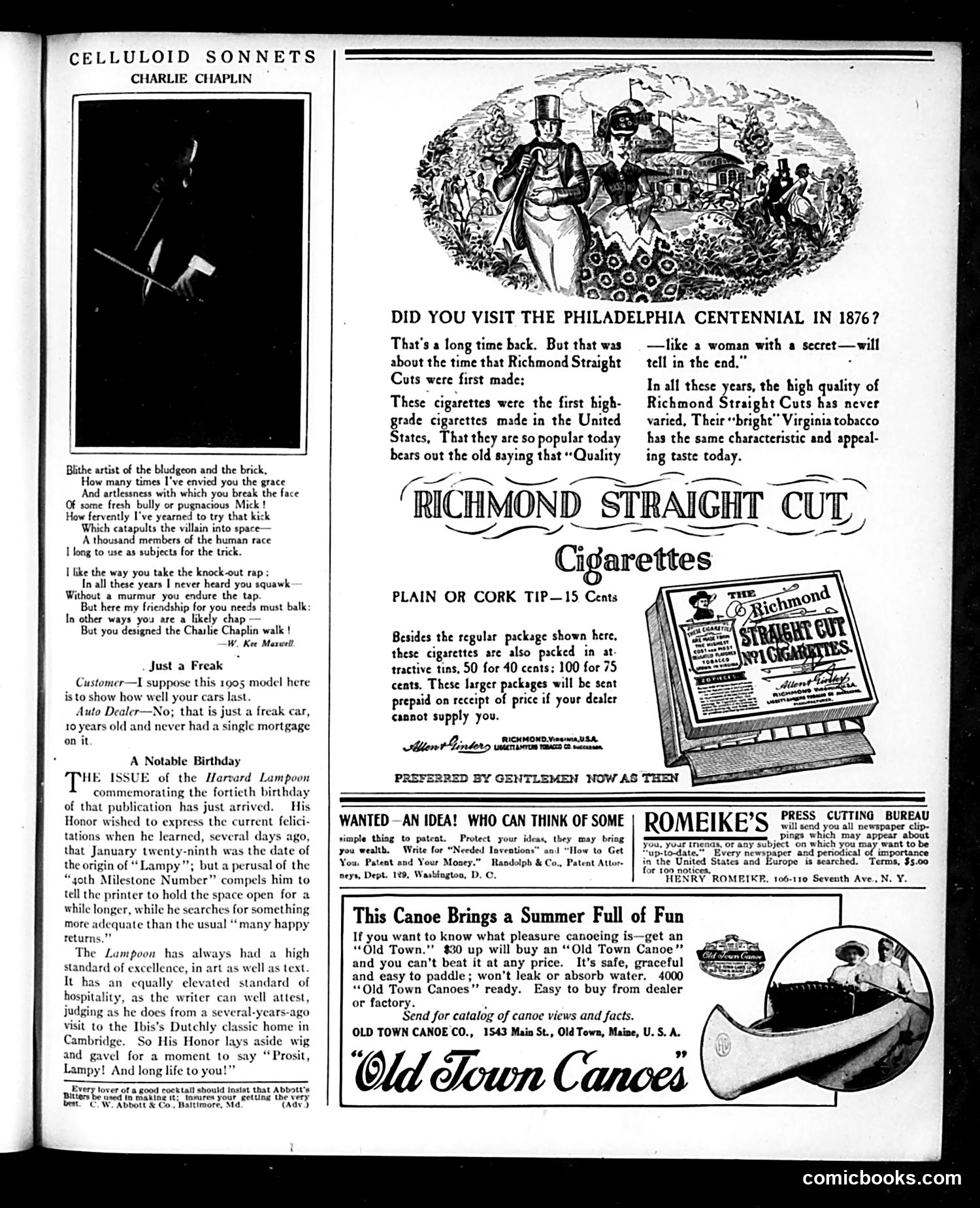
This page is primarily **advertising with minimal editorial content**. The main items are: **"Celluloid Sonnets" section** features a humorous poem about Charlie Chaplin, praising his physical comedy skills (fights, kicks) but playfully criticizing his famous "Chaplin walk" as an awkward affectation. The poem is lighthearted fan appreciation rather than satire. **Other brief items** include a joke about a 1905 car that "never had a mortgage" (suggesting it's so old it's unreliable), and a tribute to Harvard Lampoon's 40th anniversary. **Advertisements dominate** the page: Richmond Straight Cut cigarettes (emphasizing they're America's "first high-grade cigarettes" from 1876), Old Town Canoes, and various services (patent advice, press clipping bureau). There is **no political satire or caricature** on this page. It represents typical Judge magazine content of the era—a mix of light humor and commercial advertising targeting educated, affluent male readers.
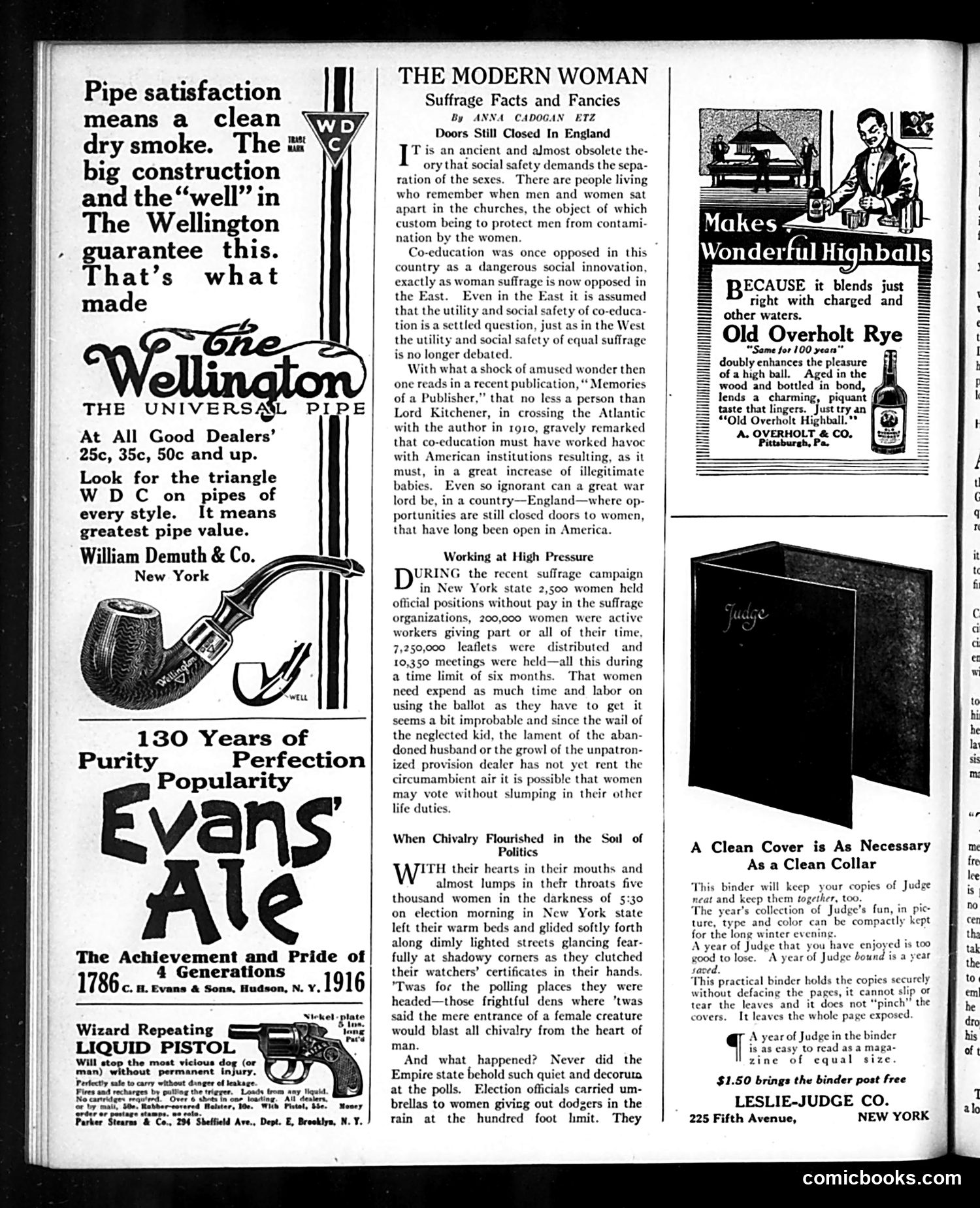
This page satirizes opposition to women's suffrage through an article titled "The Modern Woman: Suffrage Facts and Fancies" by Anna Cadogan Fitz. The piece uses irony and sarcasm to mock anti-suffrage arguments. The satire highlights the absurdity of claims that voting would harm women or society. It references Lord Kitchener's purported 1910 comment that American co-education caused illegitimacy—presenting this as ridiculous fearmongering. The final section mockingly describes 5,000 New York women voting in 1913, emphasizing the "darkness" and "frightful" polling places men claimed would corrupt female virtue. The punchline: nothing catastrophic happened. Officials even held umbrellas for women in the rain—chivalry persisted despite predictions of moral collapse. The satire's point: suffrage opponents used exaggerated danger claims when historical evidence (American co-education, actual voting) proved women could participate in public life without social disaster. The rest of the page is period product advertising (pipes, liquor, weapons), typical for Judge magazine.
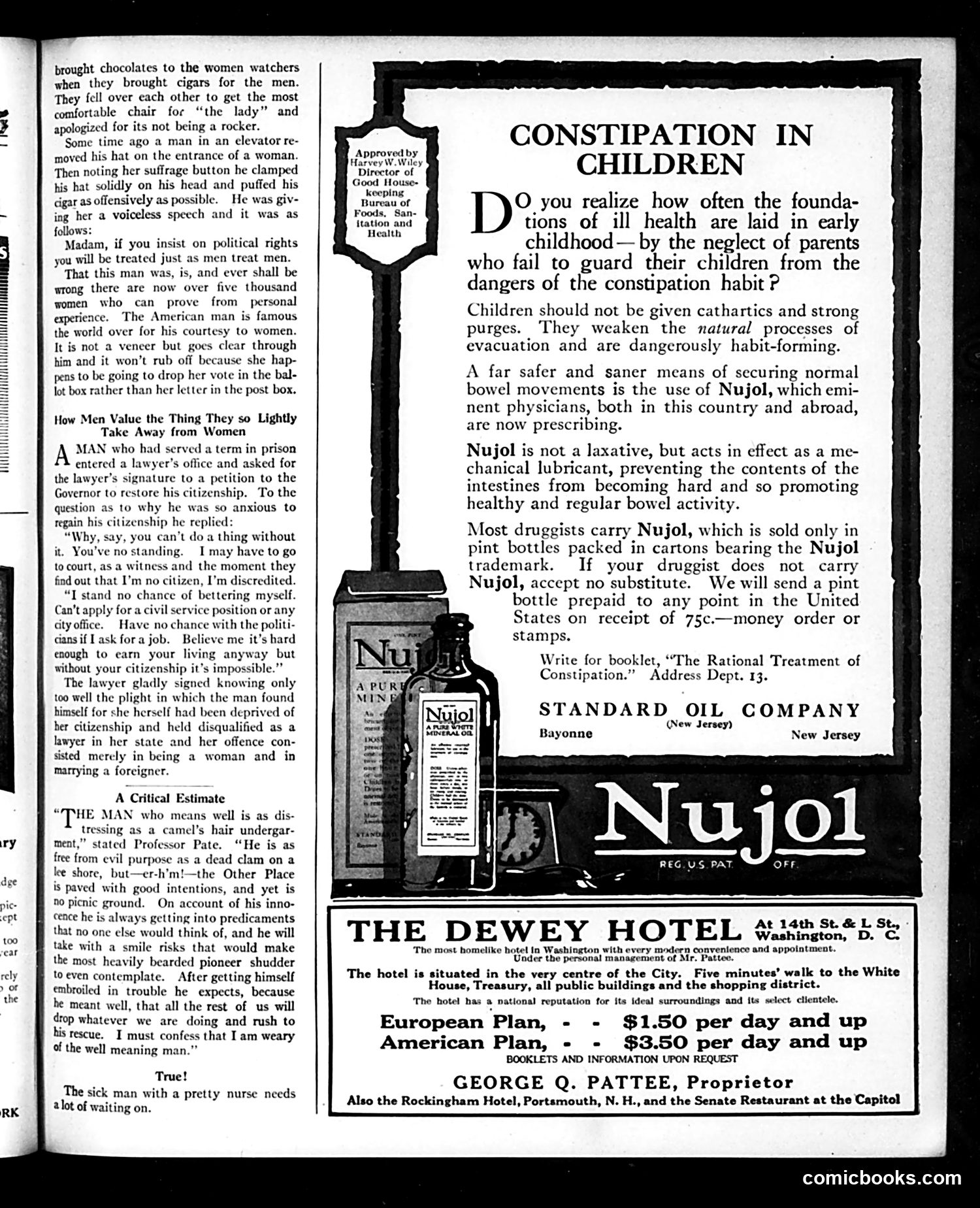
This page contains **three separate editorial pieces on women's rights** (left) and **two advertisements** (right). **Left content:** Three satirical commentaries critique American hypocrisy regarding women's equality. The first mocks men who claim to value courtesy toward women while denying them voting rights—a suffragist criticism (the "suffrage button" reference dates this to pre-1920). The second highlights the paradox that men fiercely protect citizenship rights for themselves while denying them to women, including a woman lawyer stripped of her credentials for marrying a foreigner. The third quotes a professor dismissing well-meaning but incompetent men. **Right content:** A Nujol laxative advertisement addressing constipation in children, approved by Harvey W. Wiley (a real food safety advocate), and a hotel advertisement. The page's **political point**: Women deserve the same rights and respect as men, not selective courtesy. The contrast between the editorial content and trivial advertising underscores the mundane world women navigated while fighting for basic legal equality.
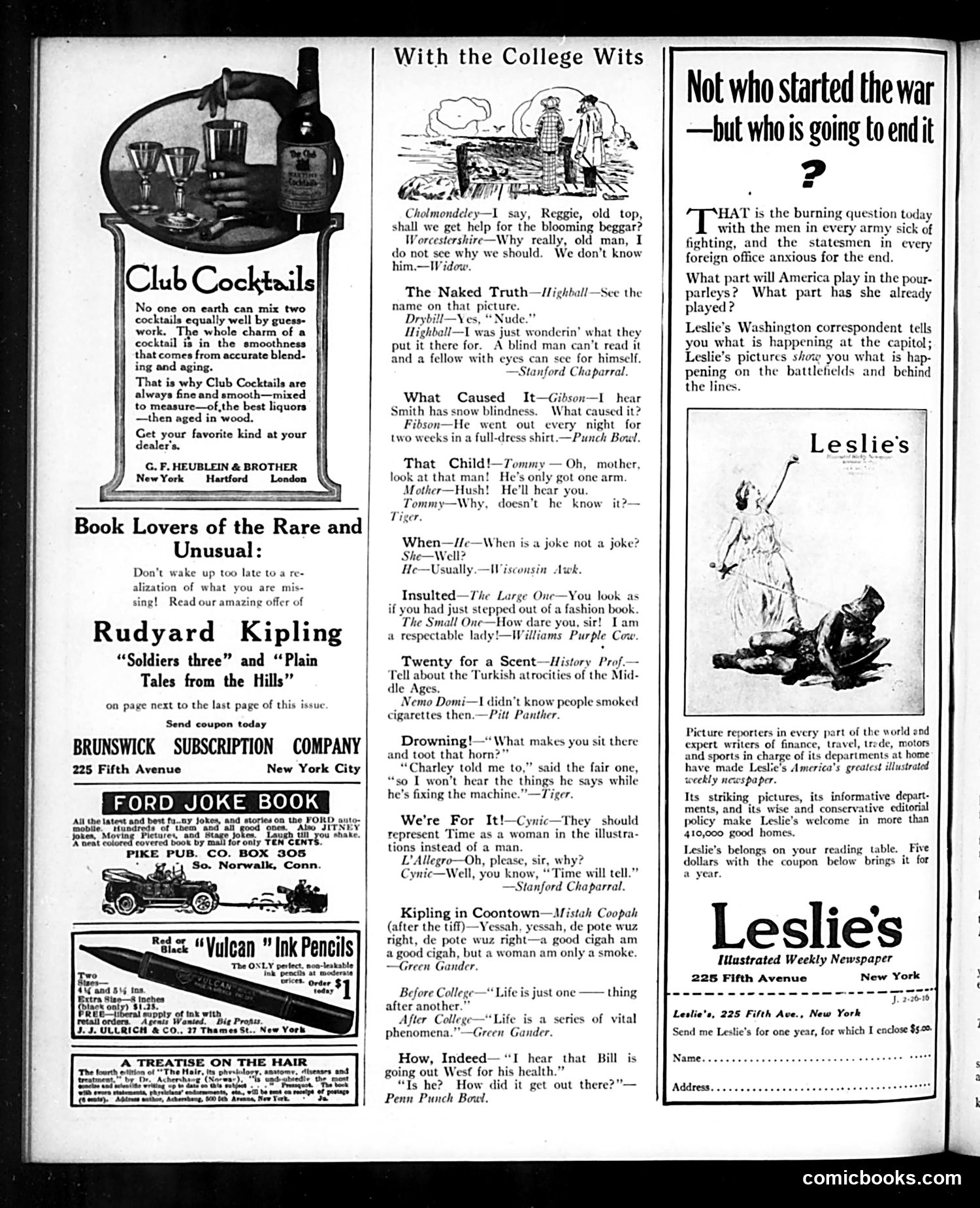
This page is primarily **advertising and humor content**, not political cartoons. The main editorial element is a Leslie's Weekly advertisement addressing **World War I**. The **central question** posed—"Not who started the war—but who is going to end it?"—reflects American anxiety circa 1914-1917 about U.S. involvement in the European conflict. The ad targets military men and foreign office officials "sick of fighting," suggesting this appeared when the war's end seemed uncertain. The remainder of the page consists of **college humor jokes** (puns and wordplay from university publications like *Stanford Chaparral* and *Wisconsin Awk*) and **product advertisements** for cocktails, books, Ford joke collections, and ink pencils—typical Judge magazine filler. The Leslie's ad positions the magazine as providing authoritative coverage of war developments through "picture reporters" and Washington correspondents, marketing itself as essential reading for understanding America's potential role in ending the conflict.
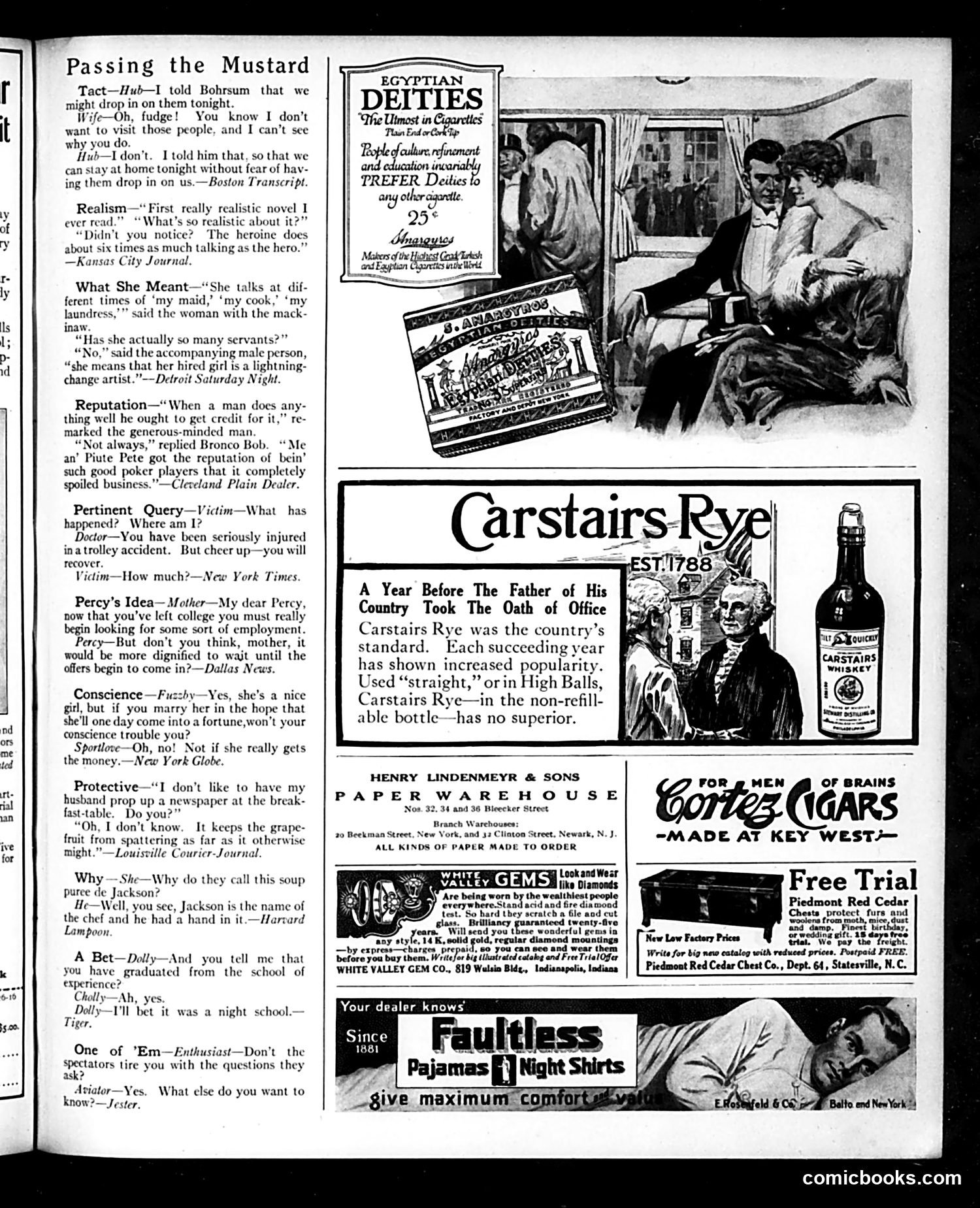
This page is primarily a **humor/jokes column** with unrelated anecdotes, not political satire. The jokes reflect early 20th-century domestic comedy: **Key themes:** - **Marriage/social etiquette**: Humorous tensions between husbands and wives over visiting obligations, newspaper reading at breakfast - **Class/servants**: A woman claiming multiple hired girls (a "lightning-change artist") to appear wealthier - **Professional reputation**: A poker player's skill ironically ruined his business because people feared playing him The remaining **two-thirds of the page is advertising** for luxury goods: Egyptian Deities cigarettes, Carstairs Rye whiskey (claiming pre-Revolutionary popularity), paper warehouses, gem dealers, and Faultless pajamas. **No identifiable political figures or events** are referenced. This appears to be a typical Judge magazine page from the 1910s-20s, mixing gentle domestic satire with period advertisements. The humor relies on wordplay and social observation rather than topical commentary.
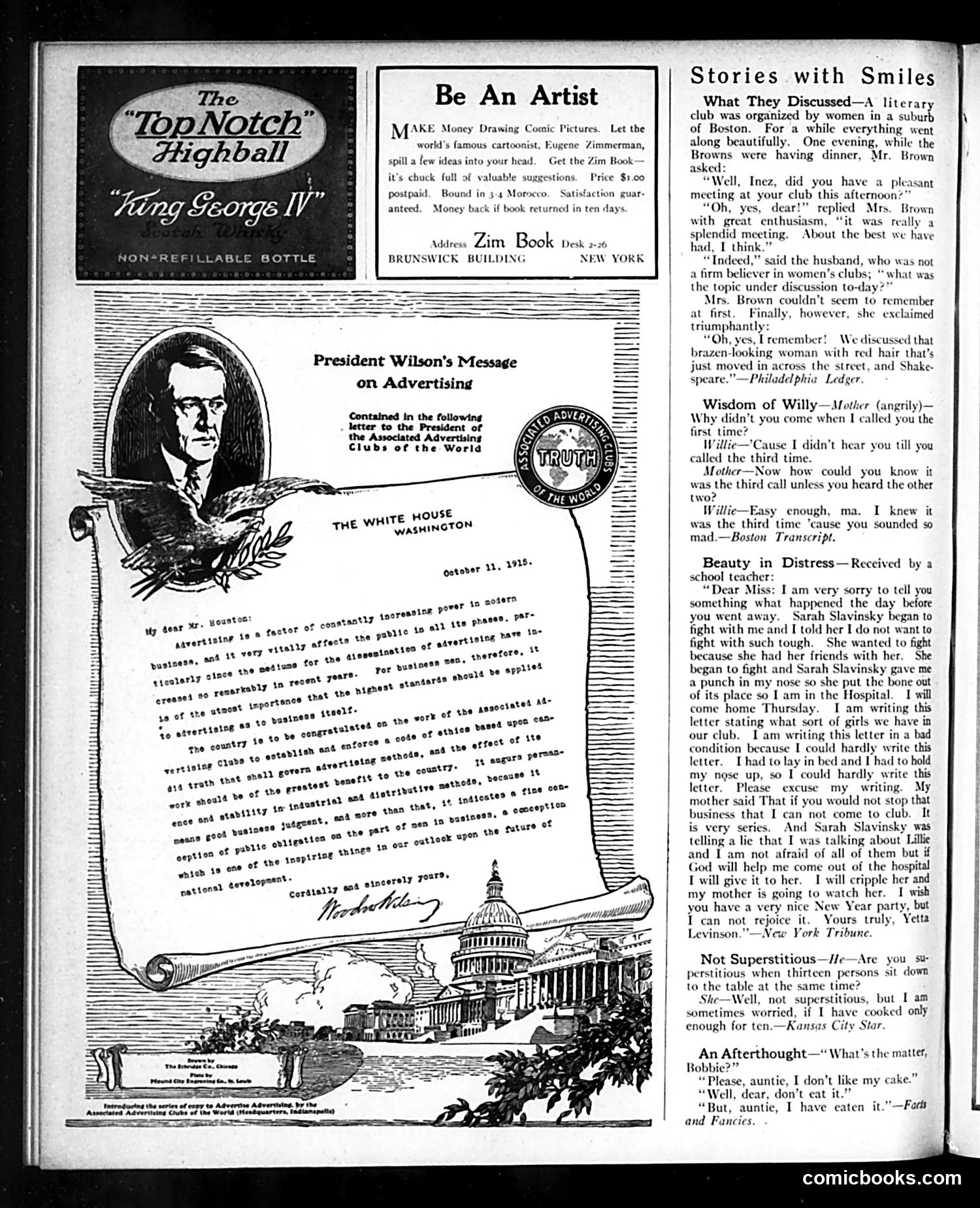
The dominant feature is a formal letter from President Woodrow Wilson (identifiable by the portrait and "THE WHITE HOUSE WASHINGTON" letterhead) addressed to the Associated Advertising Clubs of the World, dated October 11, 1915. Wilson endorses advertising as a positive force for business and society, stating that advertising "offers in all its phases" reliable information and serves the public interest. He praises the advertising industry's standards and methods. **The satire's point**: This page presents Wilson's endorsement of advertising as a prestigious, governmental stamp of approval—legitimizing what was then a relatively new and sometimes-suspect commercial practice. By featuring the President's formal message prominently in *Judge* (a satirical magazine), the editors appear to be celebrating this institutional validation of advertising, or possibly gently mocking how earnestly the advertising industry courted such official approval. The surrounding content—including ads for art instruction and humorous "Stories with Smiles"—anchors this as a typical magazine page of the era.
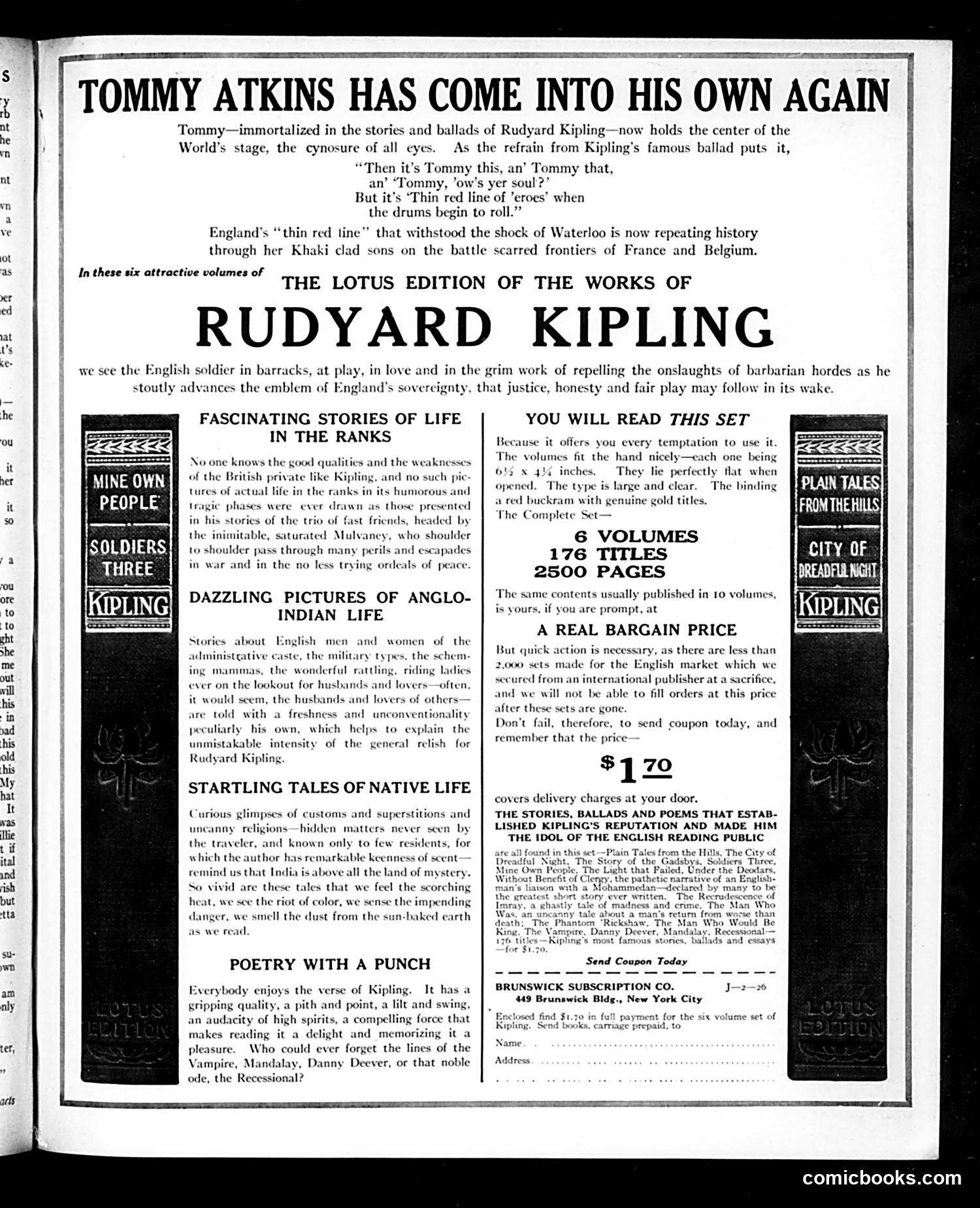
This is primarily an **advertisement**, not political satire. It's a full-page promotional piece for a six-volume "Lotus Edition" of Rudyard Kipling's works. The heading references "Tommy Atkins"—Kipling's famous literary character representing the British enlisted soldier. The ad uses the context of World War I ("battle scarred frontiers of France and Belgium," "Khaki clad sons") to market Kipling's writings about military life. The advertisement emphasizes four categories of Kipling content: British soldiers' barracks life, Anglo-Indian colonial administration, Native Indian customs and superstitions, and poetry. It stresses the set's physical appeal (hand-fitting volumes, large type, gold titles) and positions it as a bargain at $1.70—claiming scarcity to encourage immediate purchase. There is **no visible cartoon or satirical commentary** on this page. It's a straightforward sales pitch leveraging wartime patriotism and Kipling's established literary reputation to sell a book collection.
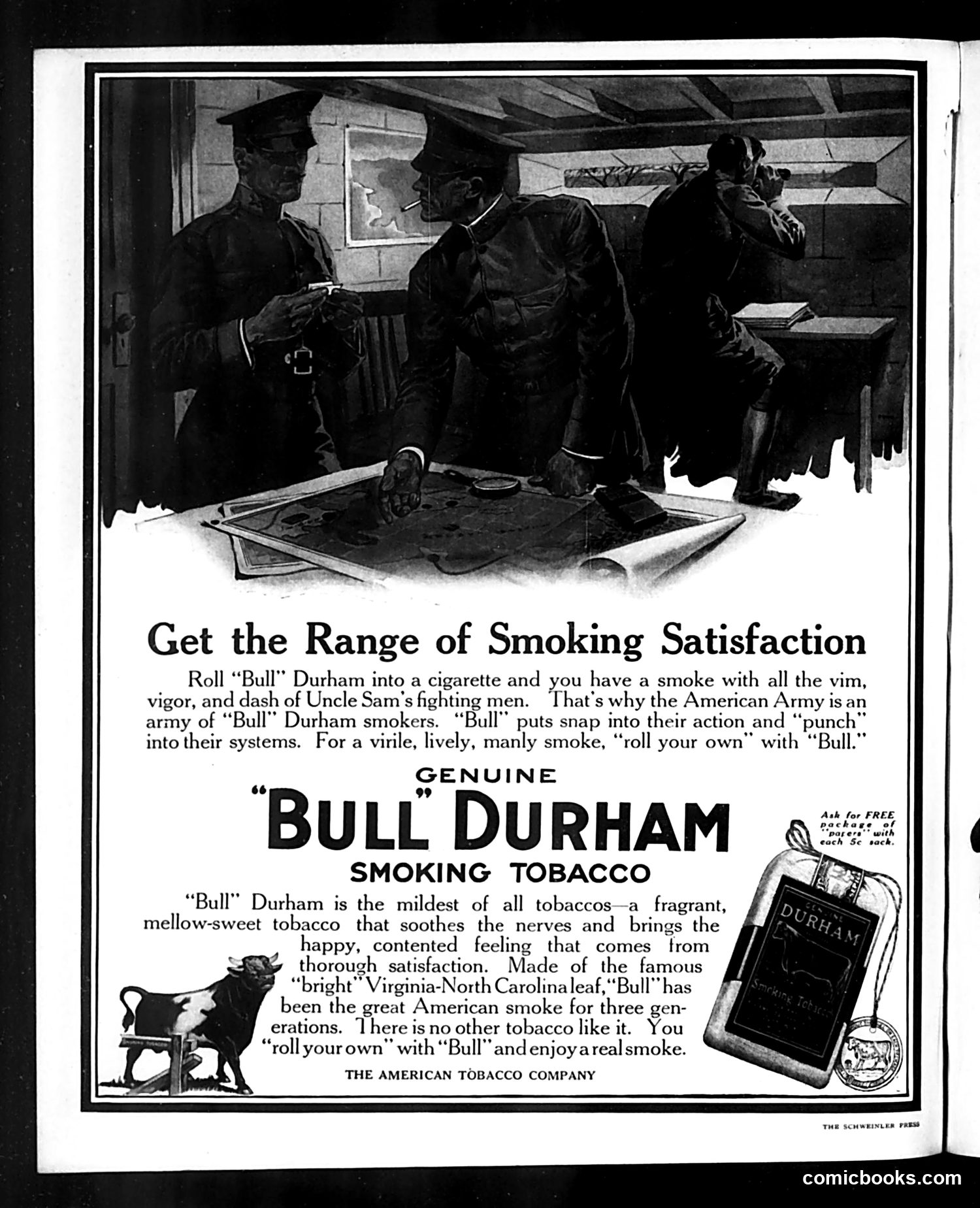
This is a **Bull Durham tobacco advertisement**, not satire. The top image shows military officers examining what appears to be a map or battle plan, establishing a patriotic wartime context (likely WWI era, given the uniforms and reference to "Uncle Sam's fighting men"). The ad conflates smoking with military masculinity: "Bull" Durham supposedly gives smokers "vim, vigor, and dash" comparable to soldiers. It emphasizes "rolling your own" cigarettes as a manly, authentic practice versus manufactured ones. The text claims the Army uses this tobacco, leveraging patriotic association to market the product. The bull mascot reinforces masculine branding. **What's dated here:** The casual linking of cigarettes with military strength and health ("soothes the nerves"), plus the assumption that hand-rolling tobacco is inherently superior—both claims modern readers recognize as advertising manipulation rather than fact.