
Judge, 1916-02-26 · page 19 of 28
Judge — February 26, 1916 — page 19: what you’re looking at
What you’re looking at
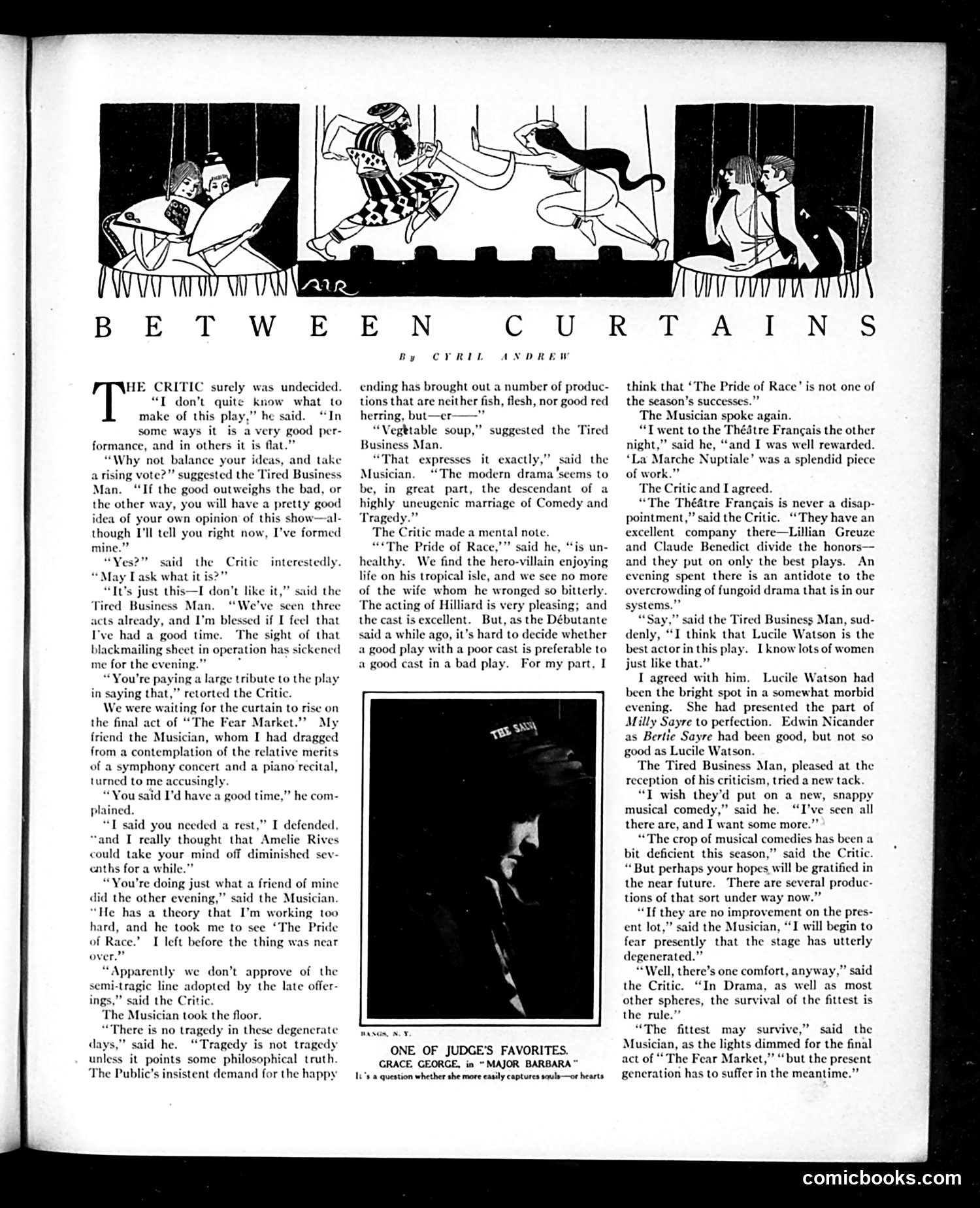
This is a theater criticism piece by Cyril Andrew featuring three stock characters debating contemporary Broadway productions. The **Critic**, **Tired Business Man**, and **Musician** discuss plays including "The Pride of Race," "The Fear Market," and "Major Barbara." The satire critiques modern theater's shift toward sentimental comedies over genuine tragedy. The Musician argues that contemporary drama lacks philosophical depth, resulting in "highly uneugenic marriage[s] of Comedy and Tragedy"—hybrid plays that are neither fish nor fowl. The group collectively laments this "fungoid drama" flooding American stages. The page includes a photograph of actress Grace George in "Major Barbara," presented as a superior theatrical offering. The dialogue suggests elite theatergoers prefer French productions (the Théâtre Français) and performances by skilled actresses like Lucile Watson over the mediocre contemporary American output. The cartoon header depicts theatrical scenes with acrobatic performers, reinforcing the theme of theatrical entertainment quality.
📄 Transcribed text from this page (OCR, searchable)
Machine-transcribed from the original scan — historical spelling and the odd misread are preserved.
E HE CRITIC surely was undecided. | “T don’t quite know what to make of this play,” he said. “In some ways it is a very good per- formance, and in others it is flat.” “Why not balance your ideas, and take a rising vote?” suggested the Tired Business Man. “If the good outweighs the bad, or the other way, you will have a pretty good idea of your own opinion of this show—al- though I'll tell you right now, I’ve formed said the what it “It’s just this—I don’t like it,” said the Tired Business Man. “W seen three acts already, and I’m blessed if I feel that I've had a good time. The sight of that blackmailing sheet in operation has sickened me for the evening. . “You're paying a large tribute to the play in saying that,” retorted the C We were waiting for the curtain to rise on the final act of “The Fear Market.’? My friend the Musician, whom I had dragged from a contemplation of the relative merits of a symphony concert and a piano recital, turned to me accusingly. “You said I'd have a good time,” he com- plained. “T said you needed a rest,” I defended “and I really thought that Amelie Rives could take your mind off diminished sev- enths for a while.” “You're doing just what a friend of mine did the other evening,” said the Musician. “He has a theory that I’m working too hard, and he took me to see ‘The Pride of Race.’ I left before the thing was near over.” “Apparently we don’t approve of the semi-tragic line adopted by the late offer- ings,” said the Critic. The Musician took the floor. “There is no tragedy in these degenerate days,” said he. “Tragedy is not tragedy unless it points some philosophical truth The Public's insistent demand for the happy Critic interestedly. E N By CYRIL ANDREW ending has brought out a number of produc- tions that are neither fish, flesh, nor good red herring, but—cr—” “Vegktable soup,” suggested the Tired Business Man. “That expresses it exactly,” Musician. “The modern dra: be, in great part, the descendant of a highly uneugenic marriage of Comedy and Tragedy.” The Critic made a m “<The Pride of Rac althy. We find the hero-villain enjoying life on his tropical isle, and we see no more of the wife whom he wronged so bitterly. The acting of Hilliard is very pleasing; and the cast is excellent. But, as the Débutante said a while ago, it’s hard to decide whether a good play with a poor cast is preferable to a good cast in a bad play. For my part, I BASGR NY. ONE OF JUDGE'S FAVORITES. GRACE GEORGE, in “MAJOR BARBARA ~ Ics a question whether she more easily captures souls—or hearts C U RTA N §$ think that ‘The Pride of Race’ is not one of the season 2. The Musi “T went to the Thédtre Francais the other night,” said he, “and I was well rewarded. ‘La Marche Nuptiale’ was a splendid piece of work.” The Critic and I agreed. The Théatre Francais is never a disap- pointment,” said the Critic. “They have an excellent. company the Lillian Greuze and Claude Benedict divide the honors and they put on only the best plays. An evening spent there is an antidote to the overcrowding of fungoid drama that is in our systems.”” “Say,” said the Tired Business Man, sud- denly, “I think that Lucile Watson is the best actor in this play. I know lots of women just like that.” I agreed with him. Lucile Watson had been the bright spot in a somewhat morbid evening. She had presented the part of Milly Sayre to perfection. Edwin Nicander as Bertie Sayre had been good, but not so good as Lucile Watson. The Tired Business Man, pleased at the reception of his criticism, tried a new tack “I wish they’d put on a new, snappy musical comedy,” said he. “I’ve seen all there are, and I want some more.” “The crop of musical comedies has been a bit deficient this season,” said the Cri “But perhaps your hopes will be gratified in the near future. There are several produc- tions of that sort under way now.” “If they are no improvement on the pres- ent lot,” said the Musician, “I will begin to fear presently that the stage has utterly degenerated.” “Well, there’s one comfort, any said the Critic. “In Drama, as well as most other spheres, the survival of the fittest is the rule.” “The fittest may survive,” said the Musician the lights dimmed for the final act of “ The Fear Market,” “but the present generation has to suffer in the meantime.” comicbooks.com