
Judge, 1916-02-26 · page 4 of 28
Judge — February 26, 1916 — page 4: what you’re looking at
What you’re looking at
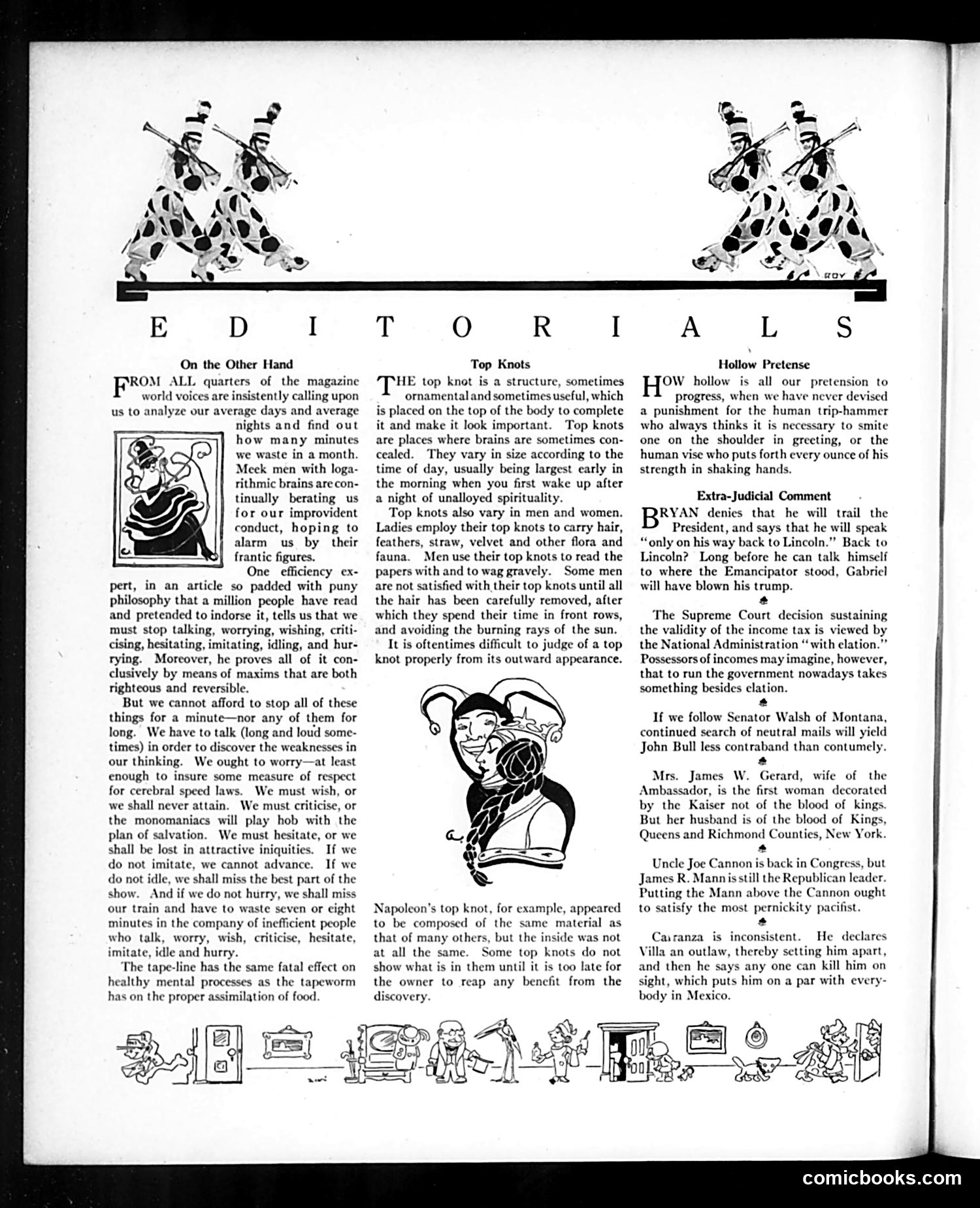
This page contains three distinct sections of political commentary from an early 20th-century American satirical magazine. **"On the Other Hand"** critiques inefficiency in magazine publishing and government, arguing against wasting time on trivial matters. **"Top Knots"** discusses hairstyles as social indicators, noting variations by gender and class. The text suggests top knots reflect character and mental state. **"Hollow Pretense"** attacks what appears to be a political figure (possibly Bryan, based on reference) for claiming he'll return to Lincoln while pursuing personal ambitions elsewhere. **"Extra-Judicial Comment"** includes brief political jabs: criticism of Bryan's motives, Supreme Court decisions on the National Administration, and commentary on Senator Walsh of Montana, Ambassador Gerard's wife, and figures like Uncle Joe Cannon and James R. Mann—all contemporary political personalities. The illustrations are decorative and don't clearly identify specific individuals.
📄 Transcribed text from this page (OCR, searchable)
Machine-transcribed from the original scan — historical spelling and the odd misread are preserved.
On the Other Hand ROM ALL quarters of the magazine world voices are insistently calling upon us to analyze our average days and average nights and find out how many minutes we waste in a month. Meck men with loga- rithmic brains are con- tinually berating us for our improvident conduct, hoping to alarm us by their frantic figures. One efficiency ex- pert, in an article so padded with puny philosophy that a million people have read and pretended to indorse it, tells us that we must stop talking, worrying, wishing, criti- cising, hesitating, imitating, idling, and hur- trying. Moreover, he proves all of it con- clusively by means of maxims that are both righteous and reversible. But we cannot afford to stop all of these things for a minute—nor any of them for long. We have to talk (long and loud some- times) in order to discover the weaknesses in our thinking. We ought to worry—at least enough to insure some measure of respect for cerebral speed laws. We must wish, or we shall never attain. We must criticise, or the monomaniacs will play hob with the plan of salvation. We must hesitate, or we shall be lost in attractive iniquities. If we do not imitate, we cannot advance. If we do not idle, we shall miss the best part of the show. And if we do not hurry, we shall miss our train and have to waste se’ or eight minutes in the company of inefficient people who talk, worry, wish, criticise, hesitate, imitate, idle and hurry. The tape-line has the same fatal effect on healthy mental processes as the tapeworm has on the proper assimilation of food R T O Top Knots ‘THE top knot is a structure, sometimes ornamental and sometimes useful, which is placed on the top of the body to complete it and make it look important. Top knots are places where brains are sometimes con- cealed. They vary in size according to the time of day, usually being largest early in the morning when you first wake up after a night of unalloyed spirituality. Top knots also vary in men and women. Ladies employ their top knots to carry hair, feathers, straw, velvet and other flora and fauna. Men use their top knots to read the papers with and to wag gravely. Some men are not satisfied with their top knots until all the hair has been carefully removed, after which they spend their time in front rows, and avoiding the burning rays of the sun. It is oftentimes difficult to judge of a top knot properly from its outward appearance. Napoleon's top knot, for example, appeared to be composed of the same material as that of many others, but the inside was not at all the same. Some top knots do not show what is in them until it is too late for the owner to reap any benefit from the discovery. Hollow Pretense OW hollow is all our pretension to progress, when we have never devised a punishment for the human trip-hammer who always thinks it is necessary to smite one on the shoulder in greeting, or the human vise who puts forth every ounce of his strength in shaking hands. Extra-Judicial Comment RYAN denies that he will trail the President, and says that he will speak “only on his way back to Lincoln.” Back to Lincoln? Long before he can talk himself to where the Emancipator stood, Gabriel will have blown his trump. e The Supreme Court decision sustaining the validity of the income tax is viewed by the National Administration “with clation.” Possessors of incomes may imagine, however, that to run the government nowadays takes something besides clation. 2 If we follow Senator Walsh of Montana, continued search of neutral mails will yield John Bull less contraband than contumely. * Mrs. James W. Gerard, wife of the is the first woman decorated by the Kaiser not of the blood of kings. But her husband is of the blood of Kings, Queens and Richmond Counties, New York. 2 Uncle Joe Cannon is back in Congress, but James R. Mannisstill the Republican leader. Putting the Mann above the Cannon ought to satisfy the most pernickity pacifist. 2 Casranza is inconsistent. He declares Villa an outlaw, thereby setting him apart, and then he says any one can kill him on sight, which puts him on a par with every- body in Mexico. comicbooks.com