
Judge, 1916-02-26 · page 15 of 28
Judge — February 26, 1916 — page 15: what you’re looking at
What you’re looking at
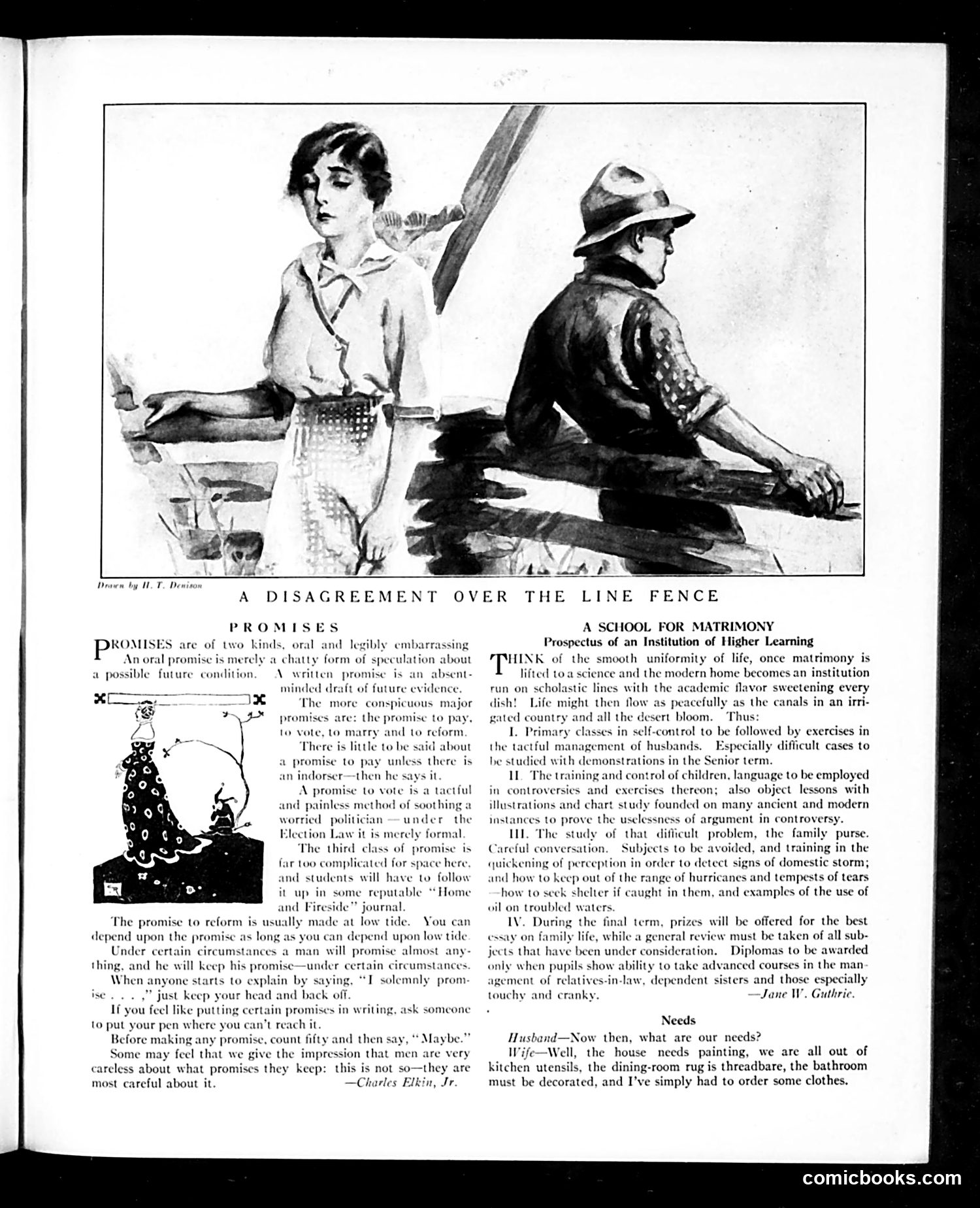
The top illustration shows a domestic dispute between a man and woman over a property boundary—a common neighborhood conflict. The satire critiques how couples handle disagreements, likely reflecting early-20th-century marital tensions. The accompanying text mocks "promises" as unreliable, particularly marriage vows and political pledges. It's cynical about human nature: promises to reform are made "at low tide" (desperation); written promises need witnesses; and men are paradoxically both careless *and* careful about keeping them. "A School for Matrimony" satirizes the idea of systematizing marriage through education—treating matrimony as an academic discipline with courses in managing husbands, controlling children, and managing finances. The humor lies in treating domestic life as a solvable science when it clearly isn't. The "Needs" dialogue concludes by showing the wife's practical concerns (home repairs, furnishings) contrasting with the husband's presumed expectations, reinforcing the page's theme: marriage promises clash with reality.
📄 Transcribed text from this page (OCR, searchable)
Machine-transcribed from the original scan — historical spelling and the odd misread are preserved.
Donen by HLT. Denison PROMISES Peouses are of two kinds, oral and legibly embarrassing An oral promise is merely a chatty form of speculation about a possible future condit \ absent- minded draft of future evidence. The more conspicuous major promises are: the promise to pay, to vote, to marry and to reform There is little to be said about a promise to pay unless there is an indorser—then he says it A promise to vote is a tactful and painless method of soothing a under the written promise is an worried politician Election Law it is merely formal The third class of pr {ar 100 complicated for space here and students will have to follow it up in some reputable “Home and Fireside” journal The promise to reform is usually made at low tide. depend upon the promise as long as you can depend upon low tide Under certain circumstances a man will promise almost any- thing, and he will keep his promise—under certain circumstances When anyone starts to explain by saying, “IT solemnly prom ise... ,” just keep your head and back off. If you feel like putting certain promises in writing, ask someone to put your pen where you can’t reach it. Before making any promise, count fifty and then say, * Maybe Some may feel that we give the impression that men are very careless about what promises they keep: this is not so—they are most careful about it. —Charles Elkin, Jr. mise is You can A DISAGREEMENT OVER THE LINE FENCE A SCHOOL FOR MATRIMONY Prospectus of an Institution of Higher Learning HINK of the smooth uniformity of life, once matrimony is lifted toa science and the modern home becomes an institution run on scholastic lines with the academic flavor sweetening every dish! Life might then flow peacefully as the canals in an irri- gated country and all the desert bloom. Thus: I. Primary classes in self-control to be followed by exercises in the tactful management of husbands. Especially difficult cases to be studied with demonstrations in the Senior term. IL. The training and control of children, language to be employed in controversies and exercises thereon; also object lessons with illustrations and chart study founded on many ancient and modern instances to prove the usclessness of argument in controversy. II. The study of that difficult problem, the family purse. Careful conversation. Subjects to be avoided, and training in the quickening of perception in order to detect signs of domestic storm; and how to keep out of the range of hurricanes and tempests of tears how to seck shelter if caught in them, and examples of the use of oil on troubled waters. During the final term, prizes will be offered for the best essay on family life, while a general review must be taken of all sub- jects that have been under consideration. Diplomas to be awarded only when pupils show ability to take advanced courses in the man agement of relatives-in-law, dependent sisters and those especially touchy and cranky. JaneW. Guthrie. Needs Husband—Now then, what are our needs? Wife—Well, the house needs painting, we are all out of kitchen utensils, the dining-room rug is threadbare, the bathroom must be decorated, and I’ve simply had to order some clothes. comicbooks.com