
A complete issue · 28 pages · 1916
Judge — February 5, 1916
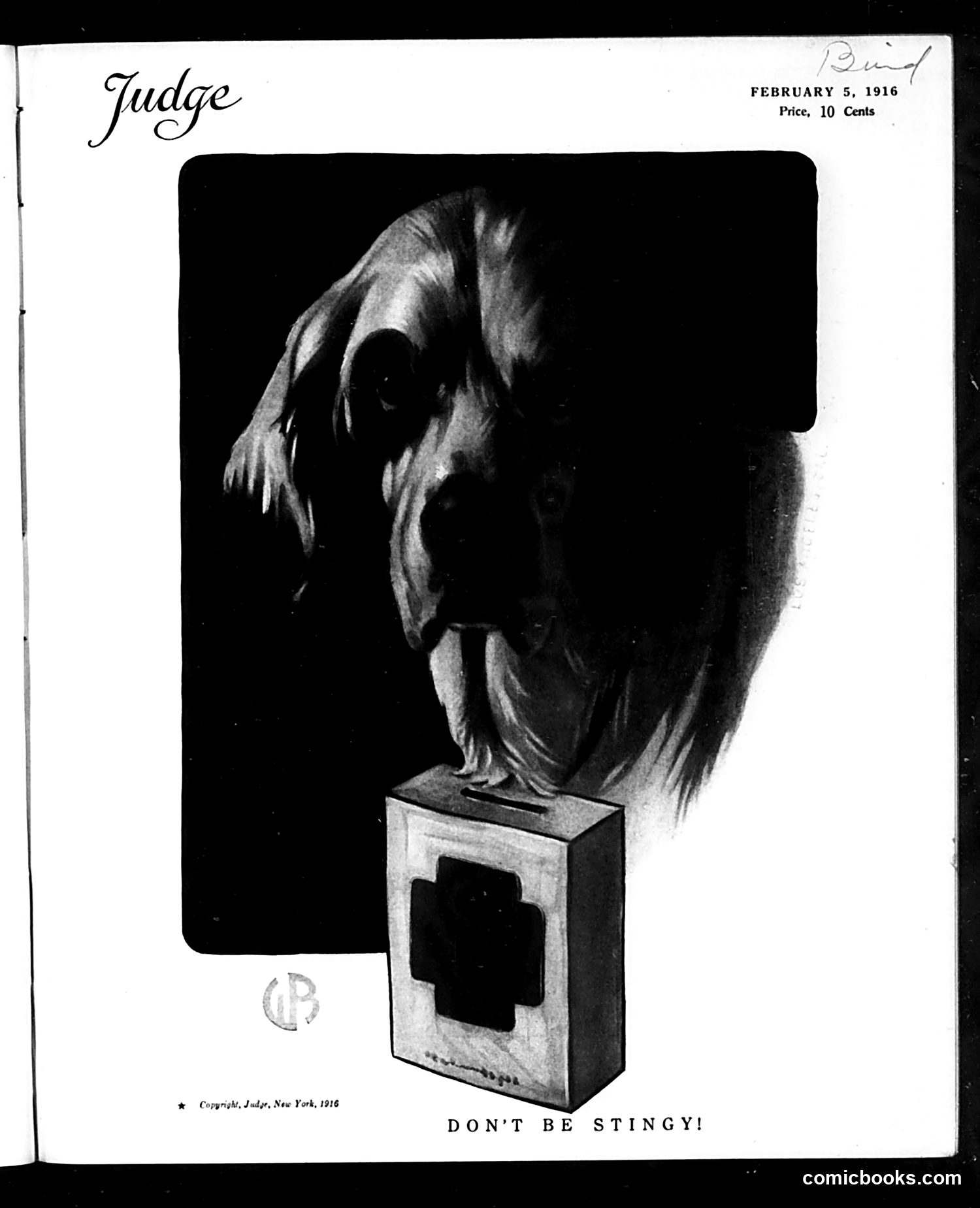
This satirical illustration titled "DON'T BE STINGY!" depicts a skeletal death figure emerging from a medical box marked with a red cross symbol. The image appears to be warning about inadequate charitable giving or support for medical/humanitarian causes, likely related to World War I relief efforts, which were active concerns in America in early 1916. The "stingy" reference suggests criticism of insufficient donations to medical aid organizations or war relief. The death imagery implies that inadequate financial support leads to preventable deaths. The red cross box directly invokes the International Red Cross, the era's primary medical humanitarian organization. The satire targets American donors for insufficient generosity during the ongoing European conflict.
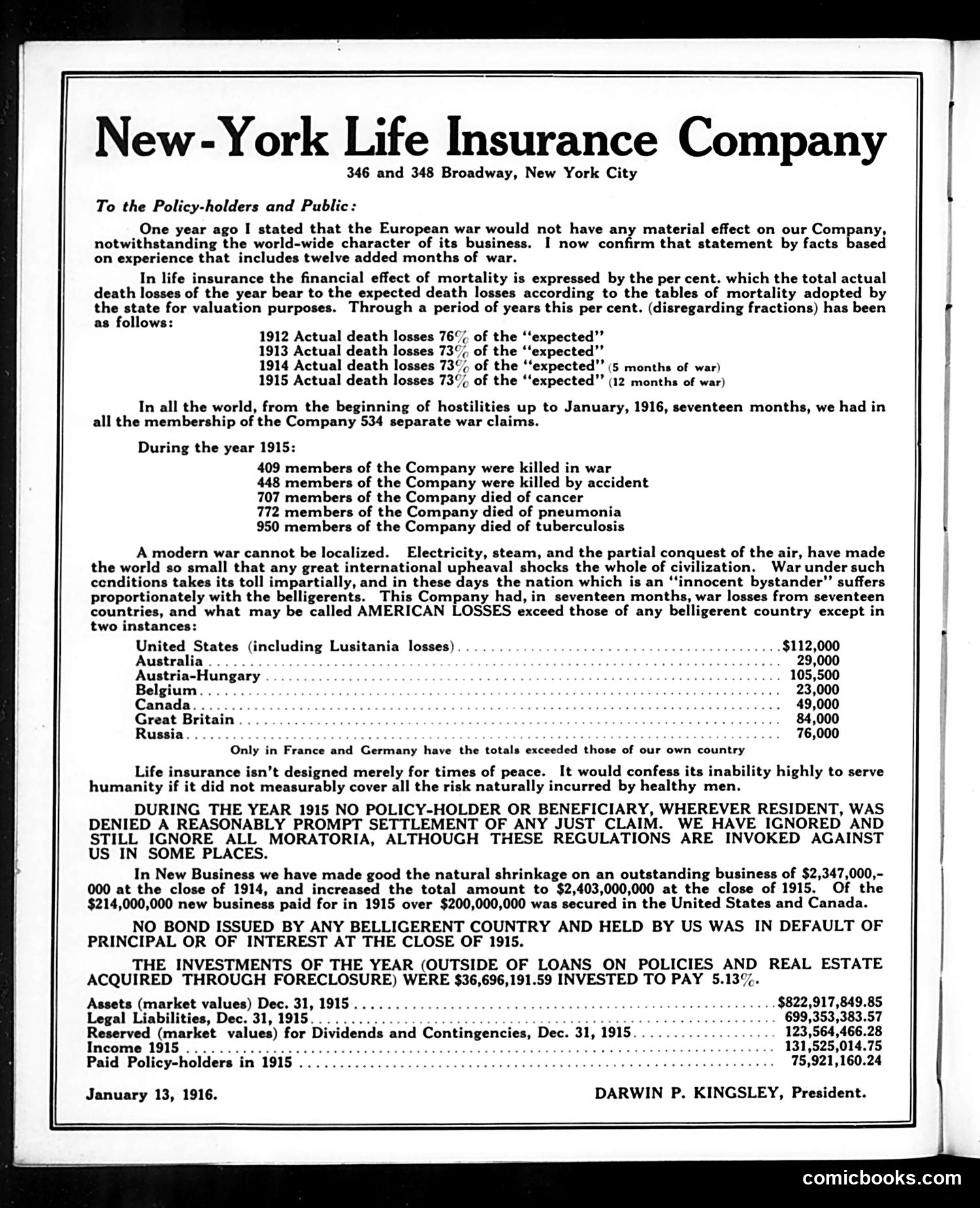
This page is **not a cartoon or satirical content** — it's a full-page advertisement/statement by the New-York Life Insurance Company, dated January 13, 1916. The company addresses policyholders about World War I's impact on their business. Key points: they claim minimal financial damage despite thirteen months of European war, cite mortality statistics showing actual death losses at 73-76% of "expected" rates, and detail 534 war-related claims across seventeen countries. The statement emphasizes the company's stability by listing war losses by nation and highlighting strong 1915 financial performance ($214 million in new business). This is corporate messaging designed to reassure Americans that their insurance company remains solvent despite ongoing international conflict.
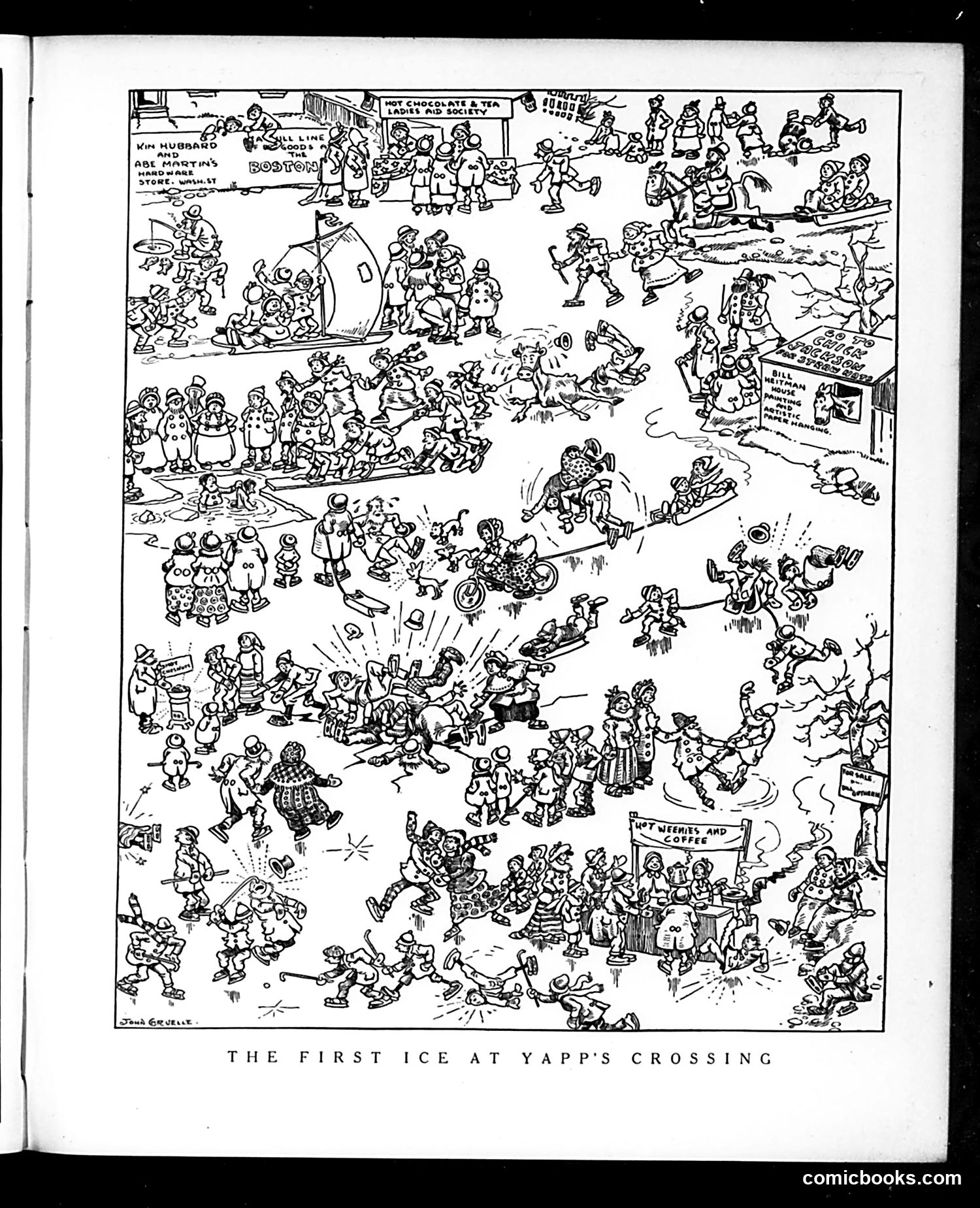
This is a densely packed satirical illustration depicting a chaotic scene at what appears to be a public gathering place or crossing. The cartoon shows numerous figures engaged in various activities and mishaps on ice—people falling, slipping, playing, and generally struggling with winter conditions. The shops visible include "Hot Chocolate & Tea," "Hot Meries and Coffee," and other establishments, suggesting this is a commercial district or popular public venue. The satire appears to target the comedic hazards of winter weather and human behavior during the first freeze—people unprepared for icy conditions, engaging in foolish or entertaining activities. Without clearer identification of "Yapp's Crossing," the specific historical or political reference remains unclear, though the overall humor derives from slapstick winter mishaps and social observation.
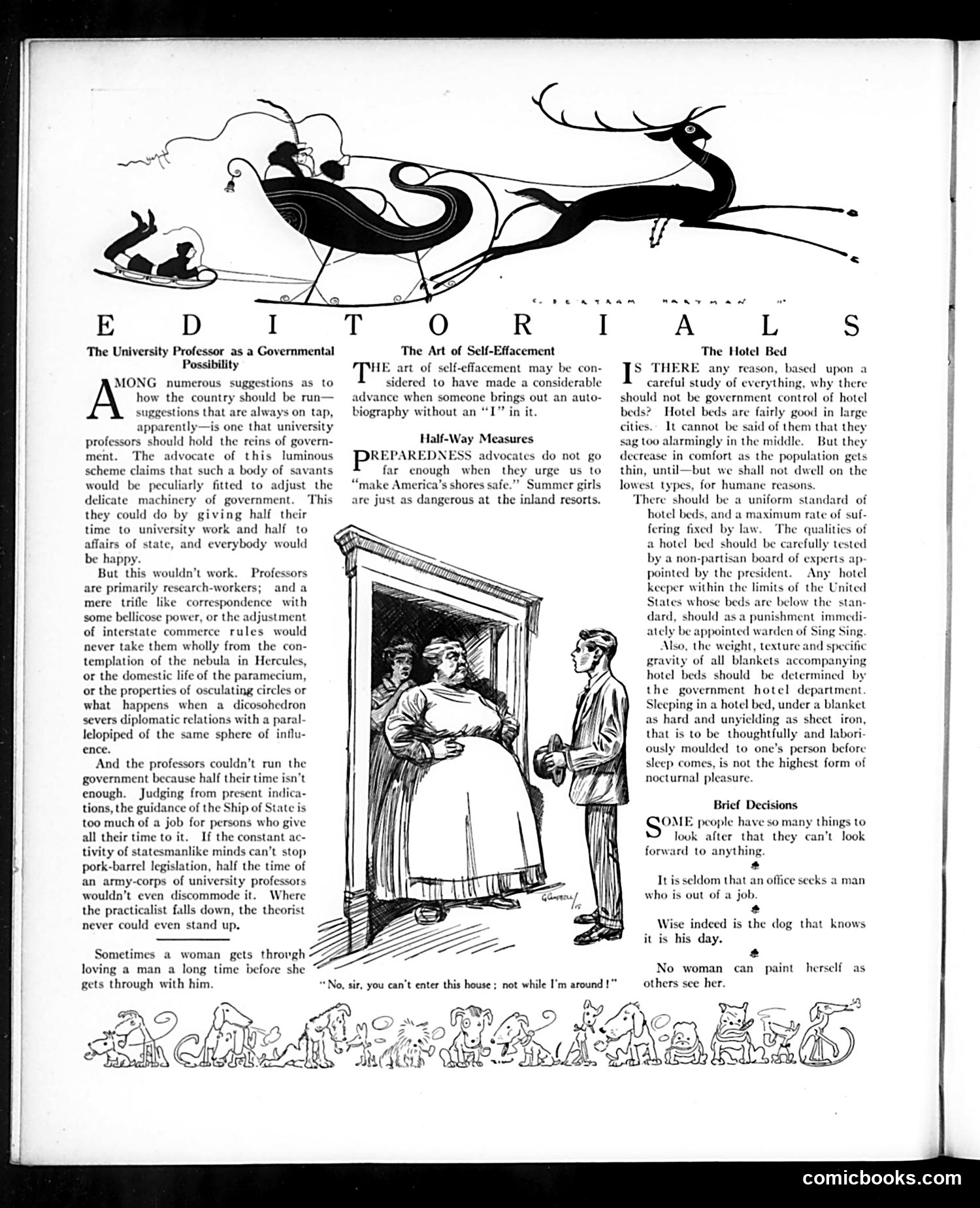
This Judge magazine page contains three distinct opinion pieces with accompanying illustrations. The top cartoon depicts a fantastical airship carrying passengers, illustrating the lead article's mockery of a proposal that university professors work half-time for government—a satirical suggestion that such divided loyalty would be impractical and ineffective. The central illustration shows a woman at a doorway addressing a man, captioning her refusal of entry with "No, sir, you can't enter this house; not while I'm around!" This appears to support the article "The Hotel Bed," which argues hotels should regulate bed quality and comfort standards through government oversight. The bottom section offers brief satirical observations ("Brief Decisions") on contemporary social matters—office employment, dogs, and women's appearance—typical of Judge's mordant humor. The decorative footer shows a line of playful animals.
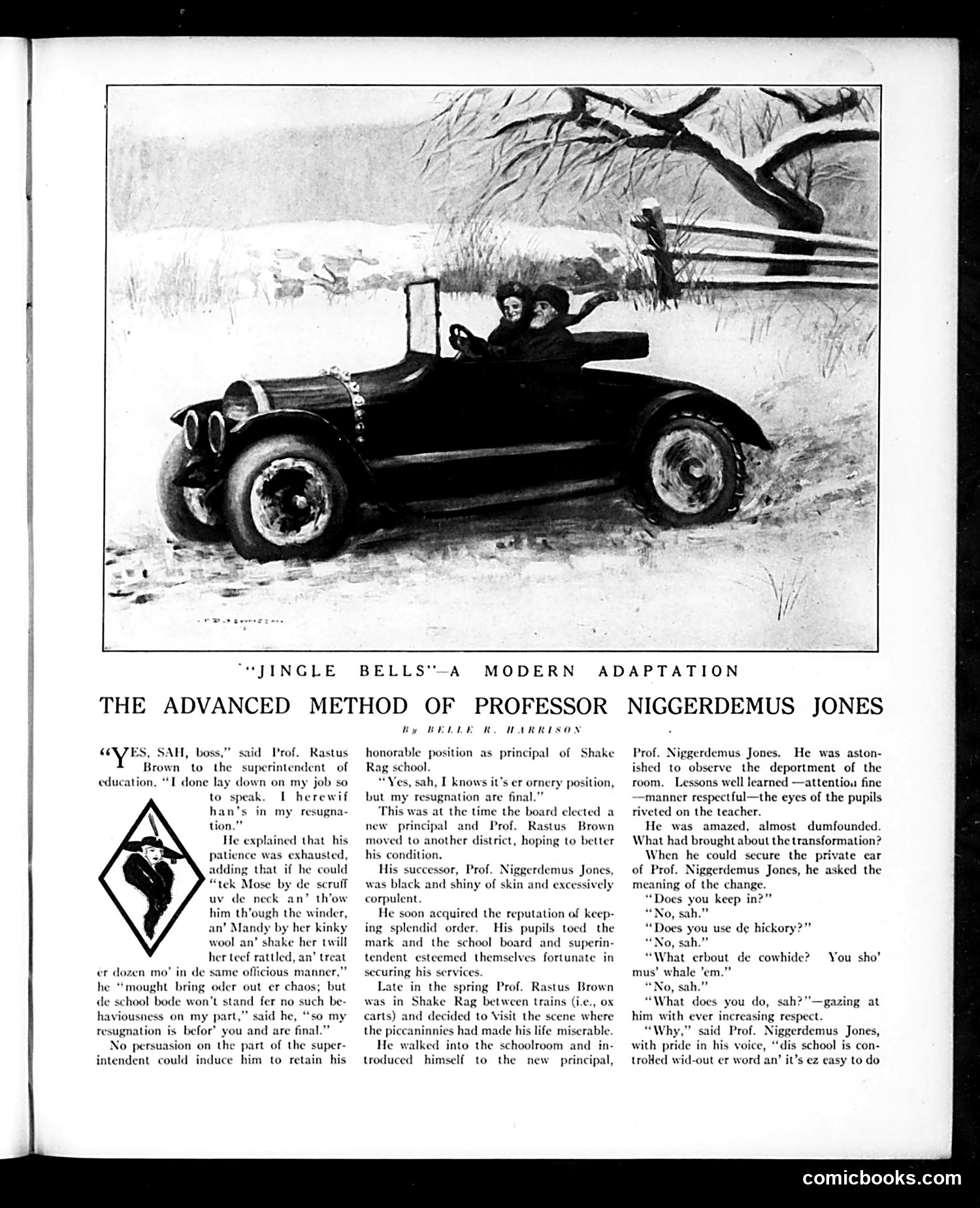
This satirical piece mocks an excessively formal, pretentious educator named Professor Niggerdemus Jones. The illustration shows him in an old-fashioned racing car (suggesting he's "behind the times" despite claiming modernity), accompanied by what appear to be students. The joke centers on Jones's overwrought management style: he replaces simple discipline with absurd euphemisms—calling a strap a "hickory," asking "does you keep in?" instead of directly commanding order, and insisting students address him with excessive respect. His verbose, affected speech patterns contrast sharply with the straightforward superintendent he replaced. The satire targets pompous educators who substitute grandiose language and pretense for effective teaching, making school administration comically ineffectual through self-aggrandizing formality.
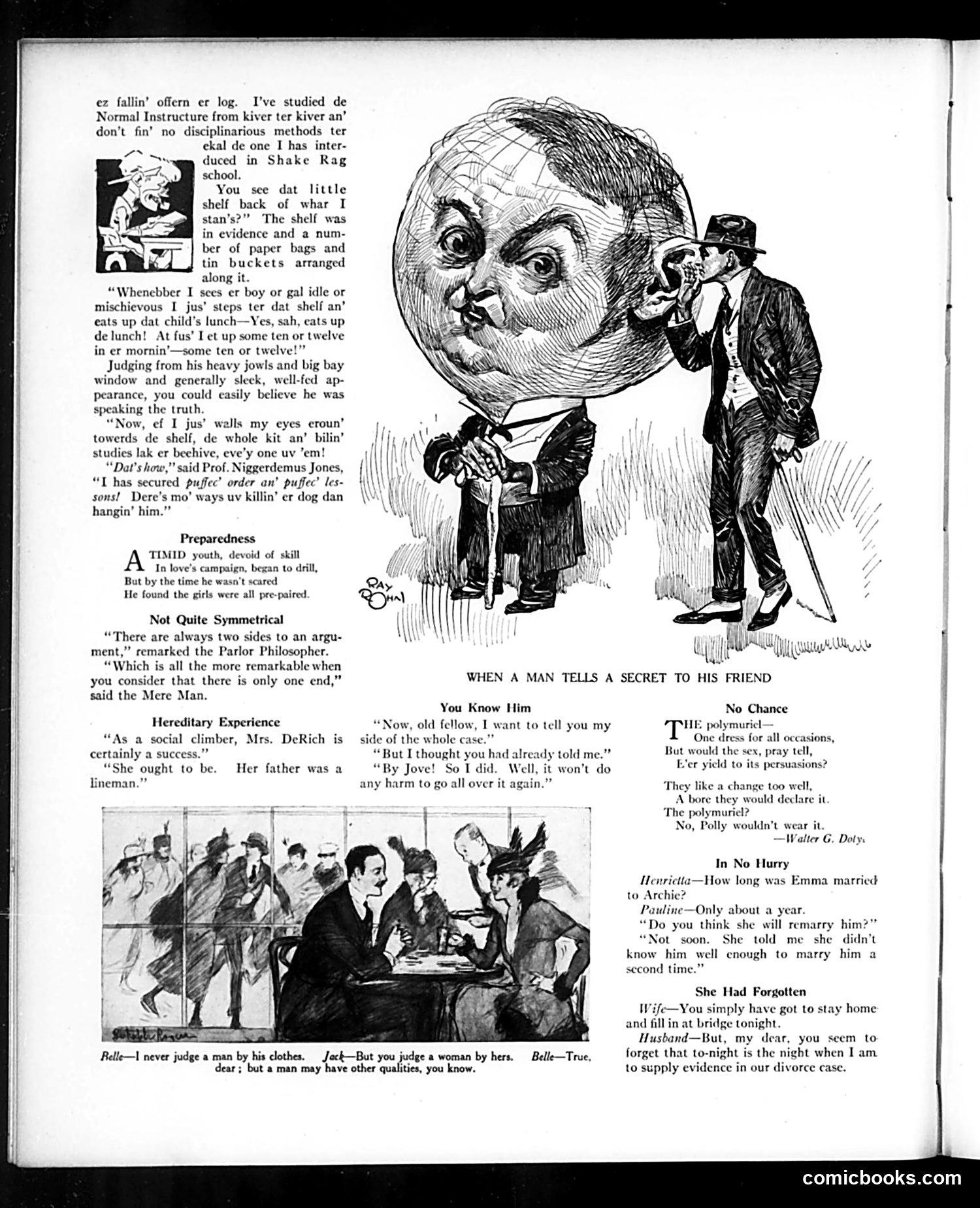
This page contains several unrelated humor pieces typical of early 20th-century Judge magazine. The dominant cartoon features **Prof. Niggerdemus Jones**, a caricatured Black schoolteacher using dialect humor. The satire appears to mock both his unconventional discipline method (confiscating students' lunches) and dialect-heavy speech patterns. This reflects the racist comic conventions of the era, presenting exaggerated Black characters as figures of ridicule. The remaining content comprises brief joke items: - "Preparedness" jokes about courtship and military readiness - A "Parlor Philosopher" quip about argument logic - Humorous exchanges about social climbing, marital infidelity, and divorce The cartoon of a man telling secrets to his friend illustrates gossip spreading through social circles. Overall, this represents typical Judge humor: lighthearted domestic situations, wordplay, and unfortunately, racial caricature that was mainstream entertainment at the time but is now recognized as deeply offensive.
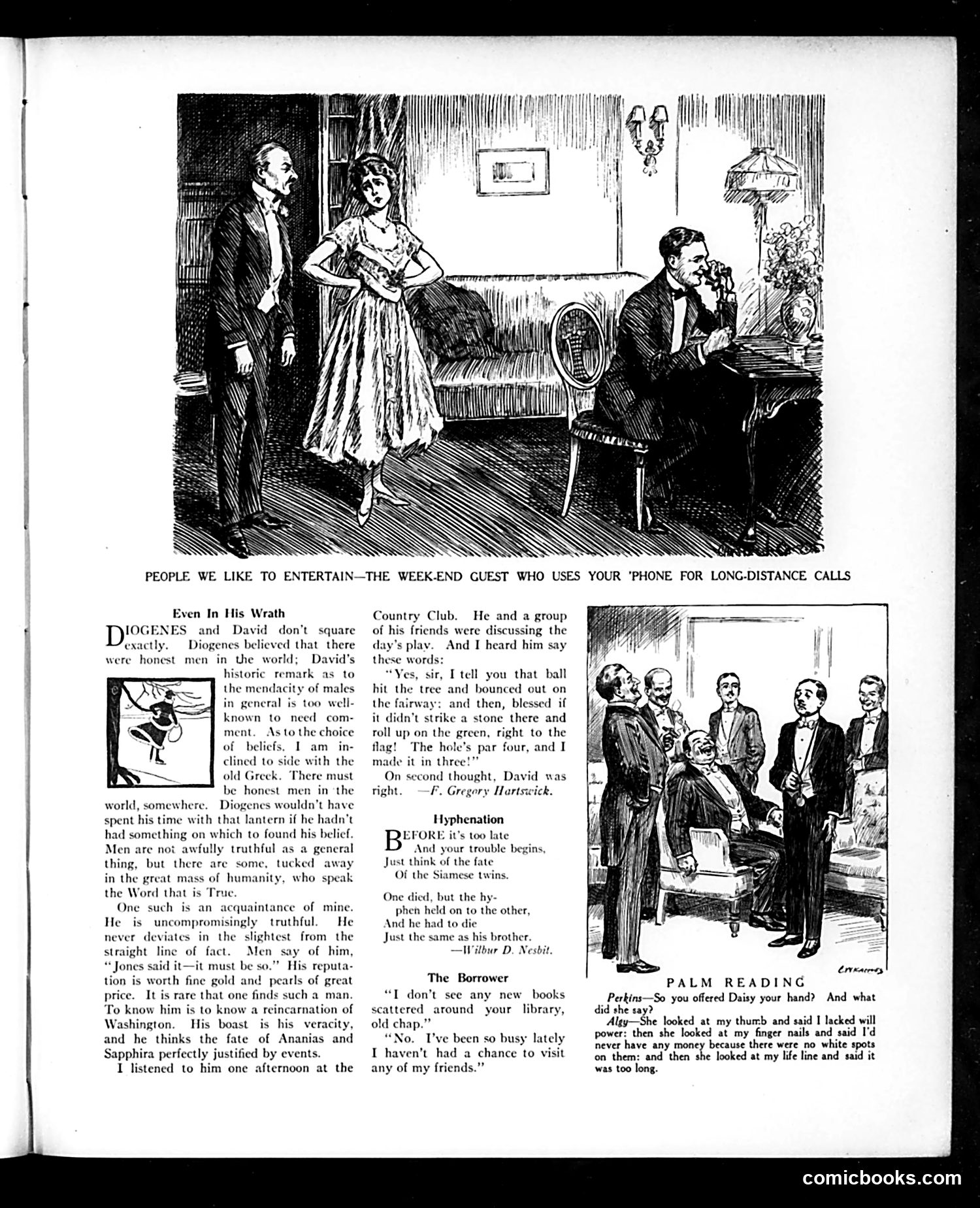
This page contains three satirical pieces targeting social hypocrisy and annoying social types. **"Even in His Wrath"** mocks a man famous for absolute honesty who contradicts himself. The setup contrasts Diogenes' belief in honest men with the biblical David's claim that all men lie. The joke: this paragon of truthfulness cheats at golf, claiming an impossible shot (making par in three when the hole is par four). It satirizes the gap between reputation and behavior among the supposedly virtuous. **"Hyphenation"** is a light verse about Siamese twins, using the hyphen metaphor darkly—when one dies, the hyphen (their connection) keeps the survivor bound to his dead brother. It's morbid wordplay. **"The Borrower"** and **"Palm Reading"** target annoying guests: the first depicts someone who borrows books constantly, the second shows a woman giving unsolicited palm readings with insulting interpretations (lacking willpower, poor financial prospects, long life—implying he'll endure her company forever). The top cartoon illustrates the introductory piece about weekend guests who monopolize the telephone for long-distance calls.
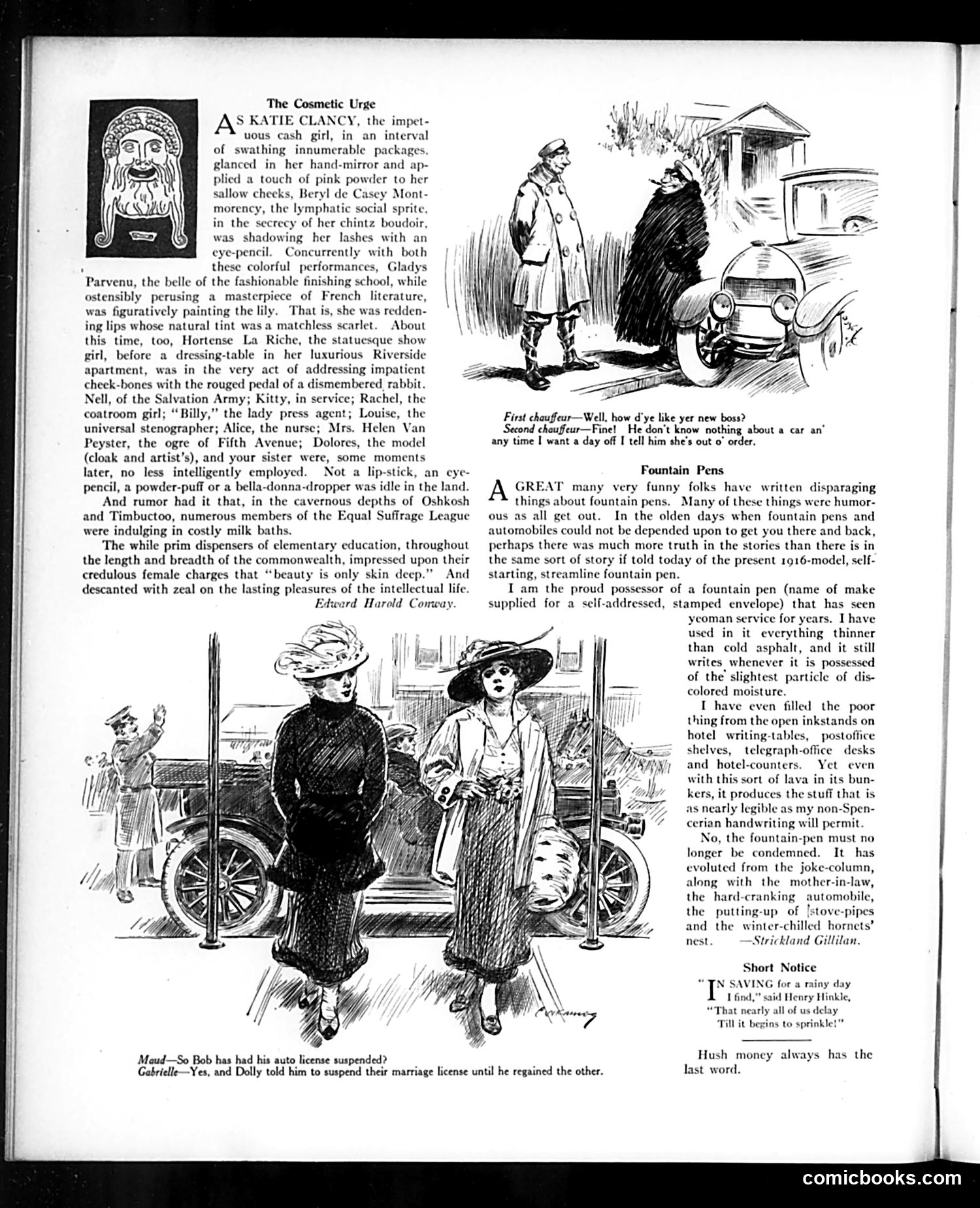
**"The Cosmetic Urge"** satirizes the widespread adoption of cosmetics across all social classes in the early 1900s. The article lists women from various backgrounds—from Katie Clancy (a shop assistant) to wealthy socialites like "Gladys Parvenu"—all simultaneously applying makeup. The satire targets the hypocrisy of the era: educators preached that "beauty is only skin deep" and celebrated intellectual pursuits, yet women across society obsessively pursued cosmetic enhancement. The reference to women in distant places like "Oshkosh and Timbuctoo" indulging in costly beauty treatments emphasizes how pervasive this "urge" had become. The accompanying car illustration jokes about marriage licenses and automobile repair—contemporary consumer products reflecting modern life's anxieties. The **Fountain Pens** section defends modern fountain pens against older satirical complaints, noting they've evolved from joke-column material into reliable tools—a meta-commentary on technological progress and changing humor.
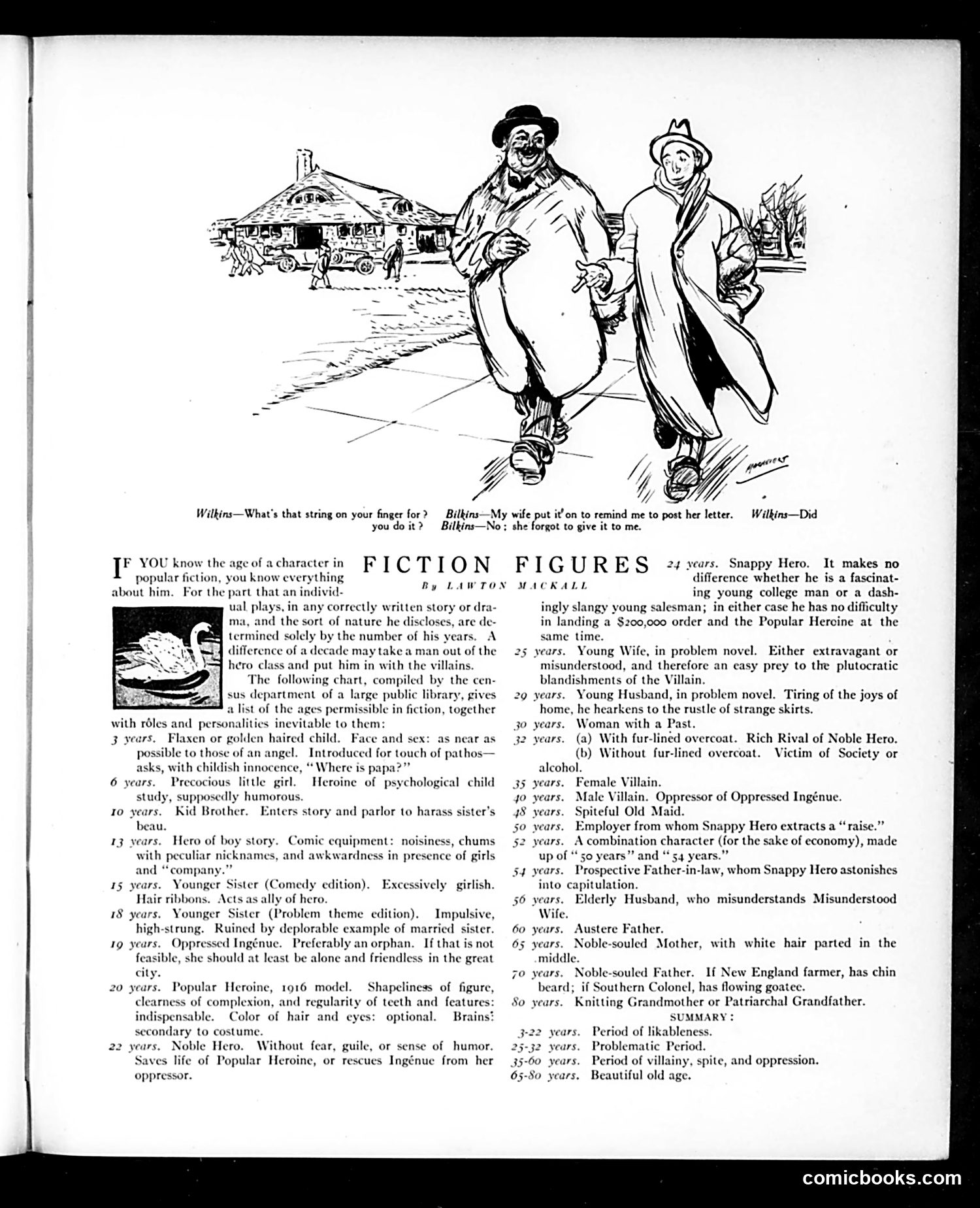
This page satirizes the rigid character archetypes that dominated early 20th-century popular fiction. The accompanying cartoon shows two men discussing a string on a finger—a memory aide—illustrating how formulaic these stories had become. The article mocks how fiction writers mechanically assigned personality traits based solely on a character's age. According to this "census department" chart, every age bracket from infancy to 80 had predetermined roles: the angelic child, the precocious girl, the "Snappy Hero" (who inexplicably closes $200,000 deals), the misunderstood young wife, and the predictable villain phases. The satire targets how unimaginative and predictable popular fiction had become—characters weren't individuals but age-based templates. The "Beautiful old age" phase at 65-80 suggests even death couldn't save characters from these tired conventions. It's criticism of mass-market literature's formulaic laziness.
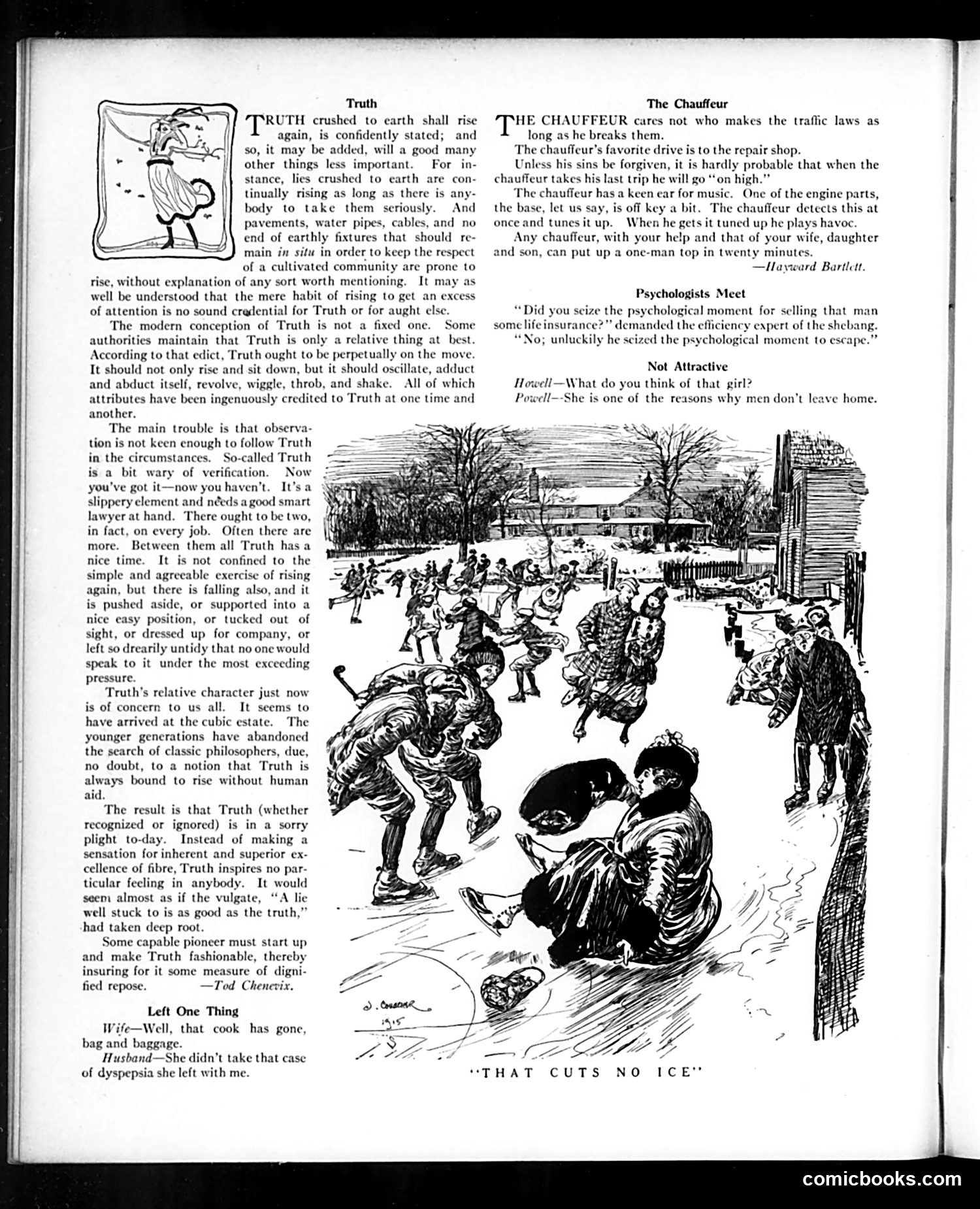
This page contains three brief satirical pieces typical of Judge's humor: **"Truth"** is a philosophical essay mocking the era's relativistic attitudes toward truth. It satirizes how truth is manipulated, suppressed, and repackaged—suggesting modern society treats truth as negotiable rather than absolute. The piece cynically notes that truth requires lawyers to defend it and that younger generations have abandoned the classical pursuit of objective truth. **"The Chauffeur"** offers humor about early automobile culture, mocking chauffeurs' reckless driving, frequent mechanical failures, and their indifference to traffic laws. This reflects the era's anxiety about dangerous, unregulated automobile use. **"Psychologists Meet"** and **"Not Attractive"** are brief joke exchanges—the first about a failed insurance sale, the second a crude joke implying a woman's unattractiveness keeps her husband home. The central illustration labeled **"That Cuts No Ice"** depicts children ice-skating, likely accompanying winter-themed humor, though the specific connection to surrounding text is unclear.
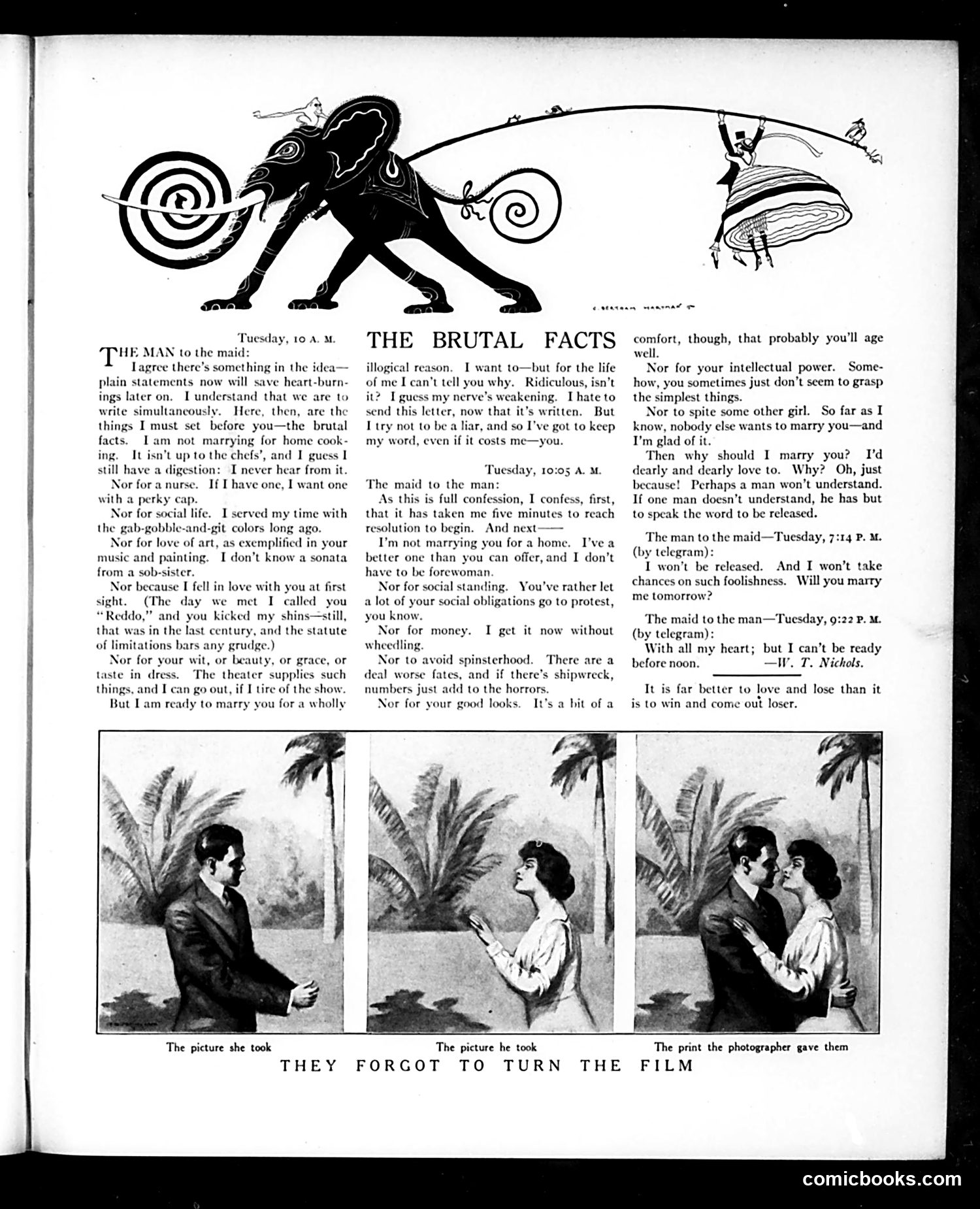
This page satirizes early 20th-century courtship and marriage through contrasting monologues. A man and woman each list reasons they're *not* marrying each other—rejecting practical motivations like cooking, nursing, social status, money, beauty, and intellect. The humor lies in their honesty about marriage's unsexy realities. The couple ultimately agrees to marry "just because" they love each other, communicated via telegram—a modern touch for the era. Their emotional sincerity triumphs over rational calculation. The three photographs below joke about amateur photography: a couple poses romantically by palm trees across three frames, but forgets to advance the film, so all three prints are identical. The caption "They forgot to turn the film" delivers the punchline—their romantic moment is literally frozen, unchanged, and unchangeable, mirroring the fixed nature of their newfound commitment.
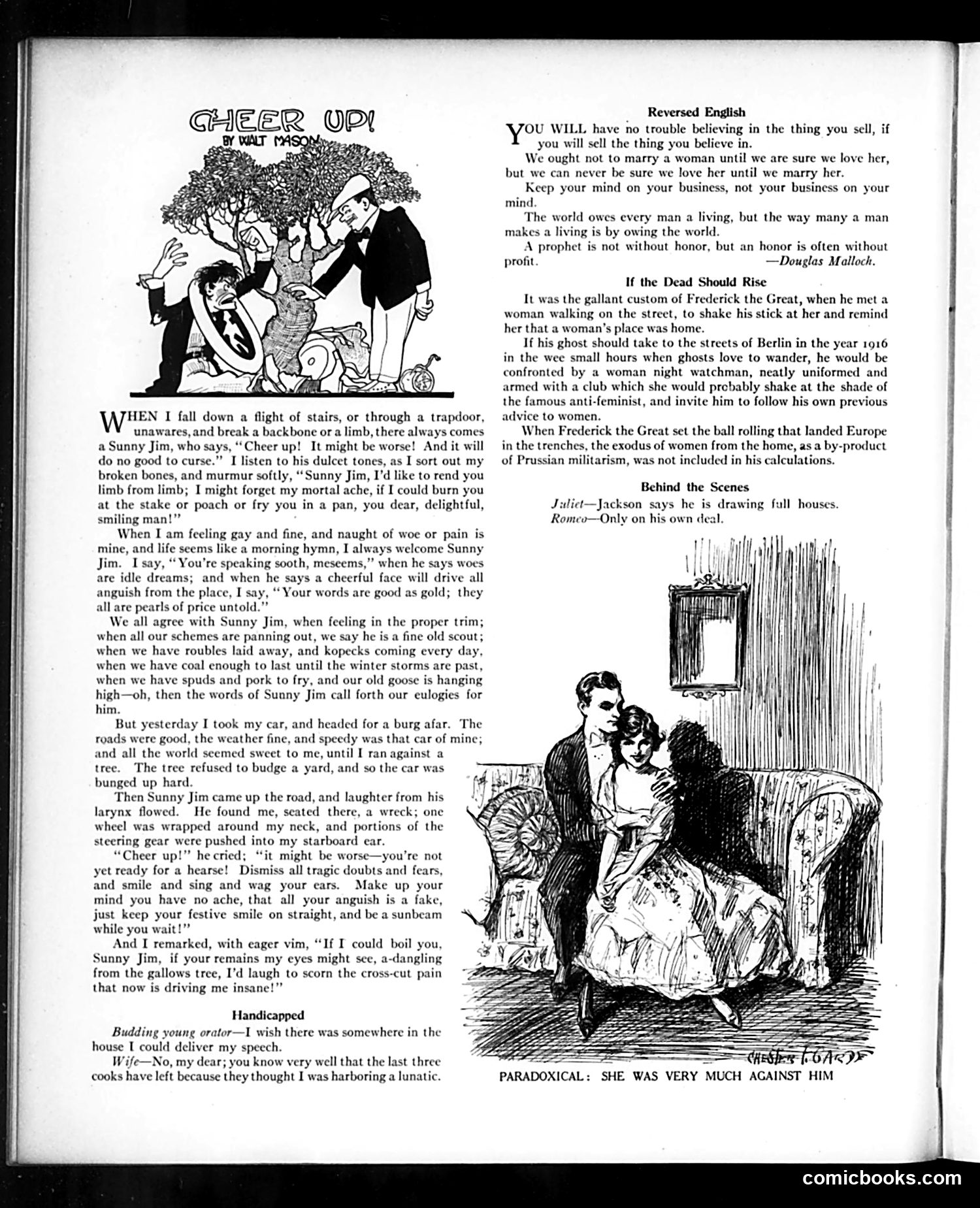
This satirical piece mocks the relentless optimism of the "Sunny Jim" archetype—the perpetually cheerful person who insists "it might be worse" regardless of circumstance. The narrator describes how this attitude becomes unbearable when actually suffering (a car crash, broken bones) versus tolerable when life is good. The satire critiques hollow positivity as simultaneously annoying and context-dependent. The page also includes other brief satirical items: "Reversed English" offers paradoxical wisdom about business and marriage; "Handicapped" jokes about a would-be orator whose wife claims he's mad; and "If the Dead Should Rise" mocks Frederick the Great's historical misogyny by imagining his ghost encountering armed female night-watchmen in WWI Berlin—suggesting women's wartime labor has ironically challenged his anti-feminist ideology.
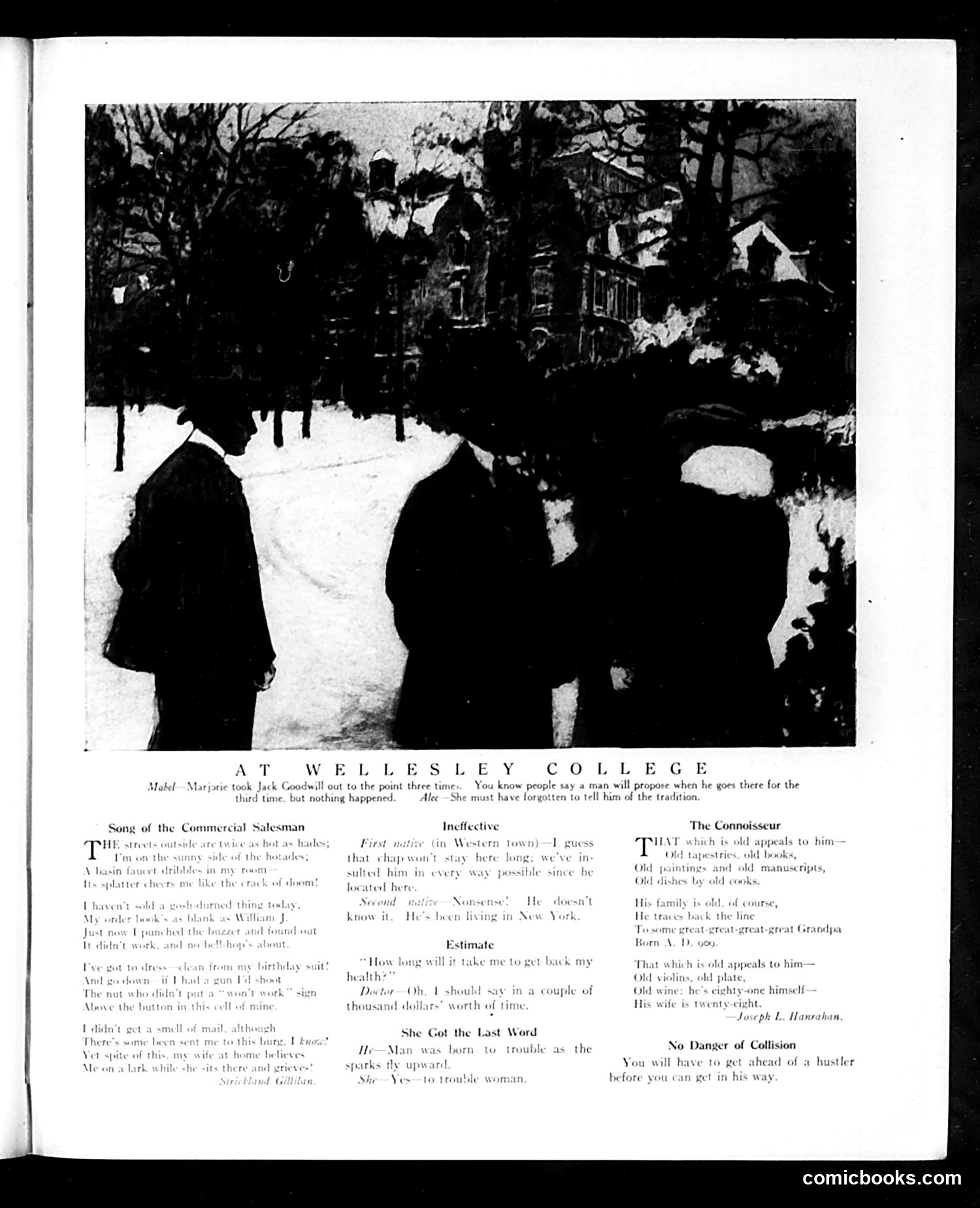
This page from *Judge* contains several short satirical pieces with accompanying verse, typical of early 20th-century American humor magazines. The photograph at top shows silhouetted figures in a snowy winter scene at Wellesley College, captioning a brief anecdote about a woman named Mabel repeatedly taking her suitor Jack Goodwell to "the point" — likely a scenic overlook — with the running joke that nothing romantic happens (she forgets tradition). Below are four humor pieces: 1. **"Song of the Commercial Salesman"** — satirizes traveling salesmen's persistence and self-deception about their appeal to women 2. **"Ineffective"** — mocks a traveling salesman's poor sales technique and outdated methods 3. **"The Connoisseur"** — pokes fun at wealthy old men obsessed with collecting antiquities and their much-younger wives 4. **"No Danger of Collision"** — a brief, cryptic quip about hustlers The humor targets conventional early-20th-century male archetypes: the ineffectual salesman, the lecherous collector, and confidence men. The satire is genteel rather than biting.
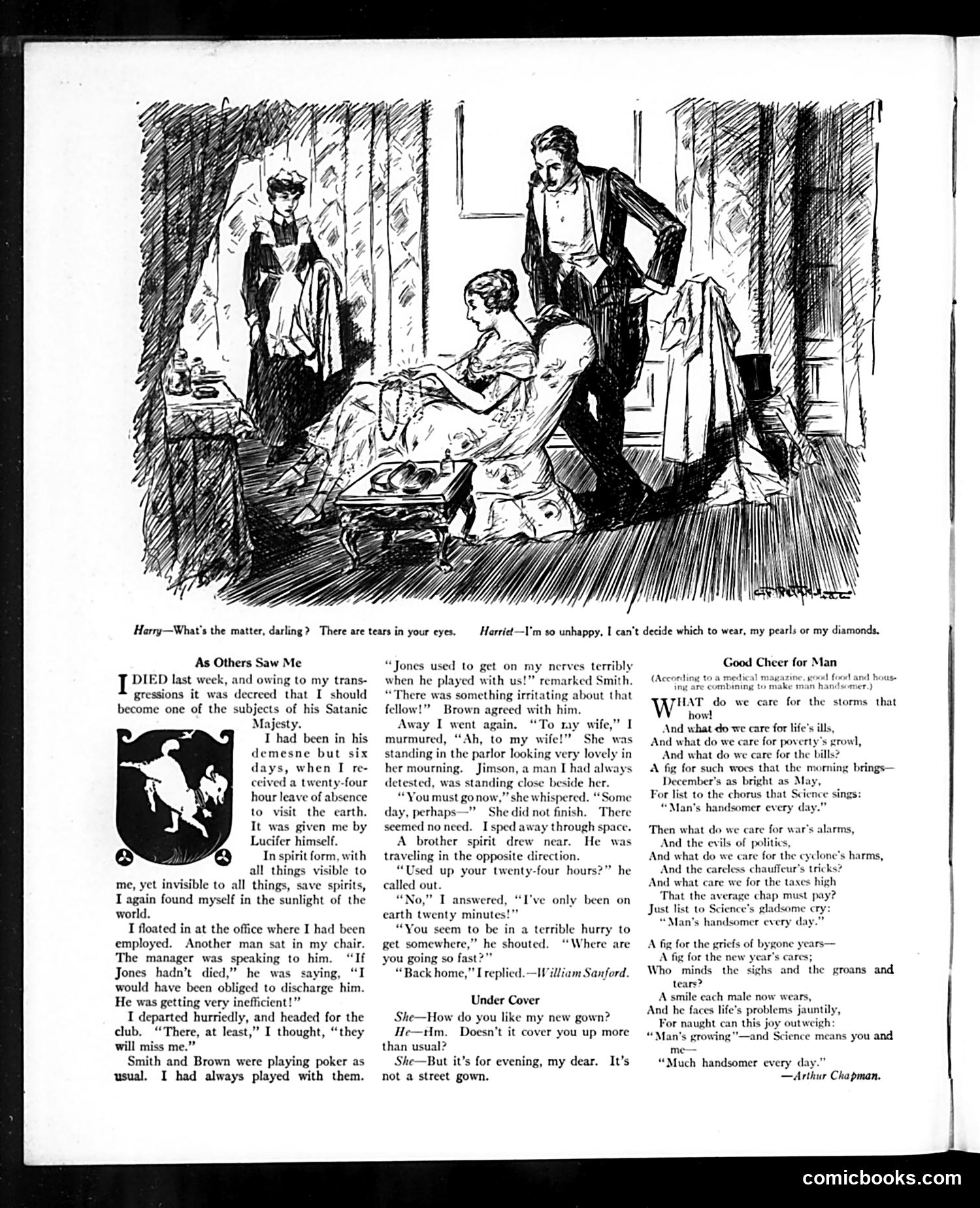
The page contains two distinct pieces of satire: **"As Others Saw Me"** (left): A supernatural fiction story where a deceased man returns as a ghost to see how he's remembered. The satire targets human selfishness—his employer was planning to fire him, his poker friends complained about him, and his wife is already being courted by a man she previously disliked (Jimson). The ghost discovers people are relieved he's gone, prompting his quick return to the afterlife. This mocks the gap between how we imagine our importance and our actual social irrelevance. **"Good Cheer for Man"** (right): A poem celebrating masculine optimism in the face of modern anxieties—storms, poverty, war, politics, cyclones, reckless drivers, and taxes. The refrain "Man's handsomer every day" sarcastically suggests that science and self-confidence allow dismissing serious social problems. This appears to mock both masculine bravado and the era's facile optimism about progress. Both pieces critique early-20th-century attitudes with dark humor.
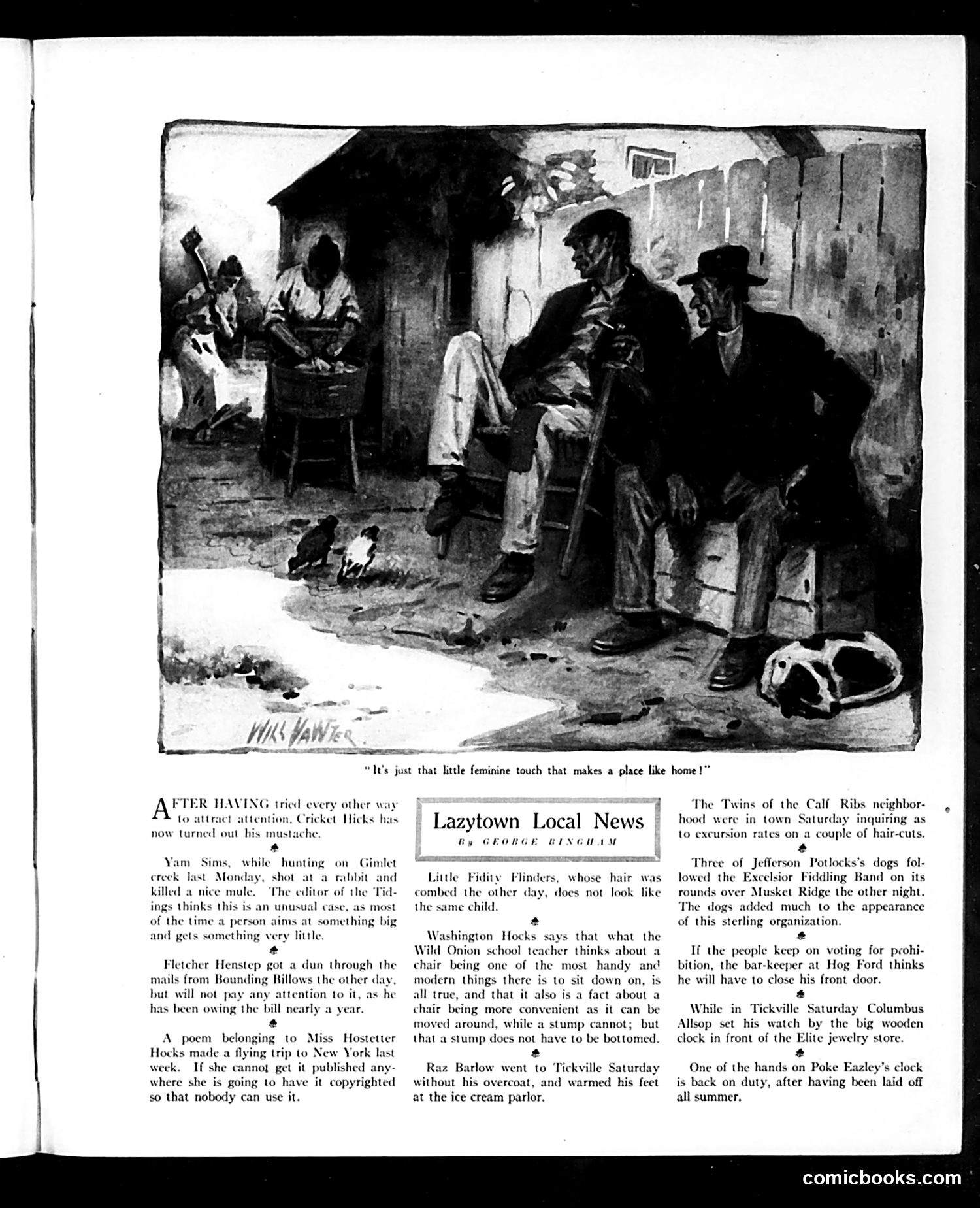
The top illustration depicts a domestic scene where men gather around a woman in modest dress in what appears to be a poor or working-class home. The caption—"It's just that little feminine touch that makes a place like home!"—uses irony to satirize sentimental notions of domesticity and women's civilizing influence. The contrast between the rough, sparse setting and the idealized rhetoric suggests mockery of Victorian-era platitudes about homemaking. Below is "Lazytown Local News," a humor column featuring absurdist small-town anecdotes—mishaps like shooting a mule instead of a rabbit, or absurd observations about chairs versus stumps. These brief satirical vignettes mock rural American life, provincial attitudes, and nonsensical logic typical of early 20th-century Judge magazine's comedic style. The humor relies on understated deadpan delivery and the cumulative effect of ridiculous scenarios presented as earnest local gossip.
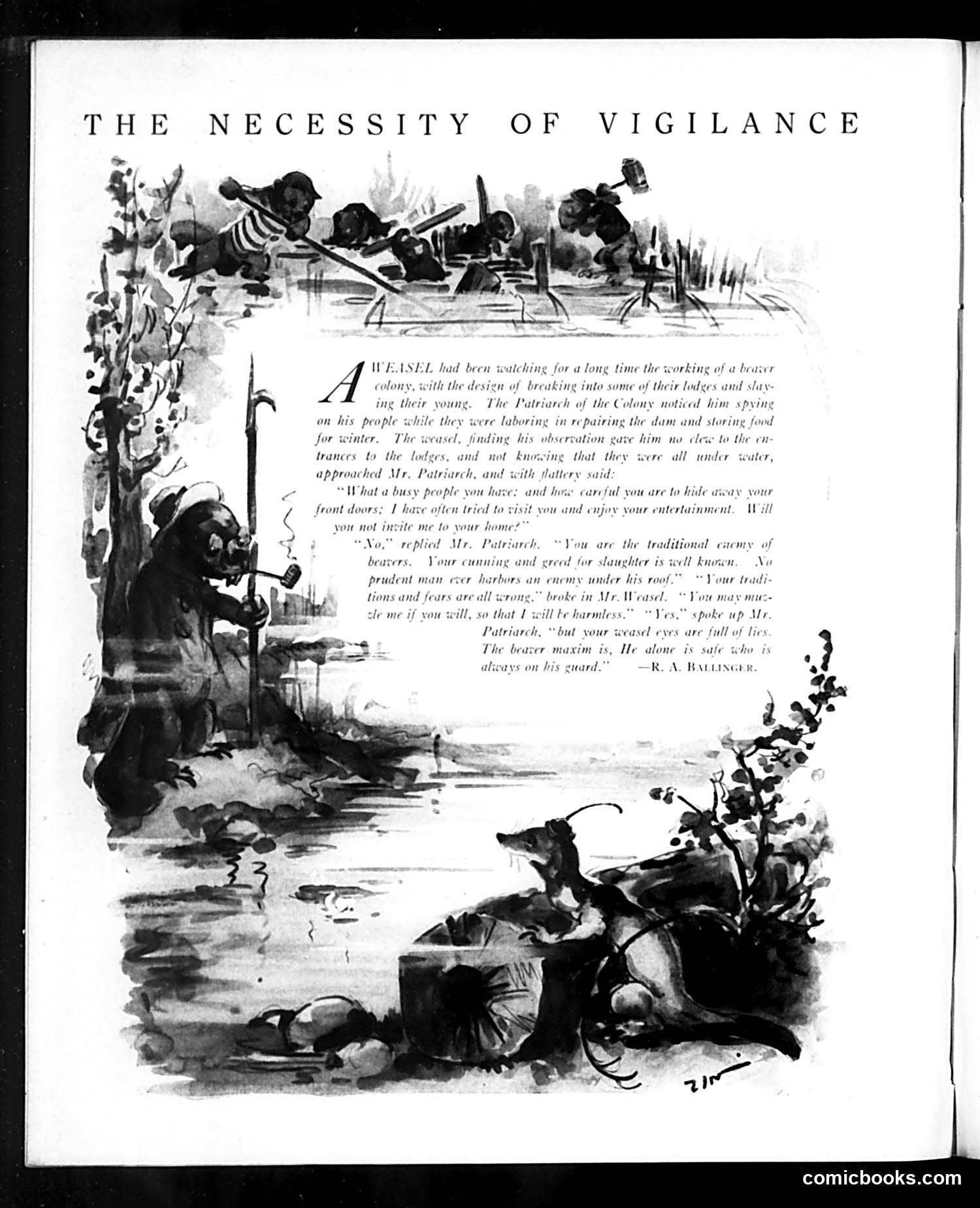
This is an Aesopian fable satirizing political naïveté, likely about trust in adversaries or appeasement of hostile powers. **The Figures:** A weasel (predator, traditional enemy) approaches a beaver colony's patriarch, flattering them and requesting access to their lodges while promising harmlessness if restrained. **The Point:** The beaver patriarch refuses, articulating the key principle: "the traditional enemy of beavers...cunning and...slaughter is well known. No prudent man ever harbors an enemy under his roof." The weasel's appeals to reason ("your traditions and fears are all wrong") are exposed as manipulation. **The Satire:** The cartoon warns against trusting traditionally hostile entities merely because they offer reassurance. The beaver's closing maxim—"He alone is safe who is always on his guard"—endorses constant vigilance against enemies, however friendly their overtures. **Historical Context:** Without a visible date, the specific political referent is unclear, but this reflects common turn-of-century Judge themes about international relations and the danger of diplomatic naïveté.
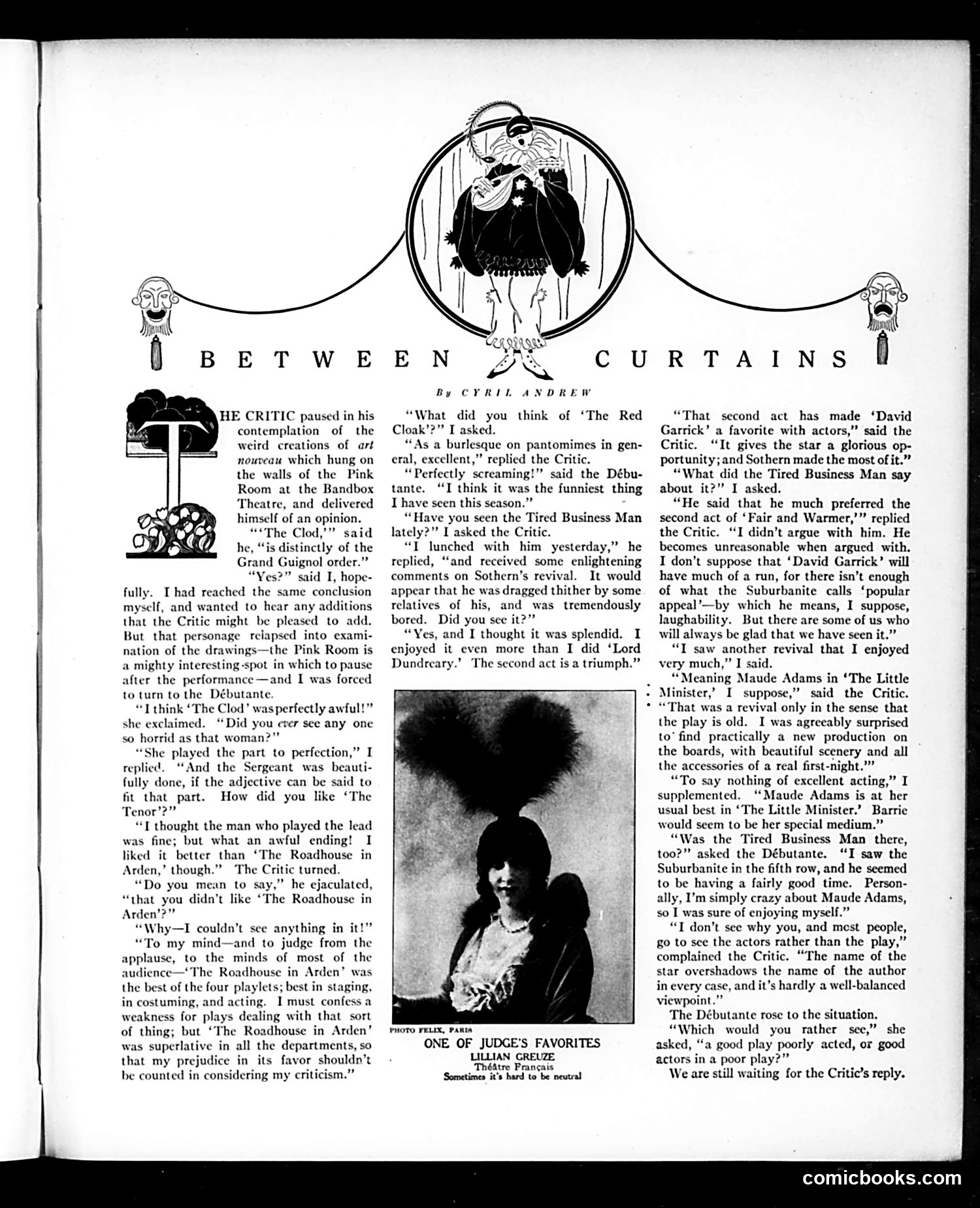
This article presents a dialogue between a sophisticated theater Critic, an enthusiastic young Débutante, and a narrator discussing recent theatrical productions at the Bandbox Theatre's "Pink Room" (an art nouveau lounge). The satire targets the gap between critical and popular taste. The Critic dismisses plays the Débutante loves ("The Clod," praised as "perfectly awful") and champions obscure productions like "The Roadhouse in Arden," while a recurring figure—the "Tired Business Man"—represents the general audience, dragged to theater by relatives and preferring broad comedies. The piece gently mocks both the Critic's pretentiousness and the Débutante's uncritical enthusiasm, positioning them as opposites on the spectrum of theatrical judgment. The accompanying photograph of actress Lillian Greuze suggests this was a genuine theater review column mixing gossip with critique—typical Judge magazine fare mixing humor with arts commentary.
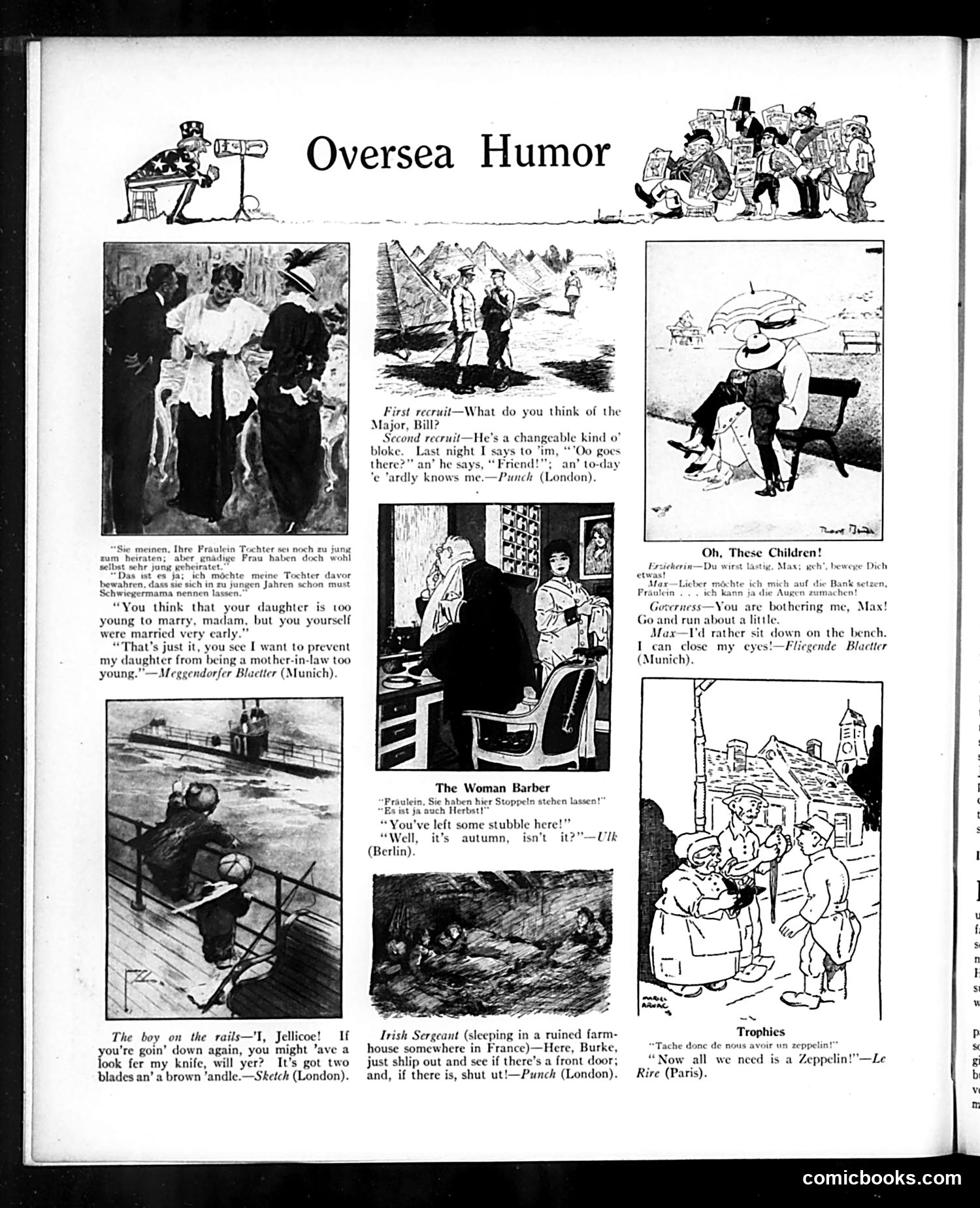
This page collects humorous cartoons from British, German, and French publications during World War I, showcasing how different nations used satire about the war. The cartoons include military recruitment humor (a recruit finds his officer suddenly distant), domestic comedy about children and governesses, and war-specific jokes. Most notably, an "Irish Sergeant" cartoon depicts soldiers in a ruined French farmhouse checking for doors—dark humor about the destruction of the Western Front. Another references a "Zeppelin," the German airships used in bombing raids, suggesting Allied concerns about aerial threats. The "Woman Barber" cartoon appears to be pre-war social satire about gender roles. The recurring theme is ordinary people's lives disrupted by wartime realities—missing loved ones, dangerous conditions, and the casual violence of trench warfare presented as comedy for home audiences.
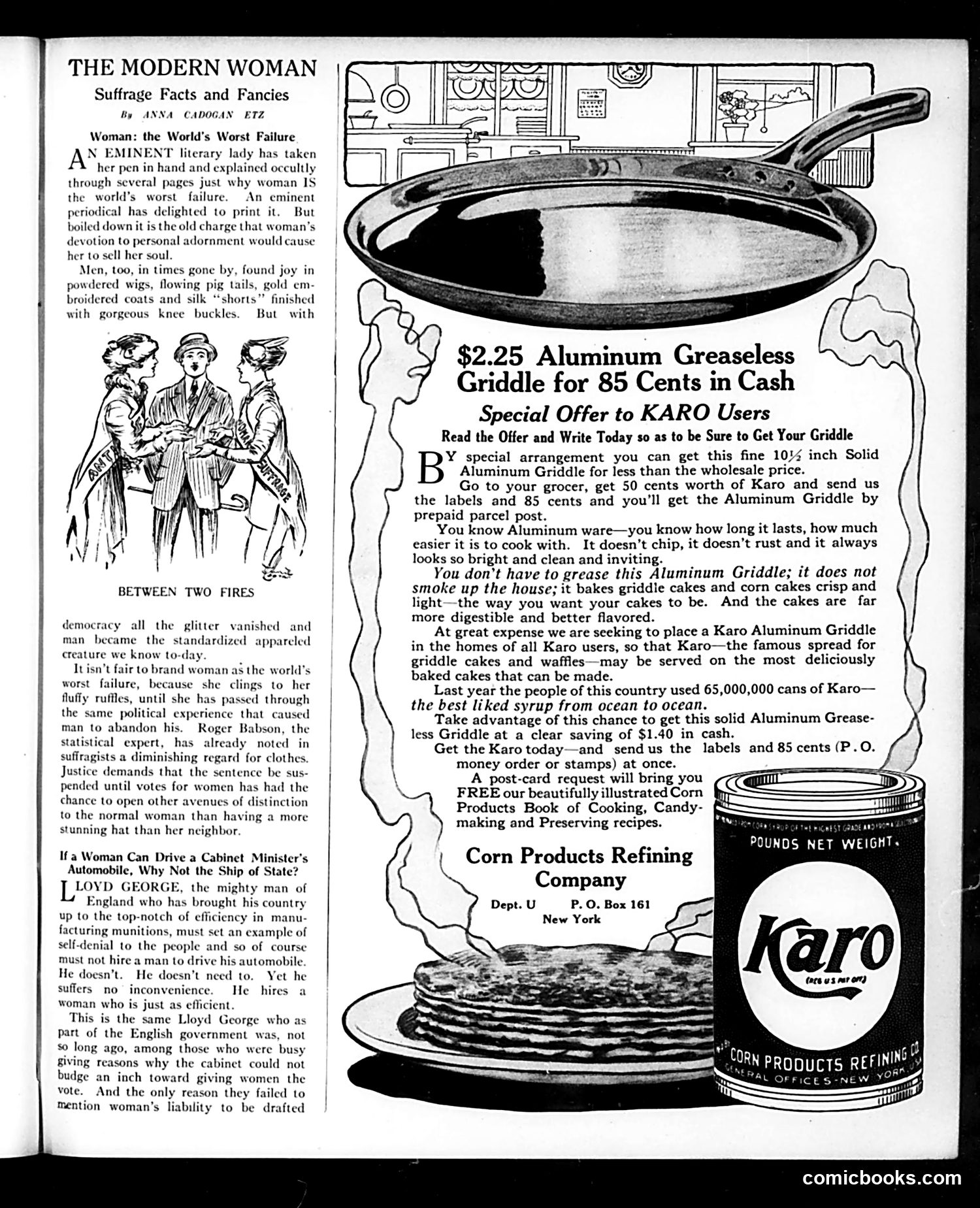
This page combines a satirical essay on women's suffrage with a product advertisement. **The Satire:** Author Anna Cadogan Etz defends modern women against accusations that they're "the world's worst failure" due to vanity and love of personal adornment. She argues men historically indulged in equal frivolity (wigs, silk stockings, buckles) before gaining political power through voting rights. Her point: women's alleged superficiality isn't inherent—it's a symptom of exclusion from serious civic participation. She cites economist Roger Babson's observation that suffragists show *less* concern for clothing, and sarcastically notes Lloyd George (British munitions minister) employs a woman driver while simultaneously opposing women's suffrage, undermining anti-suffragist arguments about women's unsuitability. **The Irony:** The advertisement immediately following—promoting an aluminum griddle tied to Karo syrup purchases—undercuts the essay's argument by marketing domestic kitchen products to women, reinforcing traditional gender roles the suffrage movement challenged.
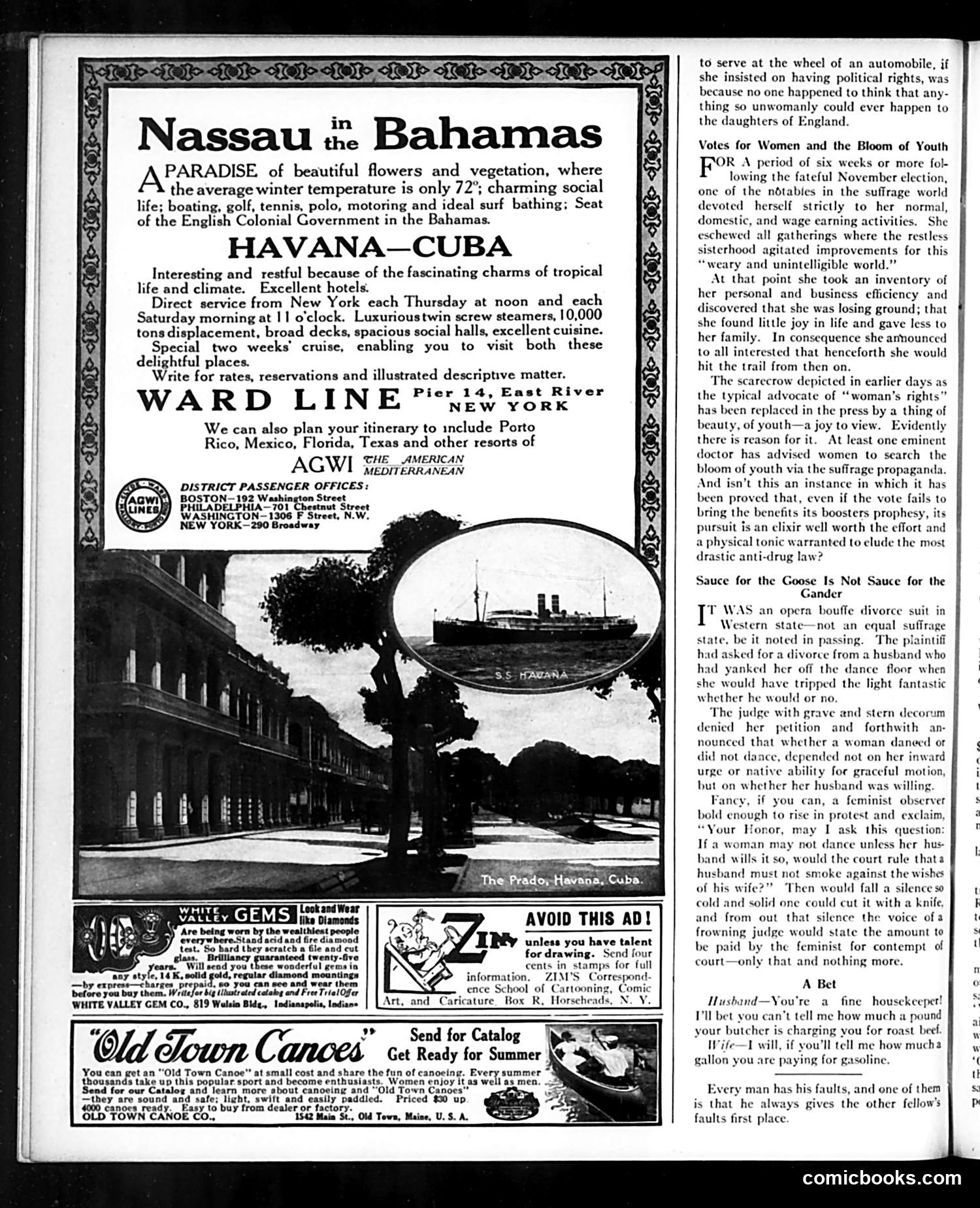
This page is primarily **travel advertising** for luxury cruises to Nassau and Havana, with several opinion pieces in the right column. The notable satirical content addresses **women's suffrage**. The main article "Votes for Women and the Bloom of Youth" mocks suffragists by claiming that a prominent women's rights advocate abandoned activism after discovering she'd "lost ground" personally. It sarcastically suggests that press depictions have replaced the "scarecrow" image of suffragists with prettier, younger women—implying suffragists are only taken seriously when conventionally attractive. "Sauce for the Goose" presents a **divorce court anecdote** highlighting legal double standards: a judge denied a woman's divorce request because her husband controlled whether she could dance. The author argues this same judge would never rule that a husband must obey his wife's wishes about smoking, exposing the hypocrisy of unequal marital law. Both pieces use sarcasm to critique anti-suffrage attitudes and gender inequality in law, though from a somewhat condescending perspective toward feminism itself.
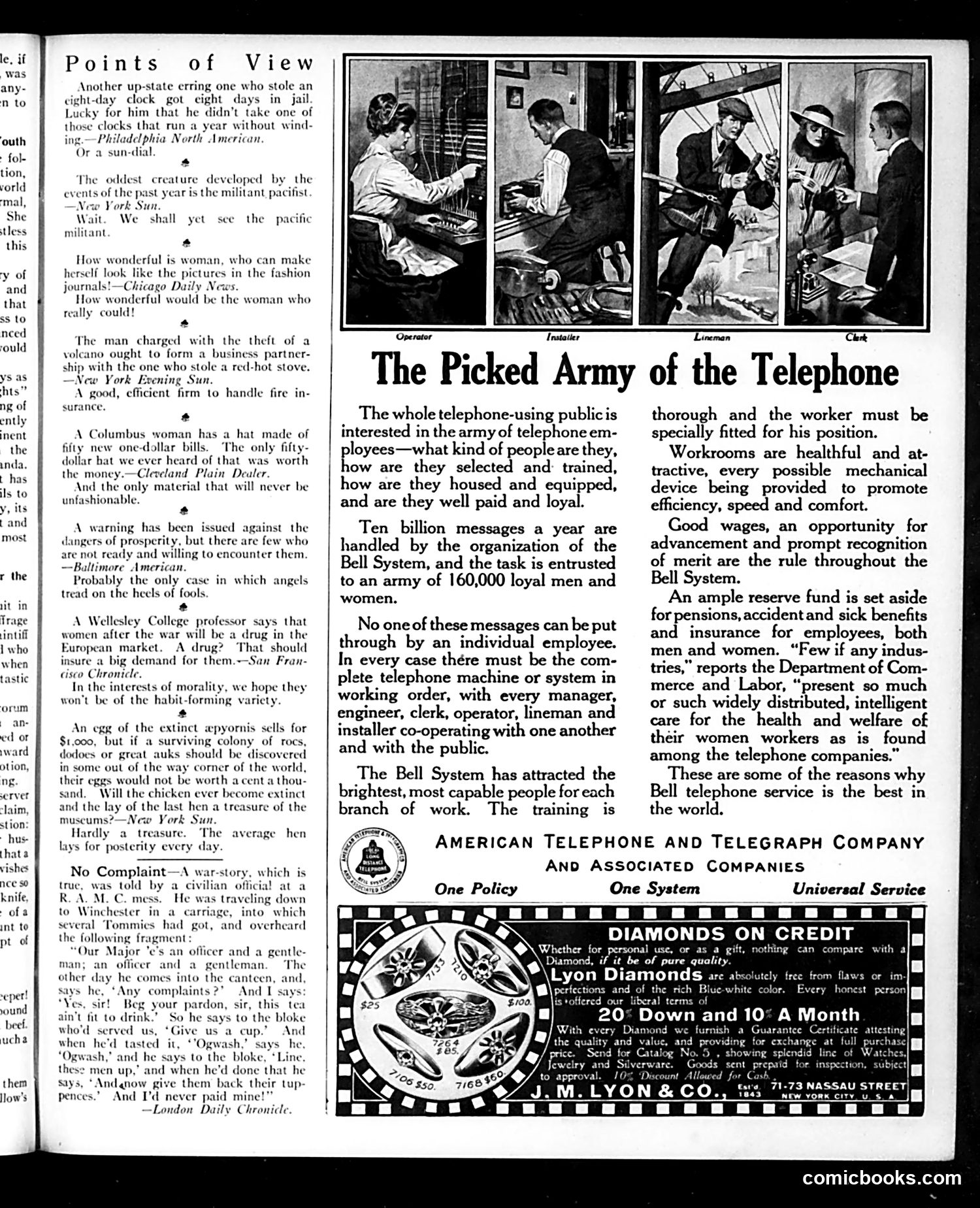
This is primarily **advertising content**, not satire. The page features a Bell System advertisement celebrating telephone workers as an organized "army" of 160,000 employees—operators, linemen, clerks, installers—coordinating to handle ten billion messages yearly. The accompanying photographs show workers at different roles: an operator, installer, lineman, and clerk, emphasizing the system's complexity and teamwork. The article emphasizes Bell's employment practices: workers are "specially fitted for his position," workrooms are "healthful and attractive," and the company offers "good wages, an opportunity for advancement and prompt recognition of merit" plus pensions and insurance benefits. This appears designed to attract quality employees and reassure the public of the system's reliability and worker welfare—framed in the language of military organization, popular during the WWI era when this likely appeared.
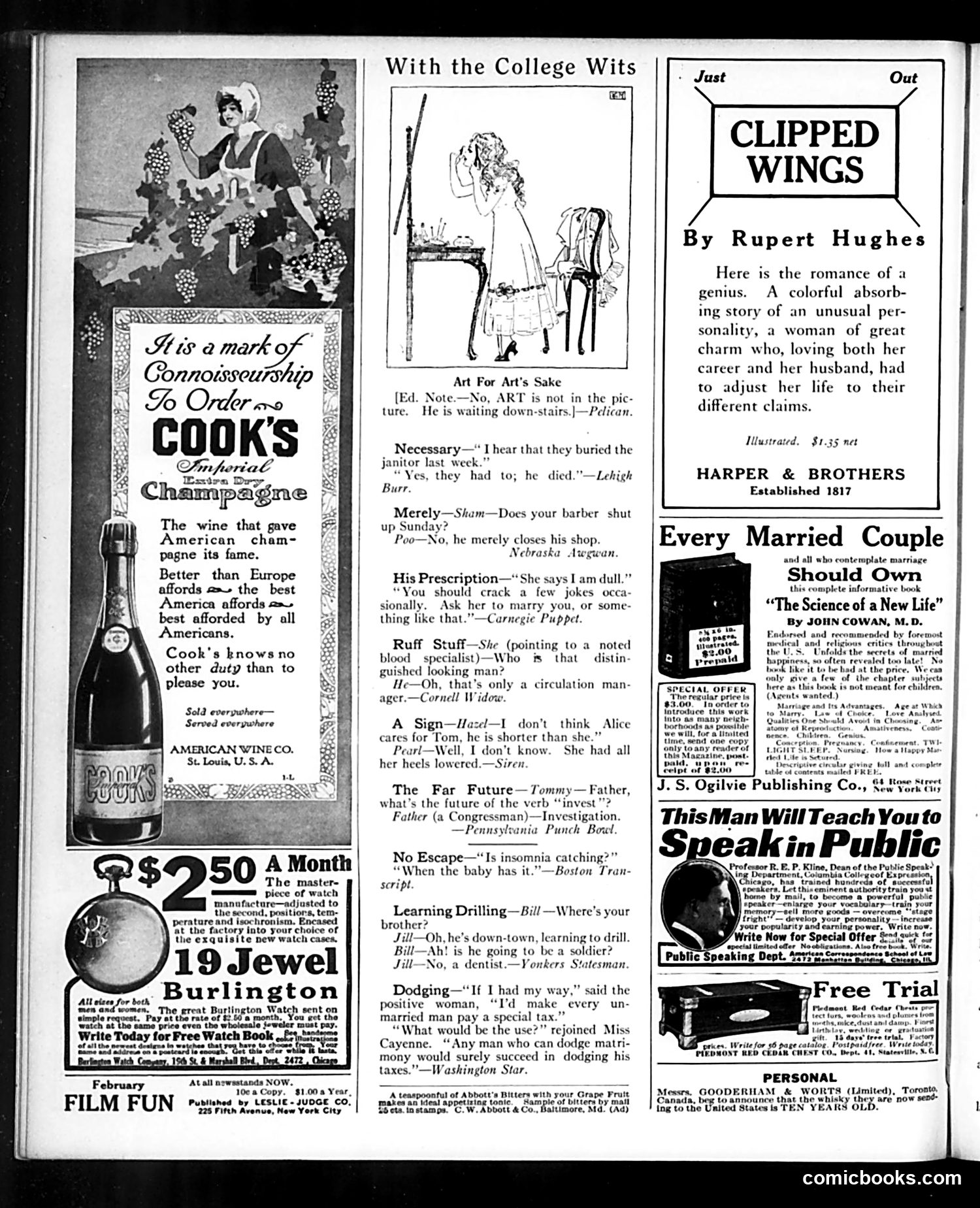
This page is primarily **advertising and book promotions** rather than political satire. The main content includes: **Advertisements:** - Cook's wine (positioned as superior American champagne) - Burlington 19-jewel watches - Film Fun magazine **Book/Product Promotions:** - *Clipped Wings* by Rupert Hughes (a novel about a woman balancing career and marriage) - *The Science of a New Life* by John Cowan, M.D. (a marriage/sex education guide) - Public speaking instruction course - Gooderham & Worts whisky (Canadian, aged 10 years) **"With the College Wits" Section:** A humor column featuring brief jokes from college publications, mostly playing on wordplay and domestic situations (barbers, dentists, insomnia, tax dodging). The page reflects early 20th-century commercial culture and attitudes toward marriage as a topic requiring scientific instruction. The college humor represents typical campus wit of the era—light, pun-based comedy with mild social commentary.
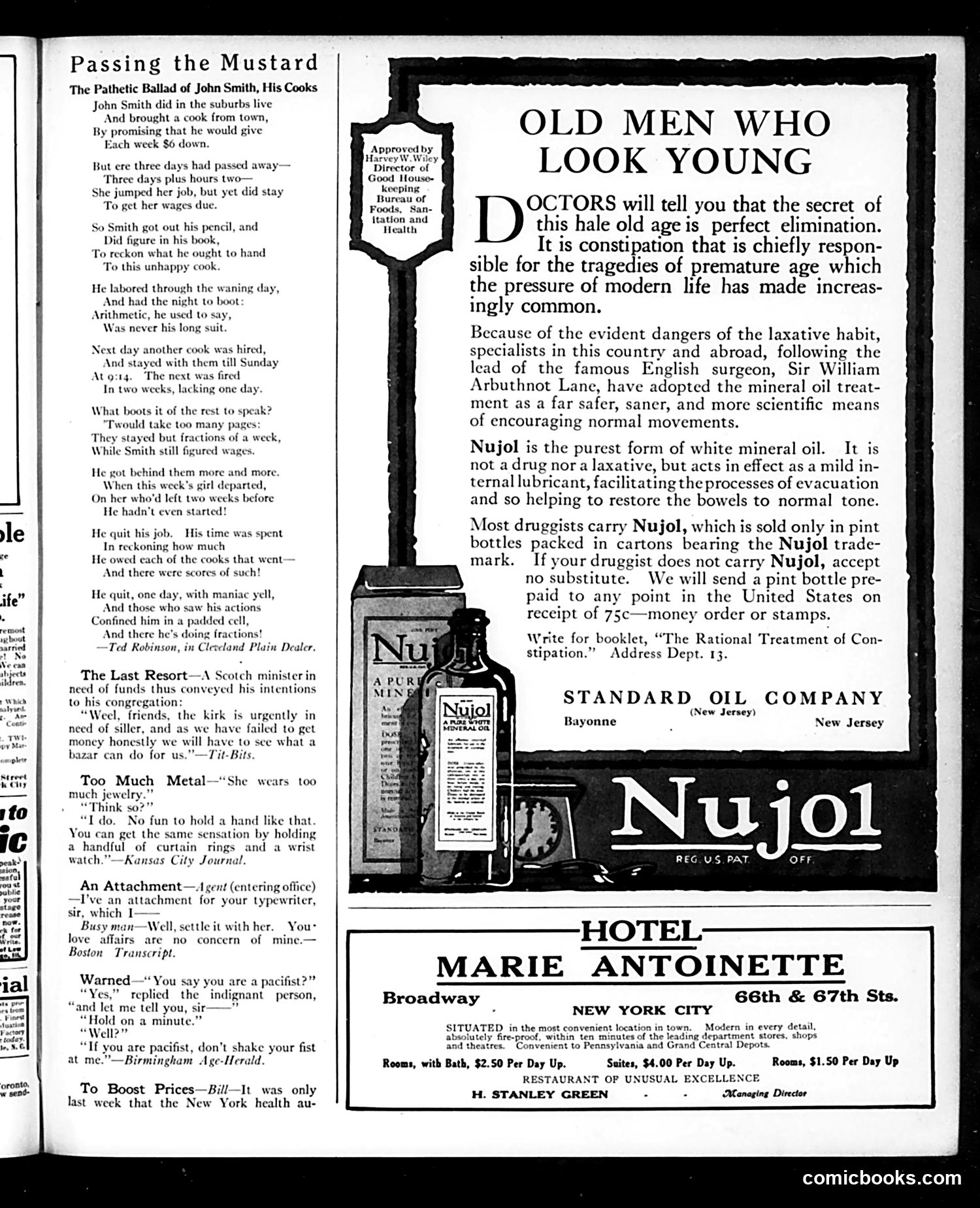
This Judge magazine page contains satirical humor and period advertising typical of the early 20th century. **"Passing the Mustard"** is a humorous poem about John Smith, a suburban homeowner driven to madness by the accounting nightmare of rapidly-cycling domestic servants. The joke satirizes both the era's chronic "servant problem" (high turnover among household staff) and the absurdity of trying to calculate wages owed to multiple departing employees—he becomes so overwhelmed he's institutionalized "doing fractions." It's social commentary on employer frustrations. The page also contains brief joke items on miscellaneous topics (church fundraising, excessive jewelry, office misunderstandings). **The Nujol advertisement** occupies the right half. Notably, it quotes Harvey W. Wiley (a real Progressive-era food safety crusader) to promote mineral oil as a "scientific" constipation treatment—not a laxative, the ad insists. This reflects early 20th-century health anxieties and the marketing of patent medicines before FDA regulation. The **Hotel Marie Antoinette** ad at bottom is straightforward lodging promotion. The page is primarily entertainment and advertising rather than political cartooning.
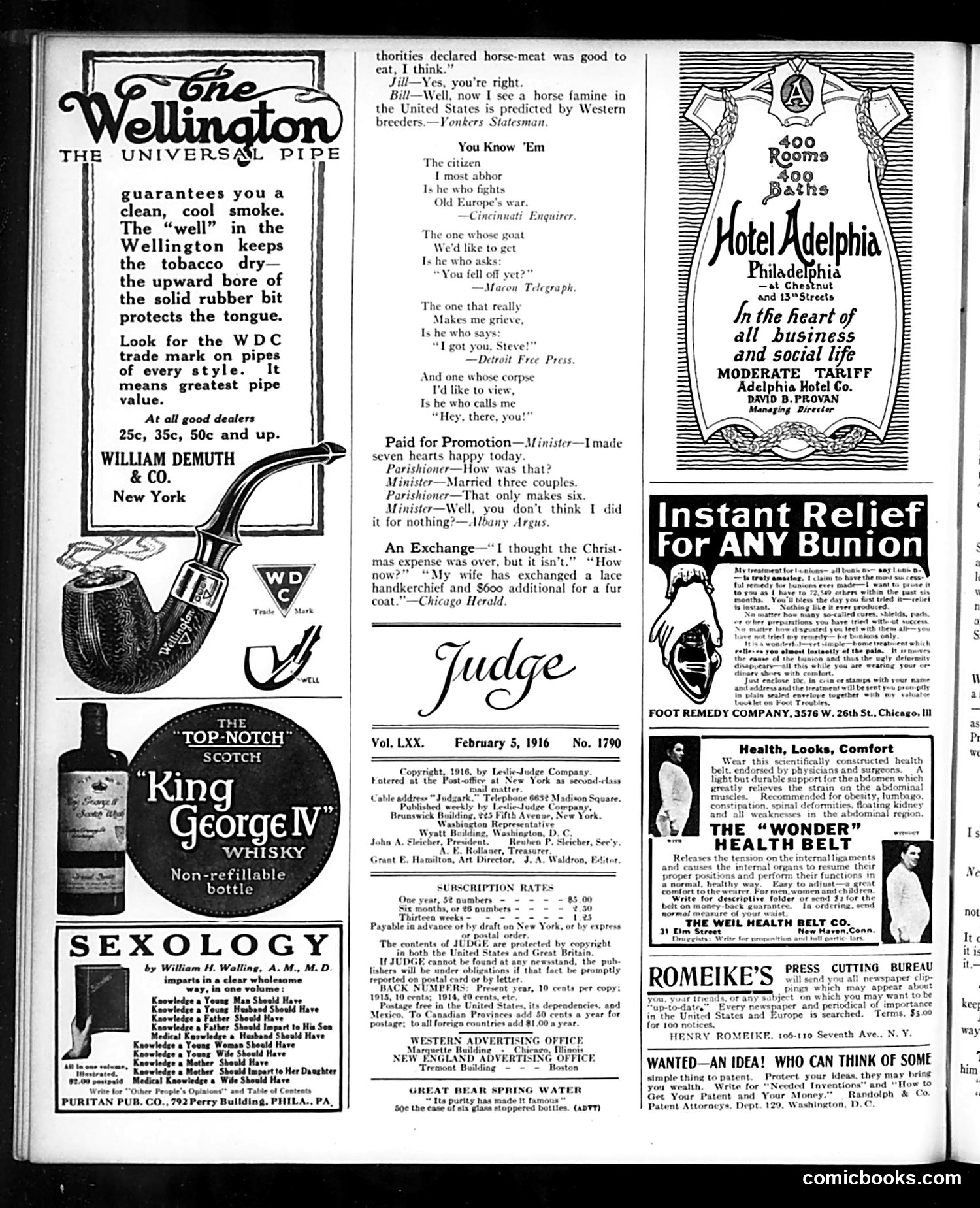
This is primarily an **advertising and masthead page** rather than satirical content. The page features the magazine's publication information and numerous period advertisements. The only editorial content consists of brief **humorous poems and jokes** mocking recognizable social types—the pacifist, the annoying acquaintance, etc. One joke references a topical concern: a minister's claim that marrying three couples made "seven hearts happy" (implying the clergyman profited financially). Another quip mentions a wife exchanging a lace handkerchief plus $600 for a fur coat, satirizing wartime luxury spending and marital negotiation. The advertisements reveal 1916 consumer culture: Wellington pipes, King George IV whisky, health belts claiming to cure abdominal weakness, bunion remedies, and patent solicitations. Notably absent is explicit political content; the pacifism reference in the poems hints at WWI-era American neutrality debates, but remains oblique. This page is representative of Judge's format—mixing light satirical verse with commercial messaging rather than elaborate political cartoons.
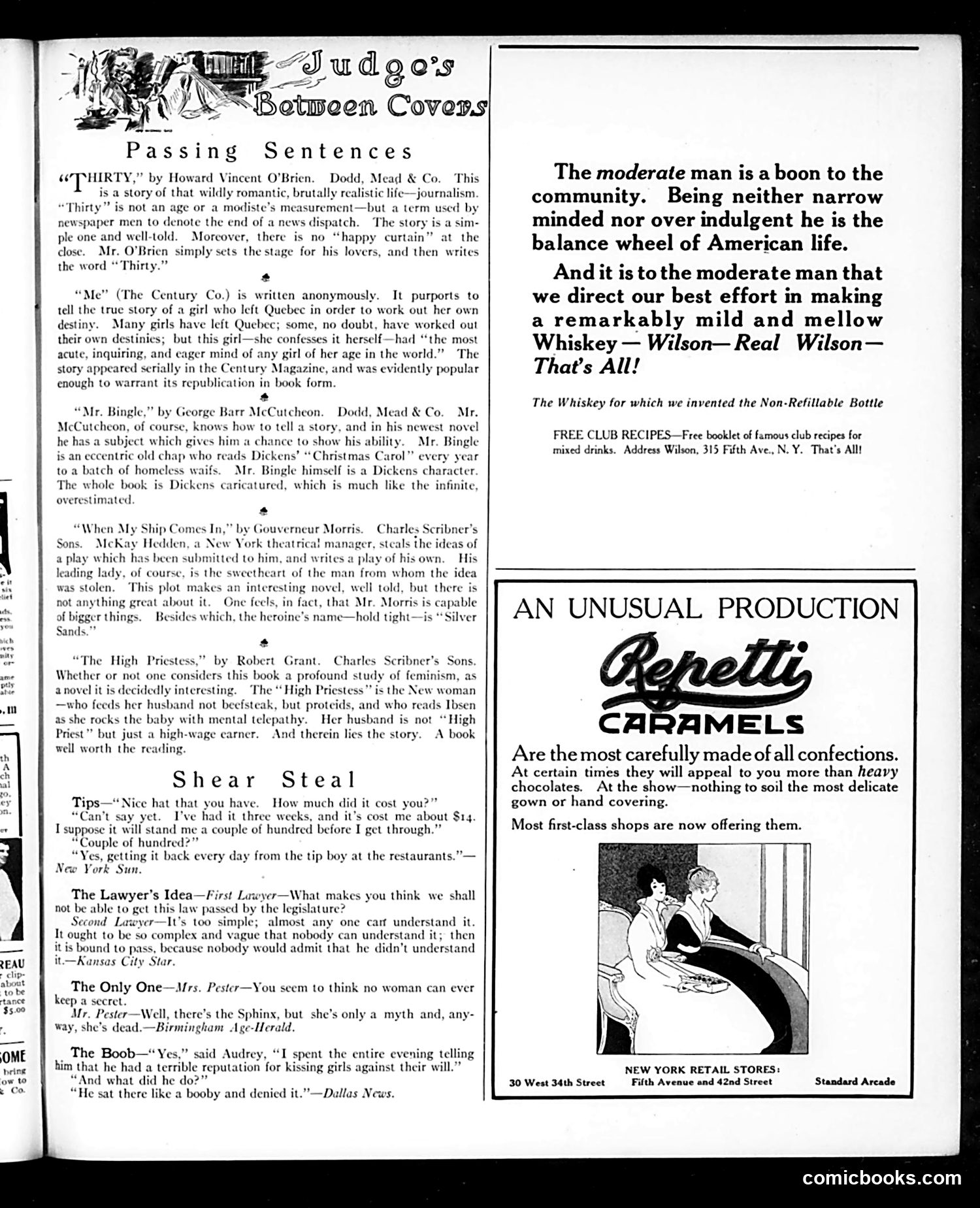
This page contains book reviews ("Passing Sentences") and advertisements. The left column reviews five novels from major publishers, discussing plots and literary merit—including works by Howard Vincent O'Brien and George Barr McCutcheon. The right side features a Wilson whiskey advertisement emphasizing the "moderate man" as ideal for American society—appealing to Prohibition-era concerns about temperance by positioning their product as balanced and reasonable rather than excessive. Below is a Benetti caramels ad with an illustration showing well-dressed figures, marketed as refined confections suitable for upscale venues ("at the show"). The "Shear Steal" humor section offers brief jokes about hat costs and lawyer incompetence, typical of Judge's satirical filler content. **No political cartoons appear on this page.** It's primarily a book review and advertising spread representative of 1920s magazine content—the whiskey ad notably markets moderation during the Prohibition era.
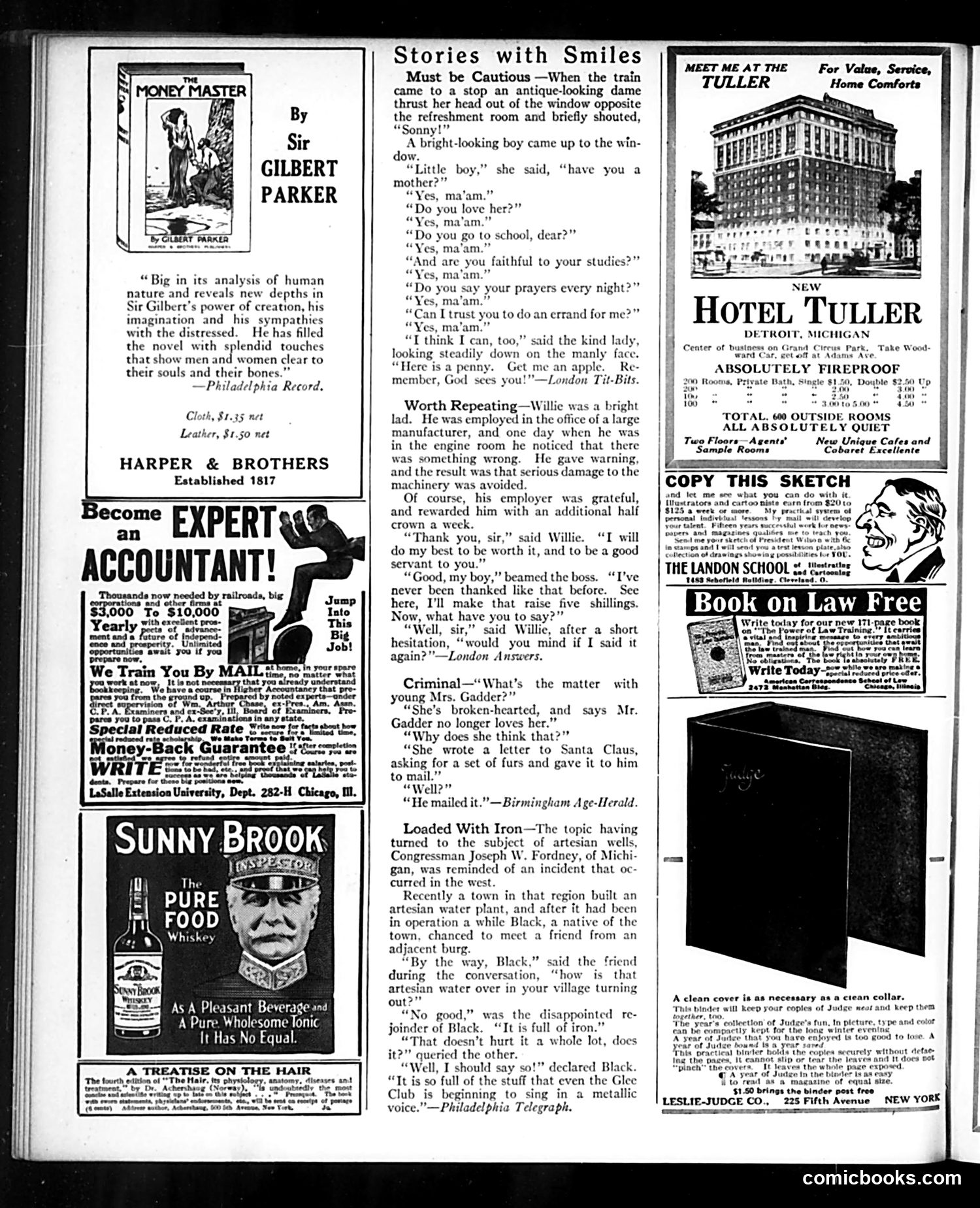
This page is primarily **advertising and humorous content** rather than political satire. The main section titled "Stories with Smiles" contains three separate comic anecdotes illustrating Victorian virtue and good character. They celebrate obedience to parents, diligent work ethic, and honesty—reflecting early 20th-century morality. The humor is gentle and sentimental rather than sharp satire. The remaining content consists of advertisements: Harper & Brothers promoting a novel by Sir Gilbert Parker; accountancy training via mail; Sunny Brook whiskey; and the Hotel Tuller in Detroit. No specific political figures or events are caricatured here. The page reflects Judge's mixed format of light humor, moral lessons, and commercial advertisements typical of early-1900s American magazines. The satire is absent; instead, content emphasizes traditional values appealing to contemporary readers.
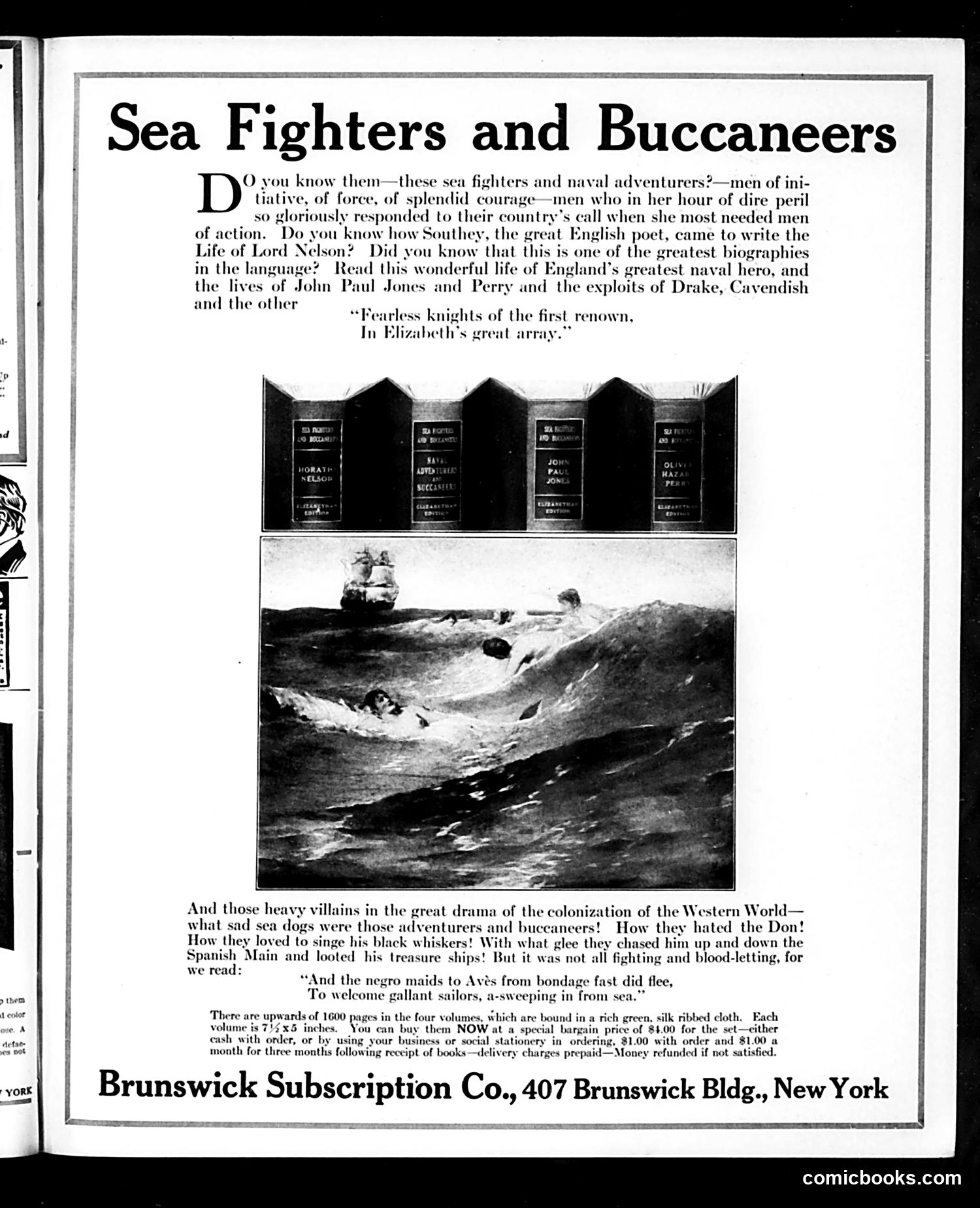
This is primarily **advertising**, not satire or political cartoon. The page promotes a four-volume biographical series about naval heroes and adventurers, published by Brunswick Subscription Co. The content celebrates English and American naval figures—Lord Nelson, John Paul Jones, Perry, Drake, and Cavendish—as courageous patriots. It also romanticizes buccaneers who attacked Spanish colonial ships and "looted his treasure ships," framing them as heroic figures fighting Spanish power during the colonization era. The final quoted couplet references "negro maids" fleeing "bondage" to greet sailors, which appears to romanticize or trivialize slavery within an adventure narrative. **For modern readers**: This reflects early 20th-century attitudes glorifying imperial naval conquest and colonial-era privateering, while the slavery reference demonstrates how such materials casually incorporated racial imagery without critical examination. The advertisement itself contains no satire—it's earnest promotional copy targeting educated, affluent readers interested in historical biography.
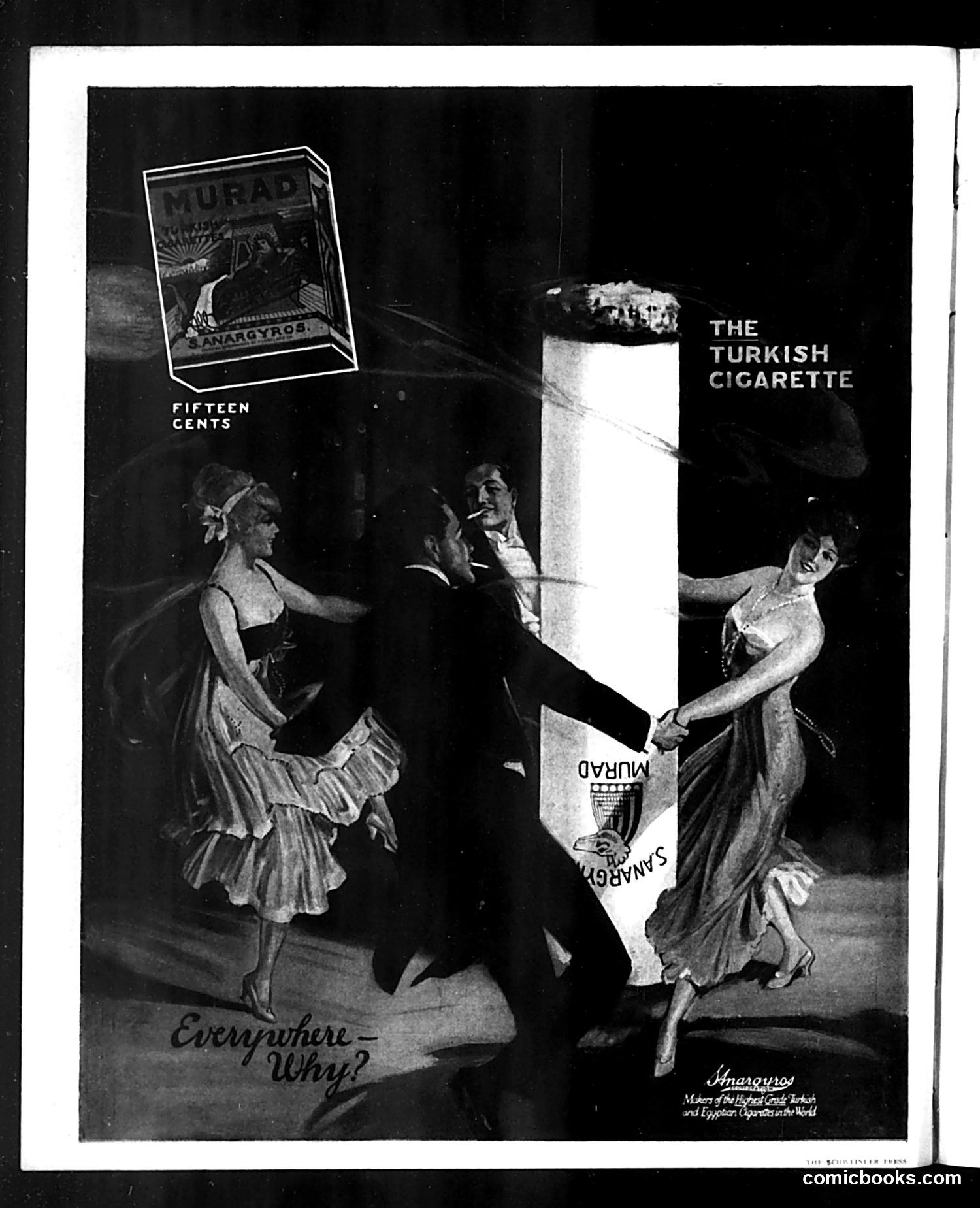
This appears to be a vintage cigarette advertisement for "Murad" Turkish cigarettes, priced at fifteen cents. The ad uses orientalist imagery popular in early 20th-century marketing: two women in belly-dance costume flank a central cigarette package, while a man in Western dress enjoys a cigarette between them. The phrase "Everywhere—Why?" suggests the product's widespread availability and popularity. The exotic staging—with dancing women and references to "Turkish and Egyptian" cigarettes—exploited contemporary fascination with the Orient as glamorous and sensual. This marketing strategy was common for tobacco companies of the era, associating the product with luxury, exoticism, and sophistication. The ad reflects period attitudes toward both advertising and orientalism that would be considered offensive today.