
Judge, 1916-02-05 · page 11 of 28
Judge — February 5, 1916 — page 11: what you’re looking at
What you’re looking at
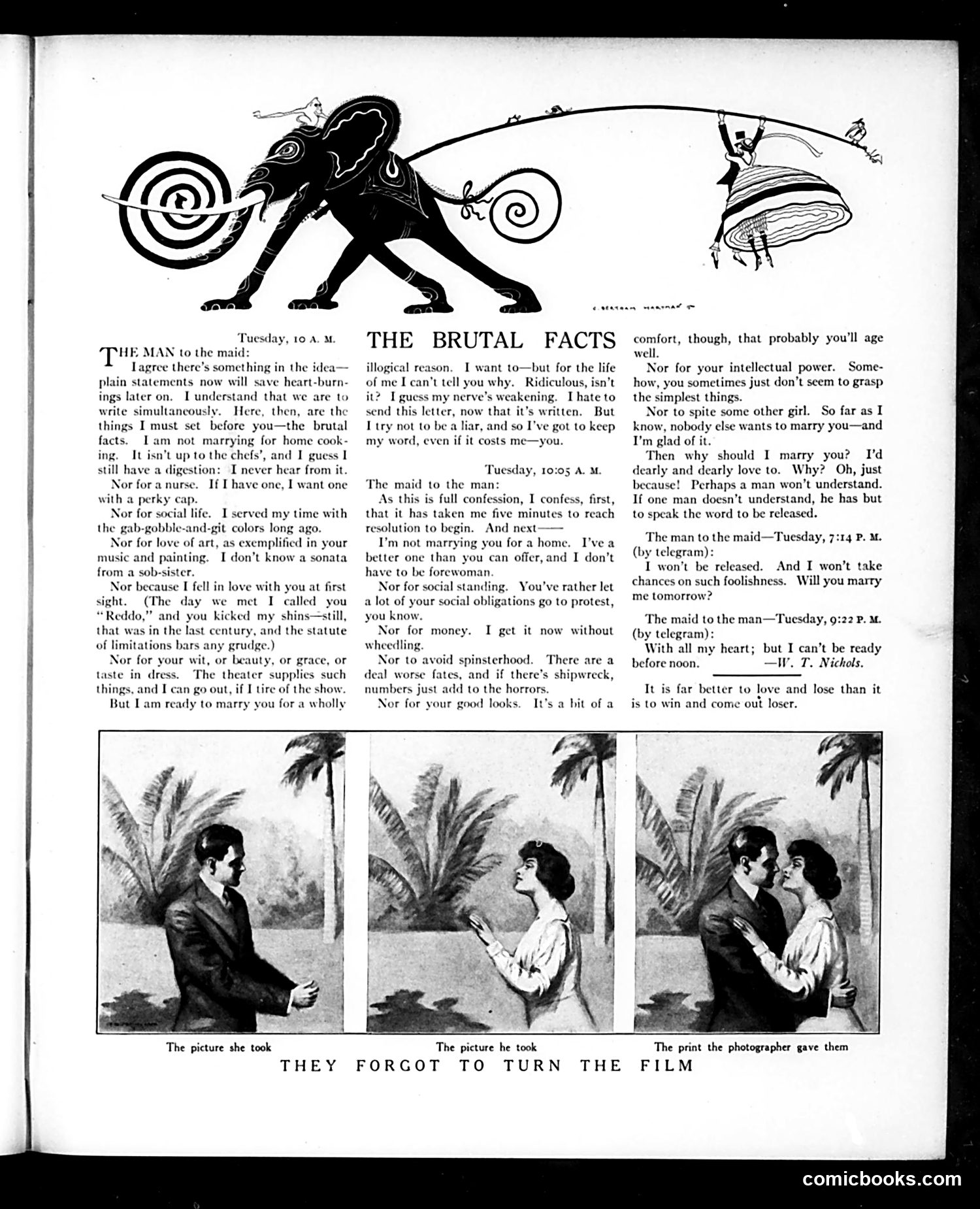
This page satirizes early 20th-century courtship and marriage through contrasting monologues. A man and woman each list reasons they're *not* marrying each other—rejecting practical motivations like cooking, nursing, social status, money, beauty, and intellect. The humor lies in their honesty about marriage's unsexy realities. The couple ultimately agrees to marry "just because" they love each other, communicated via telegram—a modern touch for the era. Their emotional sincerity triumphs over rational calculation. The three photographs below joke about amateur photography: a couple poses romantically by palm trees across three frames, but forgets to advance the film, so all three prints are identical. The caption "They forgot to turn the film" delivers the punchline—their romantic moment is literally frozen, unchanged, and unchangeable, mirroring the fixed nature of their newfound commitment.
📄 Transcribed text from this page (OCR, searchable)
Machine-transcribed from the original scan — historical spelling and the odd misread are preserved.
se ORT j | i Tuesday, 10 A. M. T! MAN to the maid Tagree there’s something in the idea— plain statements now will save heart-burn- ings later on. LT understand that we write simultancously. Here, then, are the things I must set before you—the brutal facts. Lam not marrying for home cook- ing. It isn’t up to the chefs’, and I guess I still have a digestion: I never hear from it. Nor for a nurse. If I have one, I want one with a perky cap. Nor for social life eo I served my time with the gab-gobble-and colors long ago. Nor for love of art, as exemplified in your music and painting. I don’t know a sonata from a sob-sister. Nor because I fell in love with you at first sight. (The day we met I called you “Reddo,” and you kicked my shins—still, that was in the last century, and the statute of limitations bars any grudge.) Nor for your wit, or beauty, or grace, or taste in dress. The theater supplies such things, and I can go out, if I tire of the show. But I am ready to marry you for a wholly THE BRUTAL FACTS reason, I want to—but for the life Ridiculous, isn’t illogi of me I can’t tell you why. it? I guess my nerve’s we: Thate to send this letter, now that it’s written, But T try not to be and so I've got to keep my word, even if it costs me—you. Tuesday, 10:05 A. M The maid to the man: As this is full confession, I confess, first, that it has taken me five minutes to reach resolution to begin. And next— I’m not marrying you for a home. I’ve a better one than you can offer, and I don’t have to be forewoman Nor for social standing. You've rather let a lot of your social obligations go to protest, you know. Nor for money. wheedling. Nor to avoid spinsterhood. There are a deal worse fates, and if there’s shipwreck, numbers just add to the horrors. Nor for your good looks. It’s a bit of a IT get it now without aan aan es comfort, though, that probably you'll age well. Nor for your intellectual power. Some- how, you sometimes just don’t seem to grasp the simplest things. Nor to spite some other girl. So far as I know, nobody else wants to marry you—and I'm glad of it. Then why should I marry you? I'd dearly and dearly love to. Why? Oh, just because! Perhaps a man won't understand. If one man doesn’t understand, he has but to speak the word to be released. The man to the maid—Tuesday, 7:14 P. M. (by telegram): I won't be released. And I won't take chances on such foolishness. Will you marry me tomorrow? The maid to the man—Tuesday, 9:22 P. M. (by telegram): With all my heart; but I can’t be ready before noon. —W. T. Nichols. It is far better to love and lose than it is to win and come out loser. The picture she took The picture he took FORGOT TO TURN THE FILM The print the photographer gave them comicbooks.com