
Judge, 1916-02-05 · page 10 of 28
Judge — February 5, 1916 — page 10: what you’re looking at
What you’re looking at
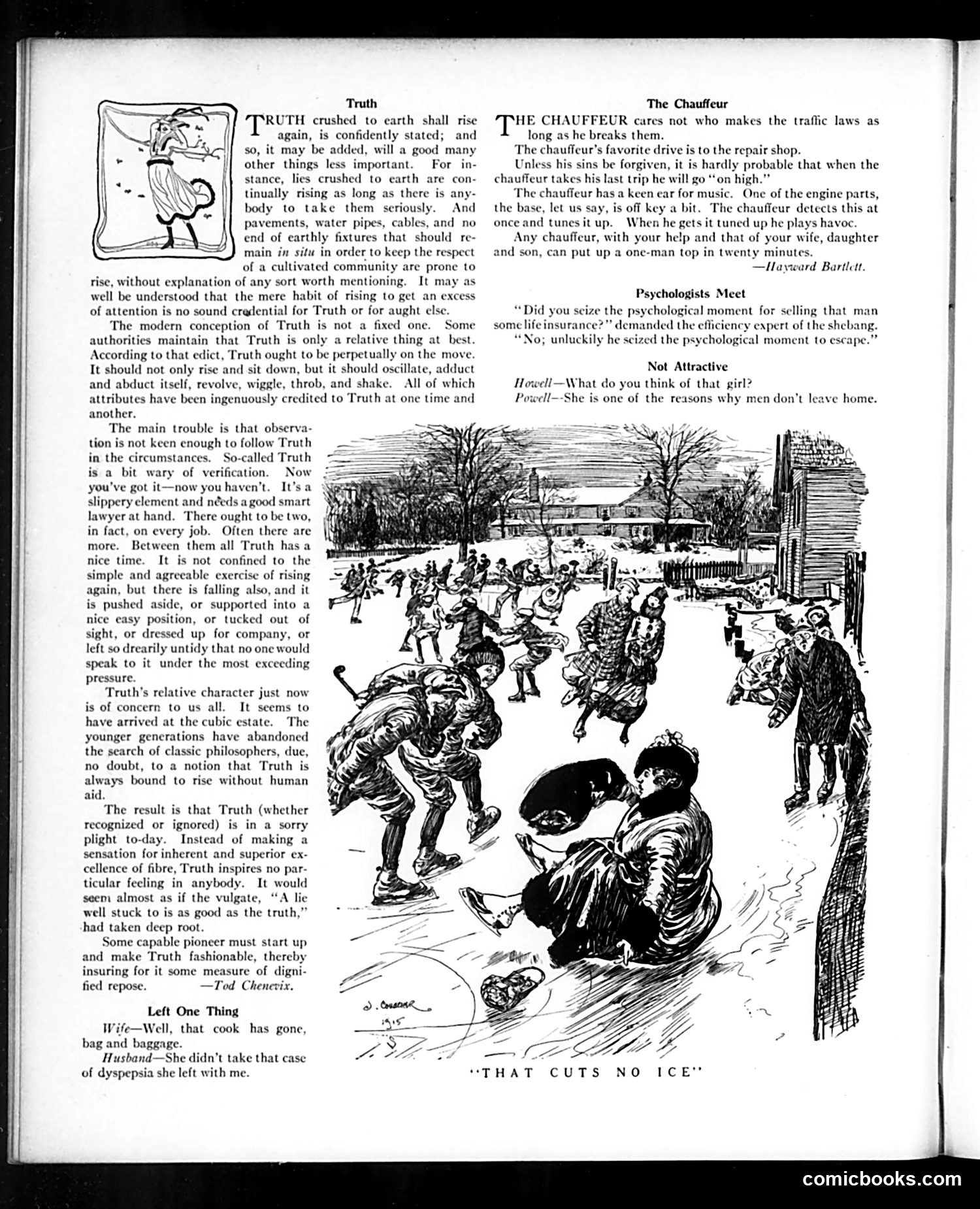
This page contains three brief satirical pieces typical of Judge's humor: **"Truth"** is a philosophical essay mocking the era's relativistic attitudes toward truth. It satirizes how truth is manipulated, suppressed, and repackaged—suggesting modern society treats truth as negotiable rather than absolute. The piece cynically notes that truth requires lawyers to defend it and that younger generations have abandoned the classical pursuit of objective truth. **"The Chauffeur"** offers humor about early automobile culture, mocking chauffeurs' reckless driving, frequent mechanical failures, and their indifference to traffic laws. This reflects the era's anxiety about dangerous, unregulated automobile use. **"Psychologists Meet"** and **"Not Attractive"** are brief joke exchanges—the first about a failed insurance sale, the second a crude joke implying a woman's unattractiveness keeps her husband home. The central illustration labeled **"That Cuts No Ice"** depicts children ice-skating, likely accompanying winter-themed humor, though the specific connection to surrounding text is unclear.
📄 Transcribed text from this page (OCR, searchable)
Machine-transcribed from the original scan — historical spelling and the odd misread are preserved.
Truth 4p crushed to earth shall rise again, is confidently stated; and so, it may be added, will a good many other things less important. For in- stance, lies crushed to earth are con- tinually rising as long as there is any- body to take them seriously. And pavements, water pipes, cables, and no end of earthly fixtures that should re- main in situ in order to keep the respect of a cultivated community are prone to rise, without explanation of any sort worth mentioning. It may as well be understood that the mere habit of rising to get an excess } of attention is no sound credential for Truth or for aught else. | The modern conception of Truth is not a fixed one. Some authorities maintain that Truth is only a relative thing at best. i) According to that edict, Truth ought to be perpetually on the move. Tl It should not only rise and sit down, but it should oscillate, adduct and abduct itself, revolve, wiggle, throb, and shake. All of which attributes have been ingenuously credited to Truth at one time and another. The main trouble is that observa- tion is not keen enough to follow Truth in the circumstances. So-called Truth is a bit wary of verification. Now | you've got it—now you haven't. It’s a | slippery element and néeds a good smart | lawyer at hand. There ought to be two, in fact, on every job. Often there are more. Between them all Truth has a nice time. It is not confined to the simple and agreeable exercise of rising again, but there is falling also, and it pushed aside, or supported into a nice easy position, or tucked out of sight, or dressed up for company, or left so drearily untidy that no one would speak to it under the most exceeding pressure. Truth’s relative character just now is of concern to us all. It seems to ) have arrived at the cubic estate. The younger generations have abandoned i the search of classic philosophers, due, i no doubt, to a notion that Truth is always bound to rise without human | aid. | | The result is that Truth (whether | recognized or ignored) is in a sorry plight to-day. Instead of i sensation for inherent and superior ex- cellence of fibre, Truth inspires no par- ticular feeling in anybody. It would | seem almost as if the vulgate, “A lie | well stuck to is as good as the truth,” | had taken deep root. Some capable pioneer must start up and make Truth fashionable, thereby sure of digni- ‘od Chenevix, insuring for it some m a | fied repose. —T | Left One Thing | Wife—Well, that cook has gone, bag and baggage. Husband—She didn’t take that case of dyspepsia she left with me. The Chauffeur HE CHAUFFEUR cares not who makes the traffic laws as long as he breaks them. The chauffeur’s favorite drive is to the repair shop. Unless his sins be forgiven, it is hardly probable that when the uffeur takes his last trip he will go “‘on high.” The chauffeur has a keen ear for music. One of the engine parts, the base, let us say, is off key a bit. The chauffeur detects this at once and tunes it up. When he gets it tuned up he plays havoc. Any chauffeur, with your help and that of your wife, daughter and son, can put up a one-man top in twenty minutes. Hayward Bartlett. cha Psychologists Meet “Did you seize the psychological moment for selling that man some lifeinsurance?” demanded the efficiency expert of the shebang. “No; unluckily he seized the psychological moment to escape.” Not Attractive Howell—What do you think of that girl? Powell—-She is one of the reasons why men don’t leave home. “THAT CUTS NO ICE" comicbooks.com