
Judge, 1916-02-05 · page 17 of 28
Judge — February 5, 1916 — page 17: what you’re looking at
What you’re looking at
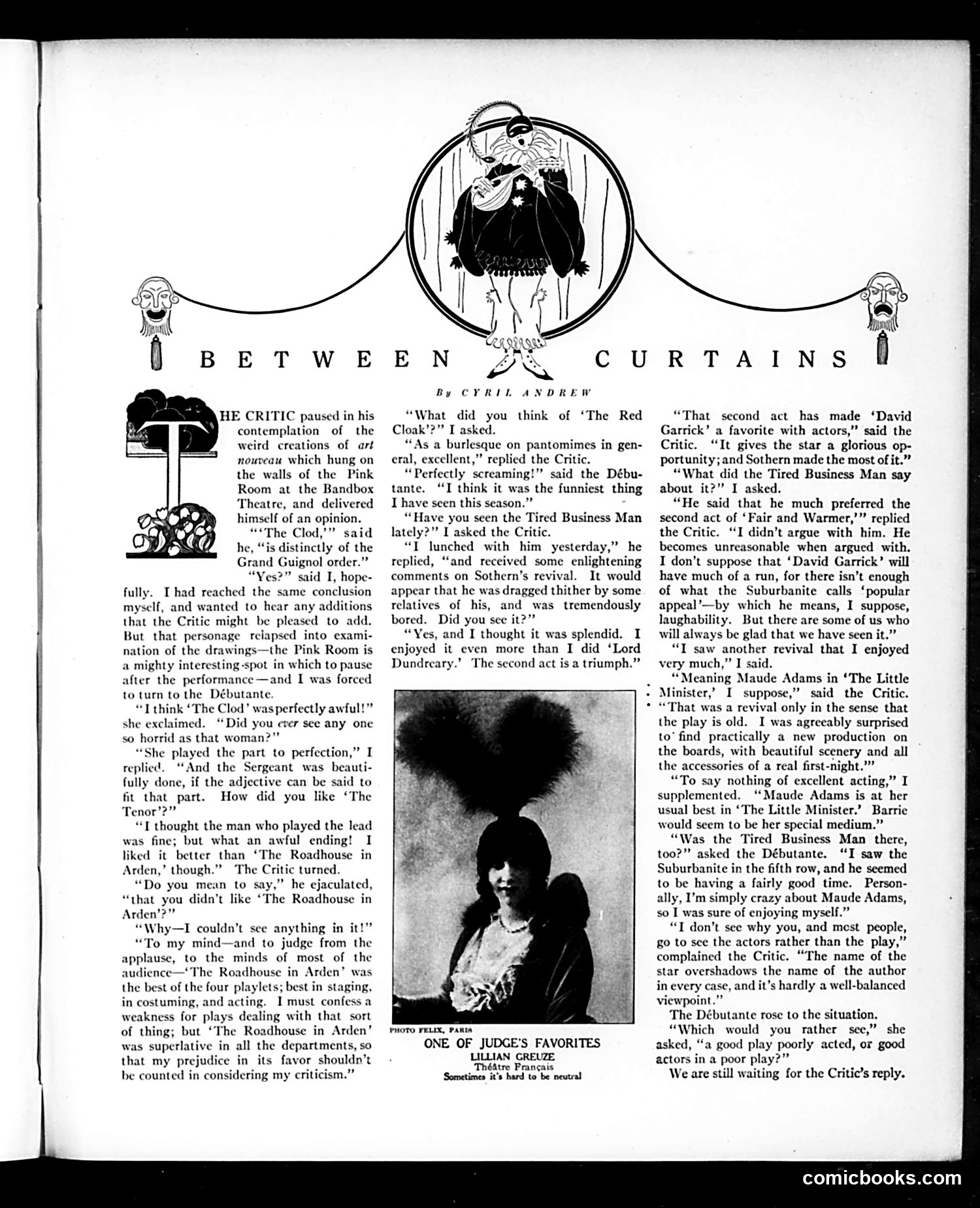
This article presents a dialogue between a sophisticated theater Critic, an enthusiastic young Débutante, and a narrator discussing recent theatrical productions at the Bandbox Theatre's "Pink Room" (an art nouveau lounge). The satire targets the gap between critical and popular taste. The Critic dismisses plays the Débutante loves ("The Clod," praised as "perfectly awful") and champions obscure productions like "The Roadhouse in Arden," while a recurring figure—the "Tired Business Man"—represents the general audience, dragged to theater by relatives and preferring broad comedies. The piece gently mocks both the Critic's pretentiousness and the Débutante's uncritical enthusiasm, positioning them as opposites on the spectrum of theatrical judgment. The accompanying photograph of actress Lillian Greuze suggests this was a genuine theater review column mixing gossip with critique—typical Judge magazine fare mixing humor with arts commentary.
📄 Transcribed text from this page (OCR, searchable)
Machine-transcribed from the original scan — historical spelling and the odd misread are preserved.
HE CRITIC paused in his contemplation of the weird creations of art nouveau which hung on the walls of the Pink Room at the Bandbox Theatre, and delivered himself of an opinion. “*The Clod,’” said he, “‘is distinctly of the Grand Guignol order.” “Yes?” said I, hope- fully. Thad reached the same conclusion myself, and wanted to hear any additions that the Critic might be pleased to add. But that personage relapsed into exami- nation of the drawings—the Pink Room is a mighty interesting spot in which to pause after the performance—and I was forced to turn to the Débutante. “think ‘The Clod’ was perfectly awful!” she exclaimed. “Did you ever see any one so horrid as that woman?” “She played the part to perfection,” I replied. “And the Sergeant was beauti- fully done, if the adjective can be said to fit that part. How did you like ‘The Tenor’?” “‘T thought the man who played the lead was fine; but what an awful ending! I liked it better than ‘The Roadhouse in Arden,’ though.” The Critic turned. “Do you mean to say,” he ejaculated, “that you didn’t like ‘The Roadhouse in Arden’?” “Why—I couldn’t sce anything in it!” “To my mind—and to judge from the applause, to the minds of most of the audience—The Roadhouse in Arden’ was the best of the four pla ; best in staging, in costuming, and acting. I must confess a weakness for plays dealing with that sort of thing; but ‘The Roadhouse in Arden’ was superlative in all the departments, so that my prejudice in its favor shouldn’t be counted in considering my criticism.” EN By CYRIL ANDREW “What did you think of ‘The Red Cloak’?” I asked. “As a burlesque on pantomimes in gen- eral, excellent,” replied the Critic. “Perfectly screaming!” said the Débu- tante. “I think it was the funniest thing I have seen this season.” “Have you seen the Tired Business Man lately?” I asked the Critic. “T lunched with him yesterday,” he replied, ‘‘and received some enlightening comments on Sothern’s revival. It would appear that he was dragged thither by some relatives of his, and was tremendously bored. Did you see it?” “Yes, and I thought it was splendid. I enjoyed it even more than I did ‘Lord Dundreary.’ The second act is a triumph.” PHOTO FELIX, PARIS ONE OF JUDGE'S FAVORITES LILLIAN GREUZE Théatre Prancais ‘Sometimes it's hard to be neutral CURTAINS “That second act has made ‘David Garrick’ a favorite with actors,” said the Critic. “It gives the star a glorious op- portunity; and Sothern made the most of it.” “What did the Tired Business Man say about it?” I asked. “He said that he much preferred the second act of ‘Fair and Warmer,’” replied the Critic. “I didn’t argue with him. He becomes unreasonable when argued with. I don’t suppose that ‘David Garrick? will have much of a run, for there isn’t enough of what the Suburbanite calls ‘popular appeal’—by which he means, I suppose, laughability. But there are some of us who will always be glad that we have seen it.” “I saw another revival that I enjoyed very much,” I said. “Meaning Maude Adams in ‘The Little Minister,’ I suppose,” said the Critic. “That was a revival only in the sense that the play is old. I was agreeably surprised to’ find practically a new production on the boards, with beautiful scenery and all the accessories of a real first-night.’” “To say nothing of excellent acting,” I supplemented. ‘‘Maude Adams is at her usual best in ‘The Little Minister.’ Barrie would seem to be her special medium.” “Was the Tired Business Man there, too?” asked the Débutante. “I saw the Suburbanite in the fifth row, and he seemed to be having a fairly good time. Person- ally, I’m simply crazy about Maude Adams, so I was sure of enjoying myself.” “T don’t see why you, and mest people, go to see the actors rather than the play,” complained the Critic. “The name of the star overshadows the name of the author in every case, and it’s hardly a well-balanced viewpoint.” The Débutante rose to the situation. “Which would you rather see,” she asked, “a good play poorly acted, or good actors in a poor play?” We are still waiting for the Critic’s reply. comicbooks.com