
Judge, 1916-02-05 · page 14 of 28
Judge — February 5, 1916 — page 14: what you’re looking at
What you’re looking at
The page contains two distinct pieces of satire: **"As Others Saw Me"** (left): A supernatural fiction story where a deceased man returns as a ghost to see how he's remembered. The satire targets human selfishness—his employer was planning to fire him, his poker friends complained about him, and his wife is already being courted by a man she previously disliked (Jimson). The ghost discovers people are relieved he's gone, prompting his quick return to the afterlife. This mocks the gap between how we imagine our importance and our actual social irrelevance. **"Good Cheer for Man"** (right): A poem celebrating masculine optimism in the face of modern anxieties—storms, poverty, war, politics, cyclones, reckless drivers, and taxes. The refrain "Man's handsomer every day" sarcastically suggests that science and self-confidence allow dismissing serious social problems. This appears to mock both masculine bravado and the era's facile optimism about progress. Both pieces critique early-20th-century attitudes with dark humor.
📄 Transcribed text from this page (OCR, searchable)
Machine-transcribed from the original scan — historical spelling and the odd misread are preserved.
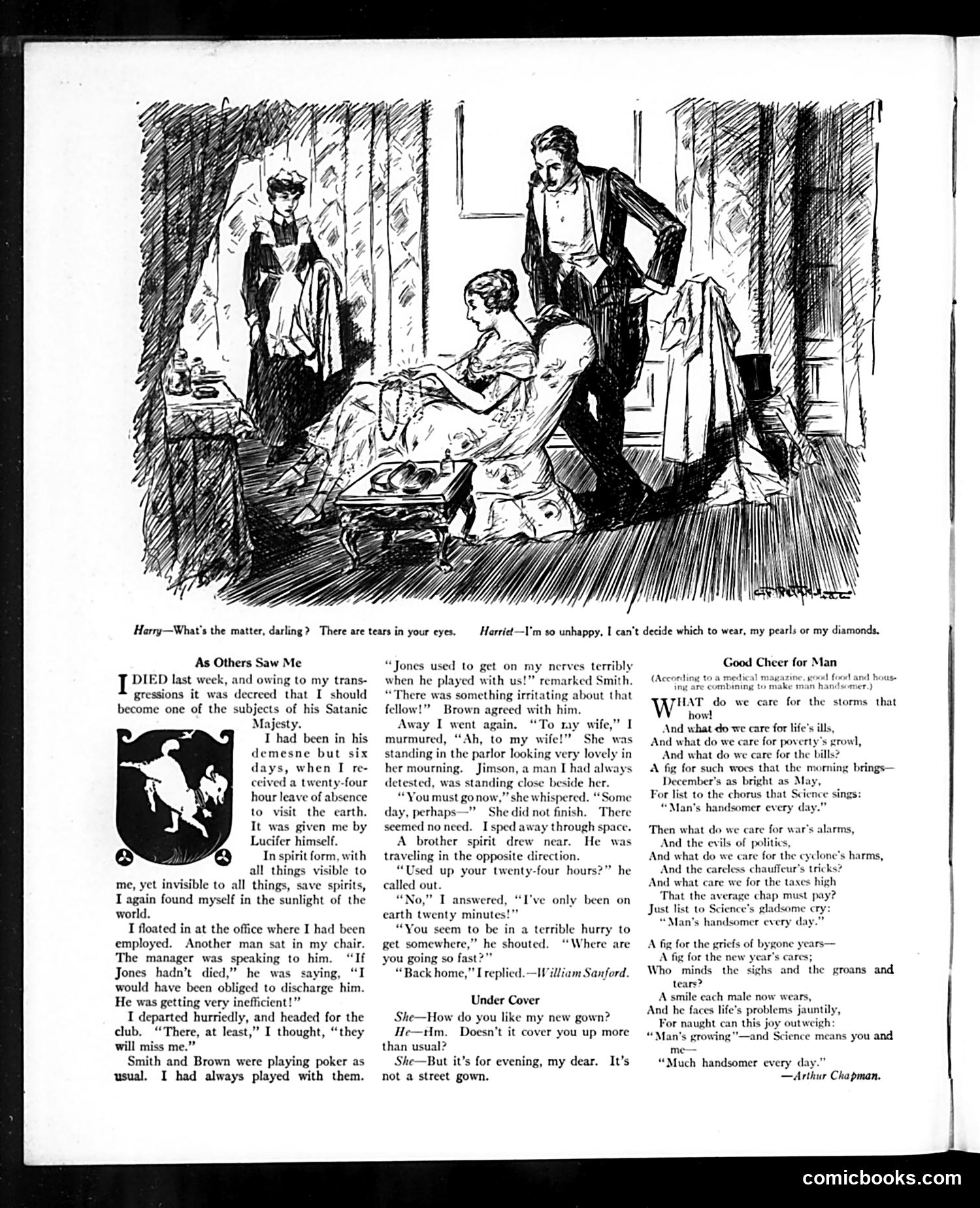
SS WSS aa Ny \ Harry—What's the matter, darling? There are tears in your eyes. As Others Saw Me and owing to my trans- s decreed that I should become one of the subjects of his Satanic Majesty. I had been in his demesne but six days, when I re- ceived a twenty-four hour leave of absence to visit the carth, It was given me by Lucifer himself. In spirit form, with all things visible to me, yet invisible to all things, save spirits, I again found myself in the sunlight of the world. T floated in at the office where I had been employed. Another man sat in my chair. The manager was speaking to him. “If Jones hadn’t died,” he was saying, “I would have been obliged to discharge him. He was getting very inefficient!” I departed hurriedly, and headed for the club. “There, at least,” I thought, “they will miss me.” Smith and Brown were playing poker as usual. I had always played with them. “Jones used to get on ni when he played with us! “There was something irri ing about that fellow!” Brown agreed with him. Away I went again. “To my wife,” I murmured, “Ah, to my wife!” She standing in the parlor looking very lov her mourning. Jimson, a man I had always detested, was standing close b “You must gonow,”” day, perhaps—” She did not finish. There seemed no need. I sped away through space. brother spirit drew near. He traveling in the opposite direction. “Used up your twenty-four hours?” he called out. “No,” I answered, earth twenty minutes “You seem to be in a terrible hurry to get somewhere,” he shouted. “Where are you going so fast?” “Back home,” I replied.—IWilliam Sanford. y nerves terribly arked Smith. “I've only been on Under Cover She—How do you like my new gown? He—tim. Doesn't it cover you up more than usual? She—But it’s for evening, my dear. It’s not a street gown. Harriet—I'm so unhappy, | can’t decide which to wear, my pearls or my diamonds, WIT do we care for the storms that how! And what do we care for life's i And what do we care for povert And what do we care for the bills A fig for such woes that the morning brings— December's as bright as Ma For list to the chorus that Sci Man's handsomer every day ‘Then what do we care for war's alarms, And the evils of politics. And what do we care for the cyclone’ And the careless chauffeur’s tri And what care we for the taxes high That the average chap must pay? Just nce’s gladsome cry: “Man's handsomer every day harms, A fig for the griefs of bygon A fig for the new y Who minds the sighs and the groans and tears? A smile And he fac For naught “Man’s growing”—and Science means you and pera “Much handsomer every day.” —Arthur Chapman. le now wears, comicbooks.com