
Judge, 1916-02-05 · page 25 of 28
Judge — February 5, 1916 — page 25: what you’re looking at
What you’re looking at
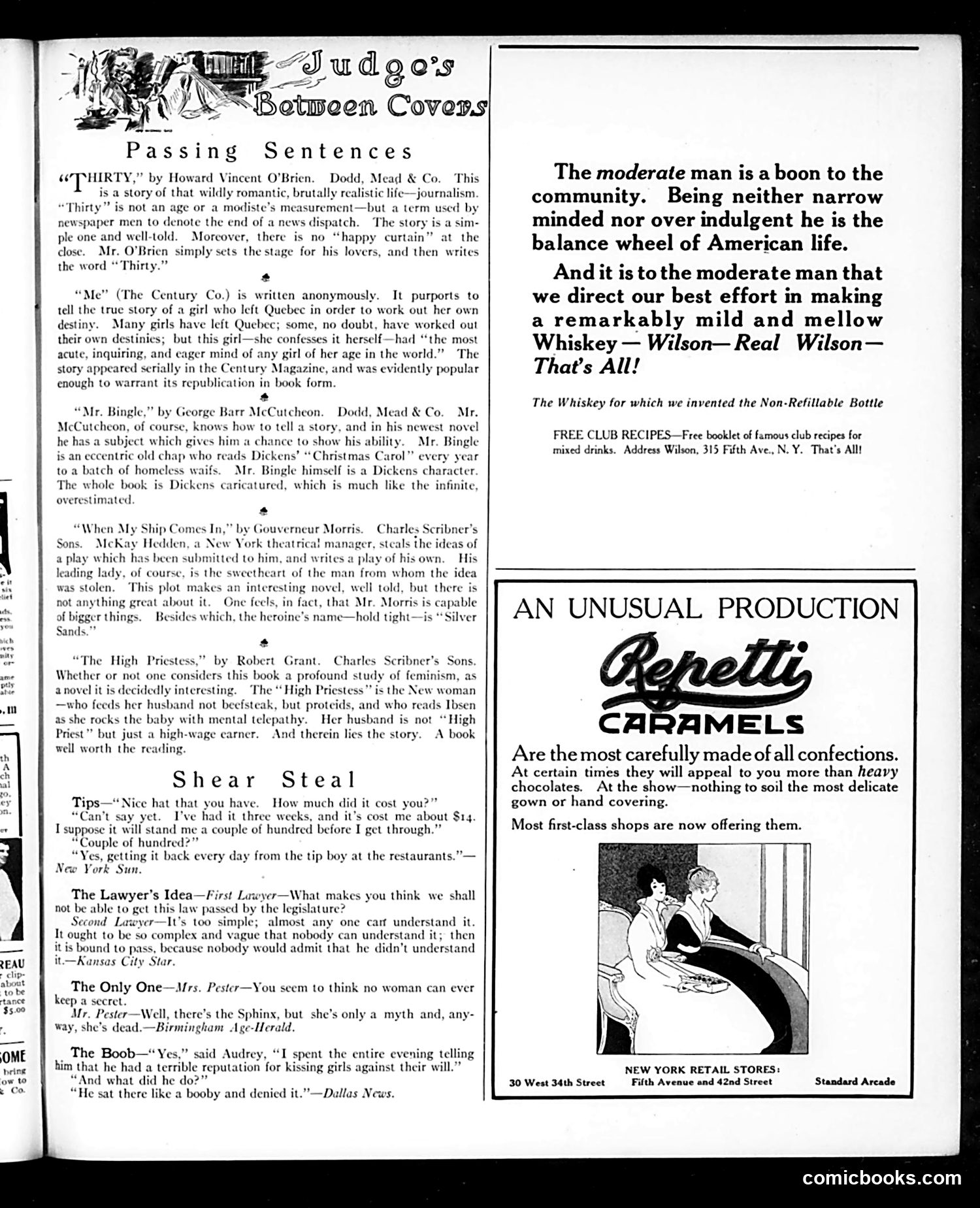
This page contains book reviews ("Passing Sentences") and advertisements. The left column reviews five novels from major publishers, discussing plots and literary merit—including works by Howard Vincent O'Brien and George Barr McCutcheon. The right side features a Wilson whiskey advertisement emphasizing the "moderate man" as ideal for American society—appealing to Prohibition-era concerns about temperance by positioning their product as balanced and reasonable rather than excessive. Below is a Benetti caramels ad with an illustration showing well-dressed figures, marketed as refined confections suitable for upscale venues ("at the show"). The "Shear Steal" humor section offers brief jokes about hat costs and lawyer incompetence, typical of Judge's satirical filler content. **No political cartoons appear on this page.** It's primarily a book review and advertising spread representative of 1920s magazine content—the whiskey ad notably markets moderation during the Prohibition era.
📄 Transcribed text from this page (OCR, searchable)
Machine-transcribed from the original scan — historical spelling and the odd misread are preserved.
“Sudgo's Zs <Beotpeen Covers Passing Sentences «TP HIRTY,” by Howard Vincent O’Brien. Dodd, Mead & Co. This The moderate man is a boon to the a story of that wildly romantic, brutally realistic life—journalism community. Being neither narrow “Thirty” is not an age or a modiste’s measurement—but a term used by newspaper men to denote the end of a news dispatch. The story is a sim- minded nor over indulgent he is the ple one and well-told. Moreover, there is no “happy curtain” at the balance wheel of American life. cose. Mr. O'Brien simply sets the stage for his lovers, and then writes he srord Stat ‘ And it is to the moderate man that “Me” (The Century Co.) is written anonymously. It purports to we direct our best effort in making tell the true story of a girl who left Quebec in order to work out her own P a remarkably mild and mellow destiny. Many girls have left Quebec; some, no doubt, have worked out f their own destinies; but this girl—she confesses it herself—had “the most Whiskey — Wilson— Real Wilson— acute, inquiring, 3 i y girl of her age in the world.” ‘The ; z story appeared serially in the Century Magazine, and was evidently popular That's All! enough to warrant its republication in book form. “Mr. Bingle,” by George Barr McCutcheon. Dodd, Mead & Co. Mr. ll ee a aera eC) McCutcheon, of course, knows how to tell a story, and in his newest novel FREE CLUB RECIPES—Free booklet of famous club recipes for he has a subject which gives him a chance to show his ability. Mr. Bingle bore " , is an eccentric old chap who reads Dickens’ “Christmas Carol” every year meixed drinks. “Address, Wilson, 315, Fifth Aven; N'Y: That's Allf to a batch of homeless waifs. Mr. Bingle himself is a Dickens character. The whole book is Dickens caricatured, which is much like the infinite, overestimated. * “When My Ship Comes In,” by Gouverneur Morris. Charles Scribner's Sons. McKay Hedden, a New York theatrical manager, steals the ideas of a play which has been submitted to him, and writes a play of his own. His leading lady, of course, is the sweetheart of the man from whom the idea was stolen. This plot makes an interesting novel, well told, but there is ae great about it. One feels, in fact, that Mr. Morris is apable AN UNUSUAL PRODUCTION things. Besides which, the heroine's name—hold tight—is Sands.” * e “The High Priestess,” by Robert Grant. Charles Scribner's Sons Whether or not one considers this book a profound study of feminism, as a novel it is decidedly interesting. The “ High Pries' s the New woman —who feeds her husband not beefsteak, but proteids, and who reads Ibsen as she rocks the baby with mental telepathy. Her husband is not “High ate CARAMELS Priest” but just a high-wage earner. And therein lies the story. well worth the reading. Are the most carefully made of all confections. Shear Steal At certain times they will appeal to you more than heavy chocolates. At the show—nothing to soil the most delicate Tips—* Nice hat that you have. How much did it cost you?” gown or hand covering. “Can't yet. I've it three weeks, and it’s cost me about $14. I suppose it will stand me a couple of hundred before I get through.” “Couple of hundred?” “Yes, getting it back every day from the tip boy at the restaurants.""— New York Sun. Most first-class shops are now offering them. The Lawyer's Idea—First Lawyer—What makes you think we shall not be able to get this law passed by the legislature? Second Lawyer—It’s too simple; almost any one cart understand it. It ought to be so complex and vague that nobody can understand it; then it is bound to pass, because nobody would admit that he didn’t understand it—Kansas City Star. The Only One—Mrs. Pester—You seem to think no woman can ever keep a secret. Mr. Pester—Well, there’s the Sphinx, but she’s only a myth and, any- way, she’s dead.—Birmingham Age-Herald. The Boob—“ Yes,” said Aud: “IT spent the entire evening telling him that he had a terrible reputation for kissing girls against their will.” NEW YORK RETAIL STORES: “And what did he do?” 30 West 34th Street ‘Filth Avenue and 42nd Street “He sat there like a booby and denied it.”—Dallas News. comicbooks.com