
A complete issue · 28 pages · 1916
Judge — January 22, 1916
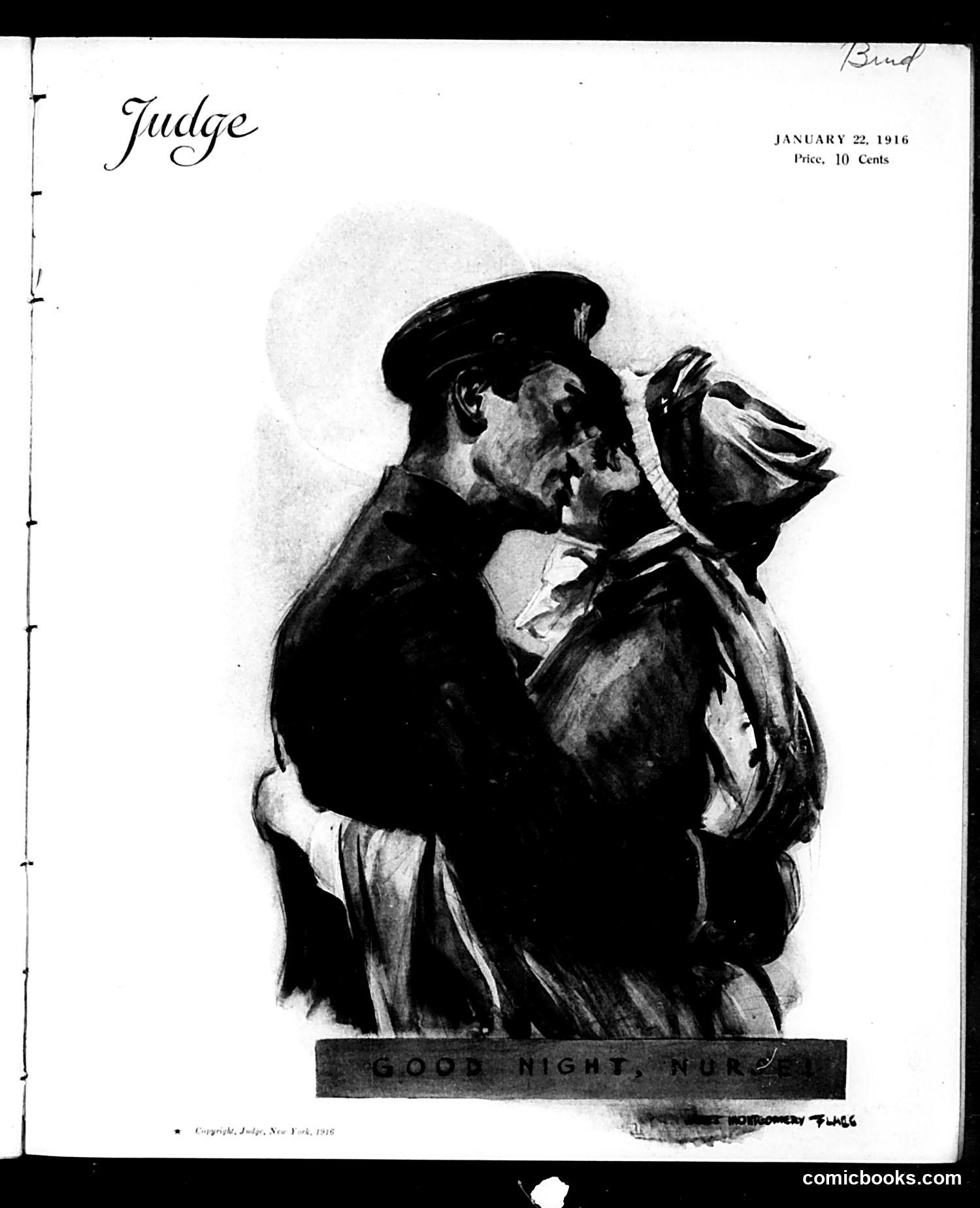
This satirical illustration, titled "Good Night, Nurse," depicts an elderly man in dark clothing being embraced or restrained by a figure in a nurse's uniform. The caption's double meaning—playing on both literal nursemaids and colloquial usage—suggests satirical commentary on care or control of an aging figure. Given the 1916 date and Judge magazine's political focus, this likely comments on contemporary political or social figures, though the specific identity remains unclear from visual caricature alone. The intimate, physical nature of the embrace may suggest dependency, manipulation, or changing power dynamics. The sophisticated rendering and prominent placement indicate this was considered significant commentary for Judge's educated readership.
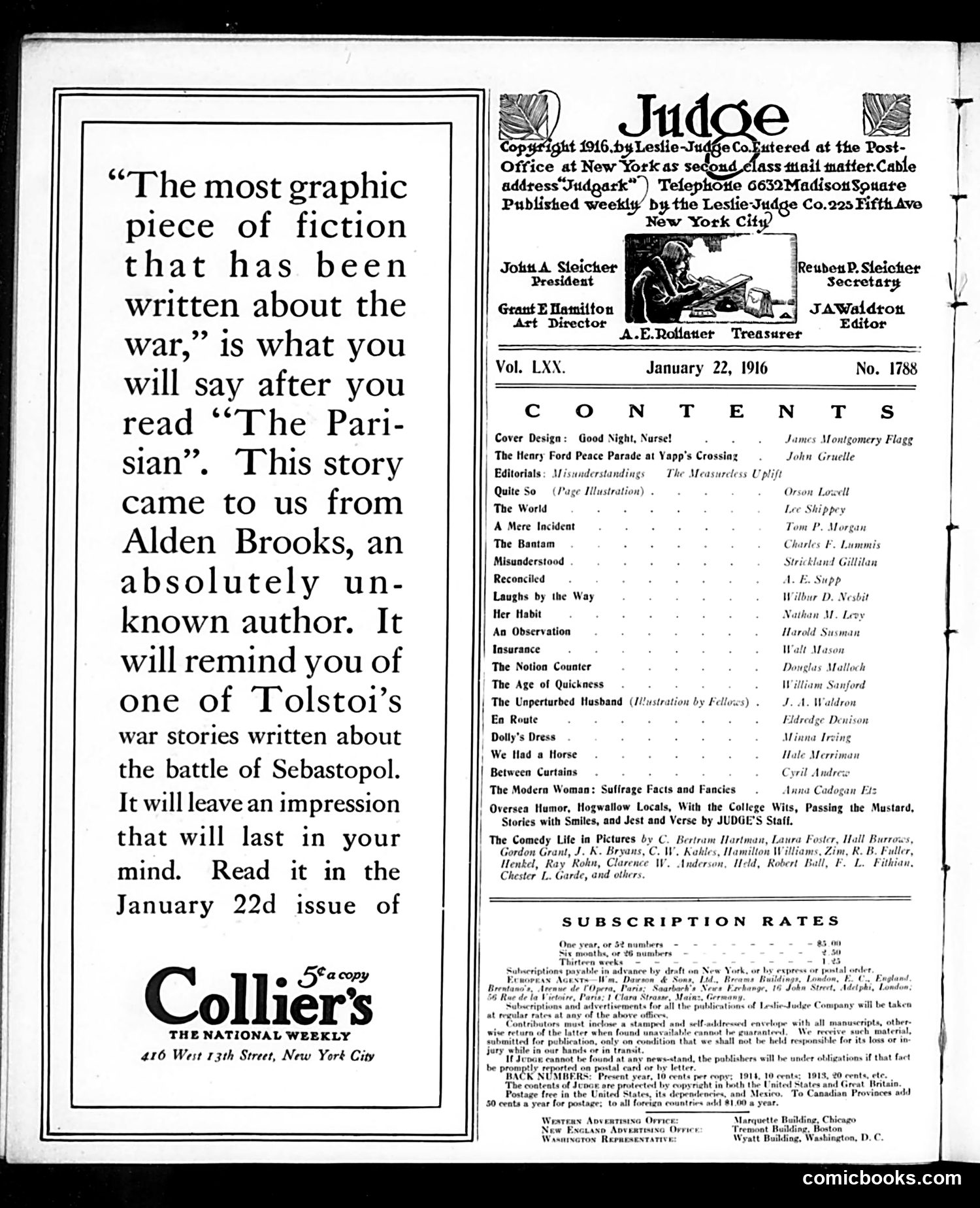
This page is primarily a **Collier's magazine advertisement** (left side) promoting a story called "The Parisian" by Alden Brooks, described as the most graphic war fiction written about the war—comparing it to Tolstoy's Sebastopol battle narratives. The right side shows the **Judge magazine masthead and table of contents** for Volume LXX, No. 1788. The contents list typical satirical pieces of the era, including articles on suffrage, World War I observations, and social commentary. The page contains **no political cartoons**—it's primarily editorial/advertising material. The war reference reflects 1916 American publishing's intense focus on WWI, then raging in Europe, before U.S. entry in 1917.
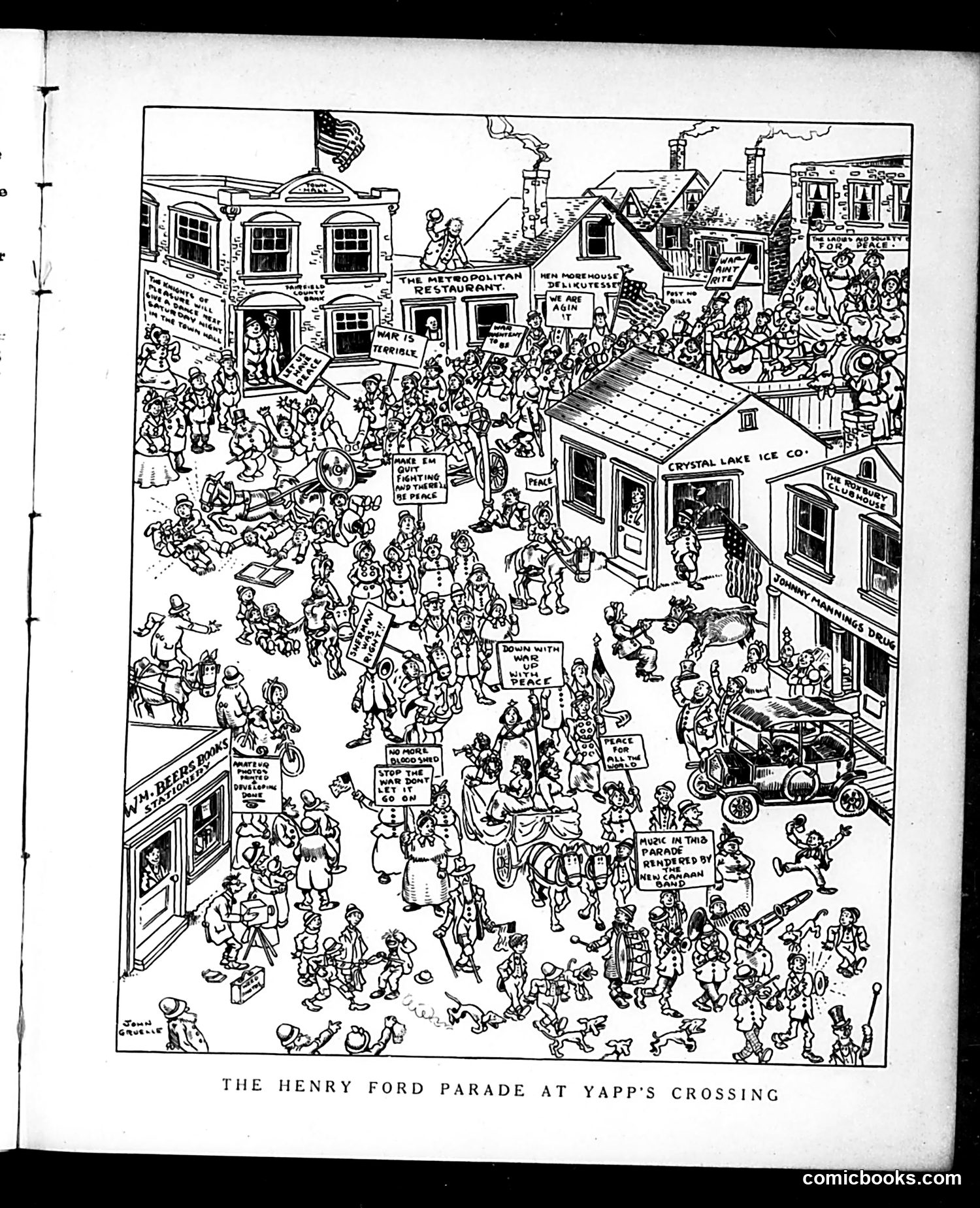
This satirical illustration depicts a crowded street scene celebrating Henry Ford's automotive innovations. The cartoon mocks the fervent public enthusiasm surrounding Ford and mass-produced automobiles in early 20th-century America. The scene shows numerous townspeople gathered around visible businesses (a restaurant, ice company, and what appears to be shops), with signs referencing Ford and automobiles. A car is prominently featured among the crowds. The satire likely critiques the almost cult-like adulation Ford received as a technological innovator, or perhaps the chaotic social disruption caused by rapid automobile adoption. The dense, frenzied crowd composition emphasizes how Ford-mania dominated public consciousness. The title "Yapp's Crossing" appears to be a fictional location, used generically to represent American towns experiencing this automotive revolution fever.
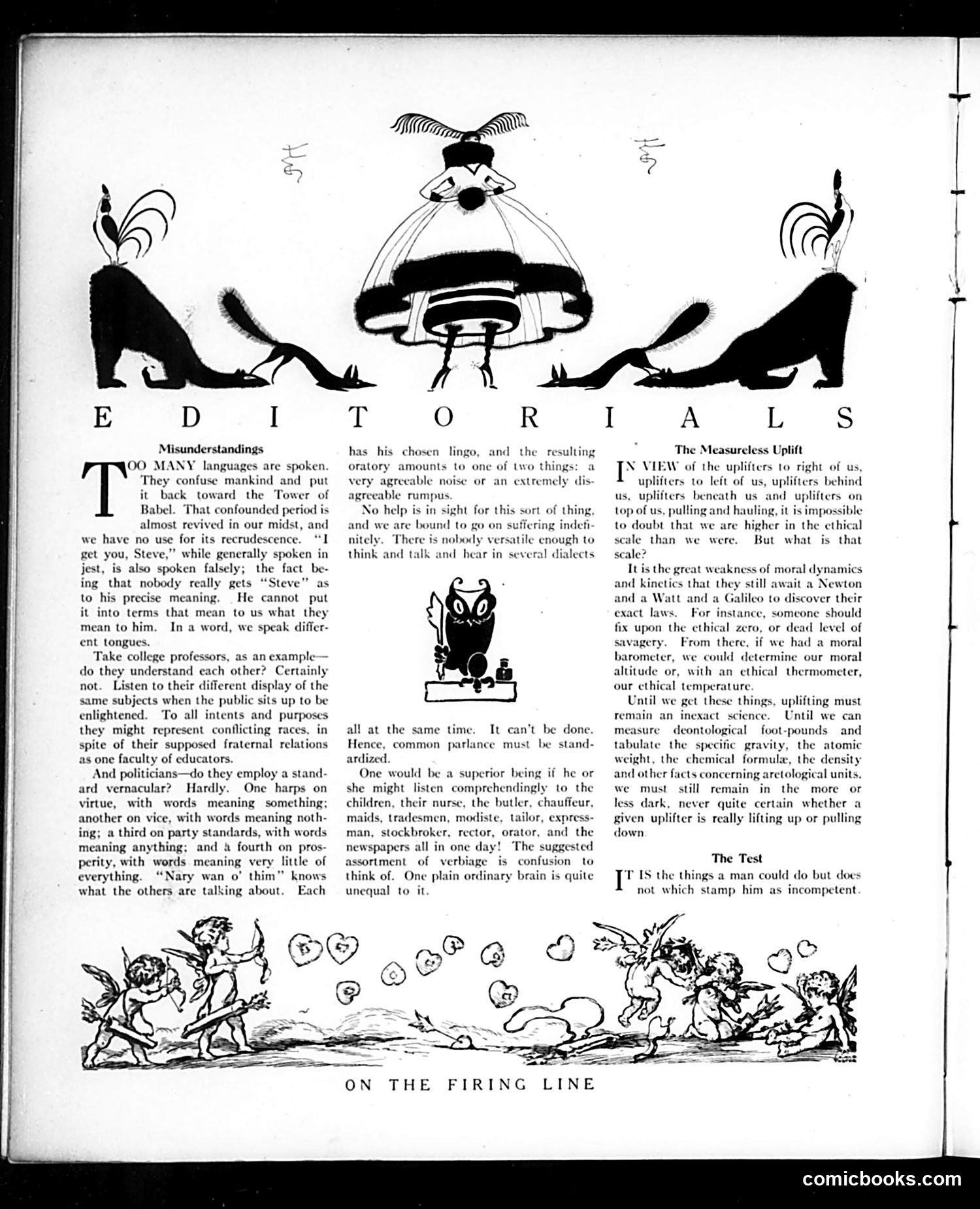
This page features satirical essays on language misuse and moral measurement, illustrated with decorative line drawings rather than political cartoons. **"Misunderstandings"** critiques imprecise speech—how people use words like "Steve" colloquially despite different actual meanings, and how professors fail to communicate effectively across disciplines. The author argues standardized language is essential for serious discourse. **"The Measureless Uplift"** questions whether moral progress can be quantified like physical phenomena. It satirizes reformers' claims to measure ethical improvement with scientific precision, arguing morality lacks such objective standards until we establish "ethical thermometers." **"The Test"** (incomplete) appears to define incompetence. The decorative illustrations of cherubs and classical figures don't correspond to specific political figures—they're generic embellishments typical of Judge's editorial pages.
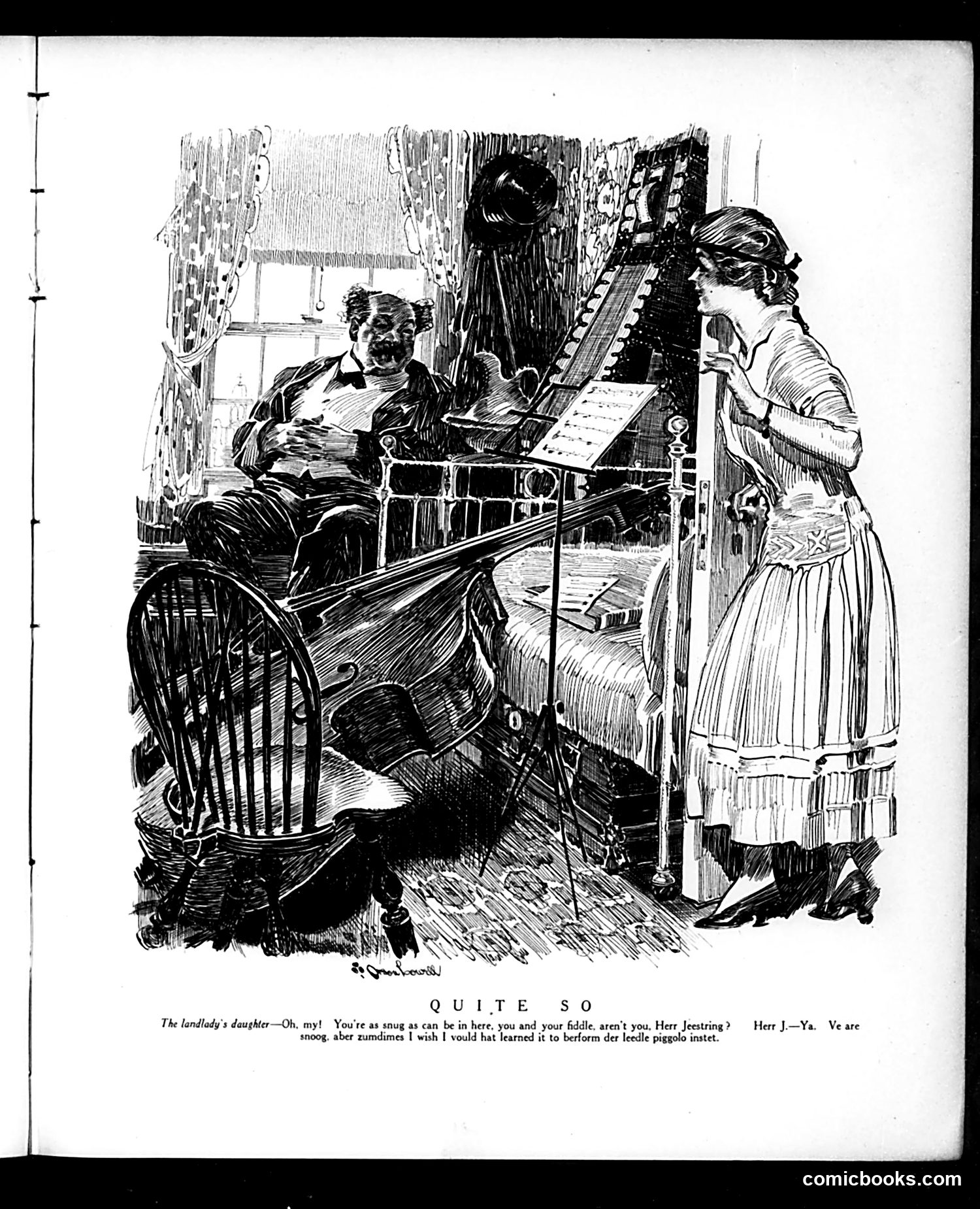
This cartoon depicts a German music teacher instructing an American landlady's daughter on the violin. The satire mocks early 20th-century American social pretensions and German cultural snobbery. The landlady's daughter claims to play violin, but the German instructor dismisses her abilities, stating she's "as snug as can be" and wishing he'd learned to perform "der leedle piggolo intet" (the little piccolo instead). The joke ridicules: (1) wealthy Americans paying for European music instruction to appear cultured, (2) German teachers' condescending attitude toward American students, and (3) the linguistic comedy of fractured German-English dialogue. The elaborate room and formal dress emphasize the pretension being mocked—despite expensive lessons, the student remains untalented.
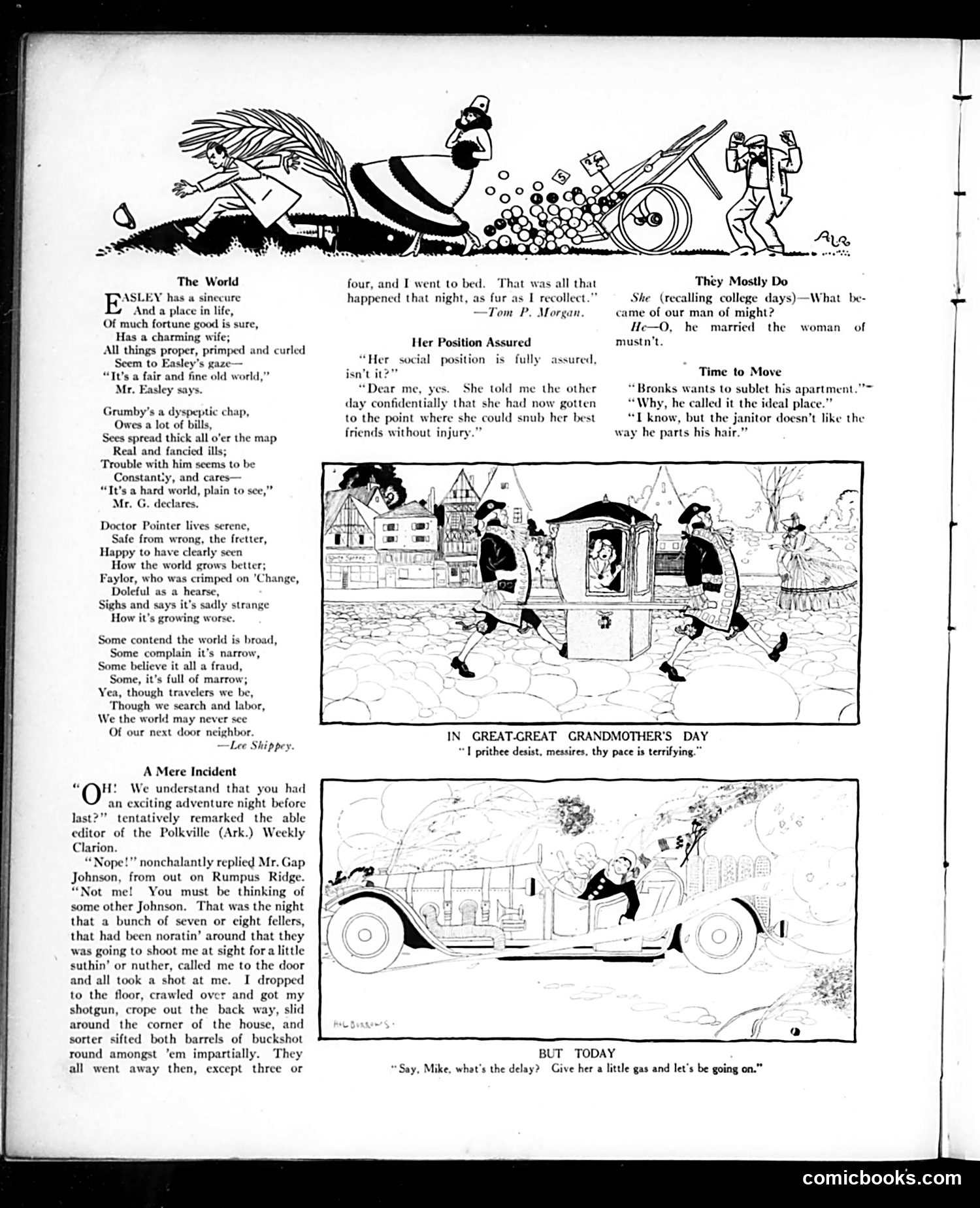
This page contains three separate satirical pieces typical of early 20th-century Judge magazine: **"The World"** — A poem by Lee Shippey presenting contrasting attitudes: Asley content, Grumby pessimistic, Doctor Pointer optimistic, and Faylor cynical. The satire mocks how different temperaments perceive identical circumstances differently, concluding that we rarely truly understand our neighbors' lives. **"A Mere Incident"** — Gap Johnson from rural Arkansas (Rumpus Ridge) casually recounts a gunfight where he exchanged fire with would-be assassins, then went to bed. The humor lies in treating lethal violence as mundane frontier life, contrasting sharply with urban readers' sensibilities. **Two cartoon strips** compare past and present: "Great-Great Grandmother's Day" shows old-fashioned, slow transportation with formal speech ("I prithee desist"), while "But Today" depicts modern impatient motorists demanding speed ("Give her a little gas"). The satire critiques how automobiles have accelerated society's pace and eliminated courtesy. All pieces reflect period anxieties about modernity, class perspectives, and changing American values.
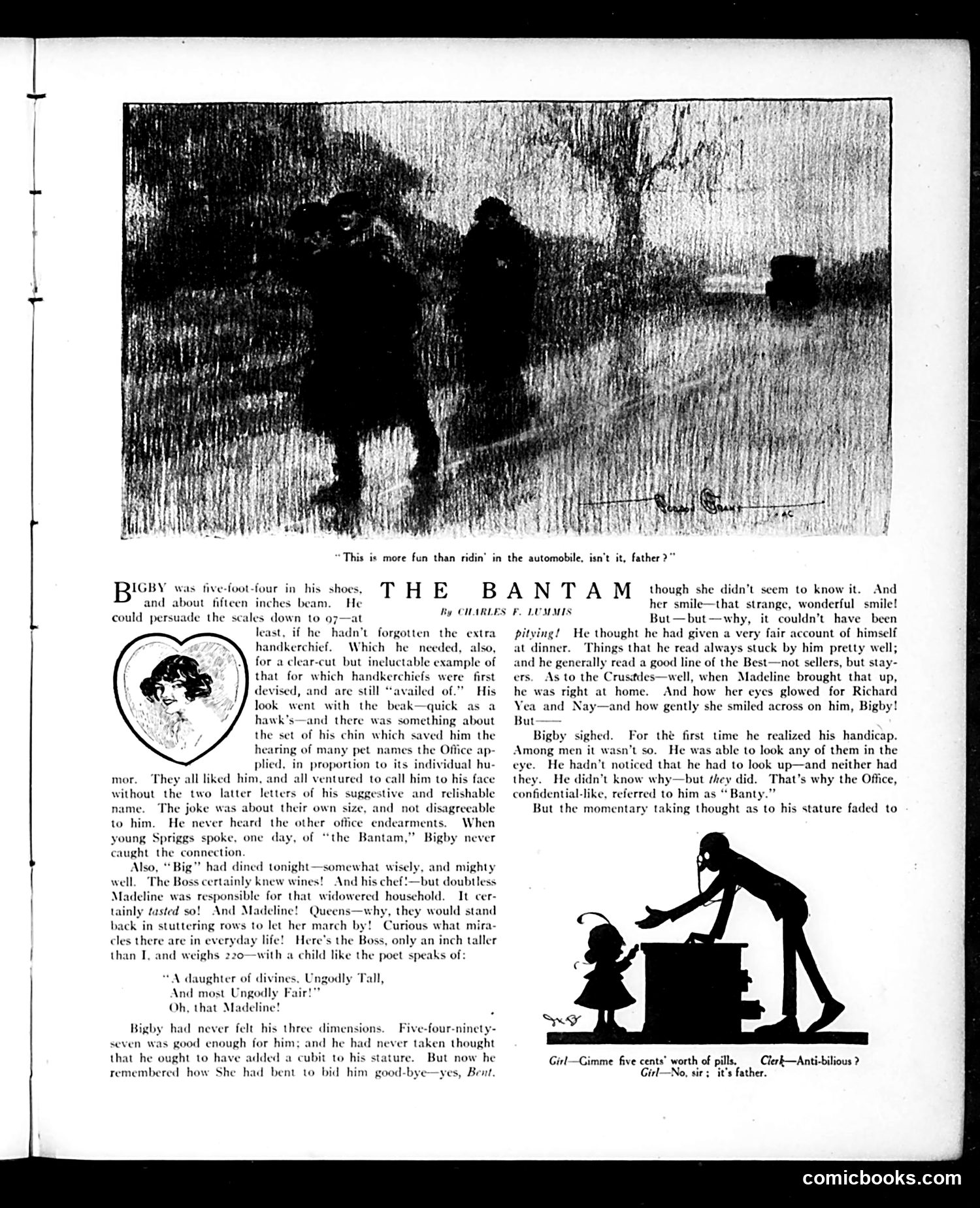
This story by Charles F. Lummis depicts a small man named Bigby (nicknamed "the Bantam") who works in an office and stands about 5'4". The narrative establishes he's confident and well-liked despite his stature—until he dines at his boss's home and meets the boss's tall, beautiful daughter Madeline. When Madeline bends down to say goodbye to him, Bigby suddenly becomes self-conscious about his height for the first time, wondering if her smile was *pitying* rather than genuine. The satire critiques how social perception and romantic anxiety can undermine a man's self-assurance—his handicap only becomes real when filtered through another person's presumed judgment. The accompanying cartoon shows a tall woman and small girl; the caption joke plays on this same theme of size disparity and social embarrassment. The story explores early 20th-century anxieties about masculinity, physical stature, and courtship dynamics.
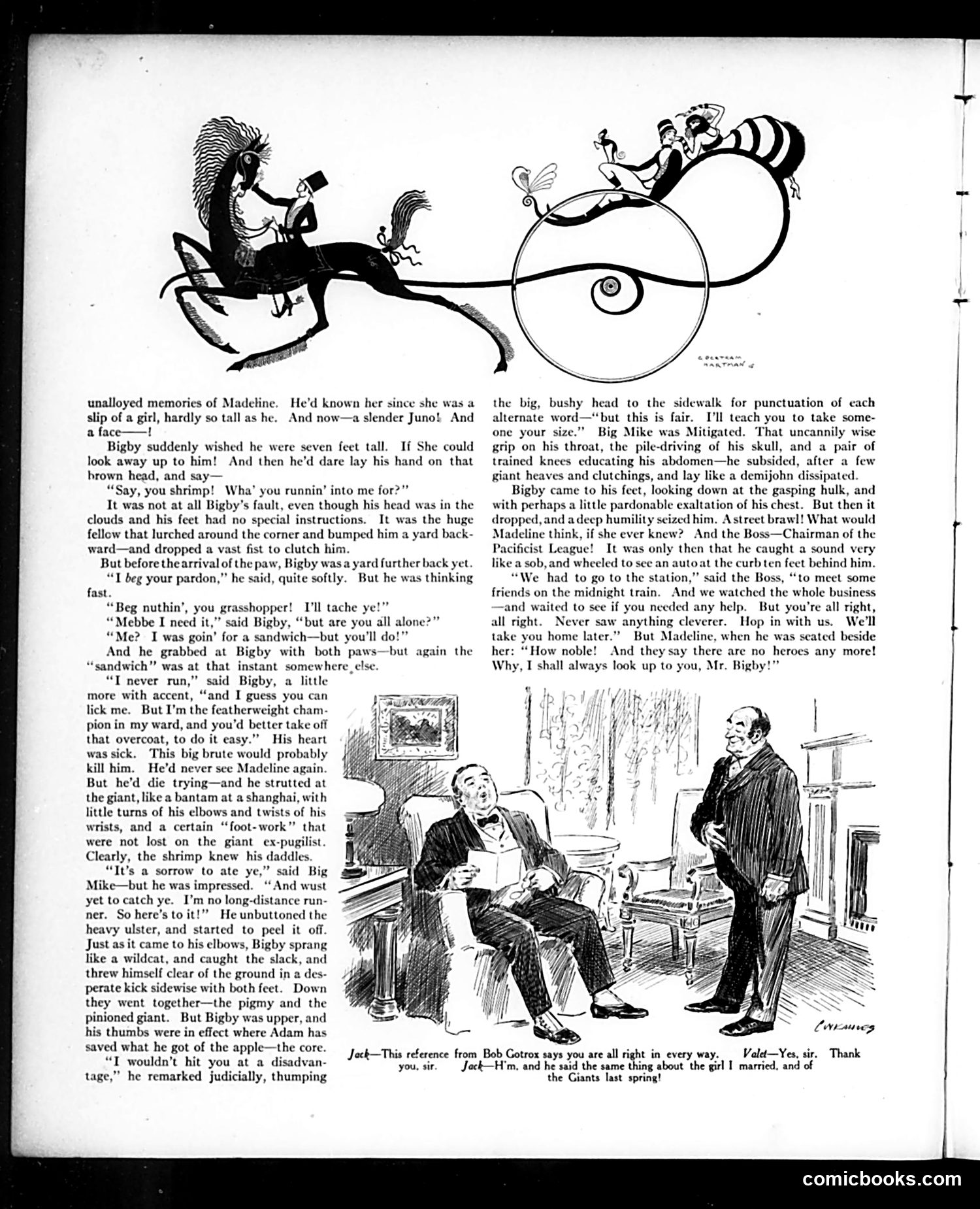
This page presents a serialized short story rather than a political cartoon. The narrative follows **Bigby**, a small man infatuated with a woman named Madeline, who encounters a large bully named "Big Mike." When Mike attacks him, Bigby defeats him through skilled fighting technique and leverage—using wrestling moves that pin the larger man despite size disadvantage. The satire targets **class anxieties and masculine ideals**: Bigby's victory impresses Madeline and "the Boss" (apparently a railroad official), validating his worth despite his small stature. The final panel's joke—about the Boss saying the same compliments about both his wife and the Giants baseball team—mocks superficial praise and conformist flattery. The story celebrates the "clever underdog" defeating brute strength through intelligence and technique, a common early-20th-century American fantasy about meritocracy and social mobility.
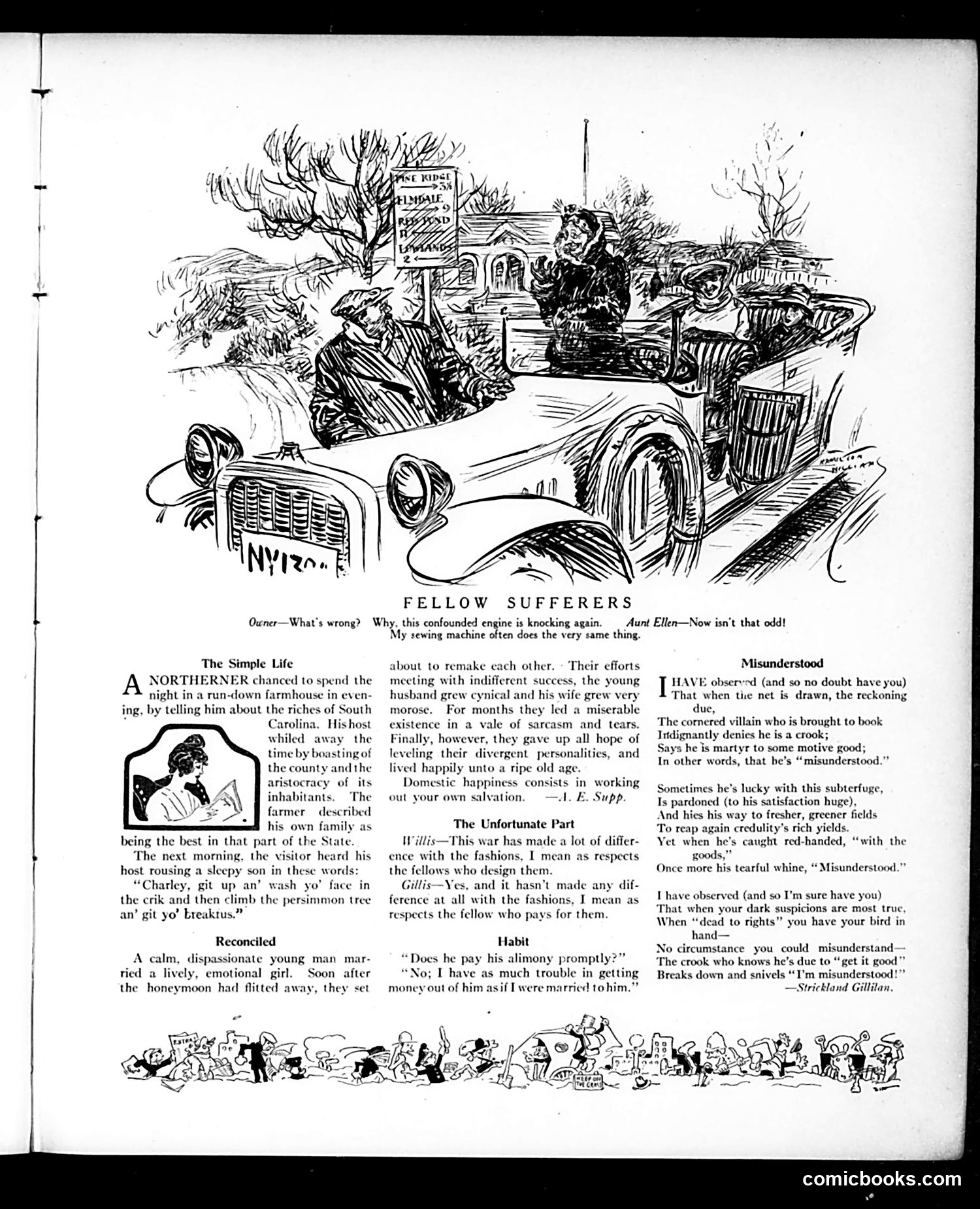
This page contains several satirical short pieces mocking American social conventions and marital dynamics. **"The Simple Life"** ridicules a Northern visitor's condescension toward Southern rural poverty, which the farmer counters by boasting of his family's supposed aristocratic status—then undercuts this by shouting his son to wash in a creek and eat persimmons for breakfast. The joke: Southern pretension masked thin reality. **"Fellow Sufferers"** (top cartoon) shows motorists with engine trouble commiserating with a woman whose sewing machine has similar problems—equating mechanical frustration across class lines. **"Reconciled"** jokes that newlyweds' initial marital conflict resolved when they stopped trying to change each other. **"The Unfortunate Part"** satirizes how wartime fashion changes affect designers but not consumers' wives, who still demand expensive clothing. **"Habit"** presents a cynical observation that obtaining alimony from an ex-husband proves as difficult as extracting money from a current one. **"Misunderstood"** uses verse to mock criminals who claim victimhood, particularly those caught "red-handed" who whine about being misjudged.
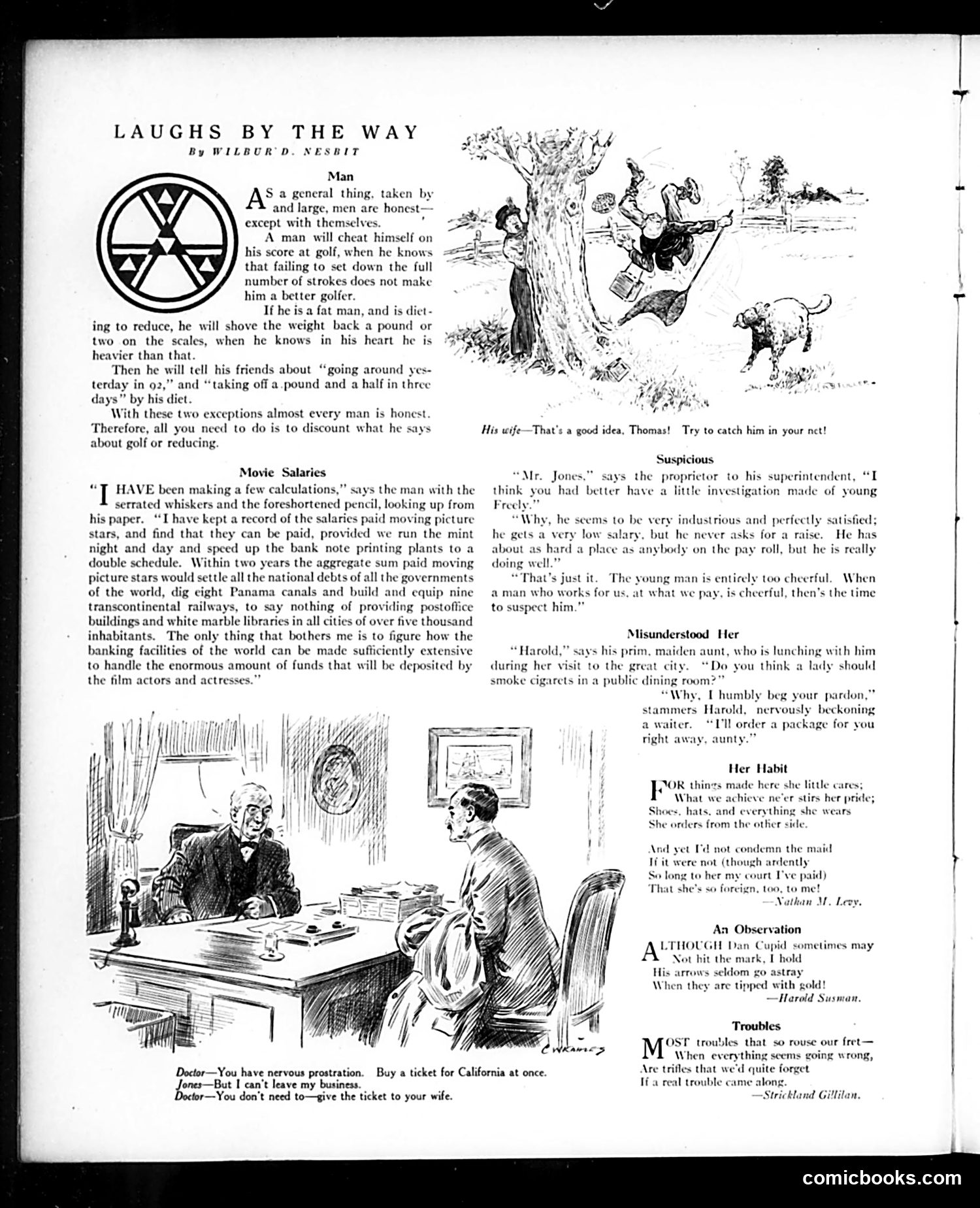
This page contains several brief satirical pieces about masculine behavior and social hypocrisy: **"Man"** mocks male dishonesty with themselves: men cheat on golf scores and lie about dieting while claiming honesty. The joke is that men rationalize self-deception while judging others. **"Movie Salaries"** satirizes the astronomical pay commanded by early film stars. A character calculates that actors' combined salaries could pay off national debts and fund major infrastructure—absurd hyperbole highlighting Hollywood's wasteful excess and the disconnect between star earnings and productive national spending. **Other brief sketches** play on misunderstandings and character observations: a nervous young man offers his aunt cigarettes thinking she criticized smoking; a boss suspects an employee who's "too cheerful" given low wages; a woman obsessed with foreign shopping. The cartoons reflect 1920s concerns: celebrity excess, gender roles, workplace anxieties, and American materialism. The art style is simple line-drawing typical of period humor magazines.
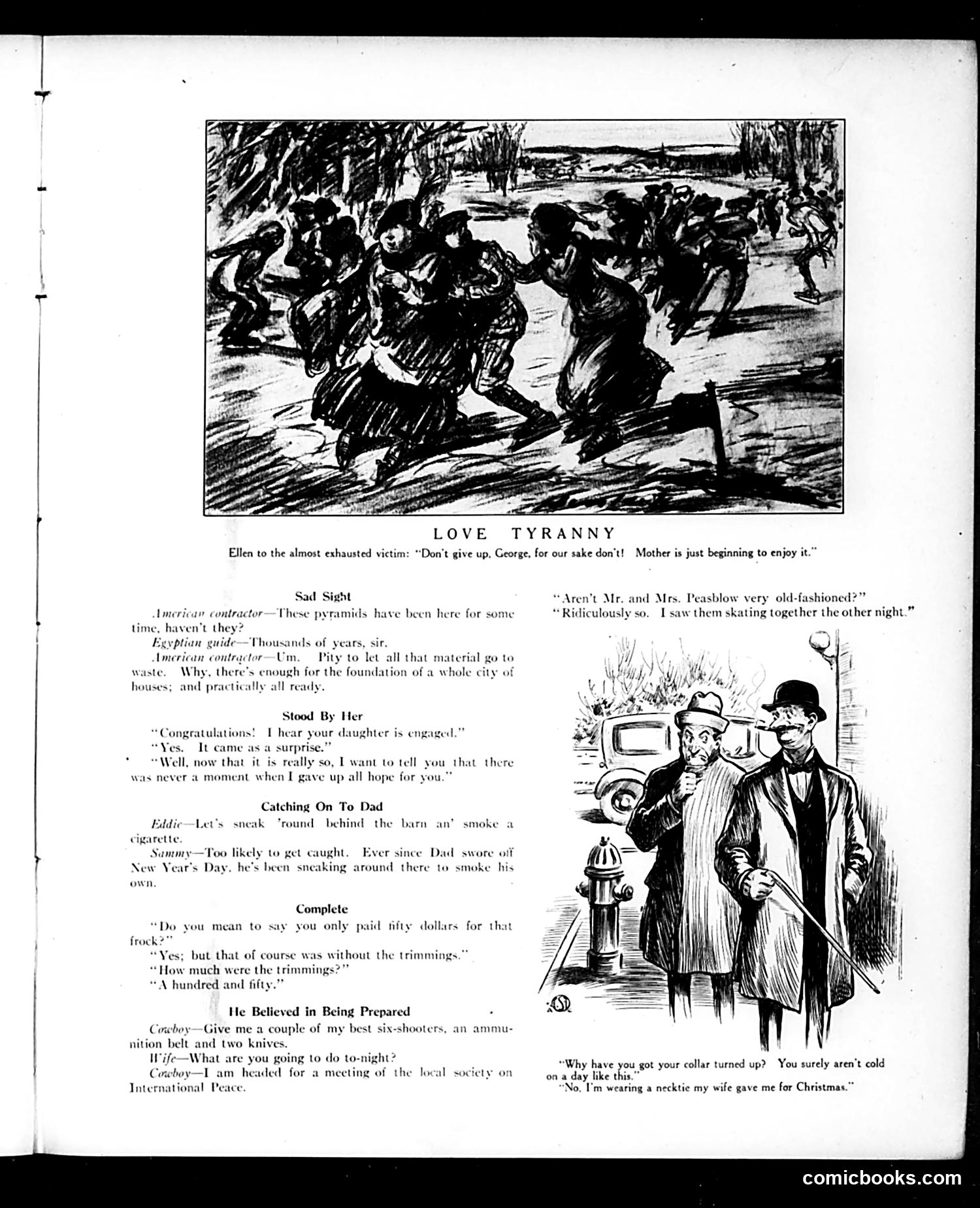
This page contains multiple brief satirical sketches mocking early 20th-century social conventions and gender dynamics. **"Love Tyranny"** (top): A woman exhausts her husband George with demands while her mother encourages her to continue, satirizing wives' domestic control over husbands. **"Sad Sight"**: Americans visiting Egyptian pyramids discuss the Peasblows as "old-fashioned" for skating together—mocking how modern society viewed couples spending time together as outdated. **"Stood By Her"**: A woman's mother claims she never lost hope for her daughter's engagement prospects, satirizing intrusive parental expectations around marriage. **"Catching On To Dad"**: Boys plan to smoke cigarettes, noting their father now sneaks to the barn to smoke—mocking parental hypocrisy about vices. **"Complete"**: A woman paid $50 for a dress but $150 for trimmings, satirizing wasteful female spending habits. **"He Believed in Being Prepared"**: A cowboy seeks weapons for a "peace" meeting, and another wears an ugly gift necktie—both mock contradiction between stated intentions and reality.
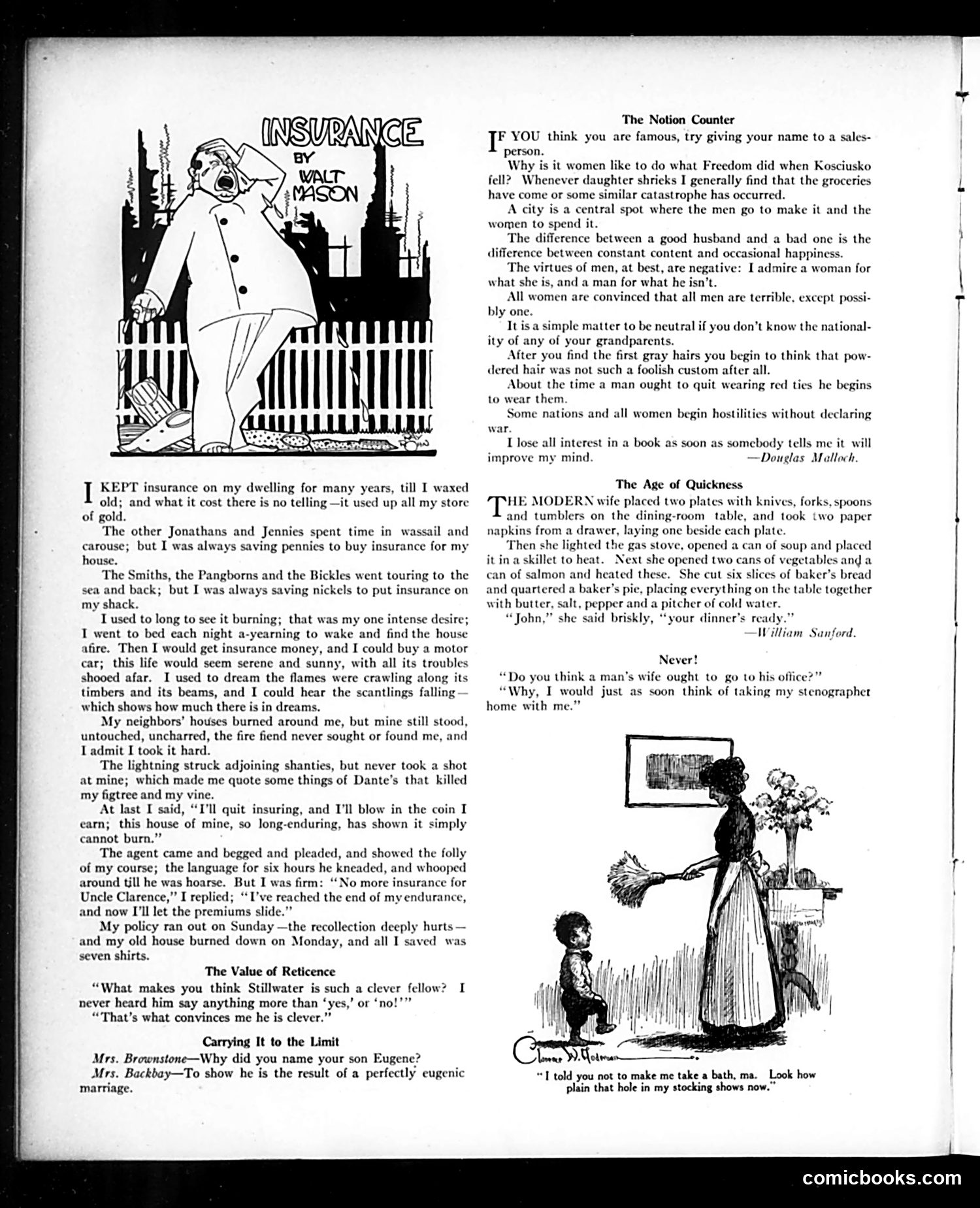
**Main Cartoon (Top Left):** "Insurance" by Walt Mason depicts a man in an overcoat standing amid city buildings. The accompanying story is a cautionary tale about false economy: a homeowner skimps on insurance premiums for years, dreaming his house will burn so he can collect money for a motor car. When he finally cancels his policy on Sunday, his house burns down Monday—leaving him with only seven shirts. **The Satire:** This critiques both human irrationality (wishing for disaster) and the insurance industry's predatory practices. It mocks the everyman's magical thinking while implicitly endorsing insurance as necessary protection, however costly. **Side Content:** The page includes humor columns like "The Notion Counter" (witty observations about gender and society), "The Age of Quickness" (satirizing modern wives' shortcuts), and brief jokes about cleverness and eugenics—typical early-20th-century Judge content mixing social commentary with casual period prejudices.
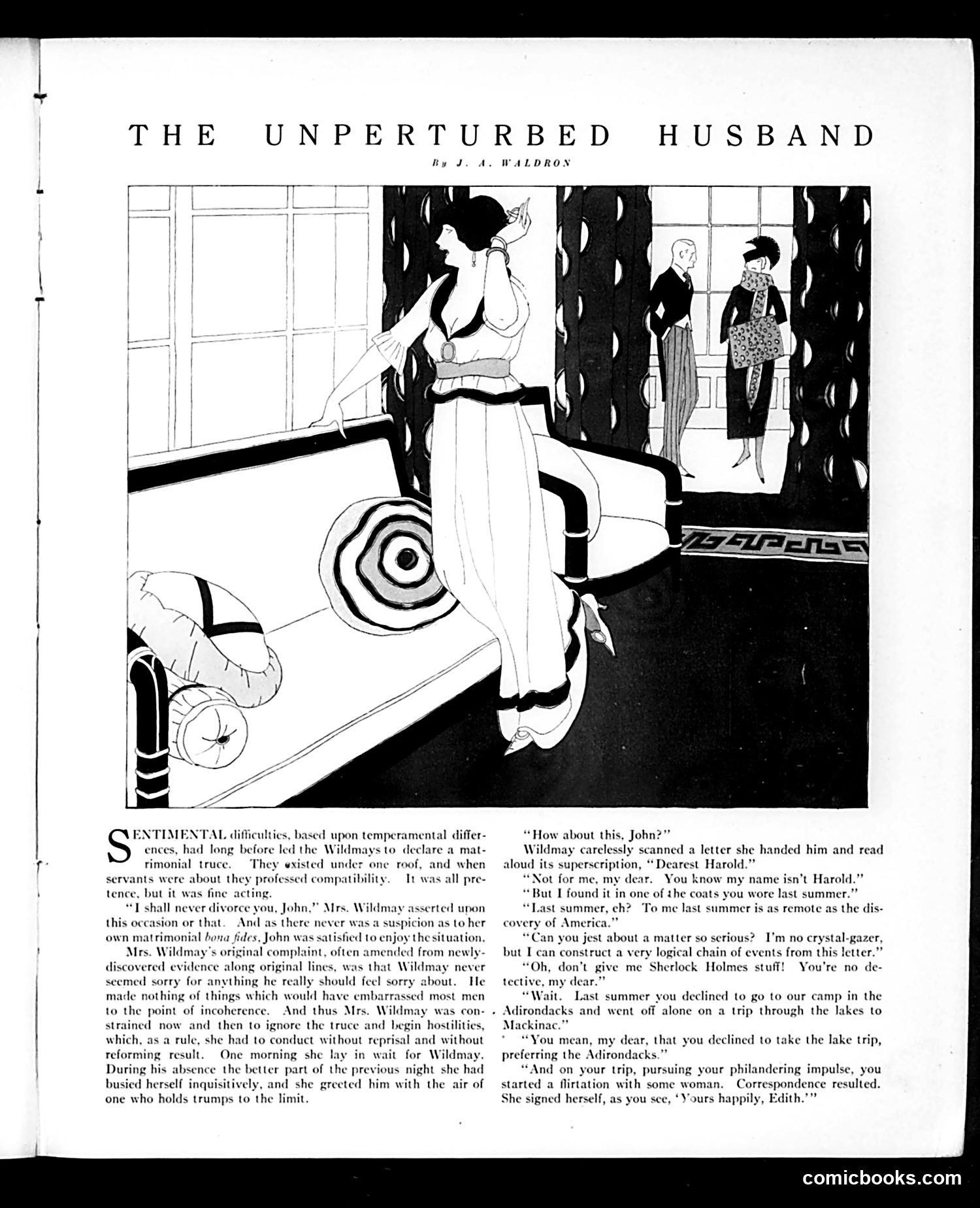
This is a satirical short story with illustration depicting a marital dispute typical of early-20th-century domestic comedy. Mrs. Wildmay discovers a love letter signed "Dearest Harold" in her husband's coat, suggesting an affair during his solo trip to Mackinac the previous summer. The humor centers on Mr. Wildmay's complete indifference to the accusation. Rather than deny, apologize, or show embarrassment, he dismisses the evidence with casual deflection—claiming he doesn't remember last summer, rejecting her "Sherlock Holmes" logic, and trivializing the discovery. The satire mocks both characters: his shameless unconcern about infidelity and her frustration at being unable to provoke genuine contrition. Their "matrimonial truce" involves enduring mutual dissatisfaction while maintaining social appearances—a critique of convenient, emotionless marriages among the wealthy. The title itself is ironic; his imperviousness is treated as comical rather than admirable.
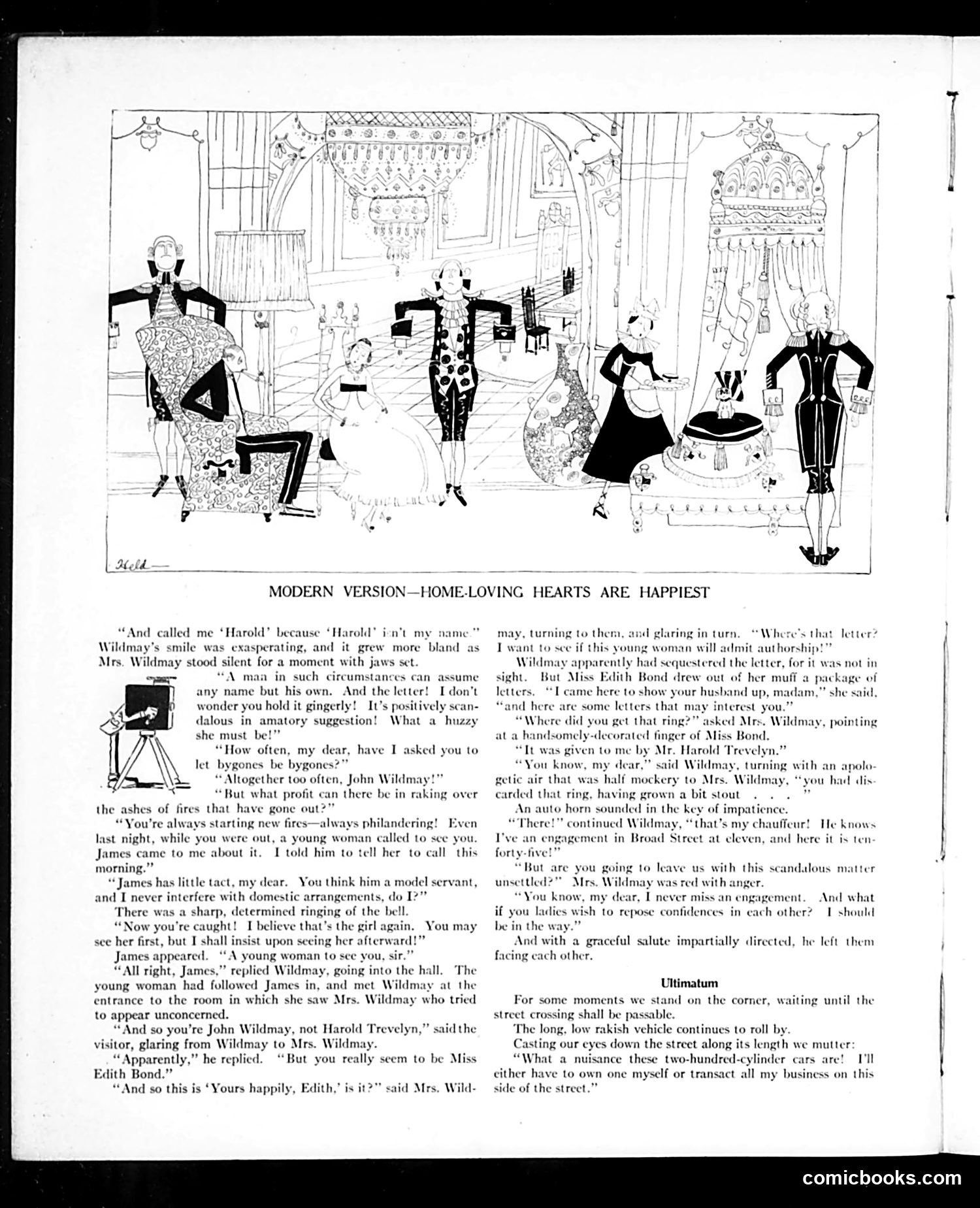
This satirical cartoon critiques modern marriage dynamics and infidelity among the wealthy. The narrative depicts John Wildmay, a philandering husband who receives romantic letters from a young woman named Edith Bond. His suspicious wife confronts him when Miss Bond unexpectedly visits. The satire targets several contemporary (1910s-era) concerns: male infidelity presented as casual and consequence-free, the absurdity of marital conflicts resolved by a husband simply leaving via automobile, and the superficiality of wealthy urban society. Wildmay's repeated evasions—excusing himself with his chauffeur and "urgent business"—mock men who use work obligations to escape domestic accountability. The title's irony is pointed: despite its claim that "home-loving hearts are happiest," the actual story shows a husband abandoning his distressed wife mid-confrontation, suggesting modern life actively prevents domestic happiness. The final section about frustrating automobiles reinforces themes of modern inconvenience disrupting daily life.
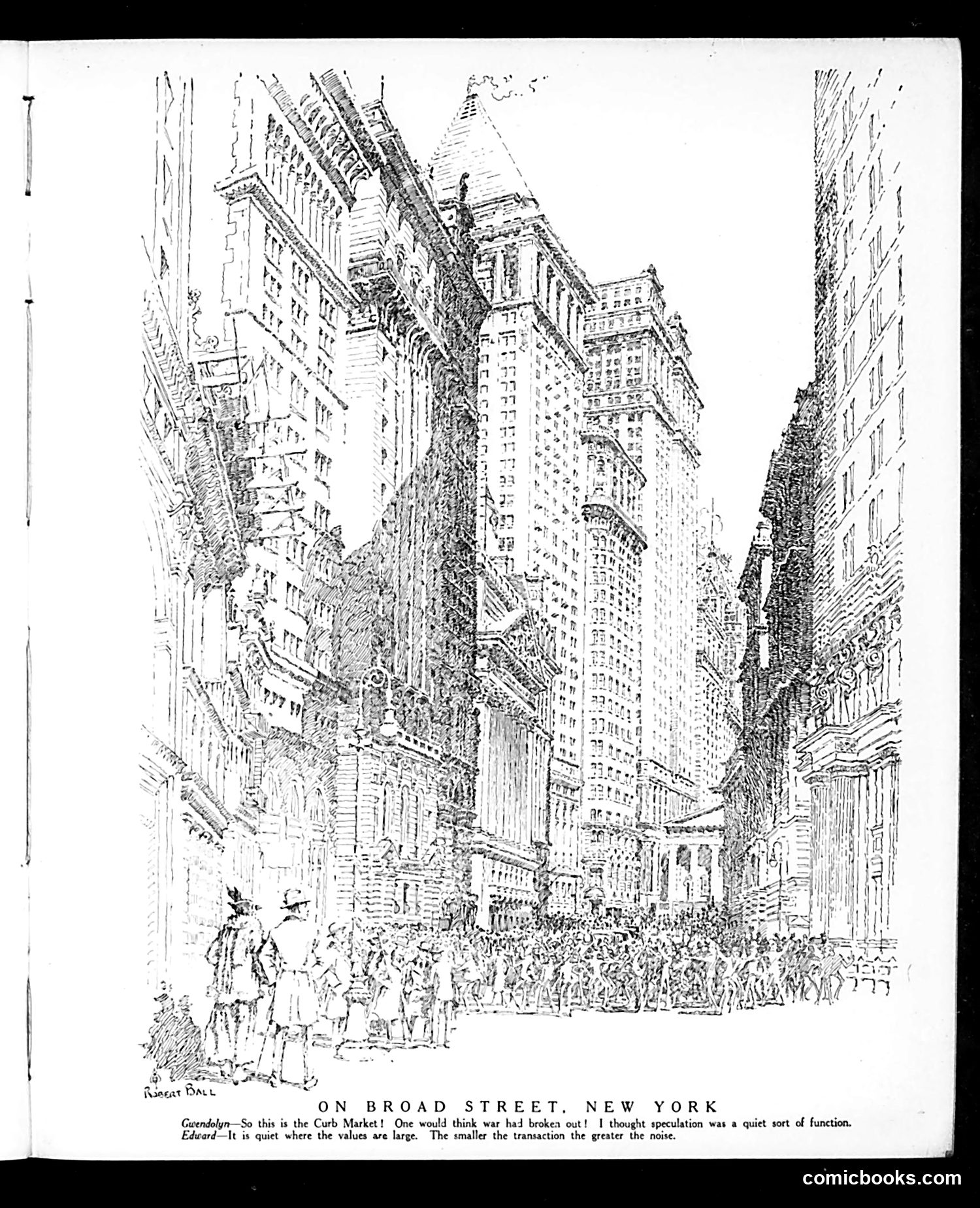
This sketch by Robert Ball depicts **Broad Street in New York**, likely during a period of financial market activity (possibly early 20th century). Two figures—Gwendolyn and Edward—observe the bustling **Curb Market** (an outdoor securities exchange that preceded the modern AMEX). **The satire**: Gwendolyn is shocked by the chaos and noise, expecting war rather than financial trading. Edward's response mocks financial markets' irrationality: **large transactions happen quietly among wealthy insiders, while small investors create the most commotion**—suggesting ordinary people speculate recklessly while the wealthy conduct calm, substantial business. The cartoon critiques both market chaos and the class divide in financial participation.
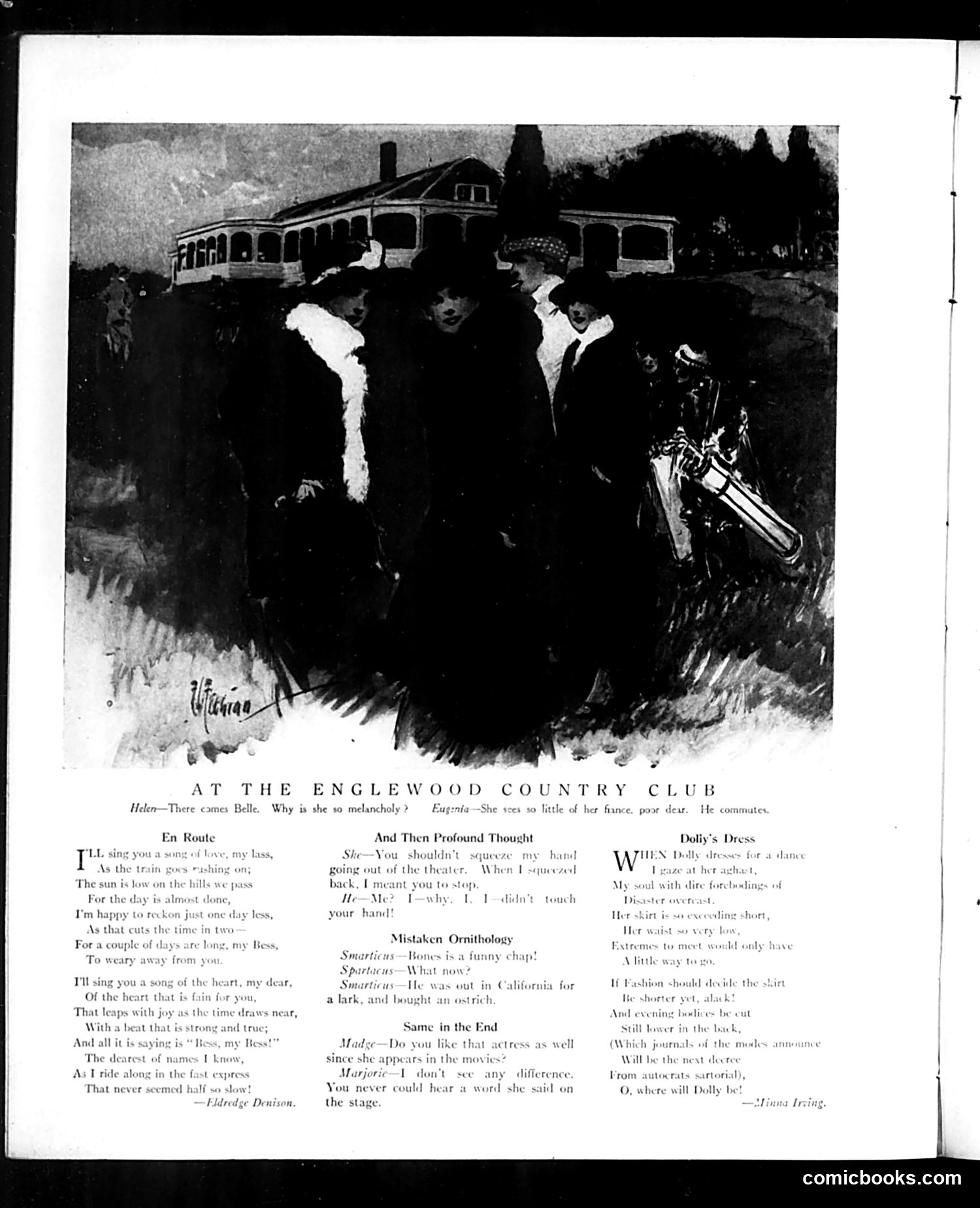
This page contains multiple brief satirical vignettes set at an exclusive country club, targeting upper-class social conventions of the early 20th century. The main cartoon depicts well-dressed women at Englewood Country Club. The satire addresses the emerging problem of commuter husbands—wealthy men who travel daily for work, leaving their wives isolated in suburban settings despite being married. Helen's friend Eugenia notes that Belle's fiancé "commutes," explaining her melancholy. The surrounding text snippets mock other social pretensions: women's fashion obsessions ("Dolly's Dress"), romantic hand-holding etiquette, misidentification of birds, and the vapidity of actresses in silent films. The closing line—"O, where will Dolly be?"—appears to question women's agency and identity within these constrained social roles. The humor targets the leisure class's shallow concerns and the isolation created by modern commuting patterns, a relatively new phenomenon at this time.
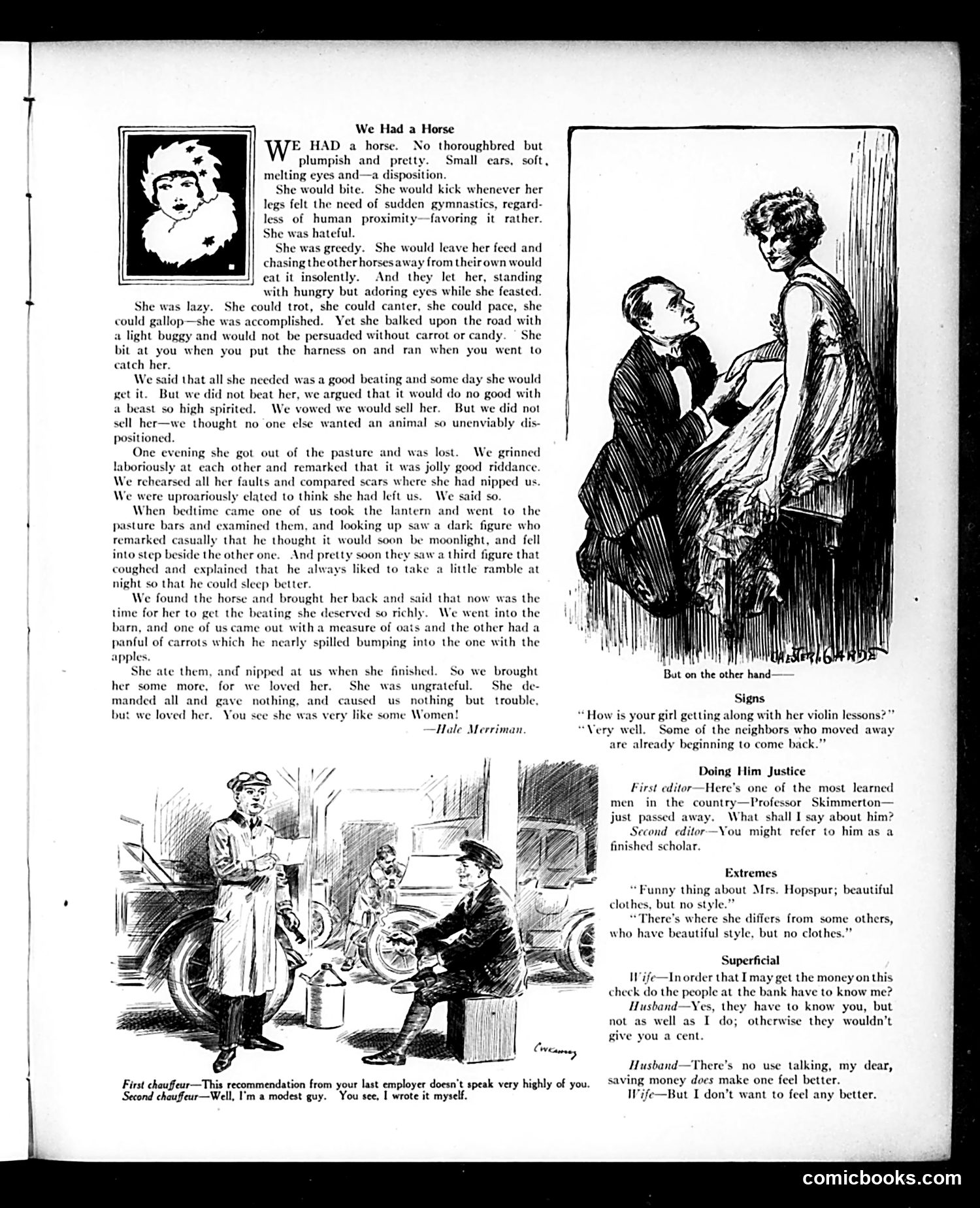
**Main Story ("We Had a Horse"):** A humorous narrative by Hale Merriman comparing an unpleasant horse to a difficult woman. The horse is vicious, greedy, and demanding—yet the owners cannot bring themselves to discipline or sell her. Instead, they secretly search for her when lost, then reward her with food and affection upon her return. The moral: women, like this horse, are illogical, demanding creatures whom men tolerate despite their faults. This reflects early 20th-century attitudes treating women as inherently unreasonable and analogous to animals. **Short Comic Sketches:** Several brief satirical dialogues mock: - **Class pretense**: A chauffeur forging his own recommendation letter - **Marriage dynamics**: A husband noting his wife won't acknowledge his financial sacrifices (she refuses to "feel better" about saving money) - **Fashion hypocrisy**: Contrasting women who have expensive clothes but poor style with those possessing style but lacking clothes The overall tone is misogynistic humor typical of the era, depicting women as vain, illogical, and burdensome to men.
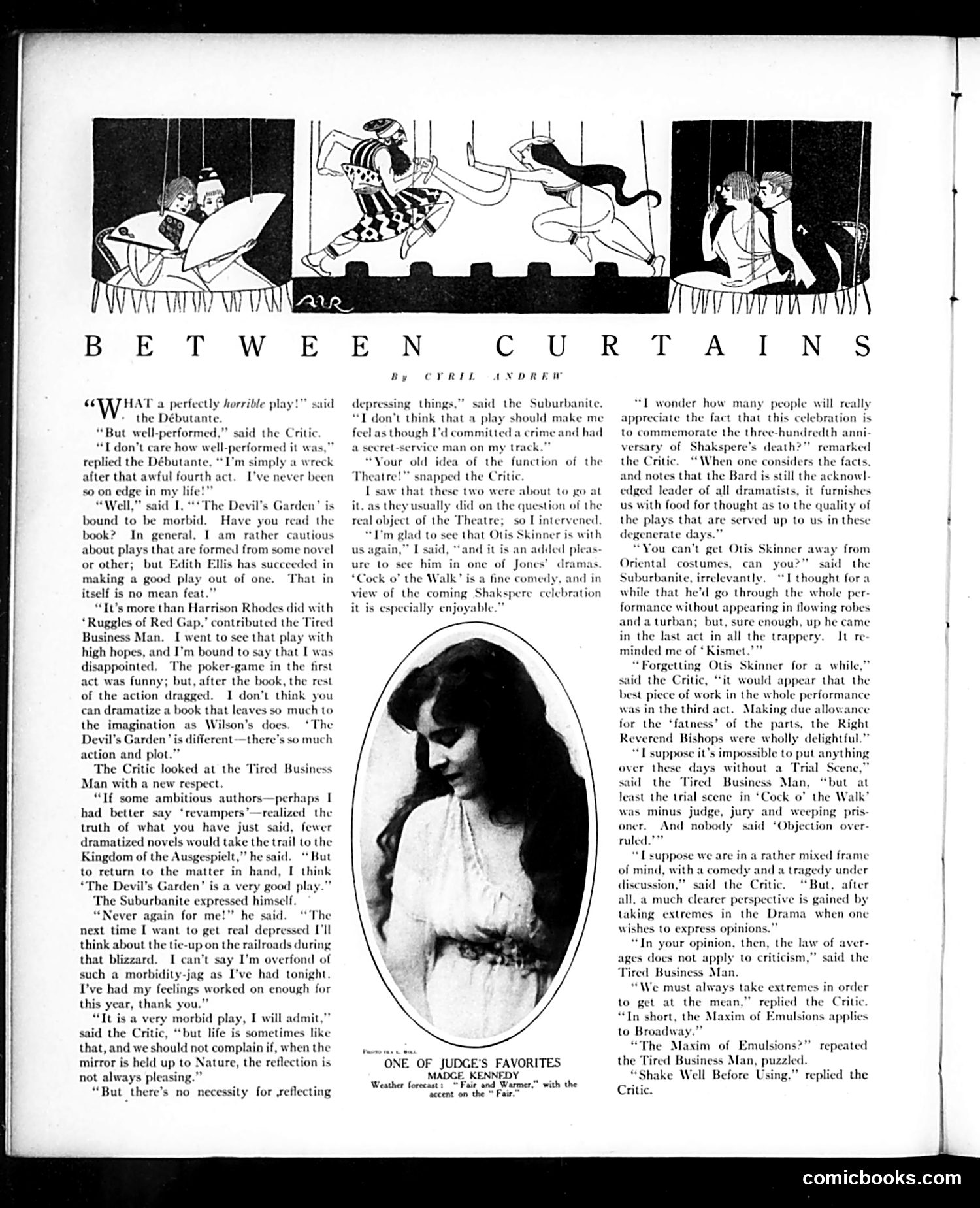
This page presents a theater criticism dialogue featuring stock Judge characters debating recent Broadway productions. The "Débutante," "Tired Business Man," "Suburbanite," and "Critic" discuss plays including "The Devil's Garden" (adapted from a novel) and "Cock o' the Walk" starring actor Otis Skinner. The satire targets differing theatergoer attitudes: the Débutante dislikes emotionally taxing dramas; the Tired Business Man criticizes adaptations that lose literary nuance; the Suburbanite objects to morally dark content; while the Critic defends theater's role in reflecting life's complexities, even unpleasant ones. The photograph shows Madge Kennedy, identified as "one of Judge's favorites," likely a popular actress of the period. The cartoon's joke centers on the tension between entertainment expectations and artistic responsibility—a recurring Judge theme mocking middlebrow taste.
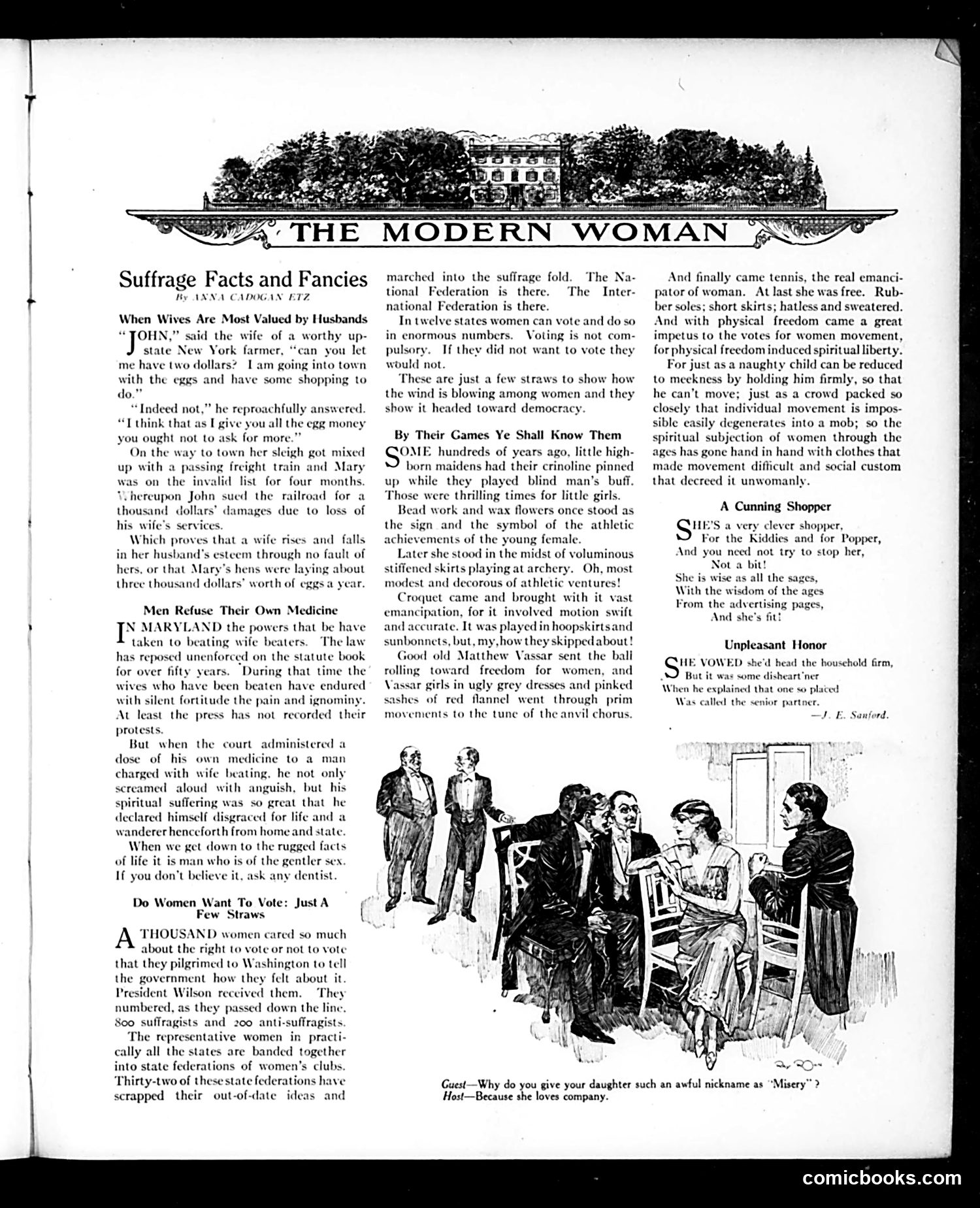
This page satirizes women's suffrage debates through mock-serious "evidence." The article by Anna Cadogan Etz uses ironic anecdotes to expose male hypocrisy: **"When Wives Are Most Valued"** mocks how husbands undervalue wives' daily work but sue for damages when injury prevents their labor—revealing women's economic worth only when quantified legally. **"Men Refuse Their Own Medicine"** ridicules wife-beaters who screamed under court punishment while their victims silently endured decades, inverting notions of male toughness. **"Do Women Want To Vote?"** counters anti-suffrage claims by noting thousands of women actively lobbied Washington, and that women voting where permitted do so in "enormous numbers." **"By Their Games"** traces women's liberation through sports history—from restrictive crinoline activities to tennis in short skirts—arguing physical freedom naturally produces political demands. The illustration shows a social scene where a guest questions why a daughter has an "awful nickname" like "Misery," and the host replies "because she loves company"—likely mocking women stereotyped as dependent or frivolous.
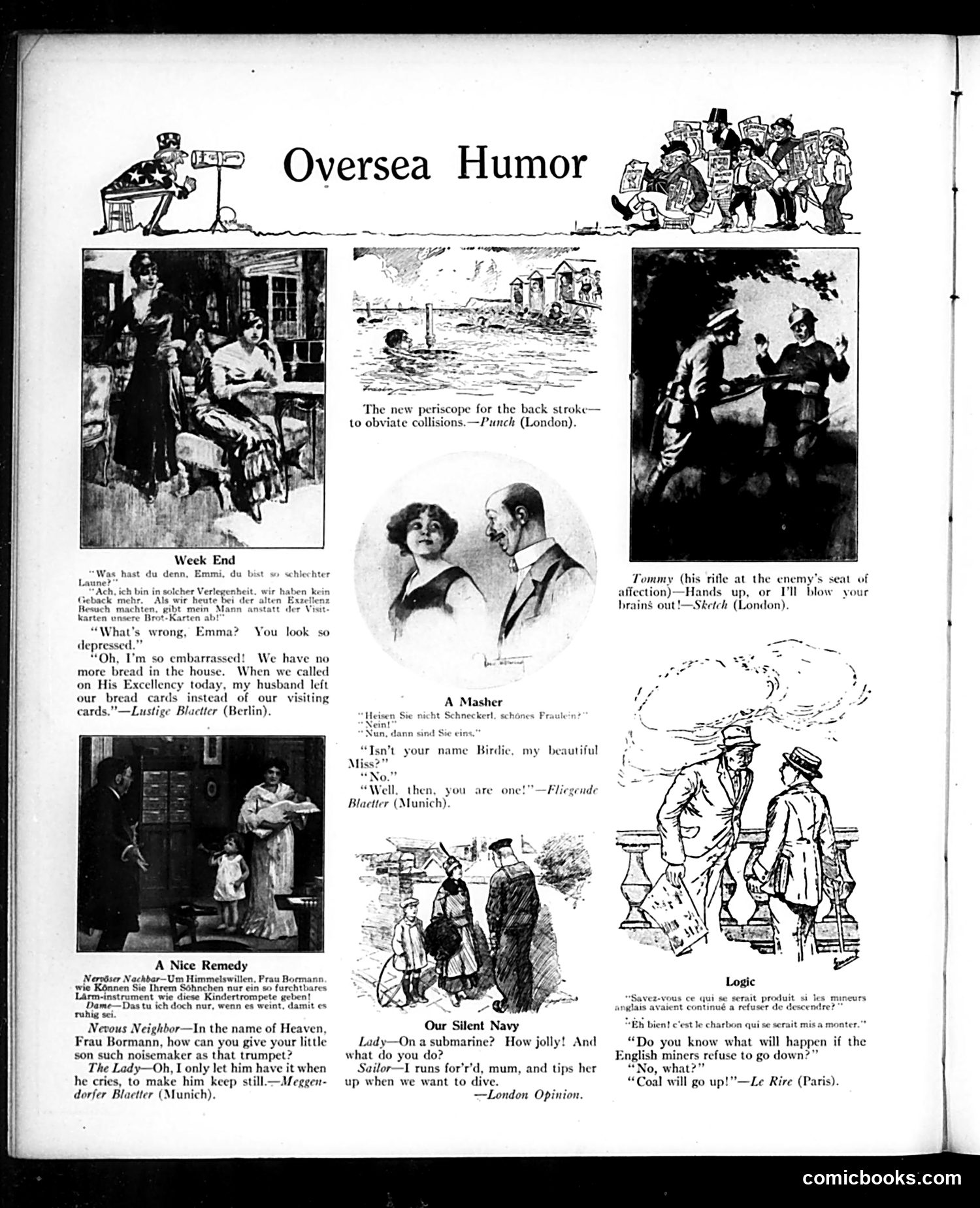
This page collects humorous reprints from European satirical magazines (Punch, Sketch, Fliegende Blätter, etc.), likely from WWI era, demonstrating how different nations joked about wartime conditions. Key items include: **"Week End"** (Berlin): A German couple embarrassed because they presented bread ration cards instead of visiting cards to an official—satirizing food scarcity under wartime rationing. **"A Nice Remedy"** (Munich): A neighbor criticizes a woman giving her crying child a toy trumpet as a pacifier—dark humor about noise and domestic annoyance during wartime. **"Our Silent Navy"** (London): A joke about submarine warfare, where a sailor "tips her up when we want to dive"—punning on naval operations. **"Logic"** (Paris): French satire about coal miners refusing to work underground, questioning English economic collapse if this occurred. The page demonstrates how Judge republished international humor to show American readers how different Allied and Central European nations satirized their own wartime experiences.
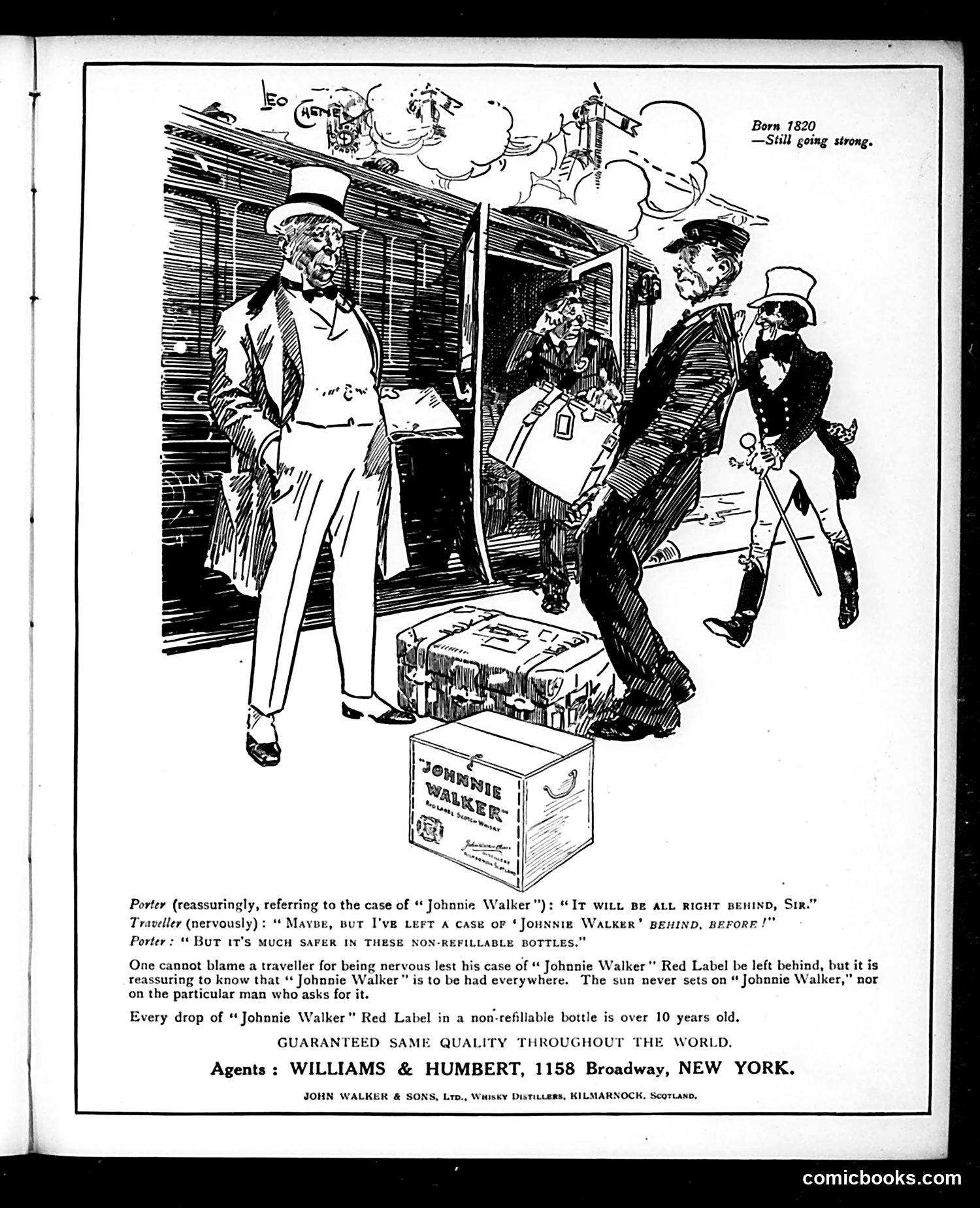
This is primarily a **product advertisement** for Johnnie Walker Red Label scotch whisky, disguised as humor. The cartoon depicts a porter reassuring a nervous traveler who fears leaving behind his case of whisky during travel. The joke plays on the traveler's anxiety about losing alcohol—a common concern for wealthy travelers in the early 20th century. The porter's reassurance has a double meaning: the whisky is safe *because* Johnnie Walker is available everywhere globally, and the new non-refillable bottles prevent tampering. The advertisement emphasizes brand reliability and worldwide availability ("The sun never sets on 'Johnnie Walker'"), positioning the scotch as a luxury good for international travelers. The product's founding date of 1820 establishes its heritage and quality. This exemplifies how Judge magazine blended advertising with satirical content to appeal to its affluent readership.
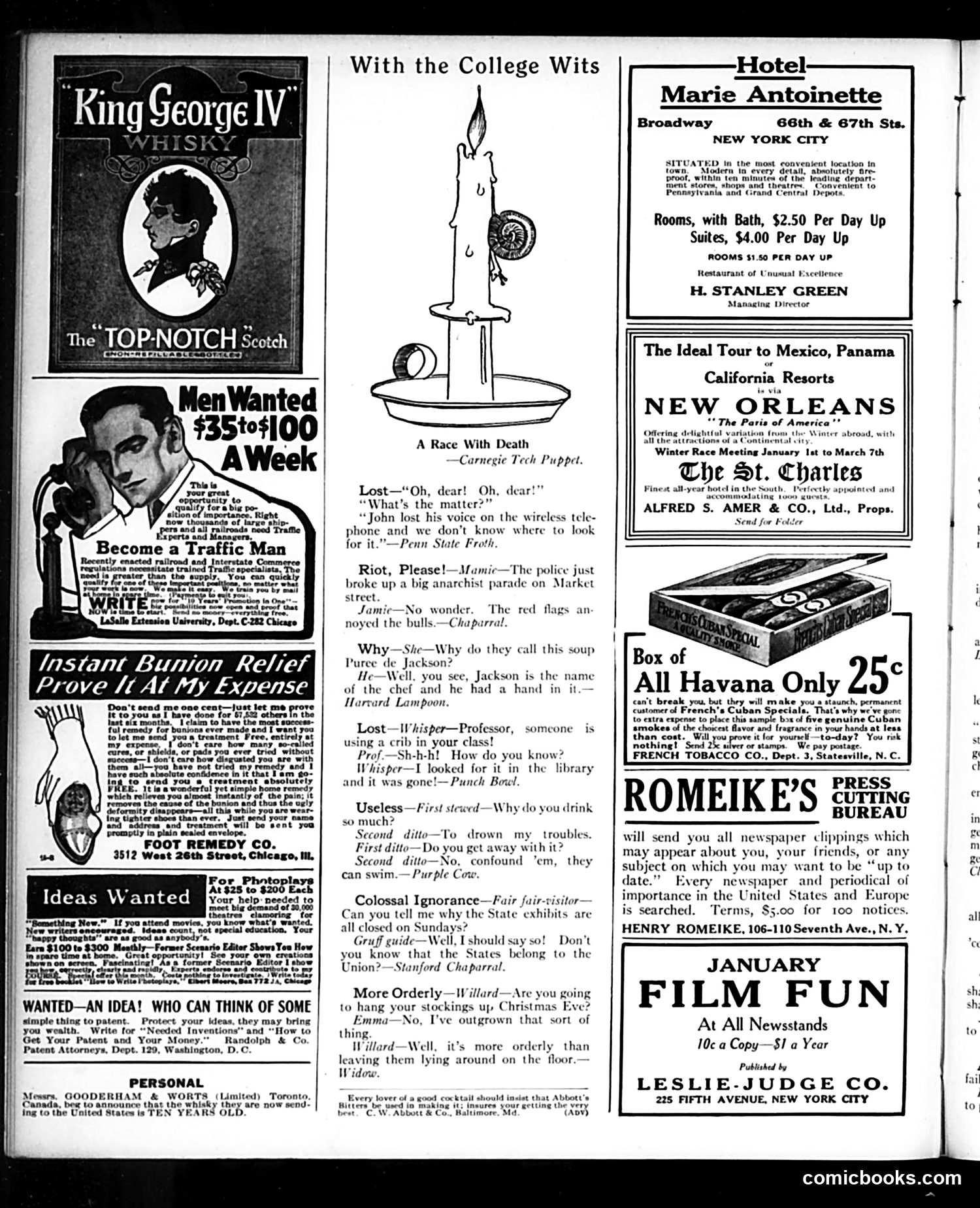
This page consists primarily of **advertisements and humor columns** rather than editorial cartoons. The "With the College Wits" section features brief jokes collected from college humor magazines (Penn State Froth, Carnegie Tech Puppet, Harvard Lampoon, etc.)—a common Judge feature. These jokes reference contemporary concerns: wireless telephone technology, anarchist demonstrations, and social customs. The one clear satirical element is the "Race With Death" cartoon heading, which appears to reference a Carnegie Tech publication and likely comments on industrial dangers or modern life's pace, though the specific context is unclear from this excerpt. The page is dominated by period advertisements for whiskey (King George IV), hotels (Marie Antoinette, St. Charles), bunion remedies, and services (Romeike's Press Cutting Bureau), typical of Judge's business model. A "Film Fun" magazine advertisement appears at bottom. The humor reflects 1920s concerns: new technology, labor unrest, and changing social norms—but without fuller context, specific satirical targets remain uncertain.
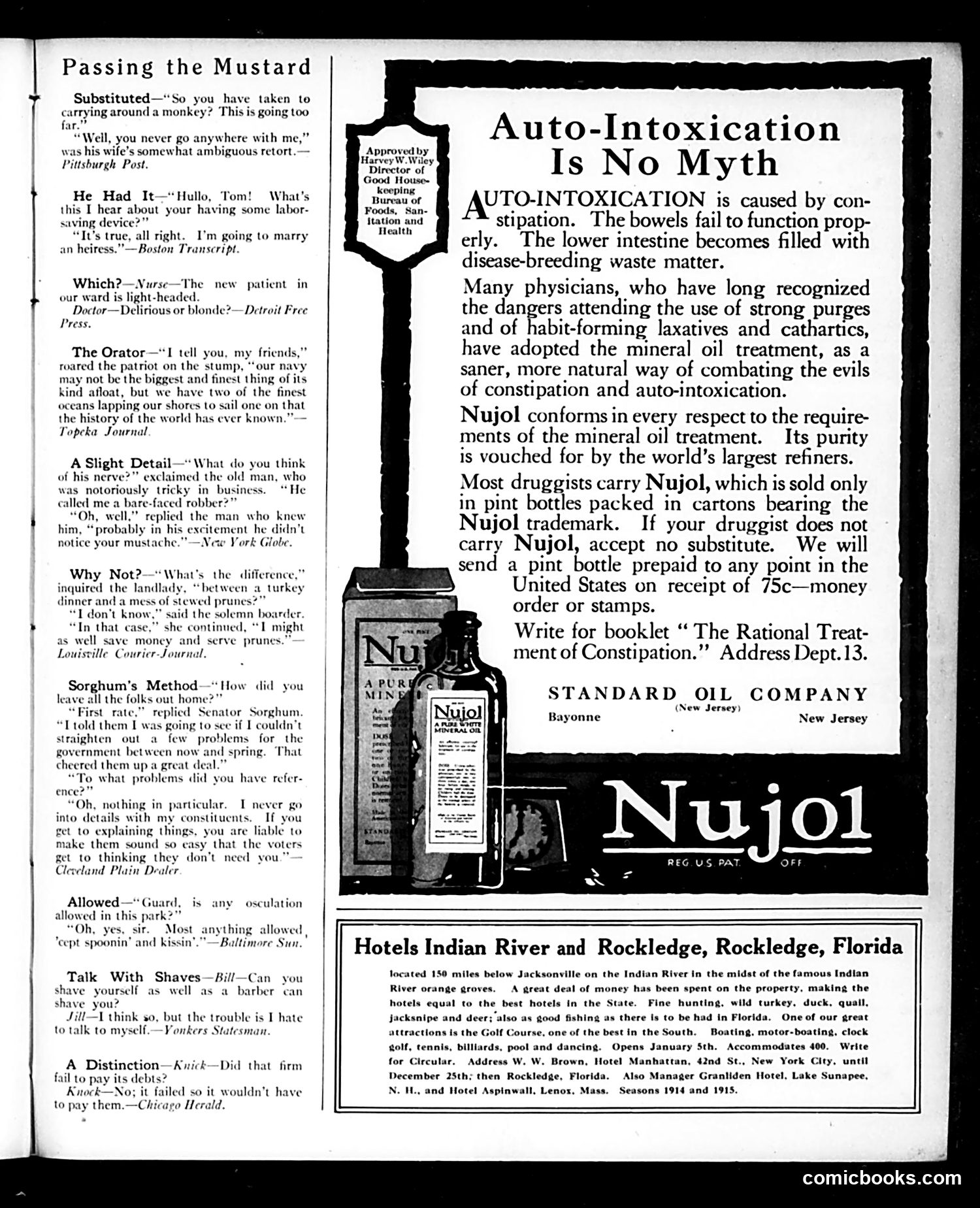
This page contains humor short-takes ("Passing the Mustard" section) typical of Judge magazine's satirical style, alongside a product advertisement for Nujol mineral oil. The jokes target familiar early-20th-century domestic and social anxieties: a wife complaining about her husband's odd habits, a man marrying an heiress for labor-saving purposes, a politician admitting he deliberately keeps constituents confused so they'll believe they need him, and various wordplay about relationships and commerce. The substantial **Nujol advertisement** occupies the right half. It promotes mineral oil as a "natural" remedy for constipation and "auto-intoxication" (a now-discredited medical concept claiming that retained waste in the bowels causes systemic poisoning). The ad cites physician approval and the Standard Oil Company's refinement credentials, reflecting contemporary trust in corporate/medical authority. The page is primarily **advertising with comedic filler**—typical Judge content mixing light humor with commercial messaging aimed at middle-class readers concerned with propriety, health, and domestic order.
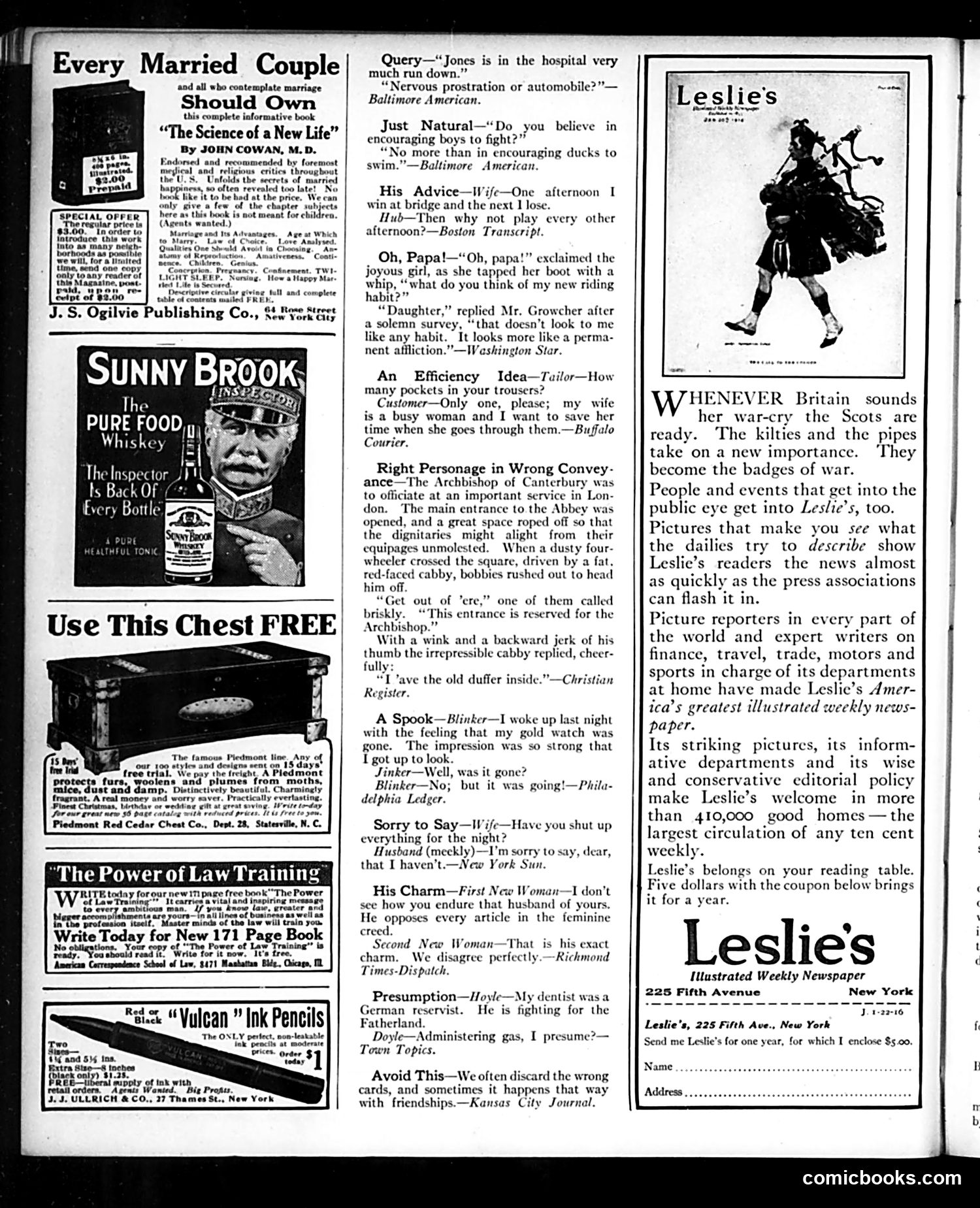
This page consists primarily of **short humorous anecdotes and jokes** rather than political cartoons. The content reflects early 20th-century domestic and social comedy. The jokes target familiar targets of the era: - **Marital dynamics**: wives' spending habits, husbands' passivity ("I'm sorry to say, dear, that I haven't") - **Gender roles**: the "New Woman" challenging traditional femininity; wives controlling household finances - **Class humor**: a taxi driver's irreverence toward authority (the Archbishop's entrance) - **Automobiles**: referenced as a modern hazard causing "nervous prostration" The page also includes period advertisements for self-improvement books, furniture, and office supplies—typical Judge magazine filler. **No specific political figures are identifiable.** The satire is gentle, targeting universal marital frustrations and social pretension rather than current events. The "New Woman" reference suggests this is from the 1910s-1920s, when women's changing social roles generated cultural anxiety expressed through humor.
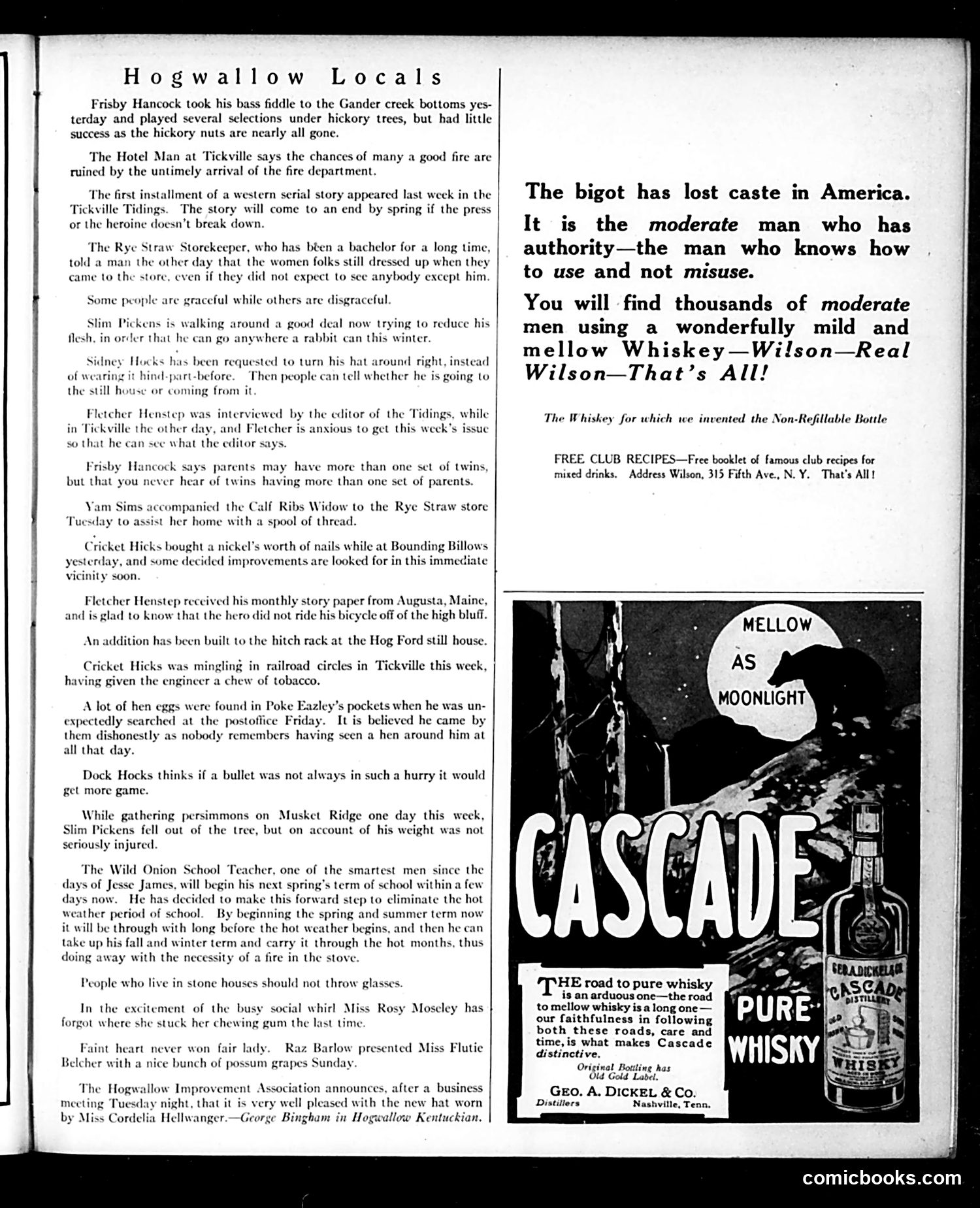
This page features humorous rural vignettes from a fictional Kentucky town called Hogwallow, presented as reprinted from the "Hogwallow Kentuckian." The column, credited to "George Bingham," satirizes backwoods Americana through absurdist anecdotes about eccentric locals—Frisby Hancock, Slim Pickens, Cricket Hicks, and others engaged in ridiculous activities (a schoolteacher rescheduling terms to avoid heat; a man found with hen eggs in his pockets; someone falling from a tree due to weight). The satire targets rural ignorance, superstition, and peculiar logic while maintaining affectionate humor rather than malice. The column represents Judge magazine's recurring mockery of rural American life as quaint but intellectually limited—a common literary trope of the early 20th century. The page also contains a Cascade Whiskey advertisement promoting "moderate" drinking, and brief local gossip items typical of small-town newspapers.
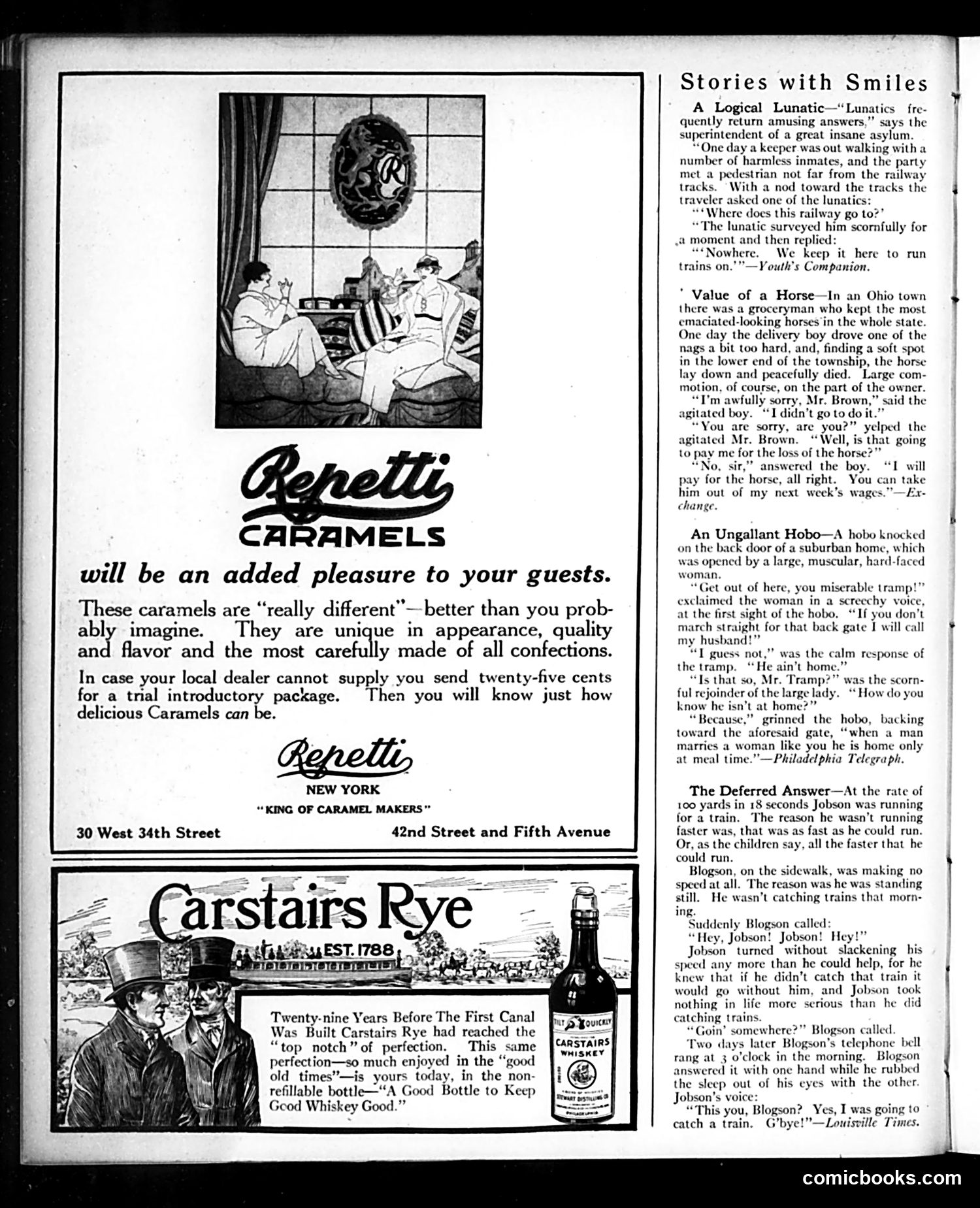
This page contains **advertisements and humorous anecdotal stories**, not political cartoons. **Advertisements:** - Repetti Caramels (top) and Carstairs Rye Whiskey (bottom) use period marketing appeals—caramels as unique confections for entertaining guests; whiskey emphasizing 29 years of established quality and tradition. **"Stories with Smiles" section:** Four brief humor pieces about everyday American life: 1. **Logical Lunatic**: A mentally ill asylum patient gives a deadpan, nonsensical answer about where railroad tracks lead ("Nowhere. We keep it here to run trains on"). 2. **Value of a Horse**: A grocer's boy kills an overworked horse and offers to repay the owner from his wages—a dark joke about the horse's worthlessness. 3. **Ungallant Hobo**: A homeless man insults a woman by suggesting her muscular husband only comes home for meals, implying marital discord. 4. **The Deferred Answer**: A man running to catch a train can't stop to answer his friend's question; the punchline plays on delays in communication. All reflect early-20th-century American vernacular humor—fairly crude by modern standards.
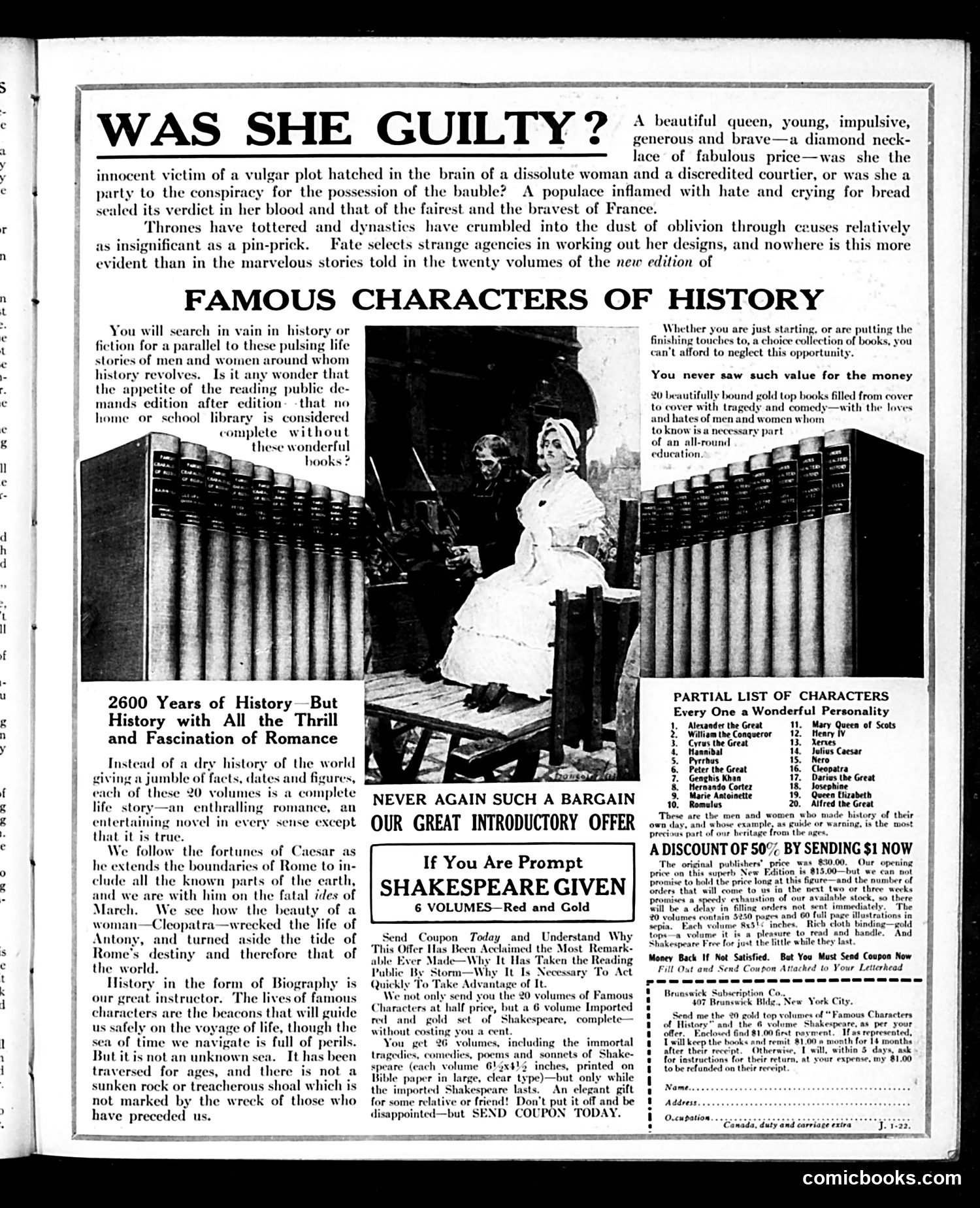
This page is primarily advertising for a book series called "Famous Characters of History," disguised as editorial content. The opening headline references **Marie Antoinette and the Diamond Necklace Affair**—a real 18th-century scandal that contributed to French royal discredit before the Revolution. The "beautiful queen" described is Marie Antoinette; the "diamond necklace of fabulous price" refers to the actual Affair of the Diamond Necklace (1785), where she was falsely implicated in a theft plot. The text poses the question: was she an innocent victim or a willing participant? For modern readers: this was a famous historical controversy that symbolized royal corruption and excess. Judge uses it as a hook to sell biography collections, arguing that reading about such dramatic historical figures is irresistible entertainment. The page also advertises Shakespeare volumes and emphasizes how biography—not dry factual history—makes the past compelling. The central image (a woman in period dress) likely depicts this historical scenario, though specific characters remain unclear from the reproduction quality.
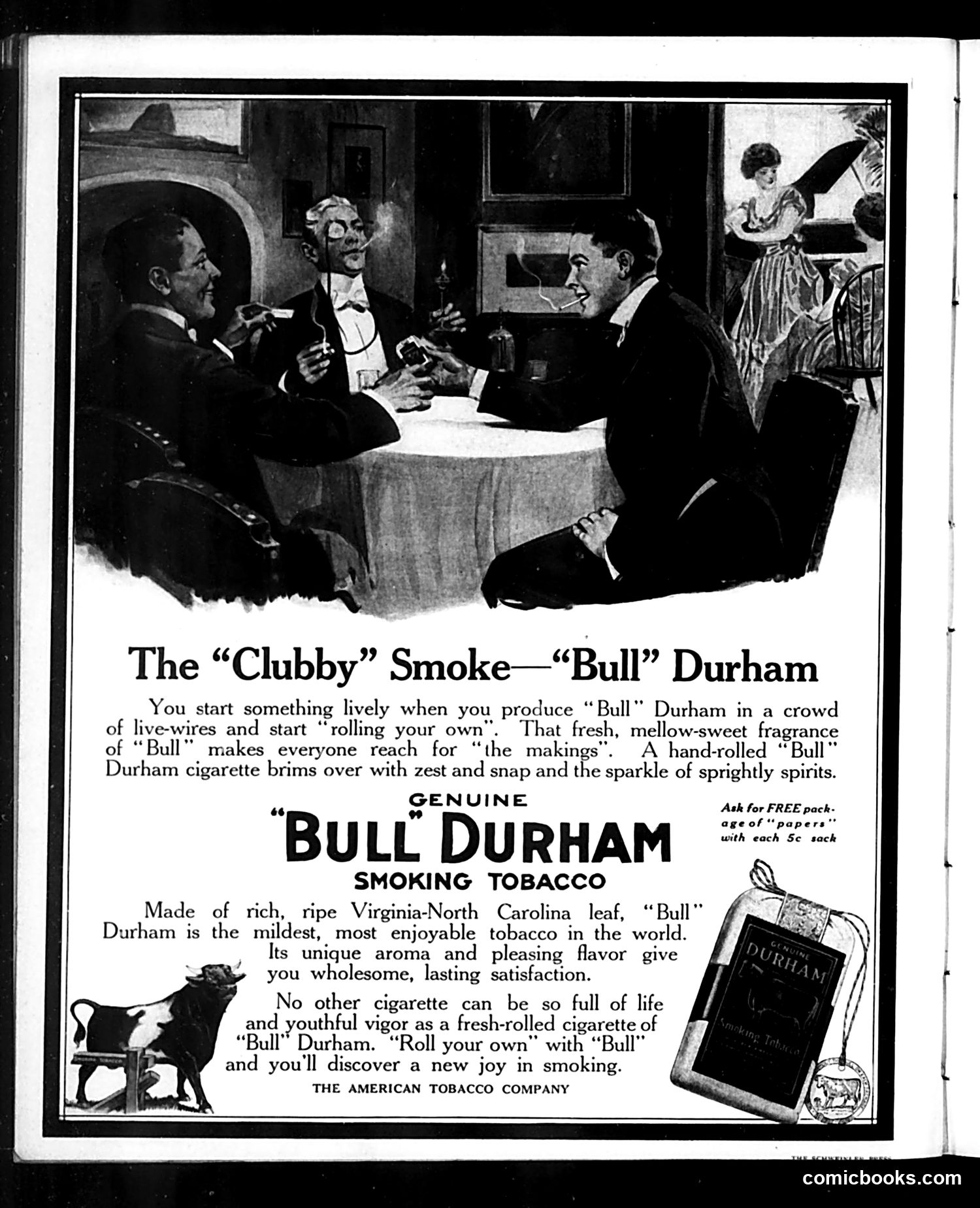
This page is primarily a **tobacco advertisement**, not political satire. It promotes "Bull" Durham smoking tobacco by The American Tobacco Company. The illustration depicts a social scene of well-dressed men at what appears to be an upscale gathering, with a woman in the background. The ad uses the phrase "The 'Clubby' Smoke" to suggest that rolling your own cigarettes with Bull Durham tobacco is a sophisticated, socially appealing activity that generates conversation among "live-wires" (lively people). The copy emphasizes the tobacco's Virginia-North Carolina origin, "mellow-sweet fragrance," and positions "rolling your own" as trendy and masculine. A free offer of cigarette papers accompanies each 5-cent purchase. This represents early 20th-century advertising strategy: associating a product with social status, sophistication, and male camaraderie. The page contains no political commentary or satire—it's a straightforward (though by modern standards, openly health-hazardous) commercial promotion.