
Judge, 1916-01-22 · page 7 of 28
Judge — January 22, 1916 — page 7: what you’re looking at
What you’re looking at
This story by Charles F. Lummis depicts a small man named Bigby (nicknamed "the Bantam") who works in an office and stands about 5'4". The narrative establishes he's confident and well-liked despite his stature—until he dines at his boss's home and meets the boss's tall, beautiful daughter Madeline. When Madeline bends down to say goodbye to him, Bigby suddenly becomes self-conscious about his height for the first time, wondering if her smile was *pitying* rather than genuine. The satire critiques how social perception and romantic anxiety can undermine a man's self-assurance—his handicap only becomes real when filtered through another person's presumed judgment. The accompanying cartoon shows a tall woman and small girl; the caption joke plays on this same theme of size disparity and social embarrassment. The story explores early 20th-century anxieties about masculinity, physical stature, and courtship dynamics.
📄 Transcribed text from this page (OCR, searchable)
Machine-transcribed from the original scan — historical spelling and the odd misread are preserved.
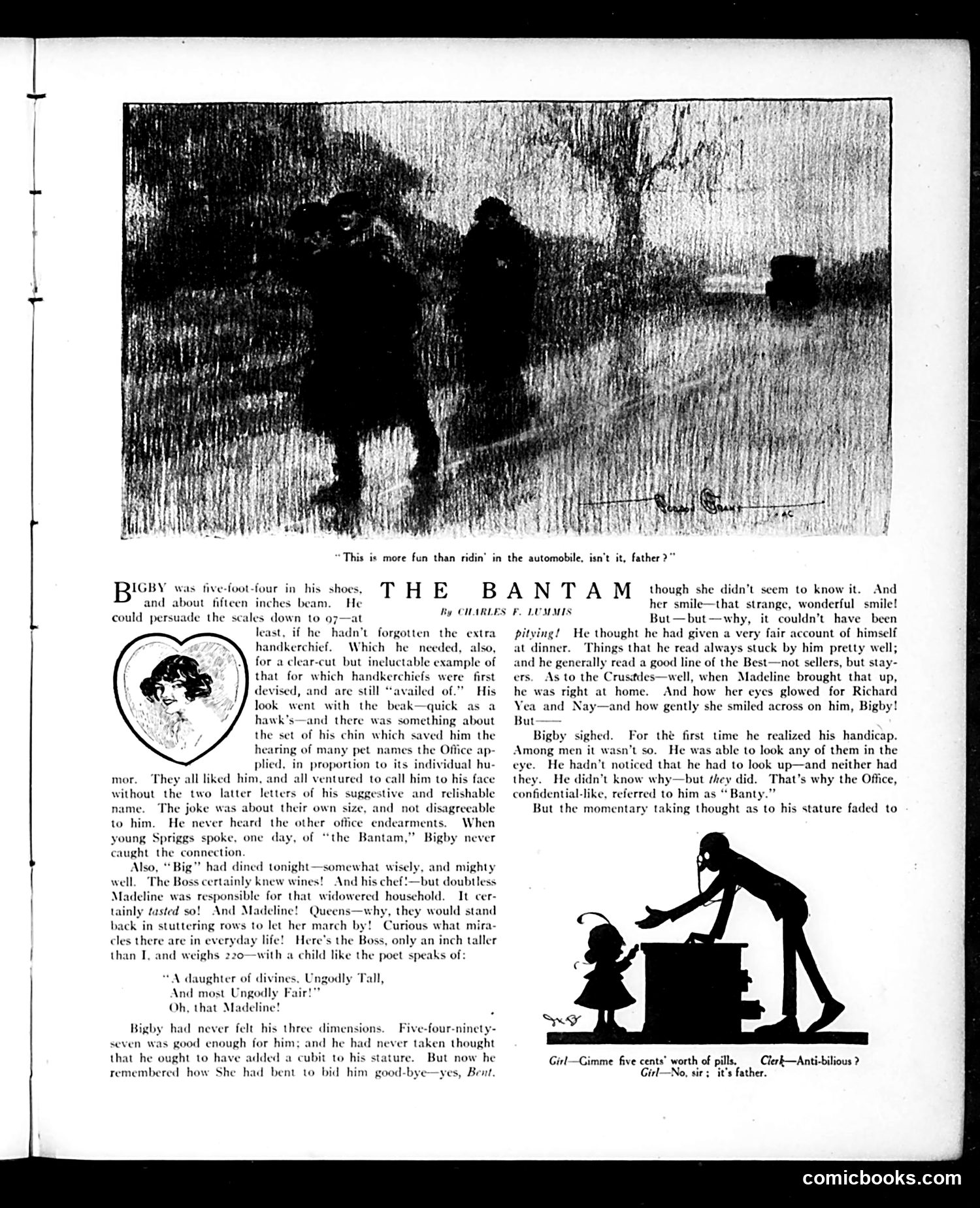
“This is more fun than ridin’ in the automobile, isn’t it, father?” IGBY was five-f and about fifteen inches beam. He could persuade the scales down to o7—at least, if he hadn't forgotten the extra handkerchief. Which he needed, also, for a clear-cut but ineluctable example of that for which handkerchiefs were first devised, and are still “availed of.” His look went with the beak—quick as a hawk’s—and there was something about the set of his chin which saved him the hearing of many pet names the Office ap- plied, in proportion to its individual hu- mor. They all liked him, and all ventured to call him to his face without the two latter letters of his suggestive and_relishable name. The joke was about their own size, and not disagreeable to him. He never heard the other office endearments. When young Spriggs spoke, one day, of “the Bantam,” Bigby never caught the connection Also, “ Big” had dined tonight—somewhat wisely, and mighty well. The Boss certainly knew wines! And his chef!—but doubtless Madeline was responsible for that widowered household. It cer- tainly tasted so! And Madeline! Queens—why, they would stand back in stuttering rows to let her march by! Curious what mira- cles there are in everyday life! Here’s the Boss, only an inch taller than I, and weighs 220—with a child like the poet speaks of: “A daughter of divines. Ungodly Tall, And most Ungodly " Oh, that Madeline! Bigby had never felt his three dimensions. Five-four-ninety- seven was good enough for him; and he had never taken thought that he ought to have added a cubit to his stature. But now he remembered how She had bent to bid him good-bye—yes, Bent. t-four in his shoes, To H EB BANT A M #thoush she didn’t seem to know it. And By CHARLES F. LUMMIS her smile—that strange, wonderful smile! But—but—why, it couldn’t have been pitying! He thought he had given a very fair account of himself at dinner. Things that he read always stuck by him pretty well; and he generally read a good line of the Best—not sellers, but stay- ers. As to the Crusitdes—well, when Madeline brought that up, he was right at home. And how her eyes glowed for Richard Yea and Nay—and how gently she smiled across on him, Bigby! But Bigby sighed. For thé first time he realized his handicap. Among men it wasn’t He was able to look any of them in the eye. He hadn’t noticed that he had to look up—and neither had they. He didn’t know why—but they did. That's why the Office, confidential-like, referred to him as “ Bant But the momentary taking thought as to his stature faded to ny Girl—CGimme five cents’ worth of pills, ClerkK—Anti-bilious ? Girl—No, sir; it's father. comicbooks.com